

Most salaried employees assume ITR filing means uploading Form 16 and clicking submit. It doesn’t. Your ITR filing checklist for salaried employees needs to cover far more — your employer’s tax data, the Income Tax portal’s own view of your income, bank interest that never appears in Form 16, deduction proofs if you are in the old regime, the correct ITR form, and a pre-verified bank account for any refund. Miss any of these and you could receive a tax notice, lose a refund, or file with incorrect figures. Rules, forms, and due dates are updated every assessment year — so what worked last year may not apply this year. This article gives you a practical, sequenced checklist — not a jargon-heavy document list — so you can file with confidence.
Quick Answer: ITR Filing Checklist for Salaried Employees
ITR filing checklist for salaried employees should include Form 16, salary slips, AIS, Form 26AS, bank interest details, deduction proofs, chosen tax regime, refund bank account, and the correct ITR form. Also verify the filing due date and late fee rules for the relevant assessment year.
Key Takeaways
- Form 16 covers your salary and TDS — but it does not include savings account interest, FD interest, or income from freelance work, all of which must be reported separately.
- Always download your AIS (Annual Information Statement) and Form 26AS from the Income Tax portal before filing — discrepancies between these and Form 16 can trigger a notice.
- Choosing old vs new tax regime before filing is mandatory — the wrong default can cost you thousands of rupees in excess tax or unclaimed deductions.
- ITR-1 (Sahaj) applies to most salaried employees with only salary and interest income below ₹50 lakh; if you have capital gains, foreign assets, or multiple properties, you likely need ITR-2.
- E-verification is the final mandatory step — an unverified ITR is treated as not filed, even if submitted on the portal.
- Validate your bank account on the Income Tax portal before filing — an unvalidated account will delay or block your refund.
- Filing after the due date attracts a late fee under Section 234F — verify the current amount and deadline for the relevant assessment year from incometax.gov.in before you file.
Key Facts at a Glance
| Document / Step | What It Covers | Mandatory or Conditional |
|---|---|---|
| Form 16 Part A | TDS deposited by employer, PAN, employer TAN | Mandatory for all salaried employees |
| Form 16 Part B | Salary breakup, exemptions, deductions claimed | Mandatory for all salaried employees |
| AIS / TIS | All income and transactions reported to IT Dept | Mandatory to check before filing |
| Form 26AS | Tax credits: TDS, TCS, advance tax paid | Mandatory to verify before filing |
| Bank interest certificate | Savings and FD interest for the financial year | Mandatory if you have bank accounts |
| Deduction proofs (80C, 80D, HRA, etc.) | Investment and expense receipts for old regime claims | Conditional — only if using old tax regime |
| Capital gains statement | Gains from shares, mutual funds, or property | Conditional — only if applicable |
| Bank account (pre-validated) | Refund credit account | Mandatory for refund |
| ITR form selection | ITR-1 or ITR-2 based on income type | Mandatory — wrong form = defective return |
The ITR Filing Checklist: Step by Step
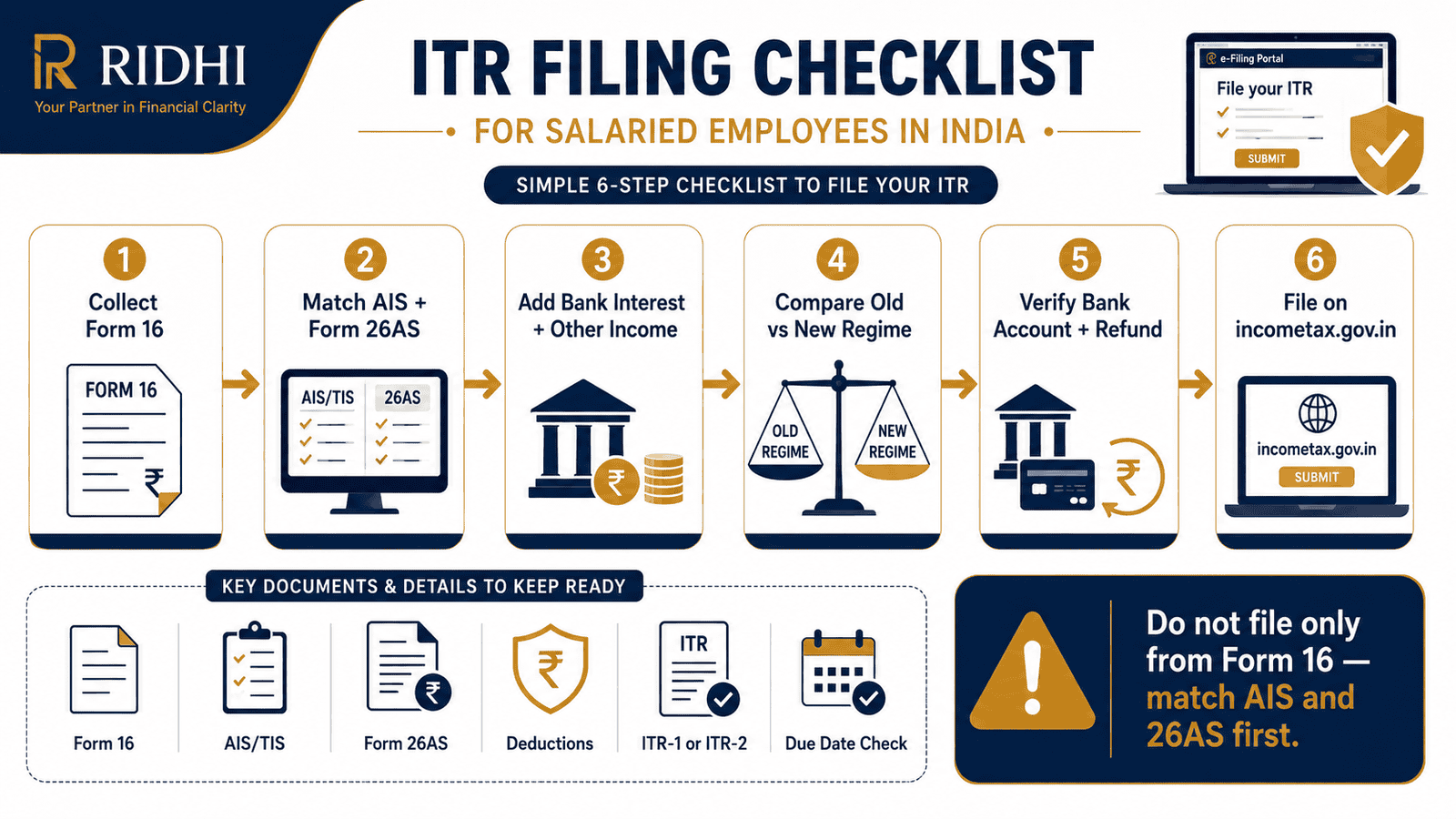
Filing ITR correctly means moving through five distinct steps before you click submit. Each step builds on the previous one. Skipping any step is the most common reason salaried employees receive tax notices or face refund delays.
Step 1: Collect Form 16 from Your Employer
Form 16 is the foundation of your ITR filing checklist for salaried employees. Your employer is required to issue it after the end of the financial year. Part A contains your PAN, your employer’s TAN, and the TDS deposited with the government quarter by quarter. Part B contains your salary breakup — basic, HRA, allowances — and all deductions your employer considered while computing TDS.
Before you use Form 16, read it carefully. Many salaried employees accept it at face value, but if your employer has applied an incorrect HRA exemption or missed a deduction you claimed mid-year, the figure in Form 16 will be wrong. Read your Form 16 in detail before using it as your primary input.
If you changed employers during the year, collect Form 16 from both employers. Both sets of TDS must appear in your return, and you will need to combine the salary figures carefully to avoid understating income.
Step 2: Download AIS, TIS, and Form 26AS from the Tax Portal
Form 16 only shows what your employer reported. The Income Tax Department collects data independently from banks, mutual funds, brokers, property registrars, and other sources. This data is available to you through two documents: the Annual Information Statement (AIS) and Form 26AS.
AIS and the Taxpayer Information Summary (TIS) show every income and transaction reported against your PAN — salary, dividends, interest, securities transactions, and more. Form 26AS shows every rupee of TDS, TCS, and advance tax credited to your account. Download both from incometax.gov.in before you touch the filing form.
Compare AIS figures against what Form 16 reports. If there is a mismatch — say, AIS shows ₹8,400 in dividend income that you forgot — add it to your return before filing. Filing without reconciling AIS and Form 26AS is the single biggest mistake salaried filers make.
Step 3: Add All Other Income Sources
Salary is not your only taxable income. Savings account interest, FD interest, interest on recurring deposits, and even interest from a PPF maturity payout (in limited cases) must be accounted for. Banks do not always deduct TDS on savings interest below ₹10,000 per year — but you are still required to declare it.
If you received rent, freelance fees, capital gains from mutual fund redemptions or share sales, or any foreign income — each of these belongs in your ITR. Omitting them because they seem small is not a defence if the IT Department’s AIS already shows them.
Step 4: Choose Old Regime or New Regime Before Filing
Tax regime choice directly determines which deductions you can claim and what your final tax liability will be. Under the old tax regime, you can claim deductions under Section 80C (up to ₹1.5 lakh), 80D (health insurance premium), HRA exemption, LTA, home loan interest, and standard deduction. Under the new tax regime, most of these deductions are not available, but the tax slabs are lower. For most salaried employees, the right choice depends on their actual investment and deduction amounts.
Compare both regimes using a tax calculator before filing — do not guess. Old or new regime: understand the impact on your specific salary before you lock in your choice at the time of filing.
Step 5: Choose the Correct ITR Form and Validate Bank Details
Using the wrong ITR form makes your return defective. ITR-1 (Sahaj) is available to salaried individuals with income from salary, one house property, and other sources (like interest), with total income up to ₹50 lakh. ITR-2 is required if you have capital gains, more than one house property, foreign assets or income, or income from business or profession. There is no shortcut here — check your eligibility before filing.
Finally, confirm that the bank account where you expect a refund is pre-validated on the Income Tax portal. An unvalidated bank account is the most avoidable reason for refund delay.
Real Example: Rohit in Pune
Rohit, 29, is a software engineer in Pune earning ₹12 lakh gross per year. His employer deducted TDS throughout the year and issued Form 16. Rohit assumed he only needed to upload Form 16 and file.
When Rohit downloaded his AIS before filing, he found ₹14,200 in savings account interest reported by his bank — income that does not appear anywhere in Form 16 because his employer had no visibility of it. He also found a ₹3,100 dividend from an old equity mutual fund he had almost forgotten. Neither figure was in Form 16.
Rohit then compared old vs new regime for his income of ₹12 lakh. He had EPF contributions of ₹86,400 per year and a health insurance premium of ₹18,000. Under the old regime, his 80C (EPF + PPF top-up) and 80D (health insurance) brought his taxable income down meaningfully. The comparison showed the old regime worked better for him at that deduction level — but this is illustrative, not a recommendation. His situation may differ from yours.
Had Rohit filed using only Form 16, he would have under-reported ₹17,300 in income. The AIS check caught it before filing — and prevented a potential notice later.
How to Calculate Your Tax Before Filing
Estimated Tax Liability = (Total Income − Deductions applicable to chosen regime) × Applicable slab rate + Cess − TDS already paid (from Form 26AS)
Use this sequence before you file:
Step 1 — Total income: Add salary income from Form 16 + savings/FD interest from AIS + any other applicable income (dividends, capital gains, rent).
Step 2 — Deductions: If using the old regime, subtract eligible deductions (standard deduction, 80C, 80D, HRA, etc.). If using the new regime, apply only the standard deduction and any regime-specific deductions that apply.
Step 3 — Apply slabs: Apply the tax slab rates for the relevant assessment year. Do not use rates from memory — slab rates and the Section 87A rebate threshold can change each Budget. Verify current rates at incometax.gov.in.
Step 4 — Compare against TDS paid: Check Form 26AS for total TDS credited. If your estimated liability is lower than TDS paid, you are likely entitled to a refund. If it is higher, you will need to pay self-assessment tax before filing.
Use the tax calculator comparison to cross-check your figures under both regimes before submitting your return.
| Scenario | Key Inputs | Likely Outcome |
|---|---|---|
| Only salary income, full 80C used, old regime | ₹12L salary, ₹1.5L 80C, ₹18K 80D | Compare against TDS — refund likely if employer deducted conservatively |
| Salary + FD interest, new regime | ₹12L salary, ₹25K FD interest | Declare total income; check if TDS on FD was deducted by bank |
| Salary + capital gains from MF redemption | ₹12L salary + gains | ITR-2 required; gains taxed separately at applicable rate |
Comparison: Key Documents and ITR Forms
| Item | What It Is | When You Need It |
|---|---|---|
| Form 16 | Employer-issued salary and TDS certificate | Always |
| AIS / TIS | IT Dept’s view of all your income and transactions | Always — download and check |
| Form 26AS | Tax credit statement: TDS, TCS, advance tax | Always — verify TDS credited |
| Bank interest certificate | Interest earned on savings and FDs | Always — declare all interest |
| Deduction proofs (80C, 80D, HRA) | Investment and expense receipts | Old regime only |
| Capital gains statement | Gains/losses from shares, MFs, property | Conditional — if applicable |
| ITR-1 (Sahaj) | Salary + interest + one house property, up to ₹50L | Most salaried employees |
| ITR-2 | Salary + capital gains / foreign assets / multiple properties | If income is more complex |
Not sure which form applies to you? Choose ITR form based on your income type before you start filling in the return.
How to Decide What’s Right for You
Your only income is salary from one employer and bank interest, and your total income is under ₹50 lakh — THEN ITR-1 (Sahaj) is the correct form for you.
You have capital gains from mutual fund redemptions, share sales, or property during the year — THEN you must file ITR-2, not ITR-1.
You have EPF contributions, LIC premiums, PPF deposits, home loan principal repayment, or health insurance premiums totalling more than ₹1 lakh — THEN compare old regime vs new regime before choosing; old regime may result in lower tax for you.
Your deductions are minimal (under ₹50,000) and your salary is in a mid-range bracket — THEN the new tax regime is likely simpler and may result in equal or lower tax; verify using a calculator.
You changed jobs during the year and received Form 16 from two employers — THEN both Form 16s must be combined in your return; do not file using only one.
Your AIS shows income that you believe is incorrect — THEN raise a feedback/correction on the IT portal before filing; do not ignore mismatched data.
If your income includes foreign assets, ESOPs with complex vesting, freelance income with expenses, or a tax notice from a prior year — a standard salaried checklist is not sufficient; consult a qualified tax professional before filing.
Common Mistakes to Avoid
Filing ITR Using Only Form 16
Form 16 shows only what your employer reported — it does not capture savings account interest, FD interest, dividends, or freelance payments. The IT Department’s AIS shows all of these.
If you file without checking AIS, you may under-report income already flagged in the portal. This can trigger a notice asking you to explain the discrepancy.
Always download AIS and Form 26AS from incometax.gov.in before starting your return.
Ignoring Bank Interest Income
Many salaried employees believe interest below a threshold is not taxable. Savings account interest is taxable — there is a deduction available under Section 80TTA (up to ₹10,000 for individuals below 60), but the interest still needs to be declared.
FD interest is fully taxable at your slab rate, and banks deduct TDS at a flat rate regardless of your bracket. Ignoring FD interest and later finding it in AIS creates unnecessary reconciliation work.
Collect interest certificates from every bank account and deposit before filing.
Choosing the Wrong ITR Form
Filing ITR-1 when you should have filed ITR-2 makes your return defective. The IT Department may issue a notice asking you to refile with the correct form.
ITR-1 cannot accommodate capital gains, foreign assets, or income from more than one house property. Check your income sources carefully before selecting the form.
If in doubt, choose the more comprehensive form — it is better to file ITR-2 correctly than to file ITR-1 incorrectly.
Claiming Deductions Without Supporting Proof
If you are filing under the old tax regime and claiming 80C, 80D, or HRA, you must have proof for each claim. Your employer may have accepted a declaration during the year, but the IT Department can ask for evidence during scrutiny.
Keep all investment certificates, insurance premium receipts, rent receipts, and HRA computation documents for at least 6 years after filing.
Skipping TDS Reconciliation Before Filing
TDS shown in Form 16 and TDS reflected in Form 26AS should match exactly. If they do not, the mismatch affects your tax credit and can alter whether you receive a refund or are shown tax payable. Salary TDS refund issues often trace back to unreconciled TDS at the time of filing.
Cross-check every TDS entry in Form 26AS against your Form 16 before submitting.
Forgetting to E-Verify After Filing
Submitting your ITR on the portal is not the end. An unverified return is treated as if it was never filed. You must e-verify — through Aadhaar OTP, net banking, or other options — within the specified window after submission.
If you miss the e-verification deadline, your return may be treated as invalid, and late filing penalties could apply as if you never filed at all.
Not Pre-Validating the Refund Bank Account
Even if you are due a refund, it will not be credited to an unvalidated bank account. The Income Tax portal requires accounts to be pre-validated with PAN and IFSC details. Do this before filing, not after.
When This May Not Be the Right Choice
This ITR filing checklist covers the standard case — salaried income, bank interest, and basic deductions. If any of the following apply to you, a standard checklist is not enough:
Foreign assets or foreign income: If you hold a foreign bank account, foreign investments, or received income from overseas employment or consultancy, your filing requirements are significantly more complex and you must disclose these in the correct schedule.
ESOPs, RSUs, or stock options: Equity compensation from employers — especially multinational companies — has specific tax treatment at vesting, exercise, and sale. Incorrect reporting here is a common reason for IT notices.
Capital gains from property, shares, or mutual funds: If you sold property, unlisted shares, or had significant mutual fund redemptions during the year, your return complexity increases and ITR-2 or ITR-3 may be required.
Prior year tax notices or corrections: If you have a pending notice, a rectification request, or are filing a revised return for a prior year, the standard checklist does not cover those scenarios.
If any of these apply to your situation, it may be worth exploring alternatives before committing.
Official Rules and Where to Verify
All ITR filing rules, forms, due dates, and tax limits are governed by the Income Tax Department of India. Before filing for any assessment year, verify the following directly from official sources:
- Income Tax Department — incometax.gov.in: File your return, download AIS, TIS, and Form 26AS, check ITR form applicability, and verify the current due date and late fee under Section 234F.
Rules, limits, and rates on this topic can change with each Budget or regulatory update. Always verify current figures directly from the official source before making any financial decision.
For AIS and Form 26AS, log in at incometax.gov.in → e-File → Income Tax Returns → View AIS. For Form 26AS, go to the TRACES portal linked from the same login. AIS 26AS difference — understand what each document shows and why both matter before filing.
Expert Tips
- Create a dedicated folder — physical or digital — each April with Form 16 (once received), AIS printout, Form 26AS, bank interest certificates, and all deduction proofs. Having everything in one place cuts filing time by more than half.
- Compare old and new regime before filing, not at the last minute in July. Run the numbers in March before your employer asks for investment declarations — that is when the choice actually saves or costs you money for the year.
- Pre-validate your refund bank account on the Income Tax portal well before the filing deadline. If your account details have changed since last year — new bank, updated IFSC — update them before submitting your return.
- If your AIS shows income you do not recognise — say, a transaction from a mutual fund you forgot — raise a feedback on the portal before filing. Ignoring it and filing with a mismatch is riskier than taking a few extra days to resolve it.
- Save your ITR-V acknowledgement and e-verification confirmation as a PDF immediately after filing. The Income Tax portal’s filing history is accessible, but having a local copy of the acknowledgement protects you if there is ever a query.
- If your employer has filed a revised TDS return after issuing Form 16 — which sometimes happens — your Form 26AS will show a different TDS amount than Form 16. Always use the Form 26AS figure for the final TDS credit, not the Form 16 figure, since the portal credits what is in 26AS.
Frequently Asked Questions
Is Form 16 enough to file my ITR as a salaried employee?
No. Form 16 covers your salary and TDS from your employer — it does not include savings account interest, FD interest, dividends, or any income outside your salary. You must also check AIS and Form 26AS for the complete picture before filing.
Is it mandatory to check AIS before filing ITR?
While not legally compulsory in the sense that the portal will stop you, skipping AIS is a significant risk. AIS shows all income reported against your PAN by third parties — banks, mutual funds, brokers. If you file without reconciling AIS, any mismatch could result in a tax notice after filing.
Which ITR form should salaried employees use — ITR-1 or ITR-2?
Most salaried employees with income only from salary, one house property (or none), and interest — with total income under ₹50 lakh — can file ITR-1. If you have capital gains, foreign assets, more than one house property, or directorship in a company, you need ITR-2. Verify your specific eligibility at incometax.gov.in for the relevant assessment year.
What should I do if Form 16 and AIS show different income amounts?
First, identify the source of the difference. If AIS shows additional income (interest, dividends) not in Form 16, include it in your return — that income is taxable regardless of whether your employer knew about it. If AIS shows income that is factually incorrect, raise a feedback/objection on the AIS portal before filing.
Can I claim a refund if extra TDS was deducted from my salary?
Yes. If your actual tax liability (after deductions and applicable slabs for the relevant AY) is lower than the TDS already deposited, you are entitled to a refund. File your ITR correctly, validate your bank account on the portal, and e-verify — the refund is processed after the IT Department validates your return.
What is the late fee for filing ITR after the due date?
A late fee is applicable under Section 234F if you file after the due date. The exact amount and the due date itself can change each assessment year. Verify the current figures at incometax.gov.in before filing.
Can I switch from old regime to new regime at the time of ITR filing?
Salaried employees without business income can generally switch between old and new tax regimes each year at the time of filing, even if they declared a different choice to their employer during the year. The ITR form itself allows you to make the final regime selection. Verify this rule for the current assessment year on the Income Tax portal.
What happens if I forget to e-verify my ITR?
An unverified ITR is treated as if it was never filed. If the e-verification window passes without verification, your return is invalid. You may need to file a condonation request or a belated/revised return depending on the timing. Always e-verify immediately after submitting your return.
Do I need to attach any documents while filing ITR online?
No physical attachments are required while filing ITR online. However, keep all supporting documents — Form 16, bank interest certificates, deduction proofs, AIS printout — for at least 6 years. The IT Department can ask for these during scrutiny even years after filing.
What if I changed jobs and have two Form 16s — how do I file?
Combine the salary income from both Form 16s in your ITR. Add the TDS from both employers — both should appear in your Form 26AS. Do not file using only one Form 16 and omit the other; the IT Department will see both employers’ TDS entries in your 26AS regardless.
Final Verdict
The ITR filing checklist for salaried employees is not just a document list — it is a pre-filing sequence. Collect Form 16, download AIS and Form 26AS, reconcile all income sources including bank interest, choose your tax regime after comparing both options, confirm the correct ITR form, validate your refund bank account, and then file through the official portal at incometax.gov.in. E-verify immediately after submission. For additional guidance on standard deduction, you can also review standard deduction as part of your pre-filing check. Each of these steps is a checkpoint — not a formality. Miss one and you risk a notice, a delayed refund, or an incorrect return. Always verify the latest rules from official sources or consult a qualified professional before making any financial decision.
This article is for educational purposes only and should not be treated as personalised financial, tax, investment, insurance, or legal advice. Tax rules, interest rates, regulatory limits, and product features can change with each Budget or policy update. Please verify current rules from official government sources or consult a qualified and registered professional before making any financial decision.

Kavita Mehra writes and edits Ridhi.com’s income tax content for Indian taxpayers, with a special focus on salaried employees and beginners who find tax rules confusing. Her work explains complex tax topics in simple language, helping readers understand how income, deductions, exemptions, rebates, TDS, Form 16, ITR filing, and refunds connect in real life.
She covers topics such as old vs new tax regime, income tax slabs, standard deduction, Section 87A rebate, HRA exemption, 80C, 80D, 80E, 80G, TDS on salary, taxable income, Form 16, AIS, Form 26AS, advance tax, and ITR filing checklists. Her content aims to help readers become more informed before filing returns or discussing tax matters with a professional.
Kavita’s approach is careful, compliance-focused, and official-source oriented. Because Indian tax rules can change after Budgets, circulars, and policy updates, her articles encourage readers to verify current figures, filing deadlines, and rules from the Income Tax Department or a qualified tax professional before acting.