

Every April, millions of salaried employees in India face the same question — old regime or new regime? Your payroll team wants an answer, your employer needs it for TDS, and one wrong call could mean paying thousands more than you should. The good news: once you understand what each regime actually requires, the decision is usually clear.
This guide compares the new tax regime vs old tax regime for salaried employees for FY 2025-26 (Assessment Year 2026-27). You will get actual slab tables, deduction logic, a real example, and a practical break-even framework — so you can choose with confidence.
Quick Answer: New Tax Regime vs Old Tax Regime
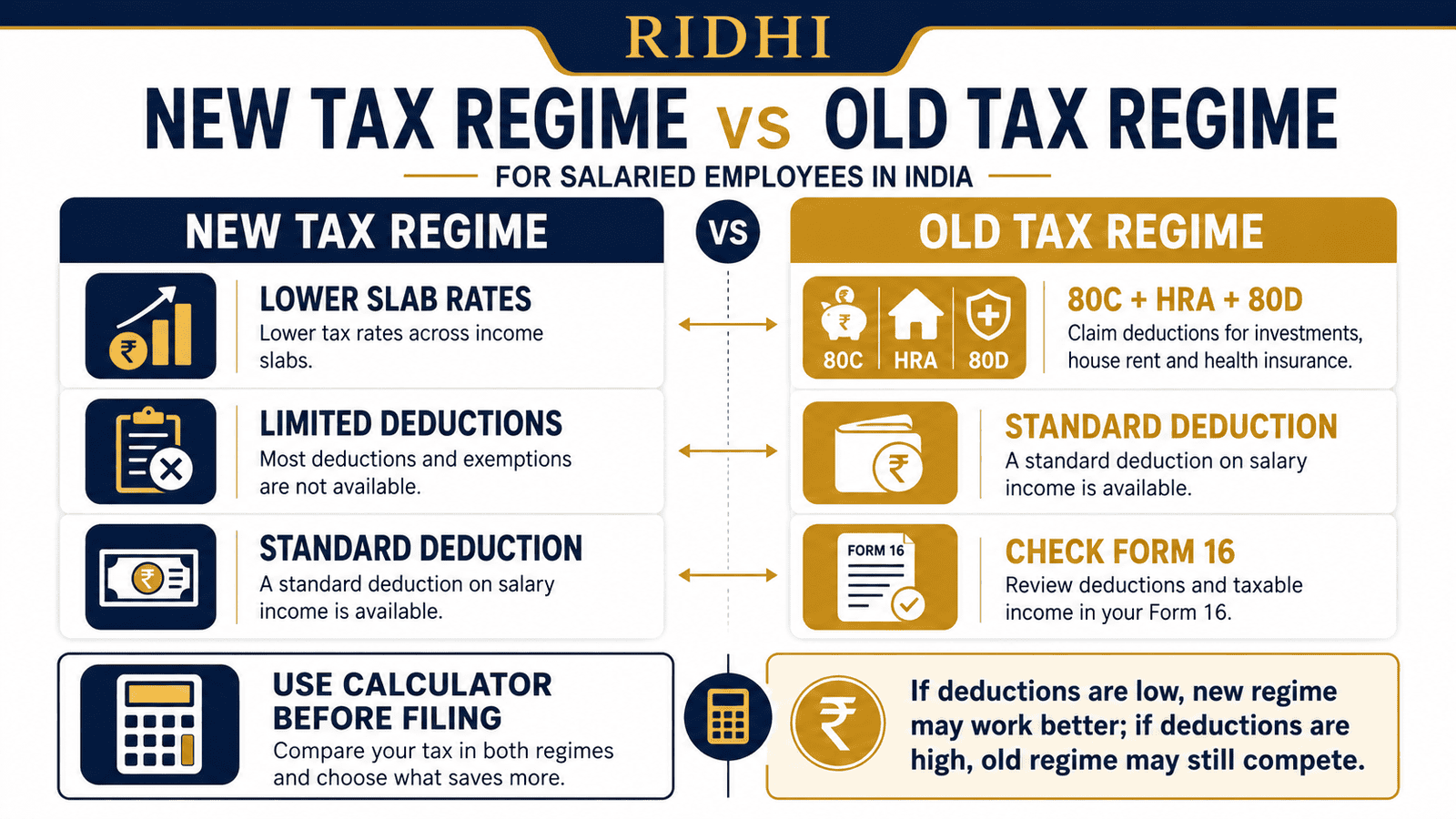
New tax regime vs old tax regime depends on salary, deductions, HRA and investments. For FY 2025-26, the new regime may suit employees with low deductions and a higher standard deduction of ₹75,000, while the old regime may work better when 80C, HRA, 80D and home-loan benefits are large. Use salary tax calculator to see your exact numbers.
Key Takeaways
- The new regime is the default regime for FY 2025-26 — you must actively opt out if you prefer the old regime.
- New regime standard deduction is ₹75,000 for salaried employees; old regime standard deduction is ₹50,000.
- Section 87A rebate in the new regime means zero tax on income up to ₹12 lakh (before cess) — a significant shift from FY 2024-25.
- The old regime can beat the new regime only when total deductions — 80C, HRA, 80D, home-loan interest, NPS — exceed the break-even threshold, typically ₹3.75 lakh or more for a ₹15 LPA earner.
- HRA is the single biggest swing factor: employees paying significant rent in metro cities often find the old regime wins — without rent, the new regime almost always wins.
- Employer NPS contribution under Section 80CCD(2) is deductible under both regimes — a rare advantage to use regardless of which regime you choose.
- Switching regimes is allowed every year for salaried employees with no business income — so your choice today is not permanent.
Comparison: New Tax Regime vs Old Tax Regime
| Parameter | New Tax Regime (FY 2025-26) | Old Tax Regime (FY 2025-26) |
|---|---|---|
| Default regime | Yes — default | No — opt in required |
| Section 87A rebate limit | Income up to ₹12 lakh (zero tax) | Income up to ₹5 lakh (zero tax) |
| Standard deduction | ₹75,000 | ₹50,000 |
| Section 80C (PPF, ELSS, LIC, EPF) | Not available | Up to ₹1.5 lakh |
| HRA exemption | Not available | Available (city-dependent) |
| Section 80D (health insurance) | Not available | Up to ₹25,000–₹50,000 |
| Home loan interest (Section 24b) | Not available for self-occupied | Up to ₹2 lakh |
| Employer NPS — Section 80CCD(2) | Available | Available |
| Leave Travel Allowance (LTA) | Not available | Available (conditions apply) |
| Best suited for | Low deduction earners, younger employees | Rent + heavy investment earners |
Key Facts at a Glance
| Fact | New Regime | Old Regime |
|---|---|---|
| Governing section | Section 115BAC | Regular IT Act provisions |
| Basic exemption limit | ₹3 lakh | ₹2.5 lakh (general) |
| 87A rebate ceiling | ₹12 lakh | ₹5 lakh |
| Standard deduction | ₹75,000 | ₹50,000 |
| Number of deductions allowed | ~5 (limited list) | 70+ exemptions and deductions |
| Applicable AY | AY 2026-27 | AY 2026-27 |
Understanding the Two Tax Regimes for Salaried Employees
India’s income tax system currently offers two parallel regimes. The new tax regime, governed by Section 115BAC, was introduced in FY 2020-21 and became the default regime from FY 2023-24. The old tax regime is the traditional system — the one with dozens of deductions and exemptions that salaried employees have used for decades.
For FY 2025-26, the new regime received two significant upgrades: the Section 87A rebate was extended to cover income up to ₹12 lakh (meaning zero tax liability before cess for incomes up to ₹12 lakh), and the standard deduction was raised to ₹75,000. These changes made the new regime substantially more attractive for a large segment of salaried earners.
New Tax Regime Slabs — FY 2025-26
| Income Slab | Tax Rate |
|---|---|
| Up to ₹3 lakh | Nil |
| ₹3 lakh – ₹7 lakh | 5% |
| ₹7 lakh – ₹10 lakh | 10% |
| ₹10 lakh – ₹12 lakh | 15% |
| ₹12 lakh – ₹15 lakh | 20% |
| Above ₹15 lakh | 30% |
Check new slabs in detail, including surcharge and cess calculations for higher incomes.
Old Tax Regime Slabs — FY 2025-26
| Income Slab | Tax Rate |
|---|---|
| Up to ₹2.5 lakh | Nil |
| ₹2.5 lakh – ₹5 lakh | 5% |
| ₹5 lakh – ₹10 lakh | 20% |
| Above ₹10 lakh | 30% |
The old regime’s slab structure looks harsher at first glance — the 20% band kicks in at ₹5 lakh. But the entire point of the old regime is to shrink your taxable income dramatically through deductions before applying these rates. Review old deductions to see the full deduction list available under this regime.
Key Deductions Under the Old Regime
The power of the old regime lies in its deductions. Here are the most impactful ones for salaried employees:
- Standard deduction under Section 16: ₹50,000 — automatic for all salaried employees. Understand standard deduction and how it works for salaried taxpayers.
- Section 80C: Up to ₹1.5 lakh — EPF employee contribution, PPF, ELSS, LIC premium, NSC, home loan principal repayment all qualify.
- HRA exemption under Section 10(13A): Potentially ₹60,000–₹1.8 lakh or more for metro employees paying rent. This is the single biggest variable.
- Section 80D: ₹25,000 for self and family health insurance; ₹50,000 if parents are senior citizens.
- Section 24b (home loan interest): Up to ₹2 lakh for a self-occupied property.
- Section 80CCD(1B): Additional ₹50,000 for voluntary NPS contribution.
When you add these up for a ₹15 LPA earner with rent, EPF, and health insurance, total deductions can easily cross ₹3.5–4 lakh — which is often enough to make the old regime the winner.
What Both Regimes Share
Not everything disappears in the new regime. Two benefits survive under both regimes and should not be overlooked:
- Employer NPS contribution — Section 80CCD(2): If your employer contributes to NPS on your behalf, this deduction is available in both regimes. Ask your HR team if this is part of your CTC structure.
- Standard deduction: Available in both regimes — ₹75,000 in the new, ₹50,000 in the old.
According to the Income Tax Department (incometax.gov.in), salaried employees can switch regimes every year during ITR filing, as long as they have no business income. This makes the decision reversible — but you still need to inform your employer at the start of the year for accurate TDS deduction.
Real Example: Rohan’s ₹15 LPA Tax Comparison
Rohan, 31, is a software developer at a Pune-based IT firm earning ₹15 lakh per year (gross CTC). He pays ₹15,000/month in rent (₹1.8 lakh/year), contributes ₹1.5 lakh to EPF and ELSS under 80C, and pays ₹12,000 annually for a family health insurance plan under 80D.
Under the new tax regime: Gross salary ₹15,00,000 minus standard deduction ₹75,000 = taxable income ₹14,25,000. Applying new regime slabs: tax comes to approximately ₹1,47,500 before cess. Add 4% health and education cess: total tax ≈ ₹1,53,460.
Under the old tax regime: Gross salary ₹15,00,000 minus standard deduction ₹50,000 minus 80C ₹1,50,000 minus HRA exemption ≈ ₹90,000 (HRA calculation depends on salary structure and actual rent) minus 80D ₹12,000 = taxable income ≈ ₹10,98,000. Applying old regime slabs: tax comes to approximately ₹1,34,600 before cess. Add 4% cess: total tax ≈ ₹1,39,984.
In Rohan’s case, the old regime saves him roughly ₹13,476 — not a fortune, but meaningful. If Rohan had no rent and fewer investments, the new regime would win easily. HRA is the decisive variable here.
How to Calculate Your Tax Under Both Regimes
New Regime Tax = Tax on (Gross Salary − ₹75,000 Standard Deduction) as per new slabs − Section 87A rebate (if applicable) + 4% cess
Old Regime Tax = Tax on (Gross Salary − Standard Deduction − 80C − HRA − 80D − Other deductions) as per old slabs − Section 87A rebate (if income ≤ ₹5 lakh) + 4% cess
Use Rohan’s numbers as a worked example:
| Scenario | Taxable Income | Estimated Tax (incl. cess) |
|---|---|---|
| New regime, ₹15 LPA, low deductions | ₹14,25,000 | ~₹1,53,460 |
| Old regime, ₹15 LPA, with rent + 80C + 80D | ~₹10,98,000 | ~₹1,39,984 |
| New regime, ₹12 LPA, no rent | ₹11,25,000 | ~₹1,02,960 |
For precise numbers on your own salary, the income tax calculator on Ridhi will run both regimes side by side with your actual inputs.
How to Decide What’s Right for You
Your gross salary is ₹12 lakh or below — THEN the new regime almost certainly wins, because the Section 87A rebate eliminates your tax liability entirely after the ₹75,000 standard deduction.
You pay significant rent in a metro city (HRA exemption ₹90,000 or more) AND fully use your 80C limit (₹1.5 lakh) — THEN run the old regime numbers: total deductions likely exceed ₹3 lakh and the old regime may win.
You have a home loan and claim ₹2 lakh interest under Section 24b, plus 80C and 80D — THEN the old regime is very likely to save more tax than the new one at most salary levels above ₹12 lakh.
You are a fresher or early-career employee with no HRA claim, minimal investments, and no home loan — THEN the new regime’s lower rates and higher rebate limit make it the straightforward choice.
Your employer contributes to NPS on your behalf under Section 80CCD(2) — THEN claim this under whichever regime you choose; it is deductible in both and reduces tax either way.
Your total deductions under the old regime (including HRA, 80C, 80D, LTA, home loan interest) are below ₹2.5 lakh — THEN the new regime will almost certainly produce a lower tax bill.
If you do not have documented proof of rent payments, actual 80C investments, and insurance premiums — do NOT assume the old regime will save you money. Without claiming verified deductions, you will end up paying higher tax under the old regime’s steeper slab structure. Calculate HRA exemption before deciding.
Common Mistakes to Avoid
Assuming the New Regime Is Always Better
Many employees default to the new regime without calculating their actual deduction stack.
If you have HRA exemption of ₹90,000, full 80C use of ₹1.5 lakh, and 80D of ₹25,000, you are already at ₹2.65 lakh in deductions — often enough to make the old regime the winner at ₹12–20 LPA salary levels.
Run both calculations with your actual figures before submitting your declaration to HR.
Not Informing Your Employer of Your Regime Choice
If you do not tell your employer which regime to use for TDS, they will default to the new regime from FY 2023-24 onwards.
This means extra TDS will not be deducted for old-regime deductions, and you will have to claim a refund at ITR time — delaying access to your own money by months.
Submit your regime declaration to HR at the start of the financial year, ideally by April 15.
Forgetting That Employer NPS Is Available in Both Regimes
Section 80CCD(2) — the deduction for employer NPS contribution — is available under both old and new regimes.
An employer NPS contribution of 10% of basic (e.g., ₹60,000 on a ₹6 lakh basic) reduces taxable income by ₹60,000 in either regime. Many employees ignore this because they associate NPS with the old regime.
Ask your HR whether this is part of your CTC and optimise it regardless of regime.
Using Last Year’s Calculation
Tax slabs, rebate limits, and deduction rules change with each Union Budget. The new regime slabs for FY 2025-26 are different from FY 2023-24.
An employee who found the old regime better two years ago may find the new regime better now, given the expanded 87A rebate and the higher standard deduction.
Redo the calculation every April using that year’s confirmed rules from incometax.gov.in.
Overcounting HRA Exemption
HRA exemption is not simply the HRA component of your salary. It is the minimum of three values: actual HRA received, actual rent paid minus 10% of basic salary, and 50% (metro) or 40% (non-metro) of basic salary.
Inflating the HRA exemption estimate leads to an incorrect old-regime calculation and potentially a wrong regime choice.
Use a dedicated HRA calculator and ensure you have rent receipts and landlord PAN for rent above ₹1 lakh/year.
Ignoring Marginal Relief
Under the new regime, marginal relief applies near the ₹12 lakh rebate threshold. If your taxable income is ₹12.05 lakh, your actual tax after marginal relief is not the full slab amount — it is capped at the income above ₹12 lakh.
Employees earning just above ₹12 lakh sometimes over-estimate their new regime tax. Use the official IT calculator at incometax.gov.in for accurate figures in this range.
Claiming Old-Regime Deductions Without Documentation
The old regime requires you to submit proof — rent receipts, insurance certificates, EPF statements, 80C investment proofs — before your employer can adjust TDS.
Missing the February proof submission window means your employer deducts full TDS without applying deductions, forcing a refund claim. Keep all documents ready by January.
When This May Not Be the Right Choice
The new tax regime may not be the right choice for you if:
- You are paying substantial rent in a metro city and your HRA exemption alone exceeds ₹1 lakh — combined with 80C and 80D, the old regime almost always wins at income levels above ₹10 lakh.
- You are servicing a home loan with annual interest above ₹1.5 lakh — the Section 24b deduction of up to ₹2 lakh is a large benefit that disappears entirely in the new regime.
- You are over 60 or a senior citizen with significant 80D claims for yourself and elderly parents — the higher deduction limits of the old regime can make a meaningful difference.
- Your employer offers a structured salary with multiple allowances (LTA, professional development reimbursements, food coupons) that are tax-free under the old regime — all of these are taxable under the new regime.
If any of these apply to your situation, it may be worth exploring alternatives before committing.
Official Rules and Where to Verify
Tax slabs, rebate limits, and deduction rules can change with every Union Budget. The figures in this article reflect the rules applicable to FY 2025-26 (Assessment Year 2026-27). Before filing your ITR or submitting your employer declaration, verify current figures directly from official sources:
- Income Tax Department — incometax.gov.in (primary source for slab tables, Section 115BAC rules, Form 16, ITR forms, and the official tax calculator)
Rules, limits, and rates on this topic can change with each Budget or regulatory update. Always verify current figures directly from the official source before making any financial decision.
When your Form 16 arrives in June, cross-check whether your employer has applied the correct regime. Use the ITR filing checklist to ensure all documents are in order before you file.
Expert Tips
- Calculate both regimes using your actual deduction stack every April — not a rough estimate. A difference of ₹20,000 in HRA or 80C can flip the winning regime at ₹12–18 LPA.
- If you earn exactly ₹12.75 lakh (₹12 lakh + ₹75,000 standard deduction = ₹12,75,000 gross salary) or below, the new regime gives you zero tax via the 87A rebate — do not overcomplicate the decision.
- Ask your employer whether they offer employer NPS contribution under Section 80CCD(2). Even in the new regime, this cuts taxable income and reduces TDS immediately — no investment lock-in required.
- If you submit rent receipts late or miss the proof window, switch to the new regime for that year rather than overpaying TDS and waiting for a refund. You can revert to the old regime the next year.
- Use the official income tax e-filing portal’s built-in “Tax Calculator” (incometax.gov.in) for final verification — it is updated after each Budget and accounts for surcharge, marginal relief, and cess automatically.
- Keep your investment proofs, rent receipts, and insurance certificates organised in a single folder by January each year. Missing the February employer-submission window is the single most common reason employees pay avoidable TDS.
- For income above ₹50 lakh, compare surcharge rates too — the new regime caps the surcharge on certain income types differently from the old regime. This matters more at higher salary brackets.
Frequently Asked Questions
Which is better — new tax regime or old tax regime for a ₹10 lakh salary?
At ₹10 lakh gross, the new regime typically wins if your deductions are below ₹2 lakh. After the ₹75,000 standard deduction, your taxable income is ₹9.25 lakh in the new regime. The old regime produces a lower tax only if your combined HRA, 80C, and 80D deductions bring taxable income significantly below that level. Run the actual numbers — a quick calculation usually settles it.
Is the new tax regime the default for FY 2025-26?
Yes. As per the Income Tax Department, the new tax regime under Section 115BAC is the default regime for all taxpayers from FY 2023-24 onwards, including salaried employees. If you want the old regime, you must explicitly opt in — by informing your employer at the start of the year and selecting the old regime when filing your ITR.
Can I switch between new and old tax regime every year?
Yes, salaried employees with no business or professional income can switch regimes every year. You can inform your employer to deduct TDS under one regime and still switch at ITR filing time — but switching after TDS has been deducted may mean paying additional tax or claiming a refund. It is cleaner to decide before April and inform your employer.
What deductions are available under the new tax regime?
The new regime allows very few deductions. The main ones are: standard deduction of ₹75,000, employer NPS contribution under Section 80CCD(2), contribution to Agniveer Corpus Fund under Section 80CCH, and transport allowance for persons with disabilities. Most other deductions — 80C, HRA, 80D, Section 24b home loan interest, LTA — are not available.
Is Section 80C deduction available in the new tax regime?
No. Section 80C deduction of up to ₹1.5 lakh is not available under the new tax regime. This is one of the primary reasons why employees with large EPF, PPF, ELSS, or LIC commitments often find the old regime more beneficial. If your 80C investments are primarily for wealth building rather than tax saving, the new regime is fine — your returns are not affected.
What is the Section 87A rebate under the new regime for FY 2025-26?
Under the new regime for FY 2025-26, the Section 87A rebate means that if your taxable income (after standard deduction) is ₹12 lakh or below, your income tax liability is nil — before cess. This is a significant enhancement from the earlier ₹7 lakh threshold. Note that cess of 4% applies on top of any remaining tax liability, and the rebate applies only to regular income, not special-rate income like capital gains.
Is HRA exemption available in the new tax regime?
No. HRA exemption under Section 10(13A) is not available in the new tax regime. If you pay significant rent — especially in cities like Mumbai, Delhi, Bengaluru or Pune — this is often the single factor that makes the old regime better. Use the HRA calculator to quantify your potential exemption before choosing.
What happens if I do not choose a regime and don’t inform my employer?
Your employer will default to deducting TDS under the new tax regime. At ITR filing time, you can still opt for the old regime and claim applicable deductions — but if TDS was deducted at new regime rates and your old regime tax turns out lower, you will need to claim the difference as a refund. Refunds can take several weeks to months to process.
Can I claim both standard deduction and 80C under the old regime?
Yes. Under the old regime, you get both: the ₹50,000 standard deduction under Section 16 and the ₹1.5 lakh Section 80C deduction. These are separate provisions and both can be claimed simultaneously. This combined ₹2 lakh deduction (before HRA, 80D, or other deductions) is a key reason the old regime suits employees with structured investments.
How do I calculate my break-even deduction threshold?
The break-even threshold is the level of old-regime deductions at which both regimes produce the same tax. It varies by income. A rough rule: if your total qualifying deductions (HRA + 80C + 80D + home loan interest + other) exceed ₹3–3.75 lakh for a ₹15 LPA earner, the old regime likely wins. Below that threshold, the new regime is typically better. Use the Ridhi income tax calculator for a precise break-even on your salary.
Final Verdict
For most salaried employees earning up to ₹12 lakh gross, the new tax regime wins cleanly in FY 2025-26 — the expanded Section 87A rebate eliminates tax entirely, and there is nothing the old regime can offer that changes that equation. Above ₹12 lakh, the answer depends on your deduction stack: rent, 80C investments, health insurance, and home loan interest are the four variables that determine whether the new tax regime vs old tax regime comparison tips in your favour.
If your combined deductions exceed ₹3.5 lakh and you have documented proof, run the old regime numbers carefully before defaulting. If your deductions are thin — no rent, modest investments — the new regime’s simpler structure and lower rates are the rational choice. Either way, the decision takes 20 minutes with a calculator and the right inputs. Use the Ridhi income tax calculator to confirm which regime saves you more this year.
Always verify the latest rules from official sources or consult a qualified professional before making any financial decision.
This article is for educational purposes only and should not be treated as personalised financial, tax, investment, insurance, or legal advice. Tax rules, interest rates, regulatory limits, and product features can change with each Budget or policy update. Please verify current rules from official government sources or consult a qualified and registered professional before making any financial decision.

Kavita Mehra writes and edits Ridhi.com’s income tax content for Indian taxpayers, with a special focus on salaried employees and beginners who find tax rules confusing. Her work explains complex tax topics in simple language, helping readers understand how income, deductions, exemptions, rebates, TDS, Form 16, ITR filing, and refunds connect in real life.
She covers topics such as old vs new tax regime, income tax slabs, standard deduction, Section 87A rebate, HRA exemption, 80C, 80D, 80E, 80G, TDS on salary, taxable income, Form 16, AIS, Form 26AS, advance tax, and ITR filing checklists. Her content aims to help readers become more informed before filing returns or discussing tax matters with a professional.
Kavita’s approach is careful, compliance-focused, and official-source oriented. Because Indian tax rules can change after Budgets, circulars, and policy updates, her articles encourage readers to verify current figures, filing deadlines, and rules from the Income Tax Department or a qualified tax professional before acting.