
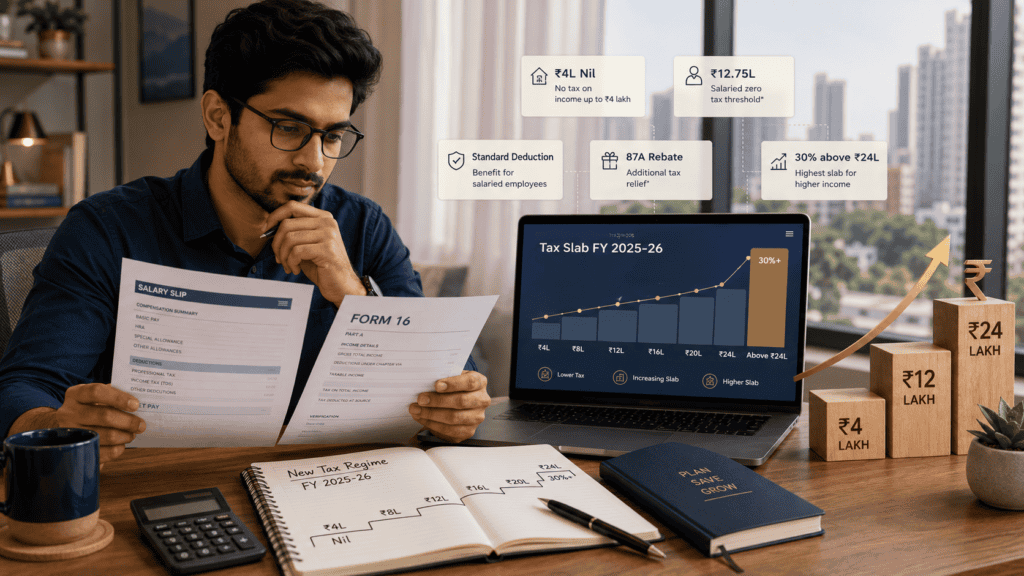
If your employer sent you a tax declaration form this year — or if you are trying to figure out whether you owe any income tax for FY 2025-26 — you are looking for the same thing: which slabs apply to you, and what your actual tax works out to. The new tax regime slabs FY 2025-26 are the default framework that applies to most salaried employees in India for Assessment Year 2026-27, unless they actively opt for the old regime. But knowing the slab rates is only half the picture. Standard deduction, Section 87A rebate, health and education cess, and your total income — including bonus and interest — all affect what you actually pay. This article walks through everything: the official slabs, how they interact with standard deduction and rebate, real salary examples, common errors salaried employees make, and exactly where to verify before you file.
Quick Answer: New Tax Regime Slabs FY 2025-26
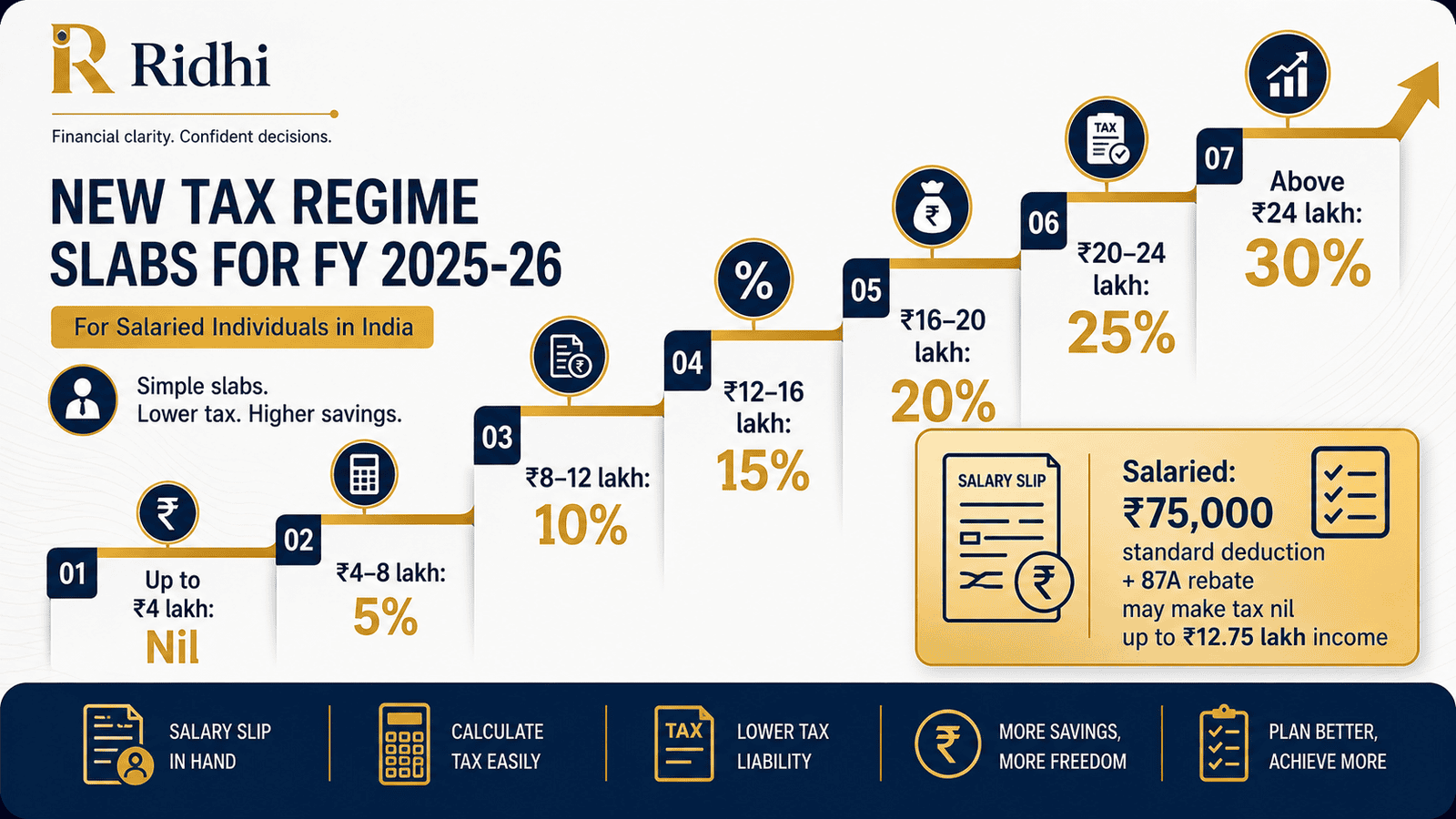
New tax regime slabs FY 2025-26 start at nil tax up to ₹4 lakh and go up to 30% above ₹24 lakh. For salaried people, ₹75,000 standard deduction plus Section 87A rebate may make tax nil up to ₹12.75 lakh salary. Verify all figures from incometax.gov.in before filing for AY 2026-27.
Key Takeaways
- The new tax regime under Section 115BAC is the default regime for FY 2025-26 — you do not need to do anything extra to be assessed under it, but you must actively opt out if you prefer the old regime.
- Slab rates are progressive: nil tax up to ₹4 lakh, rising through 5%, 10%, 15%, 20%, 25%, and 30% above ₹24 lakh — verify the complete table at incometax.gov.in before filing.
- Salaried employees are eligible for a ₹75,000 standard deduction under the new regime, which reduces gross salary to arrive at taxable income — a ₹12.75 lakh salary becomes ₹12 lakh taxable income after this deduction.
- Section 87A rebate may reduce tax payable to nil for resident individuals whose total taxable income does not exceed ₹12 lakh — but eligibility conditions apply and must be confirmed from official sources.
- Cess at 4% is added on any tax that remains payable after rebate — it is not waived even for low-tax assessees.
- If you earn more than ₹12.75 lakh, have bonus income, interest income, or other sources, your taxable income may exceed the rebate threshold and tax will be payable — calculate carefully using the official ITR utility or a verified calculator.
- The old regime may still be worth comparing if your eligible deductions — 80C, 80D, HRA, home loan interest — are substantial and documented.
Key Facts at a Glance
| Parameter | FY 2025-26 / AY 2026-27 Detail |
|---|---|
| Financial Year | FY 2025-26 (April 2025 – March 2026) |
| Assessment Year | AY 2026-27 |
| Applicable Law | Section 115BAC, Income Tax Act |
| Default Regime | New tax regime — applies unless old regime is opted |
| Nil tax slab | Up to ₹4 lakh |
| Highest slab rate | 30% on income above ₹24 lakh |
| Standard deduction (salaried) | ₹75,000 |
| Section 87A rebate limit | Up to ₹60,000; applicable where taxable income ≤ ₹12 lakh |
| Health and education cess | 4% on tax payable |
| Zero-tax salary threshold | Up to ₹12.75 lakh (gross salary, salaried individuals, subject to eligibility) |
How the New Tax Regime Slabs FY 2025-26 Actually Work
What Is the New Tax Regime Under Section 115BAC?
The new tax regime, introduced under Section 115BAC of the Income Tax Act, replaced the older optional structure and became the default regime for individual taxpayers from FY 2023-24 onwards. For FY 2025-26, it continues as the default — meaning your employer will apply new-regime slabs to your salary for TDS purposes unless you specifically inform them that you are opting for the old regime.
The regime offers lower slab rates but substantially restricts the deductions and exemptions you can claim. Most popular deductions — Section 80C, 80D, HRA, LTA, home loan interest under Section 24(b) — are not available under the new regime. The primary benefit is simplicity: you pay according to a progressive slab table without needing to plan investments or submit proofs.
The FY 2025-26 New Regime Slab Table
According to the Income Tax Department, the new regime slab rates for FY 2025-26 are structured as follows. Verify this table at incometax.gov.in before filing.
| Taxable Income Slab | Tax Rate |
|---|---|
| Up to ₹4,00,000 | Nil |
| ₹4,00,001 – ₹8,00,000 | 5% |
| ₹8,00,001 – ₹12,00,000 | 10% |
| ₹12,00,001 – ₹16,00,000 | 15% |
| ₹16,00,001 – ₹20,00,000 | 20% |
| ₹20,00,001 – ₹24,00,000 | 25% |
| Above ₹24,00,000 | 30% |
These are marginal rates — each rate applies only to the portion of income falling within that slab, not to your entire income. A person with ₹15 lakh taxable income does not pay 15% on all ₹15 lakh; they pay the applicable rate on each slice separately.
Standard Deduction and Why It Matters for Salaried Employees
Salaried employees and pensioners are eligible for a flat standard deduction of ₹75,000 under the new regime. This deduction is subtracted from your gross salary before slab rates are applied. It requires no investment, no proof submission, and no declaration — your employer applies it automatically when computing TDS. Understanding exactly how standard deduction reduces your taxable salary is worth reading in depth: standard deduction explained.
For a practical example: if your gross salary is ₹12,75,000, subtracting ₹75,000 standard deduction gives taxable income of ₹12,00,000. This single step is what brings many salaried employees into the rebate zone.
Section 87A Rebate: Not the Same as a Deduction
Many salaried employees confuse deduction and rebate — they are fundamentally different. A deduction reduces your taxable income before the slab is applied. A rebate is applied after tax is calculated, directly reducing the tax amount payable.
Under Section 87A, resident individual taxpayers whose total taxable income does not exceed ₹12 lakh are eligible for a rebate of up to ₹60,000 — effectively making their tax liability nil before cess. If your tax calculated at slab rates is, say, ₹20,000, the Section 87A rebate cancels it entirely. For the full picture of who qualifies and the exact conditions, read Section 87A rebate explained.
Important: rebate applies only if your total income — including salary, interest, rental income, and any other source — stays within ₹12 lakh after standard deduction. Additional income beyond salary can push you past the threshold and make the rebate unavailable.
Real Example: Rahul, 29, Software Engineer, Bengaluru
Rahul earns a gross salary of ₹12,75,000 for FY 2025-26. His employer deducts TDS monthly based on projected annual income.
Step 1 — Gross Salary: ₹12,75,000
Step 2 — Standard Deduction: ₹75,000 subtracted → Taxable Income: ₹12,00,000
Step 3 — Tax on ₹12,00,000 at slab rates:
- Up to ₹4,00,000 → Nil
- ₹4,00,001 – ₹8,00,000 → 5% on ₹4,00,000 = ₹20,000
- ₹8,00,001 – ₹12,00,000 → 10% on ₹4,00,000 = ₹40,000
- Total tax before rebate: ₹60,000
Step 4 — Section 87A Rebate: Taxable income is exactly ₹12,00,000, which is within the ₹12 lakh threshold. Rebate of ₹60,000 reduces tax to nil.
Step 5 — Cess: Nil tax → cess = ₹0. Final tax payable: ₹0.
Now consider Rahul gets a year-end bonus of ₹50,000. His taxable income becomes ₹12,50,000. This exceeds the ₹12 lakh rebate threshold. The Section 87A rebate no longer applies. Tax on ₹12,50,000 is calculated at slab rates — ₹60,000 on the first ₹12 lakh, plus 15% on ₹50,000 = ₹7,500, totalling ₹67,500. Add 4% cess: ₹67,500 × 1.04 = ₹70,200 payable. This is why it is worth using a verified income tax calculator rather than relying on mental math — and verifying with Form 16 before filing.
How to Calculate Your Tax Under the New Regime: Step by Step
Tax Payable = [(Gross Salary − Standard Deduction) applied to Slab Rates] − Section 87A Rebate (if eligible) + 4% Cess on remaining tax
Use the following step-by-step process for FY 2025-26. Verify all figures from incometax.gov.in before filing.
Step 1: Start with total gross salary including basic pay, allowances, and bonus. Add any other income (interest, rent, capital gains).
Step 2: Subtract ₹75,000 standard deduction (salaried employees only) to arrive at taxable income.
Step 3: Apply the FY 2025-26 slab rates to your taxable income progressively — slab by slab, not on the total.
Step 4: If taxable income ≤ ₹12,00,000 and you are a resident individual, apply Section 87A rebate (up to ₹60,000) to reduce tax to nil.
Step 5: If any tax remains after rebate, add health and education cess at 4%.
| Scenario | Taxable Income (After Std. Deduction) | Estimated Tax Payable (incl. cess) |
|---|---|---|
| Salary ₹10,00,000 | ₹9,25,000 | Nil (87A rebate applies; taxable income ≤ ₹12L) |
| Salary ₹12,75,000 | ₹12,00,000 | Nil (87A rebate of ₹60,000 applies exactly) |
| Salary ₹15,00,000 | ₹14,25,000 | Approx. ₹1,17,000 (no rebate; slab tax + 4% cess) |
These figures are illustrative. Bonus, interest, rental income, or capital gains will alter taxable income and may remove rebate eligibility. Always calculate using the official ITR utility or a verified calculator before filing.
Comparison: New Tax Regime vs Old Tax Regime
| Parameter | New Tax Regime (Default) | Old Tax Regime (Optional) |
|---|---|---|
| Default status | Default | Must opt in |
| Standard deduction | ₹75,000 available | ₹50,000 available |
| Section 80C deduction | Not available | Up to ₹1.5 lakh |
| HRA exemption | Not available | Available with rent proof |
| Section 80D (health insurance) | Not available | Up to ₹25,000–₹1 lakh |
| Home loan interest (Sec 24b) | Not available | Up to ₹2 lakh (self-occupied) |
| Slab rates | Lower, simplified | Higher, with exemptions to offset |
| Best suited for | Low-deduction, simpler income profiles | High-deduction earners with documentation |
This table is a high-level comparison only. Whether the old regime saves more tax depends entirely on your specific salary structure, the deductions you can claim, and the documentation you hold. For a full side-by-side analysis with salary examples, read old regime comparison.
How to Decide What’s Right for You
Your gross salary is under ₹12.75 lakh, you have no significant deductions, and no other income sources — THEN the new regime is likely the simpler and lower-tax option, but verify with a calculator before filing.
You claim HRA, have documented rent receipts, and your exemption is substantial — THEN calculate your old-regime tax and compare before choosing or declaring to your employer.
You have home loan interest of ₹2 lakh, PPF/EPF/ELSS investments hitting the full ₹1.5 lakh 80C limit, and 80D premiums — THEN the old regime may reduce your tax significantly; run the numbers.
Your employer asks for a tax regime declaration in April — THEN make the choice based on projected full-year income, not just current month salary. Factor in bonus, increments, and any side income.
You receive a salary hike, bonus, or interest income mid-year that pushes your taxable income above ₹12 lakh — THEN recalculate immediately because the Section 87A rebate may no longer apply.
You should not rely on a slab table alone to determine your final tax — if you have rental income, capital gains, freelance income, or any source beyond salary, your taxable income and applicable benefits are different. Use the official ITR utility or consult a qualified professional.
Common Mistakes to Avoid
Assuming ₹12.75 Lakh CTC Always Means Zero Tax
CTC and gross salary are not the same figure.
Your CTC often includes employer PF contribution, gratuity, and other components that do not form part of your taxable salary. If your actual gross taxable salary is higher than you assume — because of allowances or variable pay — the standard deduction and rebate arithmetic changes entirely.
Always check your Form 16 Part B for the actual gross salary figure your employer has used.
Forgetting Bonus, Interest, and Other Income
Many salaried employees calculate tax only on their fixed monthly salary and forget year-end bonus, savings account interest, fixed deposit interest, or rental income.
Even ₹20,000 in bank interest can push your taxable income above ₹12 lakh, eliminating the Section 87A rebate. A ₹50,000 bonus on a ₹12.75 lakh salary can add ₹70,200 to your tax bill. Track all income sources, not just salary.
Review your AIS (Annual Information Statement) on incometax.gov.in before filing — it captures income the tax department has received information about.
Confusing Deduction, Rebate, and Exemption
These three terms reduce your tax in different ways at different stages, and mixing them up leads to wrong calculations.
A deduction (like 80C) reduces taxable income. A rebate (Section 87A) reduces tax payable after it is calculated. An exemption (like HRA) reduces the taxable portion of a specific allowance. None of these are interchangeable. Using “80C in the new regime” is a common error — it is not available.
Map each benefit to the correct stage of the calculation before relying on it.
Assuming Old Regime Deductions Automatically Apply
Some employees believe that because they invested in PPF, ELSS, or health insurance, those amounts automatically reduce their tax under any regime.
Under the new regime, most investment deductions and exemptions are not available. If you declared the old regime to your employer but did not submit proofs, or if your employer defaulted to the new regime, your TDS may not reflect those deductions. The result: a mismatch between what you expected and what Form 16 shows.
Declare your regime choice clearly to your employer by the deadline they specify — typically April.
Ignoring Employer TDS Mismatch
Your employer calculates TDS on a projected annual income figure at the start of the year. If your actual income — due to bonus, job change, or salary revision — differs, TDS deducted may be more or less than your actual liability.
This does not fix itself automatically. If less TDS was deducted, you may face a tax demand when you file. For a detailed explanation of why this happens and how to check it, read salary TDS calculation.
Always reconcile Form 16 with your AIS before filing ITR.
Filing Under the Wrong Regime at ITR Stage
Even if you declared the old regime to your employer and your Form 16 reflects old-regime deductions, you can still choose the new regime when filing your ITR — and vice versa, with restrictions.
Salaried employees with only salary income generally can switch regime at ITR filing. But business and professional income taxpayers face restrictions on how often they can switch. Verify the rules applicable to your income type on incometax.gov.in before choosing your ITR regime.
When This May Not Be the Right Choice
The new tax regime slabs are straightforward — but relying solely on them without exploring the old regime may mean leaving tax savings on the table in certain situations.
If you pay substantial rent and can claim HRA exemption with documented rent receipts, the old regime may reduce your taxable income significantly. Similarly, if you have completed or are servicing a home loan, the ₹2 lakh interest deduction under Section 24(b) — available only in the old regime — can make a meaningful difference at higher salary brackets.
If you consistently max out ₹1.5 lakh in 80C investments (EPF, PPF, ELSS, LIC premium, home loan principal), ₹25,000 to ₹50,000 in 80D health insurance premiums, and contribute to NPS under Section 80CCD(1B), the combined deduction impact under the old regime can outweigh the lower slab rates of the new regime.
Additionally, if you are a self-employed professional or run a business alongside employment, your regime-switching rules and available deductions differ from a pure salary taxpayer — the new regime slabs alone will not give you the complete picture.
If any of these apply to your situation, it may be worth exploring alternatives before committing.
Official Rules and Where to Verify
Tax rules, slab rates, rebate limits, and standard deduction amounts can be revised through the Union Budget or subsequent notifications. The figures in this article reflect information available as of the article’s publication date — always verify the current rules directly before filing your ITR for AY 2026-27.
Official sources to verify:
- Income Tax Department — incometax.gov.in: Check the latest slab tables, rebate conditions, standard deduction amount, and any surcharge applicability for your income level.
- ITR filing portal — incometax.gov.in/iec/foportal: Use the official ITR utility to calculate tax under both regimes before filing.
- Form 16 from your employer: This is the primary document showing your employer-reported gross salary, TDS deducted, and regime applied. Learn how to read it here: read your Form 16.
- Annual Information Statement (AIS) — incometax.gov.in: Cross-check all income reported against your own records before submitting ITR.
Rules, limits, and rates on this topic can change with each Budget or regulatory update. Always verify current figures directly from the official source before making any financial decision.
Expert Tips
- Declare your regime choice to your employer in April, not March. Most employers ask for a tax regime declaration at the start of the financial year. Declaring in April based on projected full-year income — including expected bonus and increments — avoids TDS mismatch later and reduces the chance of a tax demand when you file.
- Run old-regime numbers before dismissing it. If you pay rent above ₹15,000 per month, have ₹1.5 lakh in documented 80C investments, and pay health insurance premiums, calculate your old-regime tax liability. In some salary brackets — particularly ₹10–18 lakh — the old regime can still result in lower tax despite higher slab rates.
- Recalculate your tax estimate every time your income changes. A salary hike in October, a bonus in February, or an FD maturing in March changes your annual taxable income. Any change that pushes you past ₹12 lakh eliminates the Section 87A rebate and adds cess — a ₹1 increase past the threshold can cost ₹70,200 if you had assumed nil tax.
- Check AIS before filing, not after. The Annual Information Statement on incometax.gov.in shows interest income your bank reported, dividend income, property transaction data, and more. Discrepancies between AIS and your ITR can trigger notices. Download and review it before you finalise your return.
- Do not assume your employer’s Form 16 always captures everything. Form 16 Part A covers TDS; Part B covers income and deductions as declared by you. If you changed jobs mid-year, you need Form 16 from both employers. Combine both when filing — missing income from one employer is a common cause of underreported income.
- Use marginal relief if your income is just above ₹12 lakh. If your taxable income is, say, ₹12,10,000, the tax payable should not exceed the amount by which your income exceeds ₹12 lakh — marginal relief provisions exist to prevent this. The calculation is specific; use the ITR utility rather than manual calculation in this range.
Frequently Asked Questions
What are the new tax regime slabs for FY 2025-26?
The FY 2025-26 new tax regime slabs are: nil tax up to ₹4 lakh; 5% from ₹4 lakh to ₹8 lakh; 10% from ₹8 lakh to ₹12 lakh; 15% from ₹12 lakh to ₹16 lakh; 20% from ₹16 lakh to ₹20 lakh; 25% from ₹20 lakh to ₹24 lakh; and 30% above ₹24 lakh. These are marginal rates. Verify at incometax.gov.in before filing for AY 2026-27.
Is income up to ₹12 lakh tax-free in the new regime for FY 2025-26?
For resident individual taxpayers whose total taxable income does not exceed ₹12 lakh, the Section 87A rebate of up to ₹60,000 may reduce tax payable to nil. This is not a nil slab — tax is first calculated at slab rates and then eliminated by the rebate. Eligibility depends on total income from all sources, not just salary. Verify the current rebate conditions at incometax.gov.in.
Why do salaried employees talk about the ₹12.75 lakh zero-tax threshold?
Salaried employees receive a ₹75,000 standard deduction before slab rates apply. A gross salary of ₹12,75,000 minus ₹75,000 equals taxable income of ₹12,00,000 — which is exactly at the Section 87A rebate threshold. At this taxable income level, the rebate of ₹60,000 covers the calculated slab tax entirely, resulting in nil tax. Any income above ₹12.75 lakh (salary) or additional non-salary income changes this outcome.
Is standard deduction available in the new tax regime?
Yes. Salaried employees and pensioners are eligible for a standard deduction of ₹75,000 under the new tax regime for FY 2025-26. No investment or proof is required — it is applied automatically by the employer when computing TDS. Verify the current amount at incometax.gov.in.
Is Section 80C deduction available in the new tax regime?
No. Section 80C deductions — covering EPF, PPF, ELSS, LIC premiums, home loan principal repayment, and others — are not available under the new tax regime. If you want to claim 80C deductions, you must opt for the old tax regime and declare this to your employer (or choose it at ITR filing, subject to income type restrictions).
Can I choose the old tax regime instead of the new one?
Yes. The new regime is the default, but salaried employees with only salary income can typically opt for the old regime either by informing their employer at the start of the financial year or by selecting it when filing ITR. Taxpayers with business or professional income face different and more restrictive switching rules. Verify the applicable rules for your income type at incometax.gov.in.
Does health and education cess apply after the Section 87A rebate?
Cess of 4% is calculated on tax payable after the rebate has been applied. If your Section 87A rebate reduces tax to nil, cess is also nil. If any tax remains payable after rebate, cess at 4% is added on that remaining amount.
What happens if my employer deducted more TDS than my actual tax liability?
If excess TDS has been deducted, you are eligible for a refund when you file your ITR. The refund is processed by the Income Tax Department after verification of your return. Ensure you file your ITR on time, verify the TDS credit in Form 26AS or AIS, and provide accurate bank details for refund. Delays in ITR filing may delay refund processing.
Does the new regime apply automatically if I do nothing?
Yes. The new tax regime is the default for FY 2025-26. If you do not inform your employer of a preference or do not opt for the old regime at ITR filing, the new regime applies. You do not need to take any action to be assessed under it, but you must actively choose the old regime if you want to claim deductions not available under the new one.
Can I have nil tax at ₹12.75 lakh if I also have ₹50,000 in FD interest?
No. If your gross salary is ₹12,75,000 and you also earn ₹50,000 in FD interest, your total income is ₹13,25,000. After ₹75,000 standard deduction, taxable income is ₹12,50,000 — which exceeds the ₹12 lakh Section 87A rebate threshold. Tax will be calculated at slab rates on ₹12,50,000 without any rebate, and cess will apply. Always include all income when calculating tax.
Final Verdict
The new tax regime slabs FY 2025-26 offer a simpler, lower-rate structure for most salaried employees — and for those earning up to ₹12.75 lakh in gross salary with no other significant income, the combination of standard deduction and Section 87A rebate can result in nil tax. But “may result in nil tax” is not the same as “always results in nil tax.” Bonus income, interest income, rental receipts, or capital gains can change the outcome entirely. The old tax regime remains relevant for taxpayers with large and documented deductions — and comparing both regimes before your April employer declaration is a habit worth building every year. Use the official ITR utility or a verified calculator, cross-check your AIS, and read your Form 16 before filing. Always verify the latest rules from official sources or consult a qualified professional before making any financial decision.
This article is for educational purposes only and should not be treated as personalised financial, tax, investment, insurance, or legal advice. Tax rules, interest rates, regulatory limits, and product features can change with each Budget or policy update. Please verify current rules from official government sources or consult a qualified and registered professional before making any financial decision.

Kavita Mehra writes and edits Ridhi.com’s income tax content for Indian taxpayers, with a special focus on salaried employees and beginners who find tax rules confusing. Her work explains complex tax topics in simple language, helping readers understand how income, deductions, exemptions, rebates, TDS, Form 16, ITR filing, and refunds connect in real life.
She covers topics such as old vs new tax regime, income tax slabs, standard deduction, Section 87A rebate, HRA exemption, 80C, 80D, 80E, 80G, TDS on salary, taxable income, Form 16, AIS, Form 26AS, advance tax, and ITR filing checklists. Her content aims to help readers become more informed before filing returns or discussing tax matters with a professional.
Kavita’s approach is careful, compliance-focused, and official-source oriented. Because Indian tax rules can change after Budgets, circulars, and policy updates, her articles encourage readers to verify current figures, filing deadlines, and rules from the Income Tax Department or a qualified tax professional before acting.