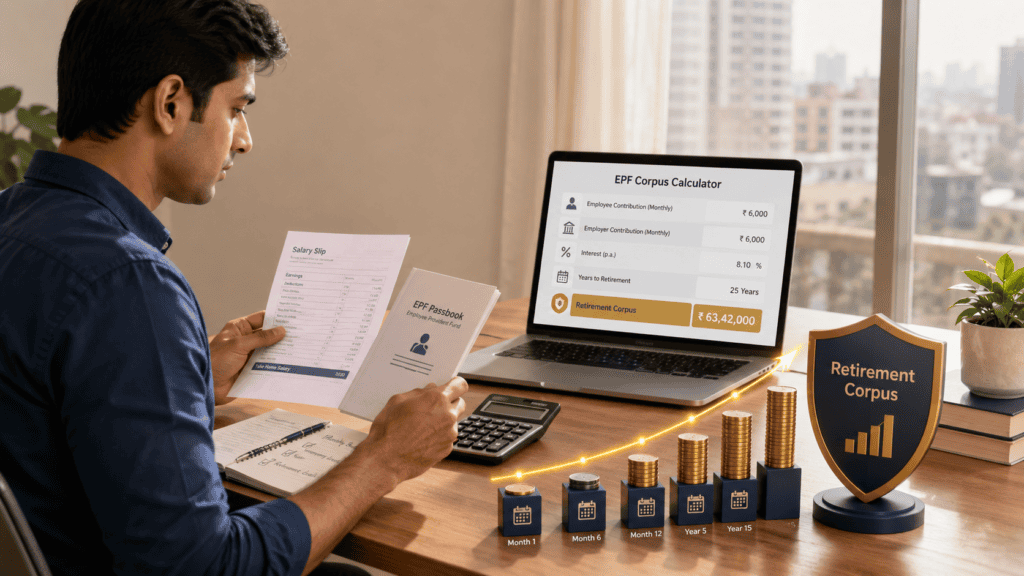

You resign from your job and the first question that hits you is: what happens to my PF? Thousands of salaried employees search for this every month — and most either rush to withdraw without checking the rules, or wait indefinitely because they are not sure what to do next.
PF withdrawal after resignation is not always immediate. EPFO rules require an unemployment waiting period before you can apply for final settlement. Submitting a claim too early, or with mismatched KYC details, is the fastest way to get it rejected. And if your total service is under five years, withdrawing without checking the tax implications first could mean an unexpected TDS deduction.
This guide explains exactly when you can withdraw your PF after resignation, which forms to use, how EPS pension is handled separately, what tax and TDS rules apply, and whether transferring to a new employer is a smarter move than withdrawing. Always verify the current rules at epfindia.gov.in before applying.
Quick Answer: PF Withdrawal Rules After Resignation
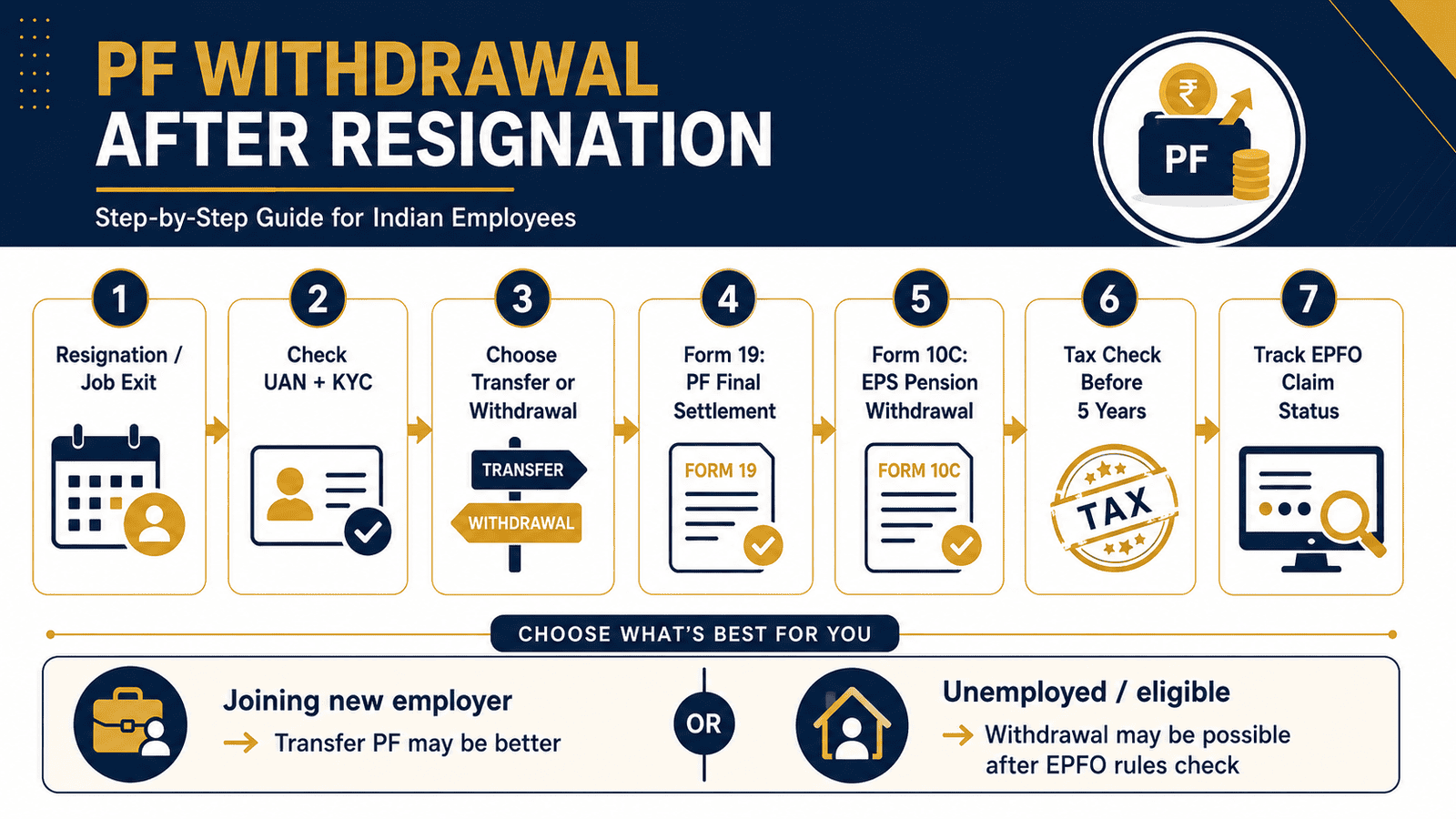
PF withdrawal rules after resignation usually allow a member to apply for final PF settlement only after the required unemployment waiting period, such as 2 months under older EPFO guidance. Check UAN KYC, Form 19, Form 10C, tax/TDS impact, and whether PF transfer is better.
Key Takeaways
- You cannot submit a PF withdrawal claim before your employer updates your date of exit on the EPFO portal — without this, every online claim will fail automatically.
- Form 19 (EPF final settlement) and Form 10C (EPS withdrawal benefit or scheme certificate) are two different claims — submitting only one means you leave money or pension rights unclaimed.
- If your total service is under five years and your EPF withdrawal exceeds ₹50,000, TDS applies under Section 192A of the Income Tax Act — 10% with PAN, or at the maximum marginal rate without PAN.
- EPS cash withdrawal benefit is available only if total service is under ten years. Above ten years, EPFO issues a scheme certificate for future pension — no cash payout is possible.
- Transferring your PF to a new employer preserves service continuity, avoids TDS, and keeps your corpus compounding tax-free at the current EPF interest rate — compare this option before withdrawing.
- Online claims through the EPFO Member e-Sewa portal require Aadhaar, PAN, and bank account all linked and verified on your UAN — fix mismatches before submitting, not after rejection.
- After submitting a claim, track status using your UAN on the EPFO portal — do not assume it has been processed without confirmation.
Key Facts at a Glance
| Claim Type | Form Required | Key Condition |
|---|---|---|
| EPF Final Settlement | Form 19 | Unemployment waiting period elapsed; UAN KYC complete |
| EPS Withdrawal Benefit or Scheme Certificate | Form 10C | Service under 10 years for cash benefit; scheme certificate above 10 years |
| Combined PF + EPS Claim | Composite Claim Form | Replaces Form 19 + Form 10C when submitted together online or offline |
| PF Transfer to New Employer | Online Transfer Claim | New employer must be PF-covered; UAN, Aadhaar, bank KYC active |
| TDS on Early PF Withdrawal | Section 192A, IT Act | Service under 5 years; withdrawal exceeds ₹50,000; 10% TDS with PAN |
What PF Withdrawal After Resignation Actually Means
When you resign from a PF-covered job, your EPF account does not close automatically. Your balance continues to earn interest, and the account stays active under your Universal Account Number. You have two broad choices: withdraw the balance (final settlement) or transfer it to your new employer’s trust when you join a new job.
Most people assume withdrawal is instant. It is not. EPFO requires a waiting period of unemployment before you can apply for full final settlement. Submitting a claim before this period has elapsed — or before your employer has updated your date of exit on the EPFO portal — will result in a rejected claim. Always confirm your date of exit is updated and visible on the EPFO Member e-Sewa portal before you apply.
Your EPF Balance Is Not One Number — It Is Two
Every month you work at a PF-covered employer, two separate contributions flow into two separate buckets inside your EPFO account.
Your contribution: 12% of your basic salary plus dearness allowance goes entirely into your EPF account. This is the primary balance you see in your passbook.
Your employer’s contribution: the employer also contributes 12% of your basic plus DA — but it is split. Roughly 3.67% goes into your EPF account. The remaining 8.33% (capped at ₹1,250 per month based on a ₹15,000 wage ceiling) goes into your EPS account — the Employees’ Pension Scheme.
These are treated differently when you resign. Your EPF balance (employee share + employer’s 3.67% share + interest) is claimable through Form 19. Your EPS balance is governed by a completely separate set of rules under the Employees’ Pension Scheme, 1995 — and it is not directly withdrawable as the raw monthly deposit amount. Instead, EPFO calculates either a withdrawal benefit based on a salary-and-service table, or issues a scheme certificate if you want to preserve your future pension.
For a deeper look at how EPF is structured, read our guide on EPF basics explained.
Why Date of Exit Is the First Thing to Check
Before you do anything else, log in to the EPFO Member e-Sewa portal and check whether your employer has updated your date of leaving service. This is a mandatory step for EPFO to process your claim. Many employers complete this quickly; some do not. If the date of exit is missing, your online claim will fail at the first eligibility check.
If your employer has not updated the date of exit within a reasonable period after your resignation, you can follow EPFO’s grievance process at epfindia.gov.in to escalate the matter.
Why EPFO Requires KYC Before Online Claims
EPFO’s Aadhaar-based online claim system is fast — but only if your KYC is clean. Before submitting any online claim, three things must be verified against your UAN: your Aadhaar number (and the name on Aadhaar must exactly match EPFO records), your PAN, and your bank account with IFSC code. A name mismatch of even one character — a spelling difference between your Aadhaar and EPFO profile, for example — is enough to get your claim rejected.
The mobile number registered on your UAN must also be active and receiving OTPs. EPFO sends a one-time password to verify identity during online claim submission. If that number is no longer reachable, fix it before you apply.
Which Form Do You Actually Need for PF Withdrawal After Resignation?
Form 19 is for EPF final settlement — it covers the withdrawal of your combined EPF balance (your contributions, the employer’s EPF portion, and accumulated interest). This is the primary claim most resigning employees are thinking of when they say “I want to withdraw my PF.”
Form 10C is separate — it covers your EPS claim. When you submit this alongside Form 19, you are claiming your pension account as well. If your service is under ten years, EPFO will either give you a withdrawal benefit (a lump sum based on a salary-service table) or issue a scheme certificate that you can present to a future employer to continue EPS service. If your service is above ten years, cash withdrawal from EPS is not permitted — only a scheme certificate is issued.
The Composite Claim Form simplifies this: it combines Form 19 and Form 10C into one submission. This is currently the standard offline form accepted at EPFO offices. For online claims, both PF and EPS can be initiated through the EPFO Member e-Sewa portal under a single session.
Transfer Is Often Worth Comparing First
If you are joining another PF-covered employer, transferring your PF rather than withdrawing has three concrete advantages. First, your service continuity is preserved — which matters significantly for crossing the five-year tax-exempt threshold. Second, your corpus keeps compounding at the EPF interest rate, tax-free, without any TDS deduction. Third, your EPS service accumulates — which affects your eventual pension eligibility and amount.
Withdrawal gives you liquidity. Transfer gives you a better long-term outcome in most cases. The decision depends on whether you genuinely need the money now, or whether you are withdrawing simply because the balance is visible in your passbook.
Real Example: Rahul’s PF Decision in Pune
Rahul is 29, a software engineer in Pune earning ₹11 lakh per year. He resigned in March after three years at his company and received an offer from another firm starting in six weeks. His EPFO passbook shows a balance of approximately ₹2,15,000.
Before touching anything, Rahul logs into the EPFO Member e-Sewa portal and verifies: date of exit is updated, Aadhaar and PAN are linked, bank account KYC is active. He then checks his passbook breakdown — employee contributions, employer EPF share, EPS contributions, and interest are all visible separately.
He reads that his three years of service put him well under the five-year threshold. Withdrawing ₹2,15,000 now means 10% TDS — roughly ₹21,500 deducted, leaving him ₹1,93,500 net. If he transfers instead, the full ₹2,15,000 continues compounding, and his service clock keeps running.
Since he is joining a new company in six weeks, Rahul decides to transfer rather than withdraw. He also chooses to keep his EPS service intact to protect future pension benefits. To verify his exact passbook balance before deciding, he uses the guide on how to check PF balance online with UAN.
The key insight: Rahul’s withdrawal decision was driven by checking the actual numbers — not just the fact that the balance was visible.
How to Calculate the Real Cost of Early PF Withdrawal
Before deciding to withdraw, it helps to run through the numbers. Here is a simple framework using Rahul’s profile as the base.
Net Withdrawal = EPF Balance − TDS (if service < 5 years and balance > ₹50,000)
Rahul’s EPF balance: ₹2,15,000 (employee share + employer EPF share + interest at current EPF rate). His service is 3 years — below the 5-year threshold. TDS at 10% with PAN = ₹21,500. Net amount received: ₹1,93,500.
This is not his final tax liability. TDS is a deduction at source. If his total income for the year — including the ₹2,15,000 — pushes him into a higher slab, he may owe additional tax at the time of filing. Conversely, if he has no other income and falls below the taxable limit, he can claim the TDS back as a refund. Speak with a tax professional to assess this for your specific year and income.
| Scenario | Action | Estimated Outcome |
|---|---|---|
| Withdraw now (3 yrs service) | Form 19 + Form 10C | ~₹1,93,500 net after 10% TDS; EPS benefit separate |
| Transfer to new employer | Online transfer claim | ₹2,15,000 preserved; compounding continues; no TDS |
| Wait until 5-year mark, then withdraw | Form 19 after crossing threshold | No TDS; full balance tax-exempt on withdrawal |
Note: the EPF interest rate used above and the TDS threshold should be verified from official sources before making any financial decision. See the Pre-Publish Verification Checklist below.
Comparison: PF Withdrawal vs PF Transfer After Resignation
Use this table to compare the two options across the factors that actually matter when you resign.
| Factor | PF Withdrawal | PF Transfer |
|---|---|---|
| Form Required | Form 19 + Form 10C (or Composite Claim Form) | Online transfer claim via EPFO Member e-Sewa |
| Tax / TDS Risk | TDS applies if service < 5 yrs and balance > ₹50,000 | No TDS — transfer is not a taxable event |
| Service Continuity | Breaks — counter resets at new employer | Preserved — service accumulates across jobs |
| Long-Term Corpus Impact | Interrupted — compounding stops on withdrawn amount | Continues — full balance keeps earning interest |
| EPS Treatment | Cash benefit (service < 10 yrs) or scheme certificate | EPS service continues at new employer |
| Best For | Genuine financial need during prolonged unemployment | Joining another PF-covered employer within a few months |
For a step-by-step process, read our guide on PF transfer after job change.
How to Decide What’s Right for You
you are joining another PF-covered employer within the next few months — THEN transfer your PF rather than withdrawing; it preserves service continuity and avoids TDS entirely.
you genuinely need the money and have been unemployed for the required waiting period — THEN proceed with Form 19 for EPF final settlement, but calculate the TDS impact first.
your total service across all employers is under five years — THEN check the tax/TDS impact before withdrawing; on a ₹2 lakh balance, 10% TDS with PAN means ₹20,000 deducted at source.
your total service is above ten years — THEN you cannot withdraw EPS as cash; EPFO will issue only a scheme certificate, which you should preserve for pension continuity.
your Aadhaar name, PAN, or bank account has any mismatch with your EPFO records — THEN fix the KYC errors before submitting any claim; mismatches are among the most common rejection reasons.
urgently in need of the money and likely to join another company soon — THEN withdrawing PF right now is probably not in your best interest; the balance earns interest at the current EPF rate tax-free while it sits at EPFO.
Before you proceed with any claim, activate and verify your UAN — read our guide on UAN account setup for the complete process.
Common Mistakes to Avoid
Applying Before Employer Updates Date of Exit
Submitting a PF claim before your employer has updated your date of leaving service on the EPFO portal will result in automatic rejection.
EPFO’s online system checks exit date eligibility before processing any claim. If the date is missing or shows you as still employed, the claim fails — and you have to restart the process after the correction is made, adding weeks of delay.
Log in to the EPFO Member e-Sewa portal and confirm your date of exit is updated before submitting anything.
KYC Mismatch Between Aadhaar, PAN, and EPFO Records
A name spelled differently on Aadhaar versus your EPFO profile — even a single character — is enough to block an online claim.
Banks, employers, and EPFO each have their own spelling of your name on file. A mismatch between any two systems causes the KYC verification to fail. This is the single most common reason for claim rejection after date-of-exit errors.
Check your EPFO profile, Aadhaar, and bank records for exact name match before applying. Update via the EPFO Member e-Sewa portal or through your employer. See our guide on claim rejection reasons for a full troubleshooting list.
Submitting Only Form 19 and Forgetting Form 10C
Form 19 covers your EPF balance. Form 10C covers your EPS pension account. They are two separate claims, and many employees submit only Form 19 without realising they have left their EPS benefit unclaimed.
If your service is under ten years and you are resigning permanently or going on a long career break, not submitting Form 10C means you either lose the EPS withdrawal benefit or fail to get a scheme certificate that preserves your pension rights.
Use the Composite Claim Form to cover both in one submission.
Ignoring TDS Before Five Years of Service
Withdrawing your EPF balance when total service is under five years and the amount exceeds ₹50,000 triggers TDS under Section 192A of the Income Tax Act.
TDS is not the same as final tax. But it is a real cash deduction at the time of settlement — 10% with PAN, significantly higher without PAN. On a balance of ₹2 lakh, that is ₹20,000 deducted before the amount reaches your account. If you are in a higher tax bracket, the total liability at filing time may be even more.
Check the tax impact before you withdraw — not after. Our detailed breakdown is in the guide on withdrawal tax rules.
Withdrawing When a New Job Offer Is Already in Hand
Withdrawing your PF and then joining a new PF-covered employer a few weeks later means you have reset your service counter and paid TDS unnecessarily.
Service continuity is critical for crossing the five-year tax-exempt threshold. Every time you withdraw and restart, you restart that clock. If your next employer requires two more years to cross five years in total, you could have reached it two years faster had you transferred instead of withdrawing.
If a new offer is likely within the next few months, compare transfer costs versus withdrawal costs before deciding.
Not Tracking Claim Status After Submission
Submitting a PF claim and assuming it will be processed without follow-up is a mistake. Claims can be returned for corrections, get stuck in processing queues, or face employer approval delays.
After submission, note down your claim reference or acknowledgement number. Track the status regularly using your UAN on the EPFO portal or via the UMANG app.
When This May Not Be the Right Choice
You are joining another employer soon. If you have an offer letter or are actively interviewing, withdrawing PF now means breaking your service continuity and paying TDS — only to start a new PF account from zero. Transfer is almost always the better option in this situation.
Your service is close to the five-year mark. If you have worked for four years and two months, withdrawing now triggers TDS and tax. Waiting a few more months — or transferring and continuing service at a new job — could mean crossing the threshold and making your eventual withdrawal completely tax-exempt.
Your KYC details are not clean. If your Aadhaar, PAN, or bank details have mismatches with EPFO records, rushing a claim will only result in rejection. Fix the KYC first — then decide whether to withdraw or transfer.
You do not fully understand the EPS impact. If you are under ten years of service, withdrawing EPS gives you a lump sum benefit based on a salary-service table. This permanently ends your EPS continuity. If you are close to ten years, you may be better off preserving the scheme certificate for future pension entitlement.
If any of these apply to your situation, it may be worth exploring alternatives before committing.
Official Rules and Where to Verify
PF withdrawal rules after resignation involve regulations under the Employees’ Provident Fund Scheme, 1952, and the Employees’ Pension Scheme, 1995. Tax treatment of withdrawals falls under the Income Tax Act, 1961 — specifically Section 192A for TDS.
Rules, limits, and rates on this topic can change with each Budget or regulatory update. Always verify current figures directly from the official source before making any financial decision.
- EPFO — epfindia.gov.in (claim forms, member portal, withdrawal rules, EPS scheme details, grievance process)
- Income Tax Department — incometax.gov.in (TDS rules under Section 192A, exemptions, PAN requirements)
For tax treatment of PF withdrawals specifically — including what changes at the five-year mark — read our full guide on withdrawal tax rules.
Expert Tips
- Download your EPF passbook before applying. Log in to the EPFO Member e-Sewa portal and download your passbook to see the exact breakdown — employee contribution, employer EPF share, EPS contribution, and interest credited. The number in your passbook is not always what you will receive in final settlement; understanding the split helps you plan correctly.
- Screenshot your acknowledgement number immediately after claim submission. EPFO does not always send confirmation emails. Take a screenshot of the claim reference number the moment it appears on your screen. You will need it for status tracking and any grievance filing.
- Fix all KYC issues before submitting a claim — not after. Claim corrections and resubmissions add weeks to the timeline. If your Aadhaar name, PAN, or bank details need updating, do it before you file. The EPFO portal shows your current KYC status under the member login section.
- If you are close to five years of total service, calculate the exact tax difference before deciding. On a ₹2 lakh balance, the difference between withdrawing at four years versus five years is roughly ₹20,000 in TDS — plus potential additional tax at filing. That gap may be worth waiting a few months for, especially if no urgent need exists.
- Do not treat your PF balance as an emergency fund. EPF is a retirement corpus — and the compounding effect on even ₹2 lakh over a 30-year career is substantial. Withdrawing it now for non-emergency expenses interrupts a tax-free compounding engine that is difficult to rebuild. If you need emergency liquidity, explore other options first.
- If service is under ten years and you are resigning permanently, decide on EPS actively. The withdrawal benefit from Form 10C is a modest lump sum based on a government table. The scheme certificate preserves your future pension rights. Neither decision is automatic — you need to actively choose and submit the right option on Form 10C.
Frequently Asked Questions
Can I withdraw PF immediately after resignation?
Not immediately. EPFO requires you to be unemployed for a waiting period before you can apply for full final settlement. Additionally, your employer must have updated your date of exit on the EPFO portal before an online claim can be processed. The exact waiting period applicable to your claim should be verified at epfindia.gov.in before you apply.
Which form is used for PF withdrawal after resignation?
Form 19 is used for EPF final settlement — it covers your employee and employer EPF contributions plus accumulated interest. Form 10C covers your EPS claim separately. You can submit both together using the Composite Claim Form, either online through the EPFO Member e-Sewa portal or offline at an EPFO office.
What is Form 10C used for in EPF claims?
Form 10C is used to claim your EPS (Employees’ Pension Scheme) benefit when you leave a job. If your total service is under ten years, you can either receive a withdrawal benefit as a lump sum (based on a salary and service table) or opt for a scheme certificate that preserves your EPS service for a future employer. If your service is above ten years, only a scheme certificate is issued — there is no cash withdrawal from EPS at that stage.
Is PF withdrawal taxable after resignation?
It depends on your total years of continuous service across all employers. If your service crosses five years, EPF withdrawal is fully tax-exempt. If it is under five years and the amount exceeds ₹50,000, TDS applies under Section 192A — at 10% with a valid PAN, or at the maximum marginal rate without PAN. TDS is not the same as your final tax liability; you will need to account for the withdrawal amount when filing your annual income tax return. Verify the current rates and thresholds at incometax.gov.in.
Should I transfer PF if I am joining a new company?
Transfer is generally worth considering seriously if your new employer is PF-covered and you plan to join within a few months. Transfer preserves service continuity — which is critical for crossing the five-year tax-exempt threshold — avoids any TDS, and keeps your corpus compounding. Withdrawal breaks the service counter and may trigger TDS. The exception is if you have a genuine, urgent financial need that cannot be met any other way.
Why was my PF claim rejected after resignation?
The most common reasons are: date of exit not updated by employer on the EPFO portal, Aadhaar or PAN name mismatch with EPFO records, bank account details not verified under your UAN, mobile number not receiving OTP, or the unemployment waiting period not yet elapsed. Check each of these on the EPFO Member e-Sewa portal before resubmitting.
How long does EPFO take to settle a PF claim online?
Online claims with clean KYC are typically processed faster than offline claims, but the exact timeline depends on EPFO’s workload and whether employer approval is required. Track your claim status using your UAN on the EPFO portal after submission. The official processing standards should be verified at epfindia.gov.in, as timelines can change.
Can I withdraw only the employee share of EPF and leave the employer share?
No. Form 19 covers the full EPF balance — your employee contribution, the employer’s EPF contribution (3.67% share), and accumulated interest together. You cannot selectively withdraw only the employee share while leaving the rest. The claim is for the complete EPF account balance as a single settlement.
Final Verdict
PF withdrawal rules after resignation are more layered than most employees expect. The waiting period, date of exit update, KYC verification, tax and TDS risk before five years, and the separate EPS claim through Form 10C all deserve attention before you submit anything.
If you are joining another PF-covered employer within a few months, transfer is almost always worth comparing against withdrawal — it preserves your service continuity, protects long-term compounding, and avoids unnecessary TDS. If you genuinely need the funds after the required waiting period, proceed carefully with both Form 19 and Form 10C, and verify your tax position first.
The safest next step is to log in to the EPFO Member e-Sewa portal, confirm your date of exit, check your KYC status, review your passbook balance, and verify the current waiting period and tax rules from official sources before applying. Always verify the latest rules from official sources or consult a qualified professional before making any financial decision.
This article is for educational purposes only and should not be treated as personalised financial, tax, investment, insurance, or legal advice. Tax rules, interest rates, regulatory limits, and product features can change with each Budget or policy update. Please verify current rules from official government sources or consult a qualified and registered professional before making any financial decision.

Raghav Menon writes about employment-linked retirement benefits in India, including EPF, PF, UAN, gratuity, EPS pension, EDLI, VPF, superannuation, and NPS-related salary benefits. His content is designed for employees who see deductions and benefit components in their salary structure but do not fully understand how those amounts work over time.
He covers practical topics such as EPF contribution, employer PF, employee PF, PF withdrawal rules, PF transfer after job change, UAN activation, PF balance checks, EPFO claim status, multiple PF account merging, EPF nomination, gratuity calculation, EPS pension eligibility, EDLI benefits, and tax treatment of PF withdrawals. His articles are useful for freshers, job switchers, employees planning resignation, and families thinking about retirement-linked savings.
Raghav’s writing is rule-focused, patient, and structured around common employee doubts. He aims to simplify official processes without overpromising outcomes. Since EPFO procedures, interest rates, withdrawal rules, contribution limits, and tax treatment may change, readers should verify current rules from EPFO, Income Tax Department, and relevant official sources.