
Most salaried employees in India find out about EPF withdrawal only when they genuinely need the money — and by then, the confusion starts. Can you withdraw PF while still employed? Will EPFO close your account? Is it even allowed?
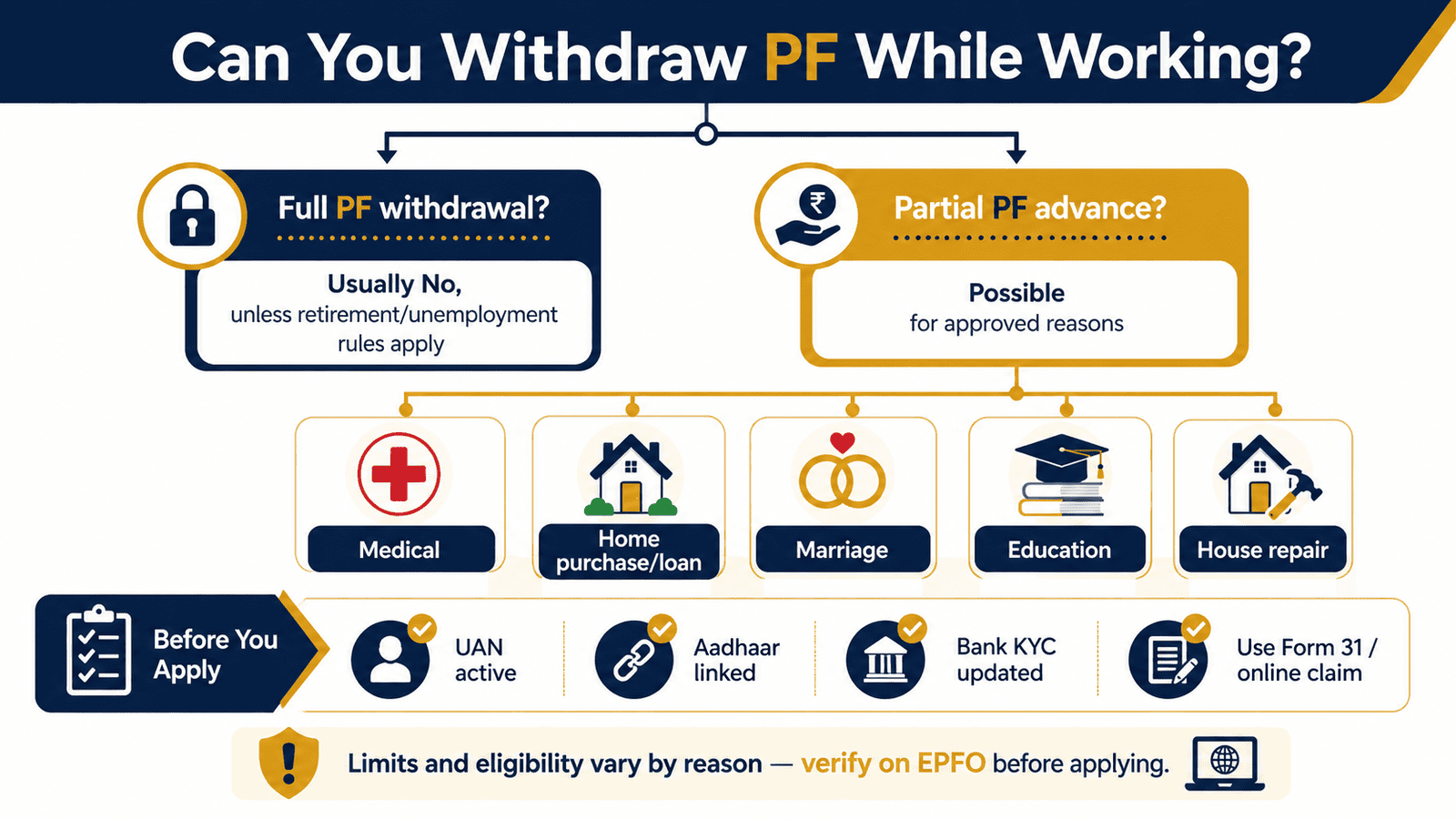
Here is the short version: you generally cannot fully withdraw your EPF balance while working at the same company. But EPFO does allow a partial PF advance — through Form 31 — for specific approved reasons such as a medical emergency, housing, marriage, or education.
The rules around eligible reasons, withdrawal limits, and service-period requirements are set by EPFO under the EPF Scheme 1952 and can change with policy updates. This guide explains the difference between full PF withdrawal and partial PF advance, when each applies, what Form 31 covers, and what to verify before you apply.
Quick Answer: Can I Withdraw PF While Working?
Can I withdraw PF while working? Usually, you cannot fully withdraw your EPF balance while employed, but you may take a partial PF advance for approved needs such as illness, education, marriage, housing, or special circumstances. Current EPFO reforms mention withdrawals up to 75% or eligible balance depending on category.
Key Takeaways
- Full PF withdrawal while working is generally not permitted — that option applies after you leave your job or retire, using Form 19.
- You may apply for a non-refundable PF advance through Form 31 while employed, but only if your reason qualifies under EPFO’s current approved categories.
- Eligible advance reasons include medical treatment, housing purchase or construction, home loan repayment, marriage, education, and natural calamity — each with its own limit and service-period requirement.
- Your UAN must be active, and your Aadhaar, PAN, and bank account must be KYC-verified before you can file an online PF advance claim without employer attestation.
- Withdrawing ₹1,00,000 from EPF today could cost you over ₹7,25,000 in lost retirement savings over 25 years at the current EPF interest rate — the real cost is compounding, not just the withdrawn amount.
- EPFO withdrawal limits, service-period conditions, and online claim rules can change — verify every figure at epfindia.gov.in before applying.
- PF advances are generally not taxable if conditions are met, but tax treatment depends on your total service period and claim type — always verify before submitting.
Key Facts at a Glance
| Aspect | Detail | What to Verify |
|---|---|---|
| Full PF withdrawal while working | Generally not permitted | Confirm current EPFO rules at epfindia.gov.in |
| Partial PF advance while working | Permitted for approved reasons only | Confirm eligible categories and current limits |
| Form used for advance | Form 31 / Composite Claim Form (Aadhaar) | Confirm current portal form labels |
| Common eligible reasons | Medical, housing, education, marriage, natural calamity | Confirm current category list with EPFO |
| Service-period requirement | Varies by reason — several categories require five or more years of contributions | Verify minimum service period for your category |
| Tax on PF advance | Generally not taxable if conditions are met | Verify at incometax.gov.in before applying |
| KYC requirement | UAN active, Aadhaar, PAN, bank account seeded | Check UAN Member Portal before submitting claim |
Can I Withdraw PF While Working? Understanding the EPFO Rules
Your EPF account is designed as a long-term retirement savings vehicle, not a salary top-up you can access freely. EPFO restricts withdrawals while you are employed specifically to protect your retirement savings from being eroded by short-term expenses. This is the core reason full withdrawal while working is generally blocked.
But EPFO also acknowledges that life throws genuine emergencies at you. That is why the EPF Scheme 1952 includes provisions for partial, non-refundable advances — money you can take from your EPF account for specific approved purposes without quitting your job. These are not loans. You do not repay them. They permanently reduce your balance and the compounding that comes with it.
Full Withdrawal vs Partial PF Advance: The Most Important Distinction
A full PF withdrawal means closing your EPF account and receiving the entire balance — your employee share, employer share, and accumulated interest. EPFO permits this only after you leave your employer and either retire or remain unemployed for a defined period. Filing Form 19 (final settlement) while you are still actively employed will result in rejection.
A partial PF advance — commonly called EPF advance or PF advance withdrawal — lets you withdraw a portion of your EPF balance while still working. The correct form for this is Form 31, also referred to as the Composite Claim Form (Aadhaar-based). This is the only withdrawal route legally available to a working employee under most circumstances.
For a clear foundation on how EPF works before diving into withdrawal rules, read our guide on EPF rules explained.
What Is Form 31 and How Does It Work?
Form 31 is the application form for EPF advances under the Employee Provident Fund Scheme 1952. It covers advances for medical treatment (Para 68J), marriage and education (Para 68K), housing, natural calamities, physical disability equipment, and other approved reasons.
Since EPFO integrated online claims through the UAN Member Portal and UMANG app, most working members can file Form 31 digitally using their Aadhaar-linked mobile OTP for authentication. Where your Aadhaar KYC is complete and your mobile is OTP-verified, no physical employer attestation is required. This has significantly reduced processing time for eligible claims.
Why EPFO Restricts Casual Withdrawals
The EPF Scheme 1952 treats your PF account as a social security instrument, not a current account. The entire framework — mandatory contributions, employer matching, tax incentives — exists to build a retirement corpus over your working life. Every rupee withdrawn early is a rupee that stops compounding for the next two or three decades.
According to EPFO guidelines and PIB announcements, EPFO has periodically revised withdrawal categories, simplified online claim processes, and adjusted advance limits to make genuine emergency access easier. However, the underlying principle remains unchanged: partial advances exist for real need, not for routine expenses.
Common Eligible Reasons for PF Advance While Working
EPFO recognises several categories under which a working employee can apply for a PF advance. The most widely used are:
- Medical treatment (Para 68J): Hospitalisation or major surgery for yourself or an immediate family member. This category generally has a lower service-period threshold than others.
- Marriage (Para 68K): Your own marriage, or the marriage of your children or siblings.
- Education (Para 68K): Post-matriculation education expenses for your children.
- Housing: Purchase, construction, or repair of a house or flat — and separately, home loan repayment. These are distinct sub-categories with different conditions.
- Natural calamity: If your area is officially declared affected, a special advance is available.
- Physical disability: Equipment purchase for a physically disabled member.
Each category carries a specific limit (expressed as a number of months’ basic wages or a percentage of your balance), a minimum service-period requirement, and documentation or self-declaration rules. These limits are set by EPFO and subject to change — verify the current conditions at epfindia.gov.in before you apply.
What You Need Before Filing an Online PF Advance Claim
To file an advance claim through the UAN Member Portal, you need all four of the following in place:
- An active UAN linked to your current employer
- Aadhaar seeded to your UAN with your mobile number OTP-verified
- PAN seeded in the UAN portal
- Bank account with IFSC code approved under KYC
Claims where any of these are incomplete are among the most common rejection reasons at EPFO. Verifying KYC before you need the money — not during the crisis — saves significant time and stress.
Real Example: Rohit’s Medical Emergency Decision
Rohit Sharma, 31, is a software engineer in Bengaluru earning ₹11 lakh per year. He has been contributing to EPF for six years and holds an illustrative EPF balance of approximately ₹4.8 lakh. He faces a ₹1.5 lakh medical expense for a family member and is wondering whether to dip into his PF.
Rohit’s first instinct — filing Form 19 to withdraw everything — would be rejected immediately. He is still employed. His correct route is Form 31 under Para 68J (illness advance), for which he needs to check the current eligible advance limit, confirm his UAN KYC is complete, and select the correct purpose code online.
Before he applies, Rohit should also run this number: the ₹1.5 lakh he withdraws today, left in EPF at an illustrative rate of 8.25% per annum for the 27 years remaining before he turns 58, would have grown to approximately ₹12.75 lakh. That is the real cost of the withdrawal — not ₹1.5 lakh, but nearly ₹12.75 lakh in lost future savings.
If Rohit’s health insurance covers the procedure, he should exhaust that first. If it does not, and the advance genuinely qualifies, he should withdraw only the amount required — not his full eligible ceiling. Use the EPF corpus calculator to estimate exactly how any withdrawal changes your long-term retirement projection.
How to Calculate the Long-Term Cost of a PF Withdrawal
Future Value = P × (1 + r)^n
Where: P = Amount withdrawn today | r = EPF interest rate per annum | n = Years remaining to retirement
Using an illustrative EPF interest rate of 8.25% per annum and ₹1,00,000 withdrawn today, here is what that amount could have grown to if left in your EPF account:
| Scenario | Key Inputs | Illustrative Future Value Lost |
|---|---|---|
| 10 years to retirement | ₹1,00,000 at 8.25% for 10 years | ₹2,21,000 |
| 20 years to retirement | ₹1,00,000 at 8.25% for 20 years | ₹4,88,000 |
| 25 years to retirement | ₹1,00,000 at 8.25% for 25 years | ₹7,25,000 |
These projections are illustrative only. The EPF interest rate is declared annually by the EPFO Central Board of Trustees and changes from year to year. This calculation assumes a constant rate and is not a guaranteed projection of any kind. Use the EPF corpus calculator on Ridhi.com to model your specific balance, contribution, and retirement timeline with verified figures.
Comparison: Partial PF Advance vs Full PF Withdrawal
| Parameter | Partial PF Advance (Form 31) — While Working | Full PF Withdrawal (Form 19) — After Leaving Job |
|---|---|---|
| When allowed | While employed, for EPFO-approved reasons only | After resignation, retirement, or defined unemployment period |
| Amount | Partial — capped by reason-specific limit | Full balance — employee share, employer share, and interest |
| EPS pension affected | No — EPS account continues | Yes — EPS withdrawn or scheme certificate issued |
| Tax risk | Generally nil if purpose conditions met | Taxable if total EPF service is under 5 years |
| Employer attestation | Not required for Aadhaar-KYC cases | Not required for Aadhaar-KYC cases |
| Retirement impact | Moderate — reduces compounding on withdrawn portion | Severe — entire corpus wiped if not reinvested |
If you are leaving your job and want to understand full withdrawal separately, read our detailed guide on after resignation rules — the eligibility conditions, forms, and tax treatment differ significantly from advances available while working.
How to Decide What’s Right for You
Your need is a genuine medical emergency and your health insurance does not cover the cost — THEN check whether a Para 68J illness advance under Form 31 is currently eligible for your situation, apply for only the amount required, and verify the current limit at epfindia.gov.in before submitting.
You need funds for a house purchase, construction, or home loan repayment and you have completed the required minimum years of EPF contributions — THEN a housing advance under Form 31 may be your most appropriate option after confirming the current service threshold and limit with EPFO.
The expense is for your child’s marriage or post-matriculation education and you meet the minimum service requirement under Para 68K — THEN apply through Form 31 with the correct purpose code and confirm the current advance ceiling at epfindia.gov.in.
You have an active emergency fund, a low-interest personal loan option, or a salary advance available from your employer — THEN exhaust these alternatives first before withdrawing from EPF; the long-term retirement cost of a PF advance is almost always higher than a short-term borrowing cost.
Your UAN is not yet activated or your Aadhaar, PAN, or bank KYC is incomplete — THEN complete your KYC before doing anything else. A claim submitted with incomplete KYC will be rejected. Read our guide on how to use your UAN to activate and verify all four KYC fields correctly.
Your reason is not covered under EPFO’s approved advance categories — THEN do not apply. A Form 31 claim for an ineligible purpose will be rejected, and repeated incorrect submissions can delay future legitimate claims. Explore alternative funding before touching your EPF.
Common Mistakes to Avoid
Filing Form 19 While Still Employed
Form 19 is the final PF settlement form — it is not for advances while working.
Submitting Form 19 while your employer record is active is one of the most frequent rejection triggers. EPFO verifies your employment status, and an active payroll record blocks a full-settlement claim immediately. This wastes weeks and leaves your emergency unresolved.
If you need money while employed, use Form 31 — not Form 19.
Selecting the Wrong Purpose Code Under Form 31
EPFO’s Form 31 has specific purpose codes — medical, housing, marriage, education, and others — each with different limits and service requirements.
Choosing an incorrect or generic purpose code mismatches your claim against EPFO’s eligibility matrix. A medical advance processed under a housing code, or vice versa, will be rejected. Getting this wrong costs you weeks of processing time.
Match your actual need to the correct EPFO purpose code before submitting. Cross-check the code description at epfindia.gov.in or through the UMANG app.
Applying Before KYC Is Verified
An online PF advance requires your UAN to be active and all four KYC fields — Aadhaar, PAN, bank account, mobile — to be seeded and approved.
Incomplete KYC is consistently among the top rejection reasons at EPFO. If your Aadhaar OTP fails or your bank account is pending verification, your claim is rejected regardless of how valid your reason is. Read our guide on claim rejection reasons to run a full pre-submission check.
Log into the UAN Member Portal and verify all KYC fields are marked approved before submitting any advance claim.
Ignoring the Minimum Service-Period Requirement
Most Form 31 advance categories require a minimum number of years of continuous EPF contributions before you can apply.
Para 68K advances for marriage and education typically require a minimum service period, and housing advances have their own threshold. Applying before you meet the requirement leads to automatic rejection — there is no partial approval or override.
Check the minimum service period for your specific advance category at epfindia.gov.in before you apply.
Assuming the Entire EPF Balance Is Freely Withdrawable
PF advances while working are capped — they are not an open draw on your full balance.
Limits are typically expressed as a specific number of months’ basic wages or a defined percentage of your employee contribution balance, varying by purpose category. Expecting to withdraw ₹4 lakh when you are eligible for ₹1.2 lakh under that category leads to confusion and last-minute plan changes.
Know the applicable advance ceiling for your category before you commit to EPF as your funding source.
Overlooking the Tax and Service-Period Interaction
PF advances for approved reasons are generally not treated as income for tax purposes. However, if your total PF service is under five years and you make certain types of withdrawals, tax liability can arise.
Not checking this can result in unexpected TDS deductions that reduce the amount you actually receive. Verify your tax position at incometax.gov.in and read our guide on withdrawal tax rules before applying.
When This May Not Be the Right Choice
A PF advance while working may not be the right decision in these situations:
- Non-urgent lifestyle expenses: A holiday, gadget upgrade, or optional home renovation does not meet EPFO’s eligibility criteria — and even if it did, the long-term retirement cost of breaking compounding far outweighs the short-term convenience.
- When insurance or an emergency fund already covers it: If a health insurance claim, vehicle insurance payout, or three-to-six-month emergency fund can cover the expense, withdrawing from EPF is financially wasteful. The compounding you lose is very difficult to rebuild.
- When total service is under five years and tax may apply: Certain withdrawals before completing five years of continuous service can have tax implications. If your service period is short, check your tax position at incometax.gov.in first — see our guide on withdrawal tax rules for a full breakdown before you act.
- When the retirement cost is disproportionate to the need: If you are under 35 and have over 20 years to retirement, even a ₹50,000 advance today can translate to a loss of ₹2–3.5 lakh in future corpus at current illustrative interest rates. The cost scales quickly with time.
If any of these apply to your situation, it may be worth exploring alternatives before committing.
Official Rules and Where to Verify
EPFO withdrawal rules, advance limits, service-period requirements, and online claim conditions are set under the Employee Provident Funds and Miscellaneous Provisions Act 1952. These change with Budget announcements, EPFO circulars, and Ministry of Labour notifications.
Rules, limits, and rates on this topic can change with each Budget or regulatory update. Always verify current figures directly from the official source before making any financial decision.
- EPFO Member Portal, claim tools, and FAQ — epfindia.gov.in
- Ministry of Labour and Employment — official circulars and policy notifications — labour.gov.in
- Press Information Bureau — recent reform and policy announcements — pib.gov.in
- Income Tax Department — tax treatment of PF withdrawals — incometax.gov.in
Expert Tips
- Build a separate emergency fund before you ever need to touch EPF. Three to six months of expenses in a liquid instrument — a high-yield savings account or liquid mutual fund — means a medical bill or urgent repair never forces a PF advance decision.
- Update your KYC before a crisis arrives. Log into the UAN Member Portal today and verify that your Aadhaar, PAN, and bank account are all marked approved. KYC updates take three to five working days — you do not want to discover a gap when you urgently need the money.
- Withdraw only the exact amount required, not your full eligible ceiling. If your advance limit is ₹1.5 lakh but you only need ₹70,000, withdraw ₹70,000. The remaining ₹80,000 keeps compounding for your retirement.
- Match your actual need to the correct purpose code precisely. EPFO’s purpose categories are specific. “General financial need” is not a code. Medical treatment, housing, marriage, and education each have defined conditions — pick the code that accurately reflects your claim or it will be rejected.
- Track your claim status after submission. Use the EPFO Claim Status portal at epfindia.gov.in or the UMANG app to monitor progress. If your claim is flagged or deficient, acting quickly can prevent further delay.
- Avoid repeated incorrect submissions. Filing for ineligible reasons not only results in rejection — it can slow down future legitimate claims due to manual review flags. Verify eligibility carefully before every application.
Frequently Asked Questions
Can I withdraw 100% of my PF balance while still working?
No. Full PF withdrawal while you are actively employed is generally not permitted by EPFO. Final settlement using Form 19 is available only after you leave your employer and meet the applicable conditions. The route available while working is a partial non-refundable advance through Form 31, capped by the relevant category limit.
Which form is used for PF advance while working?
Form 31 — also referred to as the Composite Claim Form (Aadhaar) — is the correct form for PF advances while employed. If your UAN is Aadhaar-linked and your mobile OTP is verified, you can file this entirely online through the UAN Member Portal without requiring employer attestation in most cases.
Can I withdraw PF for a medical emergency while working?
Yes. EPFO permits a PF advance for medical treatment under Para 68J of the EPF Scheme 1952, covering hospitalisation or major surgery for yourself or an immediate family member. The exact advance limit and any documentation requirements should be confirmed at epfindia.gov.in before applying, as these conditions are subject to change.
Can I withdraw PF for home loan repayment while employed?
Yes. EPFO allows a housing advance for home loan repayment, as well as for the purchase or construction of a house. This category has its own service-period requirement and limit, which are separate from the medical advance rules. Verify the current minimum contribution period and ceiling directly at epfindia.gov.in before applying.
Can I withdraw PF for my child’s marriage or education?
Yes. Para 68K of the EPF Scheme covers advances for the marriage of the member, their children, or siblings, and for post-matriculation education expenses for their children. A minimum service period is required — the current threshold should be confirmed at epfindia.gov.in before you file.
Is a PF advance taxable while I am still working?
PF advances taken for eligible purposes while working are generally not treated as taxable income. However, if your total EPF service is under five years or if certain conditions apply to your specific withdrawal type, tax liability may arise. Always verify your tax position at incometax.gov.in or with a qualified tax professional before submitting your claim.
What happens if I submit Form 19 while I am still employed?
Your claim will be rejected. Form 19 is the final PF settlement form and requires that you have left your employer. EPFO checks your active employment status, and a live payroll record triggers an automatic rejection. Use Form 31 for advances while working — not Form 19.
Can I withdraw only my employee share of PF while working?
PF advances under Form 31 are calculated based on the applicable advance category’s formula — typically a multiple of your monthly basic wages or a percentage of your employee contribution balance, depending on the reason. You do not separately select only your employee share; the limit is determined by the category you apply under.
How long does a PF advance claim take to settle?
Online advance claims with complete KYC, the correct purpose code, and no deficiencies generally settle faster than manual claims. The exact timeline depends on EPFO’s processing queue at the time of submission. Check the current settlement timeline at epfindia.gov.in or through the UMANG app, as EPFO periodically updates its processing standards.
What is the minimum service period required for a PF advance?
It varies by category. Medical advances under Para 68J generally have a lower or no minimum service threshold, while housing, marriage, and education advances typically require five or more years of contributions. Confirm the current minimum service requirement for your specific advance category at epfindia.gov.in before applying.
Final Verdict
The answer to whether you can withdraw PF while working depends on why you need the money and whether it qualifies under EPFO’s current approved advance categories. Full withdrawal while employed is generally not an option — but a partial PF advance through Form 31 is available for genuine, eligible needs such as medical treatment, housing, marriage, and education.
Before you apply, confirm your reason qualifies under the current EPFO rules, verify the advance limit and service-period requirement at epfindia.gov.in, ensure your KYC is complete, and calculate the long-term retirement cost of the withdrawal. Treat your EPF as a retirement safety net — not an emergency ATM. The compounding you protect today is very hard to rebuild tomorrow.
Always verify the latest rules from official sources or consult a qualified professional before making any financial decision.
This article is for educational purposes only and should not be treated as personalised financial, tax, investment, insurance, or legal advice. Tax rules, interest rates, regulatory limits, and product features can change with each Budget or policy update. Please verify current rules from official government sources or consult a qualified and registered professional before making any financial decision.

Raghav Menon writes about employment-linked retirement benefits in India, including EPF, PF, UAN, gratuity, EPS pension, EDLI, VPF, superannuation, and NPS-related salary benefits. His content is designed for employees who see deductions and benefit components in their salary structure but do not fully understand how those amounts work over time.
He covers practical topics such as EPF contribution, employer PF, employee PF, PF withdrawal rules, PF transfer after job change, UAN activation, PF balance checks, EPFO claim status, multiple PF account merging, EPF nomination, gratuity calculation, EPS pension eligibility, EDLI benefits, and tax treatment of PF withdrawals. His articles are useful for freshers, job switchers, employees planning resignation, and families thinking about retirement-linked savings.
Raghav’s writing is rule-focused, patient, and structured around common employee doubts. He aims to simplify official processes without overpromising outcomes. Since EPFO procedures, interest rates, withdrawal rules, contribution limits, and tax treatment may change, readers should verify current rules from EPFO, Income Tax Department, and relevant official sources.