

Your salary slip shows one number. Your offer letter shows another. Your Form 16 shows yet a third. And when TDS is deducted, the amount that lands in your bank account is something else entirely. If you are a salaried employee trying to understand which of these figures you actually pay income tax on — you are asking exactly the right question.
That figure is your taxable income. It is not your CTC, not your gross salary, and definitely not your take-home pay. Taxable income is the specific amount on which your income tax slab rate is applied — and it is lower than your gross salary because certain deductions and exemptions are subtracted first.
This article explains taxable income meaning in salary, walks through a step-by-step calculation, shows the difference between old and new tax regime treatment, and tells you exactly where to verify the number in your Form 16.
Quick Answer: Taxable Income Meaning
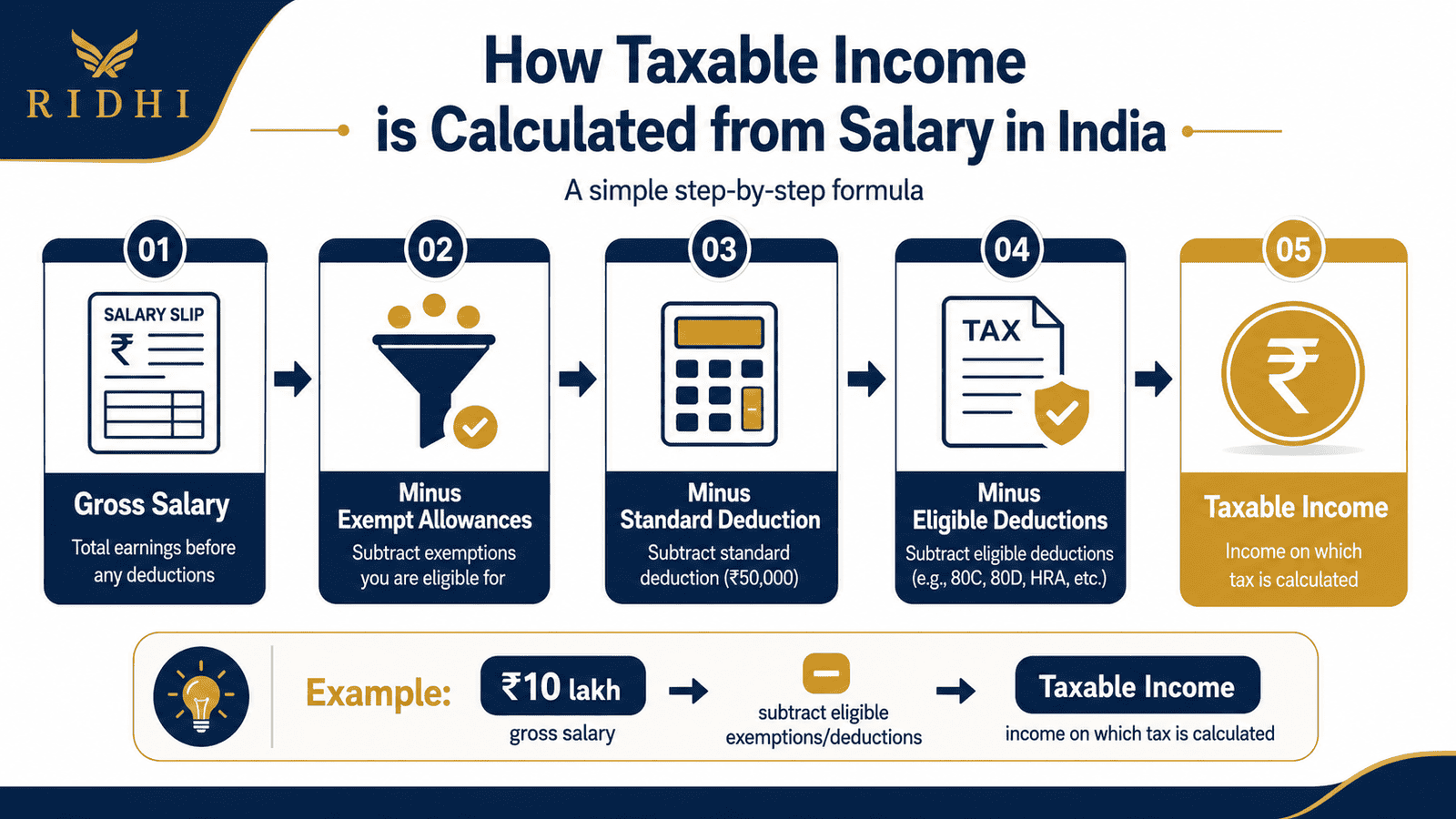
Taxable income meaning is the part of your salary that remains after subtracting eligible exemptions and deductions from gross salary. For example, a ₹10 lakh gross salary may become a lower taxable income after standard deduction, allowed deductions, and tax-regime rules are applied.
Key Takeaways
- Taxable income is not your CTC, gross salary, or take-home pay — it is the income figure your slab-rate tax is calculated on, after all eligible reductions.
- Every salaried employee in India is eligible for a standard deduction from salary income, which reduces gross salary before arriving at taxable income — verify the current amount at incometax.gov.in.
- Under the old tax regime, additional deductions under Chapter VI-A (such as Section 80C and Section 80D) can further reduce your taxable income; the new regime has a different deduction structure.
- Two employees with the same ₹10 lakh CTC can have different taxable incomes depending on their salary structure, HRA eligibility, and chosen tax regime.
- Form 16 Part B, issued by your employer after the financial year ends, shows your final computed taxable income and TDS deducted — always reconcile this with your salary slips.
- Use a salary tax calculator only after you understand what goes into the taxable income base — otherwise you may enter the wrong starting figure and get a misleading result.
Key Facts at a Glance
| Term | Meaning | Tax Relevance |
|---|---|---|
| CTC | Total annual cost to your employer, including PF contributions, gratuity, and benefits | Not taxable income — includes non-cash and deferred components |
| Gross Salary | Total salary received before any deductions or tax — typically your salary slip total before PF and TDS cuts | Starting point for taxable income calculation |
| Net / Take-Home Salary | Amount credited to your bank account after TDS, PF, and other deductions | Not the same as taxable income — TDS already removed here |
| Taxable Income | Gross salary minus exempt allowances, minus standard deduction, minus eligible deductions under chosen regime | This is what income tax slabs are applied to |
| TDS on Salary | Tax deducted at source by your employer each month, based on estimated annual taxable income | Advance tax payment — reconciled at year-end with actual liability |
For a detailed breakdown of how CTC, gross, and net salary differ, see our guide on salary versus CTC.
Taxable Income Meaning in Salary: The Full Breakdown
When your employer calculates TDS each month, they follow a specific sequence to arrive at your estimated taxable income for the year. Understanding that sequence is how you stop being confused by the numbers on your payslip.
Step 1 — Start with Gross Salary
Gross salary is your total salary package as received from your employer — before Employee Provident Fund (EPF) deductions, before TDS, and before any other cuts. It includes your basic pay, House Rent Allowance (HRA), special allowance, any performance bonus, and other components listed on your salary slip.
Your gross salary is the starting point, not the taxable figure. CTC is even higher than gross — it includes employer-side PF contributions and other cost items that never touch your salary slip. See your salary slip components to identify which items your employer counts in each figure.
Step 2 — Subtract Exempt Allowances (Where Applicable)
Certain allowances in your salary may be partially or fully exempt from tax, subject to conditions. The most common example is HRA. If you live in rented accommodation and receive HRA, a portion of it may be exempt under Section 10(13A) of the Income Tax Act — calculated based on your actual rent paid, basic salary, and city of residence. The exempt HRA amount is subtracted before arriving at taxable income.
Other exempt allowances can include Leave Travel Allowance (LTA) claimed within specified rules, children’s education allowance up to permitted limits, and transport allowances for specified categories of employees. Importantly, under the new tax regime, most of these exemptions are not available by default — the rules differ between regimes.
According to Income Tax Department guidelines at incometax.gov.in, each exemption has specific conditions and limits. Never assume an allowance is fully tax-free without checking the applicable section.
Step 3 — Apply Standard Deduction
Every salaried employee and pensioner in India is entitled to a standard deduction from salary income. This is a flat deduction — no proof of expenditure required — and is available under both the old and new tax regimes (verify current applicability and amount at incometax.gov.in before publishing).
The standard deduction reduces your gross salary figure before the income-tax calculation begins. It is one of the simplest and most widely applicable reductions for salaried employees. Our dedicated standard deduction guide explains exactly how it works and when it applies.
Step 4 — Apply Chapter VI-A Deductions (Old Regime) or Regime-Specific Rules (New Regime)
Under the old tax regime, you can further reduce taxable income by claiming deductions under Chapter VI-A of the Income Tax Act. The most well-known is Section 80C — covering investments in EPF, PPF, ELSS mutual funds, LIC premiums, and home loan principal repayment, up to a combined limit (verify the current limit at incometax.gov.in). Section 80D covers health insurance premiums. There are several other sub-sections covering NPS contributions, home loan interest, savings account interest, and more.
Under the new tax regime, most Chapter VI-A deductions are not available by default, though some exceptions apply. The new regime uses a different slab structure. Both regimes arrive at a taxable income figure — the difference is how many reductions are permitted before reaching it.
Step 5 — Taxable Income: The Final Figure
After the above reductions, what remains is your taxable income from salary. This is the number your employer uses to estimate TDS every month. It is also the number you enter when applying income tax slabs to calculate your final tax liability — before adding cess and checking for rebate eligibility under Section 87A.
In simple terms: Gross Salary − Exempt Allowances − Standard Deduction − Eligible Deductions = Taxable Income from Salary.
Real Example: Amit’s Salary in Pune
Amit is 29, a software engineer at a mid-sized IT company in Pune. His CTC is ₹12 lakh per year. After accounting for employer PF contribution and gratuity component in the CTC, his annual gross salary (the amount on his salary slip totalled across 12 months) comes to approximately ₹10 lakh.
Here is a simplified picture of how his taxable income is calculated:
Amit’s gross salary is ₹10,00,000. He lives in a rented flat and receives HRA. Based on his actual rent, basic salary, and Pune being a non-metro city for HRA purposes, a portion of his HRA qualifies for exemption — let us say ₹60,000 is exempt (this figure is illustrative; actual HRA exemption depends on individual calculations). After this, his salary income reduces to ₹9,40,000.
He then applies the standard deduction (verify current amount at incometax.gov.in). This further reduces his figure. Under the old regime, he also claims 80C deductions for his EPF contribution and a PPF investment, and an 80D deduction for a health insurance premium for himself and his parents.
After all these reductions, Amit’s taxable income from salary comes to an amount meaningfully lower than his ₹10 lakh gross. That reduced figure — not ₹10 lakh, not his CTC of ₹12 lakh, and not his monthly take-home — is what his income tax slab is applied to.
Amit’s employer calculates this estimated annual taxable income at the start of the financial year (usually April), divides the expected tax by 12, and deducts that amount as TDS each month. This is why your net salary is lower than you might expect — TDS is already removed. For more on how each salary component plays a role, see our guide on salary slip components.
How to Calculate Taxable Income from Salary
Taxable Income = Gross Salary − Exempt Allowances − Standard Deduction − Eligible Chapter VI-A Deductions (Old Regime) or Permitted Deductions (New Regime)
Follow these four steps every time:
Step 1 — Find your gross salary. Look at your salary slip total or Form 16 Part A. Do not use CTC. Do not use take-home. Gross salary is your actual received salary before EPF and TDS cuts.
Step 2 — Identify exempt components. Check which allowances in your salary qualify for exemption — HRA (if applicable), LTA (if claimed), and any other Section 10 exemptions your employer has applied. Your employer will have already computed these in Form 16 Part B.
Step 3 — Apply standard deduction. Subtract the standard deduction available for the relevant assessment year. Verify the current figure at incometax.gov.in before relying on any specific number.
Step 4 — Apply deductions based on your regime. If you are under the old regime, add up your qualifying 80C, 80D, and other deductions. If you are under the new regime, check which deductions remain applicable — the list is narrower. Subtract from the figure arrived at in Step 3.
The result is your taxable income from salary for the year. Use our salary tax calculator to estimate the tax on this figure — but always enter the correct taxable income base rather than CTC or gross salary.
| Scenario | Starting Point | Key Variable |
|---|---|---|
| No HRA, renting accommodation | Gross salary − standard deduction − 80C and 80D | HRA exemption not available; taxable income higher |
| HRA received, renting accommodation | Gross salary − HRA exempt portion − standard deduction − 80C and 80D | HRA exemption reduces taxable income meaningfully |
| New tax regime selected | Gross salary − standard deduction (if applicable under new regime) | Most Chapter VI-A deductions not available; taxable income higher but slabs differ |
Comparison: Old Regime vs New Regime — Taxable Income Treatment
| Parameter | Old Tax Regime | New Tax Regime |
|---|---|---|
| Standard Deduction | Available | Available (verify current rules) |
| HRA Exemption | Available if renting | Not available by default |
| Section 80C Deductions | Available up to limit | Not available |
| Section 80D (Health Insurance) | Available | Not available |
| LTA Exemption | Available if claimed | Not available |
| Tax Slabs | Higher rates at lower thresholds; benefit comes from deductions | Lower rates at each slab; benefit comes from simpler structure |
| Taxable Income for Same Gross | Can be significantly lower with full deductions claimed | Higher taxable income but offset by lower slab rates |
| Who it tends to benefit | Employees with high HRA, 80C investments, health insurance | Employees with few deductions or low exemption claims |
The right regime depends on your individual deductions and salary structure — not a general rule. See our detailed comparison of old and new regimes to run the numbers for your specific salary.
How to Decide What’s Right for You
You already have Form 16 from your employer for the completed financial year — THEN start there. Form 16 Part B shows your computed taxable income and the deductions your employer factored in.
You are in the middle of the financial year and want to plan TDS — THEN use your current salary slip to estimate gross salary, then subtract deductions you expect to claim by March 31.
Your 80C investments, HRA, and 80D premiums together exceed ₹3–4 lakh — THEN the old regime very likely produces a lower taxable income and lower tax despite higher slab rates at each level.
You have minimal deductions, no HRA claim, and a straightforward salary structure — THEN the new regime may give you a lower tax even with a higher taxable income base, because of its lower slab rates.
You receive HRA and pay rent — THEN calculate the HRA exemption correctly before comparing regimes; this single item can reduce old-regime taxable income by ₹60,000–₹1,50,000 or more, depending on salary and city.
You have changed jobs mid-year, have multiple Form 16s, or have income outside salary — THEN a basic salary-only calculation will not give you an accurate taxable income figure; consult a tax professional.
You should not use CTC or net take-home as your taxable income input in any tax calculator — doing so will produce a completely wrong estimate of your actual tax liability.
Common Mistakes to Avoid
Treating CTC as Taxable Income
CTC includes employer PF contribution, gratuity provision, and other cost items that are not part of your taxable salary.
If you enter ₹12 lakh CTC as taxable income in a calculator when your actual gross salary is ₹10 lakh, you will overestimate your tax by a significant margin and may make unnecessary investment decisions to reduce a tax liability that does not actually exist.
Always use gross salary from your salary slip or Form 16 Part A as the starting point.
Treating Take-Home Salary as Taxable Income
Your take-home (net salary) is already reduced by TDS, EPF deduction, and other cuts — it is not the pre-tax figure.
Using ₹6.5 lakh annual take-home when gross is ₹10 lakh will understate your taxable income and may lead you to under-report income in your ITR, which creates compliance risk.
Use gross salary as the base, then make the appropriate subtractions.
Ignoring Form 16 and Relying Only on Salary Slips
Monthly salary slips show individual components but may not reflect all year-end adjustments, bonus additions, or employer-computed exemptions.
Form 16 Part B gives you the employer’s final computed taxable income after all deductions — this is the authoritative figure. Never skip it when filing ITR.
Assuming Every Allowance Is Automatically Tax-Free
Many employees assume “allowances” are exempt from tax by default. They are not.
Only specific allowances with defined conditions under the Income Tax Act are exempt — HRA requires actual rent payment and receipts, LTA requires actual travel within India, and limits apply. If conditions are not met, the allowance is fully taxable. Assuming otherwise leads to underreporting and potential notices.
Applying Old-Regime Deductions When Under the New Regime
If you have opted for the new tax regime, most Chapter VI-A deductions — 80C, 80D, HRA exemption, LTA — are not available.
Employees who switch to the new regime but continue claiming these deductions in their ITR create a mismatch that the tax department can flag. Verify which deductions your chosen regime permits at incometax.gov.in.
Not Accounting for Mid-Year Salary Changes or Bonuses
A hike in July or a year-end bonus increases your annual gross salary — but TDS may have been calculated on the earlier, lower figure for months April to June.
This leads to a short-TDS situation where additional tax is due at filing. Reconcile your annual Form 16 against expected gross salary rather than assuming TDS deducted equals total tax payable.
When This May Not Be the Right Choice
A straightforward salary-to-taxable-income calculation works well if salary is your only income. It may not be sufficient if you have capital gains from mutual funds or stocks, rental income, freelance or consulting income in addition to salary, or foreign income or foreign assets. A single Form 16 calculation also falls short if you changed jobs during the financial year and received salary from two different employers — both will issue a Form 16, and the two need to be combined correctly. Similarly, if your AIS (Annual Information Statement) or Form 26AS shows income or TDS entries that do not match your Form 16, a simple salary calculation will produce an incorrect taxable income figure. Readers with high deductions, carried-forward losses, or outstanding tax notices should not rely on a single-source calculation.
If any of these apply to your situation, it may be worth exploring alternatives before committing.
Official Rules and Where to Verify
Income tax rules for salaried employees — including tax slabs, standard deduction amounts, deduction limits under 80C and 80D, rebate thresholds under Section 87A, surcharge rates, and health and education cess — can change with each Union Budget or subsequent amendment. Rules applicable for Assessment Year 2025-26 (Financial Year 2024-25) may differ from earlier or later years.
Rules, limits, and rates on this topic can change with each Budget or regulatory update. Always verify current figures directly from the official source before making any financial decision.
- Income Tax Department — incometax.gov.in (primary source for all tax slabs, deduction limits, and filing rules)
- Form 16 from your employer — verify the taxable income computed and TDS deducted for the year; learn how to read your Form 16
- AIS and Form 26AS — available at incometax.gov.in; cross-check TDS entries before filing ITR
Expert Tips
- Reconcile three documents, not one. Before filing ITR, compare your annual salary slips total, Form 16 Part B taxable income, and Form 26AS TDS credit. If all three match, you are in a strong position. If any two differ, investigate before filing.
- Do not copy last year’s regime choice blindly. If your salary increased significantly, your HRA changed, or you started or stopped a home loan, the break-even between old and new regime may have shifted. Recalculate each year before April.
- Claim HRA exemption correctly or not at all. Partial documentation is worse than no claim — if you claim HRA exemption without rent receipts and landlord PAN (where required), you create an audit risk that outweighs the tax saving.
- Inform your employer of your regime choice before the financial year begins. If you miss the window, your employer defaults to the new regime for TDS purposes — you can still choose the old regime when filing ITR (check current rules), but you may have underpaid TDS and owe interest.
- Do not use the calculator output as final tax — use it as a planning estimate. A calculator is only as accurate as the inputs you give it. Enter verified gross salary and confirmed deductions; do not enter CTC or approximate figures.
- If your 80C bucket is not full and you are in the 30% bracket, the last rupee into 80C (up to the limit) saves more tax than almost any other action before March 31. Verify the current 80C limit and applicable slab at incometax.gov.in.
Frequently Asked Questions
Is taxable income the same as gross salary?
No. Gross salary is your total salary before deductions. Taxable income is what remains after subtracting exempt allowances, standard deduction, and eligible deductions under your chosen tax regime. Taxable income is always lower than or equal to gross salary — never higher.
Is taxable income the same as take-home (net) salary?
No. Take-home salary is your gross salary minus TDS, EPF contribution, and other deductions — it is what hits your bank account. Taxable income is a pre-tax figure used to calculate the tax itself. The two are entirely different numbers and serve different purposes.
Where is taxable income shown in Form 16?
Form 16 Part B shows the computation of your taxable income from salary. It lists your gross salary, then subtracts exempt allowances, standard deduction, and Chapter VI-A deductions (if old regime) to arrive at the final taxable income figure. This is the number your employer used to compute TDS for the year.
How is taxable income calculated from salary step by step?
Start with gross salary. Subtract exempt allowances (such as HRA, if eligible). Subtract standard deduction. Subtract eligible deductions under your chosen regime (80C, 80D, etc. if old regime). The result is your taxable income from salary, before applying slab rates, cess, and rebates.
Does choosing the new tax regime change taxable income?
Yes. Under the new regime, most exemptions and Chapter VI-A deductions are not available, so your taxable income base is generally higher than under the old regime for the same gross salary. However, the new regime has lower slab rates — so whether your final tax is higher or lower depends on the combined effect, not taxable income alone.
Can taxable income be lower than gross salary?
Yes — and it almost always is for salaried employees. Standard deduction, HRA exemption (where applicable), and Chapter VI-A deductions under the old regime can together reduce taxable income meaningfully below gross salary. The extent of reduction depends on your salary structure and the deductions you are eligible for.
What happens if I do not submit investment declarations to my employer?
Your employer will compute TDS without factoring in your deductions, resulting in higher TDS being deducted each month. You can still claim these deductions when filing your ITR and receive a TDS refund — but you will have paid more tax upfront than required throughout the year.
Is bonus included in taxable income from salary?
Yes. Annual performance bonus, joining bonus, and other salary-related bonuses received from your employer are part of your gross salary and are included in taxable income. They are not exempt unless a specific section of the Income Tax Act applies. Check Form 16 Part B — your employer will have included bonus in the gross salary figure.
Can I calculate taxable income from salary myself without Form 16?
Yes, for estimation purposes. Use your salary slips to total gross salary for the year, then apply the deductions you expect to claim. However, Form 16 Part B is the authoritative document issued by your employer after year-end — always use it to verify your final taxable income before filing ITR.
Final Verdict
Taxable income meaning in salary is straightforward once you separate it from the other numbers on your payslip. It is your gross salary reduced by eligible exemptions, standard deduction, and applicable deductions under your chosen tax regime — and it is the base on which income tax slabs are applied, not the final tax amount itself.
For most salaried employees in India, the practical journey to finding this number runs through three documents: your salary slip (for gross salary), your investment declarations (for eligible deductions), and Form 16 Part B (for your employer’s final computation). Getting this base figure right is the most important step in accurate tax planning.
The correct taxable income depends on your salary structure, which deductions you qualify for, and which regime you choose — there is no universal shortcut. Use our salary tax calculator to estimate tax once you have the right taxable income base in hand. Always verify the latest rules from official sources or consult a qualified professional before making any financial decision.
This article is for educational purposes only and should not be treated as personalised financial, tax, investment, insurance, or legal advice. Tax rules, interest rates, regulatory limits, and product features can change with each Budget or policy update. Please verify current rules from official government sources or consult a qualified and registered professional before making any financial decision.

Kavita Mehra writes and edits Ridhi.com’s income tax content for Indian taxpayers, with a special focus on salaried employees and beginners who find tax rules confusing. Her work explains complex tax topics in simple language, helping readers understand how income, deductions, exemptions, rebates, TDS, Form 16, ITR filing, and refunds connect in real life.
She covers topics such as old vs new tax regime, income tax slabs, standard deduction, Section 87A rebate, HRA exemption, 80C, 80D, 80E, 80G, TDS on salary, taxable income, Form 16, AIS, Form 26AS, advance tax, and ITR filing checklists. Her content aims to help readers become more informed before filing returns or discussing tax matters with a professional.
Kavita’s approach is careful, compliance-focused, and official-source oriented. Because Indian tax rules can change after Budgets, circulars, and policy updates, her articles encourage readers to verify current figures, filing deadlines, and rules from the Income Tax Department or a qualified tax professional before acting.