

You are repaying a home loan every month — but your EMI is doing two things at once. Part of it is paying off the principal you borrowed. The rest is paying the bank’s interest. The Indian Income Tax Act treats both differently, and if you are on the old tax regime, both may reduce your taxable income.
Section 24B covers the interest component. Section 80C covers the principal repayment. But the actual home loan tax benefit you can claim depends on several factors that trip up even experienced borrowers: which tax regime you are on, whether your property is self-occupied or rented out, whether possession has happened, and what documents your lender has given you.
This article explains how each deduction works, what the current limits are, when you cannot claim them, and exactly what to do before you file your return. This is for educational purposes only — not personalised tax advice.
Quick Answer: Home Loan Tax Benefit
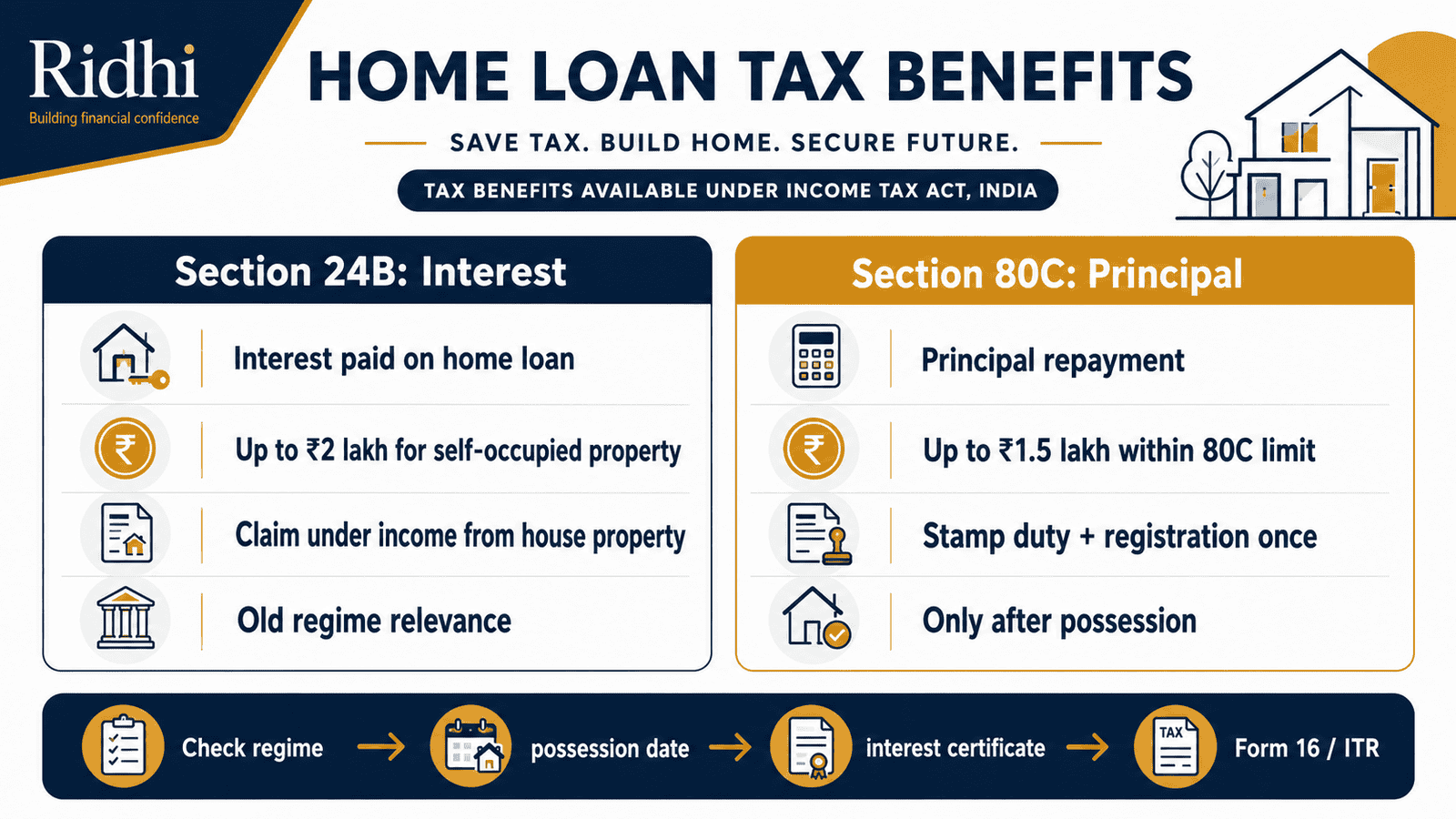
Home loan tax benefit in India mainly comes from Section 24B for interest and Section 80C for principal repayment. For a self-occupied house, interest deduction can go up to ₹2 lakh, while principal repayment fits within the ₹1.5 lakh 80C limit, usually under the old tax regime.
Key Takeaways
- Section 24B allows a deduction on home loan interest — up to ₹2 lakh per year for a self-occupied property under the old tax regime.
- Section 80C allows a deduction on home loan principal repayment within the overall ₹1.5 lakh annual cap shared with EPF, PPF, ELSS, LIC premiums, and other eligible investments.
- Stamp duty and registration charges paid for a residential property may also qualify under Section 80C in the year of payment, subject to conditions and the same ₹1.5 lakh cap.
- Under the new tax regime, Section 24B and Section 80C deductions are generally not available — making old regime more valuable for borrowers with large interest outgo.
- Possession timing matters: for an under-construction property, Section 24B interest benefit is typically deferred until possession, after which it may be claimed in five equal instalments in addition to the current year’s interest.
- Co-borrowers who are also co-owners may each claim deductions up to the respective limits — but ownership share and actual EMI contribution both need to be documented.
Key Facts at a Glance
| Deduction | What It Covers | Key Details |
|---|---|---|
| Section 24B | Home loan interest | Up to ₹2 lakh/year for self-occupied; no upper cap for let-out property (subject to overall loss set-off rules); old regime only for self-occupied benefit |
| Section 80C | Home loan principal repayment | Within the overall ₹1.5 lakh 80C cap; property must not be sold within 5 years of possession |
| Section 80C — Stamp Duty | Stamp duty and registration charges | Claimable in the year of payment; within the same ₹1.5 lakh 80C cap |
| Under-construction interest | Pre-possession interest paid | Cannot be claimed in the year paid; deferred and typically claimable in 5 equal instalments from year of possession |
| New tax regime | Both sections above | Generally not available under the new tax regime — verify current rules at incometax.gov.in |
| Joint borrower | Both interest and principal | Each co-owner and co-borrower may claim up to their share, subject to eligibility |
How Home Loan Tax Benefit Works in India
Every home loan EMI has two parts: interest and principal. Both parts can reduce your taxable income — but under entirely separate provisions of the Income Tax Act, and only if you are on the old tax regime.
Section 24B: Interest Deduction Under Income from House Property
Section 24(b) of the Income Tax Act falls under the head “Income from House Property.” When you own a residential property with a home loan, you can deduct the interest paid on that loan from your income.
For a self-occupied property, this deduction is currently capped at ₹2 lakh per financial year. The property must be acquired or constructed within five years from the end of the financial year in which the loan was taken — otherwise the cap drops significantly.
For a let-out property (one you rent out), there is no fixed upper cap on interest deduction under Section 24B. However, if the deduction creates a loss under the house property head, the amount that can be set off against other income in the same year is capped. The remaining loss can be carried forward.
According to the Income Tax Department (incometax.gov.in), deductions under Section 24 are claimed when you file your Income Tax Return, or through Form 12BB submitted to your employer during the financial year to adjust TDS.
If you want to know whether the old tax regime or new regime results in lower tax for your specific salary and loan situation, compare both options using the tax regime comparison guide before making any decision.
Section 80C: Principal Repayment Deduction
The principal component of your EMI qualifies for deduction under Section 80C of the Income Tax Act. This is the same section that covers EPF contributions, PPF deposits, ELSS mutual funds, LIC premiums, and tuition fees — and they all share a single ceiling of ₹1.5 lakh per year.
This matters because many salaried employees already use most of their ₹1.5 lakh limit through EPF alone. If your annual EPF contribution is already ₹80,000 and you invest ₹50,000 in ELSS, only ₹20,000 of your principal repayment will reduce your taxable income — even if you repaid ₹2 lakh of principal during the year.
To understand how principal competes with every other 80C option, read the 80C deduction options guide which covers the full list and how to prioritise when the cap is shared.
Old Tax Regime vs New Tax Regime
This is the most important factor many borrowers overlook. Under the new tax regime (the default regime from FY 2023-24 onwards), most deductions including Section 24B for self-occupied property and Section 80C are not available. If you opt for the new regime, your home loan interest and principal repayment generally do not reduce your taxable income.
This changes the home loan tax benefit calculation entirely. A borrower paying ₹1.8 lakh in annual interest may save ₹54,000 in tax under the old regime if they are in the 30% bracket — but save nothing on that component under the new regime.
Stamp Duty and Registration Under 80C
The stamp duty and registration fees paid when you register a residential property are also eligible for deduction under Section 80C, in the year of payment. These amounts count toward the same ₹1.5 lakh cap. If you paid ₹2.5 lakh in stamp duty and registration, you can still claim only up to ₹1.5 lakh across all 80C items combined for that year.
Real Example: Rohit’s First Flat in Bengaluru
Rohit Sharma, 35, is a product manager in Bengaluru earning ₹28 lakh per year. He bought a ₹90 lakh apartment in FY 2024-25, took a ₹72 lakh home loan at approximately 8.75% for 20 years, and got possession in September 2024. His annual EMI outgo is roughly ₹7.6 lakh.
His lender’s interest certificate shows he paid approximately ₹6.2 lakh in interest and repaid approximately ₹1.4 lakh in principal during FY 2024-25. Under Section 24B, he can claim a maximum of ₹2 lakh on interest (not the full ₹6.2 lakh) if he is on the old regime. Under Section 80C, he can claim up to ₹1.5 lakh across all eligible investments — but his EPF already accounts for ₹1.1 lakh. So only ₹40,000 of his ₹1.4 lakh principal repayment can be added to 80C.
Combined, Rohit’s maximum home loan-linked deduction is approximately ₹2.4 lakh under the old regime. At a 30% tax bracket, this could reduce his tax outgo by roughly ₹72,000 — but this is an illustrative calculation only. His actual benefit depends on his full income, all deductions, and the rules applicable to his assessment year. He should check whether the old regime still results in lower total tax before filing. See the full picture of what competes with principal in the 80C deduction options guide.
How to Calculate Your Home Loan Tax Benefit
Tax Saved = (Section 24B Eligible Interest + Section 80C Eligible Principal) × Your Income Tax Slab Rate
Use these five steps before you file:
Step 1: Download the annual interest certificate from your lender’s portal. This shows total interest paid and total principal repaid for the financial year.
Step 2: Check the interest amount against the Section 24B cap (₹2 lakh for self-occupied). Your eligible deduction is the lower of what you actually paid or the cap.
Step 3: Check how much of your ₹1.5 lakh 80C limit is already used by EPF, PPF, ELSS, or other investments. Only the remaining space can be filled by principal repayment.
Step 4: Compare your taxable income under both regimes — with these deductions under old regime vs the standard deduction and lower slab rates under new regime. The result may surprise you.
Step 5: Use the income tax calculator to estimate your actual tax under both regimes before selecting one.
Illustrative Calculation for Rohit
| Scenario | Key Inputs | Indicative Result |
|---|---|---|
| Old regime with home loan deductions | ₹2L 24B + ₹40K 80C (net of EPF space) | Taxable income reduced by ~₹2.4 lakh vs gross salary |
| New regime (no home loan deductions) | Standard deduction of ₹75,000 only | No benefit from home loan interest or principal |
| Old regime without maximising 80C | Only ₹2L 24B claimed, 80C at ₹1.1L EPF | ₹40K of 80C cap unused by principal repayment |
These figures are illustrative. Use the income tax calculator with your actual numbers and consult a tax professional before filing.
Comparison: Section 24B vs Section 80C vs Other Scenarios
| Parameter | Section 24B (Interest) | Section 80C (Principal) |
|---|---|---|
| What it covers | Home loan interest paid | Home loan principal repaid |
| Annual limit | ₹2 lakh (self-occupied) | Within overall ₹1.5 lakh 80C cap |
| Let-out property | Yes — no fixed cap | Yes — within cap |
| Under-construction property | Deferred to possession | Not available pre-possession |
| Available under new regime | Generally No | Generally No |
| Shared cap with other investments | Separate cap | Shared with EPF, PPF, ELSS |
| 5-year sale restriction | No | Yes — deductions reversed if sold |
| Joint borrower benefit | Each co-owner may claim | Each co-owner may claim |
How to Decide What’s Right for You
Your interest outgo on a self-occupied home is close to ₹2 lakh or above — THEN the old tax regime is likely worth comparing seriously, because Section 24B alone can reduce your taxable income by up to ₹2 lakh.
Your ₹1.5 lakh 80C limit is already fully used by EPF, PPF, and ELSS — THEN your principal repayment gives no additional 80C deduction, and the tax benefit from your loan is only the Section 24B interest part.
You have not yet received possession of the property — THEN you cannot claim Section 24B interest or 80C principal in the years before possession. Review the home loan process guide to understand when your claiming window opens.
You are a co-borrower but not a co-owner of the property — THEN you generally cannot claim the deduction. Both co-ownership and co-borrower status are required for each person to be eligible.
The property is let-out and generating rental income — THEN Section 24B interest deduction has no fixed upper cap, but the total loss from house property that can be set off against other income in a year may still be limited under current rules.
You are not planning to hold the property for more than five years from possession — THEN claiming 80C principal deductions may backfire: if you sell within five years, the deductions already claimed can be reversed and added back to your income in the year of sale.
After running both regime calculations, the new tax regime still results in lower tax — THEN choose the new regime. Do not stay on old regime only for the home loan deductions if the overall tax outgo is higher.
Common Mistakes to Avoid
Claiming Principal Without Checking the 80C Cap
Many borrowers assume their full principal repayment is deductible. It is not — it competes with every other 80C investment. If your EPF, PPF, and insurance premiums already total ₹1.5 lakh, your principal repayment adds nothing to your deduction. Check the cap before assuming savings.
Instead: calculate your actual remaining 80C headroom each April and then see how much of your principal repayment can fill it.
Claiming Section 24B Before Possession
Borrowers with under-construction properties sometimes claim interest deduction in the years before possession — this is not allowed for standard Section 24B claims. Pre-possession interest is typically only available as a deferred deduction in five equal instalments from the year of possession. Wrongly claiming it in earlier years can lead to tax notices. See how possession timing affects your deductions in the under-construction property tax guide.
Instead: collect the total pre-construction interest from your lender, divide by five, and add one-fifth to your Section 24B claim each year starting from the year of possession.
Ignoring the Old vs New Regime Decision
Filing under the new regime automatically without comparing both options is one of the most common and costly mistakes salaried employees make. If you are in the 30% bracket and paying ₹1.8 lakh in interest, the old regime could save you ₹54,000 more in tax — which the new regime’s lower slab rates may or may not compensate for. Calculate before you commit.
Instead: run both regimes in a tax calculator using your full salary, deductions, and loan figures before submitting Form 12BB to your employer or filing your ITR.
Assuming Co-Borrower Status Alone Gives You the Deduction
If your spouse is a co-borrower but not a co-owner of the property, they cannot claim Section 24B or 80C deductions on the home loan. Both ownership and borrower status are generally required. Many couples miss this and overclaim — which can trigger scrutiny during assessment.
Instead: ensure both partners are listed as co-owners in the sale deed if you want both to benefit from the deductions.
Not Matching the Lender Certificate with Form 16
Your employer adjusts TDS based on the investment declaration you submit. If you claimed ₹2 lakh interest deduction in your declaration but your actual interest certificate shows only ₹1.6 lakh, your final ITR will mismatch — and if TDS was under-deducted, you will owe tax at filing with potential interest under Section 234B/234C.
Instead: use the actual provisional certificate from your lender for Form 12BB in Q1, and update with the final certificate before March.
Selling the Property Within 5 Years of Possession
If you sell the home within five years of taking possession, the Section 80C deductions (principal repayment) claimed in all previous years are reversed — added back to your income in the year of sale. On a ₹1.5 lakh annual claim over four years, that is ₹6 lakh added back in a single year, potentially pushing you into a higher bracket.
Instead: factor this reversal risk into any decision to sell early, especially in a rising property market where capital gains and reversal together create a large tax event.
When This May Not Be the Right Choice
If the new tax regime results in lower total tax for your salary structure, home loan deductions under Section 24B and 80C are generally not available — and chasing those deductions by switching to the old regime could cost you more overall.
If your ₹1.5 lakh 80C cap is already filled by mandatory EPF and other commitments, the principal repayment portion of your EMI offers no additional tax benefit — making the 80C argument for borrowing less relevant.
If the property is under construction, your Section 24B and 80C benefits are delayed. If cash flow is tight, the tax benefit in future years does not offset the EMI burden today. According to RBI guidelines, total EMI obligations should ideally not exceed 40–50% of net monthly income — borrowing more than you can service comfortably, purely for a future tax benefit, is not prudent.
If any of these apply to your situation, it may be worth exploring alternatives before committing.
Official Rules and Where to Verify
Home loan tax deduction rules — including limits, eligibility conditions, regime applicability, and possession-based timing rules — can change with each Union Budget or Finance Act amendment. The figures mentioned in this article reflect rules as understood at the time of writing and should be independently verified before you file.
- Income Tax Department — incometax.gov.in (for deduction limits, ITR filing, Form 12BB, AIS, and Form 26AS)
- Reserve Bank of India — rbi.org.in (for home loan regulations, lender guidelines)
- Your lender’s official portal — for your annual interest certificate, principal repayment schedule, and provisional certificate
Rules, limits, and rates on this topic can change with each Budget or regulatory update. Always verify current figures directly from the official source before making any financial decision.
Expert Tips
- Download your provisional interest certificate from your lender in April or May and use it for your Form 12BB submission to your employer — this ensures your TDS is adjusted from the start of the financial year, not just the last quarter.
- Update your declaration with the final annual interest certificate before March to avoid any TDS shortfall. Most lenders release the final certificate between January and March for the current financial year.
- Before deciding between old and new regime, compute your tax both ways including all deductions — Standard Deduction, HRA, Section 80C, and Section 24B together. A ₹28 lakh salary with a ₹2 lakh interest deduction and full 80C does not automatically make old regime better; run the numbers.
- Keep four documents in one folder: possession letter, registered sale deed, loan sanction letter, and annual repayment certificate. These are the four documents most likely to be asked for in an ITR scrutiny related to home loan deductions.
- For joint home loans, verify the ownership split in the sale deed and ensure each co-owner’s share of EMI is clearly documented. Claiming equal deductions in an unequal ownership structure is a common red flag. Understand how co-borrower rules work in the joint loan tax rules guide before filing.
- If you paid stamp duty and registration in the same financial year as possession, claim it under 80C in that year only — it cannot be carried forward to a later year even if the 80C cap is exhausted.
- If your interest in the early years of a high-value loan significantly exceeds ₹2 lakh — say ₹4.5 lakh on a ₹60 lakh loan — consider whether the uncapped let-out property treatment (by renting the property) or simply accepting the cap and investing the difference makes more financial sense.
Frequently Asked Questions
Can I claim both Section 24B and Section 80C on the same home loan?
Yes. Section 24B covers interest paid on the loan, and Section 80C covers principal repaid — they are separate deductions under separate sections of the Income Tax Act. You can claim both in the same financial year, provided you are on the old tax regime and all eligibility conditions are met.
Is home loan tax benefit available under the new tax regime?
Generally, no. Under the new tax regime, deductions under Section 24B (for self-occupied property) and Section 80C are not available. If you opt for the new tax regime, your home loan interest and principal repayment will not reduce your taxable income. Verify the current rules at incometax.gov.in before filing.
Can I claim Section 24B interest before getting possession of the property?
No — you cannot claim the annual interest deduction under Section 24B before possession. Interest paid during the construction phase (pre-construction interest) is accumulated and then claimed in five equal instalments from the year of possession, subject to the ₹2 lakh annual cap.
Can stamp duty and registration charges be claimed under Section 80C?
Yes, subject to conditions. Stamp duty and registration fees paid for a residential property are eligible under Section 80C in the year of payment. They count toward the same ₹1.5 lakh overall cap. This benefit is not available for commercial property.
Can both husband and wife claim home loan deduction on the same property?
Yes, if both are co-owners and co-borrowers, and both are actively repaying the loan. Each may claim Section 24B and 80C deductions up to their eligible limits based on ownership share and actual EMI contribution. Only being a co-borrower without co-ownership is generally not sufficient.
What documents do I need to claim home loan tax benefit?
You need: (1) annual interest certificate from your lender showing interest paid and principal repaid, (2) possession letter, (3) registered sale deed or allotment letter, (4) loan sanction letter, and (5) Form 12BB submitted to employer if claiming TDS adjustment through payroll. For pre-construction interest, you also need the total pre-EMI interest statement from your lender.
What happens if I sell my home within 5 years of possession?
If you sell the property within five years of possession, all Section 80C deductions claimed for principal repayment in previous years are reversed. The total amount previously deducted is added back to your income in the year of sale and taxed at the applicable slab rate. Section 24B interest deductions are not reversed on sale.
Is there a deduction available for a second home loan?
Yes. For a let-out or deemed let-out second property, Section 24B interest deduction has no fixed upper cap. However, the total loss from house property that can be set off against other income in a year is currently capped. Carry-forward rules apply for unabsorbed losses. Verify the current set-off limit at incometax.gov.in.
Can I claim Section 80C deduction on a top-up loan used for home renovation?
Generally, no. Section 80C principal deduction is specific to the home loan taken for acquiring or constructing a residential property. A top-up loan used for renovation typically does not qualify for 80C. However, interest on a top-up loan may qualify under Section 24B if the funds are used for house property — verify the exact usage conditions with a tax professional.
Final Verdict
Home loan tax benefit can meaningfully reduce your taxable income — but only under the old tax regime, and only if you meet the eligibility conditions around possession, ownership, and the 80C cap. Section 24B handles the interest side with its own limit, and Section 80C handles principal repayment within a shared annual ceiling that most salaried employees are already filling through EPF and other investments.
The benefit should not be the primary reason you take a loan or stay on the old tax regime. Run both regime calculations with your actual numbers, using the income tax calculator, before deciding. The numbers — not assumptions — should guide the choice.
Always verify the latest rules from official sources or consult a qualified professional before making any financial decision.
This article is for educational purposes only and should not be treated as personalised financial, tax, investment, insurance, or legal advice. Tax rules, interest rates, regulatory limits, and product features can change with each Budget or policy update. Please verify current rules from official government sources or consult a qualified and registered professional before making any financial decision.

Neha Kulkarni writes about the financial side of home buying, renting, property decisions, and real estate costs in India. Her content helps readers think beyond the EMI and understand the total cost of owning or buying a home.
She covers topics such as rent vs buy, home loan planning, down payment, stamp duty, registration charges, brokerage, maintenance cost, property tax, furnishing cost, home insurance, builder payment plans, resale property checks, home loan affordability, total cost of ownership, and hidden costs in property decisions.
Neha’s writing is practical, family-focused, and cost-conscious. She uses Indian city examples, ₹ calculations, and decision checklists to help readers evaluate whether a property decision fits their income, savings, loan eligibility, and long-term plans. Her articles are useful for first-time home buyers, salaried couples, families, and people comparing rent with home ownership. Since property rules, stamp duty, registration charges, local taxes, home loan rates, and legal requirements vary by state and city, readers should verify current details from official state, lender, and legal sources.