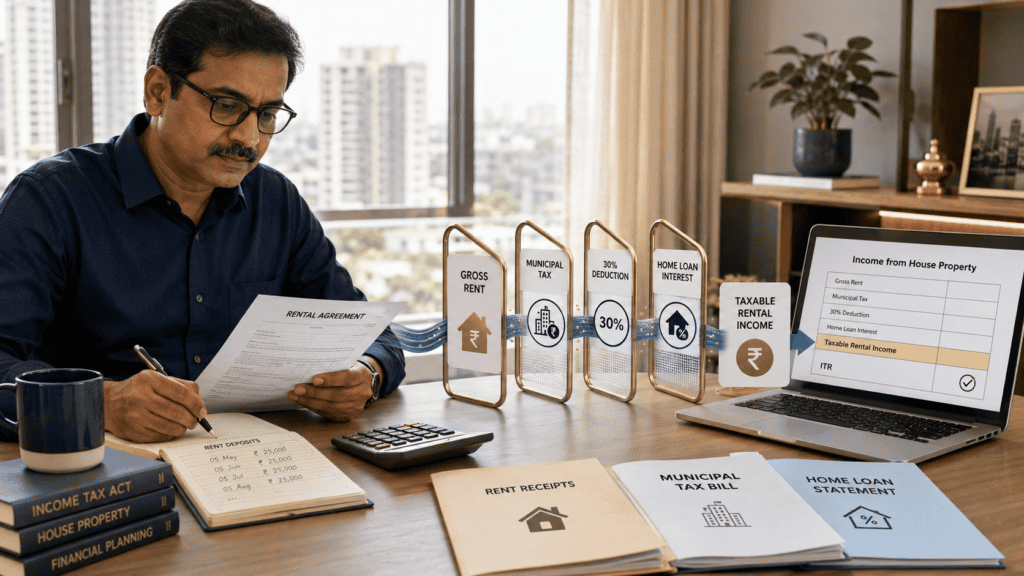

You have found two apartments in the same Bengaluru locality. One is ready to move in and priced at ₹1.1 crore. The other, under construction, is available at ₹90 lakh with possession promised in 22 months. The under construction vs ready to move property question isn’t really about which one looks better on a brochure — it is about GST you will or will not pay, Section 24(b) deductions you can or cannot claim this year, RERA risk you may or may not be taking, and 22 months of rent you may still owe while paying an EMI.
Most buyers compare only the listed prices and pick the cheaper one. That approach misses several costs that are real, measurable, and large. This article works through every dimension — price, GST, tax benefit timing, cash flow, RERA protection, possession documents — so you can make the comparison on full numbers, not just sticker prices.
If you have not yet decided whether buying is the right move at all, start with our rent or buy decision guide before going further. It may save you an even bigger decision first.
Quick Answer: Under Construction vs Ready to Move Property
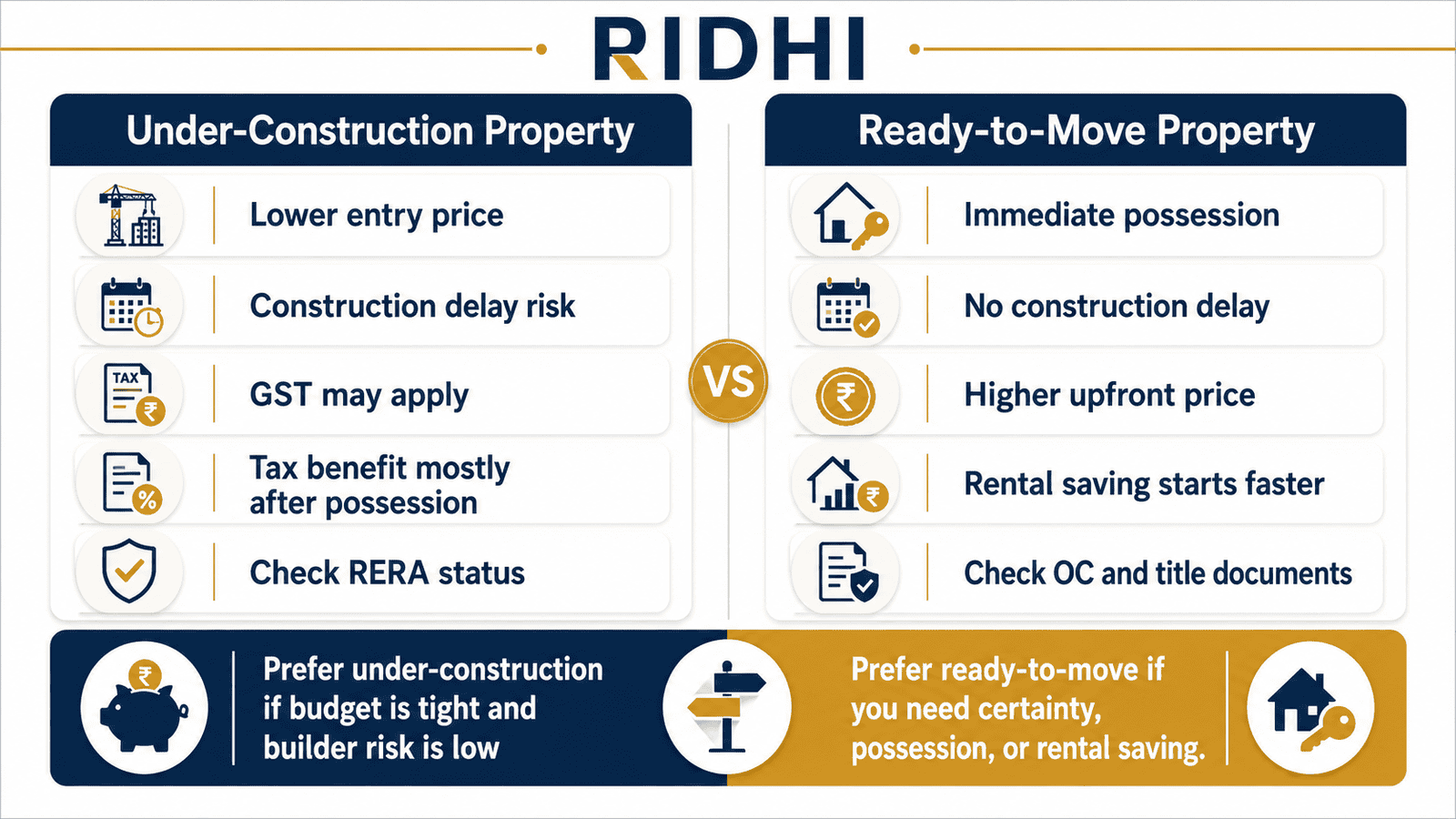
Under construction vs ready to move property depends on price, possession timing, GST, RERA risk and tax benefit timing. Under-construction homes may cost less but carry delay risk, while ready homes offer immediate use. Home loan interest deduction can be up to ₹2 lakh subject to conditions.
Key Takeaways
- Under-construction properties are typically priced 10–25% lower than ready-to-move units in the same locality — but GST, delayed possession, and dual rent-plus-EMI pressure can close most of that gap.
- GST applies only to under-construction property: 5% for regular projects and 1% for affordable housing (carpet area ≤60 sqm, agreement value ≤₹45 lakh). Ready-to-move homes with a valid Occupancy Certificate attract no GST.
- Section 24(b) home loan interest deduction of up to ₹2 lakh per year on self-occupied property starts only from the financial year of possession — under-construction buyers cannot claim this during the build period.
- Pre-construction interest paid during the build period is deductible — but divided equally over 5 financial years starting the year of possession, not claimed as a lump sum.
- Section 80C principal repayment deduction of up to ₹1.5 lakh per year is also available only after possession, even if you have been paying EMIs for two years during construction.
- Always verify an under-construction project’s RERA registration number on the state portal before paying even the booking amount — an unregistered project offers you almost no legal protection.
- If you are currently renting at ₹25,000–₹35,000/month, buying under-construction means running rent and EMI simultaneously for 20–36 months — a cash-flow drain that must be modelled before deciding.
Comparison: Under-Construction vs Ready-to-Move Property
| Parameter | Under-Construction | Ready to Move |
|---|---|---|
| Typical price | 10–25% below ready-to-move units in same area | Market rate; no discount for wait |
| GST | Applicable — 5% regular / 1% affordable | Nil — no GST if OC obtained |
| Section 24(b) interest deduction | Starts only from year of possession | Starts from year of purchase / first EMI year |
| Pre-construction interest | Available — in 5 equal annual instalments post-possession | Not applicable |
| 80C principal deduction | Only after possession | From first principal repayment year |
| Possession certainty | Delay risk — 6 to 36 months common | Immediate or as negotiated |
| RERA registration check | Mandatory — verify before booking | Verify OC / CC before signing sale deed |
| Customisation | Floor plan and fittings often negotiable | What you see is what you get |
Key Facts at a Glance
| Rule / Provision | Figure | Applies To |
|---|---|---|
| Section 24(b) interest deduction — self-occupied | Up to ₹2 lakh per year | Both types — timing differs |
| Section 24(b) limit if possession exceeds 5 years | Drops to ₹30,000 per year permanently | Under-construction buyers only |
| Section 80C principal deduction | Up to ₹1.5 lakh per year | Both types — timing differs |
| GST — regular under-construction | 5% of agreement value | Under-construction only |
| GST — affordable housing under-construction | 1% of agreement value (carpet area ≤60 sqm, value ≤₹45 lakh) | Under-construction only |
| Pre-construction interest deduction method | Total interest ÷ 5 years, from year of possession | Under-construction only |
Understanding Under Construction vs Ready to Move Property in Detail
The Price Gap: Real, but Not Always What It Seems
An under-construction apartment in a Bengaluru suburb may be listed at ₹6,500 per sqft while an equivalent ready-to-move flat in the same micro-market sits at ₹8,200 per sqft. On a 1,350 sqft unit, that is a ₹22.95 lakh difference — significant on any salary. But costs are stacked on the under-construction side that the headline price hides.
First: GST. On a ₹87.75 lakh under-construction value, 5% GST adds ₹4.39 lakh — money that does not increase the resale value of the flat and is not refundable. Second: rent. If possession is 22 months away and you pay ₹28,000/month in rent during that period, that is ₹6.16 lakh more out of pocket. Third: lost tax deductions. A 30% taxpayer who cannot claim ₹2 lakh in Section 24(b) deductions for two years loses approximately ₹1.2 lakh in actual tax savings. Add those together and the ₹22.95 lakh gap shrinks to roughly ₹11–12 lakh — still meaningful, but not the obvious winner it appeared at first glance.
GST: The Cost That Only One Side of This Comparison Carries
This is consistently the most underestimated factor in the comparison. Ready-to-move properties where the builder has obtained the Occupancy Certificate (OC) or Completion Certificate (CC) before the sale are not subject to GST. The transaction is treated as a sale of immovable property — you pay stamp duty and registration charges, full stop.
Under-construction properties are treated as a supply of service under GST law. The current rates are 5% of the agreement value for regular projects and 1% for affordable housing (broadly: carpet area not exceeding 60 sqm in metros and agreement value not exceeding ₹45 lakh). Neither rate includes input tax credit for the builder. Verify current GST rates and thresholds from cbic.gov.in before relying on any figure in this article — Budget updates have changed these provisions before.
Home Loan Tax Benefits: Timing Is Everything
Both property types qualify for the same deductions — Section 24(b) on interest and Section 80C on principal. The entire difference lies in when you can start claiming them.
For a ready-to-move property, deductions begin from the financial year of purchase. A buyer who takes possession in November 2024 can claim Section 24(b) interest and 80C principal for FY 2024–25 itself.
For an under-construction property, neither deduction is available during the build period — regardless of how regularly you have paid EMIs. You can only start claiming from the financial year in which you receive the possession certificate. If possession comes three years after disbursal, those three years of interest are treated as pre-construction interest with a separate deduction mechanism. Understanding how the full loan disbursal and tax-claim timeline connects is critical before signing — our guide on the home loan process walks through each stage clearly.
Pre-Construction Interest: The Five-Year Spread Rule
The Income Tax Act has a specific provision for interest paid before possession. All interest paid from the date of first loan disbursal up to 31 March of the year immediately before the year of possession is accumulated as pre-construction interest. This total is then divided by 5 and deducted equally over five consecutive financial years starting from the year of possession, subject to the overall ₹2 lakh Section 24(b) annual cap for self-occupied property.
There is a critical penalty clause: if possession comes more than 5 years after the end of the financial year in which the home loan was originally taken, the annual Section 24(b) limit drops from ₹2 lakh to ₹30,000 — permanently, for the life of that property. A delayed project can therefore cost you far more than just inconvenience.
RERA Registration: Non-Negotiable Before You Pay Anything
Every under-construction project above a prescribed size threshold must be registered with the state Real Estate Regulatory Authority. RERA registration gives you legally enforceable rights — including compensation for delayed possession and protection against fund diversion. Before paying even the ₹1–2 lakh typically asked as a booking amount, search the project’s RERA number on the relevant state portal. Maharashtra uses maharera.maharashtra.gov.in; every other state has a separate portal. A valid registration number is necessary — but also verify that the registration is currently active, the project’s completion date matches what the builder told you, and there are no complaints filed against the developer on the portal.
The Dual Rent-Plus-EMI Burden in Real Numbers
The cash-flow impact of paying both rent and EMI simultaneously is consistently underestimated. At a ₹90 lakh loan with an approximate EMI of ₹82,000/month and rent of ₹28,000/month, total monthly outflow is ₹1.1 lakh. Over 22 months, that is ₹24.2 lakh paid before you move in — money that cannot be recovered. A ready-to-move buyer at ₹1.1 crore pays only the EMI from month one, and moves in immediately. The rental outflow is eliminated the day the loan is disbursed.
Real Example: Rohit’s ₹1.1 Crore Apartment Decision in Bengaluru
Rohit Sharma, 35, is a senior software engineer in Bengaluru earning ₹32 lakh per year. He and his spouse are shortlisting flats in Whitefield. Option A: a ready-to-move 3BHK at ₹1.1 crore — possession in 30 days. Option B: an under-construction unit from the same developer at ₹90 lakh — possession in 22 months.
Rohit builds a proper cost comparison:
Under-construction all-in cost:
Listed price: ₹90 lakh
GST at 5%: ₹4.5 lakh
Rent during 22 months at ₹28,000/month: ₹6.16 lakh
Lost Section 24(b) savings at 30% bracket (₹2L × 22/12 × 30%): ~₹1.1 lakh
Effective cost: approximately ₹1,01,76,000
Ready-to-move all-in cost:
Listed price: ₹1.1 crore
No GST, no additional rent after possession
Section 24(b) deductions start immediately
Effective cost: ₹1.1 crore
The real gap narrows from ₹20 lakh to roughly ₹8 lakh in Rohit’s favour for the under-construction option. He decides to proceed — but only because the project is RERA-registered, the developer has delivered two previous projects on time, and his family can manage dual payments for 22 months. Use the EMI planning tool to run your own dual-payment numbers before finalising any choice.
How to Calculate Pre-Construction Interest Deduction
Annual pre-construction interest deduction = Total pre-construction interest paid ÷ 5
Using Rohit’s scenario: his ₹80 lakh loan is disbursed in stages. Over 22 months before possession, he pays a total of ₹12.8 lakh in interest on disbursed amounts. Here is how the five-year deduction works:
| Scenario | Key Inputs | Outcome |
|---|---|---|
| Standard case — possession within 5 years | Pre-construction interest total: ₹12.8 lakh | ₹2.56 lakh deductible per year for 5 years; subject to ₹2 lakh annual Section 24(b) cap |
| Regular annual interest post-possession | ₹80L loan, year 3 interest component ≈ ₹6.4 lakh | Combined with pre-construction instalment; total capped at ₹2 lakh — no carry-forward for excess |
| Delayed possession — beyond 5 years | Loan in FY 2024–25, possession in FY 2030–31 | Section 24(b) limit drops to ₹30,000/year permanently — significant annual tax loss |
Note: if your regular post-possession interest plus the annual pre-construction instalment together exceeds ₹2 lakh in any year, the excess is forfeited — it cannot be carried forward to the following financial year under Section 24(b) for self-occupied property.
How to Decide What’s Right for You
You need to move in within 6–12 months — lease ending, school admission, relocation — THEN ready-to-move is your only realistic option regardless of price difference.
The under-construction price gap exceeds ₹15 lakh after accounting for GST and your monthly rent is under ₹20,000 — THEN under-construction can still be the better financial choice.
You are in the 30% tax bracket and will occupy the property as self-occupied — THEN losing ₹2 lakh in Section 24(b) deductions per year costs you ₹60,000 in actual tax each year; price this into your comparison.
The under-construction project does not have an active RERA registration, or the developer has unresolved complaints on the state portal — THEN do not proceed regardless of the offered price.
Expected possession is more than 5 years from the end of the financial year you take the loan — THEN the Section 24(b) annual limit drops permanently to ₹30,000, making the long-term tax cost very high.
The property qualifies as affordable housing (carpet area ≤60 sqm, value ≤₹45 lakh) — THEN GST drops to 1%, which materially improves the under-construction cost equation.
If you cannot sustain 20–30 months of dual rent and EMI payments without depleting your emergency fund — do not choose under-construction on the basis of price alone.
For under-construction purchases, read our detailed guide on RERA buyer protection before signing any agreement — knowing your rights upfront can prevent expensive disputes later.
Common Mistakes to Avoid
Comparing Listed Prices Without Adding GST
Property advertisements show the base price, not the all-in price. GST is never included in listings.
On a ₹90 lakh under-construction flat, 5% GST adds ₹4.5 lakh — money the ready-to-move buyer does not pay and that does not enhance resale value. Across thousands of under-construction buyers, this single oversight routinely creates a ₹3–5 lakh blind spot in cost comparisons.
Always add the applicable GST rate to the under-construction price before comparing side-by-side with any ready-to-move listing.
Assuming Tax Deductions Start From the First EMI
Many first-time buyers assume home loan tax benefits work from the month repayment starts — they do not.
For under-construction property, neither Section 24(b) nor Section 80C deductions are available during the build period. A buyer who takes a ₹75 lakh loan in FY 2024–25 and gets possession only in FY 2027–28 loses three full years of potential ₹2 lakh deductions — that is ₹6 lakh in foregone deductions worth ₹1.8 lakh in actual tax saved at the 30% bracket.
Model the tax timing gap explicitly before calculating your effective cost of ownership.
Skipping the RERA Registration Verification
Paying ₹2–5 lakh as a booking amount without first checking RERA registration is one of the most avoidable home-buying mistakes.
An unregistered project cannot legally accept advances beyond a small initial amount under RERA, yet buyers regularly pay booking amounts without checking. If the project stalls or the developer defaults, you have almost no enforceable recourse. Recovery through civil courts can take years and is never guaranteed.
Check the RERA number on the state portal. Confirm the registration is active — not lapsed — and that the project details match what you have been shown in the brochure before signing anything.
Missing the 5-Year Possession Window
If possession comes after 5 years from the end of the financial year in which the loan was first disbursed, the Section 24(b) deduction limit drops permanently from ₹2 lakh to ₹30,000 per year.
Many buyers do not discover this until they file their ITR and their chartered accountant flags it. On a ₹80 lakh loan, losing ₹1.7 lakh in annual deductible interest means paying approximately ₹51,000 more in tax every single year for the loan tenure — a compounding loss that easily exceeds the original price saving of the under-construction flat.
Pick projects with RERA-registered timelines and a developer track record of on-time delivery.
Buying a “Ready” Flat Without Verifying the Occupancy Certificate
A flat advertised as ready-to-move without a valid Occupancy Certificate is not legally complete and may still attract GST — treating it as an under-construction supply.
Banks may also refuse to finance such properties, or will finance at reduced loan-to-value ratios, forcing you to arrange a larger down payment at short notice. Disputes over occupancy status have been resolved in courts in some cases, but the process is expensive and slow.
Always ask for the OC or Completion Certificate before signing the sale agreement. For a full document checklist, see our property registration process guide.
Underestimating the Dual Rent-and-EMI Cash-Flow Drain
The under-construction price saving is real, but 22–30 months of paying both rent and EMI quietly drains savings most buyers did not plan to spend.
At ₹28,000 rent and ₹82,000 EMI, you spend ₹1.1 lakh/month — ₹24.2 lakh over 22 months — before you step into the flat. That is cash that has actually left your account and cannot be recovered. The ready-to-move buyer stops paying rent on possession day.
Build the full dual-payment period into your comparison spreadsheet before making a final choice.
When This May Not Be the Right Choice
Under-construction may not suit you if you have an immediate housing need — a school admission deadline, an elderly parent moving in, or a lease ending in under six months — and cannot sustain dual rent and EMI payments. It is also a poor choice if the project’s RERA registration is lapsed, the developer has unresolved complaints on the state portal, or the project timeline puts possession beyond the 5-year window, exposing you to a permanent Section 24(b) deduction penalty.
Ready-to-move may not suit you if your budget cannot absorb the price premium, or if the specific property being offered does not have a valid Occupancy Certificate — which removes the single biggest legal and tax advantage of choosing ready possession in the first place.
If any of these apply to your situation, it may be worth exploring alternatives before committing.
Official Rules and Where to Verify
The tax deductions, GST provisions, RERA rules, and stamp duty charges discussed in this article are governed by official Indian law and regulatory frameworks. Rules, limits, and rates on this topic can change with each Budget or regulatory update. Always verify current figures directly from the official source before making any financial decision.
- Income Tax Department — incometax.gov.in (Section 24b interest deduction limits, Section 80C principal deduction, pre-construction interest rules, five-year possession condition)
- CBIC / GST Portal — cbic.gov.in (current GST rates on under-construction property, affordable housing definition and thresholds)
- State RERA Portals — e.g., maharera.maharashtra.gov.in for Maharashtra; each state has its own portal (project registration status, developer complaints, completion dates)
- RBI — rbi.org.in (home loan lending guidelines, interest rate circulars)
- State Stamp Duty Authority — relevant state government website (stamp duty and registration charges applicable in your state)
For a detailed breakdown of Section 24(b) and 80C deductions, including eligibility conditions and claim process, see our full guide on home loan tax benefits.
Expert Tips
- Request the RERA registration certificate — not just the number. Cross-check the project name, land parcel details, promised completion date, and any pending litigation on the state portal. A mismatch between the brochure and the RERA filing is a red flag worth walking away from.
- Keep a running record of pre-construction interest from the first disbursal. Many buyers discover at ITR-filing time that they do not have the interest breakup for the early disbursal months. Request itemised statements from your bank every six months during construction and store them digitally.
- Check whether a mid-construction price revision pushes the property out of the affordable GST bracket. Builders sometimes revise agreement values upward mid-construction. If this takes the value above ₹45 lakh, your GST rate moves from 1% to 5% — a jump of ₹1.35 lakh on a ₹45 lakh property — with no obligation from the builder to absorb that increase.
- Calculate post-possession Section 24(b) utilisation before agreeing to any under-construction price. Add your estimated regular annual interest plus one-fifth of pre-construction interest. If the total exceeds ₹2 lakh, the excess is lost — this should factor into your effective tax saving model.
- For joint purchases, both co-borrowers can each claim Section 24(b) and 80C deductions up to their respective eligible limits, effectively doubling the household tax benefit. This makes a joint home loan significantly more tax-efficient than a single-name loan on the same property.
- Negotiate the agreement value on paper before signing for an under-construction property. In most states, stamp duty is calculated on the agreement value. A higher-than-necessary agreement value inflates both stamp duty and GST. Clarify the exact figure that will appear in the builder-buyer agreement before signing.
- Time your ready-to-move purchase to take possession before 31 March if possible — this gives you one full financial year’s Section 24(b) deduction in the very year of purchase rather than waiting for the next filing cycle.
Frequently Asked Questions
Can I claim Section 24(b) interest deduction while paying EMI on an under-construction property?
No. Section 24(b) interest deduction is not available during the construction period, regardless of how many EMIs you have paid. You can start claiming it only from the financial year in which you receive the possession certificate. Interest paid before that year is accumulated as pre-construction interest and claimed in five equal instalments after possession.
What is pre-construction interest and how exactly is it deducted?
Pre-construction interest is the total home loan interest paid from the date of first loan disbursal up to 31 March of the financial year immediately before the year of possession. This accumulated total is divided by five and deducted equally over five consecutive financial years starting from the year of possession. The combined annual deduction — regular interest plus the annual pre-construction instalment — is subject to the overall Section 24(b) cap of ₹2 lakh for self-occupied property.
Is GST applicable on a ready-to-move property?
No — provided the builder has obtained the Occupancy Certificate or Completion Certificate before the sale. Once an OC is in hand, the transaction is treated as a sale of completed immovable property, not a supply of service, and GST does not apply. Only stamp duty and registration charges are payable. If a “ready” property does not have an OC, it may still be subject to GST — which is one reason verifying the OC before purchase is non-negotiable.
What happens if possession of my under-construction property is delayed beyond 5 years?
The Section 24(b) annual deduction limit drops from ₹2 lakh to ₹30,000 per year for that property — permanently. This applies from the first year you can claim the deduction and continues for the entire loan tenure. This is not a one-time penalty — it is a structural reduction that compounding over a 15–20 year loan can represent lakhs in lost tax savings. Always choose developers with a documented on-time delivery record.
Can I claim both Section 24(b) and 80C on the same home loan?
Yes. Section 24(b) covers the interest component of your EMI (up to ₹2 lakh per year for self-occupied property) and Section 80C covers the principal repayment component (up to ₹1.5 lakh per year, within the total 80C limit shared with other eligible investments). For under-construction property, both deductions begin from the financial year of possession.
Is it safe to buy an under-construction property without RERA registration?
No. Under the Real Estate (Regulation and Development) Act, 2016, a builder cannot legally advertise or accept advances for an unregistered project above prescribed thresholds. Buying from an unregistered project gives you virtually no enforceable legal recourse if the project is delayed or the builder defaults. Always verify registration status on the state RERA portal — not just from the builder’s marketing materials.
What is the difference between a possession certificate and an Occupancy Certificate?
The possession certificate is issued by the builder to the buyer confirming physical handover of the property. The Occupancy Certificate (OC) is issued by the local municipal or civic authority certifying that the building has been inspected and is safe and legal for occupation. For tax purposes, possession must be established before deductions can be claimed. Always obtain both documents. Some banks require the OC before disbursing the full loan amount.
What are the GST rates on affordable housing under-construction property?
The current GST rate on affordable housing under-construction property is 1% of the agreement value (without input tax credit to the builder). Affordable housing is broadly defined as a unit with carpet area not exceeding 60 sqm in metropolitan cities (and 90 sqm in non-metropolitan cities) with an agreement value not exceeding ₹45 lakh. Verify current definitions and thresholds at cbic.gov.in before relying on these figures, as Budget updates can change them.
Can I get a home loan for an under-construction property before the builder gets RERA registration?
Most banks and housing finance companies require a valid RERA registration before disbursing a home loan for an under-construction project. Even if you find a lender willing to proceed, it is inadvisable — RERA registration is the primary protection mechanism for your booking amount and possession timeline. Proceed with loan applications only after verifying the registration is active on the state portal.
What documents must I check before buying a ready-to-move flat?
The minimum document checklist includes: the Occupancy Certificate, the Completion Certificate, the approved building plan, the title deed (chain of ownership), the encumbrance certificate (free of encumbrances for at least 15 years), the latest property tax paid receipt, and the share certificate if it is a society. Without a valid OC, the property carries GST risk, legal exposure, and potential home loan financing issues. See our detailed property registration process guide for a complete document walkthrough.
What if I sell the under-construction property before possession?
If you sell an under-construction flat before taking possession, you are selling your rights under the builder-buyer agreement — not a completed property. Capital gains tax treatment in such cases depends on the holding period and whether a sale deed has been executed. This area has seen varied interpretations. Consult a qualified chartered accountant or tax professional before agreeing to any resale of under-construction rights.
Final Verdict
The under construction vs ready to move property choice has no single right answer — it depends on your cash flow, tax bracket, possession timeline, and risk appetite. Ready-to-move property wins on certainty: immediate use, no GST, immediate tax deductions, and no rent-plus-EMI burden. Under-construction wins on price — but only when the gap is large enough to survive GST, rent, and lost deductions, and only when the project is RERA-registered with a builder who has actually delivered on time before.
For buyers in the 30% bracket, the tax timing cost of under-construction is very real — up to ₹60,000 per year in missed savings for every year before possession. For buyers with 20–30 months of flexibility and enough cash flow to absorb dual payments, the price advantage can still outweigh everything else. Run every number. Do not compare listing prices — compare all-in costs.
Before deciding, read our complete guide on home loan tax benefits to understand your exact deduction window and maximum benefit available. Always verify the latest rules from official sources or consult a qualified professional before making any financial decision.
This article is for educational purposes only and should not be treated as personalised financial, tax, investment, insurance, or legal advice. Tax rules, interest rates, regulatory limits, and product features can change with each Budget or policy update. Please verify current rules from official government sources or consult a qualified and registered professional before making any financial decision.

Neha Kulkarni writes about the financial side of home buying, renting, property decisions, and real estate costs in India. Her content helps readers think beyond the EMI and understand the total cost of owning or buying a home.
She covers topics such as rent vs buy, home loan planning, down payment, stamp duty, registration charges, brokerage, maintenance cost, property tax, furnishing cost, home insurance, builder payment plans, resale property checks, home loan affordability, total cost of ownership, and hidden costs in property decisions.
Neha’s writing is practical, family-focused, and cost-conscious. She uses Indian city examples, ₹ calculations, and decision checklists to help readers evaluate whether a property decision fits their income, savings, loan eligibility, and long-term plans. Her articles are useful for first-time home buyers, salaried couples, families, and people comparing rent with home ownership. Since property rules, stamp duty, registration charges, local taxes, home loan rates, and legal requirements vary by state and city, readers should verify current details from official state, lender, and legal sources.