

Most salaried employees in India assume their job is done once they receive Form 16 — pick ITR-1, file, and move on. That assumption works until it doesn’t. The ITR-1 vs ITR-2 choice catches thousands of taxpayers off guard every assessment year, especially those who also sold mutual funds, received dividends from foreign employer stocks, or held a savings account in another country. Choosing the wrong form is not a minor error. The Income Tax Department can mark your return as defective, delay your refund, or issue a notice asking you to re-file. This article gives you a practical, India-specific decision guide — so you know exactly which form applies to your income profile before you log in to the e-filing portal.
Quick Answer: ITR-1 vs ITR-2
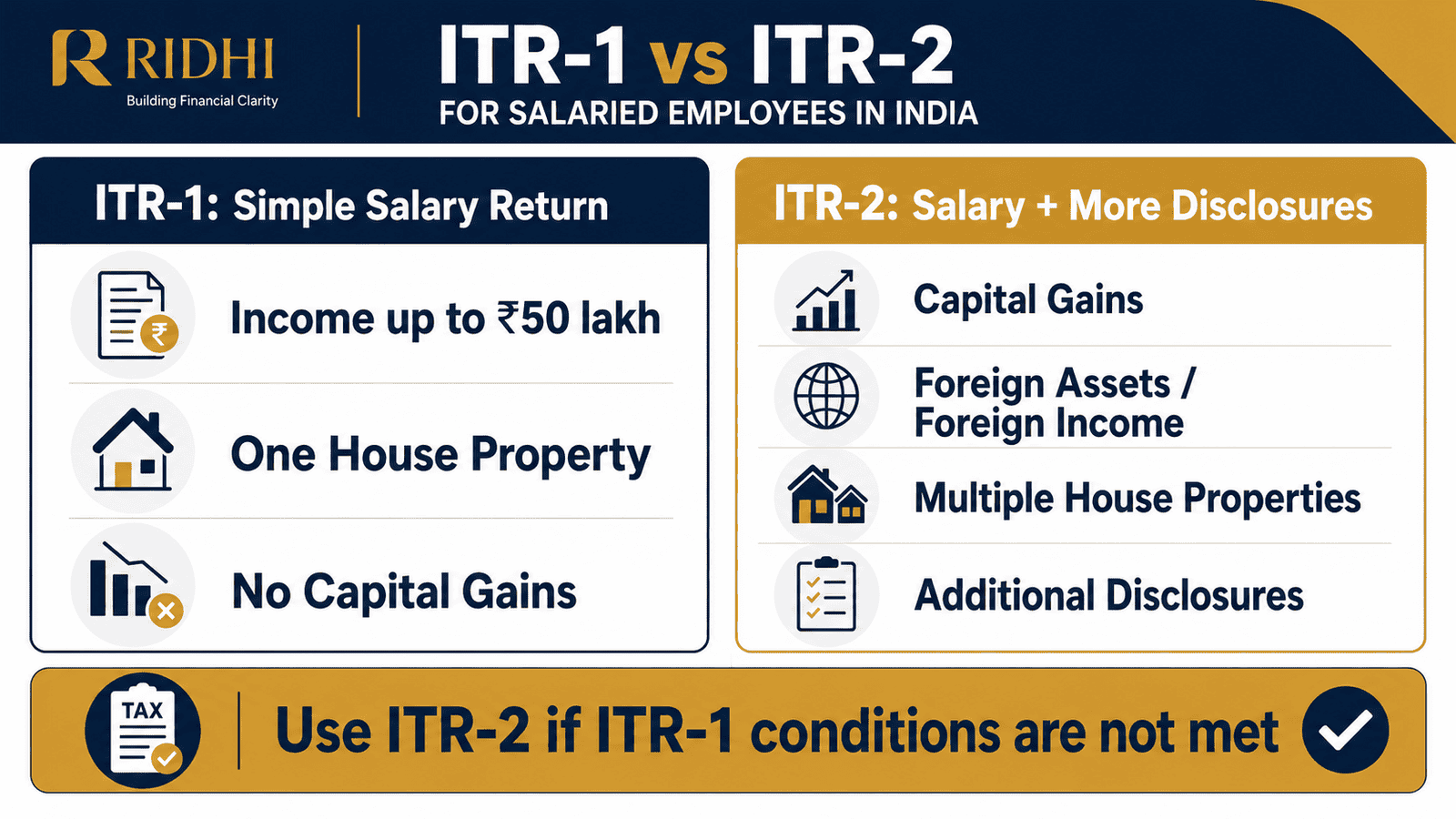
ITR-1 vs ITR-2 decides whether a salaried taxpayer can file the simple Sahaj return or needs the broader ITR-2. Use ITR-1 only when income and disclosures fit its limits, such as salary income within ₹50 lakh and permitted house-property/other-source income. Choose ITR-2 for capital gains, foreign assets, or ineligible cases. Always verify the current Assessment Year utility on incometax.gov.in before filing.
Key Takeaways
- ITR-1 (Sahaj) is for eligible resident individuals with simple income — salary, one house property, and limited other-source income — and requires total income to be within the prescribed limit for the relevant Assessment Year.
- ITR-2 applies when a salaried taxpayer is ineligible for ITR-1 but has no business or professional income — it handles capital gains, multiple house properties, foreign assets, and more.
- If you sold mutual funds, shares, RSUs, or ESOPs during the financial year, you almost certainly need ITR-2 — capital gains income disqualifies ITR-1 eligibility.
- Having a foreign bank account, foreign equity, or any foreign asset requires disclosure under Schedule FA — only ITR-2 carries this schedule.
- Form 16 alone is not enough to decide your ITR form — you must also check your AIS, Form 26AS, capital gains statements, and bank interest certificates.
- ITR form eligibility conditions are updated by the Income Tax Department each assessment year — do not rely on last year’s form choice or older articles.
- Choosing ITR-1 when ITR-2 is mandatory can result in a defective return notice — when in doubt, the broader form is the safer choice.
ITR-1 vs ITR-2: Quick Comparison
| Situation | ITR-1 (Sahaj) | ITR-2 |
|---|---|---|
| Salary income only, bank interest, one house property — total income within prescribed limit | Eligible | Can use, but ITR-1 is simpler |
| Salary plus capital gains from mutual funds, shares, or ESOPs | Not eligible | Correct form |
| Foreign bank account, foreign shares, or any foreign asset | Not eligible | Correct form |
| More than one house property | Not eligible | Correct form |
| Director in a company or holder of unlisted equity shares | Not eligible | Correct form |
| Salary plus business income or freelance professional income | Not eligible | Not eligible either — may need ITR-3 or ITR-4 |
| Non-ordinarily resident or non-resident individual | Not eligible | Correct form |
| Agricultural income above ₹5,000 | Not eligible | Correct form |
Key Facts at a Glance
| Parameter | ITR-1 (Sahaj) | ITR-2 |
|---|---|---|
| Full name | Sahaj — Income Tax Return 1 | Income Tax Return 2 |
| Who can use it | Resident individual only | Individual or HUF — resident, NOR, or NRI |
| Income types allowed | Salary/pension, one house property, other sources (interest, dividends up to limits), agricultural income up to ₹5,000 | All ITR-1 income types plus capital gains, multiple house properties, foreign income/assets, and more |
| Total income limit | Up to ₹50 lakh (verify current AY limit at incometax.gov.in) | No upper income limit |
| Capital gains | Not permitted | Permitted — Schedule CG required |
| Foreign assets/income | Not permitted | Permitted — Schedule FA required |
| Business/profession income | Not permitted | Not permitted — use ITR-3 or ITR-4 |
| Complexity level | Simple — fewer schedules | Moderate — more schedules, more disclosures |
| Best for | Straightforward salaried taxpayers with simple income | Salaried taxpayers with capital gains, foreign assets, or multiple income heads |
Understanding ITR-1 and ITR-2 for Salaried Employees
What Is ITR-1 (Sahaj) and Why Is It Called That?
ITR-1 is officially named Sahaj — the Hindi word for “simple.” The Income Tax Department designed it for resident individuals with uncomplicated income profiles. If your income comes from salary or pension, one house property, interest on savings accounts or fixed deposits, and dividends — and your total income does not cross the prescribed limit for the relevant Assessment Year — ITR-1 is built for you.
The key word is resident individual. If your residential status for the financial year is Non-Resident (NR) or Not Ordinarily Resident (NOR) under the Income Tax Act, 1961, you cannot file ITR-1 regardless of how simple your income looks. Residential status is determined each year based on the number of days you spent in India — and it can change year to year.
One other limit often missed: ITR-1 does not apply to someone who is a director in a company or holds unlisted equity shares at any point during the financial year. Many salaried employees at startups or private companies hold ESOPs in unlisted entities — this disqualifies them from ITR-1 automatically.
What Is ITR-2 and When Do Salaried Employees Need It?
ITR-2 is the step up from ITR-1. It is for individuals and Hindu Undivided Families (HUFs) who have income from more than one house property, capital gains, foreign assets or foreign income, or who are non-resident or not-ordinarily resident in India. Crucially, ITR-2 does not cover business or professional income — for that, you need ITR-3 or ITR-4.
For salaried employees, the most common triggers for ITR-2 are capital gains and foreign assets. If you redeemed mutual fund units, sold shares, or received RSU or ESOP proceeds during the financial year, those transactions generate capital gains — and the Income Tax Department requires you to report them in Schedule CG, which exists only in ITR-2.
To understand how old vs new regime choices interact with your filing, note that the tax regime you pick does not change which ITR form you file — they are separate decisions entirely.
Why Form 16 Is Not Enough to Decide Your ITR Form
Form 16 is issued by your employer and covers only salary income and TDS deducted at source. It tells you nothing about capital gains from your investments, interest income from multiple bank accounts, foreign asset holdings, or dividends from foreign employer stock. Many taxpayers who receive a clean Form 16 still need ITR-2 because of transactions that happened outside their payroll.
Learning how to read your Form 16 carefully is the first step — but it must be followed by reviewing your AIS (Annual Information Statement) and Form 26AS on the e-filing portal. These documents aggregate your income from all sources as reported to the Income Tax Department by banks, brokers, and mutual fund houses. If your AIS shows capital gains entries that are not in your Form 16, that is your signal to file ITR-2.
Agricultural Income, Lottery Winnings, and the Edge Cases
ITR-1 permits agricultural income up to ₹5,000. If your agricultural income exceeds this limit, you move to ITR-2. Similarly, lottery winnings and income from horse racing are classified under other sources but are special-rate income — they must be reported correctly under the applicable ITR-2 schedules. If you have any such income alongside salary, verify the current assessment-year instructions before deciding the form.
Real Example: Four Salaried Employees, Four Different Outcomes
Case 1 — Priya, 28, Chennai, HR Executive, ₹7.2 lakh salary: Priya has salary income, ₹14,000 in savings account interest, and one rented house property. Her total income is below ₹50 lakh, she has no capital gains, no foreign assets, and she is a resident individual. All ITR-1 conditions are satisfied. She can file ITR-1 (Sahaj).
Case 2 — Rohit, 31, Pune, Software Engineer, ₹18 lakh salary: Rohit redeemed ₹3.2 lakh from ELSS mutual funds in March and sold some shares through his broker, generating ₹42,000 in short-term capital gains. His Form 16 reflects only salary income, but his AIS shows both transactions. Capital gains disqualify ITR-1 — Rohit must file ITR-2. Use our income tax calculator to estimate his tax before filing.
Case 3 — Meera, 35, Bengaluru, Product Manager, ₹32 lakh salary: Meera’s US-headquartered employer gave her RSUs that vested and were sold during the year. The shares were listed on a foreign exchange, and Meera also holds a US brokerage account. Foreign assets and foreign income both point firmly to ITR-2, specifically Schedule FA for foreign asset disclosure.
Case 4 — Arjun, 40, Mumbai, Consultant, ₹24 lakh salary + ₹6 lakh freelance: Arjun has both salary income and professional freelance income. Neither ITR-1 nor ITR-2 covers business or professional income. Arjun likely needs ITR-3. This is a separate evaluation and he should consult a tax professional or the official portal’s Help Me Decide utility.
How to Decide What’s Right for You
You are a resident individual with only salary/pension income, one house property, bank interest, and dividends — and your total income is within the prescribed limit for the Assessment Year — THEN ITR-1 (Sahaj) is likely the correct form. Verify current AY conditions at incometax.gov.in before filing.
You sold mutual funds, shares, ESOPs, RSUs, or any other capital asset during the financial year and generated capital gains — THEN you must file ITR-2 regardless of salary level.
You hold a foreign bank account, foreign equity, foreign real estate, or received any foreign income (including employer stock vested in a foreign entity) — THEN you must file ITR-2 and complete Schedule FA.
You own more than one house property, or your residential status for the year is NOR or NRI — THEN ITR-2 is required.
You are a director in a company or held unlisted equity shares at any point during the financial year — THEN you cannot use ITR-1; file ITR-2.
You are unsure whether ITR-1 or ITR-2 applies — THEN do not force ITR-1 for convenience. Use the “Help Me Decide” utility on the Income Tax e-filing portal, or consult a qualified tax professional.
You should not file ITR-1 or ITR-2 if you have business income, professional income, freelance income, or partnership firm remuneration — these may require ITR-3 or ITR-4, and filing the wrong form can result in a defective return notice.
Common Mistakes to Avoid
Filing ITR-1 Just Because You Have Form 16
Form 16 is issued for salary income only — it does not capture capital gains, foreign assets, or interest from multiple banks.
Filing ITR-1 based solely on Form 16 when you also have capital gains or foreign assets makes your return defective. The Income Tax Department can issue a notice to re-file, delaying your refund and creating unnecessary compliance stress.
Always cross-check your AIS and Form 26AS before deciding the form.
Ignoring Capital Gains from Mutual Funds or ESOPs
Many salaried employees redeem mutual fund SIPs or receive ESOP proceeds and assume these are too small to matter for form selection.
Any capital gain — even ₹500 from a mutual fund redemption — disqualifies you from ITR-1. This rule applies regardless of whether the gain is taxable or falls under the exemption threshold. If a capital gains transaction occurred during the financial year, ITR-2 is mandatory.
Download your capital gains report from your mutual fund platform or broker before selecting the ITR form.
Not Checking AIS and Form 26AS Before Filing
Your AIS aggregates data reported by banks, brokers, mutual fund houses, and employers to the Income Tax Department.
If your AIS shows income that is not in your Form 16, and you still file ITR-1, the mismatch triggers processing flags. This can delay refunds or generate notices. Review your AIS and Form 26AS carefully before choosing and filing your return.
Log in to incometax.gov.in and download both documents before you start the form-selection process.
Assuming Residential Status Is Always “Resident”
If you travelled extensively outside India for work or personal reasons, your residential status for the financial year may be NOR or NRI under Section 6 of the Income Tax Act.
NOR and NRI individuals cannot file ITR-1 — only ITR-2. Filing ITR-1 with incorrect residential status is a reporting error that can lead to defective return notices or scrutiny.
Count your days of presence in India for the financial year and verify your residential status before choosing the form.
Missing Foreign Asset Disclosure for Employer Stock
Many employees of MNCs or Indian subsidiaries of foreign companies receive RSUs or ESOPs in a foreign-listed entity. These create foreign asset obligations under Schedule FA of ITR-2.
Skipping Schedule FA when you hold foreign employer stock — even if you have not sold it — can attract penalties under the Black Money Act, which has consequences far beyond standard income tax rules.
If you hold foreign shares in any form, ITR-2 with Schedule FA is mandatory. Consult a tax professional if the amounts are significant.
Using Last Year’s Form Choice Without Verifying the Current AY Rules
ITR form eligibility conditions, income limits, and schedules are updated by the Income Tax Department each assessment year.
A taxpayer who correctly filed ITR-1 last year may not be eligible this year if their income profile changed — or if the rules themselves changed. Never carry forward last year’s form selection without verifying the current assessment-year instructions at incometax.gov.in.
Check the official ITR-1 and ITR-2 instruction booklets published for the current AY before filing.
Choosing ITR-2 When You Also Have Business Income
ITR-2 does not cover business or professional income. Freelance work, consulting fees, or partnership firm remuneration alongside salary income may push the requirement to ITR-3 or ITR-4.
Filing ITR-2 when ITR-3 is the correct form is a structural filing error. Use the official “Help Me Decide” utility on the portal or consult a Chartered Accountant if your income has multiple heads including business or profession.
When in doubt, do not guess — verify with a professional or the portal’s guided tool.
When This May Not Be the Right Choice
If you have business income or professional income alongside salary — such as freelance design work, part-time consulting, or a sole proprietorship — neither ITR-1 nor ITR-2 is the right form. You may need to file ITR-3, and in some cases ITR-4 (Sugam) if you opt for the presumptive taxation scheme under Section 44ADA or 44AD.
If you receive remuneration, interest, or profit from a partnership firm — even passively as a partner — your filing requirement changes and may go beyond ITR-2’s scope.
If your income situation is complex — multiple employers, mid-year employer changes with different tax regimes, foreign tax credits, or significant capital gains across asset classes — a qualified Chartered Accountant or tax professional is better placed to identify the right form than any general-purpose article.
If any of these apply to your situation, it may be worth exploring alternatives before committing.
Official Rules and Where to Verify
ITR form eligibility, schedules, income limits, and filing utilities are governed and updated by the Income Tax Department. The correct place to verify before filing is the official portal — not older articles or last year’s checklist.
- Income Tax Department — incometax.gov.in (ITR form downloads, instructions, and e-filing utility)
Before filing, log in to incometax.gov.in and download the current assessment-year ITR-1 and ITR-2 instruction booklets. Compare your income profile against the eligibility conditions listed in those instructions — not against any third-party summary.
Rules, limits, and rates on this topic can change with each Budget or regulatory update. Always verify current figures directly from the official source before making any financial decision.
Use the salaried filing checklist to organise your documents — Form 16, AIS, Form 26AS, capital gains statements, bank interest certificates, and investment proofs — before you begin.
Expert Tips
- Download AIS before selecting the form. Log in to incometax.gov.in, navigate to AIS, and review every entry under capital gains, dividends, interest, and foreign remittances. Entries you did not expect are your signal to reconsider ITR-1.
- Get your capital gains report from your broker and mutual fund platform. Most platforms (Zerodha, Groww, CAMS, KFintech) provide an annual capital gains statement. If any line shows a gain or loss, you are looking at ITR-2 territory.
- Check your employment contract or offer letter for foreign stock grants. If your employer is a foreign company or a listed Indian company with a foreign parent that issued RSUs or ESOPs, you likely hold foreign assets — even if the proceeds were credited to your Indian bank account.
- Do not file ITR-1 for speed or convenience if ITR-2 conditions apply. A defective return notice from the Income Tax Department takes far more time to resolve than filing the correct form the first time.
- Use the Income Tax Department’s prefilled return feature carefully. Prefilled data is a starting point, not a final check. Verify every prefilled entry — especially capital gains and TDS — against your own documents before submitting.
- Keep all source documents until the assessment is complete. Form 16, broker capital gains reports, AIS printout, bank interest certificates, and foreign asset details should be retained for at least six years after the Assessment Year closes.
Frequently Asked Questions
Can salaried employees file ITR-2?
Yes. ITR-2 is available to individuals and HUFs who do not have business or professional income. A salaried employee must file ITR-2 if they have capital gains, foreign assets, more than one house property, or if they are NOR/NRI — regardless of how straightforward their salary income looks.
Is ITR-2 only for people with capital gains?
No. ITR-2 applies in several situations beyond capital gains — including foreign asset disclosure (Schedule FA), multiple house properties, income from a foreign employer stock that vested, agricultural income above ₹5,000, and non-resident or not-ordinarily-resident status. Capital gains is the most common trigger for salaried employees, but it is not the only one.
Can I file ITR-1 if I sold mutual funds during the year?
Generally no. A mutual fund redemption generates capital gains — short-term or long-term depending on the holding period. Any capital gains transaction disqualifies a taxpayer from using ITR-1. Even if the gain is small or falls under the basic exemption, the presence of a capital gains transaction requires ITR-2. Verify the current assessment-year rules at incometax.gov.in before filing.
Can ITR-1 be used along with Form 16?
Form 16 is a TDS certificate issued by your employer — it is not a form you “use with” an ITR. If your income profile satisfies ITR-1 eligibility conditions, you use the data from Form 16 while filing ITR-1 on the e-filing portal. If your profile requires ITR-2, you use Form 16 data as input there instead. The ITR form is determined by your complete income profile, not by which documents you have.
Which ITR form should I use for foreign company shares?
If you hold shares in a foreign company — including RSUs or ESOPs from a foreign-listed employer — you must disclose them under Schedule FA in ITR-2. Selling those shares also generates capital gains reportable in Schedule CG of ITR-2. ITR-1 has no provision for either schedule. Foreign employer stock of any kind points to ITR-2.
What happens if I choose the wrong ITR form?
The Income Tax Department can mark your return as defective under Section 139(9) of the Income Tax Act. You will receive a notice asking you to re-file within the prescribed time. If you do not respond, the return may be treated as not filed — which can affect refunds, carry-forward of losses, and compliance records. Choosing the correct form the first time avoids this entirely.
Can I file ITR-2 even if I am eligible for ITR-1?
Yes. ITR-2 is a superset of ITR-1 in terms of what it can accommodate. If you are eligible for ITR-1 but choose to file ITR-2, the return is valid. However, ITR-1 is simpler and faster to complete for those whose income genuinely fits it. There is no tax advantage to choosing ITR-2 when ITR-1 is applicable.
Do I need ITR-2 if I only have savings account interest besides salary?
Not solely on that basis. Savings account interest and fixed deposit interest are classified under “income from other sources” and are permitted under ITR-1, subject to total income limits and other eligibility conditions. However, also check for any capital gains entries in your AIS — banks sometimes report interest that looks like it but is associated with other transactions. Verify your AIS on incometax.gov.in before assuming ITR-1 is sufficient.
Can I claim a tax refund if I mistakenly filed the wrong ITR form?
If your return was marked defective and you re-filed correctly, your refund will be processed based on the corrected return. If you want to understand the refund process better, the guide on how to claim tax refund explains the steps in detail. Always file the correct form from the start to avoid refund delays.
Final Verdict
The ITR-1 vs ITR-2 decision comes down to one question: does your income profile fit inside ITR-1’s defined boundaries? If the answer is clearly yes — resident individual, salary or pension, one house property, limited other-source income, no capital gains, no foreign assets, within the prescribed income limit — ITR-1 is the right and simpler choice. If there is any doubt — capital gains from mutual funds, shares, or ESOPs; foreign employer stock; multiple properties; or a non-resident status — ITR-2 is the safer and correct form. For salary plus business or professional income, neither ITR-1 nor ITR-2 applies and a different form evaluation is required. The key habit to build: check your AIS before choosing, not after. Assessment Year conditions change — always verify the current ITR form instructions at incometax.gov.in before you file. Always verify the latest rules from official sources or consult a qualified professional before making any financial decision.
This article is for educational purposes only and should not be treated as personalised financial, tax, investment, insurance, or legal advice. Tax rules, interest rates, regulatory limits, and product features can change with each Budget or policy update. Please verify current rules from official government sources or consult a qualified and registered professional before making any financial decision.

Kavita Mehra writes and edits Ridhi.com’s income tax content for Indian taxpayers, with a special focus on salaried employees and beginners who find tax rules confusing. Her work explains complex tax topics in simple language, helping readers understand how income, deductions, exemptions, rebates, TDS, Form 16, ITR filing, and refunds connect in real life.
She covers topics such as old vs new tax regime, income tax slabs, standard deduction, Section 87A rebate, HRA exemption, 80C, 80D, 80E, 80G, TDS on salary, taxable income, Form 16, AIS, Form 26AS, advance tax, and ITR filing checklists. Her content aims to help readers become more informed before filing returns or discussing tax matters with a professional.
Kavita’s approach is careful, compliance-focused, and official-source oriented. Because Indian tax rules can change after Budgets, circulars, and policy updates, her articles encourage readers to verify current figures, filing deadlines, and rules from the Income Tax Department or a qualified tax professional before acting.