

Most Indian families spend months finding the right property — and then discover that the home loan process in India is an entirely separate maze. Sanction letters get confused with final approval. Disbursement gets mistaken for possession. And costs like stamp duty, processing fees, legal verification charges, and insurance add-ons surface only after the agreement is already signed.
The home loan journey has several distinct stages — each with its own documents, decisions, and potential delays. These stages involve the lender, the property, and often the state registration system. Miss one, and costs or delays catch you off guard at exactly the wrong moment.
This article is a step-by-step borrower checklist for the home loan process in India — from checking your eligibility before you apply to what to do between disbursement and possession. Specific processes, charges, and timelines vary by lender, property type, and state.
Quick Answer: Home Loan Process in India
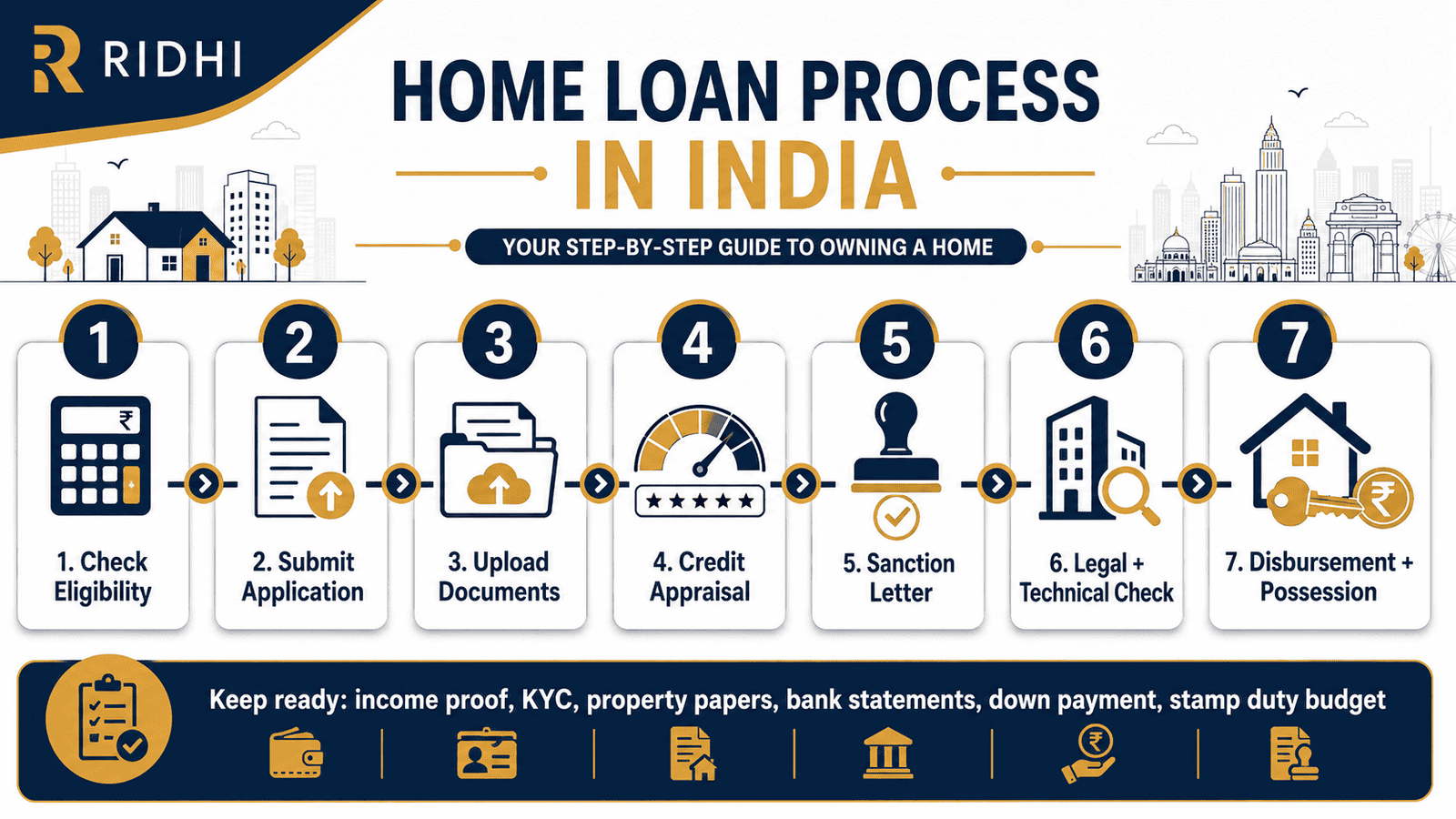
The home loan process in India usually has 7 stages: eligibility check, application, document submission, credit appraisal, sanction letter, legal and technical property verification, and final disbursement. Before possession, borrowers should also verify RERA details, registration costs, builder demand letters, insurance add-ons, and EMI affordability.
Key Takeaways
- The sanction letter confirms the lender’s conditional offer — disbursement happens only after the property separately clears legal and technical verification. These are two different approvals.
- Your CIBIL score, FOIR (fixed obligation to income ratio), and existing EMI burden each affect how much a lender will approve — not just your gross salary figure.
- Total cost of a ₹60 lakh home loan over 20 years includes principal plus approximately ₹67 lakh in interest at illustrative rates, plus processing fee, legal charges, stamp duty, and registration. Plan for this full figure — not just the monthly EMI.
- Both borrower approval and property approval must clear before disbursement. Legal or title issues at the property stage can block the loan even after you have a sanction letter in hand.
- RERA registration status, a clear title chain, and a verified encumbrance certificate are non-negotiable checks — confirm these before paying any large amount to a builder or seller.
- Stamp duty and registration are paid by you — the buyer — from your own funds. These costs are not covered by the home loan and must be separately arranged.
- Sanction letters carry a validity period. If possession or registration is delayed significantly, your lender may require fresh documentation or a renewed sanction.
Key Facts at a Glance
The table below maps each stage of the home loan process, what the borrower must do, and what documents or costs typically apply. Ask your lender for all charges in writing — including processing fee cost — before accepting any sanction.
| Stage | Borrower Action | Documents / Typical Costs |
|---|---|---|
| 1. Eligibility Check | Review CIBIL score, income, and existing EMI obligations | Credit report; last 3 months’ salary slips; Form 16 |
| 2. Application | Submit application form with KYC and basic property details | PAN, Aadhaar, employer letter; application fee at some lenders |
| 3. Document Submission | Submit income proof, bank statements, and property papers | ITR (2 years), bank statements (6 months), property agreement |
| 4. Credit Appraisal | Lender verifies income, employer, and repayment capacity | Internal lender process; borrower may need to clarify discrepancies |
| 5. Sanction Letter | Review loan amount, rate type, tenure, EMI, and all conditions | Processing fee: typically 0.25%–1% of loan amount; sanction has a limited validity period |
| 6. Legal and Technical Verification | Coordinate property documents with lender-appointed teams | Legal search report; property valuation report; fees vary by lender |
| 7. Disbursement | Sign loan agreement; execute MODT; receive funds | Loan agreement stamping; insurance add-ons may be offered |
| 8. Registration and Possession | Register sale deed; collect possession letter and OC/CC | Stamp duty + registration charges: state-specific, paid from own funds |
Home Loan Process in India: Step by Step
Step 1 — Check Eligibility Before You Apply
Before speaking to any lender, check three things: your CIBIL score, your income consistency, and your existing EMI obligations. Most banks and housing finance companies expect a CIBIL score of 700 or above. A score below 650 often results in rejection or a materially higher interest rate offer. Your good CIBIL score is the first filter every lender applies — and the easiest to prepare for if you start six months before you plan to apply.
Lenders also assess your FOIR — Fixed Obligation to Income Ratio. This measures how much of your monthly income is already committed to existing loan EMIs and other fixed payments. Most lenders prefer FOIR to remain below 50% after adding the proposed home loan EMI. If your take-home income is ₹1,50,000 per month and you already pay ₹30,000 in car loan and personal loan EMIs, only about ₹45,000 more is typically available for a home loan EMI in a lender’s calculation.
According to RBI guidelines, the loan-to-value (LTV) ratio — the maximum loan as a share of the property’s market value — is capped by loan size. Loans up to ₹30 lakh can reach up to 90% LTV, loans between ₹30 lakh and ₹75 lakh up to 80%, and loans above ₹75 lakh up to 75%. Your down payment must cover the balance from your own funds.
Step 2 — Compare Lenders and Submit Your Application
Compare lenders on interest rate type (floating versus fixed), processing fee, prepayment and foreclosure terms, and customer service — not just the headline rate. A lender with a marginally lower rate but high processing fees, strict prepayment penalties, and slow legal verification turnaround may cost you more overall.
Once you select a lender, you fill an application form with KYC details, employment information, and basic property data. Many banks and NBFCs now process applications online. At this stage, some lenders issue an in-principle approval — an indicative offer based on your profile. This is not a sanction letter, and it does not confirm disbursement.
Step 3 — Document Submission
For a salaried borrower, standard documents typically include: PAN and Aadhaar, last 3 months’ salary slips, Form 16 and ITR for 2 years, 6 months’ bank statements, employer appointment or confirmation letter, and property documents — sale agreement or allotment letter, title deed, NOC from builder, RERA registration certificate, and approved building plan.
Incomplete or inconsistent documentation is one of the most common reasons for processing delays. Prepare a complete set before starting — not after your application is submitted.
Step 4 — Credit Appraisal and Income Verification
The lender’s credit team verifies your employer, income pattern, bank transactions, and repayment capacity. They cross-check your declared income against Form 26AS, bank credits, and salary slips. For large loan amounts, some lenders conduct telephonic or physical employment verification.
If your income is variable — due to performance bonuses, allowances, or a recent job change — be prepared to explain inconsistencies clearly. Lenders look for stability, not just the most recent high figure.
Step 5 — The Sanction Letter: Read Every Line
If appraisal is successful, the lender issues a sanction letter. This document specifies: the sanctioned loan amount, interest rate and type, loan tenure, indicative EMI, processing fee, any special conditions attached to disbursement, and the validity period of the sanction.
The sanction letter is the lender’s conditional commitment — not the final step. Disbursement still requires the property to pass legal and technical verification separately. Read the rate reset clause, prepayment terms, and all conditions before signing your acceptance.
Step 6 — Legal and Technical Verification of the Property
This is where many home loan journeys slow down — and where borrower-side preparation is most valuable. The lender appoints an independent lawyer to verify the title chain, encumbrance certificate, approved building plan, mutation records, and absence of litigation. A separate technical expert visits the site to assess construction quality, valuation, and occupancy or completion certificate status.
If either report raises concerns, disbursement is withheld until the issues are resolved. This can take days or weeks depending on the complexity of the property’s documentation history. Borrowers should coordinate document availability with the builder or seller proactively — do not wait for the lender to chase.
Step 7 — Loan Agreement, MODT, and Disbursement
Once legal and technical checks clear, you sign the loan agreement and execute the Memorandum of Deposit of Title Deeds (MODT) — an equitable mortgage through which your original title documents are deposited with the lender as security.
For a ready-to-move property, disbursement typically happens as a single payment to the seller after the sale deed is ready for registration. For under-construction properties, disbursement is staged in tranches — released to the builder based on construction milestones confirmed through builder demand letters.
Step 8 — Registration, Possession, and EMI Start
After disbursement, you complete the sale deed registration at the sub-registrar’s office. Stamp duty and registration charges are paid by you from your own funds — these are not part of your home loan. After registration, you collect the possession letter, occupancy or completion certificate from the builder, and the society NOC if applicable.
Full EMI typically begins the month after disbursement. For under-construction properties, lenders usually charge pre-EMI interest on each disbursed tranche during the construction phase — the full EMI starts only after the final tranche is released.
Real Example: Rahul and Priya’s ₹75 Lakh Apartment
Rahul Sharma, 34, a senior software engineer in Bengaluru earning ₹28 lakh per year, and his wife Priya are buying a ₹75 lakh apartment in an under-construction RERA-registered project. Their lender approves a ₹60 lakh home loan — 80% of the property value — in line with the applicable LTV norm for this loan size. The remaining ₹15 lakh comes from their savings as the down payment.
Additional costs they plan for separately: stamp duty and registration charges in Karnataka (state-specific; verify current rates at the Karnataka state registration portal before budgeting), processing fee on ₹60 lakh (approximately ₹15,000–₹60,000 depending on lender terms), legal and valuation charges, and a buffer for interior work.
Because the apartment is under construction, disbursement happens in 3 tranches over 18 months, linked to builder demand letters. During construction, Rahul pays pre-EMI interest on each disbursed tranche — the full EMI begins after the final tranche is released.
Before committing to the purchase price, Rahul uses the monthly EMI estimate tool on Ridhi to test different loan amounts, interest rates, and tenures. This confirms that the proposed EMI fits within his income before he signs anything.
Key insight: Rahul’s total outflow over 20 years is principal plus total interest plus all upfront costs — not just the monthly EMI figure. Planning this before signing the builder agreement is what keeps the process manageable, not stressful.
How to Calculate Your Home Loan Affordability
Before applying, estimate three numbers: the loan amount you need, the monthly EMI you can sustain, and your total repayment over the full tenure. The total repayment — not the EMI — is the number that tells you the real cost of the loan.
Loan Required = Property Price − Down Payment
Monthly EMI = [P × r × (1+r)^n] ÷ [(1+r)^n − 1]
where P = Principal, r = Monthly interest rate (annual rate ÷ 12 ÷ 100), n = Tenure in months
Total Repayment = Monthly EMI × Number of Months
Total Interest = Total Repayment − Principal
True Total Cost = Principal + Total Interest + Processing Fee + Legal and Valuation Charges + Stamp Duty + Registration Charges
The table below uses an illustrative rate of 8.75% p.a. — actual rates vary by lender, your credit profile, loan tenure, and RBI-linked benchmarks. Verify current rates with your lender before applying. Check the safe EMI limit for your income before committing to any loan amount.
| Scenario | ₹50L Loan, 20 Years | ₹60L Loan, 20 Years |
|---|---|---|
| Monthly EMI (at 8.75% p.a.*) | ~₹44,100 | ~₹52,920 |
| Total Interest Paid | ~₹55.8 lakh | ~₹67.0 lakh |
| Total Principal + Interest | ~₹1,05.8 lakh | ~₹1,27.0 lakh |
| Add: Processing Fee (est.) | ₹12,500–₹50,000 | ₹15,000–₹60,000 |
| Add: Stamp Duty + Registration | State-specific — verify at your state’s registration department portal |
*Illustrative rate only. Actual rates vary by lender, credit score, and tenure. Verify current rates before applying.
Comparison: Ready-to-Move vs Under-Construction vs Resale vs Self-Construction
The home loan process differs significantly based on property type. Disbursement patterns, key documentation requirements, and borrower risks vary across these four categories — and lender rules on each can differ.
| Property Type | Disbursement Pattern | Key Risk / Borrower Action |
|---|---|---|
| Ready-to-Move | Full disbursement after legal and technical verification clears and sale deed is ready for registration | Verify OC/CC, title chain, and seller’s existing loan closure; lower construction delay risk |
| Under-Construction | Tranche disbursement linked to construction milestones and builder demand letters | Pre-EMI interest accrues on each tranche; verify RERA registration before any booking payment |
| Resale Property | Full disbursement after verification; may also require seller’s existing loan NOC or foreclosure letter | Older title chain needs deeper legal review; check encumbrance certificate for past dues or disputes |
| Self-Construction / Plot + Build | Staged by construction progress; separate disbursement for land and construction portions | Land must have clear title, mutation, and approved plan; stricter lender valuation norms apply |
How to Decide What’s Right for You
Your FOIR stays below 40–45% after adding the proposed home loan EMI — the loan amount is likely within a comfortable range for your income. Confirm using the safe EMI limit guide before finalising the loan amount.
You are buying an under-construction project — check RERA registration status and construction progress on your state RERA portal before paying any booking amount. Your interest cost starts earlier than for a ready-to-move property, and builder delays are a real risk.
You have received a sanction letter but the property has not yet cleared legal or technical verification — do not pay the seller or builder any large amounts on the assumption that disbursement is confirmed. Title issues or valuation gaps can still block the loan at this stage.
Two lenders offer very similar interest rates — compare total cost: processing fee, legal charges, prepayment terms, and disbursement turnaround. The lowest headline rate is not always the cheapest or fastest loan in practice.
A co-applicant has a stronger credit profile or higher income — a joint loan can increase the eligible loan amount and may reduce the offered interest rate. Understand shared repayment responsibility and tax implications before proceeding.
You have not yet confirmed stamp duty, registration charges, interior costs, and a cash emergency buffer — you are not financially ready to commit to a purchase price. These costs combined can be ₹5–₹15 lakh or more depending on property value and state, and cannot be funded through the home loan.
Your CIBIL score is below 650 — apply only after resolving the credit history issues. A rejection creates a hard inquiry on your report and may further reduce your score, making subsequent applications harder.
Common Mistakes to Avoid
Treating the Sanction Letter as Final Approval
Many borrowers celebrate the sanction letter and immediately make large payments to the builder or seller, assuming disbursement is confirmed.
If the property then fails legal or technical verification, disbursement is blocked — and recovering money already paid to a builder can be legally complex and time-consuming.
Hold off on significant payments until the lender has explicitly confirmed that both borrower approval and property verification are complete.
Skipping the RERA Verification
Buyers of under-construction projects sometimes treat lender project approval as a substitute for their own RERA check. These are separate processes.
A lender may approve a project that has RERA compliance gaps, or the registration status may have changed since the lender last reviewed it. Buyers have no direct protection from the lender’s internal project approval.
Always check the RERA registration number on your state portal before paying any booking amount. See the guide on RERA buyer protection to understand what the registration covers.
Focusing Only on the EMI and Missing the Total Cost
On a ₹60 lakh home loan over 20 years at illustrative rates, total interest alone can exceed ₹67 lakh — making the total repayment over ₹1.27 crore before adding any upfront charges.
Add processing fee, legal and valuation charges, stamp duty, registration, interior work, and maintenance corpus — and the true cost of home ownership is substantially higher than the purchase price or monthly EMI suggest.
Always calculate total cost — principal plus total interest — not just the monthly EMI figure.
Borrowing the Maximum Eligible Amount
A lender sanctioning ₹80 lakh does not mean you need to borrow ₹80 lakh. Taking the maximum pushes up your EMI, your total interest outflow, and your financial vulnerability if income changes mid-tenure.
Borrow the amount the property requires — not the ceiling the lender offers. A smaller loan amount with comfortable EMI is always better than a maximum loan with stretched monthly obligations.
Not Reading the Sanction Letter Conditions
Rate reset clauses, foreclosure charges, prepayment terms, and the distinction between floating and fixed rate loans are all in the sanction letter — and all affect your long-term cost.
Floating rates move with RBI benchmark changes. Your EMI can increase if rates rise. Read every clause before signing. Ask your lender to confirm all conditions in writing, not verbally.
Paying Booking Amounts Before Reviewing Legal Documents
Signing an agreement to sale or paying a token before reviewing property documents — especially in resale transactions where the seller may carry an existing loan — exposes you to significant risk.
Get a lawyer to review the title chain, encumbrance certificate, and existing loan status before any token payment. A legal review fee at this stage is far smaller than the dispute it can prevent.
When This May Not Be the Right Choice
Taking or rushing a home loan carries higher risk if your income is contract-based, unstable, or likely to change in the near term. A drop in income mid-tenure creates EMI stress — especially without a cash buffer to cover 3–6 months of obligations independently.
If your CIBIL score carries unresolved errors, recent defaults, or a history of missed payments, a fresh application is likely to result in rejection or an unfavourable rate offer. Address the credit history first, then apply.
If the property has title disputes, missing building approvals, an expired or missing occupancy certificate, or unresolved RERA concerns — proceeding without clarity creates both legal and financial risk. Lenders may also reject the property during verification, leaving you without disbursement after paying a booking amount.
If your budget does not yet account for stamp duty, registration charges, interior work, maintenance corpus, and moving costs, you may be committing to a purchase you cannot complete without significant financial strain.
If any of these apply to your situation, it may be worth exploring alternatives before committing.
Official Rules and Where to Verify
Home loan interest rates, processing fees, LTV norms, and lender policies can change based on RBI guidelines and individual lender policy reviews. Stamp duty and registration charges vary by state and are updated by state governments independently.
- RBI (rbi.org.in) — Regulatory context for home loan LTV ratios, fair practices code for lenders, and external benchmark lending rate guidelines.
- Your lender’s official website or your sanction letter — Current interest rate, processing fee, reset clause, prepayment terms, and disbursement conditions specific to your loan offer.
- State RERA portal — Search your project’s RERA registration number to verify project status, builder obligations, and completion timeline. Each state has its own portal (for example, rera.karnataka.gov.in for Karnataka, maharera.mahaonline.gov.in for Maharashtra).
- State registration department website — Stamp duty rates, registration charges, and the property registration process for your specific state. For a full walkthrough of what registration involves, see the guide on property registration steps.
- Income Tax Department (incometax.gov.in) — Home loan tax deductions under Section 24(b) for interest paid and Section 80C for principal repayment, including applicable limits and conditions.
Rules, limits, and rates on this topic can change with each Budget or regulatory update. Always verify current figures directly from the official source before making any financial decision.
Expert Tips
- Get a soft eligibility check from at least two lenders before paying any booking amount. Knowing your confirmed loan range upfront prevents overcommitting on the purchase price — or discovering a shortfall after signing.
- Keep your CIBIL score above 750 before applying. Many banks and HFCs reserve their sharpest rates for borrowers in this range. A 0.25–0.50% rate difference on ₹60 lakh over 20 years translates to ₹4–8 lakh in total interest difference — worth addressing before you apply.
- Ask your lender for all charges in writing before accepting the sanction — processing fee, legal fee, property valuation fee, MODT stamping charges, and any insurance premium. Oral commitments from relationship managers are not binding.
- If you are on a floating rate, read the rate reset clause carefully. Floating rates are linked to an external benchmark (typically the RBI repo rate); your EMI can rise if the benchmark increases. Understand the reset frequency and your options before signing.
- Keep a separate cash buffer of at least ₹3–5 lakh (more for higher-value properties) specifically for stamp duty, registration, society deposit, interior work, and moving costs. These cannot be funded from the home loan amount and typically need to be paid within weeks of possession.
- If the property is under construction, track RERA-linked construction milestones before approving each tranche disbursement to the builder. Under RERA, you are entitled to updated project information — use it.
- Track your pre-EMI interest from the first tranche disbursement, not from possession. This amount is payable even before your full EMI begins and is often overlooked in affordability planning.
Frequently Asked Questions
How long does the home loan approval process take in India?
Timelines vary by lender and property type. Credit appraisal for a salaried borrower with complete documentation typically takes 7–15 working days at most banks. Legal and technical verification of the property adds additional time — especially for older properties or under-construction projects with incomplete documents. Allow 3–8 weeks from application to sanction, and further time for property verification and disbursement. No lender can guarantee a fixed end-to-end timeline.
Is the sanction letter the same as loan disbursement?
No. The sanction letter is the lender’s conditional offer of a loan amount at specified terms. Actual disbursement happens only after the property passes separate legal and technical verification and you sign the final loan agreement and MODT. Treating the sanction letter as confirmed money is one of the most common — and costly — mistakes borrowers make.
What documents are required for a home loan?
For salaried applicants: PAN and Aadhaar, last 3 months’ salary slips, Form 16 and ITR for 2 years, 6 months’ bank statements, employment letter, and property documents including sale agreement or allotment letter, title deed, RERA registration certificate, approved building plan, and builder NOC. Self-employed applicants provide business financials, audited profit and loss statements, and GST returns in place of salary documents.
Can the bank reject a home loan after issuing a sanction letter?
Yes. The sanction letter is conditional. If the property fails legal or technical verification, if the borrower’s financial position changes materially before disbursement — such as a job change, income drop, or a new loan taken — or if required documentation cannot be produced, the lender can withdraw or modify the sanction. This is why property verification must be treated as a completely separate approval stage.
What happens during legal and technical verification?
The lender’s appointed lawyer reviews the property’s title chain, encumbrance certificate, approved building plan, mutation records, and the absence of legal disputes or liens. A separate technical expert visits the site to assess construction quality, current completion stage, and whether the lender’s valuation is consistent with the agreed purchase price. If either report raises issues, disbursement is held until those concerns are resolved by the borrower or builder.
Is a RERA check mandatory before buying a property?
For under-construction residential projects, RERA registration is legally required for builders before advertising or selling units. As a buyer, checking the project on your state RERA portal is strongly advisable — it confirms project registration, construction schedule, builder obligations, and any complaints registered. Your lender may also require RERA registration before approving the project. For fully completed or resale properties, RERA registration is a past stage, but verifying the occupancy certificate and title chain remains equally important.
When does EMI start after home loan disbursement?
For ready-to-move properties, the full EMI typically starts from the first day of the month following disbursement. For under-construction properties, most lenders charge pre-EMI interest on each disbursed tranche during the construction phase — interest only on the released amount, not the full EMI. The complete EMI (principal plus interest) begins after the final tranche is disbursed. Confirm your lender’s specific policy in the loan agreement before signing.
What is MODT and why does the lender require it?
MODT stands for Memorandum of Deposit of Title Deeds. It is a document through which you deposit your original property title papers with the lender as security for the home loan, creating an equitable mortgage. This protects the lender’s interest in the property for the duration of the loan. MODT requires stamp duty payment, which varies by state — confirm the applicable charge with your lender before the disbursement stage.
Can I prepay or close a home loan before tenure ends?
Yes. RBI guidelines prohibit banks and scheduled commercial lenders from charging foreclosure or prepayment penalties on floating-rate home loans to individual borrowers. Fixed-rate loans or loans from certain NBFCs may carry prepayment charges — check your sanction letter. Prepaying a portion of the principal in the early years of the loan significantly reduces total interest paid, since interest is heavily front-loaded in the initial EMIs.
What is the difference between possession and registration of a property?
Possession is the physical handover — you receive the keys and the possession letter from the builder or seller. Registration is the legal transfer of ownership documented at the sub-registrar’s office through the executed sale deed. Both steps are required. Possession without registration means you occupy the property but do not yet hold formal legal ownership. Stamp duty and registration charges are paid at the time of registration and must come from your own funds, not the loan amount.
Final Verdict
The home loan process in India is manageable — but only when you treat it as a sequence of distinct stages, not a single approval event. Eligibility, documentation, sanction, property verification, disbursement, registration, and possession each require separate attention, separate documents, and separate cost planning.
The lowest interest rate is not enough on its own. Your total outflow — principal plus total interest plus all upfront and registration costs — is what determines whether a home purchase is genuinely affordable for your income and savings position. Borrow what the property requires, verify the property independently, and read every condition in the sanction letter before signing anything.
Always verify the latest rules from official sources or consult a qualified professional before making any financial decision.
This article is for educational purposes only and should not be treated as personalised financial, tax, investment, insurance, or legal advice. Tax rules, interest rates, regulatory limits, and product features can change with each Budget or policy update. Please verify current rules from official government sources or consult a qualified and registered professional before making any financial decision.

Neha Kulkarni writes about the financial side of home buying, renting, property decisions, and real estate costs in India. Her content helps readers think beyond the EMI and understand the total cost of owning or buying a home.
She covers topics such as rent vs buy, home loan planning, down payment, stamp duty, registration charges, brokerage, maintenance cost, property tax, furnishing cost, home insurance, builder payment plans, resale property checks, home loan affordability, total cost of ownership, and hidden costs in property decisions.
Neha’s writing is practical, family-focused, and cost-conscious. She uses Indian city examples, ₹ calculations, and decision checklists to help readers evaluate whether a property decision fits their income, savings, loan eligibility, and long-term plans. Her articles are useful for first-time home buyers, salaried couples, families, and people comparing rent with home ownership. Since property rules, stamp duty, registration charges, local taxes, home loan rates, and legal requirements vary by state and city, readers should verify current details from official state, lender, and legal sources.