

Your salary hits the account and the SIP debit goes out the next day — smooth, automatic, invisible. Then one month, a sudden expense throws everything off: a medical bill, a house deposit, a car repair that refuses to wait. You open your mutual fund app and stare at two options: pause or stop. One feels reversible. The other feels final. The wrong choice can quietly damage years of investment discipline without you realising it until much later.
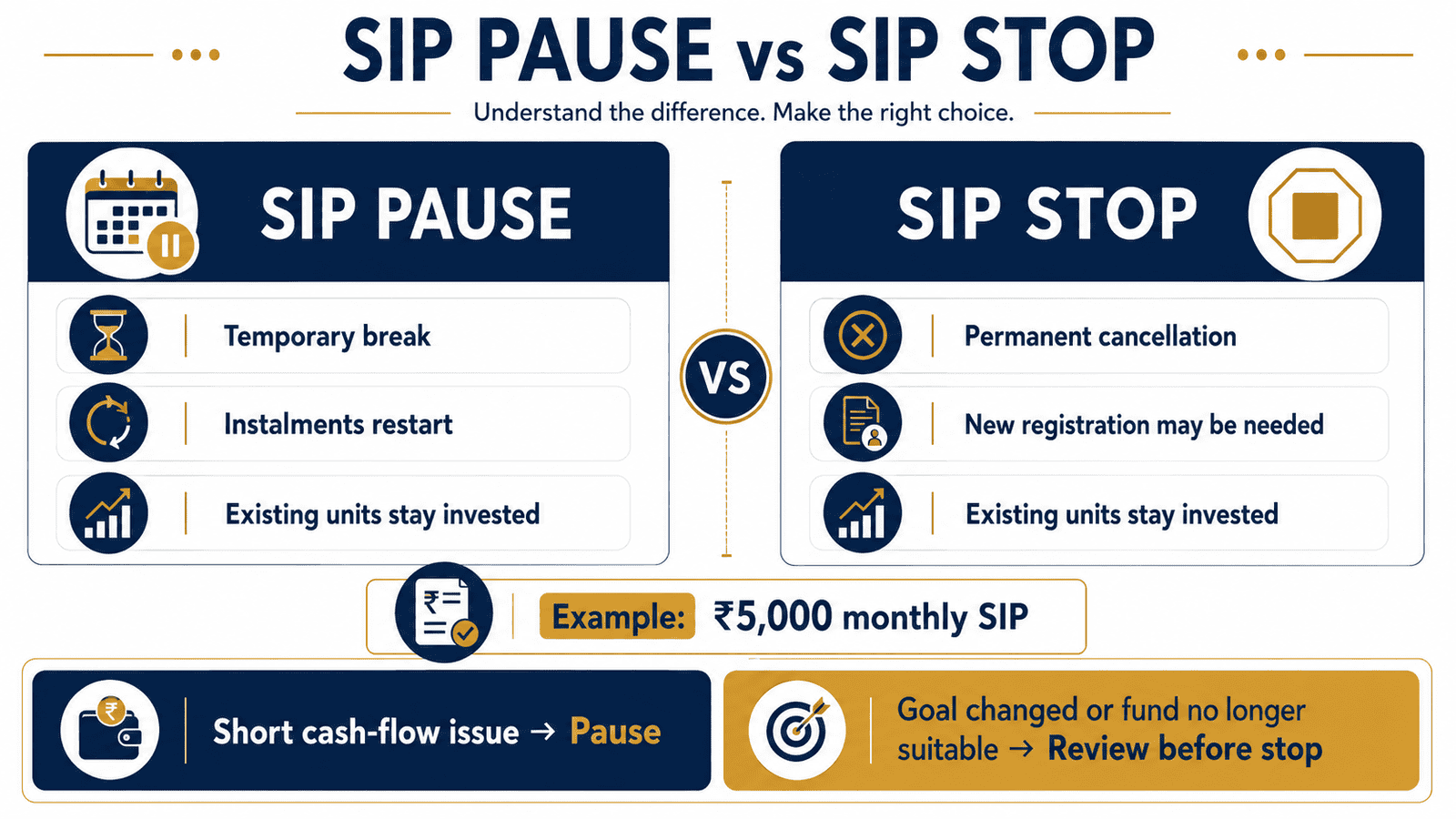
SIP pause and SIP stop sound similar, but they work very differently. Pause keeps your existing investment intact and simply delays upcoming instalments. Stop cancels the recurring SIP instruction, usually permanently. And critically, neither option automatically sells your mutual fund units — that is a separate action called redemption, which many investors confuse with stopping a SIP.
This article compares SIP pause and SIP stop in plain terms: what changes, what does not, how the restart process works, and which choice actually protects your long-term investing habit. The guidance here is general and educational — the exact process will depend on your AMC, platform, or app.
Quick Answer: SIP Pause vs SIP Stop
SIP pause vs SIP stop is a choice between temporarily skipping future SIP instalments and permanently cancelling the SIP mandate. Pause suits short cash-flow issues, while stop suits changed goals, unsuitable funds, or a decision to invest elsewhere. Existing mutual fund units usually remain invested unless you redeem them. Note that the pause facility depends on AMC or platform availability — check your app, AMC website, or RTA process before acting. Mutual fund investments are subject to market risks. Past performance does not guarantee future returns. For regulatory context, refer to SEBI at sebi.gov.in.
Key Takeaways
- SIP pause is a temporary facility — it skips upcoming instalments for a defined period without cancelling the SIP mandate.
- SIP stop is typically a permanent action — it cancels the recurring SIP instruction and future debits will not occur unless you create a fresh SIP.
- Existing mutual fund units in your folio are not affected by either action — they stay invested until you choose to redeem them.
- Pausing three months of a ₹15,000 monthly SIP means ₹45,000 less fresh investment during that window — existing units keep growing or declining with the market.
- Pause is the better choice when the problem is temporary cash flow; stop is the better choice when your goal, fund, or investment plan has genuinely changed.
- Not all AMCs or platforms offer a formal pause facility — if yours does not, missing an instalment or stopping the SIP may be your only options.
- Never stop a SIP solely because of a short-term market fall — rupee cost averaging works precisely because you buy more units when prices are lower.
SIP Pause vs SIP Stop: Side-by-Side Comparison
| Parameter | SIP Pause | SIP Stop |
|---|---|---|
| Nature | Temporary | Permanent |
| Effect on future bank debit | Skipped for the pause period; auto-resumes after | Cancelled — no future debits unless a new SIP is created |
| Effect on existing mutual fund units | No change — units stay in your folio | No change — units stay in your folio |
| SIP mandate status | Remains active; paused temporarily | Cancelled or deactivated |
| Restart effort | Usually automatic after pause period ends | Requires creating a fresh SIP, new mandate, and new bank registration |
| Best use case | Temporary cash crunch — 1 to 3 months | Goal achieved, fund no longer suitable, or plan has changed |
| Risk of misuse | Forgetting to restart if pause is manual | Stopping during market dips and missing recovery gains |
Key Facts at a Glance
| Aspect | Key Detail |
|---|---|
| SIP pause meaning | Temporarily stopping upcoming SIP instalments where the AMC or platform supports it |
| SIP stop meaning | Cancelling the SIP mandate so no future instalments are debited |
| Effect on existing units | Neither pause nor stop redeems your units — units remain invested |
| Effect on future debit | Pause: skipped temporarily. Stop: cancelled permanently. |
| Restart after pause | Often automatic, but check your AMC/platform — some require manual restart |
| Restart after stop | Requires a fresh SIP registration with new mandate |
| Best use case — pause | Short-term cash-flow pressure with intent to continue investing |
| Best use case — stop | Goal completed, fund changed, platform switch, or investment plan revised |
| Regulatory oversight | SEBI — sebi.gov.in |
Understanding SIP Pause, SIP Stop, and Redemption
Before comparing the two options, it helps to understand what an SIP actually is at a technical level. When you start an SIP, you are setting up two things simultaneously: a recurring bank instruction (usually an NACH mandate or a UPI auto-pay) and an investment instruction with the AMC or mutual fund platform. The bank instruction triggers the debit; the investment instruction tells the AMC which fund to buy units in, and at what NAV. For a full primer on how SIPs work, see SIP basics explained.
What SIP pause actually does
SIP pause is a facility that temporarily suspends upcoming SIP instalments without cancelling the underlying SIP mandate. Think of it as pressing a pause button on your auto-debit instruction. Your folio, your existing units, and your investment account remain completely intact. Depending on the AMC or platform, you may be able to pause for one month, three months, or a defined period — after which the SIP typically resumes automatically.
The important word here is where the facility is available. Not every AMC or every mutual fund platform offers a formal pause option. Some allow it only for specific fund types. If your platform does not support pause, your practical choices are limited to stopping the SIP, reducing the amount, or absorbing the instalment.
What SIP stop actually does
SIP stop — also referred to as SIP cancellation — cancels the recurring SIP instruction. Future instalments will not be debited from your bank account. The SIP mandate is deactivated. According to SEBI’s mutual fund framework, investors retain ownership of the units they have already accumulated; cancelling the SIP instruction does not trigger any redemption.
Restarting after a stop is not as simple as clicking a button. You need to create a fresh SIP, re-register the mandate (or set up a new UPI auto-pay instruction), and wait for the new debit cycle to begin. Depending on your AMC processing time, this can take several business days. The friction involved is one reason a pause is preferable when the disruption is only temporary.
What about a missed SIP instalment?
If your bank account does not have sufficient funds on the SIP debit date, the instalment is simply missed. Most AMCs do not penalise investors for one missed instalment — the SIP continues in the next cycle. However, repeated misses can disrupt rupee cost averaging and may eventually trigger a SIP deactivation notice from the AMC after a defined number of consecutive failures. The bank may charge a small amount for a failed auto-debit, depending on your bank’s policy.
Redemption is a completely separate decision
Many investors confuse stopping an SIP with redeeming units. These are two entirely different actions. Stopping your SIP means no new units will be purchased after a certain date. Redeeming means selling the units you already hold, and that triggers NAV-based settlement, potential capital gains tax, and LTCG/STCG rules depending on the fund type and holding period. You can stop a SIP and hold your existing units indefinitely, or you can pause a SIP and still redeem units if you urgently need cash — both choices are independent of each other.
Real Example: Ankit’s Three-Month Crunch
Ankit, 31, works as an IT project manager in Pune and earns ₹1.3 lakh per month. He invests ₹15,000 monthly across two SIPs — ₹10,000 in a large-cap index fund and ₹5,000 in a mid-cap fund. He has been investing for four years and has accumulated a folio worth approximately ₹8.5 lakh.
In October, Ankit’s family faces a ₹45,000 medical expense spread over three months. His regular savings cannot absorb both the SIP outgo and the additional cost. He has two realistic scenarios in front of him.
Scenario 1 — Temporary cash crunch: Ankit checks his mutual fund app and finds his AMC supports SIP pause for up to three months. He pauses both SIPs for November, December, and January. His ₹8.5 lakh folio stays fully invested and continues to move with the market. He misses ₹45,000 in fresh contributions but avoids any disruption to the SIP structure. In February, the SIP auto-resumes and he is back on track without any re-registration effort. To understand how those three missed months might affect his long-term corpus estimate, Ankit can use the estimate SIP outcomes tool.
Scenario 2 — Goal or fund change: Separately, Ankit has been dissatisfied with his mid-cap fund’s performance relative to its benchmark for over two years. He has also decided he wants to move to a direct plan from a regular plan to reduce ongoing costs. In this case, pausing the ₹5,000 mid-cap SIP is not the right answer — he actually wants to stop it, review the fund, and start a fresh SIP in a better-suited fund through a direct plan. Stopping is the correct action here because the issue is not temporary.
The key insight: the right choice between pause and stop depends entirely on whether the reason for disruption is temporary or structural.
How to Calculate the Impact of a Paused SIP
Fresh investment impact of pause = Monthly SIP amount × Number of paused months
Using Ankit’s numbers: ₹15,000 × 3 months = ₹45,000 in fresh contributions not made during the pause window. This is the direct, calculable impact — ₹45,000 less invested in that period.
| Scenario | Key Inputs | Result |
|---|---|---|
| No pause — continue SIP | ₹15,000/month × 3 months | ₹45,000 additional units purchased at prevailing NAV |
| SIP paused for 3 months | ₹0 fresh investment for 3 months | ₹45,000 less invested; existing ₹8.5L folio unaffected |
| SIP stopped permanently | No future instalments | Existing units remain; future compounding depends on current corpus only |
The actual wealth impact of a three-month pause is not just ₹45,000 — it is the compounded future value of those missed contributions, which depends on market performance and the remaining investment horizon. The pause does not hurt your existing folio; it simply reduces the number of new units bought during that window. The longer your remaining investment horizon, the smaller the proportional impact of a short pause. These are illustrative figures — actual outcomes depend on market movement and fund performance.
How to Decide What’s Right for You
Your cash-flow problem is temporary (1–3 months) and your AMC or platform supports pause — THEN pause the SIP. Your mandate stays intact and you avoid the restart friction of a fresh SIP registration.
Your investment goal has been achieved or the goal timeline has changed significantly — THEN stop the SIP. There is no point continuing a mandate that no longer matches your financial plan.
You are considering stopping because the market has fallen recently — THEN review before acting. A market dip is often when rupee cost averaging is most effective; stopping here may mean missing the recovery units. Consider reading about direct and regular plans to check whether the real issue is plan type rather than fund suitability.
The fund itself is genuinely underperforming its benchmark category over 2–3 years — THEN stop this SIP and start a fresh one in a more suitable fund, rather than pausing a poorly performing SIP indefinitely.
You urgently need cash for an emergency — THEN consider partial redemption of your existing units rather than stopping or pausing the SIP. These are separate decisions; stopping the SIP does not give you cash.
Your SIP amount has become too large relative to your current income — THEN check whether your AMC allows SIP amount reduction. Reducing is a less disruptive alternative to a full stop.
You do not have an emergency fund and you have never reviewed whether your SIP amount fits your monthly budget — THEN neither pausing nor stopping fixes the underlying problem. Build a 3–6 month expense buffer before scaling up SIP contributions to avoid repeated disruptions.
Common Mistakes to Avoid
Stopping SIP During a Market Fall
When markets fall sharply, many investors instinctively stop their SIPs to avoid buying into a declining market.
This is the opposite of what rupee cost averaging is designed for. When the NAV is lower, each ₹5,000 buys more units than it would at a higher price. Stopping during a fall means missing the recovery units that often generate the highest long-term returns.
Stay invested unless there is a genuine non-market reason to stop. Review fund fundamentals, not recent NAV movement.
Redeeming Units When You Only Need to Pause
Some investors, confused about how SIPs work, redeem their existing units when they only needed to pause or stop future debits.
Redeeming early can trigger short-term capital gains tax at 20% on equity funds held under 12 months, or forfeit the benefit of long-term compounding. For a ₹8.5 lakh folio, an unnecessary early redemption could cost thousands in taxes and lost growth.
Separate the decision: pause or stop future instalments independently of whether to hold or redeem existing units.
Assuming Pause Is Available for Every Fund or Platform
Not every AMC or mutual fund platform offers a formal SIP pause facility.
Acting on this assumption and finding that no pause option exists may leave you scrambling — either missing an instalment and facing a bank bounce charge, or stopping the SIP when you only intended to pause it.
Check your AMC’s website or app for pause availability before a cash crunch arrives, not during one.
Forgetting to Restart After the Pause Window
Some AMC or platform pause facilities require the investor to manually restart the SIP after the pause period ends, while others auto-resume.
Forgetting to restart can lead to months of no investment, breaking the discipline that took years to build.
Set a calendar reminder for the restart date at the time you initiate the pause — not later.
Cancelling the Mandate Without Confirming the Stop
When you stop an SIP, the cancellation needs to be processed before the next debit date — typically 2–3 business days in advance, though this varies by AMC and platform.
If the cancellation is submitted too late, the next instalment may still be debited. Investors who assume the stop is immediate sometimes face an unexpected bank debit.
Always request confirmation of the stop — email acknowledgement or app notification — and check your bank account on the next debit date.
Stopping SIP but Continuing to Hold a Poorly Performing Fund
Many investors stop a SIP but hold the existing units hoping for a recovery, even when the fund has consistently underperformed its benchmark for 2–3 years.
Stopping the SIP is only half the decision if the fund itself needs to be reviewed. Holding stale units in a weak fund while starting a fresh SIP elsewhere means your existing corpus is not working as hard as it could.
Review fund performance alongside the SIP decision — not as a separate afterthought.
When This May Not Be the Right Choice
If the need to pause or stop your SIP keeps recurring every few months, the real issue may not be the SIP — it may be that the SIP amount was set too high for your actual monthly budget. A ₹15,000 monthly SIP on a ₹1.3 lakh salary is manageable, but only if monthly expenses, EMIs, and emergency reserves are genuinely covered first.
If you selected the fund without understanding its risk profile — for instance, putting a short-term goal corpus into a small-cap or mid-cap fund — then pausing or stopping is a symptom, not a solution. The underlying asset allocation needs a rethink.
If you are reacting to recent negative returns without checking how the fund has performed against its benchmark over 3–5 years, stopping may cost you the recovery upside. Understanding how to read understanding fund returns properly can help you avoid this trap. According to SEBI’s investor education guidelines, investors are encouraged to evaluate fund performance in the context of category benchmarks and long-term goals, not short-term NAV movement.
If you do not have an emergency fund covering at least 3–6 months of expenses, any large unexpected cost will keep disrupting your SIP regardless of whether you pause or stop it today.
If any of these apply to your situation, it may be worth exploring alternatives before committing.
Official Rules and Where to Verify
The process for pausing or stopping an SIP, the availability of the pause facility, the advance notice period required, and the mandate cancellation timeline can vary between AMCs and mutual fund platforms. Always verify the current process directly from authoritative sources before acting:
- SEBI (Securities and Exchange Board of India) — sebi.gov.in — for mutual fund regulatory framework, investor rights, and SEBI-registered intermediary verification
- Your AMC’s official website — for fund-specific SIP pause and stop rules, processing timelines, and mandate management
- Your mutual fund platform or app — for the execution steps specific to your account and registered mandates
- RTA (Registrar and Transfer Agent) — CAMS or KFintech — for folio-level details, unit statements, and mandate status where applicable
- Your bank’s NACH mandate section — to verify the auto-debit status after a stop or cancellation request
Rules, limits, and rates on this topic can change with each Budget or regulatory update. Always verify current figures directly from the official source before making any financial decision.
Expert Tips
- Before stopping a SIP entirely, check if your AMC allows a reduction in SIP amount. Dropping from ₹15,000 to ₹5,000 per month temporarily is far less disruptive to long-term discipline than a full stop and fresh registration.
- When you initiate a pause, set a calendar alert for the restart date immediately — not when the pause period is ending. If your AMC requires manual restart, missing this step means weeks of unintended gap investing.
- Keep a dedicated emergency fund equivalent to at least 3 months of expenses before scaling up your SIP amount. A ₹30,000–₹45,000 buffer prevents a single unexpected cost from forcing a pause or stop.
- Review your fund’s performance against its category benchmark annually, not monthly. Reacting to three bad months in a well-constructed equity fund is how investors systematically exit at the wrong time.
- After submitting a stop or pause request, always save a screenshot or email confirmation. If the AMC system has a processing delay and one more instalment is debited, you have documented proof that the instruction was submitted on time.
- If you are pausing because you want to invest the money elsewhere temporarily — say, a fixed deposit for a short goal — confirm you plan to restart the SIP. Treat the pause as borrowed time, not a withdrawal from investing. For a disciplined restart, refer to start investing systematically.
- If you are stopping the SIP because your fund is underperforming, decide simultaneously what you will do with the existing units — hold, switch, or redeem — rather than leaving the decision for later when inertia sets in.
Frequently Asked Questions
What happens if SIP is paused?
When a SIP is paused, upcoming instalments are temporarily skipped — no amount is debited from your bank for the pause period. Your existing mutual fund units remain invested in the folio and continue to move with the NAV of the fund. The SIP mandate stays active, and depending on your AMC or platform, the SIP either resumes automatically after the pause window or requires a manual restart.
What happens if SIP is stopped?
When a SIP is stopped or cancelled, the recurring debit instruction is deactivated. No future instalments will be debited from your bank. Your existing mutual fund units are not affected — they remain in your folio until you choose to redeem them. To invest via SIP in the same fund again, you will need to register a fresh SIP with a new mandate.
Will my existing mutual fund units be sold if I pause or stop the SIP?
No. Pausing or stopping a SIP does not redeem or sell your existing units. Redemption is a completely separate transaction that you need to initiate explicitly. Your accumulated folio stays invested regardless of what you do to the SIP instruction.
Can I restart a stopped SIP?
You cannot simply resume a stopped SIP with one click — the mandate has been cancelled. To restart, you need to create a fresh SIP in the same (or any other) fund, re-register the mandate or UPI auto-pay, and wait for the new debit cycle to activate. The process is the same as starting an SIP for the first time.
Is missing one SIP instalment a problem?
One missed instalment due to insufficient bank balance is generally not a major issue. Most AMCs continue the SIP in the next cycle without penalty. However, your bank may charge a small amount for a failed NACH debit — check your bank’s applicable charges. Repeated consecutive misses may lead the AMC to flag or deactivate the SIP after a defined number of failures.
Is SIP pause available for all mutual funds?
No. The SIP pause facility is not universally available. Availability depends on the AMC and the mutual fund platform you use. Some AMCs offer it for specific fund categories; others do not offer it at all. Check your AMC’s website or your app’s SIP management section before assuming pause is an option.
Should I stop SIP if the market falls?
In most cases, no. A market fall is precisely when rupee cost averaging delivers its benefit — a lower NAV means each monthly instalment buys more units. Stopping during a fall and restarting after recovery means you buy fewer units at higher prices and miss the compounding benefit of the lower-cost units purchased during the dip. Unless there is a genuine non-market reason to stop — changed goal, wrong fund, or serious cash-flow issue — continuing the SIP through a market fall is generally the disciplined choice. Mutual fund investments are subject to market risks; past performance does not guarantee future returns.
What is the difference between SIP cancellation and SIP mandate cancellation?
SIP cancellation typically refers to stopping the SIP investment instruction with the AMC — no future instalments will be placed. SIP mandate cancellation refers specifically to deactivating the auto-debit instruction at the bank level (the NACH mandate). Both are related but separate steps — check with your AMC or platform on whether both need to be done explicitly or whether one triggers the other automatically.
Final Verdict
For most investors facing a temporary cash-flow squeeze, SIP pause is the smarter move — it preserves your SIP mandate, keeps your investment discipline intact, and avoids the friction of a fresh SIP registration. For investors whose goal has been achieved, whose fund no longer fits their plan, or who have decided to change their investment approach entirely, SIP stop is the correct and honest action.
The most important clarity this article should leave you with: stopping or pausing a SIP does not sell your existing units. Redemption is a separate, independent decision. Many investors make costly mistakes by conflating the two. If you are unsure about investment mode, comparing lumpsum or monthly investing may also help you decide whether continuing via SIP is the right structure going forward.
Review the reason before you act. Is the disruption temporary or structural? One question, answered honestly, usually makes the right choice obvious. Always verify the latest rules from official sources or consult a qualified professional before making any financial decision.
This article is for educational purposes only and should not be treated as personalised financial, tax, investment, insurance, or legal advice. Tax rules, interest rates, regulatory limits, and product features can change with each Budget or policy update. Please verify current rules from official government sources or consult a qualified and registered professional before making any financial decision.

Arjun Kapoor writes about mutual funds, SIPs, ELSS, fund categories, investment returns, and beginner investing concepts for Indian readers. His focus is on education, not product promotion or fund recommendations. He helps readers understand how mutual funds work before they start investing or comparing schemes.
He covers topics such as mutual fund meaning, SIP meaning, SIP calculator, direct mutual funds vs regular plans, NAV, ELSS tax-saving funds, CAGR, absolute returns, XIRR, expense ratio, large cap vs mid cap vs small cap funds, flexi cap funds, index funds vs active funds, liquid funds, debt mutual funds, SIP pause vs SIP stop, lumpsum vs SIP, and how to start SIP in India.
Arjun’s writing is simple, risk-aware, and long-term oriented. He avoids guaranteed-return language and explains investment concepts using examples, timelines, and comparison tables. His articles remind readers that mutual fund investments are subject to market risks, and past performance does not guarantee future returns. Readers should verify scheme details from SEBI, AMFI, fund houses, and official scheme documents.