

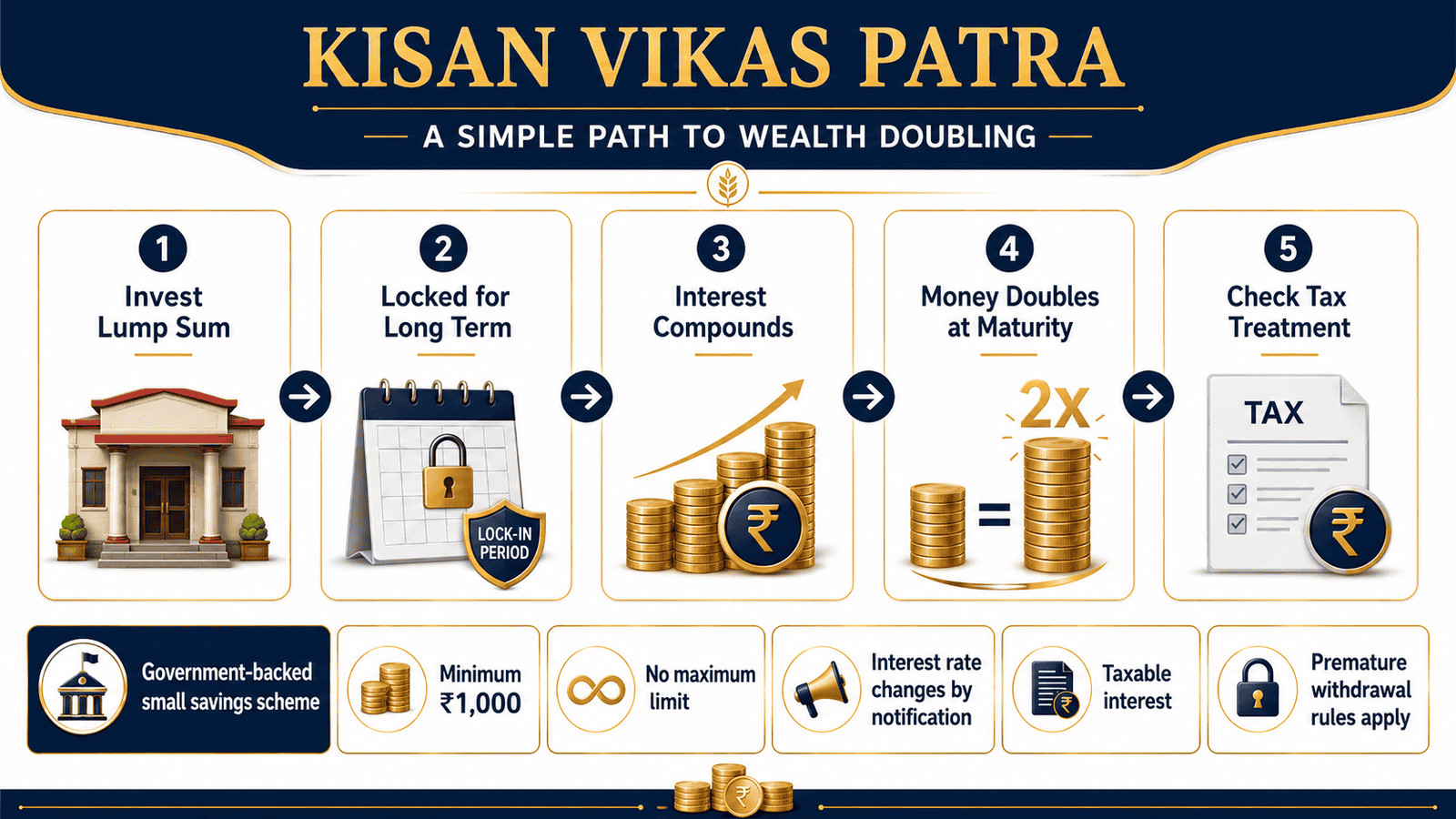
When someone says “your money will double,” it is hard not to pay attention. Kisan Vikas Patra — one of India’s oldest post office savings certificates — has been running on exactly that promise for decades. You invest a lump sum, wait for the maturity period, and receive double the amount back. No market risk, no volatility, no guessing.
But “doubling your money” needs context. At 7.5% compounded annually, that doubling takes roughly 115 months — just under ten years. The interest is fully taxable. And you cannot touch the money easily before maturity. Whether Kisan Vikas Patra is the right choice for you depends on your goal, your tax bracket, and whether you genuinely have a decade to wait.
This article explains how KVP works, what the actual post-tax return looks like, how it compares with FD, NSC, and PPF, and who should — and should not — invest in it. All rate and maturity figures in this article must be verified against official sources before you act on them.
Quick Answer: Kisan Vikas Patra
Kisan Vikas Patra is a government-backed small savings certificate where a lump sum grows to double at maturity. At the current 7.5% rate, money doubles in 115 months, but interest is taxable and liquidity is limited.
Key Takeaways
- Kisan Vikas Patra is a government-backed post office certificate scheme where your investment doubles at maturity — at a 7.5% rate, that takes 115 months (approximately 9 years and 7 months).
- The minimum deposit is ₹1,000 with no upper limit, making KVP accessible for both small savers and those parking larger lump sums.
- There is no Section 80C deduction on KVP investments — unlike PPF or NSC, you get no upfront tax benefit.
- Interest earned on KVP is fully taxable in your hands each year as “income from other sources” — in the 30% bracket, your effective annual yield shrinks significantly.
- Premature withdrawal is allowed after a mandatory lock-in period, but penalties apply — KVP should not be used for money you may need urgently.
- KVP certificates can be transferred, pledged as collateral, and held jointly — features that make them more flexible than a standard FD in certain situations.
- Rate and maturity period change with government notifications — always verify the current figures at nsiindia.gov.in before investing.
Key Facts at a Glance
| Feature | Detail | Source to Verify |
|---|---|---|
| Scheme type | Government-backed small savings certificate | nsiindia.gov.in |
| Interest rate | 7.5% compounded annually | nsiindia.gov.in |
| Maturity / doubling period | 115 months (~9 years 7 months) | nsiindia.gov.in |
| Minimum deposit | ₹1,000 (in multiples of ₹100 thereafter) | indiapost.gov.in |
| Maximum deposit | No upper limit | nsiindia.gov.in |
| Section 80C benefit | Not available | incometax.gov.in |
| Tax on interest | Fully taxable as income from other sources | incometax.gov.in |
| Premature withdrawal | Allowed after lock-in; penalties apply | nsiindia.gov.in |
| Where to buy | Post offices and authorised banks | indiapost.gov.in |
| Nomination | Available | indiapost.gov.in |
What Is Kisan Vikas Patra and How Does It Work?
Kisan Vikas Patra — KVP in short — is a fixed-income savings certificate issued by the Government of India through India Post and authorised banks. The name translates literally to “Farmer Growth Letter,” but any Indian resident adult can invest in it. It is not restricted to farmers or rural investors.
The scheme works on a simple principle: you invest a lump sum today, the government pays you a fixed compounded rate of interest, and at the end of the maturity period you receive exactly double the amount you invested. There is no guesswork. If you invest ₹1,00,000 today, you receive ₹2,00,000 at maturity. The certificate itself records both the investment amount and the guaranteed maturity value.
Why It Is Called a Double Money Scheme
The phrase “double money” comes from the way the scheme is structured. Unlike a recurring deposit where you contribute monthly, KVP is a one-time lump-sum investment. The doubling period is not fixed permanently — it changes each quarter based on the government’s small savings rate notification. According to the National Savings Institute, the current rate is 7.5% compounded annually, which results in a doubling period of 115 months. Any change in the quarterly notification by the Ministry of Finance would change this maturity timeline for new certificates issued after that date.
This is an important detail that many investors miss: the rate on your certificate is locked at the time of purchase, not at the time of maturity. If you buy a KVP certificate today at 7.5%, your doubling period remains 115 months regardless of what the government announces next quarter.
Where You Can Buy KVP
KVP certificates are available at any post office branch across India and at authorised commercial banks. According to India Post, you can purchase them in person by submitting KYC documents and the investment amount. The certificates are now issued in electronic form (e-KVP) in addition to the traditional paper passbook format.
How KVP Differs from Market-Linked Investments
KVP earns a fixed government-declared rate. Your principal is not at risk. The maturity amount is known at the time you invest. This makes KVP fundamentally different from mutual funds, stocks, or ULIPs — all of which depend on market performance. The trade-off is clear: you give up the possibility of higher returns in exchange for complete certainty of outcome. For a family that wants to set aside ₹2 lakh for a child’s education ten years from now without worrying about market crashes, that certainty has real value.
Real Example: A Jaipur Family Parks Savings in KVP
Anil Sharma, 42, from Jaipur, earns ₹12 lakh per year as a logistics manager at a private firm. After building a six-month emergency fund, he has ₹1,00,000 that he does not need for the next decade — earmarked for a home renovation when his daughter finishes school. He wants safety and certainty, not market-linked growth.
Anil visits his local post office and opens a KVP certificate for ₹1,00,000. At the current 7.5% rate, his certificate will mature to ₹2,00,000 in 115 months — roughly when his daughter turns 18.
The catch: Anil is in the 30% tax bracket. Each year, the interest accruing on his KVP is taxable as income from other sources. On a ₹1,00,000 investment at 7.5%, the first year’s interest is approximately ₹7,500 — and ₹2,250 of that goes to tax. Over the full tenure, his effective post-tax yield is meaningfully lower than the headline 7.5%. Anil still finds KVP useful for this goal because he has no better low-risk option for a ten-year fixed sum — but he checks the tax math first rather than relying purely on the doubling promise.
How to Calculate KVP Returns
Maturity Amount = Investment Amount × 2 (at the applicable rate and maturity period)
Effective post-tax return = Headline rate × (1 − your tax slab rate)
KVP’s return logic is simpler than most fixed-income instruments — the maturity value is always exactly double the investment. The variable is time, not amount. Examples using illustrative figures based on the current 7.5% rate:
| Investment Amount | Maturity Amount | Period (at 7.5%) |
|---|---|---|
| ₹50,000 | ₹1,00,000 | 115 months |
| ₹1,00,000 | ₹2,00,000 | 115 months |
| ₹5,00,000 | ₹10,00,000 | 115 months |
Now factor in tax. If Anil is in the 30% bracket and earns ₹7,500 interest in year one on a ₹1,00,000 investment, his post-tax interest is approximately ₹5,250 — an effective yield of around 5.25% for that year. Over the full 115 months, the post-tax compounding effect means the real benefit is noticeably lower than the headline doubling figure suggests. A reader in the 10% or 20% bracket will have a better post-tax outcome. Always calculate returns after your applicable tax rate, not before.
KVP vs FD vs NSC vs PPF: Side-by-Side Comparison
| Parameter | KVP | FD (Bank / Post Office) |
|---|---|---|
| Backed by government | Yes | Partly (DICGC up to ₹5L for banks) |
| Section 80C benefit | No | Only 5-year tax-saver FD |
| Interest taxation | Fully taxable | Fully taxable |
| Maturity period | ~115 months | 7 days to 10 years (flexible) |
| Premature withdrawal | After lock-in with penalty | Usually allowed with penalty |
| Interest rate | 7.5% (verify at NSI) | Varies by bank and tenure |
| Parameter | KVP | NSC | PPF |
|---|---|---|---|
| Section 80C benefit | No | Yes | Yes |
| Interest tax treatment | Fully taxable | Taxable (deemed reinvested) | Tax-free |
| Lock-in period | ~115 months | 5 years | 15 years |
| Government-backed | Yes | Yes | Yes |
| Minimum deposit | ₹1,000 | ₹1,000 | ₹500/year |
| Best for | Lump-sum, no 80C need | Lump-sum + 80C benefit | Long-term, tax-free growth |
For a fuller look at how Public Provident Fund basics stack up against other long-term savings options, including tax treatment and loan availability, that article covers the full picture. If you are specifically weighing lock-in against tax efficiency, compare NSC interest and tax rules in detail before making a decision. And if you are torn between KVP and a fixed deposit, the post office FD comparison breaks down safety, rate, and liquidity differences clearly.
How to Decide What’s Right for You
You have a lump sum you will not need for nine to ten years and want guaranteed, government-backed growth — KVP may suit your goal well.
You are in the 10% or nil tax bracket — KVP’s post-tax return is close to the headline rate, making it a competitive low-risk option.
You want a Section 80C deduction on your investment — KVP does not qualify; consider NSC or a 5-year tax-saver FD instead.
You are in the 30% tax bracket and the post-tax yield works out to around 5.25% — compare this carefully with post office FDs or debt mutual funds before committing.
You need an option where you can access the money in a genuine emergency — always keep your emergency fund planning separate from KVP; the lock-in and penalties make it a poor emergency reserve.
You want both safety and tax-free returns over 15 years — PPF is likely more efficient than KVP for that combination of goals.
You do not yet have an emergency fund, are carrying high-interest debt, or need the money within five years — KVP is not suitable; lock your savings here only after these priorities are addressed.
Common Mistakes to Avoid
Investing Only Because “Money Doubles”
The doubling headline is accurate — but it takes roughly 115 months at the current rate.
At 7.5% compounded annually, money doubles in any instrument that earns the same rate. A bank FD at 7.5% over the same period would also roughly double. KVP’s advantage is its government backing and fixed certificate rate, not a magical doubling formula. Comparing only the maturity headline without looking at the tenure misleads many first-time investors.
Always compare the annualised return, not just the end maturity value.
Ignoring Tax on Interest
KVP interest is fully taxable as income from other sources every year — not just at maturity.
A 30% bracket investor earning ₹7,500 interest on ₹1,00,000 in the first year pays ₹2,250 in tax on that interest alone. Over a 115-month tenure, cumulative tax outgo can reduce the effective yield to around 5.25% — almost two full percentage points lower than the headline rate. This is rarely explained in scheme brochures.
Calculate your post-tax return before comparing KVP with PPF or ELSS, both of which offer tax efficiency that KVP does not.
Using KVP as an Emergency Fund
KVP has a mandatory lock-in period before premature withdrawal is permitted.
Even after the lock-in, early exit comes with a penalty and lower interest payout. If you use KVP for your emergency reserve and a sudden job loss or medical bill hits in year two, you may be unable to access the full amount — or face financial loss to exit early. Emergency funds belong in a liquid savings account or liquid fund, not in KVP.
Keep at least three to six months of expenses separately before locking any money in KVP.
Not Comparing Post-Tax Returns Across Options
Most investors compare only headline rates — KVP at 7.5%, FD at 7.0%, NSC at 7.7% — without adjusting for their tax slab.
For a 30% bracket investor, NSC’s 7.7% is also taxable (though the reinvested interest qualifies for 80C each year, partially offsetting this). PPF’s tax-free return of around 7.1% may end up more valuable than KVP’s 7.5% after tax is factored in. The “best” rate depends entirely on your tax situation.
Run the post-tax numbers before deciding, not after.
Assuming the Rate Is Permanent
The KVP interest rate is reviewed and notified quarterly by the Ministry of Finance.
While the rate on your existing certificate is locked at purchase, any new certificate you buy next quarter may carry a different rate — higher or lower. Investors who see articles quoting a specific rate and assume it will always be that rate make under-informed decisions. Verify the current rate at nsiindia.gov.in before purchasing.
Never invest based on a rate you read online without checking the official source first.
Skipping Nomination
KVP allows nomination, but many investors skip it at the time of purchase.
If the certificate holder passes away without a nominee, the legal heir process to claim the maturity amount can take months and involve significant paperwork. Naming a nominee at the time of purchase costs nothing and saves the family considerable difficulty later. Always fill in the nomination form when opening the KVP certificate.
Review and update your nominee if your family circumstances change.
When This May Not Be the Right Choice
Senior citizens (60+): The Senior Citizen Savings Scheme offers a higher interest rate for those above 60, along with a Section 80C deduction and quarterly interest payouts. KVP gives none of these advantages. A retired investor locking money in KVP for 115 months should first check whether senior citizen savings option meets their goal at a better post-tax return.
Investors specifically seeking 80C deductions: KVP does not qualify for a Section 80C deduction. If your primary goal is to reduce taxable income this financial year, NSC, PPF, ELSS, or a 5-year tax-saver FD will serve that purpose — KVP will not.
Anyone without an emergency fund: Locking savings in KVP before building a liquid emergency reserve is a common and costly mistake. If a financial emergency arises during the lock-in period, early exit from KVP will cost you interest. Build your buffer first.
Investors seeking long-term wealth creation: Over a ten-year horizon, equity mutual funds have historically delivered significantly higher returns than KVP — though with market risk. A young investor in their 30s with a ten-year goal may find that a balanced approach including equity delivers far more. KVP suits conservative capital-preservation goals, not wealth-building objectives.
If any of these apply to your situation, it may be worth exploring alternatives before committing.
Official Rules and Where to Verify
KVP rules, interest rates, and maturity periods are governed by government notifications issued quarterly. Before investing, confirm the current figures directly from these official sources:
- National Savings Institute (nsiindia.gov.in) — The primary source for current KVP interest rates, maturity period, scheme rules, premature withdrawal terms, and rate history.
- India Post (indiapost.gov.in) — Operational details for purchasing KVP at post offices, documentation requirements, and account management.
- Income Tax Department (incometax.gov.in) — Tax treatment of KVP interest, TDS applicability, and reporting requirements for interest income.
Rules, limits, and rates on this topic can change with each Budget or regulatory update. Always verify current figures directly from the official source before making any financial decision.
Expert Tips
- Match KVP to a specific goal, not a vague savings habit. KVP works best when you have a named goal — a home renovation in ten years, a child’s college fund, a defined corpus for a future purchase — that can genuinely wait until maturity. Parking money in KVP without a clear timeline leads to premature withdrawal and penalties.
- Calculate post-tax yield before comparing with any other option. If you are in the 30% bracket, your effective KVP yield is approximately 5.25% after tax. Compare that number — not the 7.5% headline — with post-tax returns on PPF, NSC, FDs, and debt funds. The decision changes significantly once you run the actual numbers.
- Never put your only savings into KVP. Because KVP has a lock-in, it should represent a portion of your fixed-income allocation — not your entire savings. Keep a liquid emergency fund, contribute to EPF or PPF for retirement, and then consider KVP for a specific medium-to-long-term goal.
- Check the current rate on the NSI website every quarter before new investments. The government revises small savings rates quarterly. A rate that was 7.5% in one quarter may change in the next. If you are planning a fresh KVP purchase, verify the rate on the same day you invest — not the week before.
- Use KVP’s collateral feature if needed. KVP certificates can be pledged as collateral for loans with banks and post offices. If you ever need a short-term loan but do not want to break the certificate, this feature lets you borrow against the KVP value without losing the investment. Ask your bank or post office branch for the pledging procedure.
- File the interest in your ITR every year, not just at maturity. KVP interest accrues annually and should be reported each year under “income from other sources” in your income tax return — even though you do not physically receive the interest until maturity. Waiting until maturity to report it could trigger a tax notice for under-reported income in prior years.
Frequently Asked Questions
Is Kisan Vikas Patra a safe investment?
Yes. KVP is issued by the Government of India and backed by sovereign guarantee. Your principal is not at risk from market movements. However, “safe” does not mean suitable for every goal — the lack of liquidity and taxable returns mean safety comes with trade-offs that need to be weighed before investing.
What is the current KVP interest rate?
As per National Savings Institute notifications, KVP currently earns 7.5% compounded annually, which results in a maturity period of 115 months. This rate is reviewed quarterly by the Ministry of Finance. Always verify the current rate at nsiindia.gov.in before purchasing a new certificate, as it can change with each quarterly notification.
How long does it take for KVP to double money?
At the current 7.5% rate, KVP doubles your money in 115 months — approximately 9 years and 7 months. The maturity period changes if the government revises the interest rate for future notifications. The doubling period printed on your certificate at the time of purchase remains fixed for that certificate regardless of future rate changes.
Is KVP interest taxable?
Yes. Interest earned on KVP is fully taxable as “income from other sources” under the Income Tax Act. There is no Section 80C deduction available on the investment. Additionally, TDS applicability on KVP interest should be verified at incometax.gov.in, as rules can change. Report KVP interest in your ITR annually — not just in the year of maturity.
Can KVP be withdrawn before maturity?
Yes, but only after completing the mandatory lock-in period from the date of purchase. According to National Savings Institute guidelines, premature withdrawal before the lock-in period is generally not permitted except in cases such as the death of the account holder or a court order. After the lock-in, early withdrawal is allowed with a reduced interest payout. Verify the current premature withdrawal rules and lock-in period at nsiindia.gov.in before relying on early exit as a plan.
Is KVP better than a fixed deposit?
Not automatically. At 7.5%, KVP’s headline rate may be higher than some bank FDs — but KVP has no liquidity before the lock-in, no 80C benefit, and a fixed 115-month tenure. A bank FD can be structured for any tenure from a few months to ten years, with far more flexibility. For a 30% bracket investor, both instruments are taxable and the post-tax returns are similar. The right choice depends on your tenure, tax situation, and liquidity needs.
Is KVP better than NSC?
It depends on whether you need a Section 80C deduction. NSC qualifies for 80C (up to ₹1.5 lakh per year), while KVP does not. NSC has a 5-year lock-in versus KVP’s roughly 115-month (approximately 9 years 7 months) maturity. Both are government-backed and carry taxable interest. If you do not need the 80C deduction and prefer a longer-horizon lump-sum investment, KVP is a reasonable alternative. If tax saving is a priority, NSC may be more efficient for the same outlay.
Can I open a joint KVP account?
Yes. KVP certificates can be held jointly with another adult. The scheme also permits single accounts and accounts in the name of a minor (operated by a guardian). Joint account holders and nominees can be updated at the post office or authorised bank where the certificate is held.
What happens to KVP after the certificate holder passes away?
If a nominee is registered, the nominee can claim the maturity amount after completing the required documentation at the post office or bank. If no nominee is registered, the legal heir must go through a succession or probate process, which can take considerably longer. This is why nomination is strongly recommended at the time of opening the KVP certificate.
Can I transfer a KVP certificate from one post office to another?
Yes. KVP certificates can be transferred between post offices and from a post office to an authorised bank and vice versa. A transfer request form and relevant KYC documents are required. The certificate value and maturity date remain unchanged after transfer.
Final Verdict
Kisan Vikas Patra is a straightforward, government-backed savings certificate that does exactly what it promises: double your money at maturity. For a conservative investor who has a specific long-term goal, a lump sum to park, and no urgent liquidity needs, it is a credible option. The government backing, fixed maturity amount, and no upper investment limit make it easier to plan around than a market-linked product.
The limitations are equally real. There is no Section 80C deduction. The interest is fully taxable, and at a 30% bracket, the effective post-tax return is meaningfully lower than the headline 7.5%. The lock-in structure is rigid — KVP is unsuitable for anyone still building an emergency fund or carrying high-interest debt.
Before investing, compare the post-tax return against NSC, PPF, post-office FDs, and SCSS (if you qualify). Verify the current rate and maturity period at nsiindia.gov.in. And if you are new to savings and investment planning, reading a basic personal finance guide first will help you place KVP within a complete savings strategy.
Always verify the latest rules from official sources or consult a qualified professional before making any financial decision.
This article is for educational purposes only and should not be treated as personalised financial, tax, investment, insurance, or legal advice. Tax rules, interest rates, regulatory limits, and product features can change with each Budget or policy update. Please verify current rules from official government sources or consult a qualified and registered professional before making any financial decision.

Suresh Nair writes about Indian government savings schemes, post office schemes, and conservative long-term savings options. His content is especially useful for families, parents, senior citizens, and low-risk savers who want to understand scheme rules before depositing money.
He covers topics such as Public Provident Fund, Sukanya Samriddhi Yojana, Senior Citizens’ Savings Scheme, National Savings Certificate, Kisan Vikas Patra, Post Office Monthly Income Scheme, National Pension System, post office fixed deposits, post office recurring deposits, child savings schemes, senior citizen savings options, maturity rules, withdrawal rules, lock-in periods, and tax treatment.
Suresh’s writing is mature, rule-focused, and cautious. He explains eligibility, deposit limits, tenure, interest calculation, tax benefits, withdrawal conditions, and practical use cases in simple language. His articles are useful for readers who prefer safety and predictable rules over high-risk investments. Since government scheme interest rates, deposit limits, lock-in rules, and tax treatment may change through official notifications, readers should verify current details from India Post, PFRDA, Income Tax Department, or relevant government sources before investing.