

You spent decades building a retirement corpus — and now the question is where to park it so that money arrives in your account every three months without you doing anything. For most Indian retirees, the Senior Citizen Savings Scheme is the first government-backed instrument worth examining. It offers sovereign security, a Section 80C deduction on your deposit, and quarterly interest payouts. But the interest rate moves every quarter, the deposit cap is fixed, and the tax treatment of the interest catches many investors off guard. Before you open an account, here is everything you need to understand about SCSS.
Quick Answer: Senior Citizen Savings Scheme
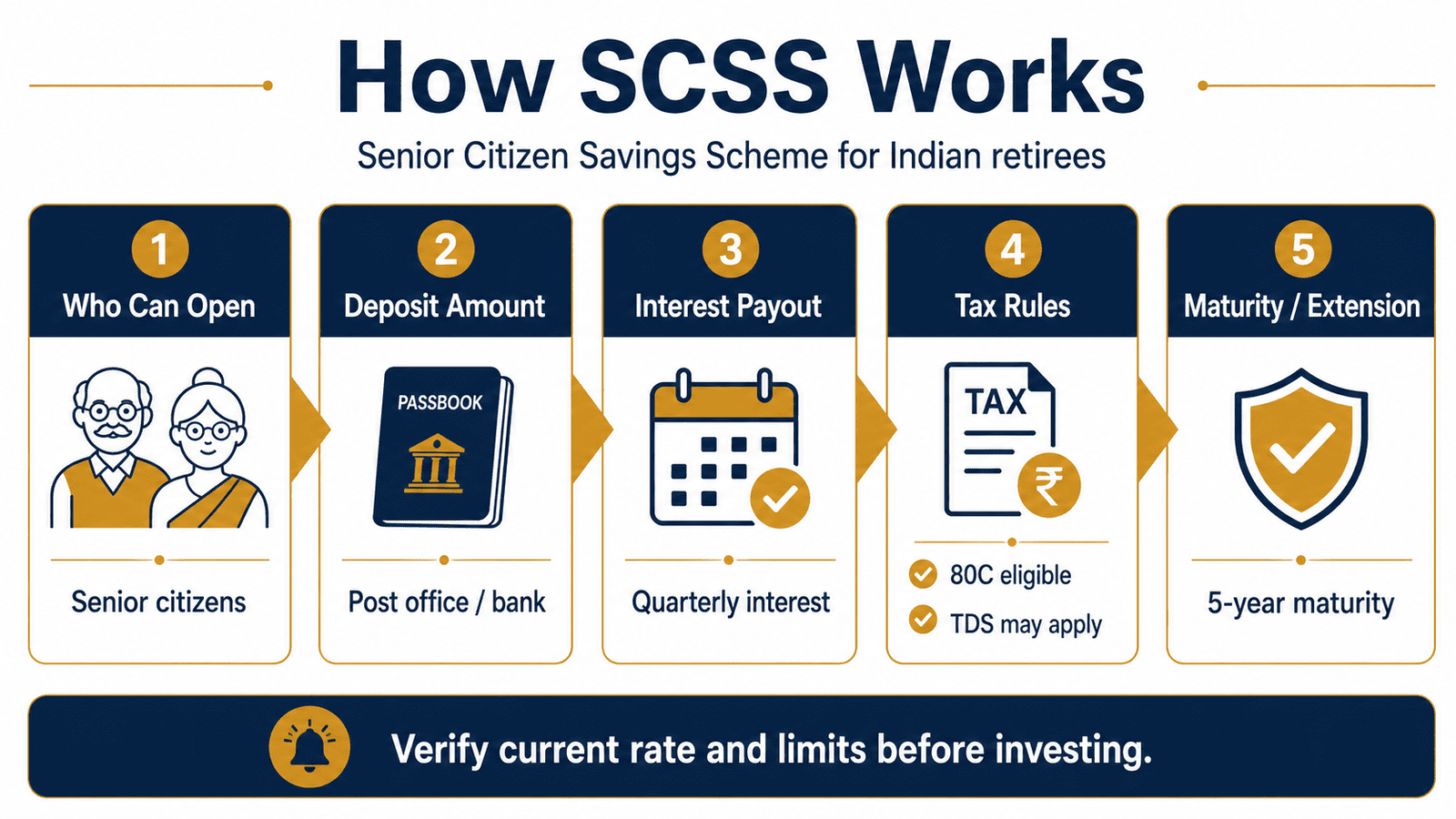
Senior Citizen Savings Scheme is a government-backed savings option for eligible senior citizens that pays quarterly interest and has a fixed maturity period. The current SCSS interest rate, maximum deposit limit, 80C benefit, TDS threshold, and premature closure rules should be verified before investing because these figures can change.
Key Takeaways
- SCSS is a Ministry of Finance small savings scheme available at all post offices and authorised banks — your principal carries sovereign backing, not just the ₹5 lakh DICGC deposit insurance that protects bank FDs.
- The maximum deposit per individual is ₹30 lakh (raised from ₹15 lakh in Budget 2023) — an eligible couple can collectively invest up to ₹60 lakh across two separate accounts.
- Interest is credited quarterly to your linked savings account in April, July, October, and January — making SCSS one of the very few government instruments that generates predictable periodic income.
- The SCSS deposit qualifies for Section 80C deduction up to ₹1.5 lakh — saving up to ₹46,800 in tax for a 30% slab taxpayer in the old tax regime.
- Interest earned is fully taxable at your slab rate — but senior citizens can claim a ₹50,000 deduction under Section 80TTB to partially reduce that tax burden.
- TDS is deducted at source if annual SCSS interest exceeds ₹50,000 — submitting Form 15H every April can prevent TDS if your taxable income is below the threshold.
- Premature closure is allowed after 1 year with a penalty of 1% to 1.5% of the deposit amount — closing before 1 year returns only the principal, with zero interest paid.
Key Facts at a Glance
| Feature | Detail |
|---|---|
| Scheme Type | Government small savings scheme — Ministry of Finance |
| Interest Rate | Revised quarterly — verify current rate before investing |
| Payout Frequency | Quarterly (1 April, 1 July, 1 October, 1 January) |
| Minimum Deposit | ₹1,000 (multiples of ₹1,000 only) |
| Maximum Deposit | ₹30 lakh per eligible individual |
| Tenure | 5 years |
| Extension Option | Once — by 3 years, requested within 1 year of maturity |
| Age Eligibility | 60+ (general); 55–60 for VRS / superannuation; 50+ for defence retirees |
| Section 80C Benefit | Yes — up to ₹1.5 lakh deduction on deposit (old regime only) |
| Interest Taxability | Fully taxable as Income from Other Sources |
| TDS Threshold | Deducted if annual interest exceeds ₹50,000 — verify current threshold |
| Premature Closure Penalty | 1.5% of deposit (1–2 years); 1% (after 2 years); nil interest before 1 year |
| Joint Account | Allowed — with spouse only; first holder must be the eligible individual |
| Where to Open | All post offices and authorised banks including SBI |
What Is the Senior Citizen Savings Scheme?
Senior Citizen Savings Scheme is a government-backed deposit product under India’s small savings scheme umbrella, administered by the Ministry of Finance and available at post offices and authorised commercial banks. It was designed specifically to give retired individuals a safe, government-guaranteed home for their retirement corpus — with the defining feature of regular quarterly interest credited directly to a linked savings account.
Unlike a cumulative fixed deposit that compounds and pays out at maturity, SCSS credits your interest to your account every three months while your principal stays intact. For a retiree managing monthly household expenses, this makes a meaningful practical difference.
How the SCSS Interest Rate Works
The Ministry of Finance reviews small savings scheme rates — including the SCSS rate — every quarter. The rate is not locked in for the full 5-year tenure at the time you invest. Your account earns the rate prevailing for each quarter as revisions are announced. In practice, the SCSS rate has remained relatively stable in recent years, but it has moved in both directions over longer periods. Always verify the current applicable rate from the India Post website or the Ministry of Finance’s small savings notification before depositing.
Eligibility: Who Can Open an SCSS Account
Three categories of Indian residents qualify for SCSS:
- Individuals aged 60 and above — no conditions beyond age and resident status.
- Individuals aged 55–60 who have retired on superannuation or under a Voluntary Retirement Scheme (VRS) — must open the account within one month of receiving retirement benefits.
- Retired defence personnel aged 50 and above — must open the account within three months of receiving retirement benefits, subject to prescribed conditions.
NRIs and HUFs are not eligible. A joint account can be opened with a spouse — but the first holder must be the eligible individual, and the ₹30 lakh deposit limit applies to that individual, not to the joint account as a combined holding.
The ₹30 Lakh Deposit Limit in Practice
Following the Budget 2023 amendment, the maximum aggregate SCSS investment per individual is ₹30 lakh. You can open multiple accounts — at post offices, banks, or both — but the total balance across all your SCSS accounts cannot cross this limit. Any excess deposited beyond ₹30 lakh is returned without interest.
If both spouses are eligible, each can hold a separate SCSS account, allowing the household to place up to ₹60 lakh in SCSS across two accounts. This is a practical planning point for couples with large retirement corpora.
Section 80C Deduction on SCSS
The amount deposited into SCSS — up to ₹1.5 lakh per year — qualifies as a Section 80C deduction under the Income Tax Act. This reduces your taxable income by that amount. For someone in the 30% bracket, a ₹1.5 lakh deposit saves ₹46,800 in tax; for the 20% bracket, the saving is ₹31,200.
This benefit is available only under the old tax regime. The new tax regime does not permit Section 80C deductions. If you invest ₹30 lakh in SCSS, only the first ₹1.5 lakh qualifies for the deduction — the remaining ₹28.5 lakh generates no further 80C benefit.
How SCSS Interest Is Taxed
The quarterly interest SCSS pays is taxed as “Income from Other Sources” at your applicable slab rate. There is no special exemption — unlike PPF, where both interest and maturity proceeds are tax-free.
Senior citizens can, however, use Section 80TTB to soften this. Section 80TTB allows a deduction of up to ₹50,000 per year on interest income from deposits held with banks, post offices, and cooperative societies — SCSS interest qualifies. If your total SCSS interest in a year is ₹2,46,000 and you claim the full ₹50,000 80TTB deduction, only ₹1,96,000 is taxable.
TDS Rules for SCSS Investors
TDS applies on SCSS interest when the total interest paid or credited in a financial year exceeds ₹50,000. The deductor — your bank or post office — deducts TDS at 10% with a valid PAN, or at 20% without one.
If your total income will be below the taxable threshold for the year, you can submit Form 15H at the start of each financial year to prevent TDS from being deducted. This submission is annual — it does not carry forward automatically. Missing the April submission means TDS is deducted from your very first quarterly payout, which you can only recover by filing an ITR and waiting for a refund.
Maturity, Extension, and Premature Closure
SCSS matures 5 years from the account opening date. At maturity, you can withdraw the principal or apply once for a 3-year extension — but only within 1 year of the original maturity date. The extension earns interest at the rate prevailing on the date of the extension application, not the original account rate.
Premature closure rules: before 1 year — no interest is paid, only the principal is returned; between 1 and 2 years — 1.5% of the deposit is deducted as a penalty; after 2 years but before maturity — 1% of the deposit is deducted. The penalty is on the deposit amount. Closing a ₹30 lakh account in Year 2 costs ₹45,000 in penalties alone.
Real Example: Ramesh Parks His Retirement Corpus
Ramesh, 62, from Pune, retired as a production manager from a private-sector manufacturing company with a corpus of ₹35 lakh. He wants predictable quarterly income without any market exposure. He deposits the maximum ₹30 lakh in SCSS at his local SBI branch. The remaining ₹5 lakh goes into a senior citizen FD for emergencies.
At 8.2% per annum, Ramesh’s SCSS generates ₹2,46,000 in annual interest — ₹61,500 credited every quarter. He claims the Section 80TTB deduction of ₹50,000, reducing his taxable SCSS interest to ₹1,96,000. In the 20% tax bracket, he pays approximately ₹39,200 in tax on SCSS interest for the year. He also claims the Section 80C deduction on ₹1.5 lakh of his deposit, saving a further ₹31,200 in tax.
Net post-tax quarterly income from SCSS: approximately ₹51,700. For a retired Punekari with moderate household expenses, this covers most monthly bills comfortably. The trade-off is that ₹30 lakh is locked for 5 years — closing early in Year 2 costs ₹45,000 in penalties. To understand exactly how 80TTB reduces your taxable interest from SCSS and other deposits, read our guide on 80TTB deduction rules for senior citizens.
How to Calculate SCSS Interest
Annual SCSS Interest = Deposit Amount × Interest Rate ÷ 100
Quarterly SCSS Interest = Annual Interest ÷ 4
Using Ramesh’s figures: ₹30,00,000 × 8.2 ÷ 100 = ₹2,46,000 per year ÷ 4 = ₹61,500 per quarter.
For different deposit levels at 8.2%, the quarterly payouts are:
| Deposit Amount | Annual Interest (8.2%) | Quarterly Payout |
|---|---|---|
| ₹5 lakh | ₹41,000 | ₹10,250 |
| ₹10 lakh | ₹82,000 | ₹20,500 |
| ₹20 lakh | ₹1,64,000 | ₹41,000 |
| ₹30 lakh | ₹2,46,000 | ₹61,500 |
All figures above use 8.2% as the reference rate. Verify the current applicable SCSS rate from the Ministry of Finance or India Post before investing — the rate is revised quarterly and these calculations will change accordingly.
Comparison: SCSS vs Senior Citizen FD vs NSC
| Feature | SCSS | Senior Citizen FD | NSC |
|---|---|---|---|
| Principal Safety | Sovereign | DICGC up to ₹5L | Sovereign |
| Interest Payout | Quarterly — auto-credited | Monthly / quarterly / cumulative | None — cumulative at maturity only |
| Maximum Deposit | ₹30 lakh per individual | No upper limit | No upper limit |
| Tenure | 5 years (extendable by 3 years) | Bank-defined — typically 1–10 years | 5 years |
| Section 80C Benefit | Yes | Only 5-year tax-saver FD | Yes |
| Interest Taxability | Fully taxable — slab rate | Fully taxable — slab rate | Fully taxable — accrual basis annually |
| Premature Closure | After 1 year with penalty | Usually allowed with penalty | Generally not permitted before maturity |
For a detailed breakdown of how senior citizen FDs compare — including bank-wise rates and the senior citizen interest premium — read our guide on senior citizen FD rules. To compare SCSS with another sovereign-backed small savings scheme that also provides Section 80C benefits, see our article on NSC tax rules.
How to Decide What’s Right for You
You are 60 or above, want government-guaranteed quarterly income, and have a corpus of ₹5 lakh or more — THEN SCSS should be your first stop before any other fixed-income instrument.
Your retirement corpus is above ₹30 lakh — THEN max out SCSS at ₹30 lakh first and place the remainder in a senior citizen FD or NSC rather than missing the sovereign-backed rate on eligible funds.
You and your spouse are both eligible — THEN open two separate SCSS accounts to collectively deploy up to ₹60 lakh at the SCSS rate, doubling your household exposure without any additional risk.
Your annual SCSS interest will exceed ₹50,000 and your total income is below the taxable threshold — THEN submit Form 15H every April to prevent TDS from being deducted on your quarterly payouts.
You are in the 30% tax slab with substantial pension or other income — THEN use our compare income tax tool to calculate your actual post-tax quarterly return before committing ₹30 lakh for 5 years.
You may need your money within 12 months — SCSS is not suitable. Premature closure before 1 year returns zero interest, and you lose all quarterly payouts received nothing in return for locking the funds.
You are below 55, or aged 55–60 but have not retired on superannuation or VRS — you are not eligible for SCSS regardless of corpus size. Look at NSC, PPF, or senior citizen FDs instead.
Common Mistakes to Avoid
Using a Stale SCSS Rate to Plan Your Income
The SCSS rate is revised every quarter and can change between the time you read an article and the time you deposit.
Planning your monthly budget around a rate you saw six months ago and discovering the actual quarterly payout is ₹3,000–₹5,000 lower creates real financial stress for a retiree on a fixed income. On ₹30 lakh, even a 0.5% rate difference means ₹12,500 less per year.
Always verify the rate for the current quarter at indiapost.gov.in or your bank’s SCSS rate page on the day you plan to invest.
Exceeding the ₹30 Lakh Limit
Any deposit above ₹30 lakh across all SCSS accounts is returned without interest.
Some investors open accounts at both a post office and a bank, lose track of the aggregate, and inadvertently cross the cap. The excess earns absolutely nothing for the entire period it was held.
Keep a note of your combined SCSS balance across all accounts and stay strictly within ₹30 lakh per eligible individual.
Not Submitting Form 15H Every April
Form 15H prevents TDS on SCSS interest if your total income is below the taxable limit — but it must be filed every year, not once.
Skipping April’s submission means TDS is deducted on your first quarterly payment. You can recover it only by filing an ITR and waiting months for a refund. On ₹30 lakh at 8.2%, 10% TDS on the first quarter’s interest is ₹6,150 locked up unnecessarily. For the full picture on TDS mechanics and when to file, see our guide on FD interest TDS rules.
Set a calendar reminder every 1 April to submit Form 15H before the first quarterly interest credit.
Assuming SCSS Interest Is Tax-Free Because of 80C
Section 80C applies to the deposit amount — not to the interest SCSS generates quarterly.
Many investors confuse the 80C deduction on the investment with tax-free income. The quarterly interest hits your “Income from Other Sources” every year at your slab rate. In the 20% bracket, ₹2,46,000 in annual SCSS interest (before 80TTB) creates a tax liability of approximately ₹49,200 if the deduction is not claimed.
Plan for SCSS interest as taxable income and consider paying advance tax in June and September if the quarterly receipts push you above the threshold.
Missing the Section 80TTB Claim
Section 80TTB allows senior citizens to deduct up to ₹50,000 from their total interest income — a deduction many miss because it is separate from 80C and less prominently communicated.
For someone in the 20% bracket, an unclaimed ₹50,000 80TTB deduction costs ₹10,400 in unnecessary tax each year. Over a 5-year SCSS tenure, that is ₹52,000 in avoidable tax outgo.
Claim 80TTB every year when filing your ITR — it covers SCSS, bank FD, and post office interest together.
Treating the Extension as Automatic
SCSS does not auto-extend at maturity — you must apply within 1 year of the original maturity date.
Missing the extension window means the account stops earning interest at the SCSS rate. Funds sitting in a matured SCSS account with no extension request earn only the post office savings account rate — far lower than the SCSS rate — until withdrawal.
Mark your SCSS maturity date in your calendar and plan the extension or withdrawal decision well in advance.
When This May Not Be the Right Choice
SCSS suits most eligible retirees with a sizeable corpus — but not every situation calls for it.
If you are in the 30% tax bracket with substantial pension, rental, or other income, your post-tax SCSS return could be materially lower than the headline rate. A tax-efficient instrument such as tax-free bonds may offer a better net yield at high income levels.
If you need flexible, short-term access to your retirement funds — for a large medical expense, a child’s wedding, or a property purchase within two years — locking everything in SCSS leaves you exposed to premature closure penalties of up to ₹45,000 on a ₹30 lakh deposit.
If you need monthly income rather than quarterly payouts, POMIS (Post Office Monthly Income Scheme) or a senior citizen FD with a monthly interest option may match your cash flow requirements more precisely.
If you are below 55 and do not qualify under the VRS or defence retiree criteria, you simply cannot open this account — regardless of your corpus or intent.
If any of these apply to your situation, it may be worth exploring alternatives before committing.
Official Rules and Where to Verify
SCSS is governed by the Senior Citizens Savings Scheme Rules and administered by the Ministry of Finance. Always verify the figures below directly from official sources before investing:
- India Post (indiapost.gov.in) — current SCSS interest rate, deposit limits, account opening procedures, premature closure rules, and scheme notifications.
- National Savings Institute (nsiindia.gov.in) — quarterly small savings rate circulars and scheme documentation.
- Income Tax Department (incometax.gov.in) — Section 80C applicability, Section 80TTB deduction limit, TDS thresholds, and Form 15H eligibility rules.
- Your bank’s SCSS page — bank-specific account opening forms and current applicable rate confirmation.
Rules, limits, and rates on this topic can change with each Budget or regulatory update. Always verify current figures directly from the official source before making any financial decision.
To understand exactly when you are eligible to submit Form 15H and how to do it correctly, read our step-by-step guide on Form 15H eligibility and submission rules.
Expert Tips
- If your corpus exceeds ₹30 lakh, invest the SCSS maximum first, then ladder the balance across a senior citizen FD and NSC — do not leave the excess in a savings account earning 3–4% while ₹30 lakh earns a government rate at SCSS.
- Open separate SCSS accounts for both eligible spouses to double the household allocation to ₹60 lakh — each account earns independently and both qualify for Section 80C on the first ₹1.5 lakh each.
- Submit Form 15H before the first working day of April every year — not in May after the first quarterly payout has already been hit with TDS.
- If you are approaching a VRS offer between ages 55 and 60, factor in the 1-month window to open SCSS into your retirement planning timeline — missing it means waiting until 60.
- Set an auto-sweep on your SCSS-linked savings account so each quarterly interest credit moves immediately into a liquid fund or recurring deposit — idle interest in a savings account often gets spent before it can be reinvested.
- Always verify the current quarterly rate on the day you plan to deposit — not the rate cited in a news article from the previous month, which may already be outdated.
Frequently Asked Questions
What is the current SCSS interest rate?
The SCSS interest rate is revised quarterly by the Ministry of Finance as part of the small savings scheme cycle. Verify the current rate at indiapost.gov.in or nsiindia.gov.in before opening an account — it can change from one quarter to the next.
Can I open more than one SCSS account?
Yes — you can hold multiple SCSS accounts at post offices and banks simultaneously. However, your combined balance across all accounts cannot exceed ₹30 lakh. Depositing beyond this limit results in the excess being returned without any interest.
Is SCSS interest tax-free?
No. SCSS interest is fully taxable as “Income from Other Sources” at your applicable slab rate. Senior citizens can reduce this burden by claiming a ₹50,000 deduction under Section 80TTB annually. The Section 80C benefit applies only to the deposit amount — not to the interest received.
Can I open a joint SCSS account?
Yes — but only with your spouse. The first account holder must be the eligible individual, and the ₹30 lakh deposit cap applies to that first holder individually, not to the combined joint balance.
What happens if I close my SCSS account before maturity?
Closure before 1 year: no interest is paid — only the principal is returned. Closure between 1 and 2 years: 1.5% of the deposit amount is deducted as a penalty. Closure after 2 years but before maturity: 1% of the deposit amount is deducted. Verify current penalty terms at indiapost.gov.in before closing, as these conditions can be revised.
Can an NRI open an SCSS account?
No. SCSS is restricted to resident Indian individuals. NRIs are not eligible to open an account. Existing account holders who become NRI during the tenure should check the current scheme rules at indiapost.gov.in for the applicable procedure.
When should I submit Form 15H for SCSS?
Submit Form 15H at the start of each financial year — before the first quarterly interest payment in April — if your total taxable income will be below the tax threshold. The form must be filed annually; it does not carry forward from one year to the next.
Can I extend my SCSS account after 5 years?
Yes — once, by 3 years. The extension request must be submitted within 1 year of the original maturity date. The account earns interest at the rate prevailing on the date of the extension application, not at the original rate.
Does SCSS qualify for Section 80C?
Yes — the deposit qualifies for Section 80C deduction up to ₹1.5 lakh per year, but only if you file under the old tax regime. The new tax regime does not allow Section 80C deductions. Confirm your chosen regime before factoring this saving into your investment decision.
What happens to an SCSS account if the holder passes away?
The nominee or legal heir can claim the deposit and accrued interest. In a joint account, the surviving spouse typically continues the account under the scheme’s survivorship rules. Verify the current nomination and continuation process from the post office or bank where the account is held.
Final Verdict
For most eligible Indian retirees, the Senior Citizen Savings Scheme is the strongest government-backed starting point for retirement income planning. The combination of sovereign security, automatic quarterly payouts, a Section 80C deduction on the deposit, and a ₹30 lakh cap makes SCSS genuinely useful — not just on paper. The trade-offs are equally clear: a 5-year lock-in with premature closure penalties, fully taxable interest, and a quarterly rate that moves with government policy. If you are in a lower tax bracket and can commit for 5 years, SCSS very likely offers one of the best post-tax yields available in the government scheme universe. For larger corpora, it works best as the anchor in a broader retirement income plan alongside senior citizen FDs and other instruments. Always verify the latest rules from official sources or consult a qualified professional before making any financial decision.
This article is for educational purposes only and should not be treated as personalised financial, tax, investment, insurance, or legal advice. Tax rules, interest rates, regulatory limits, and product features can change with each Budget or policy update. Please verify current rules from official government sources or consult a qualified and registered professional before making any financial decision.

Suresh Nair writes about Indian government savings schemes, post office schemes, and conservative long-term savings options. His content is especially useful for families, parents, senior citizens, and low-risk savers who want to understand scheme rules before depositing money.
He covers topics such as Public Provident Fund, Sukanya Samriddhi Yojana, Senior Citizens’ Savings Scheme, National Savings Certificate, Kisan Vikas Patra, Post Office Monthly Income Scheme, National Pension System, post office fixed deposits, post office recurring deposits, child savings schemes, senior citizen savings options, maturity rules, withdrawal rules, lock-in periods, and tax treatment.
Suresh’s writing is mature, rule-focused, and cautious. He explains eligibility, deposit limits, tenure, interest calculation, tax benefits, withdrawal conditions, and practical use cases in simple language. His articles are useful for readers who prefer safety and predictable rules over high-risk investments. Since government scheme interest rates, deposit limits, lock-in rules, and tax treatment may change through official notifications, readers should verify current details from India Post, PFRDA, Income Tax Department, or relevant government sources before investing.