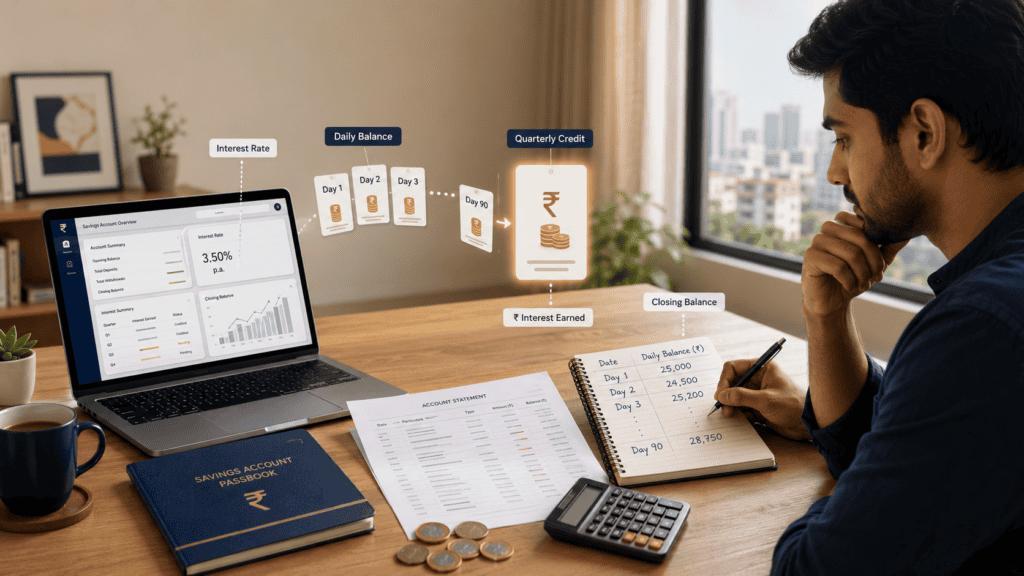
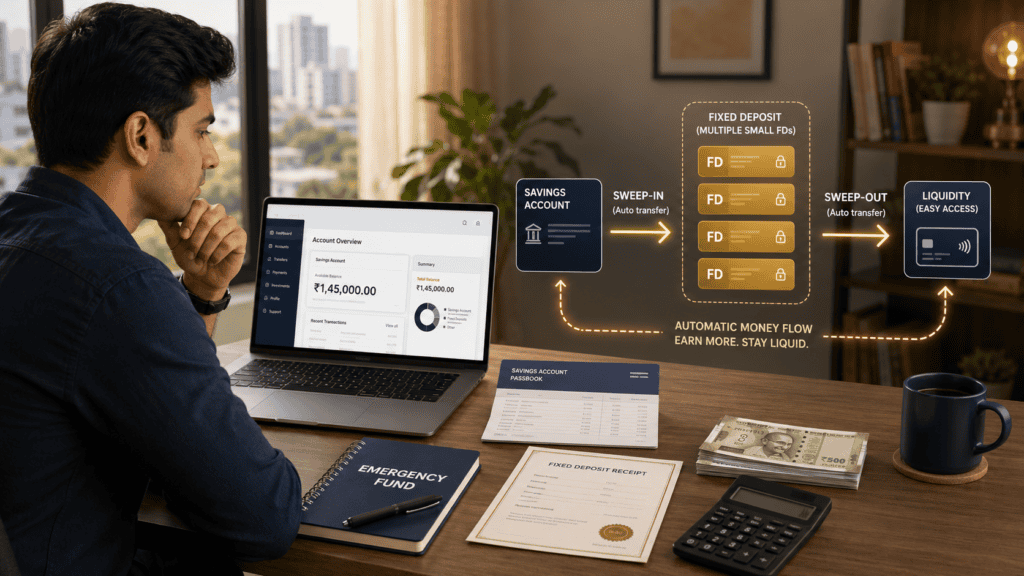
After salary credit, most salaried Indians move money for rent, EMIs, and bills — and then leave whatever is left sitting in a savings account earning 2.5% to 3.5% per year. That idle surplus could be working harder. A sweep-in FD is a facility your bank may already offer that automatically moves that surplus into a fixed deposit, where it can earn a higher FD rate — and sweeps it back the moment your account needs the money. The sweep-in FD meaning is simpler than it sounds, but the terms your bank applies matter enormously. This article explains how it works, what the risks are, who should use it, and exactly what to check before you activate it.
Quick Answer: Sweep-In FD Meaning
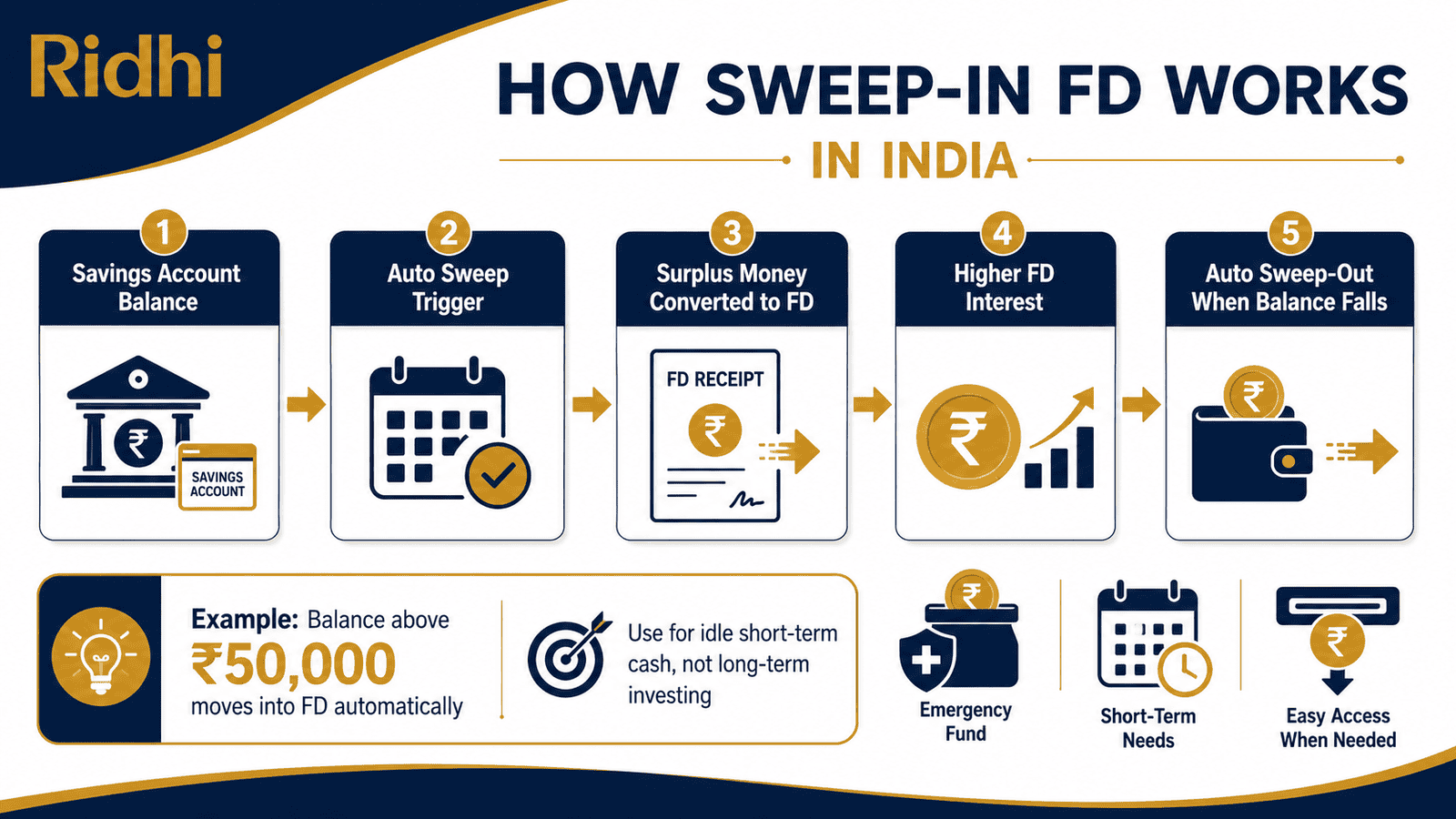
Sweep-in FD meaning is a bank facility where surplus money above a chosen savings account limit is automatically moved into a linked fixed deposit. For example, balance above ₹50,000 may earn FD interest, while money can sweep back when your account needs funds. Terms — including the threshold amount, FD tenure, and premature withdrawal rules — vary by bank. Always check your bank’s specific terms before activating this facility.
Key Takeaways
- A sweep-in FD links your savings or current account to a fixed deposit — surplus above your chosen threshold moves to FD automatically, and can return when your balance falls short.
- Only the swept amount earns FD interest; your base savings account balance continues to earn the lower savings rate, which is typically 2.5%–3.5% for most scheduled banks as of recent data.
- If your salary account regularly holds ₹1–2 lakh idle after expenses, the interest difference between a savings account and a short-tenure FD can add up to several thousand rupees a year.
- Sweep-out (reverse sweep) is triggered when your account balance drops below a minimum — the bank breaks part of your linked FD to fund the shortfall, which may attract a premature withdrawal penalty depending on your bank’s rules.
- FD interest from a sweep-in facility is fully taxable as per your income tax slab; TDS applies if total FD interest from the bank crosses ₹40,000 in a financial year (₹50,000 for senior citizens), as of recent data.
- The facility is not a replacement for financial planning — it works best for short-term idle cash, not long-term wealth building.
- Bank rules for sweep threshold, FD tenure, LIFO withdrawal order, and penalty vary widely — compare your own bank’s terms before deciding.
Key Facts at a Glance
| Feature | How It Works | What to Check |
|---|---|---|
| Product Type | Savings/current account linked to a term deposit | Your bank’s specific product variant |
| Sweep Trigger | Balance above set threshold moves to linked FD | Minimum threshold your bank allows |
| Reverse Sweep (Sweep-Out) | FD broken partially or fully when savings balance is short | Whether penalty applies on partial sweep-out |
| Interest on Swept Amount | FD rate applicable at time of sweep | Current FD rate for chosen tenure at your bank |
| Interest on Base Balance | Savings account rate on retained balance | Your bank’s current savings interest rate |
| Tax Treatment | FD interest added to income; TDS may apply | TDS threshold and Form 15G/15H eligibility |
| Deposit Insurance | Covered under DICGC up to applicable limit per depositor per bank | Current DICGC limit — verify at dicgc.org.in |
What Sweep-In FD Meaning Is — and How the Facility Actually Works
A sweep-in fixed deposit is not a separate product you buy. It is a facility attached to your existing savings or current account. Once activated, the bank monitors your account balance continuously — usually at the end of each day. When the balance crosses a threshold you set during setup, the surplus amount is automatically transferred into a linked fixed deposit. This is the “sweep-in” — money sweeping from savings into FD.
For FD basics explained, a fixed deposit locks a sum at a fixed rate for a chosen tenure. A sweep-in FD works similarly, except the creation and closure of the FD happen automatically based on your savings account activity rather than a manual instruction.
The Sweep Threshold: The Number That Controls Everything
The threshold is the balance your account is allowed to hold before the sweep kicks in. If your threshold is ₹50,000 and your account has ₹1,20,000, the bank sweeps ₹70,000 into a linked FD and leaves ₹50,000 in your account. Only the ₹70,000 earns FD interest. The ₹50,000 base continues to earn your savings rate. Choosing the right threshold is a critical decision — set it too low and you over-invest in FD; set it too high and you leave too much earning the lower savings rate.
The Reverse Sweep (Sweep-Out): When Money Comes Back
When you spend from your savings account and the balance drops below the minimum required level — or below the threshold — the bank triggers a reverse sweep, also called a sweep-out. The bank breaks part of your linked FD to replenish your savings account balance. This is what makes a sweep-in FD feel like a liquid product: you can access the money without manually breaking the FD.
However, the reverse sweep may not be fee-free. Some banks apply a premature withdrawal penalty on the swept-out FD units. The penalty is typically a reduction in the interest rate earned — for example, you may earn 0.5% to 1% less than the applicable FD rate for the period the amount was held. Always check this with your bank before assuming zero-cost liquidity. Understanding savings interest calculation helps you compare what you would have earned had the money simply stayed in your savings account.
LIFO vs. Full-Unit Withdrawal
When a sweep-out happens and you have multiple FD units linked, most banks follow the Last In First Out (LIFO) method — the most recently created FD unit is broken first. This protects the older, longer-held FD units from premature closure. Some banks break a proportional amount. Your bank’s documentation will specify the method — check the sweep-in FD product terms or ask customer support directly.
Why Bank-Specific Rules Matter
According to RBI guidelines at rbi.org.in, banks have flexibility in setting sweep facility terms. This means the threshold amount, FD tenure for swept funds, premature withdrawal penalty, LIFO vs. partial withdrawal approach, and minimum balance rules differ across banks and even across account variants within the same bank. A feature available in a premium salary account may not be available in a basic zero-balance account. Never assume your bank’s sweep-in FD works the same way as what a friend’s bank offers.
Real Example: Rohan’s Sweep-In FD in Action
Rohan, 32, a product manager in Bengaluru earning ₹1,50,000 per month, keeps ₹2–3 lakh in his salary account at any given time for rent, EMIs, school fees, and unexpected expenses. He activates the sweep-in FD facility on his account with a threshold of ₹50,000.
| Stage | Savings Account Balance | Linked FD Balance |
|---|---|---|
| Salary credited (Day 1) | ₹2,50,000 | ₹0 |
| After sweep trigger (Day 1 end) | ₹50,000 | ₹2,00,000 earning FD interest |
| Rent + EMI debited (₹80,000) | Balance would fall to negative | Sweep-out triggered automatically |
| After sweep-out | ₹50,000 restored after ₹80,000 released from FD | ₹1,20,000 remaining in FD |
The ₹2,00,000 held in the linked FD for those few days earned FD interest instead of the lower savings rate. The ₹80,000 swept out may attract a small premature withdrawal interest adjustment depending on Rohan’s bank’s rules. The remaining ₹1,20,000 continues earning FD interest until the next sweep-out event. For Rohan, who held ₹2–3 lakh idle for years, even 30–45 days of FD-rate interest on ₹1–2 lakh makes a visible difference over a year.
How to Calculate Whether Sweep-In FD Is Worth It
The interest difference sounds small per month — but it adds up quickly on large idle balances.
Extra Annual Interest = Swept Amount × (FD Rate − Savings Rate) × (Days Held ÷ 365)
Suppose Rohan keeps ₹1,00,000 in a sweep-in FD for 180 days. His bank’s savings rate is 3% and the applicable FD rate for a short tenure is 6% (example rates only — verify current rates at your bank before relying on these figures).
| Scenario | Amount & Duration | Approximate Interest |
|---|---|---|
| Kept in savings account at 3% | ₹1,00,000 for 180 days | ≈ ₹1,479 |
| Moved to sweep-in FD at 6% | ₹1,00,000 for 180 days | ≈ ₹2,959 |
| Extra interest earned | — | ≈ ₹1,480 pre-tax |
After tax at the 30% slab, the post-tax extra interest would be approximately ₹1,036. That is the net gain for keeping ₹1 lakh in sweep-in FD vs. savings for six months. To use an FD calculator and estimate your own maturity value, note that a standard FD calculator gives a useful approximation — but sweep-in behavior (partial sweep-outs, LIFO breaks) may mean the actual interest earned is lower than a full-tenure FD calculation. Always treat the calculator figure as an upper bound for your sweep-in FD interest.
Comparison: Sweep-In FD vs. Your Other Options
| Parameter | Sweep-In FD | Regular FD |
|---|---|---|
| Liquidity | High — auto sweep-out | Low — manual break needed |
| Interest Rate | FD rate on swept amount only | FD rate on full amount |
| Premature Penalty Risk | Possible on each sweep-out event | Only if you break manually |
| Best Use Case | Idle short-term surplus in salary account | Goal-based medium to long-term saving |
| Tax Treatment | Interest taxable; TDS may apply | Interest taxable; TDS may apply |
| Setup Effort | One-time activation at your bank | Manual creation per deposit |
| Parameter | Sweep-In FD | Savings Account |
|---|---|---|
| Interest Rate | FD rate on surplus, savings rate on base | Savings rate on full balance |
| Access to Funds | Available via auto sweep-out | Immediate, no conditions |
| Penalty Risk | Possible on frequent withdrawals from FD portion | None beyond minimum balance charges |
| Tax | FD interest taxable as income | Savings interest taxable; deduction under 80TTA up to ₹10,000 |
| May suit | Salaried employees with regular large surplus | Anyone needing daily frictionless access |
| Parameter | Sweep-In FD | Liquid Mutual Fund |
|---|---|---|
| Returns | Fixed FD rate on swept amount | Market-linked; historically similar to short FD rates |
| Risk | Negligible credit risk (DICGC covered) | Low but not zero — NAV can fluctuate |
| Tax (as of recent data) | Interest taxed at slab rate | Gains taxed at slab rate (per current rules — verify with SEBI/CBDT guidance) |
| Ease of Use | Fully automatic via bank account | Requires separate investment account |
| May suit | Beginners wanting simplicity | Investors comfortable with fund-based products |
How to Decide What’s Right for You
your salary account regularly holds ₹75,000 or more above your monthly expenses — a sweep-in FD may suit you, because the surplus is large enough to earn a meaningful interest differential over a savings account.
you maintain an emergency fund of 3–6 months’ expenses and want that money accessible but earning more than a savings rate — a sweep-in FD with a conservative threshold can be a practical option. Use the emergency fund amount calculator to first confirm how much you actually need liquid.
your household has predictable large monthly outflows (rent, school fees, EMIs) that leave a clear surplus window — setting the threshold just above those committed expenses can work well.
you are in the 30% tax bracket and the post-tax FD return after a premature penalty is only marginally better than the savings rate — the gain may not justify the setup; compare both net-of-tax figures first.
you frequently make large ad-hoc payments from your account — frequent sweep-outs may reduce the effective interest earned and potentially attract repeated premature penalties; a liquid mutual fund may offer similar returns with fewer friction costs.
you have a clear monthly surplus above your threshold — do not activate the facility hoping for gains; with a thin or inconsistent surplus, sweep-ins and sweep-outs may occur so frequently that penalties offset any interest advantage.
you are looking for long-term wealth creation — sweep-in FD is a short-term idle-cash tool, not an investment strategy; systematic investments in equity mutual funds or PPF will produce meaningfully better outcomes over a 5–10 year horizon.
Common Mistakes to Avoid
Assuming the Entire Account Balance Earns FD Interest
Only the amount swept above your threshold earns FD interest. The base amount retained in your savings account continues earning the lower savings rate. If your threshold is ₹50,000 and your account holds ₹60,000, only ₹10,000 moves to FD — not ₹60,000.
Many users check their savings account statement, see a healthy balance, and assume it is all earning FD returns. Always check your sweep-in FD balance separately in your bank’s app or netbanking.
Ignoring Premature Withdrawal Penalties on Sweep-Out
Each sweep-out event may attract a penalty — typically a 0.5%–1% interest rate reduction on the broken FD amount, though this varies by bank. If you make three large withdrawals in a month, you could trigger three penalty events. Review the premature withdrawal rules and your specific bank’s sweep-out terms before setting up the facility.
The fix: set a realistic threshold that avoids frequent sweep-outs. Your threshold should be above your largest single expected monthly outflow.
Setting the Threshold Too Low
A threshold set at ₹10,000 in an account that receives ₹1.5 lakh and pays out ₹1.4 lakh in bills will trigger almost continuous sweep-in and sweep-out cycles. The FD never gets time to accumulate meaningful interest, and penalties may stack up.
Set the threshold at a level where the money stays in FD for at least 30–60 days between sweep events.
Forgetting TDS and Tax on FD Interest
FD interest — including interest from a sweep-in FD — is added to your income and taxed at your applicable slab rate. If your total FD interest from a bank crosses ₹40,000 in a financial year (₹50,000 for senior citizens), TDS will be deducted. This is easy to miss when the FD is being created and broken automatically. Track your sweep-in FD interest income every quarter.
Not Checking the FD Tenure for Swept Funds
Most banks assign a default FD tenure — say 1 year or 180 days — to swept amounts. If your money sweeps in and the default tenure is 1 year but you break it via sweep-out in 45 days, the bank may apply a premature penalty on those 45-day units. Ask your bank what tenure is assigned to each swept unit and whether you can adjust it.
Treating Sweep-In FD as a Substitute for an Emergency Fund
A sweep-in FD can form part of your emergency fund strategy, but it should not be the only layer. If your bank faces a system outage or there is a delay in sweep processing, immediate access is not guaranteed. Keep a small liquid buffer of ₹10,000–₹20,000 in your savings account at all times, below the sweep threshold, as a first-response layer.
When This May Not Be the Right Choice
If your savings account balance is consistently just above the minimum required balance — say ₹5,000–₹15,000 after monthly expenses — there is not enough surplus to make sweep-in FD worthwhile. The interest gain on a small swept amount may not even cover the time spent setting up the facility.
If you spend frequently and unpredictably from your account — online shopping, ad-hoc transfers, variable bills — frequent sweep-outs may result in repeated premature interest adjustments that erode the FD rate advantage entirely.
If you are in the 30% income tax bracket and the bank you are using offers a FD rate that is only 2–3% above the savings rate, the post-tax difference narrows considerably. A liquid mutual fund, debt fund, or arbitrage fund may provide comparable net-of-tax returns with equal or better liquidity — though each carries its own risk and tax profile.
If you are parking money in a small finance bank for the higher FD rates, note that deposit insurance under DICGC covers up to a certain limit per depositor per bank. Verify the current DICGC limit at dicgc.org.in before concentrating large sums in a single bank’s sweep facility.
If any of these apply to your situation, it may be worth exploring alternatives before committing.
Official Rules and Where to Verify
Sweep-in FD terms are set by individual banks within the broad framework of RBI regulations. Because FD rates, sweep thresholds, and premature withdrawal rules can change with each bank policy review or RBI circular, always verify current terms directly:
- RBI (rbi.org.in) — for broad deposit interest rate guidelines, banking regulations, and customer rights under the fair practice code.
- DICGC (dicgc.org.in) — for current deposit insurance coverage limits per depositor per bank. Verify this before placing large sums in any single bank’s sweep facility.
- Income Tax Department (incometax.gov.in) — for FD interest taxation rules, TDS thresholds, and instructions on submitting Form 15G or Form 15H if you qualify. See also: TDS on FD interest.
- Your bank’s official website — for the specific sweep threshold range, FD tenures assigned to swept amounts, sweep-out method (LIFO or partial), and premature penalty rates applicable to your exact account variant.
Rules, limits, and rates on this topic can change with each Budget or regulatory update. Always verify current figures directly from the official source before making any financial decision.
Expert Tips
- Set your threshold above your largest single monthly outflow. If your rent is ₹30,000 and your EMI is ₹20,000, set the sweep threshold at least at ₹60,000–₹70,000. This ensures a single large debit does not immediately trigger a sweep-out and potential penalty.
- Calculate your post-tax return before comparing. If the FD rate at your bank is 6.5% and you are in the 30% tax bracket, your post-tax FD return is approximately 4.55%. Compare this with the post-tax savings rate and consider whether the difference justifies the operational complexity.
- Ask your bank specifically about the sweep-out method. Find out whether LIFO is used, whether units are broken in multiples of ₹1,000 or the exact required amount, and whether a penalty applies to partially broken units. This one question can change your effective return significantly.
- Review your threshold every quarter. If your salary increases, your rent changes, or you have a large one-time expense (school admission, home repair), your threshold may need adjustment. A threshold set six months ago may not match your current cash-flow reality.
- Track your sweep-in FD interest separately for tax purposes. Your annual interest from a sweep-in FD may be split across several FD units created throughout the year. Ask your bank for a consolidated interest certificate at year-end, or download the FD statement from netbanking before filing your ITR.
- Do not rely on bank marketing materials alone. Many bank brochures highlight the “FD interest on savings balance” benefit without prominently displaying the premature penalty clause. Read the product terms and conditions — specifically the section on sweep-out — before activating.
- Keep a small buffer below the threshold. Maintaining ₹10,000–₹15,000 below your threshold acts as a shock absorber for small unexpected debits and prevents unnecessary sweep-out events.
Frequently Asked Questions
Is sweep-in FD safe?
Sweep-in FD deposits at scheduled commercial banks are covered under DICGC deposit insurance up to the applicable per-depositor, per-bank limit. This is the same insurance protection that applies to regular FDs and savings deposits. Verify the current DICGC limit at dicgc.org.in. The facility itself is offered by regulated banks within RBI’s framework, making it a low-risk product for short-term idle-cash management — though no bank product is entirely without risk.
Does sweep-in FD earn the same interest rate as a regular FD?
In most cases, yes — the swept amount earns the FD rate applicable for the tenure assigned to that sweep unit at the time of the sweep event. However, if a sweep-out happens before the FD tenure completes, the bank may apply a premature withdrawal penalty, effectively reducing the rate earned on that unit. A regular FD held to maturity is not subject to this mid-tenure adjustment unless you break it yourself.
Can I withdraw money from a sweep-in FD at any time?
You do not “withdraw” from the FD directly. When your savings account balance falls short, the bank automatically breaks the required FD units to fund the shortfall (reverse sweep). This happens without you needing to manually break the FD. However, the speed and the conditions of this sweep-out depend on your bank’s system — confirm with your bank whether the sweep-out is real-time or processed at the end of the business day.
Is sweep-in FD a good option for an emergency fund?
It can be one layer of an emergency fund — specifically for the portion that is unlikely to be needed immediately. Sweep-in FD is not ideal as your only emergency fund layer because sweep-out processing may not be instantaneous during system downtimes. A practical approach is to keep one to two months’ expenses in a plain savings account and the remaining emergency corpus in a sweep-in FD. This gives you both immediate access and better returns on the bulk amount.
Is sweep-in FD taxable?
Yes. Interest earned on a sweep-in FD is taxed as “income from other sources” at your applicable income tax slab rate — exactly like regular FD interest. If total FD interest from a bank crosses ₹40,000 in a financial year (₹50,000 for senior citizens), TDS is deducted at the applicable rate. You must declare this interest when filing your ITR, even if TDS has already been deducted.
What is the difference between sweep-in and sweep-out?
Sweep-in refers to money moving from your savings account into the linked FD when your balance exceeds the threshold. Sweep-out (also called reverse sweep) refers to money moving back from the FD to your savings account when your balance falls below a minimum. Both are automatic — you do not need to initiate either transaction. Sweep-in earns you higher interest; sweep-out may attract a premature withdrawal adjustment depending on your bank’s rules.
What happens if I close my savings account — what happens to the linked FD?
If you close your savings account, the linked sweep-in FD is typically broken and the proceeds are paid out, often with a premature withdrawal penalty on the FD units. The exact process depends on your bank. Always check the sweep facility closure terms before closing the linked account, especially if your FD units have substantial accrued interest.
Can I choose my own sweep threshold?
Most banks allow you to set the threshold within a permitted range — for example, a minimum of ₹25,000 or ₹50,000. The exact range depends on your bank and account type. Some premium salary account variants may offer lower minimums or higher flexibility. Check your bank’s sweep-in FD product page or contact customer support for the specific threshold options available for your account.
What is the minimum tenure for a sweep-in FD?
The minimum FD tenure for swept amounts varies by bank. Many banks assign a default tenure of 6 months to 1 year to swept units. Some banks allow shorter tenures of 15 or 30 days. The assigned tenure matters because money swept in and swept out before that tenure is treated as a premature withdrawal. Always confirm the minimum and default tenure at your bank before activating the facility.
What happens if two sweep-in FD units were created and only one needs to be broken?
Banks typically follow LIFO — Last In First Out — breaking the most recently created unit first. If the required amount is less than a full unit, the bank may break an entire unit and return the excess to your savings account, or may allow partial unit breakage depending on their system. This is a bank-specific rule — ask your relationship manager or check the product terms before assuming partial breaks are possible.
Final Verdict
Sweep-in FD meaning is straightforward: it is an automatic facility that puts your idle savings-account surplus to work at FD interest rates, without asking you to manually create or close fixed deposits. For salaried employees like Rohan who routinely hold ₹1–3 lakh idle after monthly expenses, the interest advantage over a savings account is real and worth activating — provided the sweep threshold is set correctly and premature withdrawal rules are understood upfront.
The facility is not magic. It earns more than a savings account only on the swept portion, and only when sweep-outs are infrequent enough that penalties do not offset the gains. Post-tax, in a 30% bracket, the net advantage narrows. And it is not a substitute for a well-structured emergency fund or a long-term investment plan.
Verify your bank’s current sweep threshold, FD tenure, sweep-out penalty, and LIFO rules before activating. Compare the post-tax FD rate with your savings rate. If the difference is meaningful and your cash-flow is predictable, the sweep-in FD is a sensible idle-cash tool. Always verify the latest rules from official sources or consult a qualified professional before making any financial decision.
This article is for educational purposes only and should not be treated as personalised financial, tax, investment, insurance, or legal advice. Tax rules, interest rates, regulatory limits, and product features can change with each Budget or policy update. Please verify current rules from official government sources or consult a qualified and registered professional before making any financial decision.

Meera Iyer writes about banking, fixed deposits, recurring deposits, savings accounts, emergency funds, senior citizen deposits, and safe cash management for Indian readers. Her work is especially useful for families, retirees, conservative savers, and beginners who want to understand where to keep short-term or low-risk money.
She covers topics such as FD meaning, FD calculator, RD calculator, FD vs RD, simple interest vs compound interest, savings account interest, sweep-in FD, premature FD withdrawal, senior citizen FD rules, TDS on FD interest, Form 15G, Form 15H, joint account rules, zero balance accounts, minimum balance charges, small finance bank FDs, post office FD vs bank FD, and emergency fund planning.
Meera’s content focuses on safety, liquidity, taxation, and practical decision-making. She avoids hype and explains both benefits and limitations of banking products. Since deposit interest rates, TDS rules, penalty charges, DICGC coverage, and bank policies can change, readers should always confirm the latest details from their bank, RBI, DICGC, India Post, or relevant official sources before making decisions.