
Every year, millions of Indian FD holders watch TDS get deducted on their interest income — even when their total income is below the taxable limit. The fix is straightforward: submit Form 15G or Form 15H to your bank or post office before the financial year begins. But the two forms are not interchangeable, and submitting the wrong one — or missing the deadline — means the TDS gets deducted anyway, and you are left chasing a refund.
This article walks you through exactly who should submit which form, what the eligibility rules are, how the submission process works, and what the Form 121 update from the Income Tax Department means for declarations from FY 2026–27 onwards.
Quick Answer: Form 15G vs Form 15H
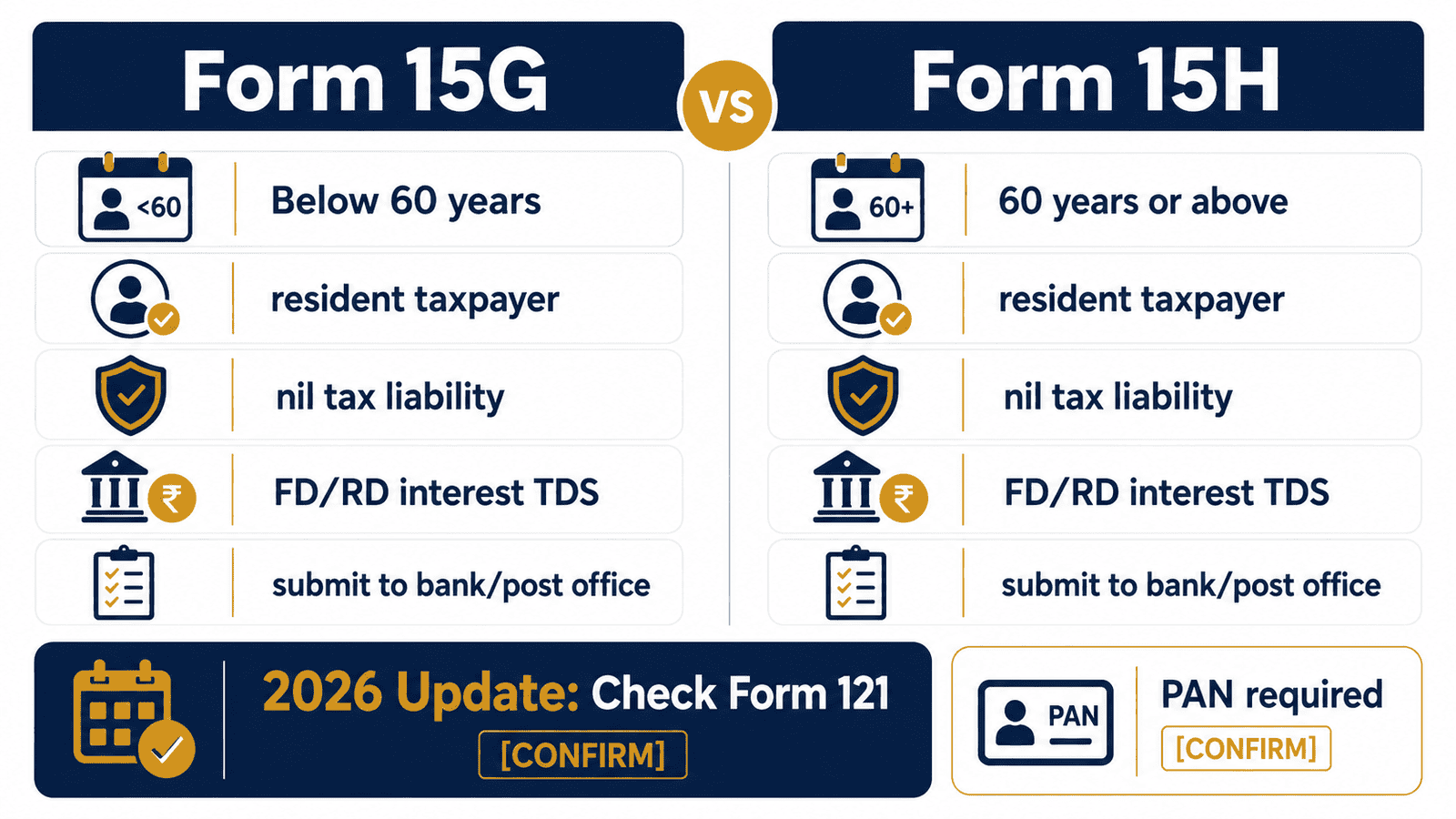
Form 15G vs Form 15H mainly differs by age and eligibility. Form 15G is for resident individuals below 60 years whose estimated total income does not exceed the basic exemption limit and whose estimated tax liability is nil, while Form 15H is for resident senior citizens aged 60 or above whose estimated tax liability is nil. Both are self-declarations submitted to banks or other deductors to prevent TDS deduction on interest income. Always verify the current eligibility thresholds from incometax.gov.in before submitting.
Key Takeaways
- Form 15G is for resident individuals below 60 years; Form 15H is exclusively for senior citizens aged 60 or above — submitting the wrong form makes it invalid.
- For Form 15G, your estimated total income for the year must not exceed the basic exemption limit; Form 15H only requires that your estimated tax liability be nil — there is no income ceiling for senior citizens.
- Banks deduct TDS at 10% on FD interest exceeding ₹40,000 per year (₹50,000 for senior citizens) — a valid 15G or 15H declaration stops this deduction entirely.
- Submit the declaration at the start of the financial year — if you submit after TDS is already deducted for a quarter, you cannot recover that deducted amount except through ITR refund.
- PAN is mandatory on both forms — without a valid PAN, the declaration is rejected and TDS is deducted at 20% instead of 10%.
- From FY 2026–27, the Income Tax Department has indicated that declarations currently filed in Form 15G and 15H must be submitted in the new Form 121 — verify this rule at incometax.gov.in before filing.
- If TDS is deducted despite eligibility, you can claim a full refund by filing your ITR — the amount appears in your AIS and Form 26AS.
Form 15G vs Form 15H: Key Differences at a Glance
| Parameter | Form 15G | Form 15H |
|---|---|---|
| Who can submit | Resident individual below 60 years; HUF | Resident senior citizen aged 60 years or above |
| Age requirement | Below 60 years | 60 years or above during the financial year |
| Income ceiling condition | Estimated total income must not exceed basic exemption limit | No income ceiling — only nil tax liability required |
| Tax liability condition | Estimated tax liability for the year must be nil | Estimated tax liability for the year must be nil |
| TDS threshold triggering need | FD interest above ₹40,000/year per bank | FD interest above ₹50,000/year per bank |
| PAN requirement | Mandatory | Mandatory |
| Validity | One financial year only | One financial year only |
| Can HUF submit | Yes | No |
| Form replacing it (FY 2026–27) | Form 121 (verify at incometax.gov.in) | Form 121 (verify at incometax.gov.in) |
Key Facts at a Glance
| Fact | Detail |
|---|---|
| TDS rate on FD interest (with PAN) | 10% |
| TDS rate without PAN | 20% |
| TDS-free FD interest limit (general) | ₹40,000/year per bank |
| TDS-free FD interest limit (senior citizens) | ₹50,000/year per bank |
| Basic exemption limit (below 60, new regime) | ₹3,00,000 (verify current rate) |
| Basic exemption limit (60–79 years, old regime) | ₹3,00,000 (verify current rate) |
| Basic exemption limit (80 years and above) | ₹5,00,000 (verify current rate) |
| Form validity period | One financial year |
| Governing section | Section 197A of the Income Tax Act |
| Form 121 applicability | Tax years beginning on or after 01.04.2026 (verify) |
Understanding Form 15G and Form 15H in Detail
Both Form 15G and Form 15H are self-declaration forms prescribed under Section 197A of the Income Tax Act, 1961. When you submit a valid declaration to your bank, post office, or NBFC, they are legally required to stop deducting TDS on your interest income for that financial year. For more on how TDS applies to fixed deposit interest, see FD interest TDS rules.
What Is Form 15G?
Form 15G applies to resident individuals below 60 years of age and to Hindu Undivided Families. It has two eligibility conditions that must both be satisfied simultaneously:
- Your estimated total income for the financial year must not exceed the basic exemption limit applicable to you.
- Your estimated tax liability for the year must be nil.
This dual condition makes Form 15G stricter than Form 15H. Even if your FD interest alone is below ₹40,000, if you have other income sources that push your total income above the exemption limit, you cannot submit Form 15G. The form covers interest from fixed deposits, recurring deposits, post office deposits, corporate bonds, and certain other interest-bearing instruments.
What Is Form 15H?
Form 15H is available only to resident senior citizens — individuals who are 60 years of age or above at any point during the financial year. The eligibility rule is simpler: your estimated tax liability for the year must be nil. There is no upper limit on total income, which means a senior citizen with significant pension and FD interest can still submit Form 15H — as long as deductions, exemptions, and the applicable tax slabs bring the final tax liability to zero.
This makes Form 15H considerably more accessible for most retired individuals who have income from pension, FD interest, and savings accounts but whose total tax liability is nil after applying the Section 80TTB deduction of up to ₹50,000 on interest income.
When Does TDS Actually Get Deducted on FDs?
Under current income tax rules, banks deduct TDS when your FD interest from a single bank exceeds ₹40,000 in a financial year. For senior citizens, this threshold is ₹50,000 per bank. This limit applies bank-by-bank — if you have FDs in two different banks, each bank applies the limit independently. However, splitting FDs across banks to stay below the threshold while having total interest income above your exemption limit does not make you eligible for Form 15G. The eligibility is based on your total estimated income — not on how much any single bank pays you.
According to the Income Tax Department at incometax.gov.in, the obligation to deduct TDS is on the deductor (the bank or NBFC). A valid declaration in Form 15G or 15H shifts the responsibility — the deductor cannot deduct TDS once a valid form is received and accepted.
The Form 121 Update for FY 2026–27
The Income Tax Department has indicated that for tax years beginning on or after 01 April 2026, declarations currently submitted in Form 15G and Form 15H must instead be submitted in the new Form 121. This change is part of a broader simplification of income tax forms. At the time of writing, this update is confirmed by the Income Tax Department portal at incometax.gov.in, but the exact implementation details, submission process, and whether older 15G/15H filings remain valid for part of FY 2026–27 must be verified directly from the official source before submitting. If you are reading this before or during FY 2026–27, check incometax.gov.in for the latest Form 121 instructions before making your declaration.
Real Example: Meena’s Situation Before She Turns 60
Meena Sharma, 58, is a retired school administrator from Pune. She receives a pension of ₹4.2 lakh per year and earns approximately ₹1.8 lakh in annual FD interest across two banks. Her total estimated income is therefore around ₹6 lakh for the year — which exceeds the basic exemption limit of ₹3 lakh applicable under the new tax regime.
Even though Meena has not worked for several years and thinks of herself as “not really earning much,” her combined pension and FD interest makes her ineligible to submit Form 15G. Her total income exceeds the exemption limit — both conditions for Form 15G must be met, and she fails the first one.
What should Meena do? She has two options. First, she can allow TDS to be deducted at 10% — which would amount to roughly ₹18,000 on her FD interest alone — and then file her ITR to claim a full refund if her net tax liability after deductions is nil. Second, she can wait: Meena turns 60 next year, at which point she becomes eligible for Form 15H, where only nil tax liability matters — not the income ceiling. Understanding how fixed deposit basics work helps first-time filers like Meena see why TDS on FD is different from TDS on salary.
Key insight: Being close to the ₹3 lakh exemption limit but just over it disqualifies you from 15G — and no partial submission is valid.
How to Calculate Your TDS Exposure on FD Interest
Estimated TDS = FD Interest Income (exceeding threshold) × TDS Rate (10% or 20% without PAN)
Use your projected FD interest for the year — not last year’s figures. You can estimate FD maturity amounts using Ridhi’s FD calculator to get accurate interest projections before checking TDS exposure.
Step-by-step using Meena’s figures:
- Annual FD interest: ₹1,80,000 across two banks — Bank A pays ₹1,10,000 and Bank B pays ₹70,000.
- Bank A TDS threshold (general): ₹40,000. Taxable interest at Bank A: ₹1,10,000 − ₹40,000 = ₹70,000. TDS at Bank A: ₹7,000.
- Bank B TDS threshold: ₹40,000. Taxable interest at Bank B: ₹70,000 − ₹40,000 = ₹30,000. TDS at Bank B: ₹3,000.
- Total TDS deducted across both banks: ₹10,000.
| Scenario | Annual FD Interest | Estimated TDS (10%) |
|---|---|---|
| Below 60 — total income ≤ exemption limit, 15G valid | ₹60,000 | ₹0 (declaration accepted) |
| Below 60 — total income above exemption limit, 15G invalid | ₹1,80,000 | ₹14,000 (across two banks, example above adjusted) |
| Senior citizen — nil tax liability, 15H valid | ₹1,80,000 | ₹0 (declaration accepted) |
How to Decide What’s Right for You
You are a resident individual below 60 years, your estimated total income (pension + FD interest + all other sources) does not exceed the basic exemption limit, and your tax liability is nil — THEN submit Form 15G at each bank at the start of the financial year.
You are a resident individual aged 60 or above and your estimated tax liability for the year is nil — THEN submit Form 15H regardless of your total income level. For more on how senior citizen deposits work and what higher interest rates mean for your TDS position, see Ridhi’s guide.
You are below 60 and your total income exceeds the basic exemption limit (even by a small amount) — THEN you are not eligible for Form 15G. Allow TDS to be deducted and file your ITR to claim a refund if your final tax liability is nil or lower than the TDS deducted.
You have FDs at multiple banks — THEN you must submit a separate Form 15G or 15H at each bank independently. One form does not cover all banks.
You are filing from FY 2026–27 onwards — THEN verify whether the new Form 121 has replaced Form 15G and 15H for your tax year at incometax.gov.in before submitting any declaration. Also see interest deduction rules under Sections 80TTA and 80TTB, which can affect your nil tax liability calculation.
You missed submitting Form 15G or 15H at the start of the year and TDS has already been deducted — THEN you cannot reverse the deduction at the bank level. File your ITR, claim a refund, and submit the declaration for the remaining quarters of the year to avoid further deductions.
Do not submit Form 15G if your estimated total income for the year genuinely exceeds the basic exemption limit — even if you believe deductions will bring your taxable income to zero. Form 15G requires both conditions to be true at the time of submission. Filing a false declaration is a punishable offence under Section 277 of the Income Tax Act.
Common Mistakes to Avoid
Submitting Form 15G When Your Income Exceeds the Exemption Limit
Many filers below 60 assume they can submit 15G simply because they expect their final tax liability to be nil after deductions. Form 15G requires your estimated total income to also stay within the basic exemption limit — not just your taxable income after deductions.
If your gross income is ₹4 lakh but you plan to claim ₹1.5 lakh under 80C to bring taxable income below ₹3 lakh, you still cannot submit Form 15G — because your estimated total income (₹4 lakh) exceeds the exemption limit of ₹3 lakh. This is a false declaration, which carries penalties.
Instead, allow TDS to be deducted and file your ITR. The deducted amount will appear in Form 26AS and AIS; you can claim a full refund if your tax liability after deductions is nil.
Filing the Declaration Late — After the First Quarter Begins
Form 15G and 15H are valid for one financial year only and must be submitted before the first interest payment of that year to avoid TDS on the first quarter. Most people submit them in April each year.
If you submit in June, TDS for the April–June quarter may already be deducted. The bank cannot reverse this — you will need to claim a refund via ITR for the amount already deducted.
Set a calendar reminder every April 1st to submit both forms to every bank where you hold an interest-bearing deposit.
Submitting Only at One Bank When You Have FDs Across Multiple Banks
Form 15G or 15H must be submitted separately at each financial institution where you hold an FD or other interest-earning deposit. A declaration at Bank A has no effect on Bank B.
Forgetting a single bank can result in TDS being deducted at that bank even though your overall tax liability is nil. This is especially common when depositors hold post office FDs or corporate FD accounts in addition to their regular bank accounts.
List all your deposit-holding institutions and submit separately at each one every April.
Not Mentioning Other Income Sources in the Declaration
Both forms ask you to declare your estimated total income from all sources — not just FD interest. Some filers only include FD income and leave out pension, rental income, or interest from other instruments.
An incomplete or understated declaration is treated as a false declaration under the Income Tax Act. Always include all income sources when estimating total income in Part I of the form.
Submitting Without a Valid PAN
PAN is mandatory on Form 15G and Form 15H. If you submit without a valid PAN, the form is rejected and TDS is deducted at 20% instead of 10%. This doubles your TDS burden and increases the refund you need to claim.
If your PAN is not linked to the bank account, resolve the linking before the start of the financial year. Banks and post offices will not process a declaration without a PAN on record.
Assuming the Form Stays Valid Beyond One Financial Year
Form 15G and 15H are valid for one financial year only. Many depositors who submit once assume it is a permanent arrangement. Banks are not obligated to notify you when the form expires.
If you do not resubmit each April, TDS will be deducted automatically from the start of the next financial year once your interest crosses the threshold. Check with each bank every year to confirm your declaration is on file.
Not Verifying Form 121 Applicability for FY 2026–27
The Income Tax Department has indicated that declarations currently made in Form 15G and 15H will need to be submitted in the new Form 121 for tax years beginning on or after 01 April 2026. Submitting an old Form 15G or 15H after the new form becomes mandatory may result in your declaration being rejected.
Before submitting any declaration for FY 2026–27 or later, verify the current valid form at incometax.gov.in. Do not rely on older printed forms or saved PDFs.
When This May Not Be the Right Choice
Submitting Form 15G or 15H is not the right approach in every situation. Consider the following scenarios carefully:
Your total income genuinely exceeds the taxable limit after all deductions. If your pension, FD interest, rental income, and other sources together result in a final tax liability above zero — even after claiming all eligible deductions — you are not eligible to submit either form. Doing so is a criminal offence under Section 277, not a paperwork technicality.
You are a non-resident Indian (NRI). Form 15G and Form 15H are available only to resident individuals. NRIs are not eligible, and TDS rates for NRI FD interest follow a different set of rules under FEMA and the Income Tax Act. Submitting Form 15G or 15H as an NRI will not prevent TDS and may trigger scrutiny.
You expect a significant income increase mid-year. If you sell a property, receive a large one-time income, or change jobs mid-year and your total income may cross the exemption limit, revise your estimate before submitting. An inflated income that makes your declaration false can lead to penalties.
Your tax liability is genuinely above zero under both regimes. If choosing either the old or new tax regime still results in tax payable after all deductions, do not submit the declaration. Pay advance tax instead and file ITR to settle the correct amount.
If any of these apply to your situation, it may be worth exploring alternatives before committing.
Official Rules and Where to Verify
Rules, limits, and rates on this topic can change with each Budget or regulatory update. Always verify current figures directly from the official source before making any financial decision.
The following official sources govern Form 15G, Form 15H, TDS on interest income, and the new Form 121:
- Income Tax Department — incometax.gov.in (Section 197A of the Income Tax Act; Form 121 update; current exemption limits and TDS thresholds)
- Reserve Bank of India — rbi.org.in (applicable for interest rates on bank deposits and regulatory guidance on FD products)
- Your bank’s official website or branch for submission processes and online portal availability
If TDS has already been deducted and you are eligible for a refund, the deducted amount will be visible in your Annual Information Statement (AIS) and Form 26AS. You can claim tax refund for excess TDS by filing your ITR on the Income Tax Department portal.
Expert Tips
- Check your eligibility every April — not just once. Your income, pension, and FD amounts change year on year. An eligibility check you did three years ago does not apply today. Recalculate from scratch every April before submitting.
- Submit online through your bank’s net banking portal. Most major banks — SBI, HDFC, ICICI, Axis, and others — now allow online submission of Form 15G and 15H through net banking. This is faster, produces an acknowledgement immediately, and avoids the branch queue. Log in, look for the TDS or Tax Declarations section, and submit for every eligible account.
- Use Section 80TTB to strengthen your Form 15H eligibility. Senior citizens can claim a deduction of up to ₹50,000 on interest income from banks, post offices, and cooperative societies under Section 80TTB. This deduction directly reduces taxable income and makes nil tax liability far easier to achieve. See how the interest deduction rules work before filing your declaration.
- Keep a copy of every submitted form and its acknowledgement. If a dispute arises later — for example, a bank claiming they did not receive the form — having a dated acknowledgement receipt protects you. For online submissions, download and save the PDF. For physical submissions, ask for a stamped copy.
- Verify Form 121 requirements before filing for FY 2026–27. The transition from Form 15G/15H to Form 121 for tax years beginning 01 April 2026 is a material change. Visit incometax.gov.in in March or April 2026 and check whether the new form is live, what information it requires, and whether it can be submitted online or only offline.
- If you have post office FDs and bank FDs, submit to both. Post office deposits are managed separately from bank accounts. Many depositors forget to submit declarations for their post office FDs. Visit your local post office branch before the first interest payment date for the year.
- Track deducted TDS in AIS quarterly. Log into incometax.gov.in, open your AIS (Annual Information Statement), and check the TDS entries under interest income every quarter. If TDS has been deducted incorrectly after a valid declaration, contact the bank’s TDS team immediately — corrections are far easier to resolve within the same financial year than after March 31.
Frequently Asked Questions
What is the main difference between Form 15G and Form 15H?
Form 15G is for resident individuals below 60 years and HUFs whose estimated total income does not exceed the basic exemption limit and whose tax liability is nil. Form 15H is for resident senior citizens aged 60 or above whose tax liability for the year is nil — with no income ceiling requirement. The age distinction is the most important dividing line.
Can I submit Form 15G if my income exceeds the exemption limit but my tax is nil after deductions?
No. Form 15G requires two conditions to be satisfied simultaneously: your estimated total income must not exceed the basic exemption limit, and your estimated tax liability must be nil. If your total income (before deductions) exceeds the exemption limit, you are not eligible for Form 15G — even if deductions reduce your taxable income to zero. Senior citizens above 60 face no such income ceiling under Form 15H.
What happens if I submit Form 15G but my income later exceeds the limit?
If your actual income turns out to exceed the basic exemption limit, your Form 15G declaration is considered false. Under Section 277 of the Income Tax Act, furnishing a false declaration is a punishable offence. If you realise mid-year that your income will exceed the limit, inform the bank immediately, withdraw the declaration, and allow TDS to be deducted for the remaining quarters. File your ITR and pay any tax due.
Is Form 15G valid for RD interest, savings account interest, or only FD interest?
Form 15G and Form 15H can be submitted for interest income from fixed deposits, recurring deposits, post office time deposits, and certain other instruments specified under Section 197A. However, the TDS threshold for savings account interest works differently — TDS on savings account interest only applies in specific cases. The forms most commonly used in practice are for FD and RD interest at banks and post offices.
What is Form 121 and will it replace Form 15G and 15H?
The Income Tax Department has indicated that for tax years beginning on or after 01 April 2026, the declaration currently submitted in Form 15G and Form 15H must be furnished in the new Form 121. This change is intended to simplify the declaration process. As of now, verify the exact status and submission process at incometax.gov.in — particularly whether Form 121 is already live, what fields it requires, and whether it can be submitted online through banks or only through the tax portal.
Do I need to submit a separate form for each bank?
Yes. Form 15G and Form 15H must be submitted separately at each bank, post office, NBFC, or other financial institution where you hold interest-bearing deposits. A declaration submitted at one institution does not cover other institutions. If you have FDs at SBI and HDFC, submit the form separately at both — and track acknowledgement receipts from each.
Can a senior citizen with ₹6 lakh in FD interest submit Form 15H?
Yes — if their estimated tax liability for the year is nil. For a senior citizen with ₹6 lakh in FD interest, the total tax position depends on pension income, Section 80TTB deductions (up to ₹50,000 on interest), and applicable tax slabs. If, after all eligible deductions and the basic exemption for senior citizens, the tax liability is zero, Form 15H is valid. Run the exact calculation before submitting, and verify current slab rates at incometax.gov.in.
What happens if TDS is deducted despite a valid Form 15G or 15H?
If TDS is deducted after a valid declaration is on file, the bank has made an error. Contact the bank’s TDS department with your declaration acknowledgement and ask for a correction. If unresolved by year-end, the deducted TDS will appear in your Form 26AS and AIS. You can claim a full refund by filing your ITR — the refund is typically processed within a few weeks of filing if your return is filed accurately.
Is there a penalty for not submitting Form 15G or 15H when eligible?
There is no penalty for not submitting — you are not obligated to submit these forms. If you choose not to, TDS will be deducted at 10% (or 20% without PAN) on eligible interest income. You can claim a full refund via ITR if your final tax liability is nil or lower than the TDS deducted. The forms are a convenience mechanism, not a legal obligation on the depositor.
How do I submit Form 15G or 15H online?
Most large banks — including SBI, HDFC, ICICI, Axis, and Kotak — offer online submission through their net banking portals. Log in, navigate to the service or tax section, select Form 15G or 15H, fill in your estimated income details and PAN, and submit. Download the acknowledgement immediately. For post office deposits, physical submission at the branch is typically required — check with your local post office for their current process. From FY 2026–27 onwards, verify whether the new Form 121 has replaced this process entirely at incometax.gov.in.
Final Verdict
The Form 15G vs Form 15H decision comes down to two factors: your age and your estimated tax liability. If you are below 60 and your total income stays within the basic exemption limit with nil tax liability — Form 15G is straightforward and will prevent TDS deduction entirely. If you are 60 or above with nil tax liability — Form 15H is the correct declaration regardless of total income, and for most retired senior citizens with FD interest and pension, it is a realistic option.
Where most people go wrong is submitting the wrong form, submitting late, or not submitting at all and then not claiming a refund. If TDS has already been deducted and you are eligible, do not leave that money with the government — file your ITR and claim tax refund for every rupee deducted in excess of your liability.
For FY 2026–27 and beyond, check whether the new Form 121 is in effect before you visit your bank branch. Always verify the latest rules from official sources or consult a qualified professional before making any financial decision.
This article is for educational purposes only and should not be treated as personalised financial, tax, investment, insurance, or legal advice. Tax rules, interest rates, regulatory limits, and product features can change with each Budget or policy update. Please verify current rules from official government sources or consult a qualified and registered professional before making any financial decision.

Meera Iyer writes about banking, fixed deposits, recurring deposits, savings accounts, emergency funds, senior citizen deposits, and safe cash management for Indian readers. Her work is especially useful for families, retirees, conservative savers, and beginners who want to understand where to keep short-term or low-risk money.
She covers topics such as FD meaning, FD calculator, RD calculator, FD vs RD, simple interest vs compound interest, savings account interest, sweep-in FD, premature FD withdrawal, senior citizen FD rules, TDS on FD interest, Form 15G, Form 15H, joint account rules, zero balance accounts, minimum balance charges, small finance bank FDs, post office FD vs bank FD, and emergency fund planning.
Meera’s content focuses on safety, liquidity, taxation, and practical decision-making. She avoids hype and explains both benefits and limitations of banking products. Since deposit interest rates, TDS rules, penalty charges, DICGC coverage, and bank policies can change, readers should always confirm the latest details from their bank, RBI, DICGC, India Post, or relevant official sources before making decisions.