

You open your mutual fund app and see two numbers side by side: “Absolute Return: 42%” and “XIRR: 16.3%.” Both describe the same investment. Both are technically correct. And if nobody has explained why they look so different, you are probably making decisions based on whichever one looks better — which is exactly the wrong approach.
Mutual fund returns are not a single number. They are three different calculations built for three different situations. Get them confused and you will overestimate a short-term lumpsum, underestimate a long SIP, or compare two funds that cannot meaningfully be compared. This article fixes that — with one unified Indian example, plain maths, and a clear framework for when to use which.
Quick Answer: Mutual Fund Returns
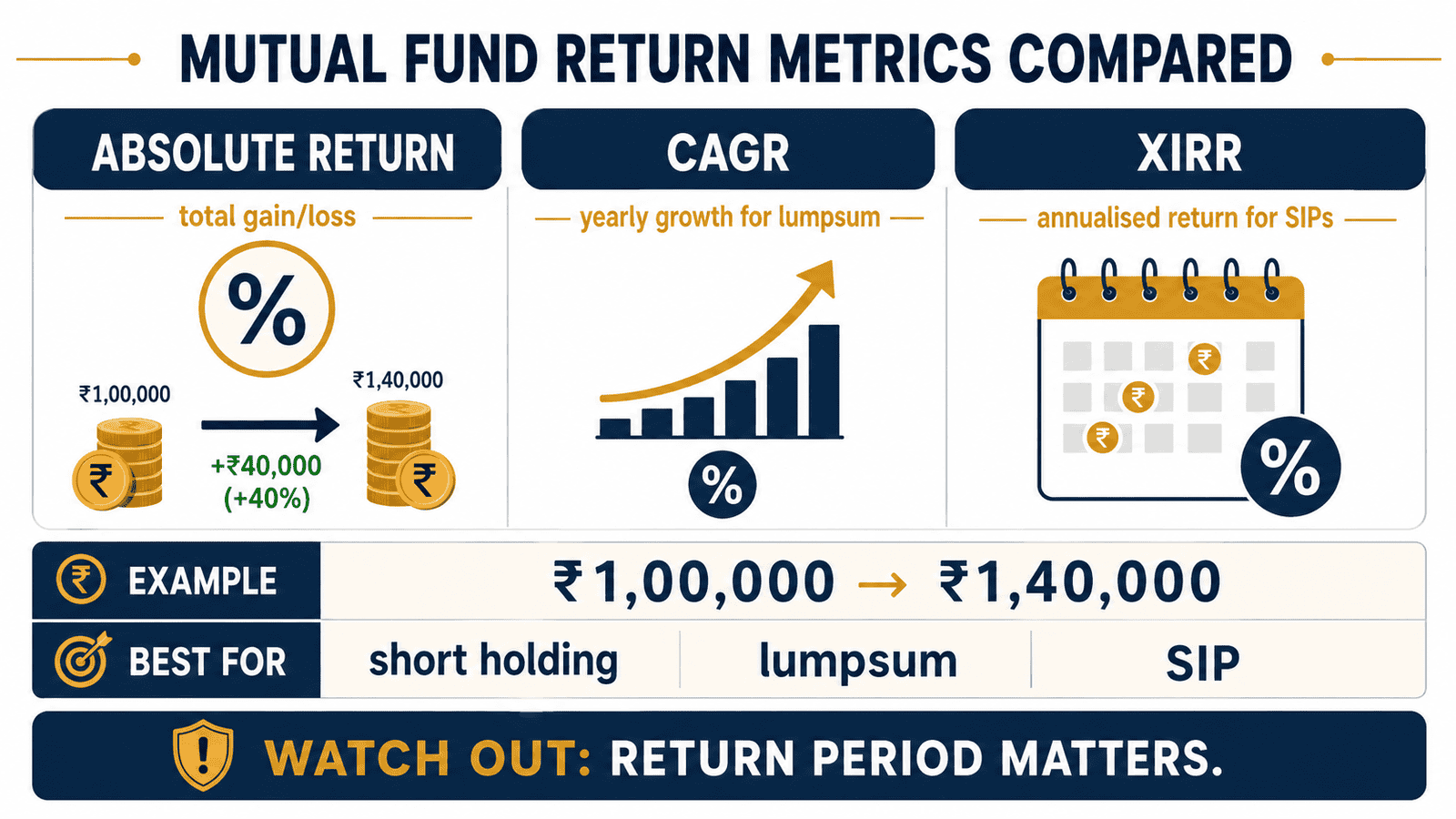
Mutual fund returns are shown differently depending on investment pattern. Absolute return shows total gain, CAGR shows annualised growth for a lumpsum, and XIRR is better for SIPs with multiple dates. For example, a ₹1,00,000 investment growing to ₹1,40,000 has 40% absolute return, but CAGR depends on time.
Key Takeaways
- Absolute return measures total percentage gain — it ignores time completely, making it misleading for anything held longer than one year.
- CAGR (Compound Annual Growth Rate) converts a lumpsum’s total gain into an annualised rate, allowing fair comparison across different holding periods.
- XIRR is the correct metric for SIPs — it accounts for every instalment’s individual investment date and gives you one annualised return figure.
- A 40% absolute return over 2 years is a CAGR of roughly 18.3% — very different from a 40% return over 5 years, which is a CAGR of just 6.96%.
- Fund factsheets and AMC websites always show CAGR-based trailing returns (1-year, 3-year, 5-year) — these apply only to lumpsum comparisons, not your SIP portfolio.
- Your portfolio app shows XIRR for a reason: it is the only honest measure of how your SIP has actually performed given your specific investment dates and amounts.
- Never compare your XIRR to a fund’s 3-year CAGR directly — they are calculated differently and will almost never match, even if you invested in the same fund.
Comparison: Absolute Return vs CAGR vs XIRR
| Parameter | Absolute Return | CAGR | XIRR |
|---|---|---|---|
| Full form | Absolute / Point-to-Point Return | Compound Annual Growth Rate | Extended Internal Rate of Return |
| Best used for | Short-term lumpsum (<1 year) | Lumpsum investments (any period) | SIPs and staggered investments |
| Considers time? | No | Yes | Yes |
| Handles multiple cash flows? | No | No | Yes |
| Output format | % gain on invested amount | % per year (annualised) | % per year (annualised, IRR-based) |
| Used in fund factsheets? | Sometimes (short term) | Yes — standard | Rarely |
| Used in portfolio apps? | Sometimes | Sometimes | Yes — standard for SIPs |
| Can be gamed or misleading? | Yes — ignores time | Only if period cherry-picked | No — most accurate for SIPs |
Key Facts at a Glance
| Metric | Formula / Basis | Key Limitation |
|---|---|---|
| Absolute Return | (Current Value − Invested) ÷ Invested × 100 | No time adjustment — 40% in 1 year ≠ 40% in 5 years |
| CAGR | (Ending Value ÷ Beginning Value)^(1/n) − 1 | Assumes one lumpsum only — breaks down with SIPs |
| XIRR | IRR across all dated cash flows including final redemption | Requires a spreadsheet or app — not a pen-and-paper formula |
| Trailing Return | CAGR from a fixed past date (1Y, 3Y, 5Y) to today | Changes daily — not locked to your personal purchase date |
| Rolling Return | CAGR calculated across every possible start date in a period | Not shown in apps — used for deeper fund analysis only |
Understanding Mutual Fund Returns: CAGR, Absolute, and XIRR
Why Return Metrics Exist in the First Place
When you invest in a mutual fund, your money buys units at a price called the fund NAV basics. Every time you invest, you buy units at that day’s NAV. When you redeem, you sell units at the NAV on that day. The gain is the difference — but expressing that gain as a useful, comparable percentage requires choosing the right formula.
The three main return metrics — absolute return, CAGR, and XIRR — exist because investors behave differently. Some invest a lumpsum once. Some invest ₹10,000 every month for years. Some mix both. No single formula serves all three situations equally well.
Absolute Return: Simple, Fast, Often Misleading
Absolute return is the most basic calculation: how much did your money grow as a percentage of what you put in? If you invested ₹1,00,000 and your current value is ₹1,50,000, your absolute return is 50%.
The problem is time. A 50% return in 8 months is extraordinary. A 50% return in 7 years is ordinary. Absolute return cannot tell you which one is which. This is why SEBI-registered advisers and AMC fact sheets almost never use absolute return as the primary metric for periods longer than one year.
Use absolute return only when your holding period is less than one year — for example, a liquid fund or an ultra short-term investment made a few months ago. For anything longer, it flatters performance by ignoring how long your money was locked up.
CAGR: The Annualised Rate for Lumpsum Investments
CAGR — Compound Annual Growth Rate — solves the time problem. It converts a total gain into an equivalent annual growth rate, as if the investment had grown at a steady pace every year. This lets you compare a fund held for 3 years against one held for 7 years on equal terms.
When you look at a mutual fund factsheet and see “3-Year Return: 14.2%” or “5-Year Return: 11.8%,” those are CAGR figures. They show how much ₹1 lakh invested three or five years ago would have grown annually, compounded, to reach today’s value. According to SEBI’s performance disclosure norms, trailing returns shown by AMCs are CAGR-based for periods above one year.
CAGR works perfectly for a single, one-time investment. Understanding how SIP works makes it immediately clear why CAGR breaks down for monthly investments — because every SIP instalment has a different start date, a different number of years invested, and therefore a different actual return. Averaging them into one CAGR produces a meaningless number.
XIRR: The Only Honest Metric for SIP Portfolios
XIRR stands for Extended Internal Rate of Return. It is the financial industry’s answer to the multiple-cash-flow problem. Instead of assuming a single start date, XIRR takes every individual cash flow — every SIP instalment with its exact date — and computes the one annualised rate that makes all those cash flows equal to the final portfolio value.
This is exactly what your investment app does when it shows your portfolio return. The result is still expressed as an annualised percentage, just like CAGR — but calculated very differently and far more accurately for a staggered investment pattern.
A practical note: XIRR requires a computer or spreadsheet. Excel and Google Sheets both have an =XIRR() function that accepts a column of cash flows (negative for investments, positive for redemptions) and a corresponding column of dates. You do not need to calculate it manually — but understanding what it represents helps you read your portfolio correctly.
Trailing Returns vs Rolling Returns: What Fund Factsheets Actually Show
When you compare funds online, you will see two additional terms. Trailing return is simply CAGR calculated from a fixed past date (say, exactly 3 years ago) to today. It changes every single day. Rolling return calculates CAGR across every possible start date within a period — for instance, every single 3-year window over the last decade — and shows how consistently a fund has performed regardless of when you entered. Rolling returns are rarely shown in consumer apps but are used by analysts for deeper expense ratio impact and quality comparisons.
For a beginner investor, the practical priority is simple: use XIRR to evaluate your own SIP portfolio, and use CAGR (trailing returns) to compare funds against each other and against benchmarks.
Real Example: Rohit’s SIP and Lumpsum Portfolio in Bengaluru
Rohit, 29, is a software engineer in Bengaluru earning ₹1.2 lakh per month. He started a ₹10,000 monthly SIP in a flexi-cap fund exactly 3 years ago — January 2022. He also made a lumpsum investment of ₹1,00,000 in the same fund in January 2022.
After 36 months, his SIP has received 36 instalments of ₹10,000 = ₹3,60,000 total invested. His SIP portfolio value is ₹4,40,000. His lumpsum of ₹1,00,000 has grown to ₹1,39,000.
For the lumpsum: Absolute return = (₹1,39,000 − ₹1,00,000) ÷ ₹1,00,000 × 100 = 39%. CAGR = (1.39)^(1/3) − 1 = approximately 11.6% per year.
For the SIP: Absolute return = (₹4,40,000 − ₹3,60,000) ÷ ₹3,60,000 × 100 = 22.2%. But this 22.2% ignores the fact that his first instalment was invested for 36 months and his last for just 1 month. His app computes XIRR — which in this case is approximately 13.8% per year.
The key insight: his SIP XIRR of 13.8% is more meaningful than his SIP’s 22.2% absolute return, because it accounts for the actual time each rupee was working for him. And it is slightly higher than his lumpsum CAGR of 11.6% in this scenario — partly because later SIP instalments bought units at lower NAVs during a dip in mid-2022.
How to Calculate Mutual Fund Returns
Absolute Return = (Current Value − Amount Invested) ÷ Amount Invested × 100
CAGR = (Ending Value ÷ Beginning Value) ^ (1 ÷ Years) − 1
XIRR = Computed by Excel/Sheets =XIRR(cash flows, dates) — annualised IRR across all dated cash flows
Using Rohit’s lumpsum numbers step by step:
- Beginning value: ₹1,00,000 | Ending value: ₹1,39,000 | Years: 3
- Absolute return: (₹39,000 ÷ ₹1,00,000) × 100 = 39%
- CAGR: (1,39,000 ÷ 1,00,000)^(1/3) − 1 = 1.39^0.3333 − 1 = ≈11.6% per year
| Scenario | Key Inputs | Result |
|---|---|---|
| Lumpsum ₹1L → ₹1.39L in 3 years | Absolute: 39% | CAGR basis: 3 years | CAGR ≈ 11.6% p.a. |
| Lumpsum ₹1L → ₹1.40L in 2 years | Absolute: 40% | CAGR basis: 2 years | CAGR ≈ 18.3% p.a. |
| Lumpsum ₹1L → ₹1.40L in 5 years | Absolute: 40% | CAGR basis: 5 years | CAGR ≈ 6.96% p.a. |
| SIP ₹10,000/mo × 36 months → ₹4.4L | Total invested: ₹3.6L | Multiple cash flow dates | XIRR ≈ 13.8% p.a. |
To estimate your own SIP outcomes and understand how time changes results, use the SIP return estimate tool on Ridhi.
How to Decide What’s Right for You
You made a single lumpsum investment and want to compare it to a benchmark or another fund — THEN use CAGR. It is the standard for point-to-point lumpsum comparison.
You are evaluating your SIP portfolio — THEN use XIRR. It is the only metric that correctly weights each monthly instalment by how long it was actually invested.
Your holding period is less than 12 months — THEN use absolute return. CAGR for sub-one-year periods amplifies short-term results into annualised rates that are not realistic projections.
You want to compare two funds against each other before investing — THEN compare their 3-year and 5-year CAGR trailing returns from AMC factsheets, on the same date. Do not compare your personal XIRR to a fund’s CAGR.
You are deciding between lumpsum or SIP and want to evaluate past performance to inform your choice — THEN use CAGR for the lumpsum scenario and XIRR for the SIP scenario. Do not mix the two in one comparison.
Your app shows XIRR of 14% and the fund’s published 3-year return is 12% — THEN do not assume you outperformed the fund. Your XIRR depends on your specific instalment dates, market levels at each entry, and actual amounts invested.
You do not understand which metric is being shown — do not use the return figure to make a buy, hold, or redeem decision until you have confirmed what calculation it is based on.
Common Mistakes to Avoid
Comparing XIRR to Fund CAGR Directly
Your portfolio app shows XIRR. The fund factsheet shows CAGR. These are not the same calculation and will rarely match even for the same fund over the same period.
Investors who see XIRR of 16% and a fund CAGR of 19% sometimes panic and switch funds — when in reality the gap is entirely due to the calculation method and their specific SIP entry dates.
Always compare like with like: CAGR to CAGR for lumpsum benchmarking, XIRR to XIRR for SIP performance evaluation.
Using Absolute Return for Long Holding Periods
A ₹50,000 investment that grew to ₹90,000 sounds impressive at 80% absolute return — until you realise it took 9 years, making the CAGR only about 6.7% per year, barely above a savings account.
Absolute return hides duration. For anything held longer than 12 months, always convert to CAGR or check XIRR.
Use absolute return only for ultra short-term holdings like liquid funds held for 3–6 months.
Ignoring the Impact of the Expense Ratio on Reported Returns
All returns shown by AMCs — whether CAGR or absolute — are net of the fund’s expense ratio. But direct and regular plans have different expense ratios, which means their returns differ even though they invest in identical portfolios.
A regular plan showing 12% CAGR versus a direct plan showing 13.2% CAGR over 5 years is a ₹14,000 gap on a ₹1,00,000 investment. Check whether you are looking at direct and regular plans before comparing across platforms.
Always compare funds on the same plan type (direct vs direct, regular vs regular).
Treating 1-Year Return as a Fund’s True Performance
A fund showing 38% return over 1 year looks outstanding. But 1-year returns are driven heavily by recent market conditions, not fund quality.
A fund that returned 38% in one bull year may have delivered only 7% CAGR over 5 years due to a bad earlier period. Always look at 3-year and 5-year CAGR alongside 1-year figures for a balanced picture.
Use at least 3-year CAGR as your minimum baseline for equity fund comparison.
Assuming XIRR of 18% Means the Market Returned 18%
XIRR is personal. Two investors in the same fund over the same period can have very different XIRRs if they invested different amounts at different times or paused their SIP during a market dip.
Never use your personal XIRR to claim a fund or the market “returned” a fixed rate. Your XIRR reflects your behaviour as much as the fund’s performance.
Use XIRR to evaluate your portfolio decisions — not to benchmark a fund for a friend’s comparison.
Forgetting to Include Dividends or Growth Option Differences
Dividend option funds pay out periodic income, reducing the NAV. If you compare a growth option fund’s CAGR to a dividend option fund’s CAGR without accounting for dividends received, you will underestimate the dividend fund’s total return.
Returns quoted on AMC websites almost always refer to the growth option. If you are in the dividend option, calculate your actual total return including all dividends received.
For consistent comparison, always use growth option NAV-based returns when evaluating fund performance.
Picking a Fund Because Its CAGR Is Highest on One Specific Date
Trailing returns change daily. A fund ranked first by 3-year CAGR today may have been ranked fifth three months ago, simply because the benchmark window shifted.
This is why analysts prefer rolling returns over trailing returns — rolling returns show consistency across all entry points, not just the most flattering current window.
Do not finalise a fund selection based on a single trailing return snapshot. Check at least two time periods and compare against a relevant benchmark.
When This May Not Be the Right Choice
If your investment horizon is under 3 years, CAGR and XIRR comparisons across equity funds become less meaningful — short-term equity fund returns are heavily driven by market timing rather than fund quality. Debt or hybrid funds may be more appropriate, and their return metrics behave differently due to accrual income and lower volatility.
If you are a very active investor who frequently tops up, partially redeems, or switches between funds mid-period, XIRR from your app may not capture each transaction cleanly depending on how the platform calculates it. In such cases, a verified XIRR from your own =XIRR() spreadsheet using CAS statements is more reliable.
If you are comparing international funds or fund-of-funds (FoFs), currency and underlying-fund expense ratios add layers that straight CAGR comparisons do not capture. These require additional analysis beyond return metrics alone.
If any of these apply to your situation, it may be worth exploring alternatives before committing.
Official Rules and Where to Verify
Return calculation norms and disclosure standards for mutual funds in India are governed by SEBI. AMCs are required to display standardised performance data in their factsheets and on their websites per SEBI’s guidelines on performance disclosure.
- SEBI (Securities and Exchange Board of India) — sebi.gov.in
Rules, limits, and rates on this topic can change with each Budget or regulatory update. Always verify current figures directly from the official source before making any financial decision.
Expert Tips
- Download your Consolidated Account Statement (CAS) from CAMS or KFintech and run your own =XIRR() in Google Sheets using actual transaction dates and amounts — this gives you the most accurate personal return figure, more reliable than app estimates which may lag or round.
- When evaluating a fund’s factsheet, always look at 3-year and 5-year CAGR together, not just the most recent 1-year figure. A fund that shows 35% in 1 year but only 10% over 5 years has had one good year, not consistent performance.
- Use the benchmark comparison in a factsheet as actively as the fund return itself. A fund showing 14% 5-year CAGR is strong — unless its Nifty 50 benchmark delivered 15.5% over the same period.
- If you invest in a direct and regular plans comparison reveals that over 10 years, a 1% lower expense ratio compounds to a meaningful difference in final corpus — always verify which plan type you hold before comparing returns across platforms.
- Never annualise a sub-one-year return manually by multiplying. A 6% gain in 3 months is not a 24% annualised return in any meaningful sense — it implies compounding that rarely holds over a full year in an equity fund context.
- When your SIP XIRR drops during a market correction, do not panic-redeem. XIRR will temporarily fall as recent NAVs pull down the portfolio value, even though older instalments may have compounded well. The metric is forward-sensitive by design.
- Set a calendar reminder to check rolling returns (available on Value Research Online or Morningstar India) before your next annual review — they give a far more honest picture of fund consistency than the trailing return shown on any given date.
Frequently Asked Questions
What is the difference between CAGR and XIRR in mutual funds?
CAGR calculates the annualised growth rate of a single lumpsum investment between two dates. XIRR calculates the annualised internal rate of return across multiple cash flows — each with its own date and amount. For a SIP with 36 monthly instalments, only XIRR accounts for the fact that your first instalment was invested for 36 months while your last was invested for 1 month. CAGR cannot handle multiple entry dates.
Which return metric should I use for my SIP portfolio?
Always use XIRR for SIPs. Your investment app will calculate it automatically. If you want to verify manually, export your transaction history from your CAS statement and use =XIRR() in Excel or Google Sheets with the cash flows (negative for investments, positive for the current portfolio value as a single final entry) and corresponding dates.
Can I compare my SIP XIRR to a fund’s 3-year CAGR?
Not directly. The fund’s 3-year CAGR assumes one lumpsum invested exactly 3 years ago. Your XIRR depends on your specific instalment amounts and dates. Even if you invested in the same fund, your XIRR will almost never match the fund’s trailing CAGR. To benchmark your SIP, compare your XIRR to the XIRR of a hypothetical SIP in the benchmark index over the same period — some platforms offer this.
What is absolute return and when is it useful?
Absolute return is simply (Current Value − Invested Amount) ÷ Invested Amount × 100. It is useful and honest only for short holding periods — typically under 12 months — where annualisation would produce misleadingly high numbers. For liquid fund investments held for 3–6 months, absolute return is the appropriate metric.
Is a higher XIRR always better?
Generally yes, a higher XIRR means your money has compounded faster given the actual cash flows and their dates. However, XIRR is highly sensitive to timing. Investing a large amount just before a market rally will produce a high XIRR due to timing luck, not necessarily fund quality. Evaluate XIRR alongside the fund’s own CAGR and benchmark performance to distinguish skill from timing.
What happens to my XIRR if I pause my SIP for a few months?
A SIP pause affects your XIRR because the gap changes the cash flow dates and timing of reinvestment. If the market rises during a pause, you miss those units at lower NAVs, which can reduce your XIRR relative to an uninterrupted SIP. If the market falls during a pause, missing those lower NAV units may slightly increase XIRR. The impact varies case by case.
Why does my mutual fund app show a different return than the AMC website?
Your app is showing your personal XIRR based on your actual transaction history. The AMC website shows trailing CAGR calculated from standardised fixed dates (1 year ago, 3 years ago, 5 years ago). Both are correct — they are answering different questions. Your XIRR tells you how your specific investment performed. The AMC’s CAGR tells you how the fund would have performed for a lumpsum investor who entered on a fixed benchmark date.
How is the 1-year, 3-year, 5-year return shown on a fund factsheet calculated?
These are trailing CAGR returns. The 3-year return, for example, takes the NAV from exactly 3 years ago today and compares it to today’s NAV, then expresses the annualised growth rate. The benchmark is also calculated the same way, which is why they are directly comparable. These figures change every day as today’s date and therefore the reference date also changes.
What is annualised return and is it the same as CAGR?
Annualised return is a broad term meaning any return expressed on a per-year basis. CAGR is one type of annualised return — specifically the smoothed compound growth rate for a single investment. XIRR is also an annualised return but uses the IRR method for multiple cash flows. When someone says “annualised return” without specifying which method, they usually mean CAGR for a lumpsum context.
Can I use CAGR to estimate future mutual fund returns?
You can use historical CAGR as a rough reference — for example, Indian large-cap equity funds have delivered approximately 12–15% CAGR over long periods historically. But past CAGR does not guarantee future returns. Market conditions, interest rate cycles, fund management quality, and your holding period all affect actual outcomes. Mutual fund investments are subject to market risks. Past performance does not guarantee future returns.
Final Verdict
Mutual fund returns are not a single number — they are a set of tools, each designed for a specific situation. Absolute return is honest only for short-term holdings under one year. CAGR is the right measure for a single lumpsum investment and for comparing funds on equal terms. XIRR is the only accurate metric for SIP portfolios with multiple dated cash flows.
For most Indian investors like Rohit — investing ₹10,000 monthly through a SIP — XIRR is the number that actually reflects how their money has compounded. Fund factsheet CAGRs are a useful benchmark for fund selection, not a mirror of personal portfolio performance.
Read your app’s XIRR, compare funds using their AMC factsheet CAGR, and never use a sub-one-year absolute return to judge a long-term investment. If you want to plan how far your monthly SIP can take you, the SIP return estimate tool on Ridhi is a practical starting point. Always verify the latest rules from official sources or consult a qualified professional before making any financial decision.
This article is for educational purposes only and should not be treated as personalised financial, tax, investment, insurance, or legal advice. Tax rules, interest rates, regulatory limits, and product features can change with each Budget or policy update. Please verify current rules from official government sources or consult a qualified and registered professional before making any financial decision.

Arjun Kapoor writes about mutual funds, SIPs, ELSS, fund categories, investment returns, and beginner investing concepts for Indian readers. His focus is on education, not product promotion or fund recommendations. He helps readers understand how mutual funds work before they start investing or comparing schemes.
He covers topics such as mutual fund meaning, SIP meaning, SIP calculator, direct mutual funds vs regular plans, NAV, ELSS tax-saving funds, CAGR, absolute returns, XIRR, expense ratio, large cap vs mid cap vs small cap funds, flexi cap funds, index funds vs active funds, liquid funds, debt mutual funds, SIP pause vs SIP stop, lumpsum vs SIP, and how to start SIP in India.
Arjun’s writing is simple, risk-aware, and long-term oriented. He avoids guaranteed-return language and explains investment concepts using examples, timelines, and comparison tables. His articles remind readers that mutual fund investments are subject to market risks, and past performance does not guarantee future returns. Readers should verify scheme details from SEBI, AMFI, fund houses, and official scheme documents.