

If you have ever tried to invest in a mutual fund online, you have probably seen two options for the same scheme: a direct plan and a regular plan. They look almost identical — same fund name, same fund manager, same portfolio — yet their NAVs are different and so are their returns over time. Most investors either pick one without understanding why, or assume the higher NAV of the direct plan means it costs more. Neither is quite right.
The difference between direct and regular mutual fund plans comes down to one thing: how the distribution cost is handled. Direct plans cut out the intermediary, which usually means a lower expense ratio and a slightly higher NAV over time. Regular plans include a distributor’s commission in their running cost, which adds a small but compounding drag. Whether that drag is worth paying depends entirely on what you are actually getting in return.
This article breaks down the direct mutual fund vs regular plan comparison clearly — costs, NAV, real SIP numbers, switching cautions, and a decision framework that works whether you are a first-time SIP investor or someone already holding a regular-plan portfolio.
Quick Answer: Direct Mutual Fund vs Regular Plan
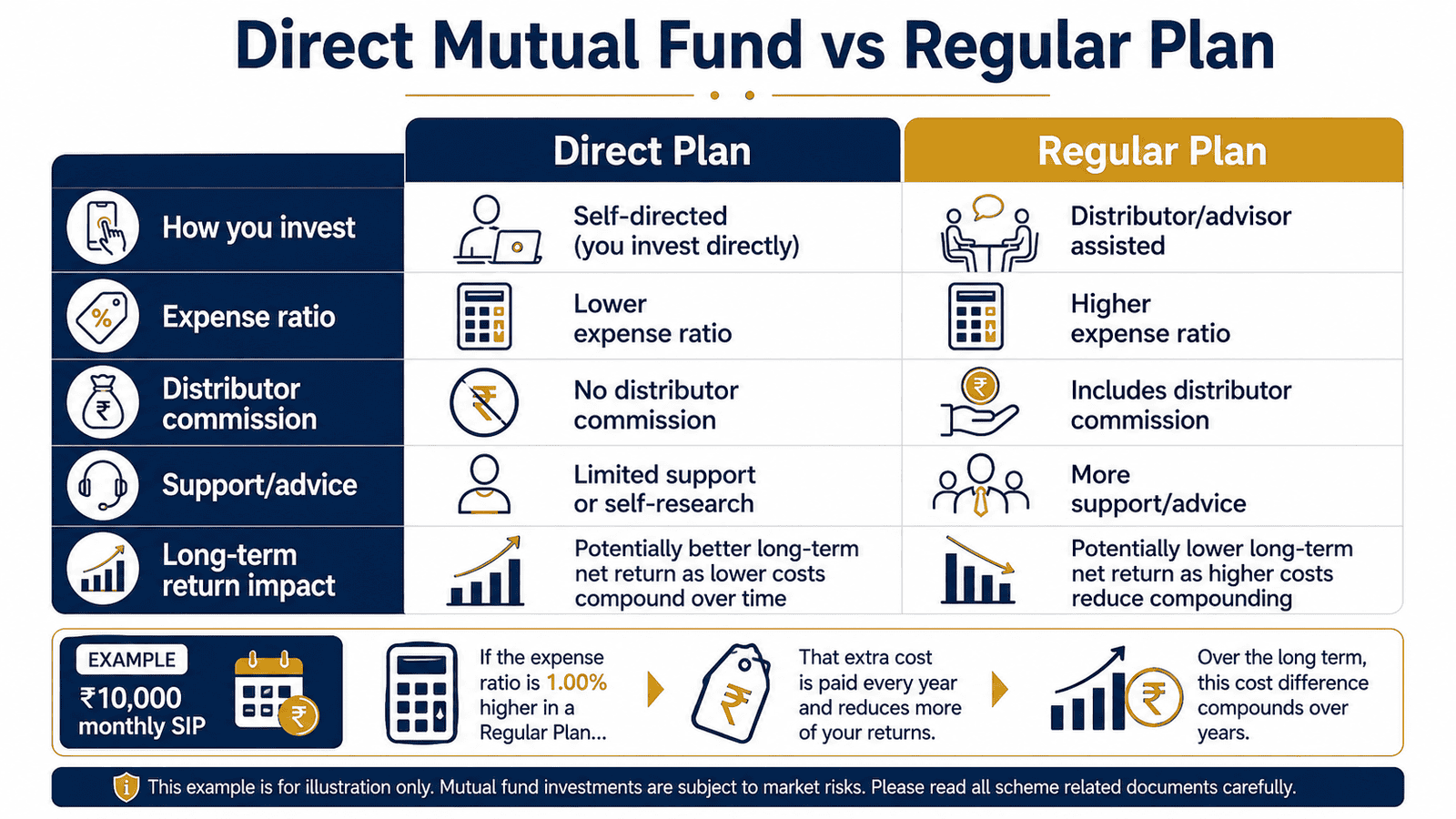
Direct mutual fund vs regular plan is mainly a cost-and-support choice: direct plans usually have lower expense ratios because no distributor commission is embedded, while regular plans include distributor support. For a ₹10,000 monthly SIP, even a small annual cost gap can compound over years, so choose based on knowledge, discipline, and need for advice.
Key Takeaways
- Direct and regular plans of the same mutual fund scheme usually invest in an identical portfolio — the fund manager and holdings are the same; only the cost layer differs.
- Regular plans include a distributor trail commission embedded in the expense ratio, which is typically 0.5%–1% per year higher than the direct plan of the same scheme.
- Because expense ratio is deducted from scheme assets, a direct plan’s NAV tends to grow faster over time — a higher NAV here means lower cost drag, not a more expensive unit.
- On a ₹10,000 monthly SIP, a 0.75% annual cost difference can compound into a meaningful gap over 10–20 years — the longer the horizon, the wider the gap.
- Regular plans can still make sense if the distributor or adviser provides genuine fund selection, asset allocation review, and behavioural coaching — not just transaction processing.
- Switching from a regular plan to a direct plan counts as a redemption and may trigger exit load and capital gains tax — check both before switching.
- Fund selection matters more than plan type: a well-chosen fund in a regular plan will still outperform a poor fund in a direct plan.
Direct Plan vs Regular Plan: Side-by-Side Comparison
| Parameter | Direct Plan | Regular Plan |
|---|---|---|
| How you invest | Directly through AMC website, MF Central, or direct-only platforms | Through a distributor, broker, bank, or adviser with an ARN |
| Expense ratio | Lower — no distributor commission included | Higher — includes distributor trail commission |
| NAV over time | Tends to be higher over time due to lower cost drag | Tends to be lower over time due to higher ongoing cost |
| Distributor commission | Nil | Embedded in TER |
| Advice and support | Self-directed — you research, select and review independently | Distributor or adviser may provide fund guidance and service |
| Portfolio and fund manager | Same as regular plan of the same scheme | Same as direct plan of the same scheme |
| Best suited for | Investor who can research funds, review allocation and stay disciplined | Investor who needs guidance, behavioural support or full-service help |
For a deeper look at how expense ratio silently eats into returns, read how mutual fund expense ratio affects your returns.
Key Facts at a Glance
| Term | What It Means | Why It Matters Here |
|---|---|---|
| Direct plan | A variant of a mutual fund scheme with no distributor commission embedded in costs | Lower Total Expense Ratio, higher NAV growth over time |
| Regular plan | A variant of the same scheme that includes distributor trail commission in costs | Slightly higher annual cost; may come with distributor or adviser service |
| AMC (Asset Management Company) | The fund house that manages your money — Mirae, HDFC, SBI MF, etc. | Both direct and regular plans are offered by the same AMC |
| Mutual fund distributor | An AMFI-registered individual or entity (ARN holder) who distributes regular plans | Earns trail commission from the regular plan’s higher expense ratio |
| Total Expense Ratio (TER) | Annual fee charged as a percentage of scheme assets to cover fund management and distribution | Direct plan TER is typically lower than regular plan TER for the same scheme |
| Net Asset Value (NAV) | Per-unit value of the scheme, calculated daily after deducting expenses | Direct plan NAV grows faster because less is deducted annually |
To understand exactly how NAV is calculated and what a higher NAV actually means for your investment, see mutual fund NAV meaning and what it tells you.
How Direct and Regular Mutual Fund Plans Actually Work
When SEBI mandated the introduction of direct plans in 2013, every mutual fund scheme in India was required to offer two separate plan options: a direct plan and a regular plan. Both options invest in exactly the same portfolio. The fund manager makes the same buy and sell decisions. The underlying stocks, bonds or other securities are identical. If you hold 1,000 units of an HDFC Flexicap Direct Plan Growth and your neighbour holds 1,000 units of HDFC Flexicap Regular Plan Growth, you both own a proportional share of the same set of investments.
The only structural difference is the cost route
When you invest in a regular plan, a portion of the scheme’s annual expenses goes toward paying distributor trail commission. This is not a fee you pay separately — it is baked into the Total Expense Ratio (TER) that the AMC deducts daily from the scheme’s net assets. According to SEBI regulations, the expense ratio for a regular plan is permitted to be higher than for the corresponding direct plan, specifically to account for this distribution cost.
A direct plan removes the distribution layer entirely. You invest directly with the AMC — through their website, through MF Central, or through a direct-only platform — and the scheme does not need to account for any distributor commission. The TER is correspondingly lower.
Why the NAVs diverge over time
NAV is calculated by dividing the scheme’s net assets by the number of outstanding units, after deducting daily expenses. Because the direct plan deducts a smaller expense percentage each day, its net assets compound slightly faster. Over months and years, this creates a meaningful NAV gap between the direct and regular plans of the same scheme.
This trips up a lot of beginners. When they see that the direct plan NAV is ₹85 and the regular plan NAV is ₹78, they assume the direct plan is costlier to buy. It is not. You are simply buying fewer units at a higher price — but those units have grown to that price because less was eaten away in costs. Understanding how mutual funds work makes this easier to grasp before comparing plan types.
What the distributor actually does — and does not do
A mutual fund distributor holds an AMFI Registration Number (ARN) and is permitted to recommend and transact regular plans on your behalf. They earn trail commission for as long as your money stays invested — typically 0.5% to 1% of your invested corpus per year, embedded in the scheme’s TER.
The trail commission model means the distributor earns on your growing corpus every year, even if they have not spoken to you in months. This is not illegal or inherently wrong — if the distributor is providing regular portfolio review, explaining when to rebalance, keeping you invested during market downturns, and helping you select funds suited to your goals, that service has genuine value. The issue arises when investors are paying trail commission without receiving any of that value in return.
A Registered Investment Adviser (RIA) registered with SEBI operates differently — they charge a direct fee for advice and must recommend direct plans only. If you want paid professional guidance without the commission model, an RIA is the route to explore, though fee structures vary.
Real Example: Rohit’s SIP in Direct vs Regular Plan
Rohit, 31, is a software engineer in Bengaluru earning ₹18 lakh per year. He has been running a ₹10,000 monthly SIP through a bank’s investment platform for the past two years, and only recently realised he is in the regular plan of the fund. He checked the direct plan of the same scheme and noticed the NAV was about ₹7 higher — and wondered if he had been doing it wrong.
Rohit’s bank distributes the fund and earns trail commission through the regular plan. His TER is roughly 1.6% per year for the regular plan versus approximately 0.9% for the direct plan of the same scheme — a gap of about 0.7% annually. On a corpus of ₹2.4 lakh invested over two years, 0.7% annual cost drag has not created a dramatic difference yet. But the gap is compounding. The longer Rohit stays invested, the wider the difference becomes — not because one plan invests differently, but purely because of the cost layer.
The key insight: Rohit’s bank did process his SIP paperwork, sent him a statement, and answered his calls. That is worth something. But if the bank never proactively reviewed his fund selection, never adjusted his allocation as his salary grew, and never coached him through the 2022 correction — then he paid commission without receiving proportional advice. That is the question every regular-plan investor needs to ask. For context on how SIP returns compound over time, read how SIP works and how to start one.
How to Calculate the Long-Term Cost Impact
Approximate annual cost drag = Corpus × TER difference
Compounded cost gap over N years = effect of (TER_regular − TER_direct) applied annually to growing corpus
The table below uses an illustrative scenario to show how the cost gap compounds. These figures are illustrative only — actual returns, TER values and corpus will vary by scheme, market conditions and investment period. Mutual fund investments are subject to market risks. Past performance does not guarantee future returns.
| Scenario (Illustrative) | Direct Plan (assumed net return 11% p.a.) | Regular Plan (assumed net return 10.3% p.a.) |
|---|---|---|
| ₹10,000/month SIP — 10 years | Approx. ₹21.4 lakh | Approx. ₹20.3 lakh |
| ₹10,000/month SIP — 20 years | Approx. ₹86.5 lakh | Approx. ₹80.1 lakh |
| Illustrative cost gap — 20 years | — | Approx. ₹6.4 lakh lower |
The assumed 0.7% return gap reflects a typical TER difference — it is not a guaranteed or universal figure. Actual TER for each scheme is published in the scheme information document and on the AMC’s website. Use the SIP calculator to model your own amount and assumption before drawing conclusions.
How to Decide What’s Right for You
You can research fund categories, understand risk levels, and review your portfolio once or twice a year — THEN a direct plan is likely the cost-efficient choice for you.
You currently hold a regular plan and your distributor has proactively reviewed your allocation, rebalanced your portfolio, or guided you through a market correction — THEN the trail commission may be worth paying for that genuine service.
You are a first-time investor who is unsure about fund categories, asset allocation and risk — THEN starting with a simple index fund (direct plan) in a broad category and learning as you go is a reasonable middle path.
Your regular-plan distributor only processes transactions but provides no meaningful review or guidance — THEN you are paying trail commission without receiving its intended value. Evaluating a switch is reasonable, but check tax and exit-load implications first.
You have a large and complex portfolio with multiple goals — retirement, child’s education, home purchase — and limited time to manage it — THEN a SEBI-registered RIA who charges a direct fee for advice may serve you better than either a commission-based distributor or going fully self-directed.
You are not yet confident in fund selection, and you are considering direct plans only because you read that they are “cheaper” — do not switch blindly. Choosing the wrong fund in direct is still a bad investment decision. To compare performance correctly after costs, see how to measure mutual fund returns.
Common Mistakes to Avoid
Thinking a higher direct plan NAV means it is expensive
Many beginners see a direct plan NAV of ₹95 versus a regular plan NAV of ₹85 and assume the direct plan is costlier per unit.
The higher NAV actually reflects lower cost drag over time — both plans started at the same NAV when introduced. More of the scheme’s growth was retained in the direct plan because less was deducted annually. Paying a higher NAV for the direct plan means you are buying fewer units, but those units represent more of the scheme’s compounded value.
Always compare returns percentage, not absolute NAV values.
Switching from regular to direct without checking exit load
Switching plans is treated as a redemption. If you redeem within the exit load period — typically one year for equity funds — the AMC will deduct a percentage of your redemption value, often 1%.
On a corpus of ₹5 lakh, a 1% exit load costs ₹5,000 immediately. That is a real upfront cost that can take a year or more of TER savings to recover.
Check your scheme’s exit load schedule in the scheme information document before initiating a switch.
Ignoring capital gains tax when switching
When you switch from a regular plan to a direct plan — even within the same fund house — it is treated as a sale for tax purposes. Short-term capital gains (STCG) on equity funds are taxed at 20%, and long-term capital gains (LTCG) above ₹1.25 lakh per year are taxed at 12.5%.
A large accumulated gain switched in one go could create a meaningful tax outgo. Consider switching in tranches, or waiting until units become long-term before switching.
Choosing a poor fund just because it offers a direct plan
Every mutual fund in India — including poorly performing ones — offers a direct plan. Choosing the direct plan of a consistently underperforming fund will not save you from poor returns.
Fund selection matters first. Then optimise the plan type. Direct in a mediocre fund is still a mediocre investment.
Comparing the direct plan of one fund with the regular plan of another
This is a common error in DIY portfolio reviews. The cost and return comparison between direct and regular is only valid when applied to the same scheme. Comparing funds across different categories, fund houses or strategies without adjusting for those variables tells you nothing reliable about direct versus regular performance.
Paying regular-plan commission while receiving no advice
If your distributor has not contacted you in a year, never suggested a review, and only processes your SIP — you are paying for a service that is not being delivered. Trail commission on a ₹10 lakh corpus at 0.75% per year is ₹7,500 annually, flowing to the distributor every year regardless of whether they speak to you.
Ask your distributor what they actually provide. If the answer is only transaction processing, the direct route deserves a fair evaluation.
Assuming the distributor and a SEBI-registered adviser are the same
They are not. A mutual fund distributor with an ARN sells regular plans and earns trail commission. A SEBI-registered Investment Adviser (RIA) charges you directly for advice and must recommend direct plans. The advice motivation and regulatory framework are different. Knowing which type of professional you are dealing with helps you evaluate whether the cost is justified.
When This May Not Be the Right Choice
Switching to — or starting with — a direct mutual fund plan is not automatically the right move for every investor.
If you cannot confidently select a fund category, assess risk levels, or understand what you own, going direct without any guidance can lead to poor fund choices that cost far more than the commission you would have paid in a regular plan.
If you tend to panic-sell during market corrections, the behavioural support of a distributor or adviser may be worth the ongoing cost. Staying invested through a 30% drawdown matters far more to long-term wealth than saving 0.7% in annual expenses.
If your portfolio is large, has multiple goals, or spans complex products — NPS, insurance, equity, debt — trying to manage it entirely without professional guidance increases the risk of structural errors in asset allocation.
If you are switching purely to save cost but have not checked exit loads, capital gains tax, and the new platform’s folio process, the short-term cost of switching may outweigh the long-term TER saving for several years.
If any of these apply to your situation, it may be worth exploring alternatives before committing.
Official Rules and Where to Verify
The direct and regular plan structure in India is governed by SEBI regulations. SEBI mandated the introduction of direct plans in 2013 to give investors a lower-cost, commission-free route to invest in mutual funds. Ongoing SEBI circulars set limits on Total Expense Ratios and disclosure requirements for AMCs and distributors.
Rules, limits, and rates on this topic can change with each Budget or regulatory update. Always verify current figures directly from the official source before making any financial decision.
- SEBI (Securities and Exchange Board of India) — sebi.gov.in — for regulations on expense ratios, distributor commissions, and RIA framework
- AMFI (Association of Mutual Funds in India) — amfiindia.com — for ARN registration checks and investor education resources
- Individual AMC websites — for scheme-specific TER, exit load, and NAV data
- Scheme Information Document (SID) — available on AMC websites — for the definitive cost, exit load and plan details of any scheme
- MF Central — mfcentral.com — for consolidated account statements and folio management across fund houses
Expert Tips
- Choose the right fund category first — large cap, flexi cap, index, hybrid — and only then decide whether direct or regular makes sense for your situation. Plan type is a secondary optimisation, not the primary decision.
- If you are in a regular plan and have been invested for less than one year, check the exit load and capital gains position before switching. The cost of exiting early can offset TER savings for 12–18 months.
- When evaluating your distributor, ask one specific question: “When did you last review my portfolio and what did you change or recommend?” If the answer is vague or never — factor that into your cost-versus-value assessment.
- Consider switching in tranches over two or three financial years rather than all at once. This spreads capital gains tax liability and keeps you under the ₹1.25 lakh LTCG annual exemption limit where possible.
- If you go direct, commit to a portfolio review at least once a year — check that your fund is still in the same category it was when you chose it, that your asset allocation matches your current goals, and that the expense ratio has not risen significantly.
- Index funds — particularly Nifty 50 or Nifty 100 trackers — are relatively straightforward to evaluate and manage independently, making them a practical starting point for investors who want to move to direct plans without deep fund research skills.
- Never evaluate a fund’s performance by comparing its direct plan NAV to its regular plan NAV. Compare CAGR or XIRR of the plan you hold, and compare that to the benchmark and peer category — not to the other plan of the same fund.
Frequently Asked Questions
Is a direct mutual fund always better than a regular plan?
Not for every investor. Direct plans are usually more cost-efficient because the expense ratio is lower. But “better” depends on whether you can select appropriate funds, review your portfolio regularly, and stay disciplined without guidance. For investors who genuinely receive useful advice through a regular plan, the cost difference may be justified.
Why is the direct plan NAV higher than the regular plan NAV for the same fund?
Both plans started at the same NAV when launched. Over time, the direct plan deducts a lower expense ratio each year, meaning more of the scheme’s assets compound. This results in the direct plan NAV growing slightly faster. A higher NAV in the direct plan reflects lower historical cost drag — it does not mean the units are more expensive to buy.
Are returns guaranteed to be higher in direct plans?
No. Mutual fund investments are subject to market risks. Past performance does not guarantee future returns. Direct plans tend to have a lower cost drag, which can translate into marginally better net returns over long periods — but the underlying portfolio performance, market conditions, and fund manager decisions affect both plans equally. No mutual fund can guarantee returns.
Can I switch from a regular plan to a direct plan of the same fund?
Yes, you can switch from the regular plan to the direct plan — typically through the AMC’s website, MF Central, or certain investment platforms. However, the switch is treated as a redemption of units from the regular plan and a fresh purchase in the direct plan. This means exit loads and capital gains tax apply if your units are within the exit load period or carry taxable gains.
Does switching from regular to direct trigger capital gains tax?
Yes. A switch is treated as a redemption for tax purposes. For equity mutual funds, short-term capital gains (holding period under one year) are taxed at 20%. Long-term capital gains (holding period over one year) above ₹1.25 lakh per financial year are taxed at 12.5%. Debt fund gains are added to your income and taxed at your slab rate regardless of holding period. Verify current tax rates before switching.
Should beginners choose direct or regular mutual funds?
Beginners who are uncertain about fund selection, asset allocation, or risk management may benefit from starting with a simple, low-cost index fund in a direct plan — these are straightforward to understand and require less active monitoring. Alternatively, if a trusted distributor or fee-based adviser provides genuine guidance, starting in a regular plan while learning is also reasonable. Avoid picking funds based solely on plan type.
Is a mutual fund distributor the same as a SEBI-registered investment adviser?
No. A mutual fund distributor holds an AMFI Registration Number (ARN) and earns trail commission by distributing regular plans. A SEBI-registered Investment Adviser (RIA) is registered under SEBI’s RIA regulations, charges the investor a direct advisory fee, and must recommend direct plans only. Their advice motivation is different — the RIA earns regardless of which fund you hold, while a distributor earns trail commission on the growing corpus.
What is the difference in expense ratio between direct and regular plans?
The gap varies by scheme, category and fund house. For actively managed equity funds, the difference typically ranges from about 0.5% to 1% per year. For index funds, the TER gap may be smaller but the absolute TER is already low for both plans. Check the scheme information document or the AMC’s website for exact current TER figures for any specific scheme.
Can I invest in a direct plan through any app or platform?
You can invest in direct plans through the AMC’s own website, MF Central (the industry-wide platform), and certain direct-only investment platforms. Some platforms that also offer regular plans may route you to regular plans by default — check the plan type before confirming your investment. If you see a plan labelled “Regular” on a third-party platform and want direct, you may need to transact directly with the AMC.
What happens if I stop my SIP in a regular plan — does the trail commission stop too?
Trail commission is paid on the corpus already invested, not only on new SIP instalments. If you stop your SIP but keep the existing units invested, the distributor continues to earn trail commission on that corpus. Commission stops only when you redeem the units. This is worth knowing if you are evaluating whether to stop SIPs in a regular plan or switch to direct.
Final Verdict
For investors who can research fund categories, assess their own risk tolerance and review their portfolio at least once a year, direct mutual fund plans are generally the more cost-efficient route. The lower expense ratio compounds into a meaningful difference over 10 to 20 years of investing — not because the portfolio is different, but because less is deducted from your growing corpus every year.
Regular plans are not automatically a bad choice. If a distributor or adviser is actively reviewing your allocation, keeping you invested during downturns, and helping you avoid panic decisions — that ongoing service has real value. The problem is paying trail commission without receiving that value.
On the direct mutual fund vs regular plan decision, the fund you choose matters more than the plan type. A well-chosen index fund or diversified equity fund in a regular plan will still build wealth over time. A poorly chosen fund in a direct plan is still a poor investment. Get the fund selection right first — then optimise costs.
If you are already in a regular plan and considering a switch, check exit loads, capital gains tax, and your holding period before acting. The short-term cost of switching can outweigh the long-term TER saving for the first year or two. Always verify the latest rules from official sources or consult a qualified professional before making any financial decision.
This article is for educational purposes only and should not be treated as personalised financial, tax, investment, insurance, or legal advice. Tax rules, interest rates, regulatory limits, and product features can change with each Budget or policy update. Please verify current rules from official government sources or consult a qualified and registered professional before making any financial decision.

Arjun Kapoor writes about mutual funds, SIPs, ELSS, fund categories, investment returns, and beginner investing concepts for Indian readers. His focus is on education, not product promotion or fund recommendations. He helps readers understand how mutual funds work before they start investing or comparing schemes.
He covers topics such as mutual fund meaning, SIP meaning, SIP calculator, direct mutual funds vs regular plans, NAV, ELSS tax-saving funds, CAGR, absolute returns, XIRR, expense ratio, large cap vs mid cap vs small cap funds, flexi cap funds, index funds vs active funds, liquid funds, debt mutual funds, SIP pause vs SIP stop, lumpsum vs SIP, and how to start SIP in India.
Arjun’s writing is simple, risk-aware, and long-term oriented. He avoids guaranteed-return language and explains investment concepts using examples, timelines, and comparison tables. His articles remind readers that mutual fund investments are subject to market risks, and past performance does not guarantee future returns. Readers should verify scheme details from SEBI, AMFI, fund houses, and official scheme documents.