

A joint home loan sounds simple — two names on one application, better eligibility, bigger loan. But most Indian families discover the finer rules only after they have already signed the paperwork. The real question is not whether a joint home loan improves your chances of approval. It is whether the co-applicant will actually receive tax benefits, ownership rights, and legal protection — or just liability. There is a specific chain of conditions: co-applicant, co-owner, actual EMI contributor, and old-regime filer. Miss one link in that chain and at least one borrower loses every rupee of their expected deduction. This article walks through each condition, each tax rule, and each mistake to avoid — before you sit across the table from your bank.
Quick Answer: Joint Home Loan
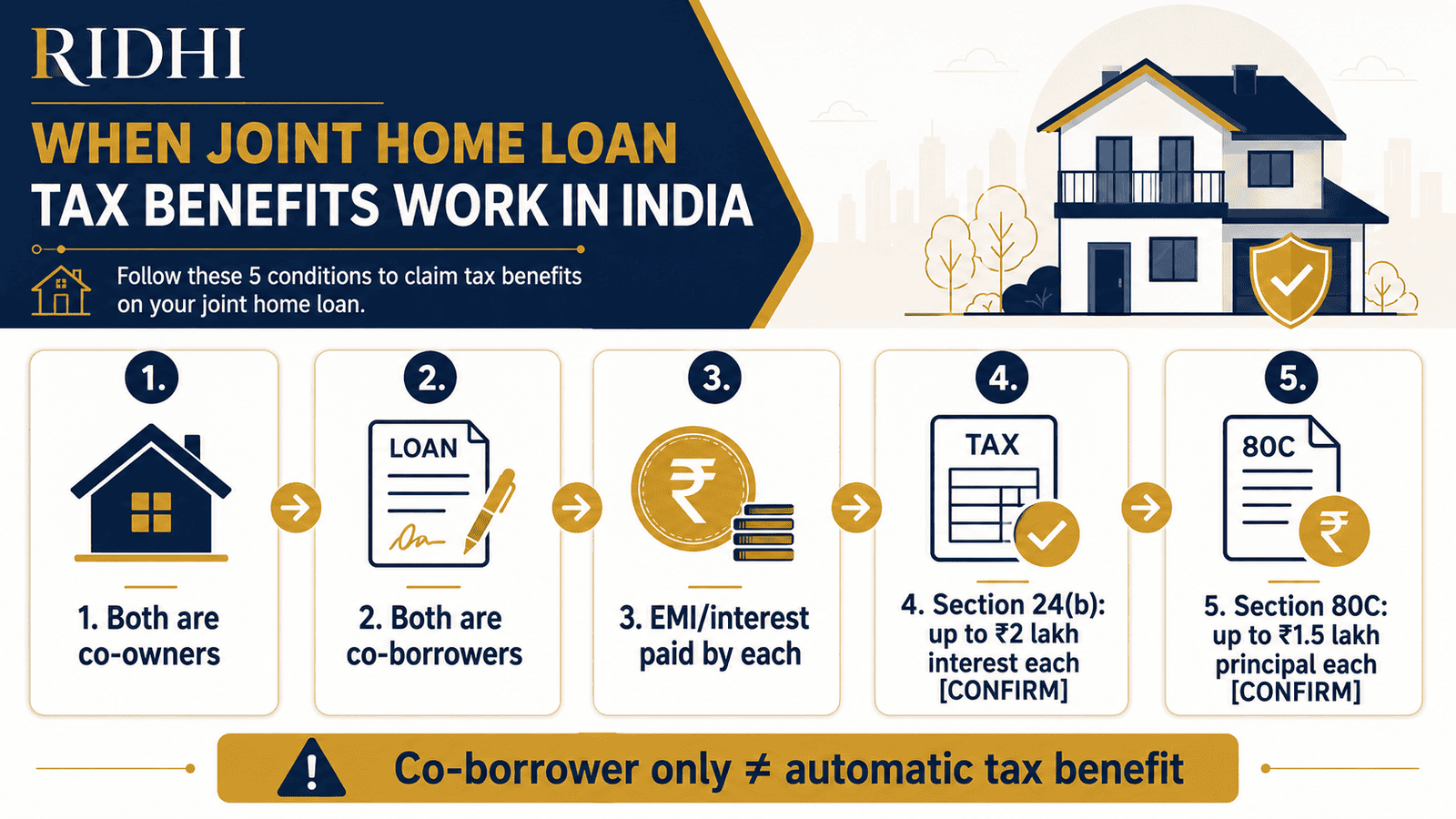
A joint home loan allows two or more eligible borrowers, often spouses or family members, to apply together for one property loan. If each borrower is also a co-owner and contributes to repayment, each may claim home loan tax deductions separately under Section 24(b) and Section 80C, subject to current limits.
Key Takeaways
- Each qualifying co-owner can claim up to ₹2 lakh per year in interest deduction under Section 24(b) — so a couple with joint ownership and shared repayment can claim up to ₹4 lakh combined on a self-occupied property annually.
- Section 80C principal repayment deduction (up to ₹1.5 lakh per person) is available to each co-owner in proportion to their actual EMI contribution — it is not split automatically by the bank.
- Being a co-applicant alone is not enough. You must also be a registered co-owner on the property title deed to claim any home loan tax deduction.
- Many Indian banks offer a 0.05% interest rate concession when a woman is the primary or co-applicant — on a ₹60 lakh, 20-year loan, this saves approximately ₹65,000–₹75,000 in total interest over the tenure.
- Both borrowers are jointly and severally liable for the full loan amount. If one stops paying, the other owes 100% of the outstanding balance — and both CIBIL scores are affected.
- Home loan deductions under Section 24(b) and Section 80C apply only under the old income tax regime. Under the new default regime, neither deduction is available for self-occupied property.
- Proof of individual EMI payment from each borrower’s own bank account is essential for supporting separate tax claims during ITR filing or scrutiny.
Key Facts at a Glance
| Parameter | Rule / Limit |
|---|---|
| Section 24(b) — Interest deduction (self-occupied) | Up to ₹2 lakh per co-owner per year |
| Section 80C — Principal repayment deduction | Up to ₹1.5 lakh per co-owner per year (within overall 80C limit) |
| Who can claim tax benefits | Co-owner + co-borrower + actual EMI contributor — all three required |
| Maximum co-applicants | Varies by lender — typically 2 to 6 |
| Women co-applicant rate concession | 0.05% lower interest rate — offered by several major banks |
| Tax regime eligibility | Deductions available under old regime only |
| Joint liability exposure | Full outstanding loan — both borrowers liable for 100% |
What Is a Joint Home Loan — and Who Can Apply
A joint home loan is a single housing loan sanctioned against one property, with two or more individuals listed as co-borrowers on the loan agreement. Banks assess the combined income, credit scores, and existing liabilities of all co-borrowers when determining the sanction amount and the applicable interest rate. This is why a dual-income household can often borrow significantly more than either partner could individually.
Who Can Be a Co-Applicant
Most Indian banks and NBFCs accept the following combinations: husband and wife; parent and adult child (son or daughter); siblings in certain cases; and business partners for commercial property. Live-in partners and unmarried couples are not accepted by most lenders. For parent-child combinations, many lenders require that the property be co-owned by both — confirm your specific lender’s policy before filing the application.
Four Roles You Must Understand Before Signing
This is where most families get into trouble. There are four distinct roles in a joint home loan, and they are not interchangeable:
- Co-applicant: A person who applies alongside the primary borrower. Their income and credit score are counted in the eligibility calculation. Co-applicant status alone does not entitle them to any tax benefit.
- Co-borrower: A person who is legally liable for repayment. In practice, every co-applicant automatically becomes a co-borrower — jointly and severally liable for the full outstanding loan amount at all times.
- Co-owner: A person named on the property’s registered title deed as an owner. Co-ownership is established at registration — not at loan sanction. This is the step most families either skip or misunderstand.
- EMI contributor: A person who actually pays part of the EMI from their own bank account. Even a registered co-owner cannot claim a tax deduction unless they can demonstrate through bank statements that they personally paid their share.
To claim tax benefits, a person must satisfy all four conditions simultaneously: co-applicant on the loan, co-borrower liability, registered co-owner on the deed, and documented EMI contributor. Miss any one of these and the deduction claim for that person is invalid.
Tax Deductions Under Section 24(b) and Section 80C
For the full mechanics of each deduction, see our detailed guide on home loan tax rules. The core structure for joint borrowers is:
Section 24(b) — Interest on housing loan: Each qualifying co-owner can deduct up to ₹2 lakh per financial year from their taxable income for interest paid on a self-occupied property. This limit applies per individual — not per loan. So a husband and wife who co-own and jointly repay the loan can each claim ₹2 lakh, giving the household a combined deduction of ₹4 lakh per year on interest alone. For let-out properties, the full interest is deductible with no ceiling, but rental income must also be declared in each co-owner’s ITR.
Section 80C — Principal repayment: Principal repaid on a home loan qualifies for a deduction under Section 80C up to ₹1.5 lakh per person per year. This sits inside the overall 80C basket — the same ₹1.5 lakh limit that covers PPF contributions, ELSS investments, life insurance premiums, and NSC. Each co-owner can claim up to ₹1.5 lakh, but only in proportion to what they actually paid and what their ownership share permits.
The Ownership Share and Repayment Proportion Rule
Tax deductions must reflect both ownership percentage and actual payment. You cannot claim more than your registered ownership share of the total annual interest. If you own 40% of the property, your maximum 24(b) claim is 40% of total annual interest — subject to the ₹2 lakh ceiling. You cannot claim ₹2 lakh if your proportionate interest works out to ₹1.1 lakh.
According to Income Tax Department guidelines, deductions are allowed in proportion to each co-owner’s share in the property. The ownership percentages stated in the registered sale deed are what tax officers use during scrutiny. Vague or unstated ownership proportions create disputes — always specify the split explicitly at registration.
Women Co-Applicant Benefits
Several major Indian banks, including SBI, HDFC Bank, and Bank of Baroda, currently offer a 0.05% interest rate concession when a woman is the primary applicant or co-applicant on a home loan. On a ₹60 lakh loan over 20 years, that 0.05% difference reduces total interest outgo by approximately ₹65,000–₹75,000 over the full tenure. In addition, several states offer lower stamp duty rates for properties registered in a woman’s name — which can save an additional ₹20,000 to ₹1.5 lakh depending on the state and property value. Both the rate concession and stamp duty reduction are lender- and state-specific — confirm current rates directly with your bank and state registration authority before relying on these figures.
Real Example: Rohan and Priya, Pune
Rohan, 34, is a salaried IT manager in Pune earning ₹22 lakh per year. His wife Priya, 31, works as a marketing professional earning ₹12 lakh per year. They plan to buy a flat worth ₹75 lakh and take a joint home loan of ₹60 lakh at 8.5% per annum for 20 years. Before finalising their repayment structure, Rohan uses the calculate your EMI tool to map out the monthly outflow.
Their combined monthly EMI works out to approximately ₹52,200. They decide to split it 60:40, matching their registered ownership share: Rohan pays ₹31,300 per month and Priya pays ₹20,900 — each from their own accounts. In Year 1, their loan generates approximately ₹5.08 lakh in interest and approximately ₹1.17 lakh in principal repayment.
Under the old tax regime, Rohan can claim ₹2 lakh under Section 24(b) and ₹70,200 under Section 80C. Priya can claim ₹2 lakh under Section 24(b) and ₹46,800 under Section 80C. Together, their household deduction on the home loan alone is ₹4.82 lakh per year — more than double what Rohan would have claimed as a sole borrower.
How to Calculate Your Joint Home Loan Tax Benefit
Each Co-Owner’s Annual Tax Saving = (Interest Deduction + 80C Deduction Claimed) × Their Income Tax Rate
Using Rohan and Priya’s Year 1 figures:
- Total annual interest: ₹5.08 lakh
- Rohan’s 60% share: ₹3.05 lakh → capped at ₹2 lakh under Section 24(b)
- Priya’s 40% share: ₹2.03 lakh → capped at ₹2 lakh under Section 24(b)
- Annual principal: ₹1.17 lakh → Rohan’s 60% = ₹70,200; Priya’s 40% = ₹46,800
| Borrower | Total Deduction Claimed | Est. Annual Tax Saving |
|---|---|---|
| Rohan (30% tax bracket) | ₹2,70,200 (₹2L + ₹70,200) | ~₹81,060 |
| Priya (20% tax bracket) | ₹2,46,800 (₹2L + ₹46,800) | ~₹49,360 |
| Combined household | ₹5,17,000 | ~₹1,30,420 |
These are Year 1 estimates only. The interest component declines each year as the loan principal reduces, so the Section 24(b) benefit will taper over time. The total interest outgo on a ₹60 lakh loan at 8.5% over 20 years is approximately ₹65.3 lakh — bringing the all-in repayment to around ₹1.25 crore against a ₹75 lakh property. Always evaluate total cost — principal plus total interest — not just the monthly EMI before committing to a loan size and tenure.
Comparison: Co-Applicant Only vs Co-Applicant + Co-Owner
| Parameter | Co-Applicant Only | Co-Applicant + Co-Owner |
|---|---|---|
| Loan eligibility boost | Yes | Yes |
| Section 24(b) interest deduction | No | Yes — up to ₹2L/yr |
| Section 80C principal deduction | No | Yes — up to ₹1.5L/yr |
| Stamp duty concession for women | No | Yes — if named on title deed |
| Liability if other borrower defaults | Full loan — 100% | Full loan — 100% |
| Impact on both CIBIL scores | Yes — both affected | Yes — both affected |
| Legal ownership of property | Primary borrower only | Both, per title deed |
How to Decide What’s Right for You
Both you and your spouse are salaried, file separate ITRs, and plan to remain on the old tax regime — THEN a joint home loan with registered co-ownership and split EMI payments lets both of you claim independent deductions, potentially saving ₹1 lakh or more per household in Year 1 alone.
Your individual income is not enough to qualify for the loan amount you need — THEN adding a co-applicant with a stable income and a CIBIL score above 750 increases the sanctioned amount and can improve the offered interest rate. Understand where this decision fits in the full home buying process before applying.
Your spouse earns enough to be in the 20% or 30% income tax bracket — THEN they must be registered as co-owner on the deed and must pay their EMI share from their own account; without both steps, their deduction entitlement is zero regardless of what the loan agreement says.
You want to take advantage of your state’s women stamp duty concession — THEN register the wife as a co-owner on the title deed and apply with her as co-applicant or primary applicant. Check your state’s stamp duty charges in advance to calculate the actual saving before finalising the registration plan.
Both you and your co-applicant are on the new default tax regime — THEN the Section 24(b) and 80C deductions are unavailable, and the tax benefit case for a joint loan disappears entirely. Evaluate it solely on eligibility improvement and interest rate terms.
You are unsure whether the combined EMI is manageable for both borrowers — THEN check your safe EMI level using both incomes before committing to a loan size. Most lenders use 50–55% of gross monthly income as the outer EMI limit.
If your intended co-applicant has a CIBIL score below 700 or carries significant existing EMIs — THEN adding them may result in a lower sanction amount or a higher interest rate than you would receive as a sole borrower. In this case, a single-name loan is likely better until their credit profile improves.
Common Mistakes to Avoid
Not Registering the Co-Applicant as Co-Owner
Many couples take a joint loan but register the property in the primary borrower’s name only. The co-applicant becomes a full co-borrower — liable for the entire outstanding amount — but receives zero tax benefit and has no legal claim over the asset.
If the primary borrower defaults or passes away, the co-borrower is left with a liability but no ownership. Ensure both names appear on the registered sale deed with explicit ownership percentages.
Paying the Full EMI from One Account
If 100% of the EMI is debited from Rohan’s account every month, Priya cannot claim Section 24(b) or 80C deductions — even if she is a registered co-owner. The Income Tax Department requires proof of actual payment by each claimant.
This error can cost ₹49,000–₹60,000 or more per year in missed savings at the 20% bracket. Set up separate standing instructions matching each borrower’s ownership share — from the very first EMI.
Ignoring the Tax Regime Mismatch
If one borrower has switched to the new default regime, they lose all home loan deductions. A household where one partner is on the old regime and the other is on the new regime can only claim one person’s deduction — cutting the expected combined benefit in half. Confirm both borrowers’ regime status before structuring the loan as a tax-saving instrument.
Adding a Co-Applicant with a Weak Credit Score
Many banks use a blended credit assessment. A co-applicant with a CIBIL score below 650 can trigger a higher interest rate or a rejection — adding lakhs to your total repayment cost. Check both scores before applying. If one is weak, delay the application until it improves rather than including a liability-only co-borrower.
Missing the Pre-Construction Interest Deduction
If your loan funds an under-construction property, interest paid before possession cannot be claimed immediately. The total pre-possession interest is deductible in five equal instalments starting from the year of possession. Both co-owners are entitled to this deferred deduction. Most borrowers miss it entirely, leaving ₹40,000–₹1 lakh or more unclaimed depending on the construction timeline.
Assuming Joint Loan Means Equal Ownership
Ownership share is decided at registration — it does not default to 50:50. If one partner funded the entire down payment and the deed does not reflect this, future disputes around inheritance, separation, or sale become legally complicated. Match the ownership percentages to actual financial contribution and record it explicitly in the sale deed from day one.
When This May Not Be the Right Choice
A joint home loan does not suit every family. It is a poor fit if the co-applicant has a CIBIL score below 700 — their profile can reduce the sanctioned amount or increase the interest rate rather than improve your terms. It is also not advisable if the second borrower already carries heavy personal loan or car loan EMIs; the combined debt-to-income ratio may breach most lenders’ threshold of 50–55% of gross monthly income, resulting in a smaller sanction than expected.
If the co-applicant will not be registered on the property deed, they bear full repayment liability while gaining no ownership rights and no tax deductions — an entirely one-sided arrangement. Finally, if both borrowers are on the new tax regime, the double-deduction argument disappears and a single-name loan may be simpler and equally cost-effective.
If any of these apply to your situation, it may be worth exploring alternatives before committing.
Official Rules and Where to Verify
Tax deduction limits, home loan interest rate concessions, and stamp duty rules can change with each Union Budget or RBI circular. Your property registration steps and the registered title deed are the foundational documents supporting any co-owner tax claim — ensure ownership percentages are explicitly stated at the time of registration.
Rules, limits, and rates on this topic can change with each Budget or regulatory update. Always verify current figures directly from the official source before making any financial decision.
- Income Tax Department — incometax.gov.in (Section 24(b), Section 80C rules, ITR guidance for co-owners)
- Reserve Bank of India — rbi.org.in (home loan guidelines, interest rate circulars, borrower rights)
- Your bank or NBFC’s official website — for current interest rates, co-applicant eligibility criteria, and women borrower concessions
- State registration department or RERA portal — for stamp duty rates, women buyer concessions, and property registration procedures (state-specific official domains)
Expert Tips
- State the ownership percentage explicitly in the registered sale deed — do not leave it as “jointly owned” without a ratio. Courts and tax officers use the registered split during scrutiny, inheritance disputes, and property sales. A vague deed causes years of complications for a few minutes of attention at registration.
- Set up separate ECS or NACH mandates from each co-owner’s individual account, mirroring the ownership percentage split. Do this at the time of the first EMI — not six months later. Banks and tax departments both look at the pattern of payments, and retroactive restructuring is difficult to document convincingly.
- If your wife is a co-owner and your state offers a reduced stamp duty rate for women (for example, Delhi charges women a lower rate than male buyers), the saving on a ₹75 lakh property can run to ₹1.5 lakh or more. Check your state’s current stamp duty charges before finalising the registration plan so you can factor this into your down payment budget.
- Under the old tax regime, file both ITRs showing the home loan deduction in proportion to ownership. Attach the loan sanction letter, the registered sale deed, and the bank’s annual interest certificate to your records for every year of the loan tenure — ITR scrutiny can be initiated up to 4–6 years after filing.
- If you and your co-applicant are in different tax brackets, consider allocating a higher ownership share to the borrower in the 30% bracket. The same ₹2 lakh Section 24(b) deduction saves ₹60,000 at 30% versus ₹40,000 at 20% — a ₹20,000 annual difference that compounds over a 20-year tenure.
- Track the pre-possession interest paid on an under-construction property in a separate spreadsheet each year. From the year of possession, divide the total by five and add it to your annual Section 24(b) deduction. Both co-owners can claim their proportionate share of this deferred deduction — it is commonly missed and worth ₹40,000–₹1 lakh per co-owner depending on the construction period and interest rate.
- Before deciding between the old and new tax regime, model your exact numbers: your salary, existing 80C investments, HRA, and this home loan’s deductions together. Our income tax calculator lets you run both regimes side by side with actual figures so you can see which one saves more money in your specific situation.
Frequently Asked Questions
Can both co-applicants claim tax deductions independently on a joint home loan?
Yes — but only if both are registered co-owners on the title deed, both contribute to EMI repayment from their individual bank accounts, and both are filing under the old income tax regime. All three conditions must be satisfied simultaneously. Failing any one of them disqualifies that person’s deduction claim entirely.
What is the maximum combined tax benefit a couple can get on a joint home loan?
Under the old regime, each co-owner can claim up to ₹2 lakh under Section 24(b) for interest and up to ₹1.5 lakh under Section 80C for principal repayment. A couple can together claim up to ₹4 lakh in interest deductions and up to ₹3 lakh in principal deductions per year — subject to their actual repayment proportions, ownership shares, and the 80C basket limits applying to each person individually.
Is it mandatory to be a co-owner to claim home loan tax benefits as a co-applicant?
Yes. The Income Tax Act requires that a claimant be both a co-owner of the property and a co-borrower on the loan. Being only a co-applicant or co-borrower — without a registered ownership share in the title deed — does not entitle a person to any deduction under Section 24(b) or Section 80C, regardless of how much of the EMI they pay.
What happens to both borrowers if one co-borrower stops paying their share?
Both co-borrowers are jointly and severally liable for the full outstanding loan amount. If one partner stops paying, the lender can demand the full EMI from the other — regardless of any private repayment arrangement between the two. The default is also reported against both CIBIL profiles, damaging both credit scores equally.
Can I add my parent as a co-applicant to get a joint home loan?
Yes, most banks accept a parent-child combination. However, many lenders restrict the loan tenure so that it ends before the older borrower reaches retirement age — typically 60 to 65 years. This can significantly reduce the available tenure and increase the EMI. The parent must also be registered as co-owner on the property deed to claim any tax deduction.
Is there any benefit to a joint home loan under the new tax regime?
The new tax regime does not allow Section 24(b) deductions for self-occupied property interest or Section 80C deductions for principal repayment. If both borrowers are on the new regime, the tax benefit argument for a joint loan disappears. You still benefit from the combined income increasing loan eligibility, and from any women co-applicant interest rate concession — but not from the deduction angle.
What documents do I need to claim joint home loan tax deductions in my ITR?
You will need: the registered sale deed stating co-ownership percentages; the loan sanction letter listing both borrowers; the bank’s annual interest certificate for that financial year; and individual bank statements showing EMI debits from each borrower’s separate account. Maintain these for the full loan tenure — tax scrutiny can go back four to six years from the date of filing.
Can the joint home loan be transferred to a single borrower later?
Yes, but it requires the lender’s formal approval, a No Objection Certificate, and potentially a deed of reconveyance if co-ownership on the property also needs to change. Most lenders treat this as a restructuring event, and processing fees apply. Consult both your bank and a property lawyer before attempting a transfer of liability.
Does a joint home loan affect both borrowers’ credit scores?
Yes. The loan account appears on both co-borrowers’ CIBIL reports from the day of disbursement. On-time payments improve both scores. Any missed EMI or default — regardless of who failed to pay — is recorded against both profiles equally and takes years to recover from.
Final Verdict
A joint home loan is one of the most effective financial structures for a dual-income Indian household — but only when set up correctly. The eligibility boost, the doubled Section 24(b) interest deduction, the combined 80C benefit, and the stamp duty concession for women co-owners make a compelling case. The condition is that both borrowers must be registered co-owners on the title deed, must pay their EMI share from individual accounts, and must both file under the old income tax regime for the full deduction benefit to apply.
Done right, a ₹60 lakh joint home loan can save a household over ₹1.3 lakh per year in taxes in the early repayment years — while building shared ownership for both partners. Before finalising the structure, review the home loan tax rules in detail so every deduction is claimed correctly. Always verify the latest rules from official sources or consult a qualified professional before making any financial decision.
This article is for educational purposes only and should not be treated as personalised financial, tax, investment, insurance, or legal advice. Tax rules, interest rates, regulatory limits, and product features can change with each Budget or policy update. Please verify current rules from official government sources or consult a qualified and registered professional before making any financial decision.

Neha Kulkarni writes about the financial side of home buying, renting, property decisions, and real estate costs in India. Her content helps readers think beyond the EMI and understand the total cost of owning or buying a home.
She covers topics such as rent vs buy, home loan planning, down payment, stamp duty, registration charges, brokerage, maintenance cost, property tax, furnishing cost, home insurance, builder payment plans, resale property checks, home loan affordability, total cost of ownership, and hidden costs in property decisions.
Neha’s writing is practical, family-focused, and cost-conscious. She uses Indian city examples, ₹ calculations, and decision checklists to help readers evaluate whether a property decision fits their income, savings, loan eligibility, and long-term plans. Her articles are useful for first-time home buyers, salaried couples, families, and people comparing rent with home ownership. Since property rules, stamp duty, registration charges, local taxes, home loan rates, and legal requirements vary by state and city, readers should verify current details from official state, lender, and legal sources.