

When you finalise a property purchase in India, the price your builder or seller quotes is never the amount you actually pay. On top of the agreement value, every buyer in India must pay stamp duty and registration charges — government fees required to make your property ownership legally valid. For an ₹80 lakh flat, these two charges alone can add ₹3 lakh to ₹7 lakh or more to your upfront cash requirement, depending on your state and buyer profile. Yet most first-time buyers plan only for the property price and the home loan EMI. This guide explains how stamp duty and registration charges are calculated, why they differ across states, and what to verify before your registration date — so you are not caught short at the sub-registrar office.
Quick Answer: Stamp Duty and Registration Charges
Stamp duty and registration charges are government fees paid when a property is legally registered in India. They vary by state, property value, buyer type, and sometimes gender. For an ₹80 lakh flat, even a small percentage difference can change upfront cost significantly, so verify current state rates before registration.
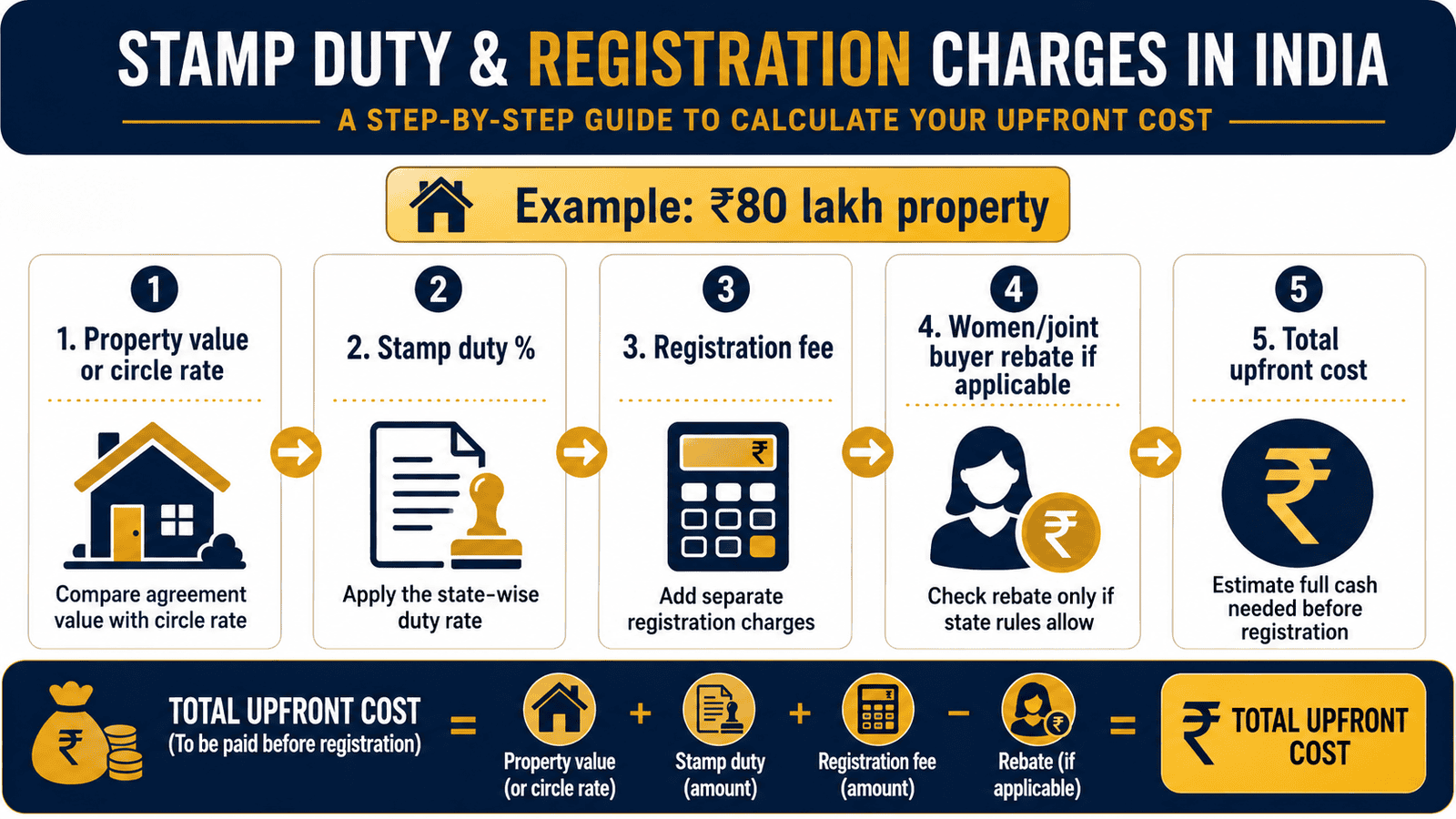
How to Calculate Stamp Duty and Registration Charges
Stamp Duty = Applicable State Rate (%) × Higher of Agreement Value or Circle Rate / Guidance Value / Ready Reckoner Rate
Registration Fee = State Registration Fee Rule × Property Value (subject to any state cap)
Total Government Charge = Stamp Duty + Registration Fee + Any Applicable Surcharge or Cess
The key variable in both formulas is the property value used for calculation. Most states require you to pay duty on whichever is higher — the actual agreement value or the government’s benchmark rate for that locality (called circle rate in Delhi and UP, guidance value in Karnataka, ready reckoner rate in Maharashtra). If your builder has priced the flat below the government benchmark, the duty is still calculated on the higher government figure.
A surcharge or cess may be added on top of the base stamp duty in some states — for example, a metro cess or local body surcharge. These additions are state-specific and can change by government notification. The registration fee is typically a flat percentage or a capped rupee amount, whichever applies in your state.
| Scenario | Key Inputs | Result (Illustrative Only) |
|---|---|---|
| Base stamp duty at 5% on ₹80 lakh | ₹80,00,000 × 5% | ₹4,00,000 |
| Base stamp duty at 7% on ₹80 lakh | ₹80,00,000 × 7% | ₹5,60,000 |
| Registration fee at 1% on ₹80 lakh | ₹80,00,000 × 1% | ₹80,000 |
These figures are illustrative only. Actual rates vary by state, property type, buyer category, and year. Use the stamp duty and registration calculator for an estimate, then confirm with your state registration department before payment.
Key Takeaways
- Stamp duty is typically the single largest non-loan upfront cost in an Indian property purchase — on an ₹80 lakh flat, it can range from ₹3.2 lakh to over ₹5.6 lakh depending on your state rate.
- Registration fee is charged separately from stamp duty — the two are not interchangeable terms for the same payment.
- Calculation is based on the higher of the agreement value or the government benchmark rate (circle rate, guidance value, or ready reckoner rate) for that locality.
- Several states offer a reduced stamp duty rate for women buyers or for properties registered in joint names — but this concession is not universal; verify with your state registration department.
- Surcharges, cess, and local body levies can increase the effective rate above the headline stamp duty percentage — always ask for the all-in figure.
- Banks generally do not include stamp duty and registration charges in the home loan amount, so you need this cash separately before disbursal and registration.
- Rates are set by state governments and can change with the state budget or a mid-year government notification — check close to your registration date, not months earlier.
Key Facts at a Glance
| Term | What It Means | Practical Note |
|---|---|---|
| Stamp Duty | State government tax on property transfer, paid via stamp paper or e-challan | Typically 4%–8% of property value; varies by state and buyer type |
| Registration Fee | Fee paid to register the sale deed at the sub-registrar office | Often 1% of property value or subject to a state cap |
| Circle Rate / Guidance Value / Ready Reckoner Rate | Government’s minimum benchmark valuation for properties in a locality | Duty is calculated on higher of this or agreement value |
| Who Pays | The buyer, unless the sale agreement explicitly states otherwise | Confirm in your sale agreement before signing |
| When to Pay | Before or at the time of registration, depending on state process | E-challan or franking — check your state’s accepted mode |
| Where to Verify | Your state’s registration and stamps department official portal | See official sources section below for state-specific links |
What Are Stamp Duty and Registration Charges?
Stamp duty is a tax levied by state governments on the transfer of property. It is governed by the Indian Stamp Act, 1899, and each state has its own Stamp Act or schedule that sets the applicable rates. When you buy a flat, plot, or house, you are legally required to pay stamp duty so that the government recognises the transfer of ownership. Without it, your sale deed cannot be registered and the property transfer has no legal standing.
Registration fee, on the other hand, is the charge for physically recording the sale deed at the sub-registrar office under the Indian Registration Act, 1908. It is a separate payment from stamp duty, collected by the state government’s registration department. Paying only stamp duty without registration — or vice versa — does not complete the legal process. Both are required.
Agreement Value vs Government Valuation
Here is where many buyers get confused. The stamp duty is not simply calculated on the price you agreed with the builder. The government assigns a minimum benchmark valuation to every area — called the circle rate in Delhi and UP, the guidance value in Karnataka, and the ready reckoner rate in Maharashtra. If your agreement value is lower than this benchmark, the duty is charged on the government’s figure, not yours. If your agreement value is higher, duty is charged on the higher agreement amount.
This matters practically. A flat you agreed to buy at ₹75 lakh in an area where the government guidance value is ₹80 lakh means your stamp duty is calculated on ₹80 lakh — not ₹75 lakh. It also means under-reporting the sale value to save on duty is not just risky; it can attract penalties and legal complications.
Why Online Calculators Can Only Estimate
A stamp duty calculator gives you a useful ballpark, but it is only as current as the data it was last updated with. State governments revise rates through budgets and mid-year notifications. If a calculator was not updated after such a revision, it will show an outdated figure. Always treat calculator output as an estimate and verify the final figure with your state registration department’s official portal — or with your property lawyer — close to your registration date.
Real Example: Priya’s Flat Purchase in Bengaluru
Priya Sharma, 34, a salaried product manager in Bengaluru earning ₹28 lakh per year, is buying her first apartment for ₹80 lakh. She has a home loan sanctioned for ₹60 lakh and is planning to fund the remaining ₹20 lakh from savings. But her bank has told her that stamp duty and registration charges will not be part of the loan amount.
Priya needs to plan for these charges separately. Here is how she should break down her cash requirement beyond the ₹20 lakh down payment, using Karnataka rates as an illustrative example that she must verify at kaveri.karnataka.gov.in before registration:
- Stamp duty (illustrative rate, to be verified): applied on ₹80 lakh or guidance value, whichever is higher
- Registration fee: separate charge as per Karnataka rules — verify current rate
- Legal and documentation charges: typically ₹15,000–₹30,000 for a property lawyer and document review
- Home loan processing fee: usually 0.25%–1% of loan amount, i.e. ₹15,000–₹60,000 for a ₹60 lakh loan
- Interior and moving buffer: separate planning item, not a registration cost
The key insight: Priya cannot finalise her budget by looking only at the ₹20 lakh down payment. She needs the stamp duty and registration cash available before the loan disbursal and registration happen. Understanding this flow is explained in detail in the home loan process guide.
| Charge Type | Based On | Who Decides |
|---|---|---|
| Stamp Duty | State rate × higher of agreement value or guidance/circle/RR rate | State government — verify at state portal |
| Registration Fee | Separate state rule — often 1% or a fixed cap | State registration department |
| Surcharge / Cess | Add-on to base stamp duty in select states | State government notification |
| Circle / Guidance / RR Rate | Government floor valuation for the locality | State revenue / registration department |
| Men vs Women Buyer Rate | Concession in some states for women or joint buyers | State-specific — not universal; verify |
| Ready-to-Move vs Under-Construction | GST applicable on under-construction; stamp duty applies to both | Central (GST) + State (stamp duty) |
How to Decide What’s Right for You
Your total upfront cash (down payment + stamp duty + registration fee + legal charges) is within 30%–35% of your property value — THEN your budget is reasonably structured for registration; proceed with official rate verification.
You are buying property in a state with a women buyer concession and the property is being registered in your name alone or jointly as the first holder — THEN verify the concession rate at your state portal before finalising the agreement, as it may reduce stamp duty by 1%–2%.
Your bank has not confirmed whether stamp duty is included in the loan amount — THEN assume it is not, keep this cash separate, and confirm in writing with your lender before signing the sale agreement.
The guidance value or circle rate for your property is significantly higher than the agreement price — THEN the stamp duty will be calculated on the government figure, not the agreement value; factor this into your cash planning.
Paying stamp duty, registration, and the down payment together would wipe out your emergency fund — THEN compare whether renting for another year while building cash reserves makes more sense. The rent vs buy guide can help you evaluate this decision.
If you are unable to confirm RERA registration, title clarity, or encumbrance status of the property — do NOT rush registration to save on a deadline offer; a legally unclear property is a larger risk than a delayed purchase.
Common Mistakes to Avoid
Budgeting Only the Property Price
Many first-time buyers calculate affordability based on the builder’s quoted price alone.
Stamp duty and registration charges on an ₹80 lakh flat can add ₹3.5 lakh to ₹6 lakh or more to your immediate cash requirement — depending on your state. If this is not planned for, buyers often scramble for funds at the registration stage, sometimes delaying the process or borrowing at high cost.
Add a separate line item for government charges in your property budget from day one.
Assuming Your Neighbour’s State Rate Applies
Stamp duty rates differ significantly between states and sometimes between urban and rural areas within the same state.
Using Maharashtra’s rate to estimate charges for a Hyderabad flat — or vice versa — can give you a figure that is off by lakhs. Each state has its own stamp duty schedule, and even districts within a state can have surcharge variations.
Always use the official portal of the state where your property is located.
Not Checking the Circle Rate Before Signing
Signing the sale agreement without checking the government’s benchmark rate for that locality is a common and costly oversight.
If the circle rate or guidance value is ₹85 lakh for a flat you agreed to buy at ₹80 lakh, your stamp duty is computed on ₹85 lakh — adding several thousand rupees to your charge. Knowing this before signing lets you renegotiate or plan cash accordingly.
Check the circle or guidance value on your state’s official registration portal before finalising any agreement.
Misunderstanding the Women Buyer Concession
Some buyers assume every state offers a stamp duty rebate for women buyers or joint ownership — this is not the case.
Where concessions exist, they may apply only if the woman is the sole buyer or the first named joint owner, and the property type may also matter. Claiming a concession that does not apply to your situation can delay registration or create legal complications.
Verify the exact eligibility condition at your state registration department’s portal before relying on any concession.
Arriving at the Sub-Registrar Office with Missing Documents
Registration appointments are time-sensitive. Arriving without the correct original documents, payment challans, or identity proof causes immediate rejection and re-booking delays.
Common missing items include PAN card, Aadhaar, passport photos, encumbrance certificate, and the e-challan showing stamp duty payment. Review the complete registration documents checklist before your appointment.
Using Outdated Calculator Estimates as Final Figures
Online calculators are useful for planning but are not always updated after state government revisions.
Treating an unverified calculator output as the final payable amount — and then discovering the actual charge is higher on registration day — leaves buyers short of cash at a critical moment. Always verify the estimate against the official state portal or with a qualified property professional close to the registration date.
When This May Not Be the Right Choice
If total upfront costs consume your emergency reserves. Stamp duty and registration charges are not financed by most home loans. If clearing these charges alongside the down payment leaves you with less than three to six months of monthly expenses in savings, your cash flow is dangerously thin for a major asset purchase.
If RERA registration, title, or encumbrance documents are not in order. No stamp duty saving or deadline pressure justifies registering a property whose legal title is unclear. Verify the project at your state’s RERA portal and check the RERA buyer protection rules before committing.
If the seller proposes under-reporting the transaction value. Deliberately stating a lower agreement value to reduce stamp duty is illegal. It attracts penalties, creates capital gains complications for the seller, and voids some buyer protections. Walk away from any arrangement that involves a cash component outside the registered value.
If your loan sanction and the registration timeline are misaligned. Banks disburse loans only after registration in most cases. If there is a gap between when your loan is approved and when the seller wants to register, sort out the sequencing with your lender in writing first.
If any of these apply to your situation, it may be worth exploring alternatives before committing.
Official Rules and Where to Verify
Stamp duty rates, registration fees, surcharges, women buyer concessions, and circle rates are set and updated by state governments. No blog, calculator, or article — including this one — can guarantee that the figures it references are current on the day you read it. Always verify close to your registration date from the official source for your state.
- Maharashtra — Department of Registration and Stamps: igrmaharashtra.gov.in
- Karnataka — Kaveri Online Services: kaveri.karnataka.gov.in
- Telangana — Registration and Stamps Department: registration.telangana.gov.in
- Tamil Nadu — Registration Department: tnreginet.gov.in
- Delhi — Revenue Department: revenue.delhi.gov.in
- Uttar Pradesh — Stamp and Registration Department: igrsup.gov.in
- All states — Your state’s official registration/stamps department portal
- Income Tax Department (for TDS on property above the notified threshold): incometax.gov.in
- RBI (for lender rules on what is included in home loan disbursal): rbi.org.in
Rules, limits, and rates on this topic can change with each Budget or regulatory update. Always verify current figures directly from the official source before making any financial decision.
Expert Tips
- Ask for a written cost sheet. Before signing any agreement, ask the builder or seller for a written breakdown that lists stamp duty, registration fee, legal charges, and GST (for under-construction properties) separately. Never rely on a verbal estimate of the “total government charges.”
- Check TDS applicability early. If you are buying a property above ₹50 lakh, TDS under Section 194-IA of the Income Tax Act is applicable — the buyer is responsible for deducting and depositing it. Confirm the current threshold and process at the property TDS rules guide and verify at incometax.gov.in before registration.
- Keep every payment document safely. The e-challan for stamp duty payment, the registered sale deed, and the receipt from the sub-registrar office are legal documents. Store digital copies in more than one location — cloud and physical. You will need these for home loan tax claims, future property sale, and any dispute resolution.
- Verify names and PAN before execution. Errors in the buyer or seller name, PAN, property description, or consideration amount in the sale deed require a correction deed or re-registration. Checking every detail before the document is executed saves significant time and cost.
- Confirm the guidance value or circle rate for your specific floor and unit type. In some states, government rates vary by floor, building age, or locality sub-zone. The rate for a ground-floor flat in an older building may differ from a top-floor flat in the same complex. Confirm the exact rate for your unit at the official portal before signing.
- Plan stamp duty payment mode in advance. States accept e-challan, franking, or e-stamp paper — the accepted modes differ. Check your state’s official process and confirm the payment window relative to the registration date so there is no last-minute mismatch.
Frequently Asked Questions
Is stamp duty refundable if the property deal falls through?
Stamp duty refund rules vary by state. In general, if a sale deed has not been executed and the stamp paper or e-stamp has not been used, a refund or adjustment may be possible — but the process, timeline, and deduction percentage differ across states. If the deal collapses after registration, a refund is very unlikely. Check your state stamps department portal for the refund procedure applicable in your case.
Who pays stamp duty — the buyer or the seller?
In most property transactions in India, the buyer pays stamp duty. However, the sale agreement can contractually specify a different arrangement. If your agreement is silent on this point, assume you are responsible as the buyer. Confirm this in your agreement before signing.
Is stamp duty or registration charge included in the home loan amount?
Most banks and housing finance companies do not include stamp duty and registration charges in the home loan disbursal. Some lenders offer a top-up or a separate registration fee component in specific products, but this is not standard. Confirm in writing with your lender whether these charges are covered — and if not, arrange the cash separately before the registration date.
Are stamp duty rates lower for women buyers?
Some states offer a concession of 1%–2% in stamp duty for properties registered in a woman’s name alone or as the first-named joint owner. This is not available in every state. Where it exists, conditions such as property type, value limits, or buyer residency may apply. Verify the current concession at your state’s registration department portal before relying on it for budget planning.
Is stamp duty calculated on the agreement value or the circle rate?
Stamp duty is calculated on whichever is higher — the agreement value or the government’s benchmark rate for the locality (circle rate, guidance value, or ready reckoner rate depending on the state). If your flat’s agreement value is ₹78 lakh but the circle rate for that area puts the value at ₹82 lakh, stamp duty is calculated on ₹82 lakh.
Can I register property online without visiting the sub-registrar office?
Some states have introduced online or doorstep registration facilities, particularly for specific transaction types. However, in most cases across India, physical presence at the sub-registrar office is still required at least for biometric verification and document attestation. Check the current process at your state’s official registration portal — this is an area where state-by-state rules differ significantly.
What happens if I delay property registration after paying stamp duty?
Stamp duty is generally paid before or on the day of registration. If registration is delayed significantly after stamp duty payment, your state may have rules on how long the stamp paper or e-challan remains valid. In some states, a penalty is applicable for delayed registration of the executed document. Check the relevant timeline rules at your state’s stamps and registration department portal.
Does stamp duty apply to resale flats or only new construction?
Stamp duty applies to all property transfers — new construction, resale flats, plots, and commercial properties — whenever a sale deed is registered. There is no general exemption for resale properties. The calculation method (agreement value vs circle rate) applies the same way for resale transactions.
Can I include stamp duty in my income tax deduction claim?
Under Section 80C of the Income Tax Act, stamp duty and registration charges paid for a residential property are eligible for a deduction, subject to the overall ₹1.5 lakh limit for that section. This deduction is available only in the year of payment. Verify the current eligibility conditions at incometax.gov.in, particularly if the new tax regime applies to you — the new regime does not allow most 80C deductions.
Final Verdict
Stamp duty and registration charges are not optional extras — they are legally mandatory costs that every property buyer in India must plan for before finalising a purchase. On an ₹80 lakh flat, they can easily add ₹4 lakh to ₹6 lakh to your immediate cash requirement, entirely outside your home loan. The exact figure depends on your state, buyer category, property type, and the current government benchmark rate for your locality. No single guide can give you the final number — because rates change with state budgets and government notifications. Use a calculator to estimate, verify the figure at your state’s official registration portal close to the registration date, and keep the cash ready separately from your down payment and emergency fund. Always verify the latest rules from official sources or consult a qualified professional before making any financial decision.
This article is for educational purposes only and should not be treated as personalised financial, tax, investment, insurance, or legal advice. Tax rules, interest rates, regulatory limits, and product features can change with each Budget or policy update. Please verify current rules from official government sources or consult a qualified and registered professional before making any financial decision.

Neha Kulkarni writes about the financial side of home buying, renting, property decisions, and real estate costs in India. Her content helps readers think beyond the EMI and understand the total cost of owning or buying a home.
She covers topics such as rent vs buy, home loan planning, down payment, stamp duty, registration charges, brokerage, maintenance cost, property tax, furnishing cost, home insurance, builder payment plans, resale property checks, home loan affordability, total cost of ownership, and hidden costs in property decisions.
Neha’s writing is practical, family-focused, and cost-conscious. She uses Indian city examples, ₹ calculations, and decision checklists to help readers evaluate whether a property decision fits their income, savings, loan eligibility, and long-term plans. Her articles are useful for first-time home buyers, salaried couples, families, and people comparing rent with home ownership. Since property rules, stamp duty, registration charges, local taxes, home loan rates, and legal requirements vary by state and city, readers should verify current details from official state, lender, and legal sources.