
You have just been handed an agreement to sale by your builder. The bank is asking for the sale deed. The sub-registrar wants to know when registration will happen. If you are buying a home for the first time, these three documents — and three different people asking for three different things — can feel overwhelming fast.
Both the agreement to sale and the sale deed can appear in the same property transaction. They are not alternatives to each other. They are different stages of the same legal process, and confusing them can cost you your down payment, your home loan approval, or worse — your legal title to the property itself. Before you sign anything or transfer any large amount, it is worth understanding exactly what each document does and when it matters. This guide covers the full picture for Indian home buyers — builder purchases, resale properties, home-loan stages, and what to verify before committing. Start with our broader home buying basics guide if you are early in the process.
Quick Answer: Agreement to Sale vs Sale Deed
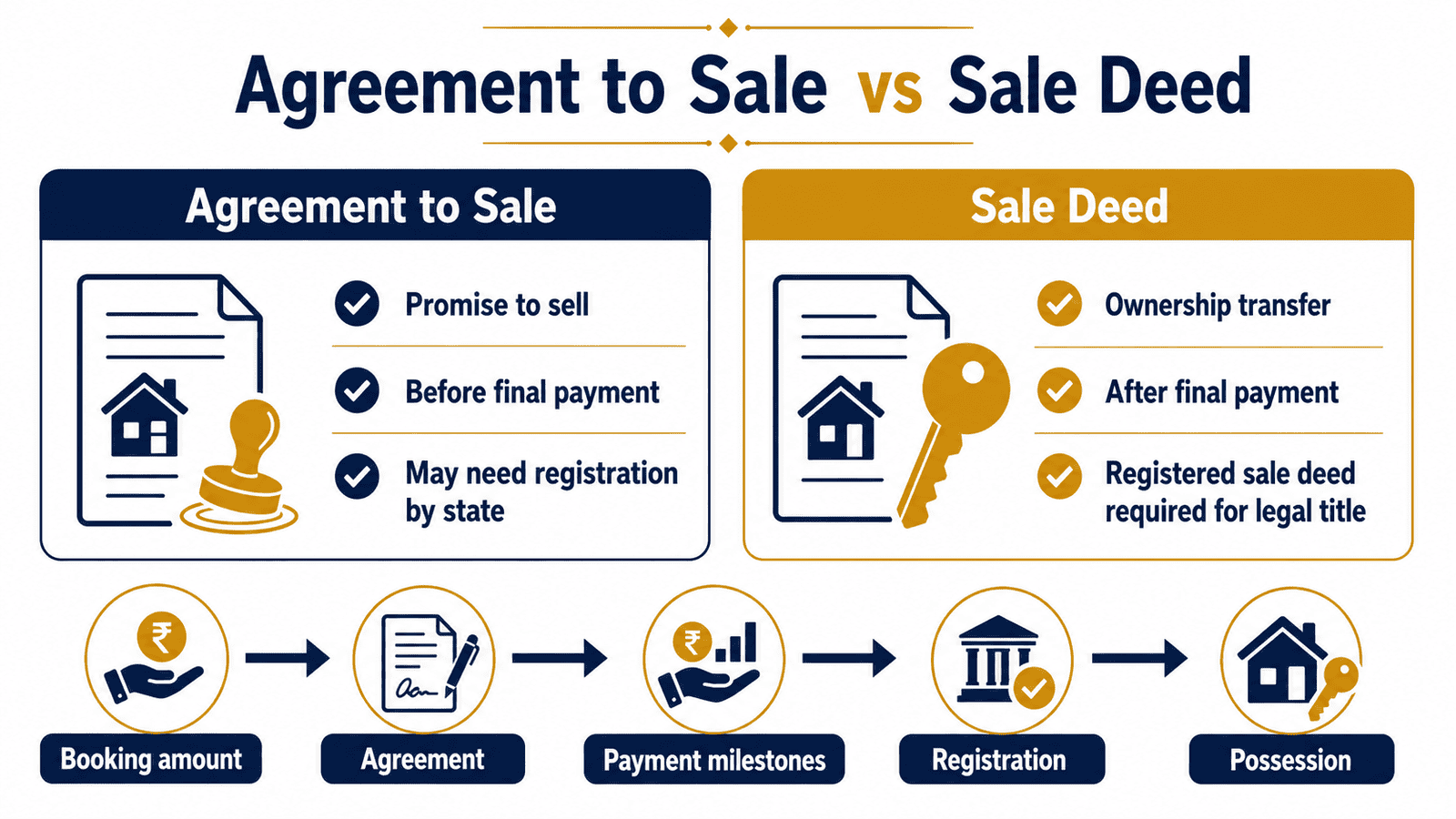
Agreement to sale vs sale deed means comparing a promise to transfer property later with the final document that transfers ownership. An agreement to sale records terms such as price, payment schedule and possession date, while a registered sale deed legally completes the sale. For a ₹95 lakh home, both documents may matter.
Key Takeaways
- An agreement to sale is signed before the final transaction — it records the terms but does not transfer ownership to the buyer.
- A registered sale deed is the document that legally completes the transfer of property ownership — without it, the buyer’s title is not fully protected.
- Banks disbursing a home loan typically require sight of both documents at different stages of the transaction — the agreement to sale for processing, and the sale deed before final disbursement.
- Stamp duty and registration charges apply to a sale deed and vary significantly by state — in some states, a nominal stamp duty also applies to the agreement to sale.
- For builder purchases, always verify that the project is registered under the relevant State RERA Authority before signing the agreement to sale or paying any booking amount.
- An unregistered or notarised-only agreement does not give you full legal protection in most Indian states — registration under the Registration Act, 1908 is the key step.
- Title verification, encumbrance certificate, and a lawyer review before signing are not optional steps — they are your primary protection against property disputes.
Agreement to Sale vs Sale Deed: Comparison at a Glance
| Parameter | Agreement to Sale | Sale Deed |
|---|---|---|
| Nature of document | Executory promise — terms agreed, transfer pending | Completed conveyance — ownership formally transferred |
| When it is signed | Before final payment — at booking or payment-schedule stage | At or after final payment — when all conditions are met |
| Ownership transfer | No — buyer has contractual rights only | Yes — ownership passes on execution and registration |
| Registration requirement | Compulsory registration required in most states if possession is transferred or consideration exceeds threshold; verify with state registration department | Registration under the Registration Act, 1908 is essential for legal title protection |
| Stamp duty | Nominal in most states — varies; verify before publishing | Full stamp duty applicable — state-specific rate |
| Buyer protection | Contract rights — breach can be enforced in court but does not equal ownership | Strongest legal proof of ownership for resale, inheritance, or dispute |
| Bank and home loan use | Used for initial loan processing and sanction | Required for final disbursement and mortgage creation |
| RERA relevance | Applicable — builder projects must be RERA-registered before agreement is signed | Comes after RERA-related milestones — possession and completion certificate stage |
Key Facts at a Glance
| Fact | Agreement to Sale | Sale Deed |
|---|---|---|
| Governed by | Transfer of Property Act, 1882 (Section 54) | Transfer of Property Act, 1882 + Registration Act, 1908 |
| Alternative name | Agreement for sale, sale agreement, purchase agreement | Conveyance deed, registered sale deed |
| Legal standing without registration | Limited — enforceability depends on state and terms | Very weak — an unregistered sale deed does not transfer legal title |
| Used in home loan | At sanction and early disbursement stages | Required for final disbursement and mortgage |
| Mutation of property records | Not applicable | Required to update revenue records after registration |
For current stamp duty and registration charges in your state, check our stamp duty charges state-wise guide before finalising your budget.
What Is an Agreement to Sale in India?
Under Section 54 of the Transfer of Property Act, 1882, an agreement to sale is a contract between a buyer and seller that sets out the terms on which a property sale will happen in the future. It is an executory document — meaning it records a promise, not a completed act.
In an Indian property transaction, the agreement to sale typically covers the agreed sale price, the payment schedule (booking amount, milestone payments, and balance), the possession date, what happens if either party defaults, and the conditions that must be met before the final sale deed is executed.
The agreement to sale does not transfer ownership. The buyer has contractual rights — they can enforce the agreement in court if the seller backs out — but they do not hold title to the property until the sale deed is executed and registered.
When Does an Agreement to Sale Get Registered?
This is where many buyers get confused. In most Indian states, an agreement to sale that involves possession being handed over or a significant part of the consideration being paid must be compulsorily registered under the Registration Act, 1908. An unregistered or only notarised agreement gives the buyer much weaker legal protection. Always check with the relevant State Registration Department for your state’s specific threshold and registration requirement.
What Is a Sale Deed in India?
A sale deed — also called a conveyance deed — is the document that actually completes the transfer of property from seller to buyer. Once executed by both parties and registered at the sub-registrar’s office, ownership passes to the buyer in law.
The sale deed records the full consideration amount, the complete property description, confirmation that the seller has clear title, handover of possession, and any covenants that both parties agree to carry forward. Crucially, it must be registered under the Registration Act, 1908 — an unregistered sale deed does not give the buyer legal title that is enforceable against the world.
Why Registration of the Sale Deed Matters
Registration is not a formality. It is the step that makes your ownership publicly recorded and legally enforceable. After registration at the sub-registrar office, you must also complete mutation — updating the local revenue or municipal records to show the new owner’s name. Without mutation, future property tax bills, utility connections, and resale paperwork can become complicated.
How Both Documents Work Together
In a typical builder purchase or resale transaction in India, both documents appear — but at different stages. The agreement to sale comes first: it locks in the price and terms while the conditions for completing the sale (construction milestones, loan approvals, title clearance) are being met. The sale deed comes last: it converts the contractual promise into a completed, registered transfer of ownership.
For builder projects specifically, the relevant State RERA Authority requires the builder to be registered and the project to be listed on the RERA portal before any agreement to sale is signed or any advance beyond the permitted booking amount is taken. Understanding RERA buyer protection is essential before signing any builder agreement — it defines your rights if possession is delayed, the project stalls, or the builder makes changes to the approved plan.
Title Verification Before Either Document
Before signing the agreement to sale, a buyer should carry out title verification — examining the chain of ownership documents going back at least 15–30 years, and obtaining an encumbrance certificate from the sub-registrar’s office to confirm that no loans, liens, or disputes are registered against the property. Skipping this step before paying a booking amount or large advance is one of the most expensive mistakes a buyer can make.
Real Example: Rohit’s ₹95 Lakh Apartment in Hyderabad
Rohit Sharma, 36, is a senior IT manager in Hyderabad earning ₹28 lakh a year. He has shortlisted a ₹95 lakh apartment in an under-construction project and is applying for a ₹76 lakh home loan.
Here is how the two documents appear in his transaction:
Step 1 — Booking and agreement to sale. Rohit pays ₹9.5 lakh as a booking amount and signs the agreement to sale. The document records the total price of ₹95 lakh, the payment schedule tied to construction milestones, the possession date (December 2026), the builder’s RERA registration number, and what happens if either party defaults. Rohit does not own the flat yet — he has contractual rights backed by the builder’s RERA obligations.
Step 2 — Home loan processing. Rohit’s bank examines the agreement to sale, the builder’s RERA certificate, the project’s title documents, and the approved building plan before sanctioning ₹76 lakh. The bank releases funds in tranches linked to construction progress. The agreement to sale is the primary document at this stage. For a full picture of how this works, see our guide on the home loan process in India.
Step 3 — Sale deed and registration. On completion and handover, Rohit and the builder execute the sale deed at the sub-registrar’s office. Rohit pays the applicable stamp duty and registration charges for Telangana on the ₹95 lakh consideration. After registration, he applies for mutation of property records in his name. Only from this point does Rohit hold legal title to the apartment.
The key insight: the agreement to sale gave Rohit contractual protection during construction. The registered sale deed gave him ownership.
How to Decide What’s Right for You
You are at the booking or early payment stage of a builder property — THEN the agreement to sale is your primary document. Confirm the builder’s RERA registration, the project approval, and the payment and default clauses before signing or paying.
You are approaching final payment and handover — THEN shift your focus to reviewing the sale deed draft carefully. Verify that all property details, names, survey numbers, and consideration amounts exactly match the agreement to sale and the title documents.
You are taking a home loan — THEN your bank will require both documents at different stages. The agreement to sale supports sanction; the sale deed is required before final disbursement and mortgage creation. Do not assume one replaces the other.
You are buying a resale property — THEN ask for the original registered sale deed from the previous transaction, verify the encumbrance certificate, and check the mutation records before paying any advance or signing a new agreement.
The seller is unable or unwilling to show the previous title documents and registered sale deed — THEN do not proceed. This is a significant red flag regardless of how attractive the deal appears.
You have completed title verification, obtained an encumbrance certificate, and had a property lawyer review the agreement and deed draft — do not pay any large amount or sign either document relying only on builder assurances or verbal commitments.
Common Mistakes to Avoid
Treating the Agreement to Sale as Proof of Ownership
Many first-time buyers believe that signing an agreement to sale and paying a booking amount makes them the owner. It does not. Ownership legally transfers only after the sale deed is executed and registered.
This confusion has led buyers to assume they can resell, mortgage, or occupy the property based on the agreement alone — only to face legal challenges later. In multiple court cases, buyers who held only an agreement to sale and no registered deed have struggled to establish their title.
Always wait for and insist on the registered sale deed before considering yourself the legal owner.
Paying a Large Advance Without Title Verification
Paying ₹5–20 lakh as an advance before verifying the title, encumbrance certificate, and ownership chain is one of the costliest mistakes in Indian property buying.
If the property has an existing mortgage, a disputed title, or an unresolved inheritance claim, recovering your advance can require years of legal action. The seller may not always have the financial ability to refund it even if you win in court.
Get the encumbrance certificate from the sub-registrar’s office before writing any large cheque.
Relying on a Notarised Agreement Instead of a Registered One
Notarisation confirms that the parties signed the document — it does not substitute for registration under the Registration Act, 1908. An only-notarised agreement to sale carries significantly weaker enforceability in most Indian states.
Always ensure the agreement to sale is properly registered at the sub-registrar’s office when registration is required under applicable state law.
Ignoring State-Specific Stamp Duty and Registration Requirements
Stamp duty and registration charges vary widely across states and even property types. In some states, the agreement to sale itself attracts a separate nominal stamp duty. Treating these costs as uniform across India can leave you with an unexpected liability of ₹1–6 lakh or more at registration time.
Check the applicable charges with the State Registration Department well before the registration date so you have the funds ready.
Not Checking Seller Identity and Authorisation
In cases involving a power of attorney, inherited property, or joint ownership, the person signing the agreement may not have the legal authority to sell. Titles sold through an improperly constituted power of attorney have been challenged successfully in Indian courts.
Verify the identity, authority, and capacity of every signatory before executing either document.
Missing the TDS Obligation on High-Value Purchases
If your property purchase price exceeds ₹50 lakh, the buyer is required to deduct TDS at the applicable rate under Section 194-IA of the Income Tax Act and remit it to the government — this applies on the agreement value, not just the registered value. Buyers who miss this obligation face interest and penalty. Check our guide on property TDS rules for the current thresholds and compliance steps.
Verify the current TDS rate and compliance procedure at incometax.gov.in before completing the transaction.
Forgetting Mutation After Registration
Registration at the sub-registrar’s office does not automatically update the municipal, panchayat, or revenue records. Without completing mutation, the previous owner’s name continues to appear in government land and property records.
This creates complications for property tax, utility connections, and future resale. Apply for mutation promptly after registration and retain the acknowledgment.
When This May Not Be the Right Choice
Proceeding with only a template agreement to sale or a downloaded sale deed format — without professional review — may not be adequate in these situations:
Disputed or unclear property title. If the property has a litigation history, a pending court case, or an unclear chain of ownership, a standard agreement or deed format will not protect you. Legal intervention and court-verified title clearance may be necessary before any document is signed.
Unverifiable ownership chain. If the seller cannot produce the previous registered sale deed, the original title documents, or a clean encumbrance certificate, the transaction carries unacceptable title risk regardless of how the current agreement is worded.
Power of attorney, inherited property, or joint-owner disputes. Transactions involving a general power of attorney, property received through intestate succession, or co-owners who are in dispute require specific legal documentation and often court orders. A generic agreement format is unlikely to adequately address these risks.
Builder project not verifiable on RERA portal. If the builder’s project does not appear on the relevant State RERA portal, or if the builder is attempting to take advance payments before the project is registered, you are proceeding without the buyer protections that RERA provides.
If any of these apply to your situation, it may be worth exploring alternatives before committing.
Official Rules and Where to Verify
Property law in India is a combination of central legislation and state-level rules. The key central laws are the Transfer of Property Act, 1882 and the Registration Act, 1908. Stamp duty and registration charges are state subjects — rates and procedures differ across every state and union territory.
Before signing any property document, verify current rules and charges from these official sources:
- State Registration Department — Your state’s official registration portal for stamp duty rates, registration charges, document requirements, and the sub-registrar office locator.
- State RERA Authority — Your state’s RERA portal to verify that the builder and project are registered, check project status, and view any complaints or orders.
- Income Tax Department — incometax.gov.in — for TDS on property purchase, Section 194-IA compliance, and Form 26QB filing requirements.
- Local sub-registrar office — For the actual registration procedure, appointment booking, and document checklist applicable to your district.
For a step-by-step breakdown of the registration procedure and the documents you will need to carry, see our guide on the property registration steps in India.
Rules, limits, and rates on this topic can change with each Budget or regulatory update. Always verify current figures directly from the official source before making any financial decision.
Expert Tips
- Match every detail across both documents before signing. The buyer’s name, seller’s name, property address, survey number or flat number, floor, wing, and the total consideration amount must be identical in the agreement to sale and the sale deed draft. A mismatch — even a spelling difference — can delay registration and complicate mutation.
- Obtain the encumbrance certificate yourself — do not rely on the seller’s copy. Apply for it directly from the sub-registrar’s office for the property’s full address. An EC covering at least the last 15 years will reveal any mortgages, legal charges, or transaction history against the property.
- Read the default and refund clauses in the agreement to sale with the same care as the price. If the builder delays possession by more than the agreed date, your RERA-backed remedy depends on what has been specified in the agreement. Vague possession clauses have left buyers unable to claim compensation even when delays stretched to 2–3 years.
- Confirm all co-owners and authorised signatories are present and correctly named. If the property is jointly owned by a husband and wife, or if the seller is acting under a power of attorney, every co-owner or principal must be properly party to both documents. Missing a co-owner’s signature can invalidate the deed.
- Budget for stamp duty and registration charges before the registration date — not after. These are typically paid at the time of registration and the sub-registrar’s office will not proceed without the demand draft or online payment. A last-minute liquidity gap at this stage can delay possession and create complications with your home-loan disbursement schedule.
- Keep the registered original of the sale deed and all supporting documents in a safe location. For a home loan case, the original registered sale deed will be held by the bank as security. Ask your bank for a certified copy and keep it separately. After the loan is repaid, collect and verify the original immediately.
- Apply for mutation within 30–90 days of registration. The timeline varies by state and local body. Late mutation applications can attract penalties in some jurisdictions, and an unmutated property creates complications in every subsequent transaction.
Frequently Asked Questions
Is an agreement to sale proof of ownership?
No. An agreement to sale gives you contractual rights — the right to enforce the transaction terms in court if the seller defaults. It does not transfer ownership. Legal ownership of property in India transfers only when the sale deed is executed and registered at the sub-registrar’s office under the Registration Act, 1908.
Is a sale deed compulsory for every property purchase in India?
For immovable property transactions where ownership is being transferred, a registered sale deed is the legally recognised document that completes the transfer. Without a registered sale deed, you cannot establish clear, enforceable legal title. For gifted or inherited property, the applicable document may differ — consult a property lawyer for those situations.
Can a registered sale deed be cancelled?
A registered sale deed can be cancelled only through a mutual cancellation deed registered at the same sub-registrar’s office, or through a court order. Unilateral cancellation by either party is not legally valid. Attempting to cancel without the other party’s consent requires legal proceedings and is not a quick process.
Is a notarised agreement to sale enough for legal protection?
In most Indian states, notarisation alone is not a substitute for registration. A notarised agreement confirms that both parties signed the document but does not create the same legal protections as a registered agreement. Where registration of the agreement to sale is required under applicable state law, a notarised-only copy carries significantly weaker enforceability.
Who pays stamp duty and registration charges?
By convention and in most documented agreements, stamp duty and registration charges on the sale deed are paid by the buyer. However, this is a negotiable term and can be agreed differently between the parties. The legal obligation is on whoever the state stamp duty rules specify — typically the person in whose favour the document is executed. Verify the applicable rule with your state’s registration department.
Can a bank give a home loan before the sale deed is executed?
Yes. Banks typically sanction a home loan based on the agreement to sale, title documents, and builder credentials. Disbursements are often made in tranches tied to construction progress, with the bank holding the agreement to sale and related documents. The final disbursement and creation of the registered mortgage generally require the sale deed to be executed and registered. Your bank’s specific requirements may vary — confirm the disbursal conditions with your lender at sanction stage.
What happens if the seller refuses to execute the sale deed after the agreement to sale is signed?
If the seller refuses without valid justification, the buyer can approach a civil court seeking specific performance — a court order directing the seller to complete the sale as agreed. Under the Specific Relief Act, courts in India can and do grant specific performance in property disputes. This process can take time and cost, which is why a lawyer-reviewed agreement to sale with clear default and remedy clauses is important from day one.
What is an encumbrance certificate and why does it matter before signing?
An encumbrance certificate (EC) is issued by the sub-registrar’s office and records all transactions — sales, mortgages, gifts, and legal charges — registered against a property over a specified period. Before signing an agreement or paying an advance, an EC covering at least 15 years helps confirm that the property has no undisclosed loans, liens, or ownership disputes that could affect your title after purchase.
Can I transfer or sell the property based only on an agreement to sale?
No. You cannot execute a valid sale deed in favour of a third party unless you yourself hold a registered sale deed for the property. Attempting to chain agreements without a registered deed creates legally fragile ownership structures that have been successfully challenged in Indian courts. Always complete registration before treating yourself as the owner for any purpose.
Final Verdict
For any Indian home buyer, the agreement to sale and the sale deed are not interchangeable — they are two sequential steps in the same transaction, each with a distinct legal role. The agreement to sale protects your negotiated terms during the period between commitment and completion. The registered sale deed is what makes you the legal owner. Treating the agreement alone as sufficient, or rushing to register without a proper title check, are both paths to expensive problems.
If you are buying with a home loan, the agreement to sale will get your loan sanctioned and disbursements started — but your bank will require the registered sale deed before the mortgage is formally created. If you are buying a resale flat, the previous registered sale deed is your single most important document to examine before paying anything.
Before you sign or pay, verify the property’s RERA status, title chain, encumbrance certificate, and state-specific registration requirements. For a complete walkthrough of buyer protections, see our guide on RERA buyer protection in India.
Always verify the latest rules from official sources or consult a qualified professional before making any financial decision.
This article is for educational purposes only and should not be treated as personalised financial, tax, investment, insurance, or legal advice. Tax rules, interest rates, regulatory limits, and product features can change with each Budget or policy update. Please verify current rules from official government sources or consult a qualified and registered professional before making any financial decision.

Neha Kulkarni writes about the financial side of home buying, renting, property decisions, and real estate costs in India. Her content helps readers think beyond the EMI and understand the total cost of owning or buying a home.
She covers topics such as rent vs buy, home loan planning, down payment, stamp duty, registration charges, brokerage, maintenance cost, property tax, furnishing cost, home insurance, builder payment plans, resale property checks, home loan affordability, total cost of ownership, and hidden costs in property decisions.
Neha’s writing is practical, family-focused, and cost-conscious. She uses Indian city examples, ₹ calculations, and decision checklists to help readers evaluate whether a property decision fits their income, savings, loan eligibility, and long-term plans. Her articles are useful for first-time home buyers, salaried couples, families, and people comparing rent with home ownership. Since property rules, stamp duty, registration charges, local taxes, home loan rates, and legal requirements vary by state and city, readers should verify current details from official state, lender, and legal sources.