

You open your brokerage app one morning and see a notification: “Rights issue announced for [Company Name]. Record date: [upcoming date].” If your first reaction was confusion — you are not alone. Many retail investors in India are unsure whether a rights issue means free shares, a compulsory payment, or something they can safely ignore. The answer is: none of those exactly. A rights issue is an offer — and like any offer, the decision to accept, sell, or walk away carries real consequences for your shareholding. This article explains rights issue meaning in plain language, walks through a real example, and tells you what to verify before acting. If you are new to how shares and corporate actions work, it helps to first read our guide on stock market basics before diving in.
Quick Answer: Rights Issue Meaning
Rights issue meaning refers to a company offering new shares to existing shareholders, usually in a fixed ratio such as 1:4, often at a set issue price. Shareholders can apply, sell the rights entitlement if permitted, or ignore it, but ignoring may reduce their ownership percentage after new shares are issued.
Key Takeaways
- A rights issue is an offer to buy additional shares at a set price — not a free share grant. You must pay to participate.
- The record date determines who is eligible. If you hold shares in a company on or before the record date, you receive a rights entitlement.
- Rights entitlement may be tradable on the stock exchange for a limited window, depending on the issue terms — you are not forced to apply or lapse it silently.
- If you ignore a 1:4 rights issue and all other shareholders apply, your ownership percentage in the company will fall after the new shares are issued.
- The issue price is typically set below the prevailing market price, but a discount alone is not a reason to apply — company fundamentals and purpose of fundraising matter equally.
- According to SEBI guidelines at sebi.gov.in, rights issues in India are governed by the ICDR (Issue of Capital and Disclosure Requirements) regulations.
- Always verify record date, issue price, entitlement ratio, and application window from the company’s official letter of offer before taking any action.
Key Facts at a Glance
| Term | Simple Meaning |
|---|---|
| Rights issue | An offer by a listed company to issue new shares to existing shareholders at a specified price |
| Eligible investor | Shareholders who hold shares on or before the record date |
| Record date | The cut-off date set by the company to identify who qualifies for the rights offer |
| Ex-rights date | The trading date from which newly purchased shares no longer carry the rights entitlement |
| Rights entitlement | The number of new shares you are entitled to apply for, based on your existing holding |
| Entitlement ratio | The ratio at which new shares are offered — for example, 1:4 means 1 new share for every 4 held |
| Issue price | The fixed price at which rights shares are offered, usually lower than the market price |
| Renunciation of rights | The act of giving up or transferring your entitlement to another eligible person |
| Share dilution | Reduction in ownership percentage when new shares are issued and you do not participate |
| Letter of offer | The official document from the company detailing all terms of the rights issue |
How a Rights Issue Works: The Full Picture
Why Companies Use a Rights Issue
A company that needs fresh capital has several options: take on debt, approach institutional investors, or raise money from existing shareholders. A rights issue is the third route. It allows the company to raise paid-up share capital without going through a public offering to new investors. Common reasons include funding expansion, acquiring another business, reducing debt, or shoring up working capital.
Whether the purpose is strong or weak matters. A company raising money to fund a well-defined project is in a different position from one raising money because it cannot service existing loans. The purpose is disclosed in the letter of offer — always read it.
According to SEBI’s ICDR framework at sebi.gov.in, listed companies must comply with specific disclosure and timeline requirements before launching a rights issue. This includes publishing a letter of offer, setting a record date, and providing shareholders with an adequate application window.
How Existing Shareholders Receive the Offer
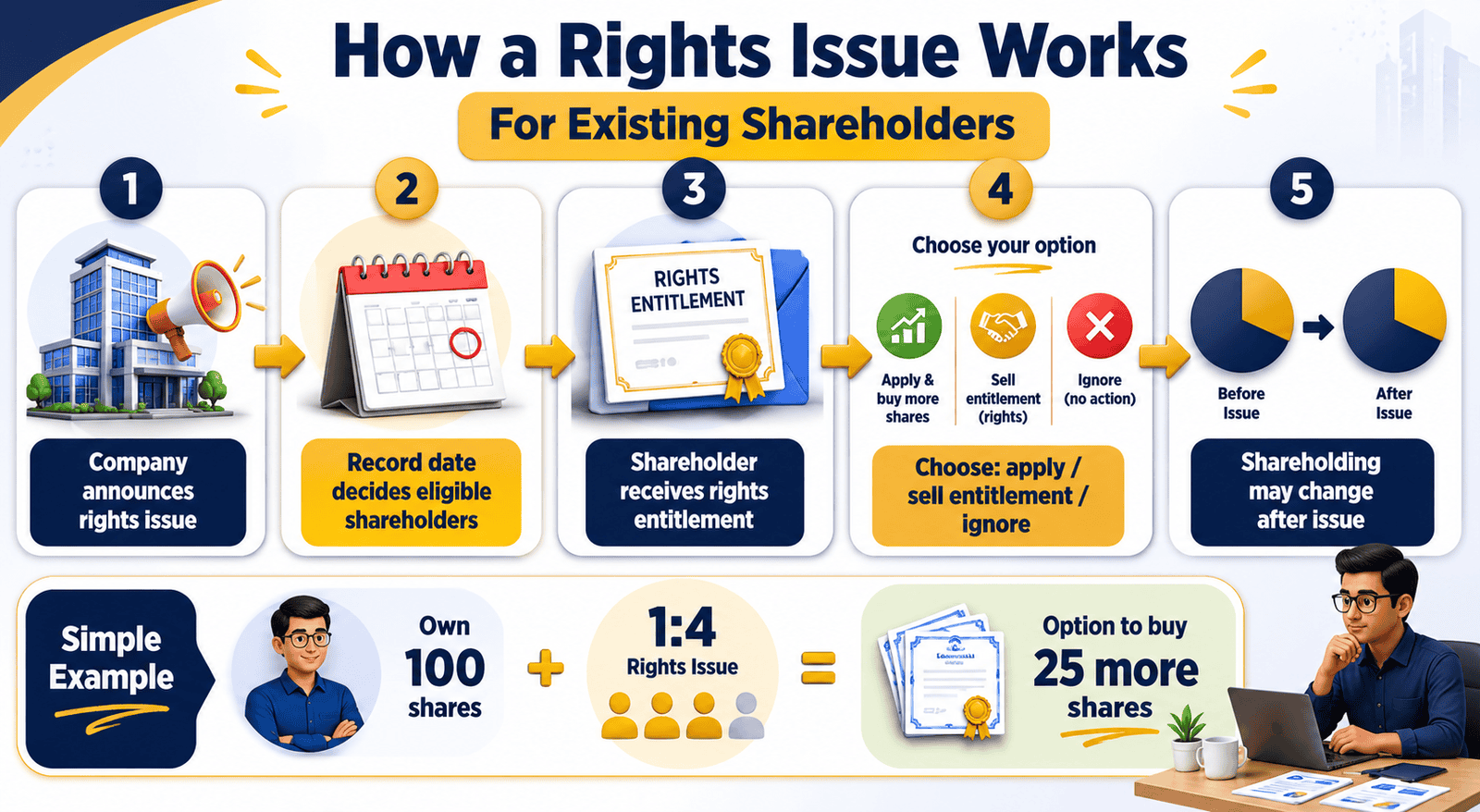
When a company announces a rights issue, it sets a record date. Every shareholder who holds the company’s shares in their demat account on that date becomes eligible. The rights entitlement — the number of new shares you can apply for — is calculated based on your holding and the entitlement ratio.
These entitlements are typically credited to shareholders’ demat accounts as Rights Entitlement (RE) securities, which can sometimes be traded on the stock exchange for a limited window before the issue closes. This is an important detail that many beginners miss: you may be able to sell your entitlement rather than apply or simply let it lapse.
Understanding what you actually own when you hold a share — voting rights, a stake in the company’s assets — is foundational here. Our article on owning company shares explains this in detail.
How the Entitlement Ratio Works
The entitlement ratio tells you how many new shares you can buy for every existing share you hold. A 1:4 ratio means one new share for every four you already own. If you hold 100 shares, you are entitled to apply for 25 new shares.
The ratio is fixed by the company and disclosed upfront. You cannot apply for more than your entitlement unless the company allows renunciation or oversubscription in specific conditions — check the letter of offer for this.
Why the Issue Price Differs from Market Price
The issue price in a rights issue is typically set below the prevailing market price — this discount is the company’s way of making the offer attractive enough for shareholders to participate. However, the market price of the share often adjusts downward after the ex-rights date to reflect the dilution caused by the new shares entering the system.
This means the gap between issue price and market price can narrow by the time you actually receive the shares. The discount is real but not as large as the initial announcement might suggest.
Share Dilution: The Risk of Ignoring a Rights Issue
Dilution is the reduction in your ownership percentage when new shares are issued. If a company currently has 1,00,00,000 shares outstanding and issues 25,00,000 new shares through a rights issue, total shares increase to 1,25,00,000. If you held 100 shares before and did not apply, you still hold 100 shares — but your stake in the company has gone from 0.0010% to 0.0008%.
For small retail investors, the absolute dilution in rupee terms may be modest, but for those holding a significant position, not participating can mean a meaningful reduction in proportional ownership.
Real Example: Rohan’s Rights Issue Decision
Rohan, 31, a software engineer in Bengaluru earning ₹18 lakh per year, holds 100 shares of a fictional company called Prism Industries Ltd. The shares are currently trading at ₹800 each. The company announces a 1:4 rights issue at an issue price of ₹600 per share. The record date is three weeks away.
Rohan’s entitlement: 100 ÷ 4 = 25 rights shares. To apply for all 25, he needs 25 × ₹600 = ₹15,000.
He now has three choices. First, he can apply and pay ₹15,000 to receive 25 additional shares, increasing his total holding to 125 shares. Second, if Prism Industries’ rights entitlements are trading on the exchange, he can sell his entitlement during the trading window and receive some cash — without applying. Third, he can do nothing, let the entitlement lapse, and retain his 100 shares. If most other shareholders apply, his proportional ownership in Prism Industries will decrease.
Rohan checks the company’s letter of offer to understand why Prism Industries is raising money. He also confirms his rights entitlement has been credited to his demat account before the application window opens. The rights entitlement shows up as a separate line item in his demat holdings — not as regular shares.
Key insight: the ₹600 issue price looks attractive against the ₹800 market price, but Rohan knows the market price will likely adjust after the ex-rights date. The real question is whether Prism Industries is a company worth owning more of — and that answer comes from the letter of offer, not the price alone.
How to Calculate Your Rights Entitlement
Rights Entitlement = Existing Shares Held ÷ Denominator × Numerator
For a 1:4 ratio: Rights Entitlement = 100 ÷ 4 × 1 = 25 shares
Cash Required = Rights Entitlement × Issue Price = 25 × ₹600 = ₹15,000
Using Rohan’s example from Section 6:
| Scenario | Key Inputs | Result |
|---|---|---|
| Full participation | 100 shares held, 1:4 ratio, ₹600 issue price | 25 new shares acquired; ₹15,000 paid; total holding: 125 shares |
| Entitlement sold (if tradable) | 25 RE credits sold at prevailing RE market price | No new shares; cash received; ownership unchanged at 100 shares but dilution possible if others apply |
| Entitlement ignored (lapsed) | No action taken; ₹0 paid | Holding remains 100 shares; ownership percentage falls as new shares are issued to other applicants |
Note: These figures are entirely illustrative. Market price movement after a rights issue depends on multiple factors and is not guaranteed. The example uses round numbers to make the calculation clear — actual issue prices and ratios vary per company announcement.
Comparison: Rights Issue vs Bonus Issue vs Stock Split
Beginners frequently confuse rights issues with bonus issues and stock splits. These are three distinct corporate actions with very different implications for your wallet and your holdings. For a deeper look at the latter two, see our comparison of bonus and split impact.
| Feature | Rights Issue | Bonus Issue | Stock Split |
|---|---|---|---|
| Does it require payment? | Yes — at issue price | No | No |
| Does company raise fresh capital? | Yes | No | No |
| Impact on number of shares | Increases — new shares issued | Increases — existing reserves capitalised | Increases — face value split into smaller units |
| Impact on ownership if you participate | Maintained or increased | Maintained proportionally | Maintained proportionally |
| Impact on ownership if you do not act | Diluted — others apply and your % falls | Not applicable — all holders receive equally | Not applicable — all holders receive equally |
| Action required by shareholder | Apply, sell entitlement, or let lapse | None — automatic credit | None — automatic adjustment |
| Governed by SEBI ICDR? | Yes | Partly | Partly |
How to Decide What’s Right for You
The company is raising capital for a clear growth project — such as a new plant, acquisition, or capacity expansion with disclosed timelines — THEN it may be worth reading the letter of offer carefully and evaluating participation on fundamentals.
The issue price is meaningfully below the recent three-month average market price and the company has a clean balance sheet — THEN the discount has real value worth considering alongside business quality.
You do not have ₹15,000 (or the required cash) readily available without touching your emergency fund — THEN check whether the rights entitlement is tradable on the exchange; selling it may recover some value without requiring fresh capital.
This company already accounts for more than 15–20% of your total equity portfolio — THEN applying for more rights shares will concentrate your risk further; consider whether your portfolio can absorb additional exposure.
Promoters have publicly stated they will participate in the rights issue — THEN it signals some level of insider confidence; if promoters are not participating, that is worth noting as well.
The company is raising money primarily to repay existing debt or cover operating losses — THEN evaluate whether the business will actually improve or whether this is a dilutive capital call that does not change the underlying problem.
You do not understand why the company needs the money, have not read the letter of offer, and are acting only on the price discount — THEN this is not enough information to make a sound participation decision; consider selling the entitlement if tradable, or letting it lapse, rather than applying blind.
Common Mistakes to Avoid
Assuming Rights Shares Are Free
Rights shares are not a gift from the company. You must pay the issue price to receive them.
Many first-time investors see a rights notification and assume they will receive shares automatically. They do not — the entitlement is the right to buy, not the right to receive for free. Confusing the two can lead to missed deadlines and unintended inaction.
Read the letter of offer for payment terms, UPI or ASBA application instructions, and the closing date.
Missing the Record Date or Application Window
The record date determines your eligibility, and the application window determines your deadline to act.
If you buy the shares after the ex-rights date, those shares do not carry the entitlement. If you miss the application window, your entitlement may lapse. Both errors are irreversible — there is no extension for individual shareholders who miss the deadline.
Set a calendar reminder the moment you see a rights issue announcement for a company you hold.
Deciding Based on Discount Alone
An issue price of ₹600 against a market price of ₹800 looks like a ₹200 gain per share. That is not how it works.
After the ex-rights date, the theoretical ex-rights price adjusts downward to reflect the new shares entering the market. The actual market price depends on demand and company performance — not the issue price calculation. A discounted price in a declining business still means you are buying more of a weaker asset.
Compare the issue price with the company’s fundamentals, not just today’s market price.
Forgetting Dilution If You Do Not Participate
Choosing not to apply is also a decision — not a neutral one.
If a significant portion of the issue is subscribed by others and you hold a meaningful stake, your proportional ownership will fall. Over time, dilution from multiple rights issues can meaningfully erode your position relative to other shareholders.
At minimum, sell the entitlement if tradable to recover some economic value from the dilution event.
Ignoring Tax Implications When Selling Entitlements
If you sell your rights entitlement on the exchange, the gain may be taxable.
The tax treatment of rights entitlement sale proceeds is a nuanced area — it may attract capital gains tax depending on the nature of the transaction and the holding period. Always check the current rules with a qualified tax professional and verify at incometax.gov.in before selling entitlements.
Do not assume trading a rights entitlement is tax-free simply because it is not a regular share.
Not Checking Whether Entitlements Are Tradable
Not all rights issues offer tradable entitlements. Some companies allow Rights Entitlement (RE) securities to trade on the exchange for a fixed window; others do not.
If you assume tradability without confirming, you may miss the window or find no liquid market for the entitlement. Always verify this from the letter of offer or your broker’s communication.
Applying Without Reading the Letter of Offer
The letter of offer contains the exact issue price, ratio, record date, application window, purpose of the fundraise, and risks disclosed by the company.
Skipping it and relying on broker notifications or WhatsApp summaries exposes you to incomplete information. SEBI requires this document to be made publicly available — read it.
When This May Not Be the Right Choice
A rights issue may not suit you if the company is raising money to repair a weak balance sheet — high debt, sustained losses, or regulatory penalties — rather than to fund genuine growth. In such cases, fresh capital may simply delay a deeper problem, and participating extends your exposure to that risk.
It may also not be suitable if this stock already forms a large portion of your portfolio. Adding more shares through a rights issue concentrates your risk further, which is rarely a sound portfolio decision regardless of issue price.
If you need your savings liquid over the next six to twelve months — for an emergency fund, a planned purchase, or an existing loan commitment — deploying cash into a rights issue ties up money you may not be able to recover quickly at a favourable price.
Finally, if you genuinely do not understand the business, its revenue model, or why it needs the capital, that is itself a sufficient reason to step back. A discounted price does not compensate for uncertainty about a company’s direction.
If any of these apply to your situation, it may be worth exploring alternatives before committing.
Official Rules and Where to Verify
Rights issues in India are regulated primarily by SEBI under the ICDR (Issue of Capital and Disclosure Requirements) Regulations. Before taking any action on a rights issue, verify the following directly from official sources:
- SEBI — sebi.gov.in: Regulatory framework for rights issues, ICDR guidelines, and investor rights disclosures.
- Income Tax Department — incometax.gov.in: Tax treatment of rights shares received, capital gains on sale of rights entitlements, and related provisions under the Income Tax Act, 1961. For a broader overview of how gains from stock market transactions are taxed, see our guide on stock tax rules.
- Company’s letter of offer: Available on the company’s investor relations page, the stock exchange filings (BSE/NSE), and SEBI’s EDGAR system. This is the primary source for issue-specific dates, price, ratio, and application instructions.
- Your registrar and broker: They will send formal communications including entitlement details and application instructions. Confirm you have received these before the application window closes.
Rules, limits, and rates on this topic can change with each Budget or regulatory update. Always verify current figures directly from the official source before making any financial decision.
Expert Tips
- Read the purpose first, not the price: The most important line in any rights issue announcement is why the company needs the money. Expansion capex is different from debt restructuring — do not skip past the fundraise purpose to get to the ratio and price.
- Check promoter participation before deciding: Many rights issue documents disclose whether promoters plan to subscribe to their full entitlement. A promoter who publicly commits to participating is putting their own capital in. A promoter who is not — or who is reducing their stake — is a signal worth weighing. Applying for an IPO has a different process, but the principle of reading all disclosed information first is the same; see our guide on IPO application basics for that context.
- Compare issue price against a three-month average, not just today’s price: A single day’s market price can be misleading. Use the company’s 52-week range and three-month average to assess whether the issue price represents a genuine discount or whether the stock has recently fallen to meet the issue price.
- Note the Rights Entitlement trading window: If the company offers a tradable RE period, mark the opening and closing dates. The RE market can be illiquid — prices move quickly and may not reflect the full theoretical value of the entitlement. Act early in the window if you plan to sell.
- Keep all application acknowledgements: Whether you apply through UPI ASBA, your broker’s platform, or net banking, save proof of your application submission and the allotment notice when it arrives. These are needed for your tax records if you ever sell the shares.
- Do not rely on SMS summaries or social media posts: SEBI mandates that the full letter of offer be publicly available. There is no reason to rely on a condensed third-party version when the primary document is accessible at no cost through BSE or NSE filings.
Frequently Asked Questions
Is a rights issue good or bad for existing shareholders?
It depends entirely on why the company is raising money and whether you choose to participate. If the capital is for genuine growth and you apply at the issue price, you may benefit from a discounted entry into more shares of a business you already believe in. If the purpose is weak or you choose not to participate, you may face dilution. There is no single answer — evaluate each rights issue on its own terms.
Is applying for a rights issue compulsory?
No. Applying is never compulsory. You can apply in full, apply partially if the terms allow, sell your rights entitlement on the exchange if it is tradable, or let it lapse. The company cannot force you to invest more money. However, not acting at all may result in dilution of your ownership percentage.
What happens if I do not apply for a rights issue?
Your existing shares remain unchanged in your demat account. However, if the rights issue is fully or substantially subscribed by other shareholders, the total number of shares in the company increases — which means your percentage ownership falls. The cash you did not spend stays with you, but your proportional stake in the company shrinks.
Can I sell my rights entitlement instead of applying?
In many rights issues in India, Rights Entitlement (RE) securities are credited to eligible shareholders’ demat accounts and can be traded on the stock exchange during a specific window before the issue closes. If this is available for the rights issue you are looking at, you can sell the RE on the exchange and receive cash, without applying for or paying for new shares. Confirm this from the company’s letter of offer, as not every rights issue offers tradable entitlements.
Is a rights issue the same as a bonus issue?
No. A bonus issue gives you additional shares at no cost, funded from the company’s existing reserves. A rights issue requires you to pay the issue price to receive new shares. In a bonus issue, all eligible shareholders receive shares automatically — no decision is needed. In a rights issue, you must actively apply, sell your entitlement, or let it lapse.
Can a rights issue reduce the share price?
Yes, typically. After the ex-rights date, the theoretical market price adjusts to reflect the dilution from new shares entering the system. This is called the theoretical ex-rights price (TERP). In practice, the actual market price also moves based on investor sentiment, company news, and broader market conditions — so the precise post-rights price cannot be predicted.
Who is eligible to receive a rights issue offer?
Only shareholders who hold the company’s shares in their demat account on or before the record date are eligible. If you buy shares after the ex-rights date, those shares do not carry the rights entitlement. If you already hold shares before the ex-rights date, you will receive the entitlement regardless of whether you applied through an IPO, bought from the secondary market, or received them as a transfer.
Where do I check the record date and other rights issue details?
The record date, issue price, ratio, application window, and purpose of the fundraise are all disclosed in the company’s official letter of offer. This document is filed with SEBI and is available on the BSE and NSE stock exchange websites under the company’s announcements or filings section. Your broker will typically also send a notification, but always verify from primary sources at sebi.gov.in or the exchange filings directly.
Can I apply for more shares than my entitlement in a rights issue?
Some rights issues allow shareholders to apply for additional shares beyond their basic entitlement, subject to availability from shareholders who have not applied. This is called an additional application or excess application. Whether this is permitted, and to what extent, is specified in the letter of offer. Do not assume it is available — always check the terms first.
What is renunciation of rights?
Renunciation means giving up or transferring your rights entitlement to another person. The recipient can then apply for the shares in your place. SEBI’s ICDR regulations permit renunciation under defined conditions. The terms and whether renunciation is allowed in a specific issue will be stated in the letter of offer. This is different from simply selling the RE on the exchange — renunciation involves a formal transfer process.
Final Verdict
A rights issue is not automatically good news or bad news — it is an offer that requires a decision. The rights issue meaning is straightforward: a company is asking its existing shareholders to buy new shares at a set price, in a fixed ratio, within a defined window. What is less straightforward is whether to say yes, and that answer depends entirely on why the company needs the money, what the terms look like relative to the company’s fundamentals, and whether you have the cash and the conviction to invest more.
For long-term investors who understand the business, a well-priced rights issue can be a genuine opportunity to increase a position at a discount. For investors who are unsure, selling the entitlement — if tradable — is a reasonable middle path that recovers some value without requiring additional capital commitment. Ignoring it entirely without checking the entitlement status is the only option that offers nothing in return.
Before you act on any rights issue, read the letter of offer, verify the record date and application window, and check the official SEBI and company filings. Always verify the latest rules from official sources or consult a qualified professional before making any financial decision.
This article is for educational purposes only and should not be treated as personalised financial, tax, investment, insurance, or legal advice. Tax rules, interest rates, regulatory limits, and product features can change with each Budget or policy update. Please verify current rules from official government sources or consult a qualified and registered professional before making any financial decision.
Mutual fund investments are subject to market risks. Past performance does not guarantee future returns. Please refer to SEBI guidelines at sebi.gov.in for regulatory context on securities and investor rights in India.

Devika Shah writes about stock market basics for Indian beginners who want to understand equity investing before taking financial risk. Her content is educational and does not provide stock tips, trading calls, price predictions, or personalised investment advice.
She covers topics such as demat account meaning, trading account basics, IPOs, dividends, brokerage charges, delivery vs intraday trading, market orders, limit orders, stock indices, blue-chip stocks, capital gains tax, stock market terminology, risk management, and the difference between long-term investing and short-term speculation.
Devika’s writing is clear, balanced, and risk-conscious. She helps readers understand how the stock market works, what accounts and documents are needed, what charges may apply, and what mistakes beginners should avoid. Her articles are suitable for students, salaried employees, and first-time investors who want a foundation before investing. Since market rules, tax treatment, brokerage fees, IPO processes, and regulatory requirements can change, readers should verify current information from SEBI, exchanges, brokers, and official tax sources.