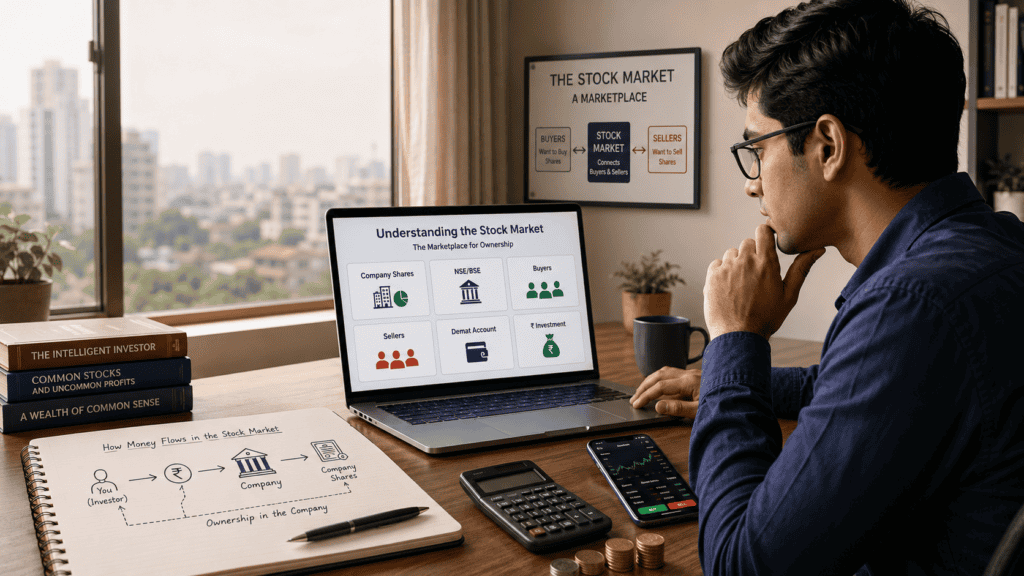
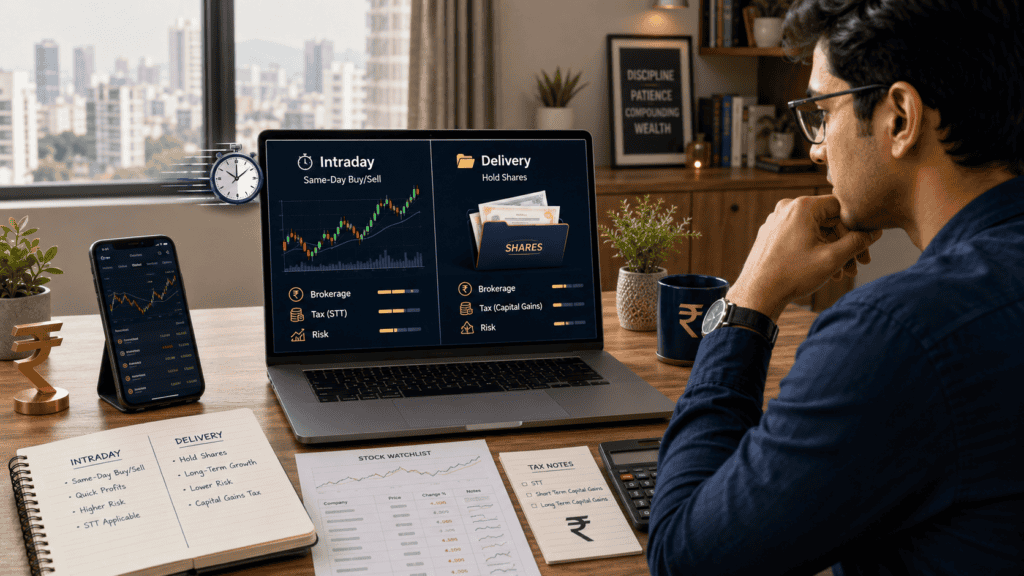
Most trading apps present you with a choice the moment you place your first order: intraday or delivery. It looks like a minor setting. It is not. This one selection determines whether you own the shares at the end of the day, how much tax you may owe on any profit, how much risk you are taking on, and whether a ₹500 gain actually stays in your pocket after charges. Intraday vs delivery trading is one of the most important distinctions a beginner can understand before putting real money into the market. If you are completely new to how the stock market works, start with our guide to stock market basics first — then return here. This article covers the real difference, the tax treatment, the cost of charges, the risk profile, and a clear decision framework to help you choose wisely.
Quick Answer: Intraday vs Delivery Trading
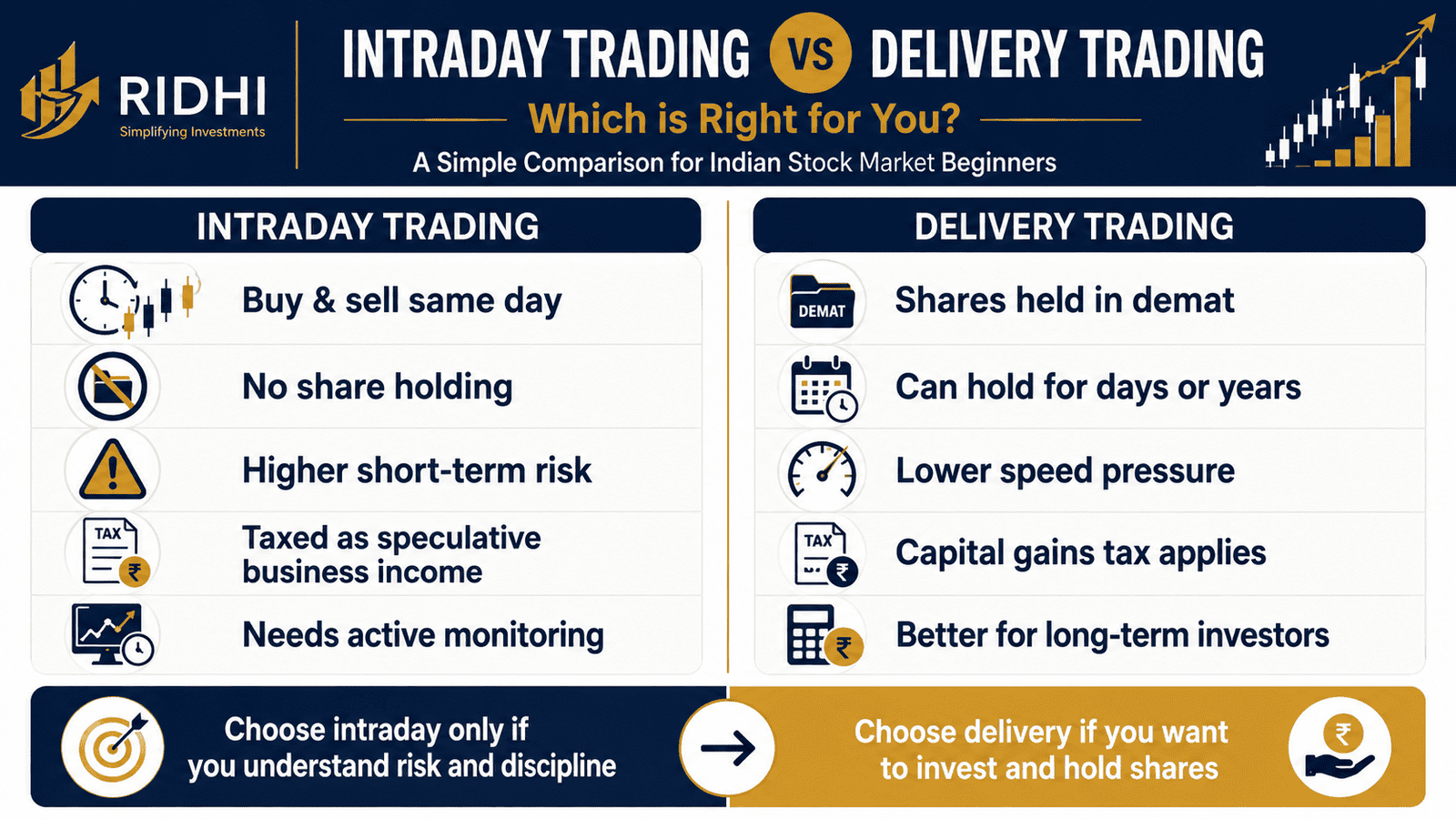
Intraday vs delivery trading means same-day share trading versus buying shares into your demat account for holding. Intraday is usually higher-risk and may be taxed as speculative business income, while delivery trades may attract capital gains tax. A ₹1,000 gross profit can shrink significantly after brokerage, STT, and applicable taxes — often more than a first-time trader expects.
Key Takeaways
- Intraday positions must be squared off on the same trading day — shares never reach your demat account.
- Delivery trades credit shares to your demat account and can be held for any period you choose — days, months, or years.
- Intraday profits are typically treated as speculative business income under the Income Tax Act — not capital gains — and are taxed at your applicable income slab rate.
- Delivery gains on shares sold within 12 months may attract short-term capital gains tax; gains on shares sold after 12 months may attract long-term capital gains tax — verify current rates at incometax.gov.in.
- Brokerage, STT, exchange charges, and GST apply to both trade types and can eliminate small profits entirely on low-value trades.
- Delivery trading is not risk-free: a share held in your demat account can still fall in value if the stock price declines after purchase.
- Beginners should understand risk management and complete several delivery trades before attempting intraday trading.
Intraday vs Delivery Trading: Side-by-Side Comparison
| Parameter | Intraday Trading | Delivery Trading |
|---|---|---|
| Holding Period | Same trading day only — exit before market close | 1 day to several years — no time pressure |
| Share Ownership | No — position squared off; shares not held overnight | Yes — shares credited to your demat account after settlement |
| Account Required | Trading account (demat not needed for settlement) | Trading account + demat account |
| Margin / Leverage | Brokers may offer intraday margin — verify with your broker | Full payment required for CNC orders; no intraday margin |
| Risk Level | High — price movement, time pressure, and leverage risk on the same day | Moderate — price risk spread over a longer holding period |
| Tax Treatment | Speculative business income — taxed at applicable slab rate | Short-term or long-term capital gains — verify current rates at incometax.gov.in |
| STT Applicability | Applicable — verify current rate and applicable leg at nseindia.com | Applicable on buy and sell — verify current rate at nseindia.com |
| Suitable for Beginners | Generally No | More Suitable |
Key Facts at a Glance
| Factor | Intraday | Delivery |
|---|---|---|
| Account Requirement | Trading account only | Trading account + demat account setup required |
| Demat Credit | No — position auto-squared off before close | Yes — shares settle on T+1 basis per NSE/BSE rules |
| Square-Off Requirement | Mandatory — broker cuts position typically around 3:15–3:20 PM | Not required — hold as long as you choose |
| Tax Category | Speculative business income under Section 43(5) of the IT Act | Short-term capital gains (STCG) or long-term capital gains (LTCG) |
| Time Commitment | High — active screen monitoring required during market hours | Lower — periodic review is usually sufficient |
| Record-Keeping | Mandatory — contract notes and P&L statements needed for ITR filing | Mandatory — contract notes, purchase price, and holding dates for tax computation |
What Is Intraday Trading?
Intraday trading means you buy and sell the same shares within the same trading session — typically between 9:15 AM and 3:30 PM on the NSE or BSE. You do not own the shares overnight. If you buy 100 shares of ABC Ltd at ₹200 in the morning and sell them at ₹207 by afternoon, your position is closed for the day. You receive the gross profit of ₹700 — minus brokerage on both legs, STT, exchange charges, and GST.
The critical detail: if you do not exit before your broker’s cut-off time (commonly 3:15 or 3:20 PM), the broker will automatically square off your open position. This auto square-off can happen at a less favourable price than you intended, and most brokers charge an additional fee for it.
Intraday trades are placed using the MIS (Margin Intraday Square-off) product type on most Indian trading platforms. Brokers may offer intraday margin — meaning you can trade a larger value than your actual account balance allows. This amplifies both profit potential and loss. A 2× margin means a 5% fall in the stock wipes out 10% of the capital you committed.
Intraday is an active activity. It requires real-time price monitoring, quick decision-making, and the discipline to exit according to a pre-set plan — not hope. Most experienced traders in India caution that consistent intraday profits are far harder to achieve than casual observers assume.
What Is Delivery Trading?
Delivery trading means you buy shares and hold them in your demat account. There is no compulsion to sell on the same day. You may hold for a week, a year, or longer. According to NSE settlement rules, delivery trades settle on a T+1 basis — meaning shares are credited to your demat account one trading day after the purchase date, and the payment for a sale is received one trading day after the sale.
Delivery trades are placed using the CNC (Cash and Carry) product type on most platforms. You pay the full value of the shares upfront. No intraday margin is available. What you receive in return is actual ownership of the shares — and time. You can research the company, wait for the price to recover from a dip, or hold for long-term growth without a daily deadline.
Delivery trading is what most people mean when they say they are “investing in shares.” But it is not passive safety. A share held in your demat account can lose value significantly if the company, sector, or broader market goes through a downturn. Ownership and performance are entirely different things.
What Happens in Your Broker App When You Select Intraday or Delivery
When you place a buy order on Indian trading platforms — whether Zerodha Kite, Groww, Upstox, Angel One, or another — a product type selector appears before you confirm the order. MIS (or Intraday) instructs the system that this position must be squared off the same day. CNC (or Delivery) instructs the system to credit shares to your demat account after settlement. One click changes ownership, tax category, risk profile, and settlement — simultaneously. Many beginners assume it is just a timing preference. It is a fundamental financial classification decision.
Why Holding Period Changes the Tax Outcome Entirely
The holding period is the single biggest driver of how your profit is taxed. Intraday trades — regardless of how briefly the position was open within the day — are classified as speculative transactions under Section 43(5) of the Income Tax Act. Profits are speculative business income: they are added to your total income and taxed at your applicable slab rate. If you earn ₹12 lakh in salary and ₹1 lakh in intraday profits, the ₹1 lakh is taxed at your marginal slab rate.
Speculative losses have restricted set-off. They can only be set off against speculative gains in the same financial year — not against salary, interest income, or other non-speculative income. Verify the current set-off rules and applicable ITR form at incometax.gov.in before filing.
Delivery trades produce capital gains. Shares sold within 12 months of purchase generate short-term capital gains (STCG). Shares sold after holding for more than 12 months generate long-term capital gains (LTCG). Both are taxed at rates that differ from income slab rates — and historically have been lower for investors in higher brackets. These rates can be revised in each Union Budget, so always verify current figures at incometax.gov.in.
Risk Is Not Only About the Stock Price Moving Against You
The most common beginner misconception about intraday risk is that it is simply about direction — will the stock go up or down? In practice, intraday risk operates on several levels at once. There is direction risk: the stock moves the wrong way. There is time risk: you must exit on the same day regardless of whether the position is profitable. There is leverage risk: margin amplifies losses beyond your cash position. There is cost drag: on small price moves, brokerage, STT, and GST can consume most of the gross profit. And there is behavioural risk: under real money and time pressure, beginners frequently override their own stop-losses, average down on losing positions, and make decisions based on panic rather than plan.
SEBI has published data on retail investor participation in equity derivatives showing that a significant proportion of individual traders experience net losses over time. While this data focuses primarily on derivatives, the underlying behavioural and cost dynamics apply to cash-segment intraday trading as well. Delivery trading carries its own risk — price risk over time — but the time pressure and leverage elements that make intraday particularly dangerous for beginners are absent.
Real Example: Rohit’s First Trade in Two Scenarios
Rohit, 28, is a software engineer in Pune earning ₹85,000 per month. He opens his trading app on a Wednesday morning and decides to place a trade on ABC Ltd, currently priced at ₹500 per share. He purchases 20 shares — total trade value: ₹10,000.
Intraday scenario: By 1:00 PM, ABC Ltd has risen to ₹508. Rohit sells all 20 shares. Gross profit: ₹160. After brokerage on both the buy and sell legs, STT on the sell side, exchange charges, and GST on brokerage, his net gain may be well under ₹100. This profit is speculative business income — added to his ₹10.2 lakh annual income and taxed at his slab rate. The net return on ₹10,000 capital, after all costs and tax, is modest at best.
Delivery scenario: Rohit buys the same 20 shares at ₹500 using the CNC product type. He holds them for 8 months. ABC Ltd rises to ₹580. He sells. Gross profit: ₹1,600. After brokerage and STT on both buy and sell, his net profit is still meaningfully positive. The gain may attract short-term capital gains tax since the holding period is under 12 months — verify the current STCG rate at incometax.gov.in.
The key insight: the delivery trade generated a larger absolute profit, had more room to absorb charges and tax, and still left Rohit ahead. The intraday trade required a faster, larger price move to produce the same net outcome — under time pressure and with more costs on a per-rupee-of-profit basis.
How to Calculate Your Real Profit After Charges and Tax
Net Profit = Gross Profit − Brokerage (buy + sell) − STT − Exchange Charges − GST on Brokerage − Applicable Tax
Using Rohit’s intraday example — 20 shares of ABC Ltd, buy at ₹500, sell at ₹508, gross profit ₹160 — each deduction line below must be verified before you place the trade, not after:
| Deduction Item | Intraday Trade | Delivery Trade |
|---|---|---|
| Brokerage | Charged on buy and sell — verify your broker’s flat fee or percentage structure | Charged on buy and sell — same structure, verify with your broker |
| STT | Applicable — verify current rate and applicable leg (buy/sell) at nseindia.com | Applicable on both buy and sell — verify current rate at nseindia.com |
| Exchange Charges + Stamp Duty | Applicable — appears on contract note; verify current rates at nseindia.com | Applicable — verify on contract note |
| GST on Brokerage | Applicable at the current GST rate on brokerage — verify at cbic.gov.in | Applicable — same rate as intraday |
| Tax on Profit | Speculative income — taxed at applicable slab rate; verify at incometax.gov.in | STCG or LTCG depending on holding period — verify current rates at incometax.gov.in |
Use our brokerage cost check to estimate the total charge load before you decide whether a trade is worth placing. For the complete tax picture — STCG, LTCG, STT, and speculative income rules — our guide on stock market tax in India explains each category in plain language. Never judge a trade’s profitability on gross price movement alone — the contract note is the only document that shows you what you actually kept.
How to Decide What’s Right for You
You want to own shares in a company and are comfortable holding through short-term price fluctuations — THEN delivery trading is the appropriate starting point for you.
You cannot actively monitor a trading screen between 9:15 AM and 3:30 PM on most working days — THEN intraday trading is not suitable for you in your current situation.
You have completed at least 20–25 delivery trades, understand how a contract note works, and have studied stop-loss and risk management — THEN you may consider learning intraday with a small, strictly capped amount you can afford to lose entirely.
Your primary goal is building wealth over 5–10 years and you have no interest in daily market monitoring — THEN delivery-based investing in quality equity is far more aligned with that goal than intraday trading.
You are in the 30% income tax bracket and an intraday trade earns you ₹10,000 in speculative profit — THEN approximately ₹3,000 goes to tax before charges are even deducted, leaving a net outcome that is considerably lower than the headline figure.
You are drawn to trading but have not yet studied chart patterns, order types, or stop-loss mechanics — THEN start with paper trading (practising with simulated trades, no real money) for at least a few weeks before committing capital.
You do not have trading capital that is fully separate from your emergency fund, monthly expenses, or money earmarked for goals — do NOT begin intraday trading. The risk of losing the entire amount in a single session is real and not hypothetical.
Common Mistakes to Avoid
Treating Intraday as a Reliable Daily Income Source
Many beginners assume intraday trading produces predictable daily profits — similar to a salary or freelance fee.
Stocks do not move consistently or on your schedule. On many days the price barely moves; on others it moves sharply against your position. A sequence of small losses can erase weeks of gains. SEBI data on individual retail participation in equity markets consistently shows that a large proportion of active individual traders incur net losses on an annual basis.
Trade only with capital you can lose in full without affecting your financial life. Never factor intraday profits into your monthly budget.
Ignoring Brokerage, STT, and Charges on Small Trades
A ₹200 gross profit on a small intraday trade can become ₹50 or less after brokerage on both legs, STT, exchange charges, and GST. Many beginners look at the price movement and call it a win — without opening the contract note.
Check every contract note immediately after every trade. The net P&L figure is the only number that matters — not the percentage price move.
Before entering any trade, calculate whether the minimum price move you expect can cover charges and still produce a net gain worth the risk.
Using Intraday Margin Without Understanding the Loss Mechanics
Intraday margin lets you buy significantly more shares than your cash balance allows. That magnifies gains when a trade works. It also magnifies losses — and in a fast-moving stock, losses can exceed the cash in your account, resulting in a margin call or forced liquidation at the worst possible price.
Never use full available intraday margin as a beginner. Start with a small fraction. Understand exactly how much a stock would need to fall before your broker force-squares your position.
Not Setting a Stop-Loss Before Entering an Intraday Trade
Skipping a stop loss on an intraday position is one of the most costly beginner errors in stock market trading. A stock that drops 6–8% in a single session on unexpected news can wipe out days or weeks of small accumulated gains in one trade.
Set a stop-loss before you enter any intraday position. Decide the maximum loss you will accept — and stick to it even if you believe the price will recover before 3:30 PM. Hope is not a risk management strategy.
Converting a Failed Intraday Trade Into Delivery Without a Plan
When an intraday trade moves against you, the instinct is to convert it to delivery — “I will hold it overnight and sell when it recovers.” This turns a disciplined intraday exit into an unplanned long-term position, locks up capital indefinitely, and changes the tax category without any deliberate portfolio decision.
Only convert to delivery if the stock genuinely fits your investment thesis and you have sufficient free cash to hold it as a properly researched delivery position.
Comparing Gross Profit Screenshots Instead of Net Returns
Trading social media is full of screenshots showing ₹5,000 or ₹20,000 intraday gains. These almost universally show gross profit — before brokerage, STT, exchange charges, and tax. A ₹10,000 gross profit can become ₹6,500–₹7,000 net after costs and applicable tax depending on your bracket.
Always compare net post-cost, post-tax returns when evaluating whether intraday or delivery trading suits you. Gross screenshots are not a fair basis for comparison.
Assuming Delivery Trading Is Automatically Safe
Delivery trading does not insulate you from loss. A share purchased at ₹500 can fall to ₹300 over months if the company or sector underperforms. The longer holding period gives you time to review — it does not protect your principal.
Research the company before buying delivery shares. A discounted price is not automatically a buying opportunity — understand why the price is where it is.
When This May Not Be the Right Choice
Intraday trading in particular is unsuitable in several specific situations. If you do not yet have an emergency fund covering 3–6 months of living expenses, trading with money you may suddenly need is financially dangerous — a losing streak and a financial emergency arriving together can cause serious harm. If the capital you are considering using is borrowed, linked to a goal (home purchase, education, retirement), or belongs to a family member, the risk profile is entirely wrong. If your job or schedule means you cannot watch markets actively between 9:15 AM and 3:30 PM, intraday is structurally unsuitable — forced inattention and open intraday positions are a poor combination. If you have not yet read a contract note in full or cannot explain how brokerage and STT appear on it, you are not yet ready to manage intraday costs. And if a single-session loss of 10–20% of your trading capital would cause genuine financial distress or anxiety that affects your daily decisions, the risk level of intraday trading does not match your current situation. Even delivery trading may not be appropriate if investable capital is already fully committed to essential near-term goals.
If any of these apply to your situation, it may be worth exploring alternatives before committing.
Official Rules and Where to Verify
Tax treatment, STT rates, brokerage norms, settlement rules, and margin regulations for both intraday and delivery trading are governed by official bodies. Use only the following official sources to verify current figures — do not rely on broker websites or trading apps for tax or regulatory accuracy:
- Income Tax Department — incometax.gov.in — speculative business income treatment, STCG and LTCG rates, set-off rules, ITR form selection, and Budget-linked tax changes
- SEBI — sebi.gov.in — investor protection guidelines, margin framework rules, broker regulations, and retail investor education resources
- NSE — nseindia.com — exchange charges, STT rates, settlement rules, and market trading hours
- BSE — bseindia.com — exchange charges, STT rates, and settlement-related rules
Rules, limits, and rates on this topic can change with each Budget or regulatory update. Always verify current figures directly from the official source before making any financial decision.
Expert Tips
- Before placing your first intraday trade, complete at least 15–20 delivery trades. Understand how settlement works, what a contract note contains, and how charges appear on your P&L. You cannot manage intraday costs if you have never studied delivery costs on a contract note first.
- Every delivery purchase should be logged with the exact date, number of shares, price, and total charges including brokerage and STT. Both the holding period and the cost basis matter for accurate capital gains computation at tax time.
- Never compare your trading results against social media profit screenshots. Screenshots show gross profit. Your ITR shows net taxable income after all deductions. These are consistently very different numbers in practice.
- If you decide to explore intraday trading, cap your starting amount at ₹5,000–₹10,000 — a sum small enough that losing it entirely does not damage your finances. Treat the first 30–40 trades as a paid education, not an income stream.
- Intraday speculative losses can be set off against speculative gains only — not against salary income. Keep a separate record of intraday P&L across the full financial year so you do not miss eligible set-offs when filing your ITR. Verify the current set-off and carry-forward rules at incometax.gov.in.
- Keep trading capital and long-term investment capital in clearly separated accounts. When an intraday trade goes badly, the temptation to dip into investment capital to “make it back” is one of the most destructive patterns in retail trading.
- Review your contract notes every week — not just when a trade is profitable. Charges on losing trades (including auto square-off fees) are often higher than charges on winning ones, and understanding your real cost base is essential before scaling up any trading activity.
Frequently Asked Questions
Is intraday trading good for beginners?
Generally, no. Intraday trading requires active market monitoring throughout trading hours, rapid decision-making under pressure, a solid understanding of leverage and stop-loss mechanics, and a genuine tolerance for same-day capital loss. Most Indian personal finance educators and SEBI’s investor education materials suggest that beginners start with delivery-based investing — building familiarity with company fundamentals, settlement processes, and capital gains tax — before attempting intraday trading.
Is delivery trading safer than intraday trading?
Delivery trading carries lower time pressure and does not involve intraday margin, which eliminates certain specific risk factors. However, it is not risk-free. A share sitting in your demat account can still fall substantially in value if the company reports poor results, the sector faces headwinds, or broader market conditions deteriorate. The difference is that delivery trading gives you time to review and decide — intraday trading gives you only the trading day.
How is intraday trading taxed in India?
Intraday trading profits are classified as speculative business income under Section 43(5) of the Income Tax Act. This income is added to your gross total income and taxed at your applicable slab rate — the same rate that applies to your salary. Speculative losses may only be set off against speculative gains, not against salary or other regular income. Verify the current set-off rules, any surcharge applicability, and the correct ITR form to use at incometax.gov.in before filing, as requirements can change with each Budget.
Is delivery trading tax-free in India?
No. Profits from delivery trades are subject to capital gains tax. Shares sold within 12 months of purchase generate short-term capital gains (STCG). Shares sold after 12 months of holding generate long-term capital gains (LTCG). Both are taxable — at rates that differ from income slab rates and from each other. These rates have been revised in recent Union Budgets. Always verify the current applicable STCG and LTCG rates at incometax.gov.in before making any assumption about your tax liability.
Can I convert an intraday trade to delivery?
Yes. On most Indian trading platforms you can convert an open MIS (intraday) position to CNC (delivery) before the broker’s square-off cut-off time, provided you have sufficient funds in your account to cover the full trade value. However, this should be a deliberate, researched decision — not a reaction to a loss you want to avoid booking. Converting a failing intraday trade to delivery locks up capital in a position you did not plan to hold and may not have researched sufficiently for a longer holding horizon.
Which has higher brokerage — intraday or delivery?
This depends on your broker’s pricing model. Most discount brokers in India charge a flat fee per executed order — in which case the per-order brokerage is the same for intraday and delivery. However, an intraday trade involves two orders (buy and sell) within the same day, making the total brokerage per intraday session potentially double that of a single delivery purchase. Traditional brokers who charge a percentage of transaction value may price them differently. Always verify your specific broker’s charge structure and check your contract note for the actual amounts charged.
Is STT applicable on intraday trading?
Yes. Securities Transaction Tax (STT) applies to both intraday and delivery trades executed on Indian exchanges. The rate and the side on which STT is charged — buy, sell, or both — differs between the two trade types. These rates can be revised in the Union Budget. Verify the current applicable STT rates and applicable legs for each trade type at nseindia.com or bseindia.com before placing a trade, rather than assuming a particular rate based on older information.
What happens if I do not square off my intraday position before market close?
If you do not exit before your broker’s cut-off time — typically around 3:15 or 3:20 PM — the broker will automatically square off your open intraday position at the prevailing market price. This automatic square-off may occur at a price worse than you would have accepted voluntarily, and most brokers charge an additional square-off fee on top of normal brokerage. Always set your exit plan — including a stop-loss and a target price — before you enter an intraday position, not after the market starts moving.
Can I lose more than I invested in intraday trading?
In standard cash-segment intraday trading, your broker’s risk management systems are designed to limit losses to your available margin. In practice, during extremely fast-moving market sessions, a stock may gap through your stop-loss before the system can execute, resulting in a debit balance in your account. Understanding your broker’s specific risk parameters, using stop-losses consistently, and avoiding full margin utilisation are the most effective ways to manage this risk. Never trade intraday on the assumption that automated systems will always protect you from losses beyond your balance.
Final Verdict
Intraday vs delivery trading are not two versions of the same activity — they are fundamentally different financial decisions with different ownership outcomes, tax categories, charge structures, time demands, and risk profiles. For most beginners, delivery trading is the sensible starting point: you own the shares, the tax treatment is more investor-friendly in most scenarios, and there is no same-day exit pressure forcing poor decisions. Intraday trading can be appropriate for disciplined, well-prepared traders who understand costs, stop-losses, and tax reporting in full — but it is not a shortcut to a second income. Whatever you choose, calculate your net profit after brokerage, STT, and applicable tax before judging any trade a success. Fit your trading activity into a broader personal finance basics plan — not as a separate pursuit divorced from your financial goals. Always verify the latest rules from official sources or consult a qualified professional before making any financial decision.
This article is for educational purposes only and should not be treated as personalised financial, tax, investment, insurance, or legal advice. Tax rules, interest rates, regulatory limits, and product features can change with each Budget or policy update. Please verify current rules from official government sources or consult a qualified and registered professional before making any financial decision.

Devika Shah writes about stock market basics for Indian beginners who want to understand equity investing before taking financial risk. Her content is educational and does not provide stock tips, trading calls, price predictions, or personalised investment advice.
She covers topics such as demat account meaning, trading account basics, IPOs, dividends, brokerage charges, delivery vs intraday trading, market orders, limit orders, stock indices, blue-chip stocks, capital gains tax, stock market terminology, risk management, and the difference between long-term investing and short-term speculation.
Devika’s writing is clear, balanced, and risk-conscious. She helps readers understand how the stock market works, what accounts and documents are needed, what charges may apply, and what mistakes beginners should avoid. Her articles are suitable for students, salaried employees, and first-time investors who want a foundation before investing. Since market rules, tax treatment, brokerage fees, IPO processes, and regulatory requirements can change, readers should verify current information from SEBI, exchanges, brokers, and official tax sources.