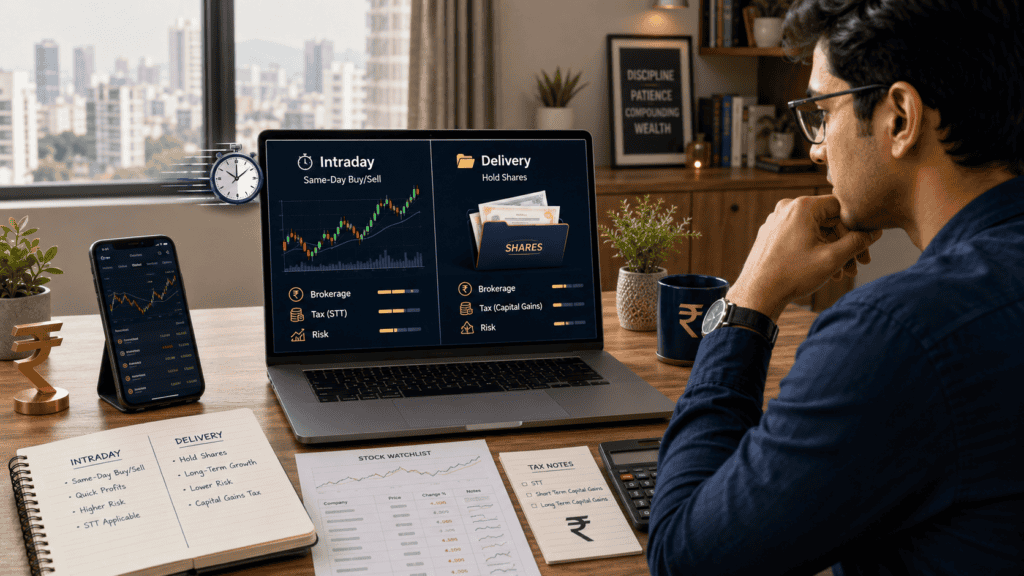

You bought a stock at ₹1,000. A week later, it’s at ₹780. You tell yourself it will recover — and it drops to ₹620. That moment of hesitation costs more than a bad trade; it becomes a habit that wipes out months of gains. Stop loss is the one tool that forces a decision before emotion takes over. If you are new to the stock market and wondering what stop loss actually means — how it works, whether it guarantees your exit price, and how to place one — this article walks you through everything you need before your first order.
Quick Answer: Stop Loss Meaning
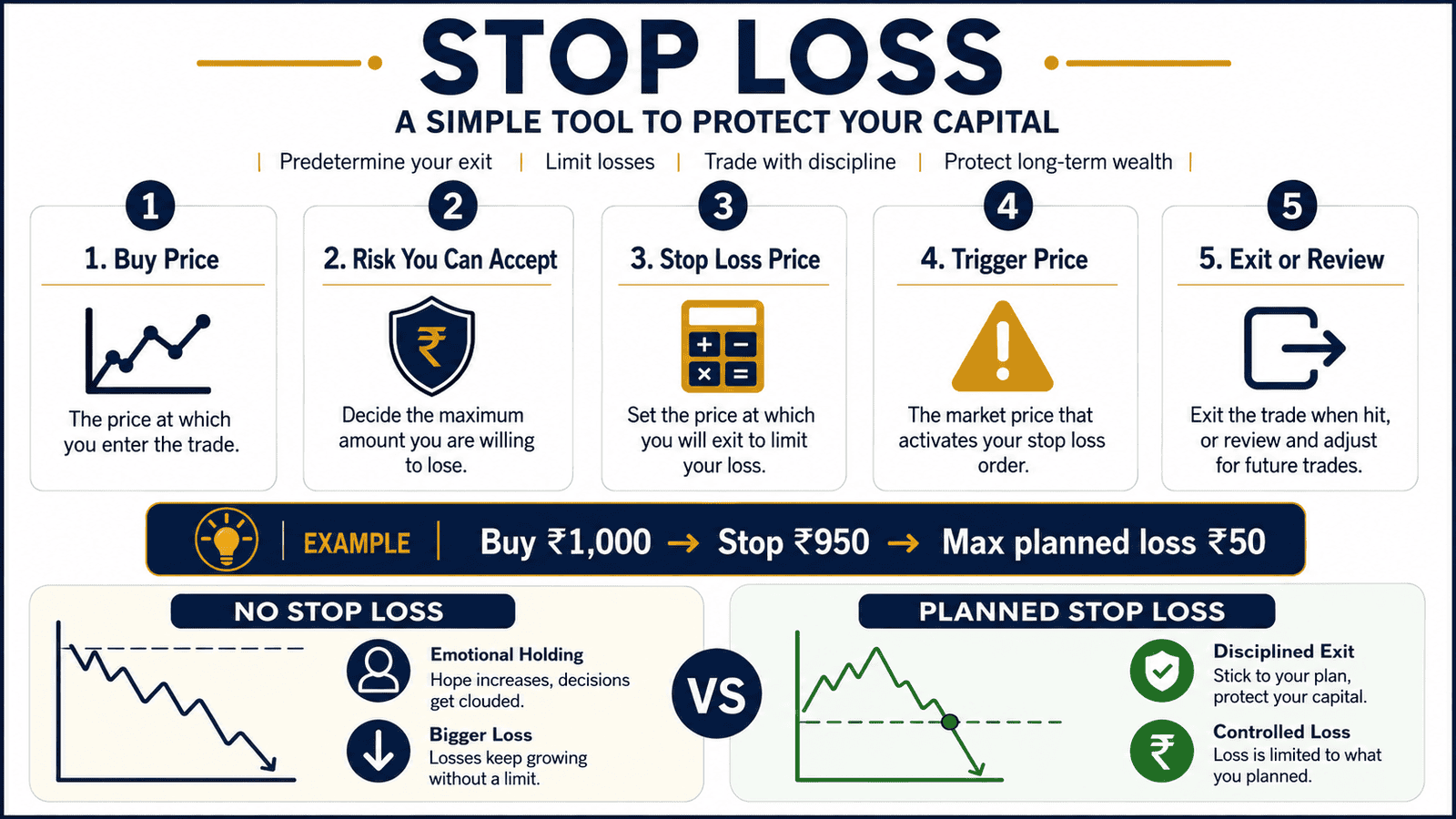
Stop loss meaning refers to a pre-set sell or buy instruction that helps limit loss when a stock moves against your plan. For example, if you buy at ₹1,000 and set a stop loss at ₹950, your planned loss is ₹50 per share, though execution may vary in fast markets.
Key Takeaways
- A stop loss order activates only when the stock hits your trigger price — it does not guarantee execution at that exact price in fast or illiquid markets.
- There are two main types: stop loss market order (executes immediately at the best available price) and stop loss limit order (executes only at or above your limit price, but may not fill).
- If you buy a stock at ₹1,000 and set a 5% stop loss, your trigger is ₹950 — you risk ₹50 per share, or ₹5,000 on a 100-share position.
- A trailing stop loss moves upward as the stock rises — it locks in gains while still capping downside, which a fixed stop loss cannot do.
- Stop loss does not work the same in intraday and delivery trades — intraday stop losses typically cancel at end of day; delivery positions need to be re-entered manually.
- Gap-down openings can cause your stock to skip past the trigger price entirely, leading to execution at a much lower price than expected — this is called slippage.
- Setting stop loss too tight (1–2% on a volatile stock) leads to frequent exits on normal price movement, costing brokerage and transaction charges each time.
Key Facts at a Glance
| Parameter | Detail |
|---|---|
| What it does | Automatically triggers a sell (or buy) order when the stock reaches a set price |
| Who uses it | Intraday traders, positional traders, delivery investors |
| Trigger price | The price at which your stop loss order activates |
| Limit price | The minimum acceptable execution price (stop loss limit orders only) |
| Execution price | The actual price at which your shares are sold — may differ from trigger |
| Slippage risk | Higher during gap-down openings, low-liquidity stocks, and circuit breaker events |
| Available on | NSE and BSE through any SEBI-registered broker’s trading platform |
| Intraday validity | Most brokers cancel intraday stop loss orders at market close (3:30 PM IST) |
What Is Stop Loss Meaning in the Stock Market?
A stop loss is a standing instruction you give your broker: “If this stock falls to ₹X, sell it — do not wait for me to log in and decide.” It is not a magic shield. It is a planned exit at a loss you have already accepted, made before panic can change your mind.
The concept is simple. You enter a trade with a view — “I think this stock will rise.” You also plan for the opposite: “If I’m wrong, I will exit at ₹950, not hold and hope.” That ₹950 becomes your stop loss level. When the stock hits that price, your broker automatically places a sell order on your behalf.
This matters because most beginner losses in the stock market do not come from a single bad trade. They come from holding a bad trade too long. Stop loss is what separates a controlled ₹5,000 loss from a ₹40,000 one.
Trigger Price vs Execution Price — The Difference Beginners Miss
The trigger price is the price that wakes up your stop loss order. Once the stock hits the trigger, your order enters the exchange. The execution price is what you actually receive when the trade fills.
In a normal market with good liquidity, these two are almost identical. But in a fast-falling stock — especially one that opens gap-down after bad news overnight — there may be no buyers at ₹950. Your order fills at ₹932, ₹918, wherever demand exists. That gap between trigger and execution is called slippage, and it is the single most misunderstood risk in stop loss trading.
To place a stop loss order, you need a Demat-linked trading account. If you haven’t set one up, the open Demat account guide walks you through the full process with Indian brokers.
Stop Loss Market Order vs Stop Loss Limit Order
There are two main order types for stop loss in India. Understanding the difference can save you from an unpleasant surprise.
Stop Loss Market Order (SL-M): Once your trigger price is hit, the system places a market order — sell at whatever price is available right now. You will exit, but the price is not guaranteed. In a fast-moving market, this is the safer choice for actually getting out.
Stop Loss Limit Order (SL): You set both a trigger price and a limit price. When the trigger is hit, the system places a limit order — sell only at ₹950 or higher. If no buyer exists at that price, your order sits unfilled. You stay in the position while the stock continues to fall. This feels safer but can trap you in a rapidly declining stock.
Most beginner guides gloss over this. The practical reality: SL-M is more reliable for actual risk control. SL with a limit price gives you price protection at the cost of execution certainty.
What Is a Trailing Stop Loss?
A trailing stop loss moves automatically as the stock price rises. Instead of a fixed ₹950, you set a trailing distance — say ₹50 below the current price. If the stock rises from ₹1,000 to ₹1,200, your stop loss trails up to ₹1,150. If the stock then drops from ₹1,200 to ₹1,150, your position is sold.
The benefit: you do not need to manually update your stop loss every day. The risk: in a volatile stock that swings ₹80 intraday, a ₹50 trailing stop may trigger and exit you during normal movement, only for the stock to recover.
Trailing stop loss works best in a clear trending stock where you want to ride the upside but cap the downside automatically.
Stop Loss in Intraday vs Delivery Trading
Stop loss behaves differently depending on how you trade. In intraday and delivery trading, the key difference is time horizon — and stop loss settings must match that.
For intraday: Your stop loss order is typically valid only for that trading session. If the stock does not hit your trigger by 3:30 PM, your broker may square off the position at market price. You must set a fresh stop loss each day.
For delivery: A stop loss order is placed manually when you decide to review your position. It does not persist automatically across days on most Indian broker platforms. Many delivery investors instead use price alerts and then manually place the order — which carries its own risk of delayed reaction.
Real Example: Rohan’s First Stop Loss Trade
Rohan, 29, a software engineer in Bengaluru earning ₹85,000 per month, recently started buying stocks through his Demat account. He bought 50 shares of a mid-cap IT company at ₹1,200 per share — a total investment of ₹60,000.
His broker advised him to set a stop loss at 5% below entry. That put his trigger price at ₹1,140. He placed a stop loss market order (SL-M) at ₹1,140. Two days later, broader markets fell sharply. The stock dropped from ₹1,200 to ₹1,135 within an hour. His stop loss triggered automatically. The execution price was ₹1,132 — slightly below trigger due to fast movement.
Rohan’s loss: ₹68 per share × 50 shares = ₹3,400. Without a stop loss, he might have held on hoping for a recovery — and if the stock had continued to ₹980, his loss would have been ₹11,000 on the same position. The ₹3,400 loss felt painful. The alternative would have been worse.
How to Calculate Your Stop Loss Level
Stop Loss Trigger Price = Entry Price − (Entry Price × Stop Loss %)
Using Rohan’s numbers:
| Scenario | Entry Price / Stop Loss % | Trigger Price |
|---|---|---|
| Conservative (3%) | ₹1,200 / 3% | ₹1,164 |
| Moderate (5%) | ₹1,200 / 5% | ₹1,140 |
| Loose (8%) | ₹1,200 / 8% | ₹1,104 |
The tighter the stop loss, the smaller the loss per trade — but the higher the chance of getting stopped out by normal price swings. A highly volatile stock that moves ±3% daily will trigger a 3% stop loss almost immediately. Matching your stop loss percentage to the stock’s typical daily range is more reliable than using a fixed rule.
Also factor in the risk-reward ratio. If you risk ₹60 per share (5% stop loss from ₹1,200), your target should be at least ₹120 higher — ₹1,320 — for a 1:2 risk-reward. Trading with a 1:1 or worse ratio over many trades leads to net losses even with a 50% win rate.
Comparison: Stop Loss Market Order vs Stop Loss Limit Order
| Parameter | SL-M (Market) | SL (Limit) |
|---|---|---|
| How it works | Sells at best available market price once trigger is hit | Sells only at limit price or better once trigger is hit |
| Execution certainty | High | Not guaranteed |
| Price certainty | Not guaranteed | You set the floor |
| Risk in fast markets | Slippage possible but position closes | Order may not fill; loss continues |
| Best used for | Liquid large-cap stocks, intraday | When exact price matters more than speed |
| Beginner recommendation | Preferred | Use with caution |
How to Decide What’s Right for You
You are doing intraday trading — THEN use a stop loss market order (SL-M) to ensure you actually exit the position before market close.
You are holding delivery stocks and the position has moved against you by more than 8–10% — THEN consider setting a manual stop loss immediately rather than waiting for further recovery.
You are buying a large-cap Nifty 50 stock with high daily volume — THEN a 3–5% stop loss is reasonable; the tight range is manageable because liquidity is high and slippage is low.
You are trading a small-cap or penny stock with low daily volume — THEN widen your stop loss to 8–12% or avoid intraday SL-M orders entirely, as slippage can be severe in illiquid stocks.
Your stock is in a clear uptrend and you want to protect unrealised gains — THEN a trailing stop loss set 5–7% below current price lets your profits run while automatically capping downside.
You should NOT use a tight stop loss (under 2%) on any volatile or news-driven stock — normal daily fluctuations alone will trigger the stop, costing you brokerage and STT on every exit without actual risk reduction.
Common Mistakes to Avoid
Setting the Stop Loss Too Tight
Placing a 1–2% stop loss on a stock that routinely moves 3–4% in a single session means normal price fluctuation will trigger an exit before any real adverse move occurs.
You end up paying brokerage, STT, and exchange charges on each exit — losing money even when your original view was correct — and re-entering later at a higher price.
Check the stock’s average true range (ATR) or its typical daily movement before fixing a stop loss percentage. Match the stop to the stock’s volatility.
Moving the Stop Loss Further Down After It Is Set
Once a stop loss is in place, some traders keep lowering it when the stock approaches the trigger — “just give it a little more room.” This defeats the entire purpose.
This habit transforms a disciplined ₹3,000 loss into a ₹15,000 one. The stop loss is effective only if you do not override it after the fact.
Set it once based on your entry logic. If the original logic has not changed, do not move the stop loss down.
Confusing Trigger Price With Guaranteed Exit Price
Beginners often assume that a stop loss at ₹950 means they will receive exactly ₹950. In fast or thinly traded markets, the actual execution price can be ₹920 or lower.
This gap — slippage — is real and can significantly increase your actual loss versus planned loss on gap-down openings.
For high-conviction risk control, use SL-M in liquid stocks and always plan for up to 1–2% slippage beyond your trigger price.
Not Adjusting Stop Loss After a Significant Price Rise
You bought at ₹1,000 with a stop at ₹950. The stock rises to ₹1,300. If you never update the stop, a fall back to ₹950 means a ₹50 loss on a position that was once ₹300 in profit.
Not updating your stop loss means you are giving back unrealised gains unnecessarily. A trailing stop or manually adjusted stop preserves them.
Review and revise your stop loss upward whenever the stock crosses a meaningful milestone — a round number, a previous resistance level, or a target price.
Using Stop Loss in a Highly Illiquid Stock
In a stock that trades only a few thousand shares per day, your SL-M order can execute at a price far below trigger — or not fill at all in extreme cases.
In gap-down or circuit-limit situations, the entire exchange may not allow trading at that price, making any stop loss temporarily ineffective.
For illiquid stocks, reduce position size instead of relying solely on stop loss for risk control.
Placing Stop Loss Without a Target Price
A stop loss without a corresponding target price means you have a plan for how much you will lose but no plan for when to book profits. This is incomplete risk management.
You end up exiting profitable trades too early or holding them until they reverse — negating the stop loss discipline on the downside.
Always pair a stop loss with a target. A minimum 1:2 risk-reward ratio — risk ₹50, target ₹100 — keeps your average trade profitable even with a less-than-50% win rate.
Ignoring Brokerage and Transaction Costs
Each stop loss trigger results in a sell transaction — which carries brokerage, STT, exchange transaction charges, and GST. On a frequent trader placing 10–15 intraday trades a week, these add up substantially.
A ₹5,000 stop loss exit on a discount broker may cost ₹25–₹50 in charges, which is small. On a full-service broker, the same exit could cost ₹150–₹250. Multiply by 15 trades a week and annual cost matters.
Factor transaction costs into your minimum risk-reward calculation — especially if you are using tight stop losses on small positions.
When This May Not Be the Right Choice
Stop loss orders do not suit every investor or every situation. If your stock is in a circuit breaker halt — upper or lower circuit — trading is suspended and no order, including stop loss, can execute until the circuit opens. You remain fully exposed despite having a stop loss in place.
If you are a long-term investor holding a fundamentally strong stock through multi-year cycles, a short-term stop loss set at 5–8% may force you out of a position you intended to hold for three to five years — costing you the eventual recovery and long-term gain.
If you are investing in equity mutual funds rather than direct stocks, stop loss orders do not apply — units are bought and sold at NAV through redemption requests, not exchange orders. Systematic withdrawal plans serve a similar stabilising function there.
If any of these apply to your situation, it may be worth exploring alternatives before committing.
Official Rules and Where to Verify
Stop loss orders are placed through SEBI-registered brokers on recognised Indian exchanges. The regulatory framework governing order types, margin requirements, and exchange trading rules is maintained by the following authorities:
- SEBI (Securities and Exchange Board of India) — sebi.gov.in — regulates broker conduct, investor protection, and trading regulations
- NSE (National Stock Exchange of India) — nseindia.com — publishes circuit filter rules, order type specifications, and market timing
- BSE (Bombay Stock Exchange) — bseindia.com — exchange-level rules for order placement and settlement
- Income Tax Department — incometax.gov.in — for understanding how stop-loss-triggered exits affect your stock market tax liability (STCG, LTCG, STT)
Rules, limits, and rates on this topic can change with each Budget or regulatory update. Always verify current figures directly from the official source before making any financial decision.
Expert Tips
- Before placing any stop loss, check the stock’s 30-day average daily range. If a stock routinely moves ±4% in a day, a 3% stop loss is almost certain to trigger on noise — not on a real adverse move.
- For intraday trades, place your stop loss immediately after entry — not after the stock moves in your favour first. The first few minutes after entry are the highest-risk window.
- If you are new to stop losses, start with Nifty 50 large-cap stocks. High liquidity means your SL-M order will fill close to trigger price, making slippage predictable and small.
- Pair every stop loss with a target price before entering the trade. A clean entry note: “Buy ₹1,200 / Stop ₹1,140 / Target ₹1,320” ensures you do not move the goalposts mid-trade out of emotion.
- For delivery investments where you are running a multi-week view, review and trail your stop loss upward every time the stock crosses a key resistance level — do not leave the original stop loss unchanged as the stock gains 15–20%.
- Never use a stop loss to justify entering a high-risk trade you would otherwise avoid. A stop loss limits loss size — it does not change the probability of a bad trade going wrong.
- After a stop loss is triggered, review whether your original entry thesis was wrong or just early. Re-entering the same stock at a lower price with a fresh stop can be valid — but only after an honest review, not out of frustration.
Frequently Asked Questions
What is stop loss meaning in simple terms?
A stop loss is a pre-set instruction to your broker to automatically sell a stock if it falls to a specific price. It limits how much money you can lose on a single trade without needing to watch the screen constantly.
Does stop loss guarantee the price I set?
No. A stop loss triggers an order when the stock reaches your set price, but execution may happen at a lower price — especially in fast markets, gap-down openings, or low-liquidity stocks. The actual sale price can differ from your trigger price.
What is the difference between trigger price and limit price?
The trigger price is the price at which your stop loss order activates and gets submitted to the exchange. The limit price (in SL orders) is the minimum price at which you are willing to sell. If the market falls below your limit price, the order may not fill at all.
Can I use stop loss for delivery stocks?
Yes, but the mechanics differ. Most Indian broker platforms require you to manually place or update a stop loss for delivery positions — it does not carry forward automatically day to day like an intraday SL order. Many delivery investors use price alerts combined with a manual review instead.
What is a trailing stop loss?
A trailing stop loss moves upward automatically as the stock price rises, maintaining a fixed distance below the current price. For example, a ₹50 trailing stop on a stock at ₹1,000 means the stop is at ₹950. If the stock rises to ₹1,300, the stop trails to ₹1,250 — locking in profits without manual updates.
What happens if a stock hits a lower circuit and I have a stop loss?
In a lower circuit situation, the exchange freezes trading at that price. No buy or sell orders — including stop loss orders — can execute until the circuit opens. Your stop loss order effectively becomes inactive during the circuit halt, leaving you exposed to the price at which trading resumes.
Is stop loss useful for long-term investors?
Stop loss is primarily a tool for traders, not long-term investors. If you are holding quality stocks for three to five years, short-term price swings may trigger stop losses unnecessarily — forcing you out of fundamentally sound investments. Long-term investors are generally better served by asset allocation and periodic portfolio review rather than tight stop losses.
What stop loss percentage should a beginner use?
There is no universal rule, but a common starting point is 5–8% below entry for delivery trades and 0.5–1.5% for intraday trades on large-cap stocks. More important than the percentage: match the stop loss to the stock’s typical daily movement. A ±4% daily-range stock needs a wider stop than a ±1% blue-chip stock.
Does a stop loss apply to mutual funds?
No. Mutual fund units are not traded on an exchange — they are bought and sold at NAV through the fund house or registrar. Stop loss orders are not applicable. If you want to limit losses in a mutual fund, you would need to manually redeem units based on a price alert or review schedule.
How does stop loss affect tax on stock profits and losses?
When a stop loss triggers a sale, it creates a realised transaction — the loss is recorded in that financial year and may be set off against capital gains. Short-term capital loss (holding under 12 months for equity) can be set off against short-term or long-term gains. Each stop-loss-triggered sale also attracts STT and exchange charges. For full details, refer to the stock market tax guide.
Final Verdict
Stop loss meaning is straightforward: it is a planned exit before panic sets in. For anyone starting out in the stock market — whether as an intraday trader or a first-time delivery investor — it is the most practical risk control tool available. The important caveats: a stop loss does not guarantee your exit price, it does not work in circuit-halted stocks, and setting it too tight will simply churn your capital through unnecessary trades. Use SL-M orders for intraday positions in liquid stocks, match your stop loss percentage to the stock’s actual volatility, always pair it with a target price, and trail it upward as your position gains. Risk control is not just for trading — it is a core part of personal finance discipline at every level. Always verify the latest rules from official sources or consult a qualified professional before making any financial decision.
This article is for educational purposes only and should not be treated as personalised financial, tax, investment, insurance, or legal advice. Tax rules, interest rates, regulatory limits, and product features can change with each Budget or policy update. Please verify current rules from official government sources or consult a qualified and registered professional before making any financial decision.

Devika Shah writes about stock market basics for Indian beginners who want to understand equity investing before taking financial risk. Her content is educational and does not provide stock tips, trading calls, price predictions, or personalised investment advice.
She covers topics such as demat account meaning, trading account basics, IPOs, dividends, brokerage charges, delivery vs intraday trading, market orders, limit orders, stock indices, blue-chip stocks, capital gains tax, stock market terminology, risk management, and the difference between long-term investing and short-term speculation.
Devika’s writing is clear, balanced, and risk-conscious. She helps readers understand how the stock market works, what accounts and documents are needed, what charges may apply, and what mistakes beginners should avoid. Her articles are suitable for students, salaried employees, and first-time investors who want a foundation before investing. Since market rules, tax treatment, brokerage fees, IPO processes, and regulatory requirements can change, readers should verify current information from SEBI, exchanges, brokers, and official tax sources.