
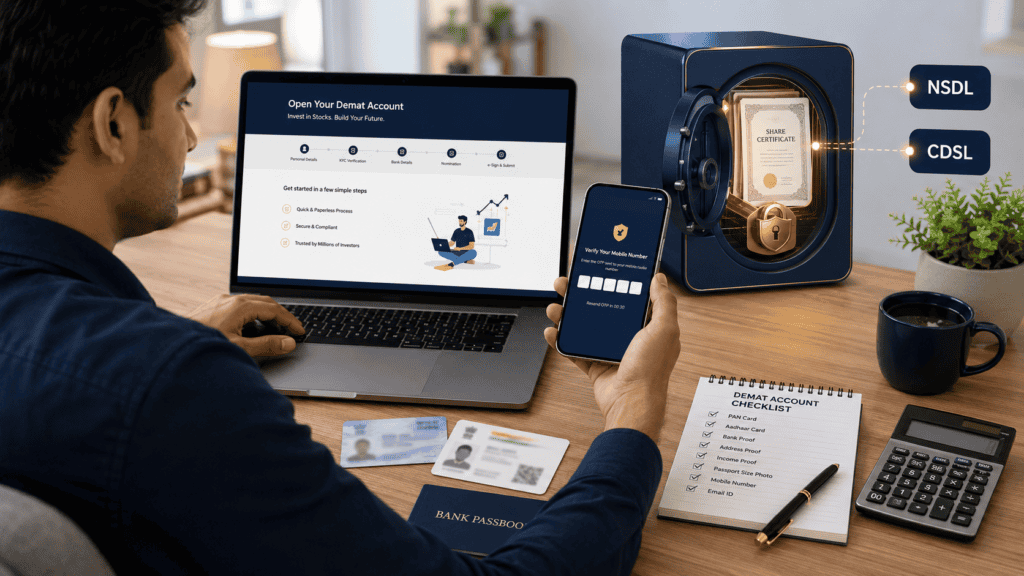
You have decided to invest in shares or apply for an IPO — and someone told you that you need a demat account first. But then you hit a wall: Is a demat account the same as a trading account? Is it the same as the broker app you downloaded? And is it actually safe to submit your PAN and Aadhaar details online to some website you found? These are fair questions, and the confusion is extremely common. A demat account is how shares and securities are held electronically in India — and understanding exactly how to open a demat account in India, what documents you need, what charges to check, and what to do after activation will save you from costly mistakes. This article walks you through all of it, step by step, without recommending any broker or platform.
Quick Answer: How to Open a Demat Account in India
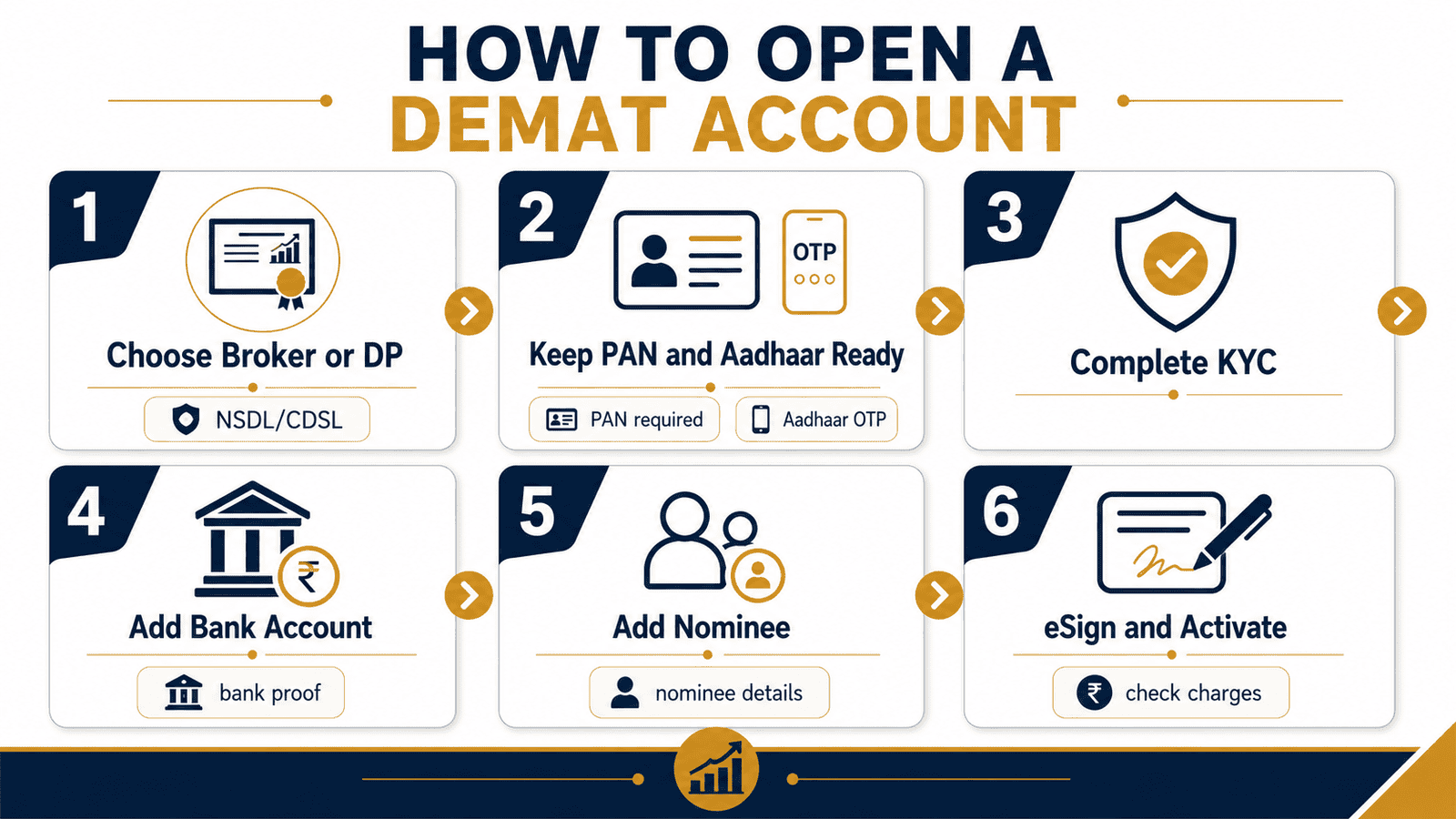
How to open a demat account in India starts with choosing a SEBI-registered broker or depository participant, keeping PAN and Aadhaar ready, completing online KYC, linking your bank account, adding nomination, and eSigning the application. Most beginners can follow these 6 steps, but charges and rules must be verified before applying.
Key Takeaways
- A demat account holds your shares and securities electronically — it is not the same as a trading account or a bank account.
- You need three things working together: a demat account (holds shares), a trading account (places orders), and a bank account (moves money).
- PAN card and an Aadhaar-linked mobile number are the most commonly required documents for online KYC — verify what your chosen broker or DP requires.
- All demat accounts in India are held through either NSDL (nsdl.co.in) or CDSL (cdslindia.com) — your broker or depository participant connects you to one of these two depositories.
- Account opening may be free at some brokers, but Annual Maintenance Charges (AMC), brokerage fees, and transaction charges apply — always read the tariff sheet before signing up.
- Nomination is not optional from a responsible investing standpoint — adding a nominee protects your holdings in case of an emergency and is part of the account setup process.
- SEBI registration of your broker or DP can be verified at sebi.gov.in and investor.sebi.gov.in — always check this before submitting any documents.
Key Facts at a Glance
| Parameter | Detail | Where to Verify |
|---|---|---|
| What a demat account does | Holds shares, bonds, ETFs, and securities electronically | nsdl.co.in / cdslindia.com |
| Who provides it | Depository Participant (DP) — usually a broker or bank registered with NSDL or CDSL | sebi.gov.in |
| Key documents (commonly required) | PAN card, Aadhaar (for online KYC), bank account proof, photo, signature | Your chosen broker/DP’s website |
| Account activation time | Varies by broker/DP — check before applying | Your chosen broker/DP |
| Charges to check | Account opening charge, AMC, brokerage, transaction charges — vary by broker/DP | Broker/DP tariff sheet |
| Depositories in India | NSDL and CDSL — all demat accounts are held with one of these two | nsdl.co.in / cdslindia.com |
| Regulator | SEBI — Securities and Exchange Board of India | sebi.gov.in |
What Is a Demat Account — and How Is It Different from a Trading Account?
A demat account — short for dematerialised account — is an electronic account that holds your shares, bonds, Exchange Traded Funds (ETFs), and other securities in digital form. Before demat accounts existed in India, investors received physical share certificates. Those certificates were lost, forged, or damaged with alarming regularity. The demat system, regulated by SEBI and operated by depositories, eliminated that problem entirely.
But here is where beginners consistently get confused: a demat account alone does not let you buy or sell shares. You also need a trading account.
The Three-Account System Every Investor Needs
Think of it this way. Your bank account holds money. Your demat account holds securities. Your trading account is the transaction counter — it is where you place buy and sell orders on stock exchanges like NSE and BSE. When you buy a share, money moves from your bank account to the exchange, and the share moves into your demat account. When you sell, the share leaves your demat account and money arrives in your bank account.
Most brokers today offer a 2-in-1 or 3-in-1 account that combines the trading account and demat account (and sometimes a savings account) under one platform. But they are still three distinct entities working together. Understanding this will prevent a lot of early confusion. To understand where a demat account fits in the broader picture, read our guide on stock market basics first.
What Is a Depository Participant (DP)?
India has two depositories: NSDL (National Securities Depository Limited, at nsdl.co.in) and CDSL (Central Depository Services Limited, at cdslindia.com). These are the institutions that actually hold your securities in the background. But you do not deal with NSDL or CDSL directly. You deal with a Depository Participant (DP) — typically a registered stockbroker or bank that is authorised to offer demat accounts through one or both depositories.
This is why you receive emails and SMS alerts from both your broker app and from NSDL or CDSL. Your broker is your DP — your interface. NSDL or CDSL is the infrastructure where your securities actually sit. According to SEBI guidelines at sebi.gov.in, every DP must be registered with SEBI and with the relevant depository before they can open demat accounts for investors.
Your Beneficial Owner ID (BO ID)
When your demat account is activated, you receive a Beneficial Owner ID — a 16-digit unique number. For CDSL accounts, this ID begins with your DP ID followed by your client ID. For NSDL accounts, the structure is similar but may differ in format. This BO ID is what identifies your holdings in the depository system. Keep this number safe — you will need it for dividend credits, IPO applications, and various forms.
Why SEBI Registration Matters
SEBI is the regulatory authority for securities markets in India. Before opening a demat account, always verify that your chosen broker or DP is registered with SEBI. You can check this directly at sebi.gov.in or investor.sebi.gov.in. A SEBI-registered entity is accountable to regulatory oversight, investor grievance mechanisms, and defined conduct norms. This is non-negotiable — do not open an account with any platform that cannot be verified on SEBI’s official website.
Shares are listed and traded on NSE (nseindia.com) and BSE (bseindia.com). Understanding the NSE and BSE difference helps you see the full picture of where your orders actually go after you place them through a trading account.
Real Example: Aarav Opens His First Demat Account
Aarav is 25, works as a software analyst in Pune, and earns ₹55,000 per month. He wants to buy his first share and apply for an upcoming IPO. He downloads three broker apps, but before signing up on any of them, he does something most beginners skip: he checks the tariff sheet on each broker’s official website.
He finds that one broker offers zero account opening charges but levies an AMC per year, while another charges a flat brokerage per order regardless of trade size. He also notices that one platform charges a pledge and unpledge fee if he ever uses shares as collateral. He notes all of this down before choosing.
He then checks all three on sebi.gov.in to confirm SEBI registration. One of the apps he downloaded is not listed clearly — he avoids it. He proceeds with one of the two remaining options.
He keeps his PAN card, Aadhaar-linked mobile number, a cancelled cheque from his savings account, a passport-size photograph, and his nominee’s name and Aadhaar details ready. He completes the online KYC using Aadhaar OTP-based verification — his Aadhaar is already linked to his mobile number, so this takes under ten minutes. He eSigns the account opening form digitally.
Within a few days, he receives his login credentials, his Beneficial Owner ID from CDSL, and a welcome message from his broker. Before placing any trade, he logs in, reviews his account details, confirms his bank account is linked and nomination is added, and downloads the account opening document from his broker’s portal. Only then does he make his first investment — two shares in a large-cap company he has been researching. What is a share explains exactly what he now owns and what rights it gives him.
How to Calculate the True Cost of a Demat Account
The phrase “free demat account” only means the account opening is free. It says nothing about what you pay every year or every time you transact. Before choosing a broker or DP, build a simple cost checklist.
Total Demat Cost = Account Opening Charge + AMC (per year) + Brokerage (per trade) + Transaction Charges + Other Charges (pledge, SMS alerts, etc.)
Here is what each cost means:
| Charge Type | What It Covers | Where to Confirm |
|---|---|---|
| Account Opening Charge | One-time fee to set up the demat account — may be ₹0 at some brokers | Broker/DP tariff sheet |
| Annual Maintenance Charge (AMC) | Yearly fee to keep the account active — varies by broker and account type | Broker/DP tariff sheet |
| Brokerage | Per-order charge on buy and sell trades — flat fee or percentage model | Broker/DP tariff sheet |
| Transaction Charges | Levied by exchanges (NSE/BSE) — passed through by broker | NSE/BSE official schedules |
| Other Charges | Pledge/unpledge fees, SMS alerts, demat debit instruction slips, etc. | Broker/DP tariff sheet |
Do not assume any of the figures above — always read the broker’s current tariff sheet before signing up. Use our brokerage cost calculator to compare what different charge structures would actually cost you based on your expected trading frequency.
Comparison: Demat Account vs Trading Account vs Bank Account
| Feature | Demat Account | Trading Account |
|---|---|---|
| Purpose | Holds securities electronically | Places buy/sell orders on exchanges |
| What it holds or does | Shares, bonds, ETFs, mutual fund units (demat form) | Executes transactions on NSE/BSE |
| Who provides it | Depository Participant (DP) via NSDL or CDSL | SEBI-registered stockbroker |
| When used | When buying, selling, pledging, or receiving securities | Every time you place a buy or sell order |
| Beginner mistake | Thinking this alone is enough to start trading | Thinking this holds your shares after purchase |
Most modern broker platforms open both accounts simultaneously. But your bank account — held with a scheduled commercial bank — is the third piece: it is the money source and destination. Linking your bank account to your trading account is a mandatory step in the demat account opening process. To understand where shares are actually listed and traded once your account is ready, read our piece on the NSE and BSE difference.
How to Decide What’s Right for You
Your primary goal is long-term investing in stocks and you plan to buy and hold — THEN a discount broker with low or zero AMC and flat brokerage may serve you well. Verify charges and SEBI registration before applying.
You want to apply for IPOs in addition to buying shares — THEN your demat account must be linked to a UPI-enabled bank account for the ASBA/UPI application process. Read our guide on how to apply for an IPO in India before your first application.
You want research support, portfolio advice, or prefer a full-service experience — THEN a full-service broker or bank-backed DP may suit you better, though charges are typically higher. Compare the tariff sheets directly.
You are not sure which depository (NSDL or CDSL) your account will be with — THEN this is determined by your broker/DP, not by you. Either is equally valid and regulated. Confirm which depository your chosen DP works with before opening the account.
You want to add or update nomination later — THEN most DPs allow this online through their portal. But adding a nominee at the time of account opening is the most straightforward path and is strongly recommended.
You do not have a PAN card yet — THEN do not proceed with account opening. PAN is a mandatory requirement for demat account KYC in India. Apply for PAN first at incometax.gov.in before starting the demat account process.
Common Mistakes to Avoid
Choosing a broker only because the account opening is free
Account opening charges are a one-time cost that may be ₹0. What matters more is the AMC, brokerage model, and transaction charges — which you pay repeatedly. A broker with zero opening charges but a high AMC can cost you more over three years than one that charges a modest opening fee upfront.
Always download and read the broker’s tariff sheet from their official website before signing up. Use the brokerage cost calculator to run the numbers on your expected transaction volume.
Ignoring Annual Maintenance Charges (AMC)
AMC is the yearly fee to keep your demat account active. Some brokers waive AMC for the first year and charge from the second. Others have different AMC tiers depending on account type. Many beginners discover the AMC charge only after their first annual renewal — by which point they have already submitted KYC and linked their bank account.
Ask specifically: what is the AMC from Year 1, Year 2, and beyond? Get it in writing from the tariff sheet, not just a promotional landing page.
Skipping nomination or leaving nominee details incomplete
Nomination is the process of designating a person who will receive your securities in the event of your death. Without a nominee, your legal heirs face a much more complex transmission process — involving court documents, succession certificates, and significant delays. Many beginners skip this step or enter incomplete information during account opening.
Treat nomination as a mandatory setup step, not an optional afterthought. Add it during account opening. Keep nominee details current.
Sharing OTPs, passwords, or screen access with others
During the Aadhaar OTP-based KYC process, you will receive an OTP on your registered mobile number. This OTP is for your use only. No legitimate broker representative, customer support agent, or “investment advisor” will ever ask you for your OTP, trading password, or remote screen access. Sharing any of these is a common entry point for fraud.
If someone contacts you claiming to be from your broker or depository and asks for an OTP, end the call immediately and report it to your broker and SEBI Investor Helpline.
Not downloading the account opening document and tariff sheet
After your account is activated, your broker is required to provide you with the account opening document — a copy of the application you submitted, including the agreed terms and tariff. Many beginners never download or save this. If a dispute arises later about charges or terms, this document is your primary reference.
Download it from your broker’s portal immediately after activation and save it securely.
Opening an account without verifying SEBI registration
Not every platform that looks like a broker app is a SEBI-registered entity. Some investment apps operate in grey areas or are third-party aggregators without their own DP registration. Before submitting PAN and Aadhaar details anywhere, verify the entity’s registration status at sebi.gov.in or investor.sebi.gov.in.
A few minutes of verification prevents the risk of submitting KYC documents to an unregulated or fraudulent platform.
Assuming mutual funds always need a demat account
A demat account is not required to invest in mutual funds through regular or direct mutual fund routes via AMC websites or MF utility platforms. Mutual funds can be held in statement of account format without demat. Beginners sometimes open a demat account unnecessarily just to invest in mutual funds — check the route you want to use before opening an account for this purpose alone.
When This May Not Be the Right Choice
A demat account is not necessary for every financial goal. If you only want bank fixed deposits, recurring deposits, or a savings account, a demat account adds no value and creates unnecessary charges. Mutual funds can often be held without demat format through the direct plan route on AMC websites or platforms — a demat account is not required for this.
Active stock trading is not suitable for everyone. Intraday trading, F&O positions, and short-term speculation carry significant loss risk and require understanding of market mechanisms that takes time to build. According to SEBI, a large proportion of individual investors in the F&O segment incur losses. Opening a demat account to trade actively — especially based on social media tips or influencer recommendations — is not a substitute for financial education. Additionally, any gains from equity investments create stock market tax obligations under Short-Term Capital Gains (STCG) or Long-Term Capital Gains (LTCG) rules — adding reporting responsibilities that beginners must be aware of.
Mutual fund investments are subject to market risks. Past performance does not guarantee future returns.
If any of these apply to your situation, it may be worth exploring alternatives before committing.
Official Rules and Where to Verify
Rules, limits, and rates on this topic can change with each Budget or regulatory update. Always verify current figures directly from the official source before making any financial decision.
- SEBI — sebi.gov.in — for market regulation, broker registration verification, and investor protection frameworks
- SEBI Investor Website — investor.sebi.gov.in — for investor education resources and grievance redressal
- NSDL — nsdl.co.in — for depository-related information, DP registration, and account-related queries
- CDSL — cdslindia.com — for depository services, account verification, and DP list
- NSE — nseindia.com — for exchange-level education and transaction charge schedules
- BSE — bseindia.com — for exchange-level education and charge schedules
- Income Tax Department — incometax.gov.in — for PAN-related processes, capital gains tax rules, and ITR filing requirements for investors
- Your Broker/DP’s official website — for the current tariff sheet, KYC document requirements, nomination process, and account opening terms
Expert Tips
- Before starting the account opening form, download the tariff sheet from the broker’s official website — not the promotional homepage. Read the AMC, brokerage, and transaction charges line by line. A broker that looks free at first glance may charge ₹300–₹750 per year in AMC from Year 2 — always check.
- Save every email and SMS you receive from NSDL or CDSL. These are official depository communications confirming your account number, transactions, and account status. They are your audit trail if anything goes wrong.
- Add nomination at the time of account opening — do not leave it for later. If you already have a demat account without a nominee, log in to your broker’s portal and update nomination details today. Depository rules around nomination have been updated in recent years — verify the current requirement at nsdl.co.in or cdslindia.com.
- Enable two-factor authentication on your broker app and trading account immediately after activation. Use a unique, strong password that you do not use for email or social media. Never share login details, even with family members who want to “help” you invest.
- If you are a beginner, start with delivery-based investing in well-researched, large-cap companies before attempting intraday trading, F&O, or complex products. The learning curve for active trading is steep and losses are real. SEBI’s investor education resources at investor.sebi.gov.in are a genuinely useful starting point.
- Your Beneficial Owner ID (BO ID) is the unique identifier for your demat account. Note it down and store it securely — you will need it for IPO applications, dividend registrations, and any correspondence with the depository.
- Review your demat account holdings statement at least once a quarter through NSDL’s CAS (Consolidated Account Statement) or CDSL’s Easi/Easiest portal — these are free and official. Cross-check your holdings with what your broker app shows.
Frequently Asked Questions
Can I open a demat account online?
Yes. Most SEBI-registered brokers and DPs offer fully online account opening using Aadhaar OTP-based KYC and digital eSign. You will need a PAN card, an Aadhaar-linked mobile number, a bank account for linking, and a passport-size photograph. The process is typically completed on the broker’s website or app without visiting any branch.
Is PAN required to open a demat account in India?
Yes. PAN is mandatory for demat account KYC in India. It is required by SEBI rules and is used to link your investments to your tax profile. Without a PAN, you cannot complete the KYC process or open a demat account. Apply for PAN first at incometax.gov.in if you do not have one.
Is Aadhaar mandatory for demat account opening?
Aadhaar is not mandatory in all cases, but it is the most commonly used document for online KYC because it enables Aadhaar OTP-based verification, which is fast and paperless. If you do not wish to use Aadhaar for KYC, most brokers also accept in-person verification (IPV) or other officially valid documents. Verify current KYC options with your chosen broker or DP before starting the process.
What is the difference between a demat account and a trading account?
A demat account holds your securities electronically after a purchase. A trading account is used to place buy and sell orders on stock exchanges. The trading account routes your order to NSE or BSE; once the trade is confirmed, the shares are credited to or debited from your demat account. Most brokers open both accounts together, but they serve different functions.
Can I have more than one demat account?
Yes. There is no restriction on holding multiple demat accounts in India — you can have accounts with different DPs. However, each account may carry its own AMC and charges. Managing multiple accounts also means tracking multiple sets of holdings, tax statements, and nominee details. For most beginners, one well-chosen account is sufficient.
What are NSDL and CDSL?
NSDL (National Securities Depository Limited) and CDSL (Central Depository Services Limited) are the two depositories in India authorised to hold securities electronically. All demat accounts in India are held through one of these two. You do not choose which depository to use — your broker or DP determines this. Both are regulated by SEBI and are equally reliable. Visit nsdl.co.in or cdslindia.com for official information.
What are the typical charges for a demat account?
Charges vary by broker/DP and can include: account opening charges (may be ₹0 at some brokers), Annual Maintenance Charges (AMC), brokerage per trade, transaction charges passed through from exchanges, and other fees such as pledge charges. Always read the current tariff sheet directly from the broker’s official website before applying — promotional offers and actual ongoing charges can differ significantly.
Is nomination required for a demat account?
Nomination is strongly recommended and is part of responsible account setup. SEBI and depositories have updated nominee requirements in recent years. Without a nominee, your legal heirs face a more complex transmission process in the event of your death. Verify the current nomination rules and whether any deadline applies at nsdl.co.in, cdslindia.com, or your broker/DP’s official portal.
Do I need a demat account to invest in mutual funds?
Not necessarily. Mutual funds can be held in statement of account (SOA) format through AMC websites or MF Utility platforms, without using a demat account. If you invest in mutual funds through a broker’s demat platform, they may be held in demat format, but this is not the only option. Check which route you prefer before opening a demat account specifically for mutual fund investment.
Is opening a demat account online safe?
Yes, if you use a SEBI-registered broker or DP and follow basic security practices. Verify the entity’s SEBI registration at sebi.gov.in before submitting any documents. Never share OTPs, passwords, or screen access during or after the KYC process. Download and save your account opening document after activation. Enable two-factor authentication on your account immediately.
Final Verdict
Knowing how to open a demat account in India is genuinely straightforward once you understand the three-account structure, the role of NSDL and CDSL, and what to check before signing up. The account opening process itself — choosing a SEBI-registered DP, completing KYC, linking your bank, adding a nominee, and eSigning — is something most beginners can complete in under an hour online. What takes time, and what separates informed investors from disappointed ones, is the work before you start: reading the tariff sheet, verifying SEBI registration, understanding charges, and treating nomination as mandatory. A demat account is a powerful and necessary tool for direct stock investing in India — but it works only when you use it with clarity about what it does, what it costs, and what responsibilities come with it. Always verify the latest rules from official sources or consult a qualified professional before making any financial decision.
This article is for educational purposes only and should not be treated as personalised financial, tax, investment, insurance, or legal advice. Tax rules, interest rates, regulatory limits, and product features can change with each Budget or policy update. Please verify current rules from official government sources or consult a qualified and registered professional before making any financial decision.

Devika Shah writes about stock market basics for Indian beginners who want to understand equity investing before taking financial risk. Her content is educational and does not provide stock tips, trading calls, price predictions, or personalised investment advice.
She covers topics such as demat account meaning, trading account basics, IPOs, dividends, brokerage charges, delivery vs intraday trading, market orders, limit orders, stock indices, blue-chip stocks, capital gains tax, stock market terminology, risk management, and the difference between long-term investing and short-term speculation.
Devika’s writing is clear, balanced, and risk-conscious. She helps readers understand how the stock market works, what accounts and documents are needed, what charges may apply, and what mistakes beginners should avoid. Her articles are suitable for students, salaried employees, and first-time investors who want a foundation before investing. Since market rules, tax treatment, brokerage fees, IPO processes, and regulatory requirements can change, readers should verify current information from SEBI, exchanges, brokers, and official tax sources.