
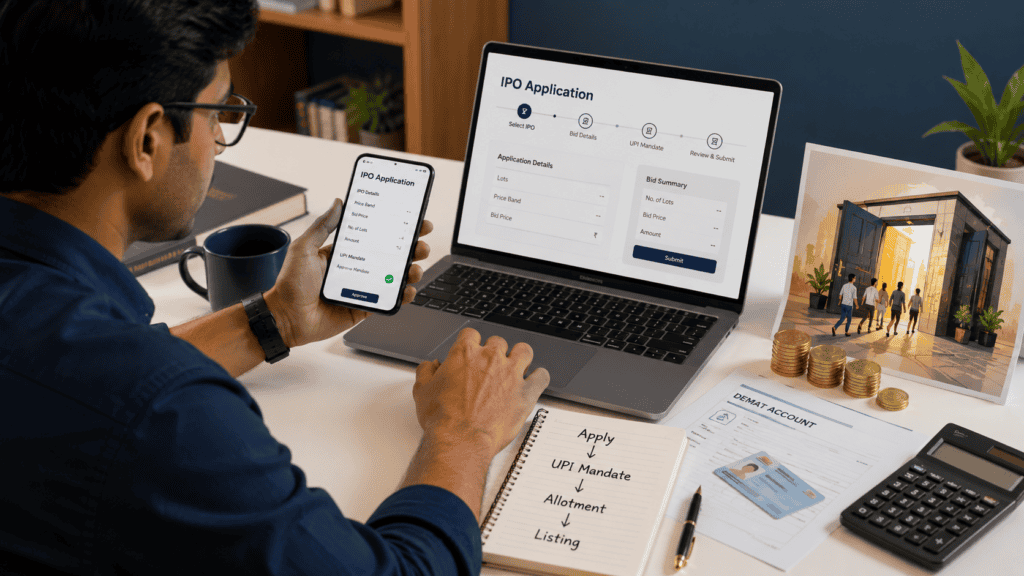
Every few months, a company you’ve heard of — or one your colleague keeps talking about — announces it’s “going public.” You see the phrase IPO everywhere: on financial news apps, in WhatsApp groups, on brokerage app banners. But what exactly is an IPO, why do companies do it, and how do you — a salaried employee with a demat account or the curiosity to open one — actually apply for one?
This guide explains IPO meaning in plain Indian English, walks you through the full application process step by step, and tells you exactly what to watch out for. No jargon. No assumptions. Just what you actually need to know before you click “Apply.”
Quick Answer: What Is an IPO?
IPO stands for Initial Public Offering. It is the first time a private company sells its shares to the general public through a stock exchange. When you apply for an IPO in India, you are bidding to buy a fixed number of shares at a price set by the company. If you are allotted shares, they appear in your demat account on listing day — and you can hold or sell them on the stock exchange. You need a demat account, a bank account linked to UPI or ASBA, and a PAN card to apply. The minimum application is one lot, and retail investors can apply for up to ₹2 lakh worth of shares per IPO.
Key Takeaways
- IPO full form is Initial Public Offering — a company’s first sale of shares to the public via NSE or BSE.
- Retail investors can apply for IPO shares worth up to ₹2 lakh per application; anything above moves you into the HNI category.
- You need three things to apply: a demat account, a linked bank account (UPI or ASBA), and a valid PAN card.
- The IPO cut-off price option lets you bid at whatever price the company finally sets — the safest bid choice for most beginners.
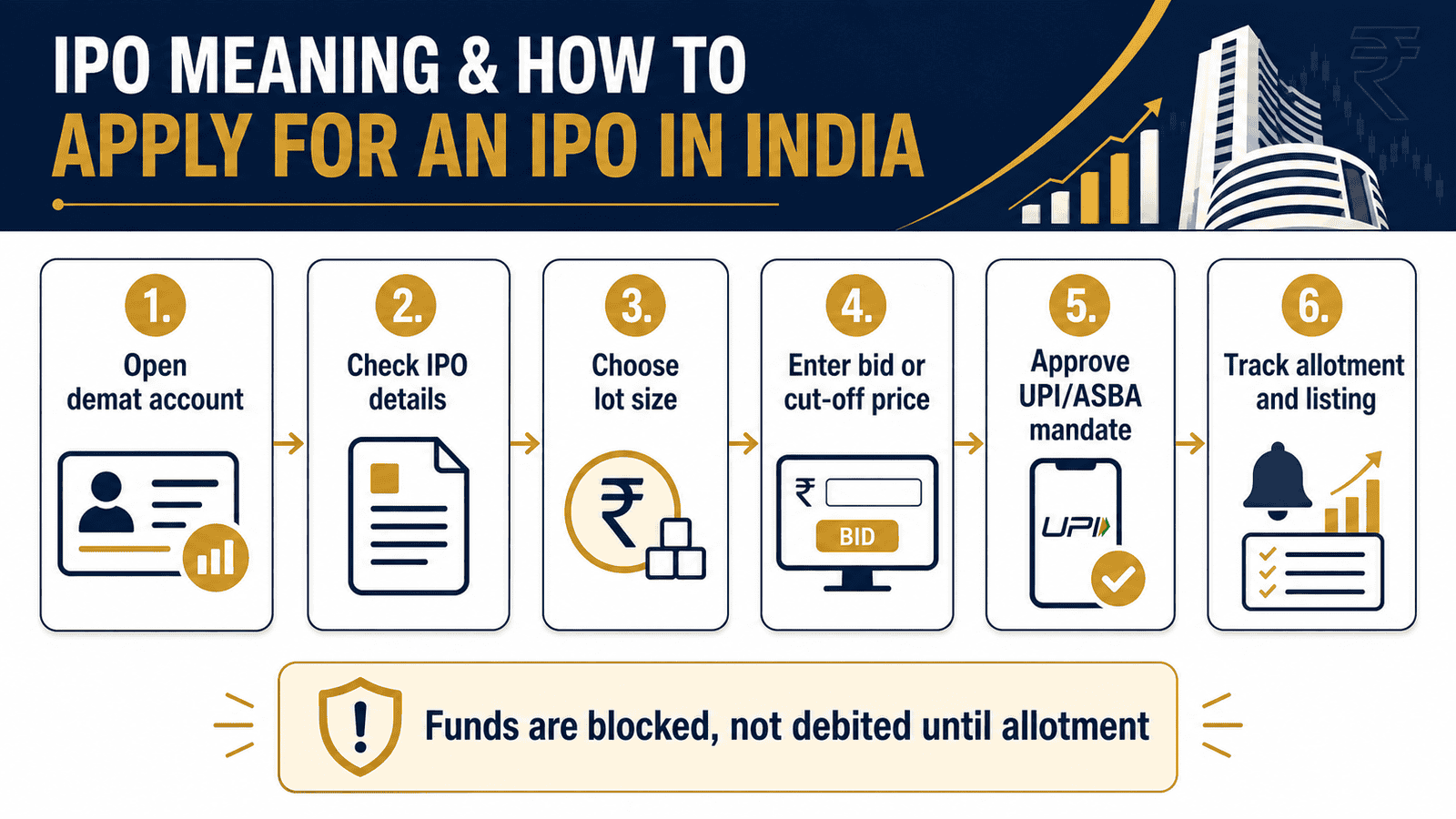
- Funds are blocked in your bank account — not debited — until allotment. If you don’t get shares, the block is released within a few days.
- IPO allotment for oversubscribed issues is done by lottery in the retail category — a heavily subscribed IPO does not mean you will definitely get shares.
- Listing gains are not guaranteed. IPOs can and do list below their issue price — losing money on listing day is a real and documented risk.
Key Facts at a Glance
| Parameter | Detail |
|---|---|
| IPO Full Form | Initial Public Offering |
| Regulator | SEBI (Securities and Exchange Board of India) |
| Stock Exchanges | NSE and/or BSE |
| Retail Investor Limit | Up to ₹2 lakh per application |
| Minimum Application | 1 lot (lot size varies by IPO) |
| Application Methods | UPI (via broker or bank app) / ASBA (bank branch or net banking) |
| Allotment Basis | Lottery for oversubscribed retail category |
| Refund Timeline | Funds unblocked within a few business days of allotment |
| Documents Required | PAN card, demat account, bank account (UPI/ASBA enabled) |
| Tax on Listing Gains (STCG) | Applicable if shares sold within 12 months of allotment |
What Is an IPO? The IPO Meaning Explained Simply
Every company starts private. Its founders, early investors, and employees own shares — but those shares cannot be bought or sold by the general public. At some point, the company decides it wants to raise larger amounts of money — to expand, repay debt, fund research, or give early investors an exit. One way to do that is to sell shares on a stock exchange where anyone can buy them. That first sale to the public is called an Initial Public Offering — an IPO.
Once the IPO is complete and the shares are listed, the company is called a publicly listed company. You can then buy and sell its shares any trading day, just like you would buy shares of Infosys or HDFC Bank.
Why Do Companies Launch IPOs?
Companies go public for several reasons — and understanding them helps you evaluate an IPO intelligently:
- Raise capital for growth: The most common reason. A company sells new shares and uses the money raised to build factories, hire people, expand into new cities, or develop products.
- Offer exit to early investors: Venture capital funds and angel investors who backed the company early may sell their existing shares through the IPO — called an Offer for Sale (OFS). In an OFS, the money goes to the selling shareholders, not the company.
- Improve brand credibility: Being listed on NSE or BSE signals scale and regulatory accountability — useful when a company is negotiating large contracts or attracting senior talent.
This distinction — fresh issue versus OFS — matters. If a large portion of an IPO is OFS, the company itself is receiving less money. Understanding what a share actually represents helps you read an IPO prospectus with much more clarity.
The IPO Process in India — From Filing to Listing
The IPO process in India follows a regulated sequence governed by SEBI:
- DRHP filing: The company files a Draft Red Herring Prospectus with SEBI, disclosing its financials, risks, promoter background, and use of proceeds. This document is public — read it before applying.
- SEBI review: SEBI reviews the filing and may ask for clarifications. Once approved, the company sets an IPO date and price band.
- IPO subscription window: The IPO opens for 3 working days. Investors place bids during this window.
- Allotment: Based on subscriptions, shares are allotted. Oversubscribed retail applications go to lottery.
- Refund / unblocking: Unsuccessful applicants have their blocked funds released.
- Listing: Shares begin trading on NSE and/or BSE — typically around 6 business days after the issue closes.
Understanding how NSE and BSE differ is useful context when you see an IPO listing on one or both exchanges.
Key IPO Terms Every Beginner Must Know
Price Band: The range within which you can bid. For example, ₹200–₹210 per share. The final issue price is set after all bids are collected.
Cut-off Price: If you bid at “cut-off,” you agree to pay whatever the final issue price turns out to be within the band. This is the recommended option for most retail investors — it ensures your application is valid at the final price.
Lot Size: The minimum number of shares you must apply for. IPO applications must be in multiples of one lot. For example, if the lot size is 50 shares and the price is ₹200, one lot costs ₹10,000.
Oversubscription: When total applications exceed available shares. A 50x oversubscription means 50 times more money has been bid than shares available. In the retail category, allotment then happens by computerised lottery.
ASBA: Application Supported by Blocked Amount. Instead of your money leaving your account immediately, it is blocked until allotment. If you don’t get shares, the block is removed. This protects your funds and ensures you continue earning interest on the blocked amount in a savings account.
UPI Mandate: A newer, faster ASBA method where you approve the fund block directly from a UPI app on your phone — no need to visit a bank branch.
The stock market basics guide for absolute beginners covers the broader framework within which IPOs operate.
Real Example: Priya Applies for Her First IPO
Priya, 29, works as a software engineer in Pune. She earns ₹11 lakh per year, has had a demat account for eight months, and has been watching IPO announcements on her brokerage app. A consumer electronics company announces an IPO with a price band of ₹450–₹480 per share and a lot size of 30 shares.
One lot costs 30 × ₹480 = ₹14,400 at the upper end. Priya decides to apply for one lot at the cut-off price. She opens her broker app, selects the IPO, enters 1 lot, ticks “cut-off price,” and submits the application. Her UPI app sends a mandate request — she approves it, and ₹14,400 is blocked (not debited) in her savings account.
The IPO is subscribed 28 times in the retail category. The lottery runs, and Priya receives an allotment notification — she has been allotted 1 lot. On listing day, the shares open at ₹530 — a ₹50 per share gain on 30 shares, or ₹1,500 before tax and charges. She decides to hold rather than sell immediately.
The key insight: Priya applied at cut-off price, so she was never at risk of her bid being invalid. Her money was never actually gone — just blocked. And she understood that at 28x subscription, allotment was not certain.
How to Calculate IPO Application Cost and Potential Allotment
Application Amount = Lot Size × Upper Price Band
Max Retail Applications = ₹2,00,000 ÷ Application Amount per Lot (rounded down to whole lots)
| Scenario | Key Inputs | Result |
|---|---|---|
| Small lot IPO | Lot: 60 shares × ₹120 = ₹7,200 | Max 27 lots but retail cap applies — 1 lot typical for allotment |
| Mid-size lot IPO | Lot: 30 shares × ₹480 = ₹14,400 | Up to 13 lots within ₹2L limit; allotment in multiples of 1 lot |
| Premium lot IPO | Lot: 14 shares × ₹1,400 = ₹19,600 | Up to 10 lots within ₹2L limit; 1 lot minimum bid |
How to Apply for an IPO in India — Step by Step
There are two main routes: through UPI (via your broker or bank app) or through ASBA (via your bank’s net banking or branch). UPI is faster and more convenient for most retail investors today.
Method 1: IPO Through UPI (Recommended for Beginners)
- Log in to your broker or bank app — look for the IPO section (most major brokers display open IPOs on the home screen).
- Select the IPO you want to apply for and review the price band, lot size, and issue dates.
- Enter bid details — number of lots and price (choose cut-off for simplicity).
- Enter your UPI ID linked to the bank account you want to block funds from.
- Submit the application. Your UPI app will send a mandate request within minutes.
- Approve the UPI mandate in your UPI app (Google Pay, PhonePe, BHIM, or your bank’s UPI app). This blocks — not debits — the funds.
- Track allotment status on the registrar’s website or your broker app after the subscription window closes.
Method 2: IPO Through ASBA (Net Banking Route)
- Log in to your bank’s net banking portal.
- Navigate to the IPO / ASBA section.
- Select the open IPO and fill in your demat account number, bid quantity, and price.
- Submit — the bank blocks the funds in your account automatically.
Both routes use the ASBA mechanism — your money is blocked, not debited. If you don’t yet have a demat account, this step-by-step guide to opening one in India covers everything you need before your first IPO application.
Checking IPO Allotment Status
After the subscription window closes and allotment is processed, check your status on the IPO registrar’s website (Kfintech, Link Intime, or Bigshare Services — the registrar is listed in the IPO prospectus). Enter your PAN or application number to see whether shares have been allotted. If not allotted, the fund block on your account is released within the timeline specified by SEBI guidelines.
Comparison: IPO Through UPI vs IPO Through ASBA (Bank Branch)
| Parameter | UPI Method | ASBA Bank Branch / Net Banking |
|---|---|---|
| Convenience | High — from phone | Medium — net banking login needed |
| Speed | Fast — mandate in minutes | Moderate |
| Fund treatment | Blocked via UPI mandate | Blocked via bank ASBA |
| Max application limit | Retail: up to ₹2 lakh | Retail: up to ₹2 lakh |
| Who should use it | Most retail investors with a demat account and UPI app | Investors who prefer bank-direct; HNI applicants |
| Demat account required | Yes | Yes |
How to Decide What’s Right for You
You have a demat account, a UPI-enabled bank account, and a PAN card — THEN you are ready to apply for an IPO today. Use the UPI method via your broker app for the fastest experience.
You want to apply but don’t yet have a demat account — THEN open one first. Most brokers allow account opening in 1–2 working days online. You cannot receive allotted shares without a demat account.
The IPO is heavily oversubscribed (say, 50x or more in the retail category) — THEN apply for exactly 1 lot. The lottery gives every retail applicant one equal chance per application regardless of lot count; applying for more lots does not improve your odds in an oversubscribed issue.
You are applying primarily for listing day gains — THEN evaluate the company’s valuations, the Grey Market Premium (GMP), and the subscription level before deciding. Listing gains are not guaranteed and depend on market conditions on listing day.
You are a long-term investor who believes in the company’s fundamentals — THEN read the DRHP carefully for revenue, profit margins, debt levels, and stated use of IPO proceeds before applying.
You do not have an emergency fund in place and the blocked amount would affect your monthly expenses — THEN do not apply. IPO funds are blocked for several days, and you may not get allotment even after waiting.
Common Mistakes to Avoid
Applying Without Reading the DRHP
Many first-time investors apply purely because an IPO is trending or because a colleague mentioned it.
The DRHP (Draft Red Herring Prospectus) discloses financials, risks, and use of proceeds. A company listing at a high valuation with weak profits and a large OFS component is a very different proposition from a profitable company raising fresh capital for expansion.
Download the DRHP from SEBI’s website or the exchange — it takes 20 minutes to read the key sections.
Bidding at a Price Below the Final Issue Price
If you bid at ₹195 on an IPO where the final price is set at ₹200, your application is rejected — you don’t even enter the allotment lottery.
This costs you nothing directly, but you lose the opportunity. Always bid at the upper end of the price band or simply select “cut-off price.”
Cut-off price is the safest and simplest option for retail investors.
Not Approving the UPI Mandate in Time
After submitting a UPI-based IPO application, a mandate request arrives in your UPI app. Many applicants miss this step or approve it too late.
If the mandate is not approved before the IPO subscription window closes, your application is treated as invalid — you are not entered in the allotment process.
Approve the mandate within minutes of receiving it. Set a reminder if you apply in the morning and plan to check later.
Applying Through Multiple Accounts in the Same IPO
SEBI rules prohibit a single PAN from making more than one application in the same IPO.
Applying through both your demat account and your spouse’s account using your PAN, or making two applications from the same bank account, results in both applications being cancelled.
One PAN, one application per IPO — no exceptions.
Confusing GMP With Guaranteed Listing Gains
The Grey Market Premium (GMP) is an unofficial, unregulated indicator showing what traders are willing to pay for IPO shares before listing. It is not a SEBI-regulated figure.
GMP can collapse between IPO close and listing day if market sentiment shifts. Several IPOs with high GMP have listed flat or at a loss.
Use GMP as one signal among many — not as a listing day guarantee.
Applying for More Lots Than Needed in Oversubscribed IPOs
In a heavily oversubscribed IPO, allotment in the retail category is by lottery — one lot per successful applicant in many cases.
Applying for 5 lots in a 100x oversubscribed IPO does not give you 5 times better odds. It only blocks a larger amount of your money for more days.
In such cases, apply for 1 lot and save the rest of your capital for other opportunities.
Forgetting That IPO Gains Are Taxable
If you sell allotted shares on listing day or within 12 months of allotment, the gain is treated as Short-Term Capital Gain (STCG) and taxed accordingly. This applies even if you sell within minutes of listing.
Factor in tax and brokerage charges when calculating actual net returns. Stock market tax in India — STCG, LTCG, and STT explained covers exactly how these calculations work.
When This May Not Be the Right Choice
IPO investing is not suitable for everyone in every situation. Consider these scenarios carefully before applying:
You need the money within 10–15 days. IPO funds are blocked for the entire subscription and allotment period. Even if you don’t get allotment, the unblocking takes a few business days. If you have a rent payment, EMI, or any short-term obligation, don’t tie up that money in an IPO application.
You are investing solely based on market buzz. Heavily marketed IPOs — especially those with celebrity endorsements or viral social media posts — are not necessarily good investments. Several high-profile IPOs in India have listed and traded below their issue price for extended periods.
You have no understanding of the company’s business. Applying without reading at least the key financials and risks in the DRHP is speculation, not investing. If you cannot explain in one sentence what the company does and how it makes money, that is a flag worth addressing before applying.
You are in high personal debt with no emergency fund. Blocked capital in an IPO reduces liquidity. Prioritise debt repayment and an emergency fund before allocating money to IPO applications.
If any of these apply to your situation, it may be worth exploring alternatives before committing.
Official Rules and Where to Verify
IPO rules, allotment timelines, UPI mandate limits, retail investor caps, and tax treatment are all subject to change by SEBI, NPCI, or the Income Tax Department. Always verify current figures directly from the official source before making any financial decision.
- SEBI — sebi.gov.in (IPO regulations, DRHP filings, investor grievance)
- NSE India — nseindia.com (open IPOs, subscription status, listing details)
- BSE India — bseindia.com (open IPOs, allotment status, issue documents)
- NPCI — npci.org.in (UPI mandate rules and limits)
- Income Tax Department — incometax.gov.in (capital gains tax rules on IPO shares)
Rules, limits, and rates on this topic can change with each Budget or regulatory update. Always verify current figures directly from the official source before making any financial decision.
Expert Tips
- Read the objects of the issue section in the DRHP first. If the majority of the IPO proceeds are going to the promoters via OFS rather than into the business, ask yourself why insiders are exiting — and at what valuation.
- Apply at cut-off price every time. There is no upside to bidding below the upper band if you want allotment. Cut-off removes the risk of your bid being invalid.
- Approve your UPI mandate immediately after submitting. Don’t wait until later in the day. UPI mandate requests can expire, and a lapsed mandate means no allotment — regardless of how quickly the IPO is subscribed.
- Check subscription data on Day 2 of the IPO. NSE and BSE publish live subscription data. If the retail category crosses 10x by Day 2, your allotment odds are already lottery-level — consider whether blocking more capital for extra lots is worth it.
- Use one demat account consistently for all IPO applications. Mixing accounts, brokers, or bank accounts for the same IPO raises the risk of duplicate PAN detection and cancellation. Simplicity reduces errors.
- Factor brokerage and STT into your listing-day P&L before selling. A ₹50 gain per share on 30 shares is ₹1,500 gross — but brokerage, STT, and STCG tax reduce that number. Use a brokerage calculator to compute your actual net gain before deciding whether to sell on listing day.
- Don’t apply every month just because IPOs are open. Selective application based on business quality, valuations, and your own financial plan is a better long-term strategy than chasing every IPO.
Frequently Asked Questions
What is IPO full form and what does it mean for a retail investor?
IPO stands for Initial Public Offering. For a retail investor, it means the first opportunity to buy shares of a private company before or at the time it lists on a stock exchange like NSE or BSE. Once listed, those shares can be held long-term or sold on any trading day.
Do I need a demat account to apply for an IPO in India?
Yes — a demat account is mandatory. Allotted shares are credited directly to your demat account. Without one, your application will not be processed. You also need a PAN card and a bank account linked to UPI or ASBA.
What is the IPO cut-off price and should I always select it?
The cut-off price means you agree to pay whatever the final issue price is, as long as it falls within the stated price band. For retail investors, this is generally the safest option — it ensures your application remains valid at the final price without needing to guess or time the bid correctly.
What is IPO lot size and how does it affect my application?
Lot size is the minimum number of shares you must apply for in one application. For example, a lot size of 40 shares at ₹350 per share means the minimum application amount is ₹14,000. You can apply for multiple lots, but the total value must not exceed ₹2 lakh for a retail investor category application.
How does IPO allotment work when an issue is oversubscribed?
When demand exceeds supply in the retail category, SEBI mandates a computerised lottery system. Each valid retail application gets one entry in the lottery — regardless of how many lots were applied for. If the issue is oversubscribed, not every applicant will receive shares. The lottery ensures no single applicant can grab a disproportionate share of the retail quota.
What happens to my money if I don’t get IPO allotment?
Your funds are never actually debited — they are only blocked via UPI mandate or ASBA. If you are not allotted shares, the block is removed and your money becomes freely available again, typically within a few business days after allotment finalisation. You continue earning any applicable savings account interest on the blocked amount during this period.
Can I apply for an IPO through multiple demat accounts?
You can apply through multiple demat accounts as long as each application uses a different PAN. A single PAN can only have one valid application per IPO. If two applications are found under the same PAN in the same IPO, both are liable to be cancelled.
What is the IPO refund process and how long does it take?
Since ASBA and UPI-based applications block rather than debit funds, the “refund” is simply an unblocking of the amount. SEBI has specified timelines for this process. The exact number of business days can change with regulatory updates — check the IPO prospectus or SEBI’s website for the current applicable timeline.
What are IPO listing gains and are they taxable?
Listing gains are the profit you make if you sell your allotted shares on the day they list at a price above the issue price. These gains are taxable as Short-Term Capital Gain (STCG) because the holding period is less than 12 months from allotment. The applicable STCG rate can change — verify the current rate at incometax.gov.in before filing your return.
Is it safe to apply for every IPO that opens?
It is not inherently unsafe, but it is not always smart. Applying without reading the DRHP, understanding the business, or checking the valuation is speculation rather than investing. Several Indian IPOs have delivered strong listing gains; others have remained below their issue price for years. Selectivity based on fundamentals and valuation tends to produce better long-term outcomes than applying to every open issue.
Final Verdict
The IPO meaning is straightforward: it is the first time you can buy a share of a company before or as it lists publicly. For a salaried Indian investor with a demat account, applying for IPOs is simpler than it looks — a few taps on a broker app, a UPI mandate approval, and your application is in. But simple does not mean risk-free. IPOs can and do list below their issue price. Allotment in popular issues is a lottery. And gains — when they do come — are taxable.
The investors who do well with IPOs over time are not those who apply to everything. They are those who read the DRHP, understand the business, check the valuation, apply at cut-off price, and treat any listing gain as a bonus — not a guarantee. For long-term wealth building, understanding the difference between delivery-based investing and short-term trading will help you place IPO investing in the right context within your overall portfolio strategy.
Always verify the latest rules from official sources or consult a qualified professional before making any financial decision.
This article is for educational purposes only and should not be treated as personalised financial, tax, investment, insurance, or legal advice. Tax rules, interest rates, regulatory limits, and product features can change with each Budget or policy update. Please verify current rules from official government sources or consult a qualified and registered professional before making any financial decision.

Devika Shah writes about stock market basics for Indian beginners who want to understand equity investing before taking financial risk. Her content is educational and does not provide stock tips, trading calls, price predictions, or personalised investment advice.
She covers topics such as demat account meaning, trading account basics, IPOs, dividends, brokerage charges, delivery vs intraday trading, market orders, limit orders, stock indices, blue-chip stocks, capital gains tax, stock market terminology, risk management, and the difference between long-term investing and short-term speculation.
Devika’s writing is clear, balanced, and risk-conscious. She helps readers understand how the stock market works, what accounts and documents are needed, what charges may apply, and what mistakes beginners should avoid. Her articles are suitable for students, salaried employees, and first-time investors who want a foundation before investing. Since market rules, tax treatment, brokerage fees, IPO processes, and regulatory requirements can change, readers should verify current information from SEBI, exchanges, brokers, and official tax sources.