

You’ve seen the premium. It fits your budget. But before you buy that family floater health insurance plan under ₹20,000, there’s a harder question to answer: does the policy actually protect your family when a real medical emergency hits?
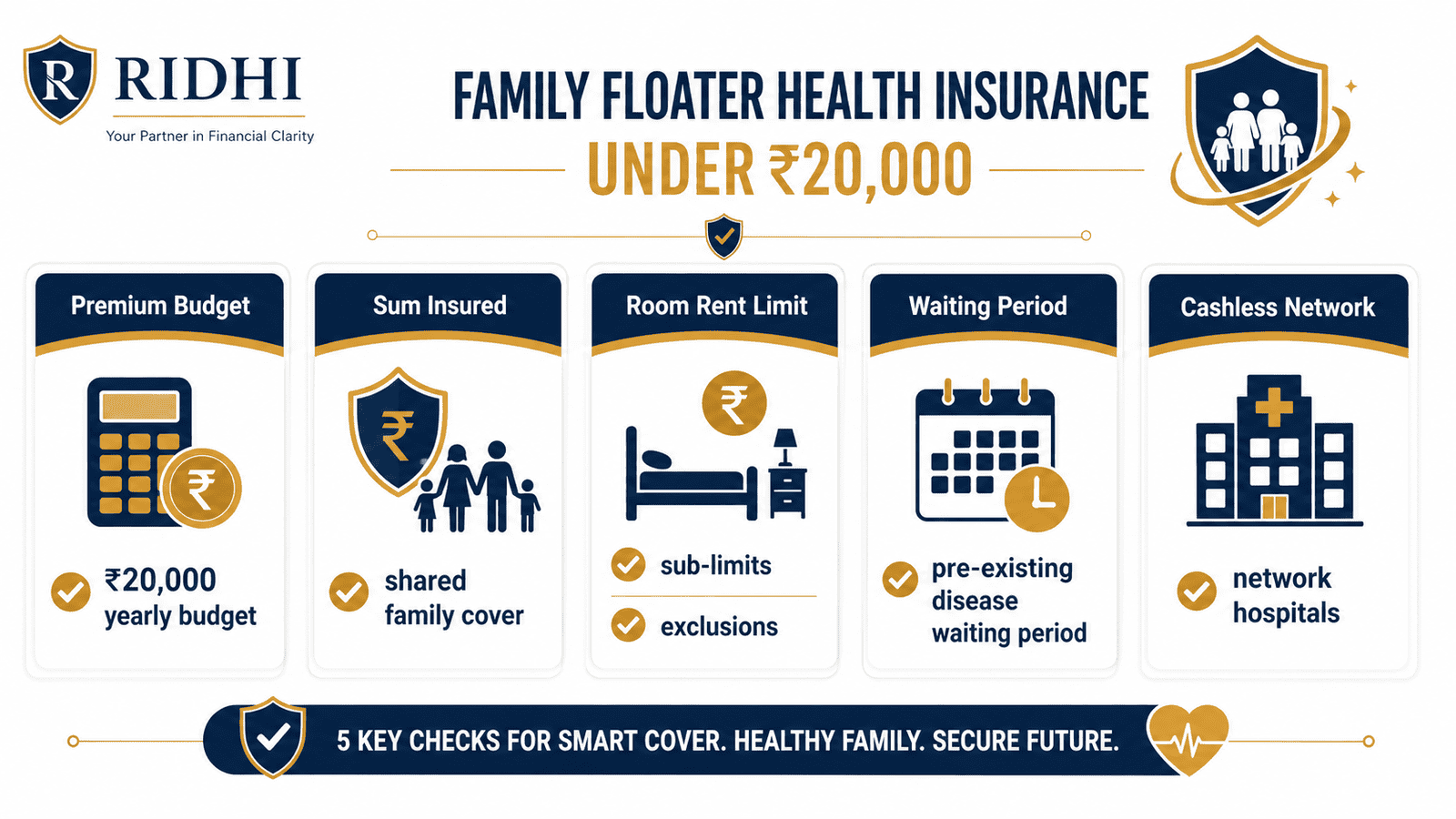
Family floater health insurance under 20000 is not a category of plans — it’s a budget filter. Policies within this range can be excellent or deeply flawed depending on five things: the sum insured, room rent limits, waiting periods, cashless hospital network, and exclusions. A premium that looks affordable in April can leave your family with a surprise shortfall in October when you’re trying to get a claim processed at 11 pm.
This article will not rank plans or name insurers. Instead, it gives you a practical checklist to evaluate any family floater policy before you buy — so your ₹20,000 works as hard as possible for your family.
Quick Answer: Family Floater Health Insurance Under ₹20,000
Family floater health insurance under 20000 can work for a young, healthy family if the policy has enough sum insured, no harsh room-rent limits, useful cashless hospitals, and clear waiting periods. Treat ₹20,000 as a premium filter, not the main decision factor. Verify current premiums, policy wording, and all coverage conditions directly from the insurer or IRDAI-registered platform before purchasing.
Key Takeaways
- A family floater policy under ₹20,000 annual premium may suit a young, healthy family of three or four — but suitability depends on underwriting, not just price.
- Check six things before any purchase: sum insured adequacy, room rent limit, pre-existing disease waiting period, co-payment clause, exclusions, and local cashless hospital network.
- Room rent limits can trigger proportional deductions across your entire bill — a ₹5 lakh policy can effectively pay out far less if your room costs more than the sub-limit allows.
- Pre-existing disease waiting periods typically range from one to four years; any claim for a covered condition within that window will be rejected.
- A co-payment clause of 10–20% means you bear that share of every claim — calculate this against a realistic ₹3–5 lakh hospitalisation bill before deciding.
- Section 80D deduction may apply to your health insurance premium — verify current limits and conditions from the Income Tax Department at incometax.gov.in before filing.
- If the only plans under ₹20,000 in your city have restrictive conditions, increasing your budget by ₹3,000–5,000 per year may be worth it rather than buying weak cover.
Comparison: Family Floater Under ₹20,000 vs Other Cover Options
| Cover Type | Key Characteristics | When to Be Cautious |
|---|---|---|
| Family floater under ₹20,000 premium | Shared sum insured for all members; affordable starting point for young families; premium varies by age, city, insurer | Older family members; members with pre-existing conditions; small sum insured relative to metro hospital costs |
| Family floater with higher premium | Fewer sub-limits, higher sum insured, wider cashless network, restoration benefit more common | May not be necessary for very young, healthy families — evaluate before stretching budget unnecessarily |
| Separate individual policies | Each member has dedicated sum insured; one large claim does not reduce cover for others; premiums add up | Higher total cost; managing multiple renewals; usually better for older members or those with health conditions |
| Employer group health insurance | Zero or low cost to employee; may include pre-existing diseases from day one; cover ends with employment | Cover stops if you resign, are laid off, or retire; sum insured often too low; policy terms set by employer, not you |
For a deeper comparison between shared family cover and separate individual policies, read floater versus individual cover before deciding which structure suits your family.
Key Facts at a Glance
| What to Check | Why It Matters | Where to Verify |
|---|---|---|
| Premium budget: under ₹20,000/year | A filter, not a quality indicator — same budget buys very different policies | Insurer website; IRDAI-registered aggregator |
| Sum insured adequacy | A serious illness or surgery in a metro city can cost ₹3–8 lakh or more | Policy document; benefit illustration |
| Room rent limit | Caps trigger proportional deductions across the entire hospital bill, not just the room | Policy wording; policy schedule |
| Pre-existing disease waiting period | Claims for covered PED conditions are rejected during this period | Policy document; insurer brochure |
| Cashless hospital network | Must include hospitals near your home and workplace, not just national count | Insurer or TPA network list |
| Co-payment clause | You bear this percentage of every claim — check before buying, not during a claim | Policy wording; schedule of benefits |
| Section 80D deduction | Tax benefit may apply — verify current limits from official source | incometax.gov.in; qualified tax professional |
How Family Floater Health Insurance Works — and Why Budget Policies Need Careful Reading
A family floater health insurance policy provides one shared sum insured for all members named on the policy. If you, your spouse, and your child are covered under a ₹5 lakh floater and your child is hospitalised for ₹1.8 lakh, the remaining cover for the rest of the year drops to ₹3.2 lakh for the other family members. This is the fundamental trade-off in floater plans — shared cover is affordable but shared risk too.
To understand what health insurance normally covers and excludes before comparing any plan, read basic coverage meaning first.
What Determines Your Premium
Premium under a family floater policy is primarily driven by the age of the oldest member being covered. A 34-year-old buying cover for himself, his 31-year-old spouse, and a 6-year-old child will pay significantly less than a 48-year-old covering the same structure. Other factors that push the premium up or down include the city of residence (metro cities typically cost more), the sum insured chosen, add-on covers selected, and the insurer’s own underwriting rules.
This is why a ₹20,000 budget gets you different policies in different scenarios. Two families with identical budgets may be looking at very different policies depending on their age and city.
What Policies Usually Cover
Most standard health insurance policies cover in-patient hospitalisation (at least 24 hours), day-care procedures listed in the policy, pre-hospitalisation expenses (typically 30–60 days before admission), and post-hospitalisation expenses (typically 60–90 days after discharge). According to IRDAI guidelines, insurers must follow standardised policy terms in several areas — but coverage conditions, sub-limits, and exclusions still vary meaningfully between insurers and products.
Why Policy Wording Beats Advertisement Claims
An insurer may advertise “comprehensive cover” or “zero co-payment” prominently. The policy wording may contain a 20% co-payment for specific age groups, or cap room rent at 1% of sum insured per day. A ₹5 lakh sum insured with a 1% room rent limit means only ₹5,000 per day is covered for the room — and if your hospital charges ₹8,000, the proportional deduction logic applies across your entire bill, not just the room charge. This is one of the most expensive surprises Indian policyholders face at the time of a claim.
The Shared Cover Risk in Floater Plans
If you have a restoration benefit in your policy — where the sum insured is reinstated after a claim — check the exact restoration terms. Some policies restore only for a different illness, not a recurrence of the same condition. Some restore only once per year. Read the exact condition in the policy document, not the sales brochure.
Real Example: Rahul’s Family in Pune
Rahul, 34, works as a senior analyst in Pune and earns ₹14 lakh per year. He wants health cover for himself, his wife Meera, 31, and their son Arjun, 6. His budget is ₹20,000 annual premium.
He finds two hypothetical policies within his budget:
Policy A costs ₹17,500 per year with a ₹5 lakh sum insured. It has a room rent limit of 1% of sum insured (₹5,000/day), a 20% co-payment for day-care procedures, and a four-year waiting period for pre-existing diseases. The cashless network in Pune includes 14 hospitals.
Policy B costs ₹19,800 per year with a ₹5 lakh sum insured. It has no room rent limit, no co-payment, and a two-year waiting period for pre-existing diseases. The cashless network in Pune includes 31 hospitals including the one closest to Rahul’s home.
Policy A is cheaper but its room rent cap means that if Arjun is admitted to a hospital charging ₹9,000 per night, proportional deductions apply across the entire bill — medicines, tests, and surgery fees are all reduced proportionally. Rahul’s out-of-pocket cost could be significantly higher despite having insurance.
The key insight: the ₹2,300 difference between Policy A and Policy B per year is far smaller than the financial exposure the restrictions in Policy A create. Premium is the starting filter, not the final decision.
How to Calculate Coverage Adequacy Before Buying
Before comparing premiums, check if the sum insured is realistic for your city and family situation.
Premium as % of Income = Annual Premium ÷ Annual Income × 100
For Rahul: ₹20,000 ÷ ₹14,00,000 × 100 = 1.43% of annual income. This is well within a reasonable range. The bigger question is whether ₹5 lakh sum insured is adequate.
Coverage Gap Check = Estimated Serious Illness Cost − Sum Insured
A serious surgery, ICU stay, or oncology treatment in a Pune private hospital can run ₹4–8 lakh or more depending on the condition. A ₹5 lakh sum insured may cover one moderate event — but two claims in a year or one large claim can leave a significant gap.
| Scenario | Estimated Hospital Cost | Gap at ₹5L Cover |
|---|---|---|
| Appendix surgery, tier-2 city private hospital | ₹1.5–2.5 lakh | Covered under ₹5L (if no sub-limits) |
| Cardiac intervention, metro private hospital | ₹4–8 lakh | ₹0–3 lakh gap depending on sum insured |
| Cancer treatment, first year | ₹6–15 lakh+ | Significant gap; top-up or higher cover needed |
If your base cover seems inadequate, a top-up health insurance plan can extend your effective coverage at a relatively low additional premium. Consider this before increasing your base policy sum insured alone.
On the tax side, Section 80D may allow a deduction on health insurance premiums — verify current limits, conditions, and eligible family members directly from the Income Tax Department at incometax.gov.in before accounting for any tax benefit in your purchase decision.
How to Decide What’s Right for You
Your family is young (oldest member under 40), healthy, and has no known pre-existing conditions — a family floater under ₹20,000 with an adequate sum insured and no harsh sub-limits is a reasonable starting point.
The only policies available under ₹20,000 in your city have room rent caps, co-payment clauses, or a very limited cashless hospital network — increase your budget rather than accepting weak coverage conditions. Before buying, check the cashless claim process and your local network hospitals; read cashless claim process to understand what a network limitation means at the time of emergency.
Your family has a member with a known health condition — buy a policy with a shorter pre-existing disease waiting period and be prepared for a higher premium. Do not buy on budget alone and expect PED claims to be covered immediately.
Your employer provides group health insurance — do not treat it as your primary long-term cover. It ends when your employment ends, and sum insured is typically inadequate for serious illnesses.
Your family’s realistic annual hospitalisation risk is low but a single serious illness would be financially catastrophic — buy the best-condition base policy you can in your budget, then layer a top-up plan on top to extend effective cover without doubling premium.
Your chosen policy has a sum insured that covers only one moderate hospitalisation event — evaluate whether a ₹3,000–5,000 increase in annual premium buys meaningfully better cover before locking in for a year.
Your family includes parents above 55 or members with chronic conditions — a single budget floater may leave the entire family under-insured. Consider separate individual policies or a dedicated senior citizen plan alongside a floater for younger members.
Common Mistakes to Avoid
Choosing the Lowest Premium Without Reading Policy Wording
The cheapest policy may have the most restrictions — room rent caps, co-payment requirements, and disease-specific sub-limits buried in Schedule 3 of the policy document.
A ₹5 lakh policy with a 1% room rent cap effectively pays proportionally less across your entire bill if you stay in a room above the daily limit. The gap between what your insurer pays and what the hospital charges falls on you.
Always request the full policy wording or specimen policy document before paying — not just the sales brochure or comparison website summary.
Ignoring Pre-Existing Disease and Specific Disease Waiting Periods
A waiting period is the time after policy issuance during which a specific condition is not covered. Pre-existing disease waiting periods typically range from one to four years depending on the insurer and policy.
If you buy a policy with a four-year PED waiting period and are hospitalised for a condition related to a known health issue in year two, the claim will be rejected. This is not fine print — it is a core policy condition. Read the waiting period impact carefully; the article on waiting period impact explains how different types of waiting periods affect your claims.
Prefer policies with shorter PED waiting periods, especially if any family member has a known condition.
Ignoring Room Rent Limits and Proportional Deductions
Room rent limits do not just cap your daily room charge — they trigger proportional deductions across surgeon fees, anaesthesia, nursing, and other charges if you stay in a room above the allowed rate.
On a ₹3 lakh hospital bill where your room cost was 30% above the policy cap, the proportional deduction could reduce your insurer’s payout by tens of thousands of rupees. Check whether your target policy has any room rent sub-limit before buying.
If a policy has no room rent limit, confirm this in writing in the policy schedule — not just in the insurer’s marketing material.
Assuming Employer Insurance Is Enough
Group health insurance provided by your employer covers you only while you are employed there. If you resign, are retrenched, or retire, the cover ends — often with no grace period for portability.
Employer group cover sum insured is typically ₹2–5 lakh per family — often insufficient for a serious illness in a metro private hospital. Treat group cover as a supplement, not a substitute for individual family cover.
Not Checking Exclusions Before Buying
Standard health insurance exclusions include cosmetic procedures, self-inflicted injuries, and treatment arising from war. But policies also have specific exclusions for certain conditions, treatments, or time periods that vary by insurer.
Read the exclusions list in full before buying. If a specific treatment your family may need — such as treatment for a known chronic condition — appears in the exclusion list, that policy is not the right one for you.
Focusing Only on First-Year Premium
An insurer may offer a discounted first-year premium that increases sharply at renewal — especially after a claim. Ask about renewal premium behaviour before buying.
Premium loading after a claim is a standard industry practice. Understand the insurer’s policy on this before committing, particularly if you are choosing based on a low year-one figure.
Not Checking Nearby Cashless Hospitals Before Buying
A policy may advertise a network of 10,000 hospitals nationally. If none of the top three hospitals nearest to your home or your child’s school are in that network, the national count is irrelevant during an actual emergency.
Download the insurer’s cashless hospital list, filter by your city and locality, and check whether your preferred hospitals are included before you buy — not during a 2 am emergency admission.
When This May Not Be the Right Choice
A family floater policy under ₹20,000 may not provide adequate protection in four specific situations.
First, if your parents above 55 are included in the same floater, the premium will rise significantly and the oldest member’s age drives up the shared risk for everyone. A separate senior citizen plan may provide better cover for parents at a comparable cost.
Second, if one or more family members have a known chronic condition — diabetes, hypertension, heart disease — a budget policy with a long PED waiting period is not useful cover for that member during the waiting period. The cover exists on paper but not in practice for the most likely source of claims.
Third, if you live near a metro city where private hospital costs routinely cross ₹4–6 lakh for a single serious admission, a ₹5 lakh sum insured with room rent caps and co-payment may leave a substantial gap even in a single claim.
Fourth, if the only policies within your budget have a co-payment clause of 20% or more combined with a room rent cap, the effective protection is meaningfully weaker than the headline sum insured suggests.
If any of these apply to your situation, it may be worth exploring alternatives before committing.
Official Rules and Where to Verify
Health insurance is a regulated product in India. All policies are issued under IRDAI guidelines, and policy terms must conform to IRDAI regulations. However, sub-limits, premiums, waiting periods, exclusions, and benefit structures vary between IRDAI-approved products — regulation sets a floor, not a ceiling.
Verify the following before purchasing:
- IRDAI (irdai.gov.in) — Regulator for all insurance products in India. Use the consumer education section for understanding your rights and checking insurer registration.
- Insurer’s official website — Download the full policy wording, benefit illustration document, and prospectus. Do not rely on comparison platform summaries or verbal sales representations alone.
- Insurer or TPA network hospital list — Request the current cashless network list specific to your city. Network hospital lists are updated periodically and may differ from what an aggregator shows.
- Income Tax Department (incometax.gov.in) — Verify current Section 80D deduction limits, eligible family members, and conditions before factoring any tax benefit into your purchase decision. For a detailed explanation of the rules and examples, read health insurance tax rules.
Rules, limits, and rates on this topic can change with each Budget or regulatory update. Always verify current figures directly from the official source before making any financial decision.
Expert Tips
- Ask for the policy document before paying. Request the specimen policy wording or full product brochure before paying the first premium. If an insurer or aggregator cannot provide this, that is itself a signal worth noting.
- Fewer restrictions beats lowest premium. A policy with no room rent cap, no co-payment, and a two-year PED waiting period at ₹19,500 is often more valuable than a policy at ₹16,000 with multiple sub-limits. The total cost of a claim is what matters — not the annual premium line.
- Check the hospital network before you need it. Open the insurer’s or TPA’s network hospital search tool and look up the three hospitals nearest to your home and your child’s school. If they are not in the network, cashless admission will not be available there during an emergency.
- Ask about renewal premium behaviour explicitly. Some insurers raise premiums substantially after a claim or at age-band crossings. Ask the insurer or aggregator for historical renewal premium data, not just the first-year quote. Compare renewal premium trajectory, not just entry-level cost.
- Use claim settlement ratio carefully alongside insurer reviews. A high claim settlement ratio is a positive signal but not the only measure of claim experience. Read about insurer claim quality to understand what CSR does and does not tell you before using it as a primary filter.
- Consider a top-up plan if base sum insured is low. If the best policy within your budget has a ₹5 lakh sum insured and you are concerned about adequacy, a top-up plan with a ₹5 lakh deductible and ₹15 lakh additional cover can meaningfully extend protection at a low incremental premium.
- Port your policy if you find a better one — but start early. IRDAI allows health insurance portability. You can port your policy to a new insurer at renewal. Start the process at least 45 days before renewal. Portability preserves your waiting period credit from the previous insurer.
Frequently Asked Questions
Is family floater health insurance under ₹20,000 enough for a family of three?
It depends on the policy conditions, not just the premium. A policy under ₹20,000 can be sufficient for a young, healthy family of three if it has an adequate sum insured, no room rent cap, no co-payment, and a reasonable cashless hospital network in your city. Verify current premiums and policy terms directly from the insurer — affordability and adequacy vary significantly by age, city, and insurer.
What sum insured should a family of three or four choose?
A sum insured of at least ₹5 lakh is a commonly suggested starting point, but the right figure depends on your city, the age and health of family members, and the cost of hospitals you are likely to use. In metros, a serious hospitalisation can easily cost ₹4–8 lakh. If ₹5 lakh is the maximum available in your budget, consider adding a top-up plan to extend effective coverage.
Can parents be added to a family floater plan?
Most insurers allow parents or parents-in-law to be included in a family floater, but including older members significantly increases the premium because premium is determined by the oldest insured member’s age. For parents above 55–60, a separate senior citizen health plan may offer better coverage at a comparable or lower cost. Verify the insurer’s specific terms for family definition and eligible members.
What is a room rent limit in health insurance and why does it matter?
A room rent limit is a daily cap on the hospital room charge that your insurer will pay. If your policy has a room rent limit of 1% of sum insured (₹5,000/day on a ₹5 lakh policy) and your hospital charges ₹9,000/day, a proportional deduction logic applies — your insurer reduces all related charges (surgeon, anaesthesia, nursing, equipment) proportionally, not just the room difference. This can significantly increase your out-of-pocket cost even with active insurance. Look for policies with no room rent limit or the highest possible limit.
What is a co-payment clause and how does it affect my claim?
A co-payment clause requires you to pay a fixed percentage of every claim amount out of your own pocket. A 20% co-payment on a ₹4 lakh hospital bill means you pay ₹80,000 regardless of your sum insured being sufficient. Co-payment clauses are common in policies for older members or in certain plan structures. Check for this specifically in the policy schedule before buying.
Is Section 80D deduction available for family health insurance premiums?
Section 80D of the Income Tax Act may allow a deduction for health insurance premiums paid for yourself, your spouse, dependent children, and parents, subject to conditions and limits. Deduction limits and conditions are set by the government and can change with each Budget. Verify the current applicable limits, eligible family members, and conditions at incometax.gov.in or consult a qualified tax professional before accounting for this benefit in your purchase decision.
Is cashless hospitalisation better than reimbursement?
Cashless hospitalisation reduces the upfront financial burden because the insurer settles directly with the hospital. In a reimbursement claim, you pay the hospital first and then file for reimbursement — which requires documentation and takes time. For emergency situations, cashless is significantly more convenient. However, cashless is only available at network hospitals. If your preferred hospital is not in the insurer’s network, you will need to use the reimbursement route. Check the local network before buying, not during an emergency.
What is a pre-existing disease waiting period?
A pre-existing disease (PED) waiting period is the time after policy issuance during which conditions that existed before you bought the policy are not covered. This typically ranges from one to four years depending on the insurer and policy. If you have a known condition and the policy has a four-year PED waiting period, claims related to that condition will be rejected for four years. Compare policies on PED waiting period length, especially if any family member has a known health condition.
What happens if both the parent and child need hospitalisation in the same year under a family floater?
Both claims draw from the same shared sum insured pool. If your child’s hospitalisation uses ₹2.5 lakh of a ₹5 lakh policy and a parent is then hospitalised, only ₹2.5 lakh remains available for the rest of the policy year. Some policies offer a restoration benefit that reinstates the sum insured after a claim — but check the exact conditions, as restoration may apply only for a different illness or only once per year.
Can I increase the sum insured at renewal?
Most insurers allow you to increase sum insured at renewal, subject to underwriting. However, the increased sum insured may come with a fresh waiting period for the additional amount. Check the insurer’s policy on this before assuming that renewing automatically gives you more cover without conditions. IRDAI guidelines require insurers to offer lifelong renewability for health insurance policies — verify current portability and renewal rights at irdai.gov.in.
Final Verdict
Family floater health insurance under 20000 is a viable starting point for a young, healthy family — but only if the policy passes the coverage quality test, not just the premium test. Sum insured adequacy, absence of room rent caps, short waiting periods, and a strong local cashless network matter far more than saving ₹2,000–3,000 on the annual premium.
If the only policies available within your budget carry room rent limits, co-payment clauses, or thin cashless networks in your city, the practical protection they offer is weaker than the sum insured headline suggests. In that case, a modest budget increase is almost always the better financial decision.
Use this article as a pre-purchase checklist — not as a plan ranking. Read the full policy wording, check your local hospital network, verify Section 80D rules from incometax.gov.in, and confirm all policy terms at irdai.gov.in before finalising. Insurance is a subject matter of solicitation. Please read the policy document carefully before purchasing.
Always verify the latest rules from official sources or consult a qualified professional before making any financial decision.
This article is for educational purposes only and should not be treated as personalised financial, tax, investment, insurance, or legal advice. Tax rules, interest rates, regulatory limits, and product features can change with each Budget or policy update. Please verify current rules from official government sources or consult a qualified and registered professional before making any financial decision.

Priya Nambiar writes about insurance concepts for Indian families, salaried employees, self-employed professionals, and first-time policy buyers. Her content focuses on helping readers understand coverage, exclusions, claim conditions, premiums, riders, and policy documents before buying or renewing insurance.
She covers topics such as term insurance, health insurance, family floater plans, riders, critical illness cover, employer insurance vs personal insurance, waiting periods, exclusions, deductibles, co-payment, no-claim bonus, claim settlement, premium comparison, renewal rules, and tax benefits linked to insurance.
Priya’s writing is careful, consumer-focused, and policy-document oriented. She explains why insurance should be understood as financial protection, not just a tax-saving tool or investment substitute. Her articles encourage readers to compare coverage, understand limitations, and ask better questions before buying a policy. Premiums, exclusions, claim rules, and benefits vary by insurer, age, health, sum insured, and product type. Insurance is a subject matter of solicitation, and readers should read the official policy document carefully before purchasing.