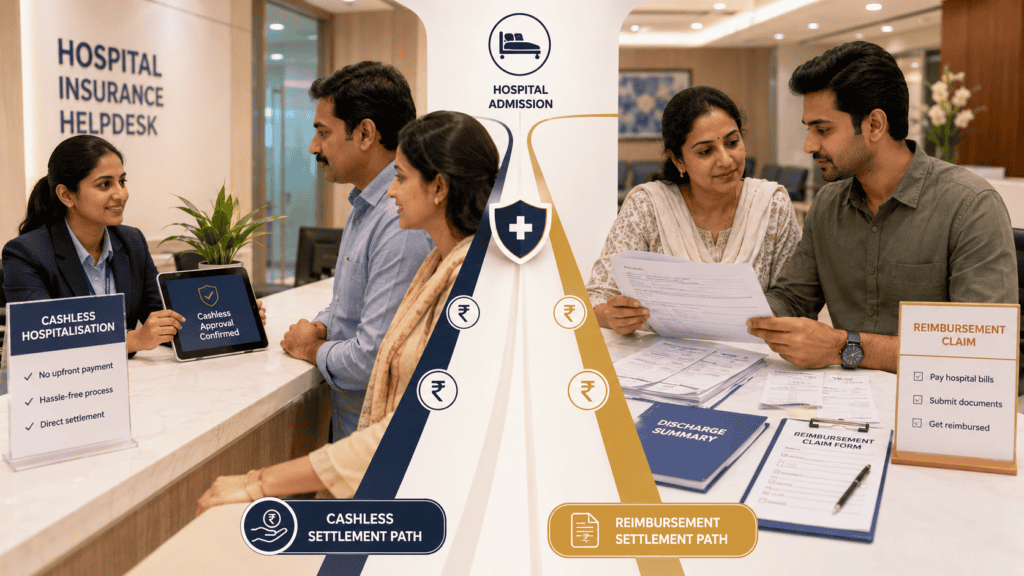
The moment a family member needs hospitalisation, most people’s first question is not about treatment — it is about payment. “Will I have to pay the full hospital bill right now?” or “Will my insurance company settle directly with the hospital?” The answer depends on which claim route your policy uses and whether the hospital is in your insurer’s network. Understanding cashless vs reimbursement hospitalisation before an emergency can save your family from financial shock and documentation chaos. According to IRDAI, claim settlement disputes are among the most common complaints policyholders raise — and many arise from confusion about how each route works rather than actual policy rejection. Your health insurance basics determine what is covered, but the claim method determines who pays whom and when. This article explains both routes in plain terms — including what you will still pay out of pocket even with cashless hospitalisation.
Quick Answer: Cashless vs Reimbursement Hospitalisation
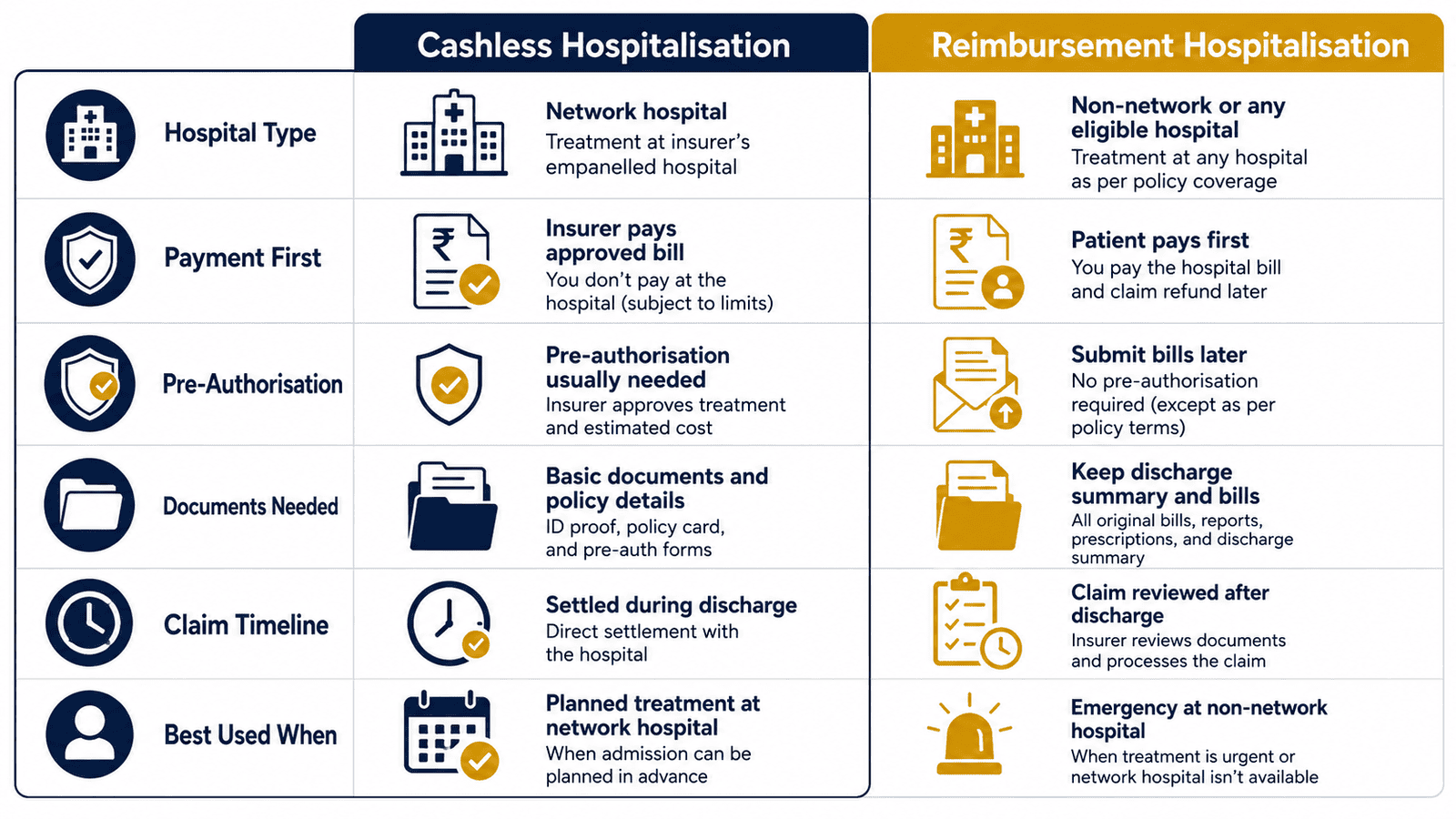
Cashless vs reimbursement hospitalisation explains two ways a health insurance claim can be settled after admission. In cashless treatment, the insurer pays the approved hospital bill directly at a network hospital; in reimbursement, you pay first, keep bills, and claim repayment later from the insurer, subject to policy terms and exclusions.
Key Takeaways
- Cashless hospitalisation does not mean zero payment — you will still pay non-payable items, room rent upgrades above your policy sub-limit, co-payment amounts, and any deductible applicable under your policy.
- Reimbursement claims require you to arrange the full hospital bill upfront — on a ₹2,50,000 bill, you may need to arrange the entire amount before claiming back the eligible portion.
- Cashless works only at network hospitals listed by your insurer or TPA — calling the insurer helpline before planned admission to confirm network status takes under five minutes and can save significant stress.
- Reimbursement is your only practical option for emergency admissions at non-network hospitals — claim intimation to your insurer within the stated timeframe (typically 24–48 hours for emergency, 48–72 hours for planned) is mandatory.
- Both routes assess your claim against policy terms — pre-existing disease waiting periods, sub-limits, exclusions, and room rent caps apply equally regardless of which route you use.
- Keeping original bills, prescriptions, lab reports, and discharge summary is non-negotiable — a missing original bill is one of the leading reasons reimbursement claims are partially settled or rejected.
- Verify your hospital’s network status, insurer’s pre-authorisation process, and document checklist directly with your insurer before planned treatment — network lists and insurer procedures change periodically.
Cashless vs Reimbursement Hospitalisation: Side-by-Side Comparison
| Parameter | Cashless Hospitalisation | Reimbursement Hospitalisation |
|---|---|---|
| Who pays the hospital initially | Insurer pays approved amount directly to hospital | You pay the full bill; insurer reimburses eligible amount later |
| Hospital requirement | Must be a network hospital empanelled by your insurer or TPA | Any hospital — network or non-network |
| Approval process | Pre-authorisation request submitted by hospital to insurer or TPA before or during admission | Claim intimation to insurer within policy-specified timeframe; documents submitted after discharge |
| Upfront cash needed | Only non-payable items, co-payment, deductible, and room rent excess | Full hospital bill — can be ₹1 lakh to ₹5 lakh or more for serious treatment |
| Document burden | Lower at admission — hospital insurance desk coordinates; keep copies for your records | High — original bills, prescriptions, discharge summary, lab reports, claim form must all be compiled |
| Speed and convenience | Higher — insurer settles directly, reducing stress during hospitalisation | Moderate — depends on how quickly you file complete documents post-discharge |
| Risk of delay or partial approval | Pre-authorisation can be delayed or partially approved — insurer may query certain procedures | Incomplete documents or late intimation can reduce or reject the claim |
| Best situation to use | Planned treatment, elective surgery, maternity at a verified network hospital | Emergency at non-network hospital, specialist treatment unavailable in network, cashless facility temporarily unavailable |
Key Facts at a Glance
| Fact | Cashless | Reimbursement |
|---|---|---|
| Minimum hospitalisation for claim | Typically 24 hours (day-care procedures listed separately in policy) | Typically 24 hours (same rule applies) |
| Claim intimation timing | Pre-authorisation before or at admission (emergency: immediately after admission) | Intimate insurer within stated hours of admission (check your policy document) |
| Key document at hospital | Health insurance e-card or policy number, government photo ID | All original bills, prescriptions, reports, discharge summary, claim form |
| Non-payable items still paid by | Policyholder | Policyholder (deducted from reimbursement amount) |
| Who to call first | Insurer helpline or TPA helpline at admission | Insurer helpline immediately — then compile documents for claim filing |
How Cashless and Reimbursement Hospitalisation Actually Work
Cashless Hospitalisation: What Happens at the Hospital Desk
Cashless hospitalisation is a direct-payment arrangement between your insurer (or their Third Party Administrator, the TPA) and an empanelled network hospital. When you are admitted at a network hospital, the hospital’s insurance desk submits a pre-authorisation request to your insurer or TPA. This request contains the treating doctor’s diagnosis, proposed treatment, and estimated cost. The insurer reviews it against your policy terms and responds — approving, partially approving, or querying the request.
Once approved, the insurer pays the hospital directly for the covered amount after discharge. You pay the remainder — which includes non-payable items (consumables, personal comfort items, administrative charges that most policies exclude), any room rent difference if you chose a room above your policy’s sub-limit, co-payment if applicable, and the deductible if your policy has one.
The key word is “approved.” Cashless approval is not a guarantee that the entire bill is settled. Insurers approve claims based on covered procedures, policy limits, and exclusions. A ₹2,80,000 hospital bill may result in ₹2,10,000 approved by the insurer and ₹70,000 paid by you — even in a cashless case. Understanding your employer health cover limits is equally important, because corporate group policies often have sub-limits that reduce the cashless approval amount significantly.
Reimbursement Hospitalisation: Pay First, Claim Later
In reimbursement hospitalisation, you pay the full hospital bill at discharge and then file a claim with your insurer for the eligible amount. This route is typically used when treatment happens at a non-network hospital, when the cashless facility is not available at the time of admission, or when a specialist or hospital outside the network is medically necessary.
The process starts with claim intimation — informing your insurer within the timeframe stated in your policy document (the exact hours vary by insurer and by whether the admission is planned or emergency). After discharge, you collect all original documents: hospital bills itemised by procedure, pharmacy bills, laboratory and imaging reports, doctor’s prescriptions, the discharge summary, and the completed claim form from your insurer. You submit this file to your insurer or TPA, who then assesses and reimburses the eligible amount — which again is subject to policy exclusions, sub-limits, and deductions for non-payable items.
Network Hospital, Non-Network Hospital, and TPA: The Three Key Roles
A network hospital is a hospital that has a formal agreement with your insurer or TPA to provide cashless treatment to policyholders. Network lists are maintained by each insurer and updated periodically — a hospital that was in-network when you bought your policy may not be in-network at the time of admission. Always verify directly with your insurer’s helpline or website before planned hospitalisation.
The TPA — Third Party Administrator — is a licensed intermediary that processes claims on behalf of some insurers. Your policy documents will state whether your insurer uses a TPA or handles claims in-house. In either case, the pre-authorisation and reimbursement claim process routes through this entity. According to IRDAI guidelines, insurers and TPAs are required to acknowledge and process claims within defined timelines — check irdai.gov.in for the current regulatory framework governing claim settlement timelines.
For broader context on what health insurance covers before a claim is even filed, read our guide on health insurance basics.
Real Example: Rohan’s Family Hospitalisation in Pune
Rohan Mehta, 36, works as an IT manager in Pune earning ₹18 lakh per year. He has a family floater health insurance policy covering himself, his wife, his child, and his parents, with a sum insured of ₹10 lakh. His mother requires planned knee replacement surgery estimated at ₹2,50,000.
Scenario A — Cashless at a network hospital: Rohan calls the insurer helpline two days before admission and confirms the hospital is in-network. The hospital insurance desk submits a pre-authorisation request. The insurer approves ₹2,10,000. The remaining ₹40,000 covers non-payable items (consumables, attendant charges, registration fees) and a room rent difference because Rohan’s mother chose a semi-private room above the policy sub-limit. Rohan pays ₹40,000 at discharge. No bills need to be compiled into a claim file — the insurer settles directly with the hospital.
Scenario B — Emergency admission at a non-network hospital: Three months later, Rohan’s father has a cardiac event and is rushed to the nearest private hospital, which is not in the insurer’s network. Rohan calls the insurer helpline immediately to intimate the claim. He pays ₹2,80,000 at discharge. He then compiles all original bills, prescriptions, ECG reports, discharge summary, and the insurer’s claim form. After assessment, the insurer reimburses ₹2,20,000 — deducting non-payable items and a co-payment applicable under the policy. Rohan needed liquid savings of ₹2,80,000 available within hours. The key insight: cashless is smoother, but reimbursement is not impossible — it just requires cash availability and document discipline.
How to Calculate Your Actual Out-of-Pocket Cost
Out-of-Pocket Amount = Total Hospital Bill − Insurer-Approved Covered Amount + Non-Payable Items + Room Rent Excess + Co-payment + Deductible
Using Rohan’s Scenario A as an illustration (figures are hypothetical and for explanation only — actual claim depends on your sum insured, policy terms, exclusions, and insurer assessment):
| Scenario | Key Figures | Patient Pays |
|---|---|---|
| Cashless at network hospital | Total bill ₹2,50,000 | Approved ₹2,10,000 | Non-payables + room excess ₹40,000 | ₹40,000 at discharge |
| Reimbursement at non-network hospital | Total bill ₹2,80,000 | Eligible ₹2,20,000 | Non-payables + co-pay ₹60,000 | ₹2,80,000 upfront; ₹2,20,000 claimed back later |
This is why an emergency fund matters even if you have full health insurance coverage. In the reimbursement route, you need to arrange the entire hospital bill amount immediately — the insurer refunds the eligible portion only after claim assessment, which can take days to weeks. A liquid emergency fund of at least ₹3–5 lakh for a family with ₹10 lakh health cover is a practical benchmark, though your own requirement depends on your policy structure and hospital costs in your city.
How to Decide What’s Right for You
Your treatment is planned and the hospital is confirmed in your insurer’s network — THEN request cashless hospitalisation; contact the insurer helpline at least 48 hours before admission to initiate pre-authorisation.
You face a medical emergency and the nearest hospital is not in-network — THEN choose reimbursement; prioritise treatment first, intimate the insurer immediately, and save every document from admission to discharge.
You have a family floater policy covering senior parents who may need emergency admissions — THEN verify your insurer’s network hospitals near their city of residence in advance; do not wait for an emergency to discover the nearest hospital is non-network.
Your savings are limited and you cannot arrange ₹2–3 lakh immediately — THEN planned reimbursement admissions are a cash-flow risk; prioritise network hospitals where cashless is possible for large planned procedures.
Your cashless pre-authorisation request is delayed or partially approved during admission — THEN ask the insurer for the specific reason in writing; you may be able to provide additional documents or appeal; do not assume rejection is final.
You do not have liquid savings to cover a large hospital bill upfront and your policy requires co-payment or has significant sub-limits — THEN the reimbursement route may expose you to serious financial stress; address this gap through an emergency fund or a higher sum insured before a hospitalisation event occurs.
Common Mistakes to Avoid
Assuming Cashless Means You Pay Nothing at All
Many policyholders are surprised to receive a bill at hospital discharge even when cashless was approved.
Insurers do not pay non-payable items — consumables, administrative charges, attendant charges, laundry, personal hygiene items — regardless of cashless approval. Room rent chosen above your policy sub-limit also creates a proportional deduction. On a ₹2,50,000 bill, non-payable deductions alone can add up to ₹30,000–₹60,000 depending on the hospital and treatment duration.
Read your policy’s list of non-payable items before admission and budget accordingly.
Not Confirming Network Hospital Status Before Planned Admission
Network lists are updated by insurers; a hospital that appeared in last year’s list may have been removed.
Arriving at a hospital expecting cashless and discovering it is non-network on admission day creates an emergency cash requirement. This is avoidable — call your insurer helpline or check the live network list on your insurer’s website within one week of planned admission.
Spend five minutes verifying before booking the admission slot.
Missing Claim Intimation Within the Policy-Specified Timeframe
Both cashless and reimbursement routes require you to inform the insurer within a stated number of hours from admission. Missing this window is one of the most common reasons reimbursement claims are partially settled or rejected.
For emergency admissions, the window is typically short — often 24 hours. A delayed intimation can give the insurer grounds to question the claim even if the treatment itself is fully covered under the policy. Read our guide on waiting period rules to understand other conditions that can affect eligibility.
Save your insurer’s helpline number in your phone before you need it.
Discarding Original Bills, Prescriptions, and Lab Reports
Reimbursement claims require original documents — photocopies or scans are typically not accepted as primary submissions.
A single missing original bill or prescription can result in deduction of that amount from the reimbursement. On a ₹2,80,000 claim, losing ₹12,000 worth of pharmacy receipts means ₹12,000 is deducted from your payout. This is entirely preventable.
Keep a separate folder for every hospitalisation — bills, prescriptions, lab reports, discharge summary, and insurer correspondence — from day one of admission.
Choosing a Room Above the Policy Sub-Limit Without Understanding the Consequences
Many health policies have a room rent sub-limit — for example, ₹3,000 per day — and if you choose a room above this limit, the insurer applies a proportional deduction to the entire eligible claim, not just the room cost.
Upgrading from a ₹3,000-sub-limit room to a ₹6,000 room means the insurer may reduce all associated procedure and ICU costs proportionally. On a ₹2,50,000 claim, this can reduce reimbursement or cashless approval by ₹30,000–₹50,000.
Check your policy’s room rent limit before choosing a room at admission.
Not Providing an Itemised Bill for Reimbursement
A consolidated bill is not sufficient for most reimbursement claims. Insurers require a fully itemised bill showing each procedure, medicine, consumable, room charge, and doctor’s fee separately so that non-payable items can be identified and deducted correctly.
Ask the hospital billing department for an itemised bill before discharge — some hospitals do not provide this automatically.
An itemised bill also helps you cross-check non-payable deductions for accuracy.
Ignoring Pre-Existing Disease Waiting Periods and Policy Exclusions
A claim filed for a condition under the waiting period is not payable — cashless or reimbursement. Many policyholders discover this at the claim stage rather than at policy purchase.
If your parent was diagnosed with diabetes three years ago and your policy has a four-year waiting period for pre-existing diseases, a diabetes-related admission claim will be rejected during that window regardless of how well you managed the claim process.
Review exclusions and waiting period status before any planned treatment.
When This May Not Be the Right Choice
Cashless hospitalisation may not work as expected when the best specialist or preferred hospital for a specific condition is not in your insurer’s network. In smaller cities or towns, insurer network coverage can be limited — forcing a reimbursement route even for planned procedures. If cashless is partially approved or approval is delayed during admission, you may need to arrange partial payment immediately, which can be stressful without adequate liquid savings.
Reimbursement may not be a realistic option if you do not have sufficient liquid savings to pay the full hospital bill upfront. For serious treatments costing ₹3–5 lakh or more, the cash outflow before reimbursement is received can create significant financial strain. Incomplete documentation — a common issue — can reduce or reject the reimbursement, leaving you with a partial recovery on what you paid. For large planned procedures, consider whether your base policy sum insured is sufficient or whether top-up cover works for your situation.
If any of these apply to your situation, it may be worth exploring alternatives before committing.
Official Rules and Where to Verify
Health insurance claim procedures, pre-authorisation requirements, document checklists, and exclusion lists are governed by your policy document and by IRDAI regulations. Rules change with regulatory updates, insurer policy revisions, and annual renewals. Always verify current rules directly from official sources before any hospitalisation.
- IRDAI (Insurance Regulatory and Development Authority of India) — irdai.gov.in — the primary regulator for all health insurance products in India, including claim settlement timelines and policyholder rights.
- Your insurer’s website and policy document — the policy wording you received at purchase is the definitive source for your specific sub-limits, exclusions, co-payment terms, waiting periods, and network hospital list.
- Insurer helpline or TPA helpline — call before planned hospitalisation to confirm network status, pre-authorisation process, and document requirements for your specific policy.
- Hospital insurance desk — the designated team at network hospitals that coordinates pre-authorisation; they can clarify what documents are required and what non-payable items apply.
Rules, limits, and rates on this topic can change with each Budget or regulatory update. Always verify current figures directly from the official source before making any financial decision.
Expert Tips
- Save your insurer helpline number, TPA helpline number, policy number, and health insurance e-card in your phone contacts — and share them with at least one other family member. You may not be the person making the call during an emergency.
- Before any planned hospitalisation, call your insurer helpline to confirm: (a) the hospital is currently in-network, (b) the treating doctor is empanelled, and (c) the procedure requires pre-authorisation. This one call can prevent the most common cashless admission problems.
- Keep a physical folder and a phone album of all medical records — diagnosis letters, prescriptions, lab reports, and previous discharge summaries. These matter most for reimbursement claims where the insurer may request clinical history to assess claim validity.
- Always ask for an itemised bill from the hospital billing desk before signing the final discharge paperwork. A consolidated bill creates delays and disputes in reimbursement — it makes it harder to verify what was actually charged and what is non-payable under your policy.
- Do not upgrade the hospital room above your policy’s room rent sub-limit without calculating the proportional deduction impact. Ask the hospital or your insurer in advance — the deduction is applied to the entire eligible claim, not just the room cost.
- When evaluating insurers or renewing a policy, look at the claim settlement ratio alongside network hospital count and premium — a low-premium policy with a poor settlement track record may cost you more during a real hospitalisation.
- For reimbursement claims, submit documents as soon as possible after discharge — do not wait until the insurer’s maximum submission deadline. Early submission gives time to provide additional documents if the insurer raises queries.
Frequently Asked Questions
Is cashless hospitalisation completely free — do I pay nothing at all?
No. Cashless means the insurer settles the approved covered amount directly with the hospital. You still pay non-payable items (consumables, personal comfort charges), any room rent difference above your policy sub-limit, co-payment if applicable, and any deductible. On most hospitalisations, the patient still pays ₹20,000 to ₹60,000 or more out of pocket even in a fully cashless case.
Can cashless hospitalisation be denied even at a network hospital?
Yes. Pre-authorisation can be denied or partially approved if the treatment falls under a policy exclusion, is within a waiting period, the diagnosis is not sufficiently documented, or the insurer queries the clinical necessity of a procedure. Denial of cashless does not mean the claim itself is denied — you can pay and file for reimbursement instead, subject to the same policy terms.
Can I claim reimbursement for treatment at a non-network hospital?
Yes. Reimbursement is available for non-network hospitals, provided the treatment is covered under your policy, the admission is not for a condition under a waiting period or exclusion, and you file a complete claim with original documents within your insurer’s stated deadline. The eligible reimbursement amount is still subject to sub-limits, co-payment, and deductions for non-payable items.
What documents are required for a reimbursement claim?
Required documents typically include: original hospital bills (itemised), original pharmacy bills with prescriptions, all diagnostic reports and imaging with doctor’s referral, discharge summary, completed claim form (from your insurer), doctor’s certificate or case summary, and government-issued ID and policy copy. Your specific insurer or TPA may require additional documents — download the current checklist from your insurer’s website at the time of filing.
Is pre-authorisation required for emergency admissions in the cashless route?
For emergency admissions, most insurers allow post-admission pre-authorisation — meaning you intimate the insurer immediately after admission rather than before. The hospital insurance desk typically initiates this. Verify your insurer’s specific emergency pre-authorisation process from your policy document or helpline, as the timeframe and process vary.
What happens if my cashless claim is only partially approved?
If pre-authorisation is partially approved, the insurer settles only the approved amount with the hospital. You pay the difference directly to the hospital. If you believe the partial approval is incorrect, you can raise a query or complaint with your insurer; IRDAI’s integrated grievance management system (IGMS) at irdai.gov.in provides a formal escalation mechanism for unresolved disputes.
Can I use both cashless and reimbursement in the same hospitalisation?
In some cases, yes — if the insurer approves part of the claim via cashless and the remaining eligible expenses are claimed via reimbursement. This is less common but can occur when additional procedures are added after the initial pre-authorisation, or when some expenses are outside the pre-authorised scope. Check with your insurer’s helpline if this situation arises.
What is the difference between an insurer and a TPA in processing my claim?
An insurer is the company that sold you the policy and bears the financial risk. A TPA — Third Party Administrator — is a licensed intermediary that processes claims on the insurer’s behalf: handling pre-authorisation, document review, and reimbursement processing. Some insurers process claims in-house without a TPA. Your policy document will specify whether a TPA is involved and which one. Contact the TPA for day-to-day claim queries and your insurer’s grievance team for escalations.
Does the 24-hour hospitalisation rule apply to cashless and reimbursement equally?
Yes. Most health insurance policies require a minimum continuous hospitalisation of 24 hours for a claim to be eligible, with specific day-care procedures listed as exceptions. This rule applies regardless of whether you use the cashless or reimbursement route. Review your policy’s day-care procedure list to understand which treatments are covered without overnight hospitalisation.
Final Verdict
For most families, cashless hospitalisation is the more convenient option — lower upfront cash requirement, less document burden at the time of admission, and direct insurer settlement with the hospital. It works best for planned procedures at verified network hospitals where pre-authorisation can be arranged in advance. Reimbursement is not a weaker route — it is the practical option when emergencies happen at non-network hospitals or when the cashless facility is unavailable. Both routes settle claims against the same policy terms, exclusions, and sub-limits. Understanding cashless vs reimbursement hospitalisation before an emergency — not during one — is the preparation that matters. Verify your network hospital list, keep your insurer helpline saved, maintain a liquid emergency fund, and read your policy’s non-payable items list. Always verify the latest rules from official sources or consult a qualified professional before making any financial decision.
This article is for educational purposes only and should not be treated as personalised financial, tax, investment, insurance, or legal advice. Tax rules, interest rates, regulatory limits, and product features can change with each Budget or policy update. Please verify current rules from official government sources or consult a qualified and registered professional before making any financial decision.
Insurance is a subject matter of solicitation. Please read the policy document carefully before purchasing.

Priya Nambiar writes about insurance concepts for Indian families, salaried employees, self-employed professionals, and first-time policy buyers. Her content focuses on helping readers understand coverage, exclusions, claim conditions, premiums, riders, and policy documents before buying or renewing insurance.
She covers topics such as term insurance, health insurance, family floater plans, riders, critical illness cover, employer insurance vs personal insurance, waiting periods, exclusions, deductibles, co-payment, no-claim bonus, claim settlement, premium comparison, renewal rules, and tax benefits linked to insurance.
Priya’s writing is careful, consumer-focused, and policy-document oriented. She explains why insurance should be understood as financial protection, not just a tax-saving tool or investment substitute. Her articles encourage readers to compare coverage, understand limitations, and ask better questions before buying a policy. Premiums, exclusions, claim rules, and benefits vary by insurer, age, health, sum insured, and product type. Insurance is a subject matter of solicitation, and readers should read the official policy document carefully before purchasing.