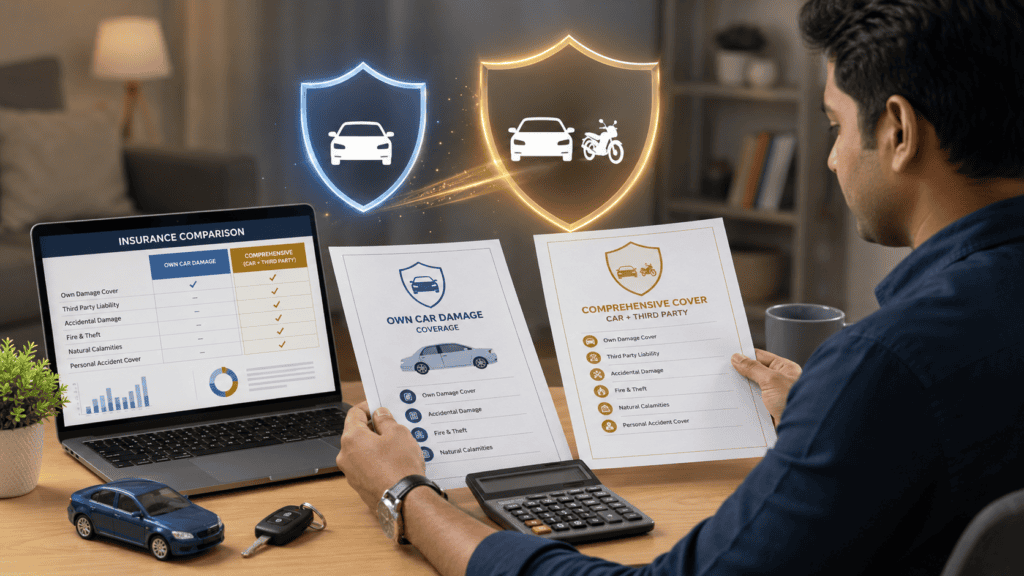
When Rohit renewed his car insurance last April, the insurer’s app showed him three different quotes. One said “standalone own damage.” Another said “comprehensive.” A third just said “OD + TP bundled.” Same car. Same year. Very different prices. He picked the cheapest one — and only later realised it did not include third-party liability because he assumed his old policy had auto-renewed. It had not.
This confusion costs Indian car owners money every renewal season. Own damage and comprehensive motor insurance are not the same thing — but the names make them sound like they might be. One covers your car. The other covers your car and your legal liability to others. And under IRDAI regulations, at least one of these components — third-party liability — is mandatory for every vehicle on Indian roads.
This article compares own damage vs comprehensive insurance on coverage, cost, add-ons, claims, and who should choose what. No jargon. No insurer bias.
Quick Answer: Own Damage vs Comprehensive Insurance
Own damage vs comprehensive insurance compares a standalone cover for your vehicle’s damage with a broader policy that combines own damage and third-party liability. If your ₹20,000 repair bill is for your own car, own damage may help; if another person’s vehicle or injury is involved, comprehensive cover includes third-party protection too.

Key Takeaways
- Standalone own damage (OD) covers only your vehicle — theft, accident, fire, flood — but does not include any third-party liability. You need a separate active third-party policy alongside it.
- Comprehensive motor insurance bundles own damage and third-party liability into one policy — one renewal date, one insurer, one document.
- Third-party motor insurance is mandatory under the Motor Vehicles Act for every vehicle on Indian roads. Driving without it is a legal offence.
- A comprehensive policy with zero depreciation add-on can increase your claim payout significantly on newer cars — the difference on a ₹40,000 bumper job can be ₹8,000–₹15,000 depending on depreciation rate.
- Insured Declared Value (IDV) directly affects both your premium and your claim ceiling — setting IDV artificially low saves a few hundred rupees but can cost tens of thousands at the time of a total loss claim.
- No Claim Bonus (NCB) can reduce your own damage premium by up to 50% after five consecutive claim-free years — protecting this discount is often worth more than saving on add-ons.
- Add-ons such as engine protection, consumables cover, and roadside assistance are only available on OD or comprehensive policies — they cannot be attached to a standalone third-party policy.
Comparison: Own Damage vs Comprehensive vs Third-Party Car Insurance
| Parameter | Standalone Own Damage | Comprehensive |
|---|---|---|
| Covers damage to your car | Yes | Yes |
| Covers third-party liability | No | Yes |
| Legally mandatory on its own | No | Yes (includes TP) |
| Needs a separate TP policy | Yes — must be active | No |
| Covers theft of vehicle | Yes | Yes |
| Covers fire and natural calamity | Yes | Yes |
| Add-on availability | Yes | Yes |
| Relative premium level | Lower (OD portion only) | Higher (OD + TP combined) |
| Best for | Buyers with active TP policy needing only own car cover | Most buyers wanting single-policy protection |
| Main risk if misunderstood | No TP cover if separate policy lapses | Higher cost if add-ons not evaluated carefully |
Key Facts at a Glance
| Factor | Own Damage | Comprehensive |
|---|---|---|
| Covers own vehicle damage | Yes | Yes |
| Covers third-party injury or property damage | No | Yes |
| Personal accident cover for owner-driver | Available as add-on / separate | Available as add-on / separate |
| Premium drivers | IDV, car age, RTO zone, NCB, add-ons, deductibles | IDV, car age, RTO zone, NCB, add-ons, deductibles, TP component |
| Mandatory under Motor Vehicles Act | No (but TP component must be active separately) | Yes (includes TP) |
| Regulatory body | IRDAI — irdai.gov.in | IRDAI — irdai.gov.in |
Understanding Motor Insurance Types in India
What Is Own Damage Car Insurance?
Own damage car insurance — also called a Standalone Own Damage policy — covers financial loss caused to your own vehicle. This includes accidental collision, fire, explosion, theft, natural calamities such as floods and earthquakes, and damage during transit. If your car is rear-ended and the bumper needs replacement, your OD policy pays the claim (subject to deductibles, depreciation, and exclusions).
What it does not cover: damage you cause to someone else’s vehicle, property, or person. That is an entirely separate legal liability — covered by third-party insurance, not OD.
What Is Comprehensive Motor Insurance?
Comprehensive motor insurance combines the own damage component and the third-party liability component in one policy. Buy one policy, get both. Your own car is protected, and your legal liability to third parties is also covered — all under one renewal date and one policy document.
The word “comprehensive” does not mean every possible risk is covered. Mechanical breakdown, electrical failure, or damage from driving under the influence are typically excluded even from comprehensive policies. The coverage is “comprehensive” relative to standalone third-party cover — not unlimited.
How Third-Party Insurance Fits In
Third-party motor insurance is the legal floor under the Motor Vehicles Act in India. Every vehicle on the road must have at least third-party cover. It protects others — not you or your car. If you hit a pedestrian or damage another vehicle, your third-party policy pays the compensation awarded by the Motor Accidents Claims Tribunal.
A standalone OD policy cannot replace third-party cover. You need both: an active third-party policy plus your OD policy. Comprehensive eliminates this complexity by packaging both into one.
What Is a Standalone Own Damage Policy?
IRDAI introduced the standalone OD policy category, which allows a vehicle owner to buy own damage cover from one insurer while maintaining a third-party policy from another. This gave car owners flexibility to shop for the best OD deal separately from their mandatory TP cover. However, this also introduced a gap risk: if the standalone third-party policy lapses without the owner noticing, they may be driving with only OD cover and no legal TP cover — which is a Motor Vehicles Act violation.
Add-On Covers — What They Are and Why They Matter
Add-ons are optional extensions available on OD and comprehensive policies. They are not available on a standalone third-party policy. Common and financially significant add-ons include:
- Zero depreciation: The insurer pays the full replacement cost of damaged parts without applying depreciation. Especially useful for cars under five years old.
- Engine protection: Covers engine damage due to water ingression or oil leakage — useful if you live in a flood-prone city.
- Consumables cover: Pays for nuts, bolts, lubricants, and similar items that standard claims exclude.
- Roadside assistance: Emergency support if the car breaks down — towing, flat tyre help, fuel delivery.
- Return to invoice: In case of total loss or theft, pays the original invoice value rather than the depreciated IDV.
For a deeper look at personal accident protection that is separate from motor insurance, see our guide on accident cover basics and disability insurance rules.
Real Example: Rohit’s Car Renewal in Pune
Rohit, 34, is a product manager in Pune renewing insurance for his 3-year-old hatchback. The car’s IDV is approximately ₹6 lakh (hypothetical — actual IDV depends on make, model, age, and insurer).
He gets three quotes from the aggregator:
- Scenario A — Standalone OD only: Premium quote of approximately ₹8,000 per year (hypothetical). This covers his own car. But Rohit must have an active third-party policy from a separate insurer — or he is legally uninsured for TP liability.
- Scenario B — Comprehensive (OD + TP): Premium quote of approximately ₹13,000 per year (hypothetical). One policy. One renewal reminder. Both own car and TP liability are covered.
- Scenario C — Comprehensive with zero depreciation and engine protection add-ons: Premium quote of approximately ₹17,500 per year (hypothetical). Higher cost upfront — but if Pune’s monsoon floods the engine, or a collision needs full part replacement without depreciation cuts, the claim payout could be substantially higher than Scenario B.
Rohit’s takeaway: Scenario A looks cheapest but requires him to track a separate TP policy. Scenario C costs ₹4,500 more than B but protects against flood damage — relevant for Pune’s waterlogging risk. The lowest premium is not automatically the best value.
If you are buying a car on loan and calculating insurance as part of total ownership cost, our article on buying your first car: true total cost with EMI, insurance and tax maps every expense in one place. For borrowers comparing the cost of car loans against outright purchase, see car loan vs buying with cash: true cost comparison in India.
How to Calculate the Real Cost of Motor Insurance Options
The headline premium is not the full story. Here is what determines actual out-of-pocket cost:
Total payable premium = OD base premium + TP premium + Add-on premiums + GST (at applicable rate)
For a standalone OD policy, only the OD component and selected add-ons are in this calculation. The TP premium is paid separately to the TP insurer. For a comprehensive policy, all components appear in one invoice.
| Scenario | Key Components | Illustrative Annual Cost |
|---|---|---|
| Standalone OD only (no add-ons) | OD base + GST | ~₹8,000 (hypothetical) |
| Comprehensive (OD + TP, no add-ons) | OD base + TP base + GST | ~₹13,000 (hypothetical) |
| Comprehensive + zero dep + engine protection | OD + TP + add-ons + GST | ~₹17,500 (hypothetical) |
All figures above are illustrative only. Actual premium depends on vehicle make, model, engine capacity, manufacturing year, RTO zone, IDV chosen, NCB percentage, insurer pricing, and applicable taxes. Obtain a quote from the insurer or aggregator for accurate figures.
The hidden cost most buyers miss is the claim settlement gap — the difference between what you expect to receive and what the insurer actually pays. This gap comes from depreciation on parts, compulsory deductible, voluntary deductible, and exclusions. A ₹40,000 repair bill on a 4-year-old car without zero depreciation may result in a payout of ₹26,000–₹30,000 after standard depreciation rates apply. That ₹10,000–₹14,000 gap comes out of your pocket regardless of what the premium was.
For families planning annual insurance renewals alongside EMI and household expenses, see our guide on car loan vs buying with cash: true cost comparison in India to factor insurance into the full ownership calculation.
How to Decide What’s Right for You
You have an active third-party policy that is not lapsing and you need to add own car protection — THEN a standalone own damage policy can work. Make sure both policies renew on the same date to avoid a gap.
You want one policy that handles both your car and your legal liability to others — THEN comprehensive motor insurance is the simpler and safer choice.
Your car is under five years old and repair costs are high — THEN consider adding zero depreciation to whichever policy you choose. The add-on premium is usually recovered in one mid-sized claim.
You park outdoors in a city with heavy monsoon flooding — THEN engine protection add-on is worth evaluating. Engine damage from water ingression is one of the most expensive repairs and is excluded from standard OD cover.
You are comparing two policies with very similar premiums — THEN look at the claim settlement ratio of the insurer, the garage network in your city, and the deductibles — not just the headline price.
You should not decide between own damage and comprehensive based only on which quote is cheaper. The cheapest standalone OD quote is meaningless without an active TP policy running alongside it.
Avoid choosing an insurer purely on low premium. A claim settlement ratio below 85% is a warning sign — it means more claims are rejected or underpaid than the industry average. Our guide on how to use claim settlement ratio to choose an insurer explains what that number means and how to use it. Separately, fit the annual insurance renewal into your household plan using our monthly budget rule for Indian families.
Common Mistakes to Avoid
Buying Standalone OD Without Confirming TP Is Active
A standalone own damage policy without an active third-party policy means you are legally driving without TP cover — which is a Motor Vehicles Act violation.
This is the single most dangerous mistake in motor insurance. Many buyers do not check whether their long-term TP policy (3-year or 5-year) has actually lapsed. Even a one-day lapse exposes you to legal and financial risk.
Before buying standalone OD, confirm the TP policy’s expiry date in writing. Align renewal dates where possible.
Setting IDV Too Low to Save Premium
Insured Declared Value is the maximum amount the insurer will pay in a total loss or theft claim. Reducing it artificially — say, from ₹6 lakh to ₹4.5 lakh — might save ₹800–₹1,200 on annual premium.
But if the car is stolen or totalled, you receive ₹4.5 lakh — not ₹6 lakh. That ₹1.5 lakh shortfall is permanent. The premium saving over three years does not cover it.
Set IDV as close to current market value as the insurer allows. Do not trade a one-time large claim payout for marginal annual savings.
Assuming Comprehensive Covers Everything
Comprehensive is broader — it is not unlimited. Mechanical breakdown, tyre puncture (without accompanying accident damage), driving under the influence, and consequential damage are typically excluded.
Read the exclusions section in the policy document, not just the product summary brochure. The policy wording is the legal contract — the marketing summary is not.
Ignoring Add-On Exclusions
Zero depreciation add-on often has sub-limits: maximum number of claims per year, exclusion on certain parts like plastic components or rubber, and eligibility cut-off by car age.
Buying zero depreciation for a 6-year-old car when the insurer only covers cars up to 5 years means you paid for an add-on that will not pay out.
Read add-on terms before purchase. Confirm eligibility for your car’s age and model.
Missing the Renewal Date and Losing NCB
No Claim Bonus reduces your own damage premium up to 50% after five consecutive claim-free years. A lapsed policy resets your NCB to zero.
Even a short lapse — 30 days — can mean losing years of built-up discount. Set a calendar reminder 45 days before expiry. Do not wait for the insurer to remind you.
Not Reading the Deductible Terms
Every motor insurance policy has a compulsory deductible — an amount the insurer always deducts from the claim regardless of add-ons. This is set by IRDAI based on engine capacity. Adding a voluntary deductible on top further reduces the claim payout.
If you opted for a high voluntary deductible to reduce premium, make sure you can afford that amount out of pocket when a claim arises. Many buyers forget this at the time of claim.
Choosing Policy Only by Aggregator Ranking, Not Garage Network
A cashless claim requires the vehicle to be at a network garage. If the insurer’s cashless garage network does not include a garage near your city or home, you end up paying out of pocket and waiting for reimbursement.
Check the insurer’s cashless garage count specifically in your city — not just the national total — before finalising.
When This May Not Be the Right Choice
Standalone OD may not suit you if your third-party policy has lapsed or is about to expire and you cannot confirm it will be renewed on time. In that situation, a comprehensive policy is the safer default — it covers both components with no coordination risk between two insurers.
Comprehensive with multiple add-ons may not suit you if your vehicle is more than seven years old and the IDV is below ₹2–2.5 lakh. At that valuation, the add-on premiums may approach or exceed likely claim benefits. A basic comprehensive without add-ons — or even a third-party-only policy — may be more economical for a low-value older vehicle.
Any OD or comprehensive policy may not deliver expected value if the policy exclusions, deductibles, or add-on eligibility restrictions mean most realistic claims will be partially paid or denied. Read policy wording before purchase, not after a claim is filed.
If any of these apply to your situation, it may be worth exploring alternatives before committing.
Official Rules and Where to Verify
Motor insurance in India is regulated by the Insurance Regulatory and Development Authority of India (IRDAI). Rules, limits, and rates on this topic can change with each Budget or regulatory update. Always verify current figures directly from the official source before making any financial decision.
- IRDAI — irdai.gov.in (motor insurance regulations, third-party premium circulars, policyholder guidelines)
- Your insurer’s policy document — the legally binding contract; overrides all marketing summaries and brochures
- Policy schedule — confirms IDV, premium paid, add-ons selected, TP expiry date, and NCB percentage
- Previous policy document — needed to confirm active TP cover before buying standalone OD
Expert Tips
- Compare final payable amounts, not base premiums. Two policies with the same base OD premium can differ by ₹2,000–₹4,000 once add-ons, TP component, and GST are applied. Always compare the total invoice amount.
- Keep IDV realistic, not minimal. If your car’s current market value is ₹5.8 lakh, setting IDV at ₹4.5 lakh saves roughly ₹600 per year on premium but costs ₹1.3 lakh in a total loss claim. The maths rarely works in favour of underinsurance.
- Add zero depreciation only if your car is under five years old and repair costs are significant. For a 1-year-old car with alloy wheels and painted bumpers, zero dep can recover its cost in a single medium repair. For a 6-year-old car, check whether the insurer even offers it — many do not.
- If you live in Chennai, Mumbai, Bengaluru, or Hyderabad — evaluate engine protection seriously. These cities have recorded recurring flooding events. Engine repair after water ingression can cost ₹50,000–₹2 lakh and is excluded from standard own damage cover.
- Protect your NCB by not claiming small repairs. A ₹6,000 dent repair can cost you ₹12,000–₹18,000 in lost NCB at the next renewal — depending on your current slab. Pay minor repairs out of pocket to protect the discount.
- Save every document in one folder: policy schedule, previous year’s policy, add-on endorsements, claim history, and garage repair bills. Claim processing is significantly faster when documents are ready.
- Set renewal reminders 45 days before expiry. This gives you time to compare quotes, confirm TP status, negotiate add-ons, and avoid a lapsed policy — without rushing into the first quote you see.
Frequently Asked Questions
Is own damage insurance mandatory in India?
No. Own damage insurance is not legally mandatory. What is mandatory under the Motor Vehicles Act is third-party motor insurance. You can legally drive with only third-party cover — but your own car will not be protected against accident, theft, fire, or flood damage.
Can I buy standalone own damage insurance without a third-party policy?
Technically, insurers can issue a standalone OD policy. But IRDAI guidelines require that you have an active third-party policy to drive legally. Buying OD without TP does not make your driving legal — it only means you have cover for your own vehicle. Both must be active simultaneously.
Is comprehensive insurance always better than own damage?
Not always. Comprehensive is broader because it includes third-party liability in the same policy. But if you already have a long-term active TP policy (such as a 5-year TP policy bought with a new car), a standalone OD policy can give you own vehicle protection without duplicating TP cover. The right answer depends on your existing policy status.
Which is cheaper — own damage or comprehensive?
Standalone OD policies typically show a lower premium because the TP component is not included. Comprehensive policies include both OD and TP components — so the headline premium is higher. But this comparison only makes sense if you already have a separate active TP policy. If you do not, the cost of a standalone TP policy must be added to the OD quote for a fair comparison.
Does comprehensive insurance automatically include zero depreciation?
No. Zero depreciation is an add-on that must be selected and paid for separately. Standard comprehensive cover applies depreciation on parts at the time of claim, reducing your payout. Zero depreciation eliminates this cut — but it costs extra and may not be available for older vehicles. Check insurer eligibility criteria.
What is IDV in car insurance?
IDV stands for Insured Declared Value. It is the current market value of your vehicle as agreed between you and the insurer — and it is the maximum amount the insurer will pay in case of total loss or theft. IDV reduces each year with vehicle age. Your premium is partly calculated as a percentage of IDV — so higher IDV means higher premium, but also higher claim ceiling.
What happens if my third-party policy expires while I have a standalone OD policy?
You are then driving with own damage cover only — and no legal third-party cover. This is a Motor Vehicles Act violation. If you cause an accident, you are personally liable for any third-party injury or property damage. Renew your TP policy immediately. Never let TP lapse even if OD is active.
Can I switch from standalone own damage to a comprehensive policy at renewal?
Yes. At renewal, you can change from standalone OD to comprehensive or vice versa. If switching from standalone OD (with a separate TP policy) to comprehensive, the new comprehensive policy will include a fresh TP component — confirm there is no overlap or gap with your existing TP policy dates. Your NCB applies to the OD component regardless of policy structure.
Are add-ons available on a third-party-only policy?
No. Add-ons such as zero depreciation, engine protection, consumables cover, and roadside assistance can only be added to policies that include an own damage component — either standalone OD or comprehensive. A third-party-only policy covers legal liability only and does not support any OD-linked add-ons.
Does No Claim Bonus transfer if I switch insurers at renewal?
Yes. NCB belongs to the policyholder, not the insurer. When switching insurers at renewal, obtain an NCB certificate from your current insurer and submit it to the new insurer. Your accumulated NCB discount (up to 50% on the OD component after five claim-free years) should be applied by the new insurer. Verify the exact process with the insurer before switching.
Final Verdict
Own damage vs comprehensive insurance is not a contest — they serve different needs. Standalone own damage is a focused tool: it protects your vehicle when you already have active third-party cover and want to manage both policies separately. Comprehensive is the practical default for most buyers: one policy, one renewal date, both own car and third-party liability covered together.
For most Indian car owners — especially those who do not actively track separate policy expiry dates — comprehensive motor insurance reduces the risk of an accidental coverage gap. Add-ons like zero depreciation make financial sense for newer cars; evaluate each one against your car’s age, city flood risk, and realistic repair scenario before paying for it.
Do not make this decision based only on the headline premium. Compare IDV, deductibles, add-on eligibility, cashless garage network in your city, and the insurer’s claim settlement record. For broader financial planning that puts insurance in context, start with our guide on personal finance basics for Indian beginners.
Always verify the latest rules from official sources or consult a qualified professional before making any financial decision.
This article is for educational purposes only and should not be treated as personalised financial, tax, investment, insurance, or legal advice. Tax rules, interest rates, regulatory limits, and product features can change with each Budget or policy update. Please verify current rules from official government sources or consult a qualified and registered professional before making any financial decision.
Insurance is a subject matter of solicitation. Please read the policy document carefully before purchasing.

Priya Nambiar writes about insurance concepts for Indian families, salaried employees, self-employed professionals, and first-time policy buyers. Her content focuses on helping readers understand coverage, exclusions, claim conditions, premiums, riders, and policy documents before buying or renewing insurance.
She covers topics such as term insurance, health insurance, family floater plans, riders, critical illness cover, employer insurance vs personal insurance, waiting periods, exclusions, deductibles, co-payment, no-claim bonus, claim settlement, premium comparison, renewal rules, and tax benefits linked to insurance.
Priya’s writing is careful, consumer-focused, and policy-document oriented. She explains why insurance should be understood as financial protection, not just a tax-saving tool or investment substitute. Her articles encourage readers to compare coverage, understand limitations, and ask better questions before buying a policy. Premiums, exclusions, claim rules, and benefits vary by insurer, age, health, sum insured, and product type. Insurance is a subject matter of solicitation, and readers should read the official policy document carefully before purchasing.