

If you’ve heard about accidental death and disability insurance but assumed your term plan or employer health cover already handles accident risk — you may be leaving a significant protection gap open. Term insurance pays only on death. Your employer health plan covers the hospital bill — not your lost salary while you recover. The scenario most families never plan for is the one in the middle: you survive a serious accident, you cannot work for months, and your income stops while your EMIs and household expenses continue exactly as before. This is the gap that personal accident insurance is designed to fill. Before we go into detail, it helps to understand how this cover sits within the broader family protection stack — start with insurance protection basics if you want that context first.
Quick Answer: Accidental Death and Disability Insurance
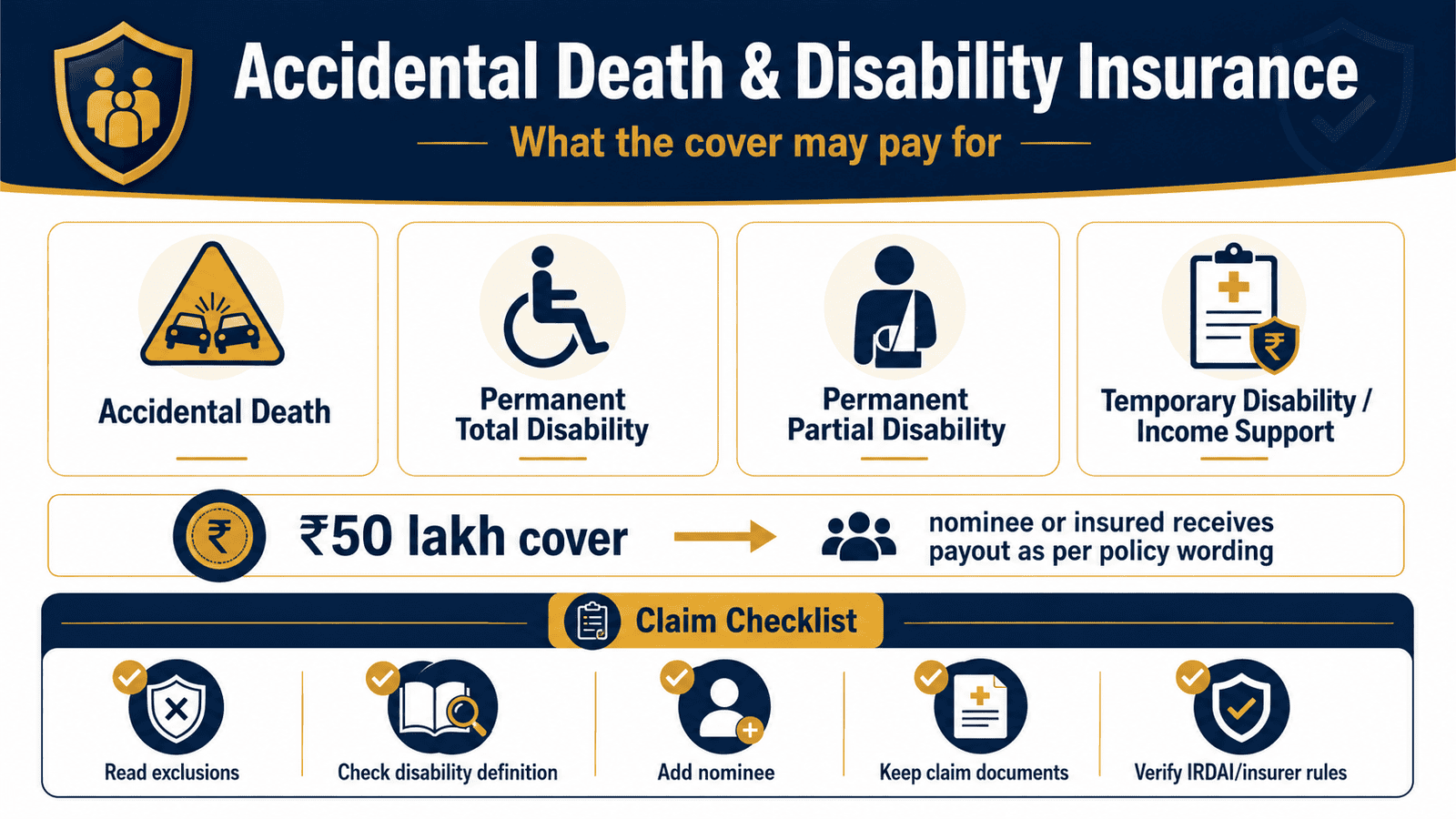
Accidental death and disability insurance pays a benefit when an accident causes death or covered disability, depending on policy wording. A ₹50 lakh cover may protect family income, loans, and recovery costs, but payouts differ for death, permanent total disability, partial disability, and temporary income loss. Always check exclusions and claim conditions.
Key Takeaways
- A personal accident policy covers accidental death, permanent total disability (PTD), permanent partial disability (PPD), and often temporary total disability (TTD) — these are four distinct benefits with different payout amounts, not a single fixed sum.
- Permanent total disability typically pays 100% of the sum insured — the same payout as accidental death — making it one of the most financially critical benefits in any accident policy.
- Employer group personal accident cover usually equals 2–3 times your basic salary, which may not replace even 12–18 months of income for a ₹15–20 lakh earner — and it disappears the moment you change jobs.
- An accidental death rider added to a term plan covers death only — it pays nothing for disability, partial limb loss, or income loss during recovery.
- Most personal accident policies have no waiting period, making cover effective from day one — unlike health insurance where waiting periods of 30 days or more are standard.
- Key exclusions include self-inflicted injuries, accidents under the influence of alcohol or drugs, illness-linked disability, war, and adventure sports unless a specific add-on is purchased.
- Claim documents typically include an FIR, treating doctor’s certificate, hospital discharge summary, and a disability certificate from a recognised medical authority for disability claims.
Key Facts at a Glance
| Parameter | Standard Rule | What It Means for You |
|---|---|---|
| Accidental Death Benefit | 100% of sum insured paid to nominee | Replaces lost income and can service outstanding loans |
| Permanent Total Disability | 100% of sum insured (both eyes, both limbs, etc.) | Full payout even if you survive the accident |
| Permanent Partial Disability | Percentage of SI per disability schedule | Loss of one eye or one limb is typically 50%; a finger is lower |
| Temporary Total Disability | Weekly benefit, up to a capped number of weeks | Replaces a portion of weekly income during recovery |
| Entry Age Range | 5 years to 65–70 years (varies by insurer) | Cover available across most earning years; children coverable too |
| Waiting Period | Typically none (some policies: 15–30 days) | Cover usually starts from policy inception date |
| Tax Deduction | No deduction under Section 80C or 80D | Premium is paid from post-tax income |
| Payout Type | Lump-sum (or weekly for TTD) | No restriction on how the benefit amount is used |
What Is Accidental Death and Disability Insurance?
Accidental death and disability insurance — sold in India most commonly as a Personal Accident (PA) policy — is a fixed-benefit insurance product that pays a pre-agreed lump sum when an accident results in death, permanent disability, or temporary disability. It does not reimburse hospital bills (that is your health insurance’s role), and it does not pay for disability caused by illness. What it does cover is financially precise: the income loss, EMI risk, and recovery cost that follows a sudden, external accident.
Insurance is a subject matter of solicitation. Please read the policy document carefully before purchasing. According to IRDAI regulations, insurers are required to disclose the complete schedule of benefits, exclusions, and claims procedures in the policy document before issuance.
The Four Disability Benefits You Must Understand Before Buying
Most personal accident policies organise benefits into four categories. Not every plan includes all four — and the gap between a basic plan and a comprehensive one can be significant.
Accidental Death Benefit: If an accident directly and solely causes death — typically within 12 months of the incident — the full sum insured is paid to the nominee. This is the most understood benefit and the one most families consider first.
Permanent Total Disability (PTD): If an accident permanently eliminates your ability to earn — through events such as loss of both eyes, both hands, both feet, or one eye and one hand — the insurer pays 100% of the sum insured. This payout is identical to the death benefit, which reflects how serious it is financially. A salaried earner who becomes permanently and totally disabled loses the same income their family would lose if they had died. Yet many people who buy term insurance and a death rider overlook this scenario entirely.
Permanent Partial Disability (PPD): If the accident causes permanent but partial impairment — such as loss of one eye, one foot, one hand, or hearing in one ear — the insurer pays a percentage of the sum insured based on a disability schedule attached to the policy. The percentages differ between insurers, so comparing the schedule — not just the headline premium — is essential when evaluating plans side by side.
Temporary Total Disability (TTD): If an accident prevents you from working for a defined period — say, a spinal injury that sidelines a professional for three months — many policies pay a weekly or monthly income benefit for the duration of incapacity, up to a capped limit. This is one of the most practically useful benefits for a salaried earner, yet it is absent from many basic plans and almost entirely absent from term insurance riders. Check whether TTD is included before purchasing.
Standalone Policy vs Accidental Death Benefit Rider in a Term Plan
You can access accident cover in two primary forms. A standalone personal accident policy is purchased separately from a general insurer. Depending on the plan you choose, it can cover death, PTD, PPD, and TTD — giving you the broadest protection across all accident outcomes.
An accidental death benefit rider is an add-on to a term insurance policy. It increases the payout if death is caused by an accident. The critical limitation: an AD rider covers accidental death only. It pays nothing for disability — not permanent total, not partial, and certainly not temporary income loss. If disability protection is your goal, a standalone PA policy is the product you need, not a rider. For the broader context of why accident disability cover must sit alongside — not replace — your term plan, review the full picture of term cover planning.
Why Employer Group PA Cover Is Not Enough
Most large employers in India provide group personal accident cover as part of the employee benefits package. This is valuable — but it has three structural limitations that many employees discover too late.
First, the cover amount. Employer group PA cover typically equals 2–3 times basic salary, not total CTC. For a software engineer with a ₹18 lakh CTC where basic is ₹7.2 lakh, the group PA benefit may be ₹14–21 lakh — not enough to replace even two years of actual take-home income.
Second, portability. The moment you resign, are laid off, or are between jobs, the group cover lapses. This is precisely when financial stress is highest, and it is when many people find themselves with no accident cover at all.
Third, terms. Employer group cover terms are set by the group contract negotiated between your employer and the insurer — not by your individual needs. You may have no TTD benefit, a reduced PPD schedule, or adventure sport exclusions you were never told about.
What Personal Accident Insurance Does Not Cover
Exclusions matter as much as benefits. Standard exclusions under most personal accident policies include: suicide and self-inflicted injuries; disability or death resulting from illness rather than an external accident; accidents occurring while under the influence of alcohol or drugs; war, civil unrest, and nuclear events; adventure sports and hazardous activities unless covered by a specific add-on; and injuries during pregnancy or childbirth. Some policies also exclude two-wheeler commute accidents unless an add-on is purchased. Always read the exclusion schedule — not just the product brochure.
Real Example: Rohit’s Protection Gap After a Road Accident
Rohit, 34, is a software engineer in Bengaluru earning ₹18 lakh per year. He holds a ₹1 crore term plan, employer group health insurance, and an employer group PA cover of approximately ₹3 lakh (roughly 2.5× basic salary). In early 2024, Rohit fractures both legs in a road accident and cannot work for four months.
His employer health insurance covers the hospital bill: ₹1.8 lakh reimbursed. His term plan pays nothing — he survived. His employer PA cover pays ₹3 lakh as a lump sum. But Rohit’s monthly outflows during recovery — home loan EMI ₹35,000, household expenses ₹40,000, physiotherapy and medical follow-ups ₹20,000 — total ₹95,000 per month. Over four months, that is ₹3.8 lakh — more than his employer PA cover paid.
Had Rohit held a standalone personal accident policy with TTD cover, he would have received an additional weekly income benefit throughout his recovery, bridging this gap. The lesson: his existing covers were not wrong — they simply were not designed to replace income during a disability that did not kill him.
How to Calculate How Much Accident Cover You Need
Minimum PA Cover = (Annual Income × Income Replacement Years) + Outstanding Loans + Recovery Cost Buffer − Existing Employer PA Cover
Applying this to Rohit’s situation:
| Component | Rohit’s Figure | Cover Required |
|---|---|---|
| Annual income × 5 years replacement | ₹18L × 5 | ₹90 lakh |
| Outstanding home loan | ₹30 lakh | ₹30 lakh |
| Recovery, rehab, and adaptation costs | Estimated conservatively | ₹5–10 lakh |
| Less: existing employer PA cover | ₹3 lakh | Deduct |
| Net standalone PA cover target | ≈ ₹1.2–1.25 crore |
Most people undersize accident cover because they confuse it with the AD rider in their term plan. The income replacement logic is the same whether you are sizing for death or disability — you can estimate family cover using the same framework and apply it directly to your PA sum insured target.
Comparison: Standalone Personal Accident Policy vs Accidental Death Rider
| Feature | Standalone Personal Accident Policy | AD Rider in Term Plan |
|---|---|---|
| Accidental Death | Covered — 100% SI | Covered — additional payout |
| Permanent Total Disability | Covered — 100% SI | Not Covered |
| Permanent Partial Disability | Covered — % per schedule | Not Covered |
| Temporary Total Disability | Optional add-on in most plans | Not Covered |
| Hospitalisation Bill Reimbursement | Not Covered | Not Covered |
| Portable After Job Change | Yes — independent policy | Yes — tied to term plan |
| Tax Deduction on Premium | No 80C or 80D benefit | Part of term premium under 80C |
| Covers Disability Risk Fully | Yes | No |
Note: personal accident cover and health insurance serve entirely different purposes. For hospital bills after an accident, your health policy applies — not your PA policy. Understanding what each product covers and where it stops is essential before combining them. Review your health policy limits separately to understand how the two interact.
How to Decide What’s Right for You
You are a salaried earner with dependents and no standalone PA policy — THEN buying one with PTD and PPD cover is a priority. Your term plan does not pay for disability survival, and this is the gap that creates the most financial damage.
Your employer provides group PA cover of 2–3× basic salary — THEN treat it as a starting cushion, not full protection. Top it up with a standalone policy to cover your actual income, outstanding loans, and recovery costs as calculated above.
You already have an AD rider in your term plan — THEN understand it covers accidental death only. It does not pay for PTD, PPD, or TTD. A separate personal accident policy is still required for comprehensive disability cover.
You are self-employed, freelance, or run a business without employer cover — THEN a standalone PA policy with TTD cover is especially important, because there is no employer salary or group cover to fall back on during any period of disability.
You want to protect against disability from illness rather than accident — THEN a personal accident policy is not the right product. PA policies cover only external accidental events. Review critical illness cover for illness-linked lump-sum disability protection instead.
You do not have basic term insurance and a health policy in place yet — THEN prioritise those first. A personal accident policy is a complementary layer, not a substitute for foundational life and health cover.
Common Mistakes to Avoid
Treating the Accidental Death Rider as Full Accident Protection
An AD rider in a term plan increases the death benefit if death is caused by an accident — nothing more.
If you become permanently disabled in an accident but survive, the AD rider pays ₹0. Your income disappears, your EMIs continue, and your recovery costs accumulate. The rider was never designed to address this scenario.
Always buy a standalone PA policy with PTD, PPD, and TTD cover if disability protection is your actual goal.
Relying Entirely on Employer Group Cover
Employer group PA cover lapses on your last working day — precisely when your financial stress may be highest.
A ₹14 lakh group PA cover sounds reasonable until you realise it replaces under 10 months of a ₹18 lakh CTC. Most employer group PA plans also offer no TTD benefit. Use employer cover as a supplement; never your primary protection.
When you change jobs, check whether the new employer provides equivalent or greater cover — and bridge the gap with a standalone policy in the interim.
Under-Sizing the Sum Insured
Choosing ₹5–10 lakh in PA cover because the premium is low leaves you with a PTD payout that does not even cover one year of income for most ₹10 lakh+ earners.
Size your PA cover the same way you would size term insurance: annual income multiplied by income replacement years, plus outstanding loans, plus recovery costs.
Not Comparing the Disability Benefit Schedule
PPD benefits are calculated as a fixed percentage of the sum insured — and that percentage varies between insurers for the same disability.
Loss of one eye may be 50% under one policy and 40% under another. A ₹500 annual premium difference between two plans is irrelevant if the disability schedule is meaningfully worse. Always request and compare the schedule before purchasing.
Missing the Claim Notification Window
Most PA policies require the insurer to be notified within a defined period after an accident — often 7 to 30 days. A delayed FIR or delayed claim notification can lead to rejection even if the accident was genuine.
Call your insurer or broker immediately after any accident, even before you are certain you will make a claim.
Assuming All Accidents Are Covered
Accidents while under the influence of alcohol, adventure sports without an add-on, and injuries linked to pre-existing illness are all standard exclusions. Some policies also exclude two-wheeler commute accidents without a specific rider.
Read the full exclusion schedule before assuming any scenario is covered — the key features page is not sufficient for this.
Skipping the Insurer Check
A low premium from an insurer with a poor claims track record can result in a more painful outcome than paying ₹500 more elsewhere. Before finalising, review the insurer’s claim ratio check — but treat it as one signal among several, not the only selection criterion.
When This May Not Be the Right Choice
Personal accident insurance is broadly valuable, but there are situations where it may not be your most urgent priority right now.
If you have no emergency fund and no health insurance — address those first. Spending ₹4,000–₹5,000 on a PA policy before you have even ₹2–3 lakh in liquid savings means that any hospitalisation — accident or illness — could still wipe out your finances within days.
If you are retired with no active earned income — the income-replacement rationale for PA cover weakens considerably. Once your financial dependence is on investment returns rather than a monthly salary, the disability-income gap that PA cover bridges may no longer apply to your situation.
If your primary disability risk is illness rather than accident — personal accident policies do not cover disability from cardiac events, strokes, cancer, or other health conditions. A critical illness policy is the relevant product in that scenario, not a PA policy.
If any of these apply to your situation, it may be worth exploring alternatives before committing.
Official Rules and Where to Verify
Personal accident insurance in India is regulated by the Insurance Regulatory and Development Authority of India (IRDAI). All policy benefits, exclusions, disability schedules, claim procedures, and insurer conduct standards fall under IRDAI’s regulatory framework. Premiums and product terms vary by insurer, age, occupation category, and cover amount — always get quotes from multiple IRDAI-registered insurers before purchasing.
Rules, limits, and rates on this topic can change with each Budget or regulatory update. Always verify current figures directly from the official source before making any financial decision.
- IRDAI — irdai.gov.in (regulatory circulars, insurer registration, claim guidelines, grievance redressal)
- Income Tax Department — incometax.gov.in (tax treatment of PA policy premiums and benefit payouts)
Expert Tips
- Buy a standalone personal accident policy from a general insurer rather than relying solely on an AD rider in your term plan — only a standalone policy covers PTD, PPD, and TTD, which are statistically more likely outcomes of a serious accident than death.
- If your employer provides group PA cover, use it as a floor and top up with a standalone policy to bring your total accidental disability cover to at least 10 times annual CTC. The gap between the two is exactly what your standalone policy needs to fill.
- Always opt for the TTD benefit when it is offered — it is typically priced as a modest add-on relative to the base premium and covers the scenario (unable to work for weeks or months) that is far more common in real life than permanent disability.
- Compare disability benefit schedules between policies when shortlisting, not just premiums. A ₹300 difference in annual premium is irrelevant if one policy pays 50% of SI for loss of one hand and another pays 40%.
- Create a small claims folder — physical or digital — containing your PA policy document, insurer helpline number, claim notification deadline, and required document list. Your family must be able to act on this within hours if you are incapacitated.
- If you commute daily on a two-wheeler, verify whether your PA policy covers two-wheeler accidents by default or requires a specific add-on. Many standard policies exclude this scenario.
- Review and increase your PA sum insured any time your income rises by ₹3 lakh or more — cover sized for a ₹10 lakh salary provides inadequate income replacement at ₹18 lakh, and the additional premium is typically very small.
Frequently Asked Questions
What is the difference between personal accident insurance and health insurance?
Health insurance reimburses hospital bills, surgery, and treatment expenses — for both accidents and illnesses. Personal accident insurance pays a fixed benefit when an accident causes death or covered disability — it does not reimburse medical bills. The two products cover different risks and most earning households need both.
Does accidental death and disability insurance cover death from illness?
No. Personal accident policies cover only external, sudden, visible, and violent accidents. Death or disability caused by illness, internal health conditions, or disease is not covered under a PA policy. For illness-related death, your term insurance policy applies.
Can I claim both my health insurance and my PA policy for the same accident?
Yes. Health insurance covers hospitalisation bills; your PA policy pays the fixed accident benefit for death or disability. These are separate products covering separate risks — claiming one does not reduce or cancel the other. In fact, many accident victims should legitimately claim from both.
What documents are typically needed to file a personal accident claim?
Standard documents include a completed claim form, FIR copy if the accident occurred in a public place, treating doctor’s medical certificate, hospital discharge summary, disability certificate from a recognised medical board for disability claims, and government-issued photo ID. Your specific insurer may require additional documents — always check the policy’s claim procedure section.
Is the payout from a personal accident policy taxable?
Generally, lump-sum payouts under personal accident policies — for death or covered disability — are not treated as income and are not taxable in the hands of the recipient. However, the premium you pay for a standalone PA policy does not qualify for a deduction under Section 80C or 80D. Verify the applicable tax treatment with a chartered accountant, as rules can change with Budget updates.
What happens to my employer’s accident cover if I leave my job?
It lapses on your last working day. Employer group personal accident cover is tied entirely to your employment contract. This is one of the strongest reasons to hold a standalone personal accident policy that is independent of your employer and remains in force regardless of your employment status.
Is permanent partial disability always included in PA policies?
Not automatically. Some low-cost or basic PA plans cover only accidental death and PTD. PPD coverage depends on the plan variant you purchase. When comparing policies, check the disability benefit table in the policy schedule to confirm PPD is included and to compare the percentages offered for specific disabilities relevant to your occupation.
Is there a waiting period for personal accident insurance?
Most personal accident policies have no waiting period — cover typically takes effect from the policy inception date. Some policies impose an initial cooling period of 15–30 days. Verify this with your insurer before assuming immediate cover, particularly if you are switching from employer cover to a standalone policy.
Can I cover my entire family under a single personal accident policy?
Yes. Most general insurers offer both individual and family personal accident policies covering a spouse, children, and sometimes dependent parents under a single plan. Premiums are generally calculated per covered member based on age, occupation, and the sum insured chosen for each person.
What does IRDAI require insurers to disclose before issuing a PA policy?
According to IRDAI guidelines, insurers must provide the complete policy document — including the full schedule of benefits, the disability benefit percentage table, all exclusions, and the claims procedure — before or at the time of policy issuance. If any insurer issues cover without sharing these documents, you can raise a complaint through IRDAI’s Bima Bharosa portal at irdai.gov.in.
Final Verdict
Accidental death and disability insurance fills a protection gap that term insurance and employer health cover cannot address: income loss when you survive a serious accident but cannot work. For most salaried earners with dependents, EMIs, and daily commuting risk, a standalone personal accident policy with PTD, PPD, and TTD cover is one of the highest-value protections available relative to its cost. Do not mistake the AD rider in your term plan for complete accident protection — it covers one outcome only. And do not rely solely on employer group PA cover that disappears when your employment ends. The right approach is to layer all three where applicable: employer cover as a floor, a standalone policy sized to your actual income and loans, and an AD rider if you want additional death-specific benefit. Premiums on accidental death and disability insurance vary by age, health, occupation, and insurer — compare quotes from multiple IRDAI-registered providers before purchasing. Always verify the latest rules from official sources or consult a qualified professional before making any financial decision.
This article is for educational purposes only and should not be treated as personalised financial, tax, investment, insurance, or legal advice. Tax rules, interest rates, regulatory limits, and product features can change with each Budget or policy update. Please verify current rules from official government sources or consult a qualified and registered professional before making any financial decision.
Priya Nambiar writes about insurance concepts for Indian families, salaried employees, self-employed professionals, and first-time policy buyers. Her content focuses on helping readers understand coverage, exclusions, claim conditions, premiums, riders, and policy documents before buying or renewing insurance.
She covers topics such as term insurance, health insurance, family floater plans, riders, critical illness cover, employer insurance vs personal insurance, waiting periods, exclusions, deductibles, co-payment, no-claim bonus, claim settlement, premium comparison, renewal rules, and tax benefits linked to insurance.
Priya’s writing is careful, consumer-focused, and policy-document oriented. She explains why insurance should be understood as financial protection, not just a tax-saving tool or investment substitute. Her articles encourage readers to compare coverage, understand limitations, and ask better questions before buying a policy. Premiums, exclusions, claim rules, and benefits vary by insurer, age, health, sum insured, and product type. Insurance is a subject matter of solicitation, and readers should read the official policy document carefully before purchasing.