

Picking ₹1 crore of term cover because it sounds like a big number is one of the most common and costly mistakes salaried families make. The real question is not what sounds impressive — it is whether your nominee will have enough money to close the home loan, keep the household running, fund your child’s education and support ageing parents if your income stops tomorrow. For most people earning between ₹15 lakh and ₹30 lakh with a family, ₹1 crore is not enough. The right cover depends on six inputs: your income, your outstanding loans, your future goals, your dependants, your existing investments and whatever life cover you already hold. This guide gives you a repeatable calculation framework to arrive at a number that actually fits your life.
Quick Answer: How Much Term Insurance Cover Do I Need?
How much term insurance cover do I need depends on your income, loans, dependants and goals. A practical starting point is annual income × 10–15, plus outstanding loans and future goals, minus existing investments and existing life cover. This thumb rule is only a starting point — final premium and eligibility depend on age, health, occupation, disclosures and insurer underwriting. According to IRDAI, policy terms, exclusions and rider benefits differ by insurer, so always read the policy document carefully before purchasing.
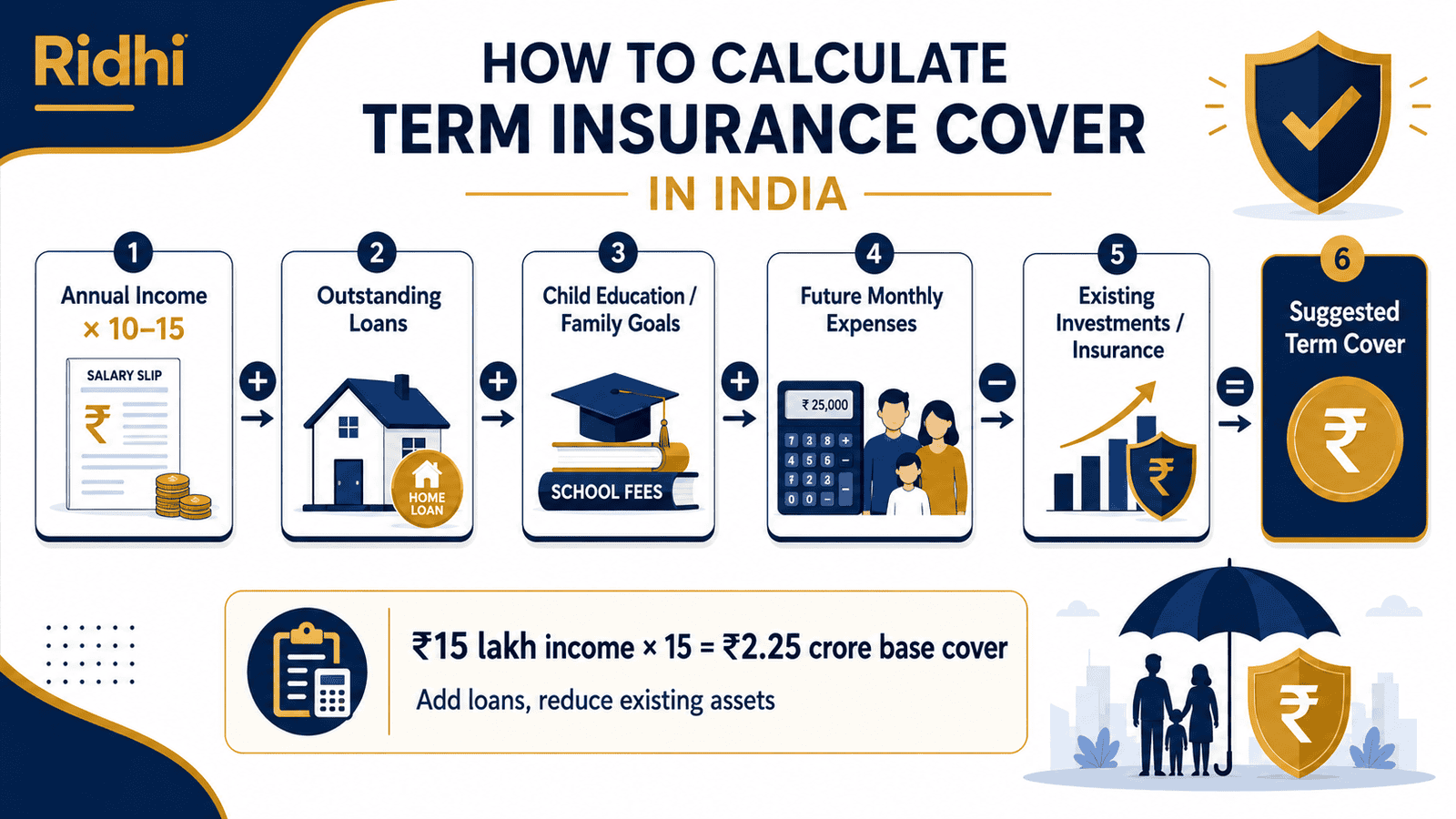
How to Calculate How Much Term Insurance Cover You Need
Required Cover = (Annual Income × 10 to 15) + Outstanding Loans + Future Goals + Family Buffer − Usable Existing Assets − Existing Life Cover
Here is how each component works:
Income replacement amount: Multiply your current gross annual income by 10 to 15. A ₹22 lakh annual income gives you a base range of ₹2.2 crore to ₹3.3 crore. The higher end applies if you have more dependants, fewer savings or a longer remaining working life. The lower end may apply if you are closer to retirement or have substantial existing assets.
Add outstanding loans: Every rupee of debt your family cannot service from their own income needs to be covered separately. Home loan outstanding of ₹55 lakh, a personal loan of ₹3 lakh — these go in full.
Add future goals: Child’s higher education fund (₹40 lakh in today’s money), spouse support for non-working years, parent care costs — estimate conservatively and add them.
Subtract only usable assets: EPF balance, mutual fund corpus and fixed deposits that your nominee can actually liquidate count. Ancestral property, a locked ULIP or a plot of land in a distant town does not count — your family cannot pay next month’s EMI with an illiquid asset.
Subtract existing life cover: If your employer provides ₹25 lakh group cover, subtract it. Remember: group cover lapses the moment you change jobs.
| Component | Rohit’s Example (₹) | Your Estimate (₹) |
|---|---|---|
| Annual income × 12 (mid-point) | 2,86,00,000 | |
| + Home loan outstanding | 55,00,000 | |
| + Child education goal | 40,00,000 | |
| + Parent care buffer | 15,00,000 | |
| − Existing investments (usable) | −18,00,000 | |
| − Existing life cover | −25,00,000 | |
| Estimated Required Cover | ~3,53,00,000 |
Rohit’s calculation suggests roughly ₹3.5 crore — not ₹1 crore. Use the Ridhi term insurance cover calculator to run your own numbers in minutes.
Key Takeaways
- The income × 10–15 thumb rule is a starting point only — it understates required cover if you carry large loans or have multiple dependants.
- A salaried employee earning ₹22 lakh with a ₹55 lakh home loan, one child and ageing parents may need ₹3–3.5 crore of cover, not ₹1 crore.
- Outstanding loans must be added to the income multiple — not absorbed by it.
- Only subtract assets your family can actually liquidate; property, illiquid ULIPs and ancestral land should not reduce your required cover figure.
- Employer group cover typically lapses on resignation — do not count it as permanent life cover.
- Honest health disclosures protect your nominee’s claim; hiding a condition does not save premium — it risks claim rejection.
- Review your cover after any major life event: home loan, salary jump, new child or change in dependants.
Key Facts at a Glance
| Input | What to Include | Notes |
|---|---|---|
| Income replacement multiple | Annual gross income × 10–15 | Higher multiple for more dependants or longer working life remaining |
| Outstanding liabilities | Home loan, personal loan, car loan, education loan | Use outstanding principal, not original loan amount |
| Future goals | Child’s education, spouse support, parent care | Estimate in today’s money; inflation will erode real value |
| Usable existing assets | EPF, mutual funds, FDs, existing life cover | Exclude illiquid or inaccessible assets |
| Policy term | Age to retirement, or age 60–65 | Match term to income-earning years |
| Nominee | Spouse, child, parent | Update after every major life change |
| Riders | Critical illness, accidental death, waiver of premium | Compare cost versus benefit; read exclusions carefully |
What Term Insurance Cover Actually Means
The sum assured is the lump sum your nominee receives if you die during the policy term. That is the only purpose of a pure term plan. It is not a savings product. There is no maturity benefit if you survive the term, and that is exactly why term insurance is the most cost-efficient way to buy large life cover for a salaried family.
Understanding the basics of pure protection basics before calculating cover helps you make a better-informed decision. According to IRDAI guidelines, insurers are required to clearly state sum assured, policy term, exclusions and premium payment obligations in the policy document — so read it before you sign.
Why underinsurance is a serious risk. If your home loan outstanding is ₹55 lakh and your term cover is ₹50 lakh, your nominee may have to sell the family home to cover the shortfall — even after receiving the claim. The lender’s interest does not pause for a grieving family.
Why overinsurance is a real cost. Buying ₹5 crore of cover when your realistic need is ₹3 crore means paying an unnecessarily higher annual premium every year for 30–35 years. That surplus premium could go into your EPF, a health cover top-up or an equity SIP.
Cover need versus premium affordability. These are different questions. Your calculation may suggest ₹3.5 crore of cover. If the annual premium for that amount is ₹28,000 and your budget is tight at ₹20,000, you have a trade-off to resolve — not ignore. A smaller premium you actually pay for 30 years is always better protection than a larger policy you lapse in year five.
Real Example: Rohit from Pune
Rohit is 34, an IT manager based in Pune, earning ₹22 lakh per year. His wife is a schoolteacher earning ₹6 lakh a year. They have one child aged 4. Rohit’s parents live with them and he supports approximately ₹1.5 lakh of their annual expenses. He has a home loan with ₹55 lakh outstanding and a car loan with ₹3 lakh remaining. His EPF balance stands at ₹12 lakh, mutual fund SIPs have accumulated to ₹6 lakh, and his employer provides a ₹25 lakh group term cover.
He estimates the child’s higher education will cost ₹40 lakh in today’s money and he wants a ₹15 lakh buffer for his parents’ care over the next 10–12 years. Running the formula: income replacement at 13× gives ₹2,86,00,000; add ₹58 lakh in loans, ₹55 lakh in goals and buffers; subtract ₹18 lakh in usable investments and ₹25 lakh in existing cover. Estimated required cover: approximately ₹3.56 crore.
Rohit rounds up to ₹3.5 crore as a planning estimate, notes that he should verify the actual premium at his age and health status, and decides to compare two or three insurers rather than simply choosing the cheapest. This example is illustrative only — not a recommendation.
Comparison: Different Cover Calculation Methods
| Method | How It Works | Best For |
|---|---|---|
| Thumb rule (10–15× income) | Multiply annual income by 10 to 15 | Quick estimate — useful starting point, often understates actual need |
| Income replacement method | Estimate years of income family needs; discount to present value | Salaried families with a clear earning horizon |
| Human life value (HLV) method | Discount future earnings to present value net of personal expenses | More rigorous but needs assumptions about discount rate and salary growth |
| Goal + liability method | Add income replacement + all loans + all goals − usable assets | Best for most — practical for families with loans, children and goals |
| Online calculator method | Tool computes an estimate based on your inputs | Good for sanity-checking; should be cross-verified with the formula above |
No single method is universally best. The goal + liability method suits most salaried families in India because it forces you to confront real numbers — loan balances, education costs — rather than abstract income multiples. For a deeper look at why pure protection beats bundled savings plans, see term versus endowment.
How to Decide What’s Right for You
you have a home loan, dependant children and a non-working or lower-earning spouse — THEN your required cover is almost certainly higher than ₹1 crore; run the goal + liability formula.
your employer’s group cover makes up more than 40% of your calculated required cover — THEN buy personal term cover immediately; group cover lapses the day you leave the company.
your calculated cover need is ₹3 crore but the annual premium is unaffordable — THEN buy ₹2 crore now and top up when your income rises; a lapsed policy gives zero protection.
you are comparing two insurers and premiums are within ₹2,000–₹3,000 per year of each other — THEN check claim settlement ratio, solvency ratio and consumer complaint data from IRDAI before choosing. See insurer claim record to evaluate insurer reliability.
your policy term expires before age 60 — THEN extend to match your actual income-earning years; a gap between policy end and retirement creates uninsured risk.
you choose term cover based on the lowest available premium alone — THEN you risk picking an insurer with a weak claims record or a policy with exclusions that reduce your nominee’s protection.
Common Mistakes to Avoid
Choosing ₹1 crore because it sounds sufficient
₹1 crore is a round, familiar number — not a calculated one.
For a family earning ₹22 lakh with a ₹55 lakh home loan, ₹1 crore covers barely two years of income replacement after closing the loan. The surviving spouse is left with almost nothing to fund education, daily expenses and retirement.
Run the formula. Let the number tell you the answer, not familiarity with a figure.
Ignoring outstanding loans entirely
Many buyers calculate only the income multiple and forget that loan EMIs do not stop because the earning member dies — the lender will pursue recovery.
A ₹55 lakh home loan not covered in your sum assured means your nominee may be forced to sell the family home within months of a claim. Add every outstanding loan principal to your calculation.
Check balances on your home loan, personal loans and car loan statements before finalising your cover amount.
Counting illiquid property as a usable asset
A plot of land or an ancestral property cannot pay next month’s school fees or EMI.
Only subtract assets your nominee can convert to cash within 30–60 days: EPF, mutual funds, FDs, savings accounts. Illiquid assets do not reduce your insurance requirement.
Subtract only what your family can realistically access quickly.
Hiding health conditions or lifestyle habits in the proposal form
Undisclosing smoking, drinking, diabetes, hypertension or a past surgery feels like saving a few thousand rupees in premium today.
According to IRDAI guidelines, non-disclosure of material facts can result in claim repudiation — your nominee receives nothing after years of premium payment. The cost of hiding a condition is a rejected claim worth crores, not a premium saving of ₹3,000 a year.
Disclose fully. Premiums for disclosed conditions are higher but claims are secure.
Adding riders without reading exclusions
A critical illness rider sounds useful until you discover it covers only 10 conditions while your policy wording lists 37 exclusion scenarios.
Riders add to the annual premium every year. If the exclusions make the rider difficult to claim, the cost is a permanent drag on affordability. Consider a standalone critical illness cover with broader coverage rather than a bundled rider with limited scope.
Read the rider certificate and exclusion list before paying extra.
Not reviewing cover after major life changes
A ₹1.5 crore policy you bought at 28 when you were single may be seriously inadequate at 34 with a home loan, a child and dependant parents.
Cover that was right five years ago can be dangerously wrong today. Review after every home loan, salary jump, child or new dependant. Premium for an additional policy bought at 34–35 is still far lower than the gap in protection if you delay.
Set a calendar reminder to review cover every two to three years or after any major financial change.
When This May Not Be the Right Choice
No financial dependants, no major liabilities: If you are single with no dependants, no loans and a reasonable savings base, buying a large term cover immediately may not be your most urgent financial priority.
Your existing cover is already adequate: Run the formula. If your current personal and group cover already meets the calculated need, adding more cover adds cost without proportionate benefit.
Premium affordability is genuinely stretched: A policy you lapse in year three because premiums strain your cash flow gives your family zero protection. Prioritise an amount you can sustain for the full term. Build an family emergency fund before committing to a premium that leaves no liquidity buffer.
Complex health history requiring careful navigation: If you have a significant medical history, compare multiple insurers, consult an independent advisor and disclose fully — buying in a rush from any single insurer may not give you the best terms.
If any of these apply to your situation, it may be worth exploring alternatives before committing.
Official Rules and Where to Verify
Rules, limits, and rates on this topic can change with each Budget or regulatory update. Always verify current figures directly from the official source before making any financial decision.
- IRDAI (Insurance Regulatory and Development Authority of India) — irdai.gov.in: Verify insurer registration status, policyholder protection guidelines, consumer education resources, grievance redressal procedures, claim settlement ratio data and solvency margin requirements for all Indian life insurers.
- Income Tax Department — incometax.gov.in: Verify current tax treatment of term insurance premiums and any applicable deductions. Tax benefits and the rules governing them can change with each Union Budget and should not be the primary reason to buy or structure a term plan.
Note that policy wording, exclusions, waiting conditions, rider benefits and premium rates differ by insurer and product. Always read the specific policy document for the plan you are considering.
Expert Tips
- Buy early, but buy enough: Every year you delay buying term cover after getting dependants adds to your premium at renewal. But buying ₹50 lakh at 28 is not better than buying ₹3 crore at 34 — the amount matters more than the timing within a reasonable age window.
- Update your nominee details after every major life event: Marriage, divorce, childbirth and the death of an existing nominee all require nominee updates. A stale nominee record can complicate claim settlement for your family. Check with your insurer at least once every two years.
- Review cover after any new loan: The day you take a new home loan or increase an existing one, your insurance gap widens by that exact amount. Many people forget to re-evaluate cover at loan disbursement — schedule it the same week.
- Consider accidental disability protection separately: A term plan pays on death. If you are disabled in an accident and lose your income — but survive — a basic term plan provides nothing. Consider accidental disability protection as a separate layer if income loss risk from disability is a concern.
- Store policy documents where your family can find them: According to IRDAI’s policyholder protection guidelines, nominees need the policy number and insurer name to initiate a claim. Keep physical and digital copies in a location your spouse and family can access without needing a password only you know.
- Do not evaluate insurers by premium alone: A ₹2,000 annual saving in premium is meaningless if the insurer has a materially lower claim settlement ratio or a history of disputed claims in your category. Compare IRDAI data before finalising.
Frequently Asked Questions
Is ₹1 crore term insurance enough in India?
For most salaried families earning above ₹15 lakh with a home loan and dependants, ₹1 crore is unlikely to be sufficient. Run the goal + liability formula: if your income multiple alone is ₹1.8–₹2.5 crore and you have outstanding loans on top, your actual need is likely ₹2.5–₹4 crore or more. ₹1 crore became a popular benchmark when it was a large number — in today’s income and loan context, it often covers less than two years of family expenses after debt repayment.
Is the 10–15 times income thumb rule reliable?
It is a useful starting point, not a precise answer. The thumb rule gives a quick ballpark but does not account for specific loan burdens, number of dependants, non-working spouse years, or existing assets. Use it to open the calculation, then add liabilities and goals and subtract usable assets to arrive at a more realistic figure.
Should I include my home loan in the term insurance cover calculation?
Yes, always. Outstanding home loan principal is a direct liability your family must service. If the earning member dies and the loan is not covered, the lender can initiate recovery proceedings — including on the mortgaged property. Add the current outstanding principal of every loan to your calculation.
Should my spouse’s income reduce the cover I need?
It depends on how much of the family’s financial obligations your spouse’s income can independently sustain. If your spouse earns enough to service the home loan EMI, cover school fees and manage household expenses — the required cover may be lower. If the spouse earns significantly less or would need to stop working to care for children or parents, reduce the income offset only by what can be realistically sustained.
Should I buy term insurance if I have no dependants?
If you have no financial dependants and no co-signed loans, the immediate need is lower. However, premiums are lowest when you are young and healthy. If you expect dependants within the next three to five years, locking in a policy now at a lower premium may be worth considering — but this is a personal decision, not a universal rule.
How often should I review my term insurance cover?
Review after every major financial change: a new or increased home loan, a salary jump of 20% or more, a new child or additional dependant, change in employer affecting group cover, or significant change in existing investments. At minimum, a full review every three years is a reasonable cadence for most salaried families.
What happens if I stop paying premiums mid-term?
For a pure term plan, missing premium payments results in a lapse — the policy ceases to provide cover from the due date of the missed premium (subject to insurer grace period terms). There is no surrender value to recover. A lapsed term policy gives your family zero protection. If premium affordability is a concern, it is better to reduce cover to a sustainable amount than to risk a lapse.
Can I have multiple term insurance policies from different insurers?
Yes. There is no restriction under IRDAI rules on holding multiple term policies from different insurers, provided you disclose existing policies at the time of application. The combined sum assured from all policies is what your nominee receives. Spreading cover across two insurers can also reduce the impact of any single insurer’s claims process on your family.
Final Verdict
How much term insurance cover you need is not a fixed number — it is a calculation. Start with your annual income multiplied by 10 to 15, add every outstanding loan and every significant future goal, then subtract only the assets your family can actually use in a crisis. For most salaried employees in India with a home loan, a child and dependant parents, the right cover sits between ₹2.5 crore and ₹4 crore — well above the ₹1 crore default that most people buy without questioning. The Ridhi term insurance cover calculator gives you a personalised estimate in minutes. Once you have a number, compare two or three insurers on IRDAI claim data and policy terms — not just premium. Always verify the latest rules from official sources or consult a qualified professional before making any financial decision.
This article is for educational purposes only and should not be treated as personalised financial, tax, investment, insurance, or legal advice. Tax rules, interest rates, regulatory limits, and product features can change with each Budget or policy update. Please verify current rules from official government sources or consult a qualified and registered professional before making any financial decision.
Insurance is a subject matter of solicitation. Premiums vary by age, health, occupation, insurer and underwriting. Please read the policy document carefully before purchasing.

Priya Nambiar writes about insurance concepts for Indian families, salaried employees, self-employed professionals, and first-time policy buyers. Her content focuses on helping readers understand coverage, exclusions, claim conditions, premiums, riders, and policy documents before buying or renewing insurance.
She covers topics such as term insurance, health insurance, family floater plans, riders, critical illness cover, employer insurance vs personal insurance, waiting periods, exclusions, deductibles, co-payment, no-claim bonus, claim settlement, premium comparison, renewal rules, and tax benefits linked to insurance.
Priya’s writing is careful, consumer-focused, and policy-document oriented. She explains why insurance should be understood as financial protection, not just a tax-saving tool or investment substitute. Her articles encourage readers to compare coverage, understand limitations, and ask better questions before buying a policy. Premiums, exclusions, claim rules, and benefits vary by insurer, age, health, sum insured, and product type. Insurance is a subject matter of solicitation, and readers should read the official policy document carefully before purchasing.