

You are comparing two very different life insurance products — and the confusion is understandable. An endowment policy gives you money back when the policy matures. A term plan gives you nothing if you survive. On paper, endowment sounds better. In practice, that “money back” often comes at the cost of the one thing life insurance is actually for: protecting your family’s income if you are no longer around.
This is the trade-off that most insurance buyers in India do not clearly see until they already have a policy. The same monthly premium can either buy you ₹1 crore of family protection or ₹10–15 lakh of coverage bundled with a savings component. That gap in cover — not the maturity value — is what this article is about.
Below, you will find a clear comparison of term insurance vs endowment policy covering cover adequacy, premium trade-off, returns, surrender rules, liquidity, and tax treatment. By the end, you will know what to look for in the policy document and how to decide what suits your specific situation.
Quick Answer: Term Insurance vs Endowment Policy
Term insurance vs endowment policy is mainly a choice between pure protection and insurance-plus-savings. A term plan can provide ₹1 crore family cover at a much lower premium, while an endowment policy offers maturity value but usually gives lower cover for the same budget. Verify current premium rates with your insurer before purchasing.
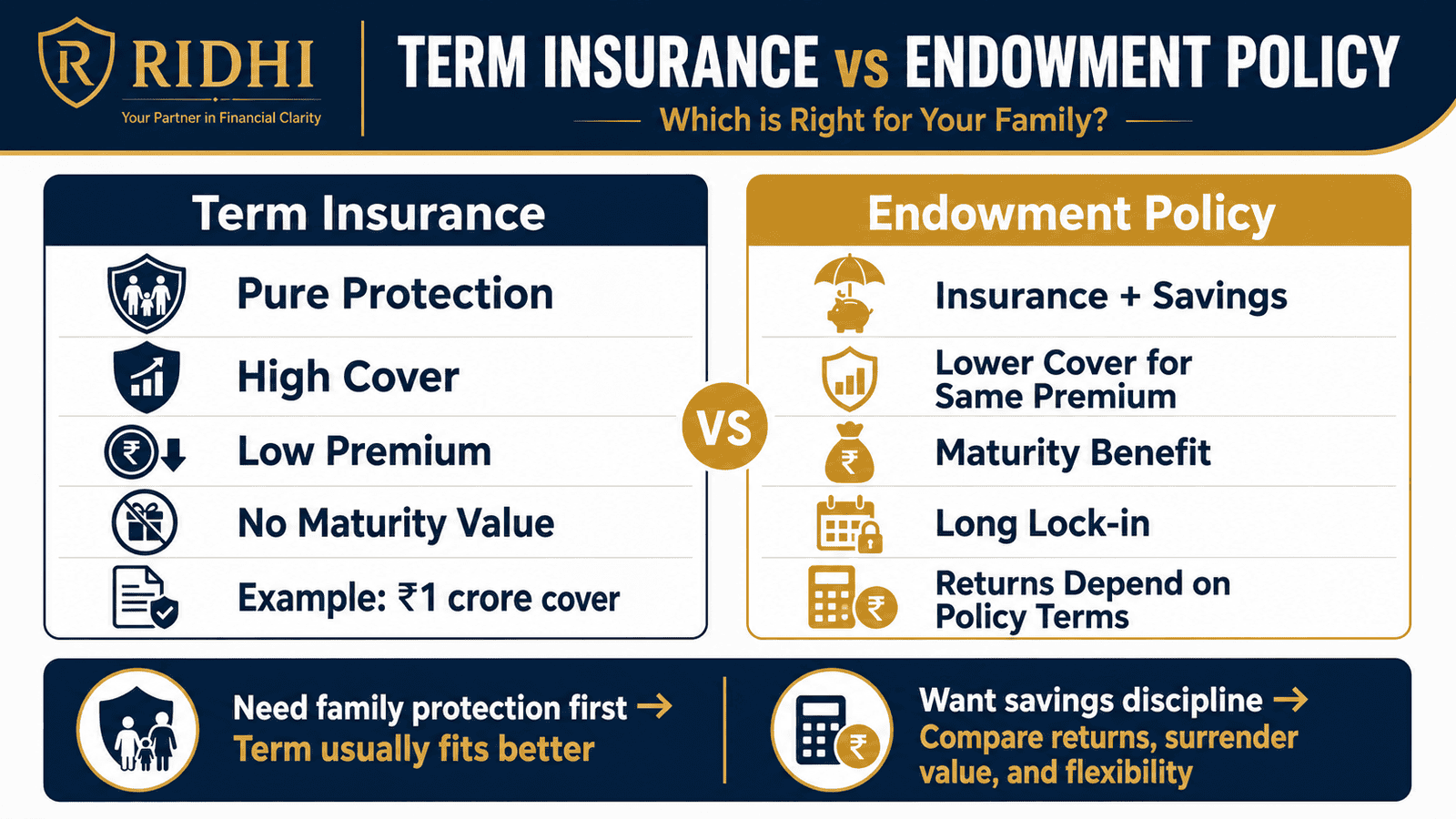
Key Takeaways
- For the same monthly premium budget, a term plan typically delivers substantially higher life cover than an endowment policy — the gap can be ₹50 lakh or more.
- An endowment policy bundles savings and protection, but the effective returns on the savings portion are often lower than standalone fixed-income instruments — check the benefit illustration carefully.
- Life insurance should first solve income replacement for dependents — the “money back” feeling from endowment does not substitute for adequate cover.
- Endowment policies have surrender rules and lock-in conditions; exiting early usually means a loss on premiums paid, especially in the first few years.
- Section 80C applies to premiums for both products, and death benefits are generally tax-free under Section 10(10D) — but tax benefit should never be the main reason to choose either product.
- Bonus declarations in endowment policies are not guaranteed — always check the policy document’s guaranteed versus non-guaranteed benefit illustration before signing.
- According to IRDAI guidelines, every insurer must provide a benefit illustration showing projected returns at two different assumed growth rates — compare these before buying any endowment plan.
Comparison: Term Insurance vs Endowment Policy
| Parameter | Term Insurance | Endowment Policy |
|---|---|---|
| What it does | Pure protection — pays death benefit to family | Protection + savings — pays death or maturity benefit |
| Cover for same premium | Higher cover | Lower cover |
| Maturity benefit | None in standard term plans | Sum assured + bonus (non-guaranteed portion) |
| Premium affordability | Lower relative premium | Higher relative premium |
| Surrender value | No surrender value in most term plans | Surrender value available after minimum premium years |
| Returns on savings portion | Not applicable | Typically modest; check benefit illustration |
| Flexibility / liquidity | Low — no exit value, but low premium frees cash | Low — surrender penalties apply in early years |
| Best suited for | Families needing income replacement protection | Conservative savers wanting forced savings with cover |
| Traditional policy comparison | See traditional policy comparison for a specific product breakdown |
Key Facts at a Glance
| Feature | Term Insurance | Endowment Policy |
|---|---|---|
| Product type | Pure risk cover | Savings-linked insurance |
| Main benefit paid | Death benefit only | Death benefit or maturity benefit |
| Relative premium | Lower for same cover amount | Higher for same cover amount |
| Liquidity | No surrender value in most plans | Surrender value after minimum premium terms |
| Tax benefit | 80C on premium; 10(10D) on death benefit | 80C on premium; 10(10D) applies — verify conditions |
| Best use case | Family income protection with dependents | Forced long-term savings with limited cover |
Understanding Term Insurance and Endowment Policy
Before comparing the two products side by side, it helps to understand exactly what each one does — and what it does not do. Both are life insurance products regulated by IRDAI (Insurance Regulatory and Development Authority of India), but they serve fundamentally different purposes.
What term insurance actually does
A term insurance plan is the simplest form of life cover. You pay a premium for a defined policy term. If you die during that term, the insurer pays the sum assured to your nominee. If you survive the term, the policy ends with no payout. There is no savings component, no bonus, and usually no surrender value.
This “pure protection” structure is precisely what makes term insurance efficient at its core job — family protection basics — providing a large sum assured at a comparatively low premium. Because the insurer is pricing only the mortality risk and not setting aside a savings fund on your behalf, the premium is considerably lower than an endowment policy for the same cover amount.
According to IRDAI disclosure norms, every term plan sold in India must clearly state the death benefit, policy term, premium payment term, and any exclusions in the policy document. Reading this document — not the sales brochure — is the only reliable way to know exactly what you are buying.
What an endowment policy actually does
An endowment policy is a savings-linked insurance product. You pay premiums over a policy term. If you die during the term, your nominee gets the sum assured (and sometimes accumulated bonuses). If you survive, you receive the maturity benefit — the sum assured plus whatever bonuses or additions the insurer has declared.
This maturity benefit is what makes endowment policies emotionally attractive. For many Indian buyers, paying a premium and getting nothing back at the end feels like a loss. An endowment policy solves that feeling. But it solves it by doing two jobs at once — protection and savings — and it does neither as efficiently as a standalone product designed for that single purpose.
Why the cover gap is the critical issue
The biggest practical problem with endowment policies for most salaried families is the cover gap. Because the insurer must price the policy to fund both the death benefit and the maturity savings pool, the same monthly premium produces far less life cover than a term plan.
Consider a 32-year-old who can budget ₹15,000 per year for a life insurance premium. A term plan at this age and premium level may provide ₹75 lakh to ₹1 crore or more in cover. An endowment policy for the same premium is likely to offer ₹10–20 lakh. If this person’s family depends on their ₹18 lakh annual income, a ₹15 lakh endowment cover would replace less than one year of income. That is not family income replacement — it is a partial payout that will not last the dependents long.
This is the core argument that financial planners make when they say term insurance is preferred for income replacement goals. It is not that endowment policies are bad products — it is that they are the wrong tool for the job of protecting a family from income loss. The premium-to-cover ratio is simply not designed for that purpose.
When the bundled structure creates problems
Insurance and investment have different time horizons, liquidity needs, and return expectations. When bundled into one product, trade-offs are inevitable. Endowment bonuses — reversionary and terminal — are typically non-guaranteed. The benefit illustration mandated by IRDAI will show projected figures at two different assumed growth rates, but actual declarations depend on the insurer’s investment performance.
If you stop paying premiums before the policy matures, you do not simply lose future growth — you may lose a significant portion of premiums already paid, depending on when you stop. Understanding the paid-up value and surrender value rules in the policy document before committing to a long premium payment term is essential.
Real Example: Rohan’s Insurance Decision in Bengaluru
Rohan is 32 years old, a software engineer in Bengaluru earning ₹18 lakh per year. He has a spouse, a 4-year-old child, and a home loan of ₹40 lakh outstanding. His parents are partially dependent on him. He is trying to decide between a term plan and an endowment policy.
Using a rough income replacement estimate of 15 times his annual income, Rohan’s family would need approximately ₹2.7 crore in total cover to replace his income for a sufficient period and settle the home loan. Even rounding down to ₹2 crore, that is the protection gap he needs to fill.
With a budget of ₹20,000 per year for life insurance, a term plan for a 32-year-old non-smoker can potentially provide ₹1–1.5 crore or more in cover (exact premium depends on insurer, health declaration, and policy term — verify before buying). An endowment policy for the same premium is unlikely to offer more than ₹15–25 lakh in cover.
If Rohan buys the endowment policy because it gives money back, he has ₹15–25 lakh of cover against a ₹2 crore need. If he passes away unexpectedly, his family receives a fraction of what they actually need. The maturity value he was looking forward to never materialises for them.
The key insight here: the “safety” of getting money back from an endowment policy comes at the cost of the financial safety his family actually needs. These are not the same thing.
How to Calculate the Cover You Actually Need
Rough Cover Need = (Annual Income × 10 to 15) + Outstanding Loans + Child Education Goals − Existing Liquid Assets − Existing Life Cover
This formula is a planning estimate — not personalised financial advice. It gives you a starting number to compare against what any policy actually offers.
Using Rohan’s numbers as an illustration:
| Component | Rohan’s Figure | Calculation |
|---|---|---|
| Income replacement (15×) | ₹18L × 15 | ₹2.7 crore |
| Home loan outstanding | ₹40 lakh | Already in income replacement buffer |
| Existing liquid assets | ₹5 lakh (emergency fund) | Subtract ₹5 lakh |
| Existing life cover | ₹0 | No existing policy |
| Approximate need | ₹2.65 crore or round up to ₹3 crore |
Now compare this need against what a ₹20,000 per year premium buys: roughly ₹1–1.5 crore via a term plan, or ₹15–25 lakh via a typical endowment policy. Even the term plan may need to be supplemented — but it closes the gap far more effectively than an endowment policy at the same premium.
To run this calculation with your own figures, use the calculate your cover tool, which walks you through income, loans, and existing assets step by step.
How to Decide What’s Right for You
Your family depends on your income for day-to-day expenses, loans, or education — THEN prioritise getting adequate life cover first, and evaluate term insurance as your primary protection tool before considering any other life insurance product.
You already have sufficient life cover for your dependents and are looking for a conservative, long-term, structured savings product — THEN an endowment policy can be evaluated on its own merits, comparing the benefit illustration against other fixed-income alternatives.
Your income is irregular or you are unsure whether you can commit to premium payments for 15–25 years — THEN be cautious about endowment policies, as surrendering early typically results in a loss relative to premiums paid.
You are primarily buying a life insurance policy to save tax under Section 80C — THEN compare the effective post-tax returns against PPF, ELSS, or other 80C options before deciding; tax saving alone is not a strong enough reason to buy either product.
You want the emotional comfort of “getting something back” from your insurance — THEN quantify the protection gap first; if the endowment cover is significantly lower than your income replacement need, the maturity value does not compensate for the under-insurance risk your family faces.
You have no financial dependents and have sufficient liquid assets to cover your liabilities — THEN a large term insurance policy may not be necessary, and any life insurance decision should be based on your actual financial obligations rather than a default recommendation.
Common Mistakes to Avoid
Choosing endowment only because it gives money back
The maturity value feels reassuring, but it comes at the direct cost of cover adequacy.
For the same premium, an endowment policy may offer 5–10 times less life cover than a term plan. If your family’s financial security depends on that cover, the maturity value is the wrong trade-off. A ₹20 lakh endowment payout does not protect a family that needed ₹1.5 crore of income replacement.
Calculate your actual cover need first. Then compare what each product delivers against that number.
Comparing premium without comparing cover
A common mistake is comparing the rupee premium of two policies without checking the sum assured each one provides.
Two policies at ₹20,000 per year can offer ₹1.2 crore or ₹18 lakh respectively. The premium looks the same; the cover is not. Always calculate the premium-to-cover ratio and compare it against your actual protection need — not just the affordability of the monthly outflow.
Ask every insurer: “What sum assured does this premium buy me, and what does my family actually need?”
Ignoring surrender value and lock-in rules
Many endowment policyholders stop paying premiums mid-term and discover that the surrender value is considerably lower than what they paid in.
In the early years of a policy — often the first 2–3 years — surrender value may be zero. Even after that, surrender penalties can mean you receive back only a fraction of total premiums. This lock-in effect reduces your liquidity significantly. Read the surrender clause in the policy document before signing.
If you are unsure about your ability to commit to a 20-year premium payment schedule, factor that into the decision.
Buying primarily for the Section 80C tax deduction
Both term and endowment premiums qualify for Section 80C deduction up to ₹1.5 lakh annually. But making an insurance decision based mainly on the tax benefit is a mistake.
At the 30% tax bracket, a ₹1.5 lakh 80C deduction saves ₹46,800 in tax. That saving does not justify paying for a product that leaves your family underinsured or delivers poor effective returns. Choose the product that solves your actual protection or savings need — the tax benefit is secondary. Also note that Section 10(10D) tax-free treatment on endowment maturity proceeds has conditions — verify current rules from incometax.gov.in before purchasing.
Use 80C capacity for the product that best matches your goal, not the one sold most aggressively.
Not checking the claim settlement ratio before choosing an insurer
Buyers often compare policies by premium or maturity value but forget to check whether the insurer actually pays claims reliably.
A policy is only as good as its insurer’s willingness and ability to settle claims. IRDAI publishes insurer-wise claim settlement data. Before finalising any life insurance purchase, check insurer reliability using the claim settlement ratio and complaints data. A lower premium from an insurer with a weak claims record may cost your family far more than the premium saved.
Ignoring policy exclusions and conditions
Life insurance policies have exclusions — conditions under which a claim may be denied.
Common exclusions include suicide within the first policy year, non-disclosure of pre-existing conditions, and specific causes of death depending on the product. Not reading the exclusion clause is a significant risk. Nominees have faced claim rejections because the proposer did not disclose a medical condition at the time of purchase. Read every exclusion listed in the policy document carefully.
When This May Not Be the Right Choice
Term insurance may not be the right choice if you have no financial dependents, have sufficient liquid assets to cover your liabilities, and are not servicing any significant loans. In that situation, the primary purpose of a large term plan — replacing your income for dependents — does not apply.
An endowment policy may not suit you if you need high liquidity, are uncertain about a 15–25 year premium commitment, or expect market-linked or inflation-beating returns from the savings component. Endowment bonuses are typically modest and non-guaranteed in their entirety.
Bundled insurance products in general — including endowments and ULIPs — may not suit readers who prefer transparent, separately trackable returns on their investments. For a detailed look at another bundled alternative, see the compare ULIP alternative breakdown.
Conservative savers who fully understand the trade-offs — lower cover, modest returns, long lock-in — and still prefer a guaranteed-structure savings product with a life cover component may find endowment policies appropriate for a portion of their portfolio.
If any of these apply to your situation, it may be worth exploring alternatives before committing.
Official Rules and Where to Verify
Insurance product terms, premium rates, tax treatment, surrender rules, and bonus declarations can all change. Do not rely on a sales brochure or verbal communication from an agent. Verify directly from official sources before any purchase decision.
- IRDAI (Insurance Regulatory and Development Authority of India) — irdai.gov.in: Policy disclosure norms, insurer-wise claim settlement data, product approval status, and consumer grievance information.
- Income Tax Department — incometax.gov.in: Current rules for Section 80C deduction on premiums, Section 10(10D) tax-free status on maturity and death proceeds, and any conditions or limits applicable.
- Always ask the insurer for the benefit illustration — mandated by IRDAI — showing projected returns at two assumed growth rates before purchasing any endowment or linked product.
- Read the policy document (not just the Key Features document or sales brochure) for exact surrender value table, paid-up value rules, exclusions, and claim procedure.
Rules, limits, and rates on this topic can change with each Budget or regulatory update. Always verify current figures directly from the official source before making any financial decision.
Expert Tips
- Calculate your income replacement need before comparing any policy. A ₹50 lakh policy may look affordable and adequate until you realise your family needs ₹1.5 crore — start with the need, then find the product that fills it.
- If you are in your early 30s and have dependents, buying a term plan now locks in a lower premium for your entire policy term. Every year you delay means a higher premium for the same cover — buy adequate term cover before your next birthday if your family needs are already clear.
- Read the surrender value table in any endowment policy before signing. Find the row for year 3, year 5, and year 10 — and ask yourself honestly whether you are certain you can pay premiums until maturity without needing to exit early.
- Do not buy an endowment policy as a tax-saving instrument without comparing its effective post-tax returns against PPF or ELSS. At many income levels and policy durations, the after-tax returns from a structured endowment product are lower than simpler alternatives available within the same Section 80C limit.
- Review your life cover after every major financial event: marriage, childbirth, a new home loan, a salary increase above 20%, or taking on a parent’s financial dependency. What was adequate at 28 may be significantly short at 35.
- Premiums vary considerably by age, health status, tobacco use, sum assured, policy term, riders chosen, and insurer — always get individual quotes and compare the actual sum assured, not just the premium amount.
- If you already hold an endowment policy and are wondering whether to surrender it, compare the surrender value today, the paid-up value option, remaining premiums to be paid, and the cover it provides against your current need — consult a fee-only financial advisor before deciding, as the right answer depends on your individual situation.
Frequently Asked Questions
Is term insurance better than an endowment policy?
For most earning individuals with financial dependents, term insurance provides more cover per rupee of premium, making it more efficient for income replacement. Endowment policies provide maturity value but at the cost of lower cover for the same premium. Whether one is “better” depends on whether your primary goal is family protection or structured savings — and most financial planners recommend solving protection first before evaluating savings products.
Why do most experts prefer term insurance over endowment?
Experts prefer term insurance because it separates protection from savings, allowing each goal to be optimised independently. With term insurance, you get maximum cover for minimum premium. The freed-up premium budget can then be directed toward dedicated savings products that may offer better liquidity, transparency, or returns. Bundling protection and savings in an endowment policy means neither goal is served as efficiently as it could be.
Does term insurance give any money back if I survive?
Standard term plans do not pay a maturity benefit if you survive the policy term. Some insurers offer “return of premium” term plans that refund total premiums at maturity, but these plans charge a higher premium — and the effective cost of the returned premiums, adjusted for time value of money, is typically not in the buyer’s favour. Read the full benefit illustration before opting for a return-of-premium variant.
Are the returns on an endowment policy guaranteed?
Endowment policies usually have two components: a guaranteed sum assured and a non-guaranteed bonus. The bonus — reversionary bonus declared annually and terminal bonus at maturity — depends on the insurer’s actual investment performance and is not guaranteed in advance. IRDAI requires insurers to show projected figures at two assumed growth rates in the benefit illustration. Always read these projections carefully — the total maturity payout is not a guaranteed number in most traditional endowment plans.
Can I hold both a term plan and an endowment policy?
Yes. There is no regulatory restriction on holding both. Some people use a term plan to secure adequate income replacement cover and separately hold an endowment policy for a structured savings purpose. The key is to ensure the term plan alone provides sufficient cover for your dependents — the endowment cover should be treated as additional, not the primary protection.
What happens to my endowment policy if I stop paying premiums?
If you stop paying after the minimum premium payment period (typically 2–3 years), the policy usually converts to a paid-up policy with a reduced sum assured. If you stop before that point, the policy may lapse with no value. Surrendering the policy returns the surrender value, which in early years can be substantially lower than total premiums paid. Check the paid-up and surrender clauses in your specific policy document for exact terms.
Should I surrender my existing endowment policy and buy term insurance instead?
This is a decision that depends on how many years of premiums you have paid, the current surrender value, the remaining premium obligation, and your existing cover level versus your family’s actual need. There is no single right answer. Compare what you will receive on surrender against the future premiums you would pay and the cover you actually need. For a significant policy, consulting a fee-only financial advisor before surrendering is worth considering. Surrendering may or may not be the right call — it depends on your specific numbers and goals.
Is the maturity amount from an endowment policy tax-free?
In many cases, the maturity amount from a life insurance policy qualifies for tax-free treatment under Section 10(10D) of the Income Tax Act. However, this has conditions — including limits on the premium-to-sum-assured ratio and the policyholder’s status. Tax rules have been updated in recent Budgets. Verify current conditions from incometax.gov.in or consult a tax professional before assuming tax-free treatment applies to your specific policy.
What is the minimum sum assured in a term plan?
Minimum sum assured rules vary by insurer and product. IRDAI does not prescribe a universal minimum for term plans. Most insurers set their own lower limits, typically starting from ₹25 lakh or ₹50 lakh for online term plans. Check the specific insurer’s product page and policy document for applicable minimums, maximums, and any underwriting conditions that may affect the cover available to you.
Final Verdict
For most salaried earning individuals with dependents — a spouse, children, parents, or an outstanding home loan — the primary job of life insurance is income replacement. Term insurance solves this job more efficiently than an endowment policy for most people at most income levels. The same premium budget delivers substantially more cover, and the freed-up cost can be directed toward dedicated savings instruments.
An endowment policy is not a bad product in every situation. For a disciplined saver who fully understands the low-cover, modest-return, long-lock-in trade-off and is looking for a structured savings product with a life cover layer, it can serve a purpose. But it should not be chosen primarily because it gives money back — especially if the cover level it provides leaves your family underinsured.
Start with your actual protection need, compare what each product delivers against that need, and use the term insurance vs endowment policy comparison above as a framework — not a final answer. For a broader view of how insurance fits into your overall financial plan, see financial planning basics. Always verify the latest rules from official sources or consult a qualified professional before making any financial decision.
This article is for educational purposes only and should not be treated as personalised financial, tax, investment, insurance, or legal advice. Tax rules, interest rates, regulatory limits, and product features can change with each Budget or policy update. Please verify current rules from official government sources or consult a qualified and registered professional before making any financial decision. Insurance is a subject matter of solicitation. Please read the policy document carefully before purchasing.

Priya Nambiar writes about insurance concepts for Indian families, salaried employees, self-employed professionals, and first-time policy buyers. Her content focuses on helping readers understand coverage, exclusions, claim conditions, premiums, riders, and policy documents before buying or renewing insurance.
She covers topics such as term insurance, health insurance, family floater plans, riders, critical illness cover, employer insurance vs personal insurance, waiting periods, exclusions, deductibles, co-payment, no-claim bonus, claim settlement, premium comparison, renewal rules, and tax benefits linked to insurance.
Priya’s writing is careful, consumer-focused, and policy-document oriented. She explains why insurance should be understood as financial protection, not just a tax-saving tool or investment substitute. Her articles encourage readers to compare coverage, understand limitations, and ask better questions before buying a policy. Premiums, exclusions, claim rules, and benefits vary by insurer, age, health, sum insured, and product type. Insurance is a subject matter of solicitation, and readers should read the official policy document carefully before purchasing.