

Your salary lands in your account on the 1st. By the 25th, you are wondering where it all went. Rent, groceries, school fees, EMIs, medicines for a parent — and then, maybe, whatever is left over goes toward savings. For most Indian families, this is not a budgeting failure. It is the result of never having a system.
A monthly budget rule gives your money a job before it gets spent. The most popular version — the 50/30/20 rule — divides income into needs, wants and savings. It works well in textbooks and for some households. But for a family in Pune paying ₹22,000 in rent, school fees of ₹8,000, and supporting elderly parents, the numbers rarely fit so neatly.
This article explains how the monthly budget rule works, how to apply it to an Indian household, and — more importantly — which alternatives actually work when 50/30/20 does not.
Quick Answer: Monthly Budget Rule
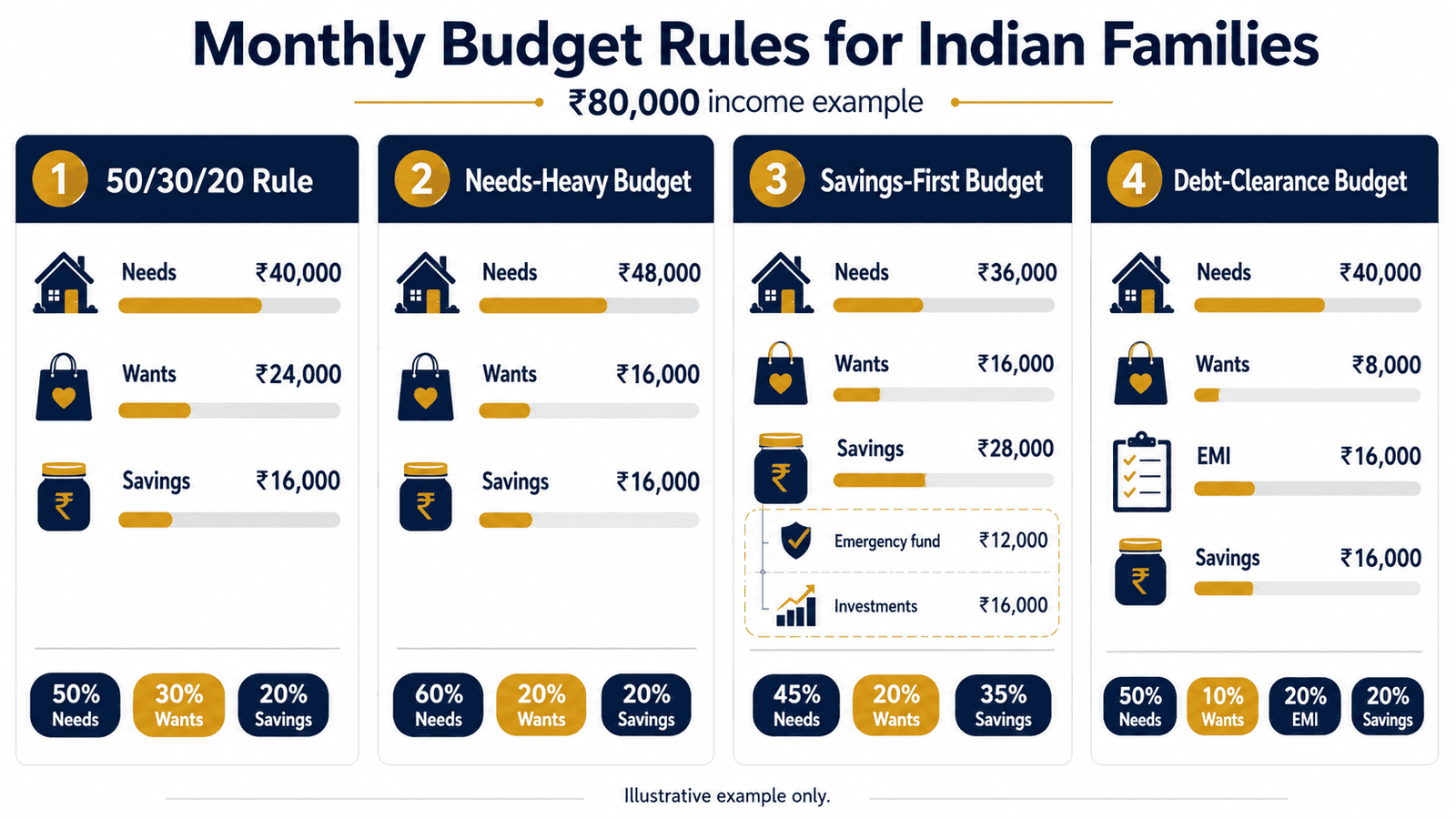
The monthly budget rule is a simple way to divide income into spending, saving and investing buckets. In the 50/30/20 rule, a family earning ₹80,000 may keep ₹40,000 for needs, ₹24,000 for wants and ₹16,000 for savings, but Indian families may need flexible alternatives.
Key Takeaways
- The 50/30/20 rule allocates 50% to needs, 30% to wants and 20% to savings — on a ₹80,000 income, that means ₹40,000, ₹24,000 and ₹16,000 respectively.
- Indian families with high rent, school fees or dependent parents often find needs consume 60–70% of income, making the standard 50% needs cap unrealistic.
- Alternatives like the 60/20/20 or 70/20/10 rule are not failures — they are honest adjustments to your actual cost structure.
- Saving whatever is “left over” at month-end almost never works; automating savings within 48 hours of salary credit is far more effective.
- Your emergency fund should be funded before aggressive investing — 3–6 months of household expenses is the generally recommended buffer.
- Review your budget every month for at least three months before deciding whether the rule you chose is working or needs to change.
- The best monthly budget rule is not the one with the most popular name — it is the one you can follow consistently.
Key Facts at a Glance
| Budget Rule | Allocation Split | Best For |
|---|---|---|
| 50/30/20 Rule | 50% needs / 30% wants / 20% savings | Stable income, moderate fixed expenses |
| 60/20/20 Rule | 60% needs / 20% wants / 20% savings | High-rent cities, families with dependents |
| 70/20/10 Rule | 70% needs / 20% wants / 10% savings | Early-career families, high-cost first years |
| Pay-Yourself-First | Fixed savings first, rest split freely | Disciplined savers with stable income |
| Zero-Based Budget | Every rupee assigned a category | Families with irregular spending or leakage |
How the Monthly Budget Rule Works
A monthly budget rule is not a savings hack or an investment strategy. It is a framework that tells you, before the month begins, how much of your income goes where. The absence of this framework is why most families end up with “leftover savings” — which is usually nothing.
What Counts as a Need?
Needs are non-negotiable expenses. If you stop paying them, something essential breaks down. For an Indian household, this typically includes:
- Rent or home loan EMI
- Groceries and household supplies
- Electricity, water and gas bills
- School or college fees
- Health insurance premiums
- Transport to work (fuel, public transit, cab subscriptions)
- Basic medical expenses and medicines
- Support payments to elderly parents or dependents
Notice that EMIs are in this list — but not all EMIs are needs. A personal loan taken for a vacation is technically a want you are paying for later. A home loan or a two-wheeler EMI for commuting is a need. The distinction matters when you are categorising your actual spending.
What Counts as a Want?
Wants are discretionary — life is better with them, but you can function without them if you must. This includes dining out, OTT subscriptions, weekend trips, clothing beyond basics, gadget upgrades and gym memberships. The tricky part is that Indian families often bundle festival expenses, gifts and relatives’ visits in this category, and they tend to underestimate how much these cost annually.
What Goes Into Savings?
In the 50/30/20 framework, the 20% savings bucket is broad. It covers your emergency fund contribution, monthly SIP in mutual funds, EPF and PPF contributions, insurance premiums beyond health basics, and any goal-specific savings — children’s education, a home down payment, retirement. Debt prepayment, especially for high-interest loans, also belongs here rather than in needs.
Why “Save Whatever Is Left” Fails
When savings are treated as a residual — whatever survives after spending — they almost always disappear. Monthly expenses have a tendency to expand to fill available income. If ₹10,000 is not earmarked for savings before the month starts, it will be spent on something. This is why every serious budgeting approach, from 50/30/20 to pay-yourself-first, makes saving a fixed action at the start of the month, not a hope at the end.
To understand the full personal finance basics that sit behind budgeting, it helps to first know how money flows and compounds over time before you set your rules. And when you are ready to implement a working plan, the monthly budget steps guide walks through the full process of building a live budget from your bank statements.
Real Example: The Sharma Family, Pune
Rohit Sharma, 36, works as an IT professional in Pune. His take-home salary after tax and PF deductions is ₹80,000 per month. His wife contributes a part-time income of ₹15,000, making combined take-home ₹95,000. They have one school-going child and support Rohit’s parents who live with them.
Here is what a standard 50/30/20 application looks like on ₹80,000 of Rohit’s income alone:
- Needs (50% = ₹40,000): Rent ₹22,000 + school fees ₹7,500 + groceries ₹6,000 + utilities ₹2,000 + transport ₹2,500 = ₹40,000. This barely fits — and the moment rent goes up by ₹2,000 in the next lease, needs exceed 50%.
- Wants (30% = ₹24,000): Dining out ₹4,000 + OTT + mobile ₹2,000 + shopping ₹6,000 + family outings ₹4,000 + festival/gifts ₹8,000 (averaged monthly). This is tight.
- Savings (20% = ₹16,000): SIP ₹8,000 + EPF contribution ₹9,600 (employer + employee) + health insurance ₹3,000. When EPF is counted separately from take-home, the 20% feels more achievable.
For Rohit, 50/30/20 works — but barely, and only if he controls wants rigorously. A family with higher rent, an additional loan EMI, or a parent’s medical expenses would likely find needs at 60–65% of income, making 50/30/20 a source of guilt rather than guidance.
For families earning more, the headroom improves considerably. If you want to see how budgeting changes at a higher income, the ₹1 lakh salary plan shows a detailed breakdown with more room for insurance, an emergency fund and a meaningful SIP.
How to Calculate Your Monthly Budget Allocation
Monthly bucket = monthly take-home income × allocation percentage
Here is the step-by-step process:
Step 1: Calculate your monthly take-home income — salary credited to bank after tax and PF, plus any consistent secondary income.
Step 2: Multiply your take-home by 50%, 30% and 20% to get your three bucket targets.
Step 3: List every actual monthly expense and assign each to needs, wants or savings. Use your last two bank statements — not memory.
Step 4: Compare your actual numbers to your ideal buckets. If needs exceed 50%, consider shifting to a 60/20/20 allocation. If savings are below 10%, use a savings-first approach before addressing wants.
Step 5: Review at the end of each month for at least three months. Only change the rule after three honest reviews — not after one bad month.
| Scenario | Monthly Take-Home | Suggested Allocation |
|---|---|---|
| Single earner, metro rent ₹25,000+ | ₹80,000 | 60/20/20 — needs dominate |
| Dual income, no home loan | ₹1,20,000 | 50/30/20 — standard rule fits |
| Early-career, heavy EMI or loan | ₹55,000 | 70/20/10 — save 10% for now, scale up |
Comparison: 50/30/20 vs Alternatives for Indian Families
| Parameter | 50/30/20 Rule | 60/20/20 / 70/20/10 |
|---|---|---|
| Needs flexibility | Moderate | High |
| Savings target | 20% | 10–20% |
| Works for high-rent households | Often No | Yes |
| Works for families with dependents | Sometimes | Better fit |
| Simplicity | High | High |
| Suitable for beginners | Yes | Yes |
| Guilt when needs exceed budget | Common | Avoidable |
How to Decide What’s Right for You
your needs (rent, groceries, school fees, utilities, transport) are under ₹40,000 on a ₹80,000 take-home — THEN the standard 50/30/20 rule is a practical starting point.
your rent plus school fees alone exceed 50% of your income — THEN move to a 60/20/20 rule and keep wants firmly capped at 20%.
you have no emergency fund and your income is stable — THEN use the pay-yourself-first method: auto-transfer ₹5,000–₹10,000 to a separate savings account on salary day before anything else. Build 3–6 months of expenses first. For a detailed look at whether to prioritise safety savings or investing, see our guide on emergency fund priority.
you have high-interest credit card debt or a personal loan at 18–24% interest — THEN redirect the wants bucket toward debt prepayment until the loan is cleared. Investing while carrying 20% interest debt almost never makes mathematical sense.
you are in the first 2–3 years of earning, earning under ₹50,000 take-home, with EMIs and family expenses — THEN start with the 70/20/10 rule: save 10% consistently, then increase it by 1–2% with every salary hike.
money leaks from your account despite your best intentions and you cannot explain where it goes — THEN a zero-based budget is more useful than any percentage rule. Assign every rupee a name before the month begins.
you are not yet tracking your expenses for even one month — THEN do not change your budget rule yet. Spend 30 days recording every expense, then decide which rule fits your actual numbers.
Common Mistakes to Avoid
Treating EMI as an invisible expense
Many families record their EMI payment separately from their budget and forget to categorise it.
A ₹15,000 car or personal loan EMI that is not assigned to either needs or debt repayment creates a phantom gap — you cannot figure out where the money went. On a ₹70,000 income, that EMI alone is 21% of take-home, which changes every calculation.
Always assign every EMI to either needs (home loan, essential vehicle) or debt repayment (personal loan, credit card) before you allocate anything else.
Planning only for monthly expenses, not annual ones
School admission fees, insurance premiums, car servicing, home repairs, festival shopping and annual subscriptions are all real expenses — but they happen once a year and destroy monthly budgets when they arrive.
A ₹40,000 school annual fee, averaged monthly, is ₹3,333. If you have not budgeted for it, that month’s savings vanish completely. Create a sinking fund: set aside a fixed amount each month in a separate account for annual expenses.
Saving only what is left at month-end
This is the most common budgeting failure across Indian households.
When savings are residual, they are zero in most months. Lifestyle, festivals, unexpected expenses and impulse purchases absorb everything. Automating a transfer to savings within 24–48 hours of salary credit makes savings non-negotiable, not optional.
Ignoring lifestyle inflation after salary hikes
A salary jump from ₹70,000 to ₹90,000 feels like freedom. The danger is that wants expand to absorb the entire ₹20,000 increase — restaurant spend goes up, subscriptions multiply, weekend trips become habits.
Budget rule: when income rises, increase savings rate first (by at least half the increment), then allow wants to grow. Understanding lifestyle inflation control is essential before a salary hike changes your habits permanently.
Setting a budget once and never reviewing it
Rent changes. School fees increase. Insurance premiums get revised. A budget set in January may be broken by April without anyone noticing.
Review your actual vs planned spending every month. A 30-minute monthly review is enough to catch leakage before it becomes a habit.
Treating wants as zero to compensate for overspending
Eliminating all discretionary spending completely is not sustainable, especially for families with children.
A budget that allows zero dining out and zero entertainment usually collapses in the second month. Set a realistic wants budget — even ₹5,000–₹8,000 — rather than ₹0. Controlled wants are better than suppressed ones that explode later.
When This May Not Be the Right Choice
The 50/30/20 rule is a useful framework for many households, but it is not universally appropriate. Consider these situations where it may give you an inaccurate picture:
Very low income households: If your take-home is under ₹35,000–₹40,000 and you live in a metro, needs alone — rent, food, commute, utilities — may consume 70–80% of income. Applying a 50% needs cap here creates guilt, not guidance.
Families with heavy home loan EMIs: A ₹25,000 EMI on a ₹70,000 income leaves only ₹45,000 for everything else. The standard rule does not account for this reality, and attempting to follow it without adjustment leads to chronic shortfalls.
Households with chronic medical expenses: Families caring for a diabetic parent or a child with ongoing therapy costs may find that healthcare alone pushes needs past 60%. No budgeting rule should make someone feel they are failing for meeting a medical obligation.
Irregular or freelance income: The 50/30/20 rule assumes a stable, predictable monthly income. For self-employed individuals or freelancers with variable income, a percentage-based rule applied rigidly each month creates instability rather than control.
If any of these apply to your situation, it may be worth exploring alternatives before committing.
Official Rules and Where to Verify
No government regulation in India mandates a specific monthly budget rule. The 50/30/20 rule and its alternatives are financial frameworks — useful guides, not legal obligations.
However, several financial decisions connected to budgeting do involve regulated products and official rules. Verify current information from these sources:
- RBI (rbi.org.in): For banking charges, deposit insurance limits, and financial awareness materials relevant to savings and transactions.
- SEBI (sebi.gov.in): For investment education, registered adviser guidelines, and mutual fund regulations relevant to the savings component of your budget.
- Income Tax Department (incometax.gov.in): For current tax slabs, deductions under Section 80C, and tax treatment of savings instruments like ELSS, PPF and NPS.
Rules, limits, and rates on this topic can change with each Budget or regulatory update. Always verify current figures directly from the official source before making any financial decision.
Expert Tips
- Automate savings within 48 hours of salary credit. Set a standing instruction to transfer your fixed savings amount — even ₹5,000 to begin with — to a separate account on the 2nd or 3rd of every month. What the eye does not see, the hand does not spend.
- Create a dedicated annual expenses account. Add up every non-monthly expense you have — school fees, insurance premiums, vehicle servicing, festival gifts, home repairs. Divide by 12 and park that amount in a separate account every month. When the bill arrives, it is already paid for. Track your real wealth calculation quarterly to see whether your monthly system is actually building assets.
- Hold a monthly money meeting with your family. Even 20 minutes on the 1st of the month — reviewing last month’s actual spending vs the budget, and confirming the upcoming month’s priorities — prevents financial misalignment between spouses and reduces impulsive decisions mid-month.
- Allow wants — but cap them visibly. Tell yourself and your partner: “Our dining-out budget is ₹6,000 this month.” A named, capped wants budget is far easier to stick to than a vague “spend less” instruction. When the ₹6,000 is gone, it is gone.
- Increase your savings rate with every salary hike, not your lifestyle. When you get a ₹10,000 hike, commit to redirecting ₹5,000–₹6,000 of it into savings or SIP before lifestyle adjustments happen. Do this automatically — revise your standing instruction on day one of the new salary cycle.
- Review your budget rule annually, not just your budget. Your budget rule should match your life stage. A 70/20/10 rule that made sense at age 28 should be moving toward 50/30/20 or better by age 35. Life stages — marriage, child, home loan, children’s education — change what is realistic.
Frequently Asked Questions
Is the 50/30/20 rule good for Indian families?
It is a useful starting framework for households where fixed expenses are moderate. In practice, many Indian families — especially those in metro cities with rent above ₹20,000, school-going children and dependent parents — find that needs exceed 50% of take-home income. In these cases, a 60/20/20 or savings-first approach is more realistic than forcing the 50% needs cap.
What if my needs are more than 50% of my income?
Adjust the rule rather than abandoning budgeting entirely. Move to a 60/20/20 split — 60% for needs, 20% for wants and 20% for savings. If needs genuinely exceed 60%, tighten wants to 10–15% and protect at least a minimum savings rate of 10%. As income grows or fixed expenses reduce, gradually shift back toward a higher savings percentage.
Should I count my home loan EMI as a need or debt repayment?
A home loan EMI for your primary residence is broadly classified as a need — it replaces rent and builds an asset. However, a personal loan EMI or credit card debt repayment is better categorised separately as debt repayment within the savings bucket, because it should be cleared aggressively before investing. Never treat any EMI as invisible when building your budget.
How much should an Indian family save every month?
There is no single correct answer — it depends on income, life stage and goals. As a general guidance: aim for a minimum of 10% of take-home income if starting out, work toward 20% as income stabilises, and ideally 25–30% if you have long-term goals like a home purchase or retirement corpus. Begin with whatever is realistic and scale up consistently.
Which budget rule works best for a family with school-age children?
Families with school-age children typically have higher fixed outflows — fees, books, activities, transport. The 60/20/20 rule is usually a better fit than 50/30/20. Additionally, starting a dedicated education sinking fund — even ₹2,000–₹3,000 per month in a recurring deposit — protects the main budget from fee spikes in later years.
Can I use the 50/30/20 rule if I have a credit card balance?
Use the rule with one adjustment: move the credit card minimum payment into needs immediately, and shift additional repayment from wants or savings into an aggressive debt clearance plan. Carrying a credit card balance at 36–42% annualised interest makes investing almost counterproductive. Clearing the balance should take priority over growing the savings bucket.
How often should I review my monthly budget?
Monthly, at minimum. A 15–30 minute review at the end of each month — comparing actual spending with your budget categories — catches leakage early. Do a deeper review every six months to check whether your budget rule still matches your income, expenses and life stage. Annual reviews alone are too infrequent for most families.
What is a sinking fund and do I need one?
A sinking fund is a savings reserve built monthly for a specific future expense — school fees, insurance premiums, car service, home repairs, holidays or festivals. If you set aside ₹3,000 every month in a separate account, you have ₹36,000 available when the annual school fee bill arrives. Without a sinking fund, these annual expenses appear as “surprises” that break the monthly budget every time.
Is the 50/30/20 rule related to any government guideline?
No. The 50/30/20 rule is a financial planning framework — not a government mandate or a regulatory standard. It originated as a consumer finance guideline popularised globally and does not have any formal recognition from RBI, SEBI or the Income Tax Department. Use it as a thinking tool, not a rule.
Can I apply the 50/30/20 rule if I earn ₹35,000 per month?
At ₹35,000 take-home in a metro, needs alone — rent, food, transport, utilities — often reach ₹25,000–₹28,000, which is 70–80% of income. The 50/30/20 rule is genuinely difficult to apply at this income level in high-cost cities. Focus on understanding personal finance basics first and use a simpler approach: set aside a fixed savings amount on salary day (even ₹2,000–₹3,000), then manage the rest as carefully as possible until income grows.
Final Verdict
The monthly budget rule — especially the 50/30/20 version — is one of the most useful introductions to household financial discipline available. It gives families a simple structure where none existed before. But it is a starting framework, not a universal formula. Indian households with metro rent, school-going children, dependent parents and active EMIs will often find that needs consume more than 50% of take-home income — and that is not a failure.
The smarter approach is to start with 50/30/20 as a benchmark, measure where your actual numbers land, and then choose a variation — 60/20/20, pay-yourself-first, or zero-based — that fits your real household. The goal is not to hit a specific percentage. The goal is positive cash flow, a growing emergency fund, and wants that are controlled rather than unchecked.
Start by tracking one month of expenses. That single month of data will tell you more about your household budget than any rule can predict. Always verify the latest rules from official sources or consult a qualified professional before making any financial decision.
This article is for educational purposes only and should not be treated as personalised financial, tax, investment, insurance, or legal advice. Tax rules, interest rates, regulatory limits, and product features can change with each Budget or policy update. Please verify current rules from official government sources or consult a qualified and registered professional before making any financial decision.

Sanya Malhotra writes about everyday personal finance for Indian individuals and families. Her content focuses on budgeting, saving, emergency funds, debt control, net worth tracking, family money decisions, and practical habits that help readers manage money with more confidence.
She covers topics such as monthly budgeting, expense planning, saving habits, emergency fund behaviour, debt repayment, household financial planning, family discussions about money, financial mistakes, net worth tracking, short-term vs long-term goals, and beginner personal finance concepts.
Sanya’s writing style is warm, simple, and realistic. She avoids making personal finance feel intimidating and instead explains money decisions through relatable Indian examples, ₹ budgets, checklists, and step-by-step frameworks. Her articles are useful for students, freshers, couples, parents, and families who want to improve daily money habits. Her content is educational and does not provide personalised financial advice. Readers should adapt examples to their own income, family responsibilities, city, debt level, risk comfort, and financial goals.