

You get a salary hike. For a few weeks, the extra money feels real. Then, slowly, it disappears — higher rent, a new gadget on EMI, more food delivery orders, another streaming subscription, weekend brunches that have become a habit. Three months later, you are just as stretched as before. This is lifestyle inflation, and it is one of the most common reasons salaried employees in India feel financially stuck even after multiple income increases.
Lifestyle upgrades are not the enemy. Comfort, convenience, and better experiences are reasonable goals. The problem is when every salary hike gets fully absorbed into new recurring expenses, leaving your savings rate exactly where it was — or worse, lower than before. This article explains what lifestyle inflation means, how to identify it in your own spending, and exactly how to control it so your income actually builds wealth over time.
Quick Answer: What Is Lifestyle Inflation?
Lifestyle inflation means your spending rises as your income rises, often after a salary hike or bonus. For example, if your salary increases by ₹20,000 but rent, EMIs, subscriptions, and dining out rise by the same amount, your savings do not improve. Controlling it means saving first, upgrading slowly, and tracking lifestyle commitments.
Key Takeaways
- Lifestyle inflation occurs when monthly expenses grow proportionally with income — leaving your savings rate unchanged or falling after a salary hike.
- Recurring upgrades — higher rent, new EMIs, streaming subscriptions, frequent dining out — are more financially damaging than occasional one-time treats because they lock in a permanently higher cost base.
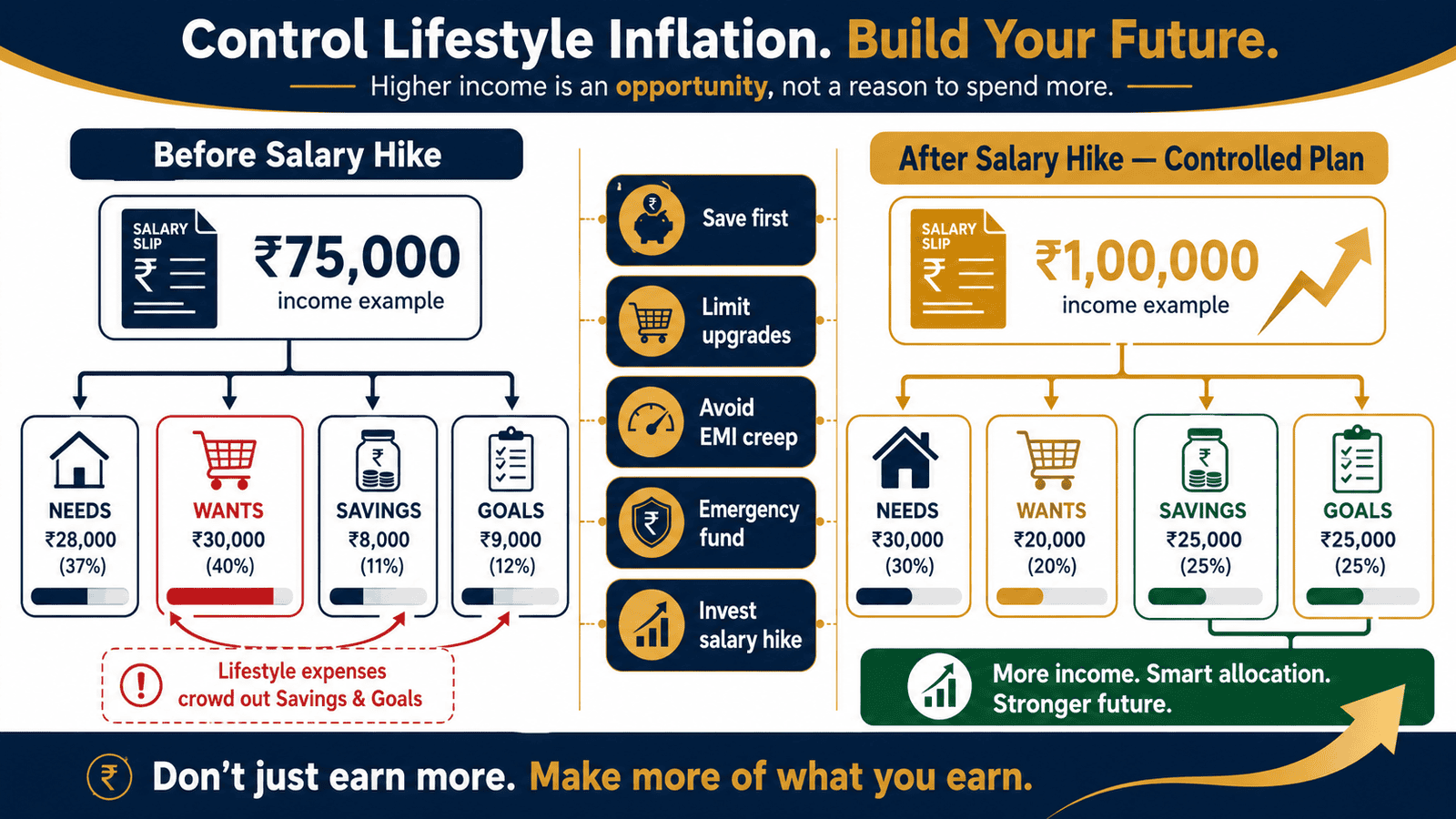
- If your savings amount stays at ₹15,000 per month despite income rising from ₹75,000 to ₹1,00,000, your savings rate has actually dropped from 20% to 15%.
- The 50/30/20 rule (50% needs, 30% wants, 20% savings) is a useful starting point, but the key is that savings percentage must not fall after any income increase.
- Saving first — automatically diverting a set amount on salary day — is more effective than saving whatever is left at month-end.
- The goal is controlled lifestyle improvement, not extreme frugality. One or two deliberate upgrades per year, funded after savings targets are met, is a sustainable approach.
Key Facts at a Glance
| Aspect | Details |
|---|---|
| What it means | Spending rises proportionally with income; savings do not improve |
| Common triggers | Salary hike, annual bonus, promotion, peer spending, easy credit and EMIs |
| Warning signs | Stagnant savings amount, rising EMI total, frequent gadget upgrades, growing subscription list |
| Most harmful pattern | Recurring upgrades — higher rent, new car EMI, subscriptions — rather than one-time purchases |
| Best control methods | Automate savings on salary day, wait 30 days before new recurring expenses, review EMIs quarterly |
| Who it affects most | Salaried employees with growing income but no savings-rate target, especially in the first 5–10 working years |
What Is Lifestyle Inflation — and How Does It Work?
Lifestyle inflation, also called lifestyle creep, is the gradual increase in spending that follows an increase in income. The word “gradual” matters here. It rarely happens all at once. It happens one reasonable-seeming decision at a time: a slightly better apartment, a cab instead of the metro, a gym membership, a new phone before the old one has stopped working.
Each individual choice can often be justified. The cumulative effect cannot — especially when those choices become recurring monthly commitments.
Lifestyle Inflation vs General Inflation
These are two different things, though they get confused often. General price inflation — tracked by indices like the Consumer Price Index — means the cost of the same goods and services rises over time. Your grocery bill goes up even if you buy the same items. That is general inflation, and it is largely outside your control.
Lifestyle inflation is different. It is a voluntary increase in the standard of goods and services you consume. You switch from cooking at home to ordering Swiggy four nights a week. You move from a ₹15,000-per-month flat to a ₹22,000-per-month flat after a promotion. You upgrade from a ₹25,000 phone to a ₹75,000 one on a no-cost EMI. These are choices — and choices can be controlled.
The Needs, Wants, and Savings Buckets
A useful mental model is to split post-tax income into three buckets: needs (essentials you cannot function without), wants (discretionary spending that improves comfort or enjoyment), and savings and investments (money directed toward future goals).
The budget rule guide for Indian families explains how the 50/30/20 framework divides income — 50% for needs, 30% for wants, and 20% for savings. This is a useful starting point, not a rigid law. The critical principle is that the savings percentage must not fall after a salary hike. If it does, lifestyle inflation has already taken hold.
The Recurring Expense Trap
The most financially damaging form of lifestyle creep is not a large one-time purchase. It is the accumulation of new recurring monthly expenses. A ₹2,499-per-month gym membership. A ₹1,500 premium streaming plan. A ₹6,000 dining-out habit that did not exist two years ago. A ₹28,000 car EMI taken because the salary hike made it look affordable.
Each of these locks in a higher cost floor every single month. You cannot easily reverse them without disruption — breaking a lease, foreclosing an EMI, cancelling a service you rely on. This stickiness is what makes recurring lifestyle upgrades more dangerous than occasional treats. A one-time ₹8,000 dinner is far less harmful than a new ₹8,000/month recurring expense that runs for years.
Why Salaried Employees in India Are Particularly Vulnerable
Several factors make lifestyle creep especially common for salaried employees in Indian cities. Annual appraisal cycles create a predictable income jump that is immediately visible in the bank account. No-cost EMI offers from banks and e-commerce platforms make expensive purchases feel manageable month-to-month. Peer spending in urban professional networks creates visible benchmarks — colleagues’ vacations, cars, and gadgets that feel like the new normal. Easy access to credit cards extends purchasing power well beyond actual income.
None of these factors are inherently bad. But together, they create a strong pull toward spending every rupee of additional income rather than directing any of it toward financial goals.
Real Example: Rohan’s Salary Hike in Bengaluru
Rohan, 28, is a product manager in Bengaluru earning ₹75,000 per month after tax. His monthly savings are ₹15,000 — a 20% savings rate. He has a basic emergency fund, no car EMI, and modest subscriptions.
After his annual appraisal, his salary increases to ₹1,00,000 per month. Here is what happens under two scenarios.
Uncontrolled path: Rohan moves to a bigger flat closer to his office — rent goes from ₹14,000 to ₹22,000. He buys a used car on EMI — ₹12,000 per month. He adds two more OTT subscriptions and a gym — ₹3,500 per month combined. Dining out becomes more frequent — an extra ₹5,000 per month. His new monthly outgo has risen by ₹28,500. Savings remain at ₹15,000 — now only 15% of his higher income.
Controlled path: Rohan first increases his SIP and emergency fund contributions by ₹10,000. He then allows himself one deliberate upgrade — moving to a slightly better flat at ₹18,000 rent instead of ₹22,000. He skips the car EMI for now. Total lifestyle increase: ₹4,000 per month. Savings: ₹25,000 — now 25% of income.
In the controlled path, Rohan’s real wealth actually grows with his income. In the uncontrolled path, only his cost base grows. These figures are illustrative; actual budgets will vary based on city, family situation, and personal goals.
How to Calculate Your Lifestyle Inflation
Lifestyle Inflation Amount = Total monthly expenses after income rise − Total monthly expenses before income rise
Savings Rate = (Monthly Savings ÷ Monthly Income) × 100
Using Rohan’s numbers:
| Scenario | Key Inputs | Result |
|---|---|---|
| Before hike | Income ₹75,000 / Savings ₹15,000 | Savings rate: 20% |
| After hike — uncontrolled | Income ₹1,00,000 / Savings ₹15,000 | Savings rate: 15% (declined) |
| After hike — controlled | Income ₹1,00,000 / Savings ₹25,000 | Savings rate: 25% (improved) |
The single most revealing number is not how much you earn or even how much you save in absolute terms — it is whether your savings rate has improved after an income increase. If it has not, lifestyle inflation has consumed your entire raise. All figures above are illustrative examples only.
Comparison: Healthy Lifestyle Improvement vs Harmful Lifestyle Inflation
| Parameter | Healthy Lifestyle Improvement | Harmful Lifestyle Inflation |
|---|---|---|
| Timing of upgrade | After savings and investment targets are met for the month | Immediately on receipt of salary hike or bonus |
| Type of spending | One or two deliberate, planned upgrades per year | Multiple new recurring expenses added simultaneously |
| Savings rate after hike | Improves — savings percentage is higher than before | Same or lower — income absorbed into new expenses |
| Decision driver | Personal goals, health, productivity, family well-being | Impulse, peer comparison, credit availability |
| Net worth trend | Grows meaningfully with each salary cycle | Stagnant despite rising income |
| Reversibility | Upgrades chosen to be sustainable; can be reduced if needed | Locked in — EMIs, leases, and habits hard to reverse |
How to Decide What’s Right for You
your emergency fund covers at least 3–6 months of expenses — THEN you have a safety base and can consider directing part of a salary hike toward a lifestyle upgrade, after increasing savings first. Read more about emergency fund priority before investing.
your total EMI payments already exceed 30–35% of your take-home salary — THEN adding a new car, appliance, or gadget EMI will push your financial flexibility to a dangerous level. Hold off on any new EMI-based purchase.
the upgrade you are considering is a one-time purchase, not a recurring monthly commitment — THEN it is substantially less risky than a new subscription or EMI of the same value.
your savings rate will be higher after the salary hike than before — THEN you have controlled lifestyle inflation successfully, and a selective upgrade is financially reasonable.
the upgrade directly supports health, safety, work productivity, or childcare — THEN it is not lifestyle inflation in the harmful sense; it is a reasonable quality-of-life investment.
your savings rate has not improved after two consecutive salary hikes — THEN this is a clear signal that lifestyle creep has fully absorbed your income growth. A full expense audit, not another upgrade, should be the next step.
Common Mistakes to Avoid
Upgrading Rent Immediately After Every Hike
Moving to a more expensive apartment is the single largest lifestyle upgrade most salaried employees make after a salary hike.
Rent is a fully recurring, sticky expense. If you move from ₹14,000 to ₹22,000 rent, you commit ₹96,000 extra per year — every year — regardless of what happens to your income or expenses later. A ₹8,000/month rent increase over five years is ₹4.8 lakh in additional outgo, before any returns your savings might have generated.
Instead: wait at least three months after a hike before making a housing move, and limit rent to 25–30% of take-home income. Understanding how inflation reduces money value over time makes this trade-off clearer.
Taking EMIs for Wants Instead of Goals
No-cost EMI offers on phones, laptops, televisions, and appliances make large purchases feel small.
But each EMI is a recurring expense you have committed to for months or years. A ₹12,000/month car EMI and a ₹4,500/month phone EMI running simultaneously consume ₹16,500 of every monthly salary before you have made a single discretionary choice. EMI creep is one of the fastest ways to lock in lifestyle inflation.
Instead: use EMIs only for goals (home purchase, essential vehicle for long commute) and save up for wants rather than financing them.
Treating Every Subscription as a Small Harmless Expense
A ₹199 music plan, a ₹499 streaming service, a ₹999 news subscription, a ₹2,499 gym, a ₹349 cloud storage plan — individually, each seems minor.
Added together, these five alone total ₹4,545 per month — ₹54,540 per year. Most people with lifestyle creep cannot immediately name all their active subscriptions or recall their combined monthly cost.
Instead: audit every subscription once per quarter. Cancel anything you have not actively used in the past 30 days.
Saving Whatever Is Left at Month-End
The most common budgeting mistake in India is treating savings as a residual — saving only after all spending is done.
When income rises, spending tends to expand to fill the new amount. If you wait until month-end to save, the extra salary is usually already spent. The result: savings amount stays the same even as income grows.
Instead: set up an automatic SIP, RD, or transfer on salary day. Savings happen first; spending happens from what remains.
Confusing General Inflation with Lifestyle Inflation
When expenses rise after a salary hike, it is tempting to attribute everything to rising prices.
General inflation does raise costs — groceries, fuel, rent in growing cities. But if you are also switching to a premium grocery store, adding food delivery, and upgrading your phone plan, the increase is mostly lifestyle inflation, not general inflation. Blaming all cost increases on prices conceals the controllable portion.
Instead: separate unavoidable price increases (same goods, higher price) from voluntary upgrades (better goods, higher price by choice).
Spending to Match Peers Rather Than Personal Goals
Urban professional networks in Indian cities are visibly aspirational. A colleague’s Goa trip, another’s new car, a friend’s apartment upgrade — these create an informal spending benchmark that is easy to unconsciously follow.
Peer comparison is one of the most powerful drivers of lifestyle creep because the reference point constantly shifts upward. What was a luxury two years ago becomes the expected standard.
Instead: anchor spending decisions to your own income, goals, and timeline — not to what colleagues or social media contacts appear to be spending.
When This May Not Be the Right Choice
Avoiding all lifestyle upgrades is not the goal. There are situations where spending more after a salary hike is not lifestyle inflation in the harmful sense — it is a reasonable, justified improvement.
If you are moving from unsafe or unsuitable housing to something more appropriate for your family — particularly with young children or elderly family members — that is a genuine need, not discretionary creep. If you have been under-spending for years and your basic comfort is genuinely low, a considered improvement is warranted. If a purchase directly improves your earning ability — better internet, a reliable laptop for remote work, transport to a new higher-paying job — the return may justify the cost. If you are managing health, childcare, or family-support commitments that have increased with income, that spending is not lifestyle inflation.
The issue is not spending more when you earn more. The issue is spending more with no plan, no savings target, and no awareness of the long-term cost. If any of these apply to your situation, it may be worth exploring alternatives before committing.
Official Rules and Where to Verify
Lifestyle inflation is a behavioural and budgeting topic, not a legal or regulatory one. There are no official rules that define how much you should spend or save. However, the following official sources provide relevant financial education context:
- RBI (Reserve Bank of India) — rbi.org.in: Publishes consumer awareness materials on financial planning, credit, and inflation. Relevant for understanding how general inflation affects purchasing power and for responsible credit use guidelines.
- SEBI (Securities and Exchange Board of India) — sebi.gov.in: Provides investor education resources including the importance of long-term savings habits and financial goal-setting through its investor education initiatives.
Budgeting frameworks like the 50/30/20 rule are practical guidelines, not legal mandates. Similarly, savings rate recommendations used in this article are illustrative benchmarks. Rules, limits, and rates on this topic can change with each Budget or regulatory update. Always verify current figures directly from the official source before making any financial decision.
Expert Tips
- Apply the 50% rule to every salary hike: Before you spend any part of a new salary increase, direct at least 50% of the net hike amount to savings or investments. If your take-home rises by ₹20,000, increase your SIP or RD by ₹10,000 first. The remaining ₹10,000 can fund a lifestyle upgrade. This single rule, applied consistently, prevents lifestyle inflation from consuming entire raises.
- Wait 30 days before any new recurring expense: Impose a 30-day cooling-off period before adding any new subscription, EMI, or monthly commitment. Impulse upgrades — gym memberships, streaming plans, delivery service subscriptions — often feel less compelling after 30 days of reflection. If it still makes sense after a month, it is a deliberate choice, not reactive spending.
- Maintain a lifestyle upgrade shortlist: Keep a running list of upgrades you want. Allow yourself to act on only one or two per year, funded after your savings targets for that month are fully met. This creates intentionality and eliminates the feeling of deprivation — the list is not a “never” list, it is a “not yet” list. Think about the cost of each choice before committing.
- Review EMIs and subscriptions every quarter: Set a calendar reminder once every three months to list every active EMI and subscription. Total them up. If recurring commitments exceed 40% of your income, you have a structural problem, not just a spending habit. Cut or defer at least one commitment each quarter until that ratio improves.
- Track net worth, not salary: Your salary is your input; your net worth is your output. Someone earning ₹80,000 per month with ₹12 lakh in savings and investments is in a better financial position than someone earning ₹1.5 lakh with no savings and ₹8 lakh in consumer debt. Reviewing net worth quarterly — assets minus liabilities — keeps the focus on wealth-building rather than income bragging rights.
- Automate before spending: On salary day, transfer savings to a separate account, SIP, or RD before any discretionary spending begins. What the eye does not see, the hand does not spend. Automation removes the monthly willpower requirement and makes saving the default, not the exception.
Frequently Asked Questions
What is lifestyle inflation in simple terms?
Lifestyle inflation means your monthly expenses rise every time your income rises. The result is that even though you earn more, your savings either stay the same or grow more slowly than your income. A common example: a ₹15,000 salary hike disappears into higher rent, a new car EMI, and additional subscriptions — leaving savings unchanged.
Is lifestyle inflation always bad?
No. Spending more when you earn more is entirely reasonable — as long as your savings rate also improves. The problem is when all additional income gets converted into new recurring expenses, with nothing directed toward financial goals. Intentional lifestyle improvement, funded after savings targets are met, is not the same as uncontrolled lifestyle creep.
How do I know if I have lifestyle inflation?
Check your savings rate from two or three years ago versus today. If your income has grown by 30–40% but your monthly savings have grown by far less — or not at all — lifestyle inflation has likely consumed most of your income growth. A simpler check: can you name every active subscription and EMI you have right now, and total them in under two minutes? If not, your recurring expenses may have drifted.
How much of a salary hike should I save?
There is no universal rule. A practical starting point is to direct at least 50% of any net salary increase to savings or investments before increasing any expense. This is a framework, not a legal requirement, and may need adjustment based on your current savings rate, EMI commitments, and life situation. The goal is that your savings rate improves after every income increase.
Can the 50/30/20 rule help with lifestyle inflation?
Yes, as a framework. If you apply 50/30/20 and ensure the 20% savings bucket grows with income, it prevents lifestyle inflation from consuming all of your raise. The key discipline is that the savings percentage — not just the absolute amount — must stay the same or improve as income rises.
What is the difference between general inflation and lifestyle inflation?
General inflation means the same goods and services cost more over time — your grocery bill rises even if you buy identical items. Lifestyle inflation means you are buying better, more expensive, or more goods and services than before. One is driven by external prices; the other is driven by personal spending choices.
What are the most common lifestyle inflation triggers for salaried employees in India?
Annual appraisal salary hikes, year-end bonuses, promotions, and peer spending patterns are the most common triggers. No-cost EMI offers from banks and e-commerce platforms also enable large purchases that would otherwise be deferred — making it easier to commit to recurring financial obligations quickly after an income increase.
Can lifestyle inflation affect someone with a high income?
Yes — and it is particularly common among high earners. Higher income makes large recurring expenses feel proportionally small. A ₹20,000/month car EMI feels more manageable on ₹2 lakh income than on ₹80,000 income. But the mechanism is identical: if spending rises to consume all of the income, savings rate does not improve regardless of how high the income is.
Final Verdict
Lifestyle inflation is not about enjoying life less — it is about upgrading intentionally. Every salary hike is an opportunity to improve both your quality of life and your financial security. The mistake is treating those two goals as mutually exclusive or, worse, letting the spending side win automatically every time.
The practical approach is straightforward: increase savings first on salary day, then decide on one or two deliberate lifestyle upgrades per year from whatever remains. Review your subscriptions and EMIs once a quarter. Track your savings rate — not just your salary. If your savings rate has not improved after two consecutive hikes, that is the signal to audit your recurring expenses, not add more.
Your next salary hike is a test. Read the complete guide to using every salary hike to build a concrete allocation plan before that income arrives. Always verify the latest rules from official sources or consult a qualified professional before making any financial decision.
This article is for educational purposes only and should not be treated as personalised financial, tax, investment, insurance, or legal advice. Tax rules, interest rates, regulatory limits, and product features can change with each Budget or policy update. Please verify current rules from official government sources or consult a qualified and registered professional before making any financial decision.

Sanya Malhotra writes about everyday personal finance for Indian individuals and families. Her content focuses on budgeting, saving, emergency funds, debt control, net worth tracking, family money decisions, and practical habits that help readers manage money with more confidence.
She covers topics such as monthly budgeting, expense planning, saving habits, emergency fund behaviour, debt repayment, household financial planning, family discussions about money, financial mistakes, net worth tracking, short-term vs long-term goals, and beginner personal finance concepts.
Sanya’s writing style is warm, simple, and realistic. She avoids making personal finance feel intimidating and instead explains money decisions through relatable Indian examples, ₹ budgets, checklists, and step-by-step frameworks. Her articles are useful for students, freshers, couples, parents, and families who want to improve daily money habits. Her content is educational and does not provide personalised financial advice. Readers should adapt examples to their own income, family responsibilities, city, debt level, risk comfort, and financial goals.