

You get your first decent salary, open a few finance apps, and suddenly everyone is talking about SIPs, mutual funds, and the magic of compounding. The obvious question follows: should you start investing right now, or build an emergency fund first? This is one of the most common dilemmas for salaried employees in India — and getting the order wrong can cost you far more than a few months of missed returns.
Emergency funds and investments are not competitors. They solve completely different problems. One protects you when something goes wrong — a job loss, a medical bill, a car repair, a family emergency. The other builds wealth over time when things go right. The confusion starts when people treat them as interchangeable, or assume that any idle money is wasted money. Before you map out your first SIP, it helps to understand personal finance basics — and then build in the right order.
Quick Answer: Emergency Fund vs Investment
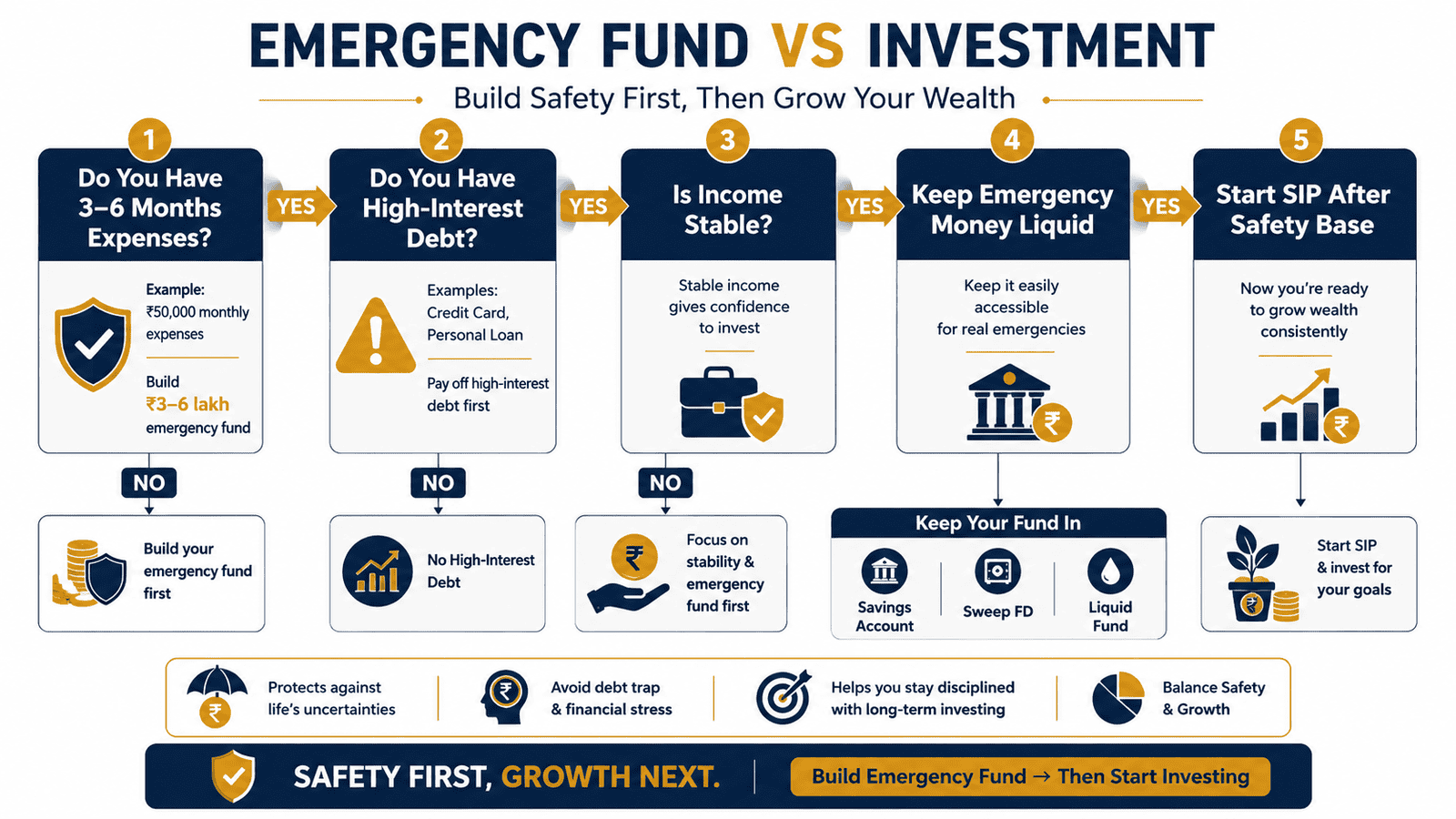
Emergency fund vs investment should come first as a safety question, not a return question. If monthly essential expenses are ₹50,000, build at least ₹1.5–3 lakh for 3–6 months before serious investing. Then start SIPs gradually while keeping emergency money liquid, separate, and easy to access during job loss, medical costs, or urgent repairs.
Key Takeaways
- An emergency fund covering 3–6 months of essential expenses — typically ₹1.5 lakh to ₹4 lakh for most salaried households — should be in place before you scale up investments.
- Investments build long-term wealth but can fall in value at exactly the moment you most need cash — making them unreliable as a safety net.
- High-interest debt (credit card outstanding, personal loan above 15%) should generally be cleared before both a full emergency fund and aggressive investing.
- A starter buffer of ₹50,000–₹75,000 takes priority; small SIPs of ₹1,000–₹2,000 per month can run in parallel once that base exists and income is stable.
- Emergency money must be liquid — savings account, sweep-in FD, or liquid mutual fund — never parked in equity funds, ULIPs, or locked instruments.
- Single earners, families with EMIs, and people in contractual or unstable jobs need a larger buffer: 6–12 months, not just 3.
- Once the emergency fund target is met, increase SIP amounts progressively rather than waiting for the “perfect time” to invest.
Emergency Fund vs Investment: Head-to-Head Comparison
| Parameter | Emergency Fund | Investment (SIP / Mutual Fund) |
|---|---|---|
| Primary purpose | Protection from unexpected costs | Wealth creation over time |
| Time horizon | Immediate or within days | 3 years to 20+ years |
| Liquidity need | Very high — must be accessible quickly | Medium to low — ideally held long term |
| Capital risk | Low — stability is the goal | Present — market or credit risk applies |
| Return expectation | Modest, secondary to safety | Growth-focused, goal-linked |
| Suitable instruments | Savings account, sweep-in FD, liquid fund | Equity/debt MF, PPF, NPS, direct stocks |
| During job loss | Covers rent, EMI, groceries without panic | May be down in value; selling early locks in loss |
| During market fall | Unaffected — value stays stable | NAV drops; forced redemption hurts returns |
| For monthly expenses? | No — only for genuine emergencies | No — liquidating SIPs for expenses defeats the purpose |
Key Facts at a Glance
| Factor | Emergency Fund | Investment |
|---|---|---|
| Recommended size | 3–6 months of essential expenses | Based on goal amount and time horizon |
| Access time | Same day to 1 business day | T+2 to T+3 for mutual funds; longer for locked products |
| Tax on returns | Interest taxed as per income slab | STCG / LTCG rules apply depending on asset type |
| Regulator | RBI (for bank-held money) | SEBI (for mutual funds and securities) |
| When to start | Immediately, before any major investing | After basic buffer is in place and cash flow is stable |
Why Emergency Fund and Investment Are Not the Same Thing
The reason most personal finance advice puts the emergency fund first is not because investing is risky or because cash is better than compounding. It is because these two things serve completely different functions — and confusing them creates a dangerous gap in your financial structure.
Think of an emergency fund as self-insurance. It is not supposed to earn high returns. It is supposed to be there, reliably, when you need it most. A savings account or a sweep-in fixed deposit may earn a modest amount — but that is a side benefit, not the point. The point is that your rent, your EMI, your groceries, and your medical bills can be paid for 3 to 6 months even if your income stops completely tomorrow.
Why Investing Without a Buffer Can Hurt You
Imagine you put ₹8,000 per month into a SIP starting January. By July, your employer announces layoffs and your salary stops. Your savings account has ₹30,000. You now have three uncomfortable choices: redeem your mutual fund units (which may be down in value during the same economic stress that caused the layoffs), take a personal loan at 14–18% interest, or borrow from family. None of these is what you planned for.
This is what finance professionals call forced redemption — selling an investment not because it has reached its goal, but because you have no other option. According to SEBI guidelines, equity mutual fund investors are encouraged to stay invested across market cycles. Forced early exits during volatile periods can significantly reduce actual returns compared to the projected long-term average.
The answer is not to avoid investing. The answer is to not invest money that you may need within 12 months.
Essential Expenses vs Full Salary — Know the Difference
One common error is calculating emergency fund size using the full salary. If you earn ₹85,000 per month but only ₹52,000 covers truly essential expenses — rent, EMI, groceries, utility bills, insurance premiums, school fees — then your 3-month emergency fund target is ₹1.56 lakh, not ₹2.55 lakh. This distinction matters because it makes the target more achievable and avoids over-saving in a low-return instrument when that extra money could be investing for growth.
Identifying essential expenses accurately is the first step. The monthly budget rule can help you separate needs from wants and calculate a realistic monthly baseline — which then directly determines how large your emergency buffer should be.
Where Emergency Money Belongs
Emergency funds should sit in instruments that are safe, accessible, and not subject to meaningful capital risk. The typical choices for Indian households are:
- Savings account: Fully liquid, zero redemption friction, insured up to ₹5 lakh per depositor per bank under DICGC. Return is modest.
- Sweep-in fixed deposit: Earns FD-level interest on the portion above a set threshold, automatically swept back to savings when needed. Available at most major banks.
- Liquid mutual fund: Generally redeemable within 1 business day, lower credit risk than equity, but subject to SEBI regulations and scheme-level risk factors. Suitable for the second layer of emergency money — not the first layer you need on a Sunday night.
Equity mutual funds, ULIPs, PPF (which has a 15-year lock-in), and stocks are not appropriate for emergency money under any circumstance. Their value can drop significantly at exactly the wrong moment.
Real Example: Rohan’s Priority Ladder in Pune
Rohan, 29, is a software analyst in Pune earning ₹85,000 per month after tax. His essential monthly expenses — rent ₹18,000, EMI on a two-wheeler ₹4,500, groceries and household ₹12,000, insurance premiums ₹3,500, utilities and transport ₹7,000 — total approximately ₹45,000. He currently has ₹70,000 in his savings account and is feeling pressure to start a SIP.
Here is how a practical priority ladder looks for Rohan:
Step 1 — Starter buffer: Before anything else, Rohan keeps ₹50,000–₹60,000 as a do-not-touch base. He already has ₹70,000, so this box is roughly ticked.
Step 2 — 3-month target: ₹45,000 × 3 = ₹1.35 lakh. Rohan needs approximately ₹65,000 more to reach this. He sets aside ₹10,000 per month toward the emergency fund and starts a small SIP of ₹2,000 simultaneously — because his base buffer exists and income is stable.
Step 3 — 6-month target: ₹45,000 × 6 = ₹2.7 lakh. Once the 3-month fund is complete, he increases the SIP to ₹6,000–₹8,000 per month and continues adding ₹5,000 to the emergency fund until he reaches ₹2.7 lakh.
Step 4 — Full investment mode: With ₹2.7 lakh in a sweep-in FD, Rohan can now direct his monthly surplus almost entirely into investments. The key insight: delaying his SIP by 4–6 months cost him relatively little in compounding terms, but the buffer he built protects him from a scenario where he would have to redeem during a market correction.
How to Calculate Your Emergency Fund Target
The formula is straightforward:
Emergency Fund Target = Essential Monthly Expenses × Number of Months
Using this formula with two common expense levels:
| Scenario | Essential Expenses / Month | 3-Month Target |
|---|---|---|
| Single, no EMI, metro city | ₹35,000 | ₹1.05 lakh |
| Married, one EMI, tier-2 city | ₹55,000 | ₹1.65 lakh |
| Family, two EMIs, metro city | ₹85,000 | ₹2.55 lakh |
When should 3 months be enough? If you have a stable government or PSU job, two earning members, no large EMIs, and strong family support nearby, a 3-month fund may be a reasonable start. When should you target 6–12 months? If you are a single earner supporting dependents, have a home loan EMI, work in a private company in a cyclical industry, or are self-employed, 6 months is a safer baseline and 12 months is worth considering.
Use the emergency fund calculator to work out your personal target based on your essential expenses, income stability, and household situation.
How to Decide What’s Right for You
You have no savings buffer at all — THEN build a starter fund of at least ₹50,000 before starting any SIP, however small. A market correction or job disruption with zero savings is a financial emergency waiting to happen.
You have high-interest debt — credit card outstanding at 36–42% per annum, or a personal loan above 15% — THEN clear that debt aggressively while keeping a minimal ₹30,000–₹50,000 safety buffer. High-interest debt destroys more wealth than any SIP can create at the same time.
You have a starter buffer of ₹50,000–₹75,000 and your income is stable — THEN a small SIP of ₹1,000–₹3,000 per month can begin in parallel while you continue building toward a 3-month fund. You are not missing compounding; you are buying it safely.
You are a single earner with dependents, an active home loan EMI, or are in a contractual or commission-based job — THEN prioritise a 6-month fund before scaling any SIP beyond ₹2,000–₹3,000 per month. Your income-disruption risk is meaningfully higher than a dual-income, no-EMI household. Refer to the detailed guide on how to build a six-month emergency buffer step by step.
Your emergency fund target is fully met — THEN direct your monthly surplus toward goal-based investments. Review asset allocation based on time horizon, not just return expectations.
You have a stable two-income household with no EMIs, low expenses, and a reliable family support network nearby — you likely need a smaller baseline fund than the standard 6-month rule suggests. A 2–3 month buffer may be adequate while you invest the rest for long-term goals.
Common Mistakes to Avoid
Investing Emergency Money in Equity Funds or Stocks
Emergency money placed in equity mutual funds or direct stocks is exposed to market volatility.
If markets fall 30% in a bad year — which has happened in India more than once — and you simultaneously face a job loss, you are forced to sell at a loss to pay rent. A ₹2 lakh emergency fund invested in equity could be worth ₹1.4 lakh exactly when you need ₹2 lakh. That ₹60,000 gap is paid with borrowed money or stress.
Keep emergency money only in savings accounts, sweep-in FDs, or liquid funds — products with low capital risk and fast access.
Treating Credit Card Limit as Emergency Fund
A credit card limit is not an emergency fund. It is a credit line at 36–42% annual interest if unpaid.
Using a credit card during a job loss and carrying that balance for 3 months can turn a ₹1 lakh emergency into ₹1.09 lakh in debt — before interest compounds further. This creates a debt cycle that takes longer to recover from than simply having saved the ₹1 lakh in a savings account.
Use the credit card as a payment tool, not as a financial safety net.
Calculating Fund Size from Full Salary Instead of Essential Expenses
Many beginners multiply their full take-home salary by 3 or 6 to calculate the emergency fund target.
This overstates the requirement. If your salary is ₹85,000 but your essential expenses are ₹48,000, your 6-month target is ₹2.88 lakh — not ₹5.1 lakh. Over-saving in a low-return instrument means your surplus sits idle rather than compounding. Use actual essential expenses as the base.
Waiting for the Perfect Fund Before Starting Any Investment
Waiting until you have a full 6-month fund before starting any SIP is not always the right call.
If you earn ₹85,000, have a ₹60,000 starter buffer, and stable employment, a ₹2,000 SIP alongside your emergency-building effort costs you very little in liquidity while starting the compounding clock. Indefinitely deferring investment “until the fund is perfect” can delay wealth building by 12–18 months unnecessarily.
Keeping Emergency Money in Cash at Home
Physical cash at home earns nothing and carries theft and fire risk.
A savings account takes 30 seconds to access via UPI or net banking and earns modest interest. There is no financial case for keeping significant emergency cash outside the banking system — and it also remains outside DICGC deposit insurance protection.
Ignoring Emergency Fund After Starting Investments
Some investors build an emergency fund, then gradually raid it for lifestyle upgrades, SIP top-ups, or travel.
If the fund falls below target — say from ₹2.7 lakh to ₹90,000 — and then a job loss hits, the investor is back to square one. Treat the emergency fund floor as non-negotiable. Replenish it immediately after any withdrawal.
When This May Not Be the Right Choice
Very high-interest debt exists: If you are carrying a credit card balance or personal loan above 18–20% interest, the conventional sequence shifts slightly. Aggressively repaying that debt while maintaining only a small ₹30,000–₹50,000 starter buffer may make more mathematical sense than building a full emergency fund first. High-interest debt destroys net worth faster than a modest investment portfolio can build it.
Strong, reliable family backstop: If you have immediate family nearby who can cover 2–3 months of your expenses at zero notice — and this is genuinely reliable, not theoretical — your personal emergency fund requirement may be lower than the standard 3–6 month rule. A 1–2 month buffer may be adequate in this situation while you invest the rest.
Major known expense on the horizon: If you are planning a wedding, house deposit, or major purchase in the next 6–12 months, that money should not be treated as investable surplus. It is a committed outflow, not an emergency fund and not a long-term investment. Keep it liquid and separate from both.
Freelancers and irregular income earners: The standard 3–6 month rule is designed for salaried employees with predictable income. If your income is highly variable, you may need 9–12 months of expenses as your buffer before investing aggressively. The safety calculation changes when income itself is uncertain.
If any of these apply to your situation, it may be worth exploring alternatives before committing.
Official Rules and Where to Verify
The products typically used for emergency funds and investing are regulated by different bodies in India. Rules, limits, and rates on this topic can change with each Budget or regulatory update. Always verify current figures directly from the official source before making any financial decision.
- RBI (rbi.org.in): Regulates savings accounts, fixed deposits, sweep-in accounts, and the broader banking ecosystem. DICGC deposit insurance (up to ₹5 lakh per depositor per bank) is administered under the RBI framework.
- SEBI (sebi.gov.in): Regulates mutual funds — including liquid funds, debt funds, and equity funds used for investing. Fund-level risk labels (riskometer), scheme information documents, and redemption timelines are governed by SEBI regulations.
Before parking emergency money in a liquid fund, read the scheme’s Scheme Information Document (SID) for credit risk, liquidity terms, and exit load. Before opening a sweep-in FD, check your bank’s premature withdrawal terms. For general guidance on liquid funds as a potential vehicle for the second layer of emergency money, see the explainer on liquid fund basics — and verify current rules from SEBI directly.
Expert Tips
- Keep emergency money in a separate, clearly labelled account. Mixing it with your salary account makes it psychologically easy to spend. A second savings account named “Emergency Fund — Do Not Touch” creates a visible barrier that works better than willpower alone.
- Split your emergency fund into two layers. Layer 1: 1 month of expenses in your main savings account — instant access, zero friction. Layer 2: remaining 2–5 months in a sweep-in FD or liquid fund — slightly better return, accessible within 1 business day. This structure balances liquidity with modest yield.
- Automate both emergency savings and SIP on salary credit day. Set up two auto-transfers: one to the emergency fund account, one to your SIP. Doing this before discretionary spending removes the temptation to skip either. Once your emergency fund is complete, redirect the auto-transfer to a second SIP or an investment goal.
- Revisit your fund size after major life events. Marriage, a child, a home loan, a job change, or relocation can change your essential expenses significantly. A fund that was adequate at ₹1.5 lakh when you were single may need to be ₹3.5 lakh after a home loan EMI and a dependent. Review and recalculate annually.
- Never chase return with emergency money. The moment you ask “how do I earn more from my emergency fund?” you have started making the wrong trade-off. A few extra percentage points of return on ₹2 lakh amounts to ₹4,000–₹8,000 per year. The cost of not having that ₹2 lakh when you need it — in borrowed interest, in forced MF redemption losses, in financial stress — is far higher.
- When you are ready to scale your SIP, start small and increase annually. A ₹2,000 SIP today with a ₹500 annual step-up grows meaningfully over a decade. For how to structure your first SIP correctly, see the guide on how SIPs work and how to start — and remember that mutual fund investments are subject to market risk; read all scheme-related documents carefully.
Frequently Asked Questions
Should I save an emergency fund before investing?
For most salaried individuals, yes — building at least a starter buffer of ₹50,000–₹75,000 before any SIP is the safer approach. If your income is disrupted and you have no liquid savings, you may be forced to sell investments at a loss or take high-interest debt. A 3-month emergency fund before scaling investments is a widely accepted personal finance baseline.
Can I start a SIP while building my emergency fund?
Yes, in many cases. If you have a starter buffer of ₹50,000 or more, stable employment, and no high-interest debt, a small SIP of ₹1,000–₹3,000 per month alongside your emergency fund contribution is reasonable. The key is not to treat the SIP money as accessible for emergencies — these are two separate buckets with two separate purposes.
Is a 3-month emergency fund enough in India?
It depends on your situation. A 3-month fund may be adequate for a dual-income household with no EMIs, low essential expenses, and nearby family support. For a single earner with a home loan, dependents, or employment in a volatile sector, 6 months is more realistic. Freelancers and gig workers should target 9–12 months given income variability.
Where should I keep my emergency fund in India?
The most practical options are a savings account for the first layer (immediate access, DICGC-insured up to ₹5 lakh) and a sweep-in fixed deposit or liquid mutual fund for the second layer (better return, accessible within 1 business day). Avoid equity mutual funds, stocks, or locked instruments for any part of your emergency fund.
Can I use my credit card as an emergency fund?
No. A credit card limit is a borrowing facility, not savings. If you use it during a job loss and cannot pay the full bill, interest charges of 36–42% per annum apply immediately. A ₹1 lakh emergency absorbed on a credit card and carried for 3 months can become ₹1.09 lakh in debt. An actual savings buffer avoids this entirely.
Should my emergency fund be in an FD or a liquid fund?
Both are reasonable for the second layer of an emergency fund, with trade-offs. An FD may have premature withdrawal penalties but is straightforward and widely available. A liquid mutual fund generally has no exit load after 7 days and redeems in approximately 1 business day, but carries scheme-level credit risk and is subject to SEBI regulations. Read the scheme document before using a liquid fund. Verify current FD terms and premature withdrawal rules from your bank directly.
What if I have already invested but have no emergency fund?
This is more common than people admit. The practical fix: pause or reduce SIP contribution for 3–4 months and redirect that amount to build a starter emergency buffer. Do not redeem existing investments unless there is an active emergency — let the portfolio continue. Once the buffer is in place, resume or increase the SIP.
What is the emergency fund vs investment priority if I have an EMI?
An active EMI is a fixed monthly obligation that does not stop during a job loss. This makes a larger emergency fund — 4–6 months, not just 3 — more important, not less. Your fund size should cover EMI, rent, and all essential expenses for the buffer period. Investing before securing this coverage creates real financial risk.
Can I use my PPF balance as an emergency fund?
Not effectively. PPF has a 15-year lock-in with limited partial withdrawal rules (only after year 7, and only a portion of the balance). Relying on PPF as an emergency fund means you may not be able to access the money when you need it, or you may face tax and penalty implications. PPF is a long-term wealth creation tool, not a liquidity vehicle.
Final Verdict
The emergency fund vs investment debate has a clear answer for most people starting out: protection first, then growth. Build a starter buffer before your first SIP. Work toward 3 months of essential expenses as your core target, and 6 months if your income is single, your EMIs are large, or your employment is less stable. Only once that floor is secure should you scale up your SIP and investment contributions aggressively.
This is not anti-investment thinking. It is sequencing. A ₹2,000 SIP started 4 months later because you spent those months building an emergency fund costs you very little in compounding terms. Getting forced out of investments at a loss because you had no buffer can cost you far more — in rupees, in time, and in confidence. Calculate your own target, build it in the right instrument, and then invest for the long term without the fear of needing to pull that money back. Always verify the latest rules from official sources or consult a qualified professional before making any financial decision.
This article is for educational purposes only and should not be treated as personalised financial, tax, investment, insurance, or legal advice. Tax rules, interest rates, regulatory limits, and product features can change with each Budget or policy update. Please verify current rules from official government sources or consult a qualified and registered professional before making any financial decision.

Sanya Malhotra writes about everyday personal finance for Indian individuals and families. Her content focuses on budgeting, saving, emergency funds, debt control, net worth tracking, family money decisions, and practical habits that help readers manage money with more confidence.
She covers topics such as monthly budgeting, expense planning, saving habits, emergency fund behaviour, debt repayment, household financial planning, family discussions about money, financial mistakes, net worth tracking, short-term vs long-term goals, and beginner personal finance concepts.
Sanya’s writing style is warm, simple, and realistic. She avoids making personal finance feel intimidating and instead explains money decisions through relatable Indian examples, ₹ budgets, checklists, and step-by-step frameworks. Her articles are useful for students, freshers, couples, parents, and families who want to improve daily money habits. Her content is educational and does not provide personalised financial advice. Readers should adapt examples to their own income, family responsibilities, city, debt level, risk comfort, and financial goals.