

You have ₹3 lakh sitting in your savings account — some of it earmarked for upcoming expenses, some of it loosely called “emergency money.” Your salary comes in every month, and after paying rent and bills, a small surplus builds up. The question a lot of salaried Indians eventually ask is: is this money just sleeping in the bank, earning modest interest, when it could be doing slightly more work?
Liquid funds often come up as an answer. They are a category of debt mutual fund that parks money in very short-term instruments — and they have attracted attention as a parking option for surplus cash. But before you shift money out of your savings account, you need to understand what a liquid fund actually is, what risks it carries, how it is taxed, and when a savings account is simply the better choice.
This article explains liquid fund meaning in plain terms, compares it with a savings account across the factors that matter, and gives you a practical framework for deciding which one suits your situation — without assuming either option is universally superior.
Quick Answer: Liquid Fund Meaning
Liquid fund meaning refers to a debt mutual fund that parks money in short-term instruments, usually maturing within 91 days. It may suit short-term surplus money better than a savings account, but returns are not guaranteed, tax applies, and it is not as risk-free as a bank deposit.
Key Takeaways
- A liquid fund is a debt mutual fund — not a bank deposit. Your money is not insured by the Deposit Insurance and Credit Guarantee Corporation (DICGC), unlike a savings account.
- Liquid funds invest in instruments with very short maturities, which can reduce interest-rate sensitivity — but credit risk and NAV movement are still possible.
- Redemption from a liquid fund typically takes one business day (T+1), and instant redemption may be available up to a capped limit — verify current terms with your AMC before assuming same-day access.
- Taxation on liquid fund gains follows debt mutual fund rules: gains are added to your income and taxed at your applicable slab rate — this can reduce the return advantage over a savings account for investors in higher tax brackets.
- Exit load may apply for redemptions within a very short holding period — typically the first few days — so liquid funds are not ideal for money that may be needed at any moment.
- Keep your immediate emergency cash in a savings account. Consider a liquid fund only for short-term surplus with a clearer time horizon — not your entire buffer.
- Liquid fund returns vary by scheme, market conditions, and expense ratio. Never compare two options using headline return alone.
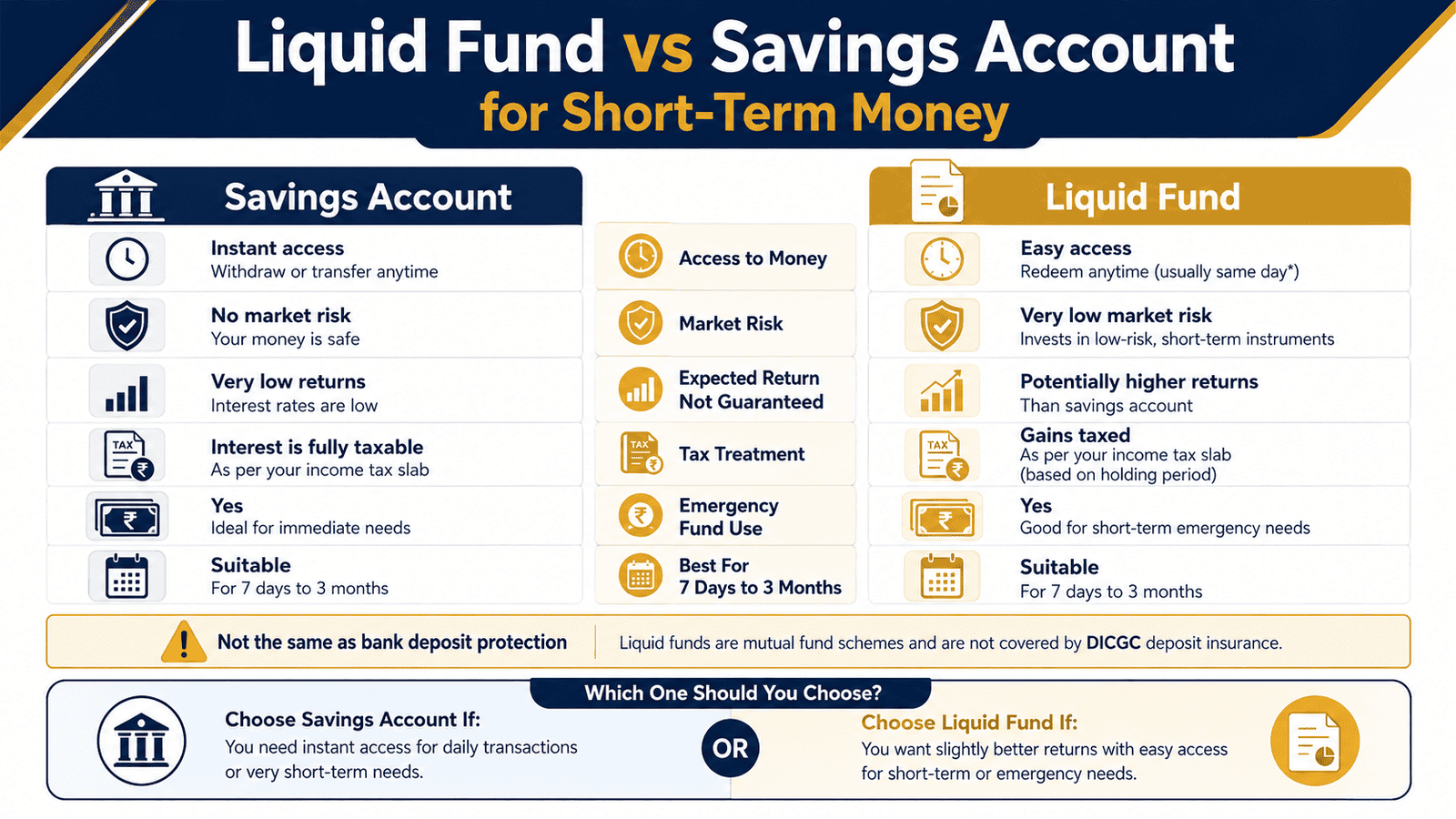
Liquid Fund vs Savings Account: Side-by-Side Comparison
| Parameter | Liquid Fund | Savings Account |
|---|---|---|
| Product type | Debt mutual fund — regulated by SEBI | Bank deposit — regulated by RBI |
| Capital safety | Not guaranteed. NAV can move. No DICGC cover. | Protected up to ₹5 lakh per depositor per bank under DICGC |
| Returns | Market-linked. Not guaranteed. Varies by scheme and market conditions. | Fixed rate set by bank. Typically lower, but certain. Verify current rates at savings account interest rules. |
| Liquidity | Redemption typically T+1 business day. Instant redemption available up to a limit — verify with AMC. | Instant withdrawal via ATM, UPI, or net banking at any time |
| Taxation | Gains added to income; taxed at your applicable slab rate (debt mutual fund taxation rules — verify current treatment at incometax.gov.in) | Interest income added to income; taxed at slab rate. TDS applies above ₹10,000/year in interest. |
| Exit load | May apply for redemptions within the first few days — check scheme document | None |
| Best suited for | Short-term surplus money with a time horizon of a few weeks to a few months | Daily transaction money, immediate emergency cash, operational buffer |
Note: Savings account interest rates referenced above are illustrative. Actual rates vary by bank and are set by each bank’s board, subject to RBI guidelines. Always verify current rates directly with your bank or at rbi.org.in.
Key Facts at a Glance
| Feature | Detail |
|---|---|
| Product category | Debt mutual fund — liquid fund category, regulated by SEBI |
| What it invests in | Treasury bills, commercial paper, certificates of deposit, short-term money-market instruments |
| Residual maturity of instruments | Up to 91 days (verify current SEBI category rule at sebi.gov.in) |
| Lock-in period | No lock-in, but exit load may apply for early redemption (verify current exit load terms in scheme document) |
| Redemption timeline | Typically T+1 business day; instant redemption may be available up to a capped limit — verify with AMC |
| Risk level | Low within the mutual fund universe — but not zero. Credit and interest-rate risk apply. |
| Returns | Market-linked, not guaranteed. Returns vary by scheme and market conditions. |
| Taxation | Gains taxed at your applicable income-tax slab rate (verify current debt fund taxation at incometax.gov.in) |
| Regulatory oversight | SEBI (Securities and Exchange Board of India) — sebi.gov.in |
What Is Liquid Fund Meaning — Explained Simply
A liquid fund is a category of mutual funds that sits within the debt fund universe. Instead of investing in stocks or long-duration bonds, a liquid fund pools investor money and deploys it into very short-term debt instruments — things like Treasury bills issued by the Government of India, commercial paper issued by large corporates, and certificates of deposit issued by banks.
The key feature is maturity. According to SEBI’s mutual fund categorisation framework, liquid funds are required to invest in instruments with a residual maturity of up to 91 days. This short maturity window is important — it is the reason liquid funds have relatively lower sensitivity to interest-rate changes compared to longer-duration debt funds.
Why Short Maturity Matters
When interest rates in the economy change, the prices of existing debt instruments move in the opposite direction. A bond maturing in 10 years is far more sensitive to a rate change than a Treasury bill maturing in 45 days. Because liquid funds hold only very short-maturity paper, large swings in NAV are less common than in long-duration or gilt funds. But “less common” is not the same as “impossible.”
How NAV Works in a Liquid Fund
Your investment in a liquid fund is reflected as units at a Net Asset Value (NAV). When you invest ₹1,00,000, you receive units based on the NAV on that day. As the underlying instruments accrue returns, the NAV rises — slightly, day by day. If a credit event hits a portfolio holding (for example, if an issuer of commercial paper defaults), NAV can fall. This is why liquid funds are not equivalent to a savings account. For a plain explanation of how NAV works, see our guide on mutual fund NAV meaning.
Liquid Fund vs Debt Fund vs Savings Account
A debt mutual fund is the broader category. Liquid funds are one specific sub-category within debt funds — characterised by the 91-day maturity cap. Other debt fund categories like short-duration funds, corporate bond funds, or dynamic bond funds take on more interest-rate or credit risk for potentially higher returns. A savings account is not a mutual fund at all — it is a bank product with capital protection up to ₹5 lakh per depositor per bank under DICGC insurance.
What “Liquid” Actually Means
The word “liquid” in liquid fund does not mean the same thing as instant access. It signals that the underlying instruments are short-term and relatively easy to convert to cash — easier than equity shares or long-term bonds. But your money in a liquid fund is still subject to a redemption process. Redemption requests typically settle on the next business day (T+1). Some AMCs offer instant redemption up to a capped amount, but this is not universal and the cap matters. If you need ₹1,00,000 urgently at 11 PM on a Sunday, a liquid fund cannot deliver it the way a savings account or UPI can.
Real Example: Ananya’s ₹1,00,000 Parking Decision
Ananya, 31, a product manager in Bengaluru earning ₹22 lakh per year, received a ₹1,00,000 performance bonus in April. She knows the money will be needed in about 45 days — it is earmarked for her apartment’s security deposit when she renews her lease. Her options are: leave it in her savings account, or park it in a liquid fund for 45 days.
If she keeps it in her savings account, she earns interest at her bank’s prevailing savings rate — certain, instantly accessible, and zero paperwork. The return is modest but completely predictable.
If she moves it to a liquid fund, she may earn a slightly higher return over 45 days, but she needs to account for: the expense ratio of the scheme, exit load if she redeems within the first few days (she should verify the specific scheme’s terms), and the tax on gains at her income-tax slab rate (30% plus surcharge and cess for her income level). After accounting for tax, the net advantage over her savings account may narrow considerably.
Crucially, Ananya’s ₹50,000 emergency buffer — money she might need at any moment — should stay in her savings account regardless. Moving all short-term money to a liquid fund to chase a marginal return difference is not the right trade-off when certainty and instant access matter more.
How to Calculate Your Approximate Short-Term Return
Approximate return = Principal × Annual return rate × (Holding days ÷ 365)
This formula gives a rough pre-tax estimate. It does not account for daily NAV compounding, expense ratio deductions, or exit load.
Illustrative example (figures are assumptions for calculation purposes only — not a forecast):
Assume ₹1,00,000 parked for 30 days, with an illustrative gross annual return of 6.5% (this is an assumption only — actual liquid fund returns vary by scheme and market conditions, and no return is guaranteed).
Pre-tax return ≈ ₹1,00,000 × 6.5% × (30 ÷ 365) ≈ ₹534
If Ananya is in the 30% tax slab, her post-tax return on the liquid fund gain ≈ ₹534 × (1 − 0.30) ≈ ₹374 for 30 days.
Compare this with a savings account earning at an illustrative rate — the difference shrinks once tax is applied. For a reader in the 30% bracket, the post-tax return gap between a liquid fund and a savings account is often narrower than the headline number suggests. The Income Tax Department’s current rules on debt mutual fund gains should be verified at incometax.gov.in before making decisions based on this comparison.
Additionally, the expense ratio of the liquid fund scheme — typically low for this category, but still real — is deducted from NAV daily before you ever see a return figure. An expense ratio of even 0.20% per annum eats into a 45-day return meaningfully on a small amount. Always check the scheme’s factsheet for the actual expense ratio.
How to Decide What’s Right for You
The money is your emergency buffer and you may need it at any hour, any day — THEN keep it in a savings account. Instant access and capital safety matter more than a marginal return difference.
You have a short-term surplus with a defined time horizon of 2–8 weeks and you are comfortable with a T+1 redemption process — THEN a liquid fund may be worth considering for that portion of money. Use our emergency fund calculator to first separate how much must stay instantly accessible.
You want a completely certain return with a fixed tenure and no NAV movement — THEN a fixed deposit may suit you better than either option. Certainty of return has real value for short-term goals.
Your time horizon is as short as 1–7 days and you want an even shorter maturity exposure than liquid funds — THEN consider an overnight fund, which invests only in instruments with one-day maturity. Credit risk is lower, but returns are also typically lower.
You are in the 30% tax bracket — THEN always calculate post-tax returns before comparing a liquid fund to your savings account. The pre-tax return advantage may shrink meaningfully after applying your slab rate.
You need the money the same day and cannot wait for T+1 settlement — THEN a liquid fund is not suitable for that portion of money, even if instant redemption is offered. Verify the specific limit and process with your AMC before relying on it.
You understand how debt mutual fund NAV, taxation, and redemption timelines work — do not invest in a liquid fund simply because a competitor website called it a “better savings account.” It is not a savings account substitute.
Common Mistakes to Avoid
Treating a Liquid Fund Like a Bank Account
A liquid fund is a mutual fund scheme — not a bank deposit. Your money is not insured, and the NAV can fall if a portfolio holding defaults.
Even in the low-risk liquid fund category, events like a commercial paper issuer downgrade have caused NAV dips in the past. The risk is low but not zero.
Keep your operational and emergency cash in an actual bank account, and use a liquid fund only for money you can genuinely afford to wait T+1 for.
Ignoring Exit Load on Very Short Redemptions
Many liquid fund schemes charge an exit load if you redeem within the first few days of investment — the slab typically applies to Day 1 through Day 6 or 7 redemptions.
If you park ₹1,00,000 for just 3 days and redeem with an exit load, your net return may be lower than simply leaving the money in a savings account for those 3 days.
Always read the Key Information Memorandum (KIM) of the specific scheme before investing. Check the exit load table carefully.
Not Accounting for Taxation
Liquid fund gains are currently added to your income and taxed at your slab rate. For a reader in the 30% bracket, this significantly reduces the effective return advantage over a savings account.
Always calculate post-tax return — not just the gross return quoted in fund factsheets or comparison websites — before deciding. Verify current tax rules at incometax.gov.in.
Chasing the Highest Recent Return
Liquid fund returns vary by scheme, AMC, and portfolio quality. A fund with a slightly higher trailing return may hold riskier commercial paper or have a higher expense ratio.
Chasing a 10–15 basis point difference in headline return between liquid funds while ignoring credit quality and expense ratio is a common beginner mistake. Use the risk-o-meter and portfolio disclosure in the scheme factsheet, not just the return table.
Confusing NAV Movement With Loss
New investors sometimes panic when they check their liquid fund balance and find it slightly different from what they expected. NAV in a liquid fund accrues daily — it is not static like a savings account balance.
Understanding mutual fund NAV before investing prevents unnecessary redemptions at the wrong time.
Moving All Short-Term Money Out of the Savings Account
Some investors move their entire short-term buffer — including emergency money — into a liquid fund to optimise every rupee. This creates a problem the moment an unexpected expense arises on a weekend or at night.
A two-bucket approach works better: instant-access money stays in the savings account; medium-term surplus that has a defined purpose and timeline can be considered for a liquid fund.
Not Checking the Scheme Information Document
Two liquid funds from different AMCs can have meaningfully different portfolio compositions, expense ratios, and exit load structures. The Scheme Information Document (SID) and Key Information Memorandum (KIM) from the AMC are the only authoritative sources for the rules that govern your investment.
Reading only a comparison website’s summary — without verifying the actual scheme documents — is a common and avoidable error.
When This May Not Be the Right Choice
A liquid fund may not be suitable for your situation in the following cases:
You need instant, any-time access. If your money may be needed at 9 PM on a Sunday for a medical emergency or an urgent bill, a liquid fund cannot reliably deliver it. Savings accounts with UPI access are designed for this — liquid funds are not.
You are in a high tax bracket and the holding period is very short. For investors in the 30% slab redeeming within a few weeks, the post-tax return on a liquid fund may barely exceed — or in some cases not exceed — a savings account’s interest. The arithmetic deserves a calculation before a decision.
You would be disturbed by even a small, temporary NAV dip. In the rare event of a credit event in a liquid fund’s portfolio, NAV can fall — even if temporarily. If you cannot tolerate even a ₹50 dip on a ₹1,00,000 investment, the psychological cost of monitoring a mutual fund scheme is probably not worth the marginal return difference.
Your short-term corpus is your only financial buffer. If ₹1,00,000 is all the money you have available and it doubles as your emergency fund and your upcoming expense fund, keeping it in a simple savings account is the more sensible choice. Complexity adds risk when the margin for error is thin.
If any of these apply to your situation, it may be worth exploring alternatives before committing.
Official Rules and Where to Verify
Liquid fund rules, taxation, exit load norms, and category definitions can change with each SEBI circular, Union Budget, or RBI policy update. Do not rely on any third-party article — including this one — as your final source of truth for figures that affect your financial decision.
Verify current rules from the following official sources:
- SEBI (Securities and Exchange Board of India) — sebi.gov.in: Mutual fund categorisation rules, liquid fund category definition, residual maturity norms, investor education resources, and AMC regulatory filings.
- Scheme Information Document (SID) and Key Information Memorandum (KIM): Published by each AMC for each scheme. Contains current exit load, portfolio mandate, expense ratio, redemption process, and risk factors specific to that fund.
- RBI (Reserve Bank of India) — rbi.org.in: Bank deposit insurance information, savings account interest rate framework, and monetary policy context.
- Income Tax Department — incometax.gov.in: Current tax treatment of debt mutual fund gains, applicable slab rates, TDS provisions, and any Finance Act amendments.
- AMC fund factsheet: Monthly document published by each Asset Management Company, showing current portfolio holdings, average maturity, credit quality distribution, expense ratio, and AUM.
Rules, limits, and rates on this topic can change with each Budget or regulatory update. Always verify current figures directly from the official source before making any financial decision.
Expert Tips
- Do not compare liquid funds on headline returns alone. Two schemes with similar trailing returns can have very different credit quality profiles and expense ratios. A scheme holding lower-rated commercial paper to push returns by 15 basis points is taking more risk than one holding only T-bills. Check the portfolio disclosure in the factsheet before deciding.
- Always check the expense ratio of the specific scheme. Even within the liquid fund category, expense ratios vary. A difference of 0.20% per annum may sound small, but on a ₹5,00,000 parking for 60 days, it is a real rupee impact. Understand how the expense ratio eats into your returns before selecting a scheme.
- Split your short-term money into two buckets. Keep 2–3 months of essential expenses in your savings account for true emergencies. Consider parking anything beyond that minimum — with a defined 4–8 week time horizon — in a liquid fund if the post-tax return advantage justifies the process. Do not move the core buffer.
- If your time horizon is under one week, consider an overnight fund instead. Overnight funds invest in instruments maturing the next business day — credit risk is minimal and portfolio churn is daily. For very short parking needs, the lower return of an overnight fund may be the right trade-off for peace of mind.
- Review your tax position before redeeming. If you are close to a financial year-end and your total income is near a slab boundary, the timing of a liquid fund redemption can push you into a higher tax bracket. Consider this before redeeming large amounts in March.
- Use direct plans if you are investing via an AMC platform or MF utility. Regular plans carry distributor commissions that reduce NAV. For a short parking period where returns are thin to begin with, the expense ratio difference between direct and regular plans has a proportionally larger impact than it does in a long-term equity fund.
- Simplicity has real value for short time horizons. If processing a mutual fund redemption, checking NAV, and managing taxation adds stress for a marginal return difference of ₹200–400 on ₹1,00,000 over 45 days, the savings account is the right answer for you. Return optimisation is only useful when the process cost — in time, attention, and anxiety — is lower than the benefit.
Frequently Asked Questions
Is a liquid fund safe?
Liquid funds are considered low-risk within the mutual fund category, but they are not safe in the way a bank savings account is safe. Your capital is not insured by DICGC, and NAV can fall if a portfolio holding defaults or is downgraded. The risk is low but not zero. SEBI requires liquid funds to assign a risk-o-meter rating — check the scheme’s current rating in its factsheet before investing.
Can a liquid fund give negative returns?
Yes — in rare circumstances. If a holding in the fund’s portfolio is downgraded or defaults, the fund’s NAV can fall, giving you a negative return for that period. This is uncommon but has occurred with some debt fund schemes in India. It is more likely in schemes with lower credit quality holdings than in those holding only government securities.
Is liquid fund better than a savings account?
It depends on your specific situation — and this is a case where “it depends” has a direct answer. For very short-term surplus money where you can wait T+1 for redemption, a liquid fund may offer a post-tax return advantage. For emergency money or operational cash needed at any moment, a savings account is more suitable. For investors in the 30% tax bracket with very short holding periods, the post-tax advantage of a liquid fund may be minimal.
What is the liquid fund redemption time?
Standard redemption requests are typically processed and credited to your bank account on the next business day (T+1). Some AMCs offer instant redemption — money credited within minutes — up to a capped limit per day, per investor. Verify the specific cap and process with your AMC before relying on instant redemption for a large sum.
Is a liquid fund good for an emergency fund?
Partially. A liquid fund can hold a portion of your non-immediate emergency buffer — money you may need in 1–4 weeks rather than tonight. But your immediate, first-access emergency cash should stay in a savings account for instant availability. Never put your entire emergency corpus in a liquid fund. For calculating the right split, see our emergency fund calculator.
How is a liquid fund taxed in India?
Under current rules, gains from debt mutual funds — including liquid funds — are added to your total income and taxed at your applicable income-tax slab rate. There is no separate long-term/short-term distinction for gains from debt mutual funds under current tax law (verify the latest position at incometax.gov.in, as debt fund taxation has seen significant rule changes and may change again). TDS may also apply in certain cases.
What is the difference between a liquid fund and an overnight fund?
Both are debt mutual fund categories. A liquid fund invests in instruments with a residual maturity of up to 91 days. An overnight fund invests only in instruments maturing the next business day — effectively rolling the portfolio over every single day. Overnight funds have lower credit risk and near-zero interest-rate risk, but typically offer lower returns. If your surplus is for 1–7 days, an overnight fund may be more appropriate; for 2–8 weeks, a liquid fund is the more common choice.
What is exit load in a liquid fund?
Exit load is a small charge deducted when you redeem your units before a specified holding period. In liquid funds, exit load is typically structured as a graded slab for the first 6 or 7 days of holding — Day 1 carries the highest exit load, which reduces each day and reaches zero from Day 7 or later. Verify the exact exit load table in the scheme’s Key Information Memorandum (KIM) before investing, as it varies by scheme and AMC.
Is a liquid fund a good option for parking money before an SIP?
Some investors park a lump sum in a liquid fund and run a Systematic Transfer Plan (STP) into an equity fund. This is a common strategy for staggering equity investments. However, it adds complexity — taxation applies on each STP redemption from the liquid fund. Understand the full tax and process implications before using this approach. For basics on how SIPs work, see our guide on debt mutual fund meaning and safety.
Can I invest in a liquid fund with as little as ₹500?
Yes — many liquid fund schemes accept minimum investments of ₹500 or ₹1,000, though the minimum varies by AMC and plan. For very small amounts over very short periods, ensure the potential return after tax and expense ratio is worth the effort of setting up the investment and managing the redemption process.
Final Verdict
Liquid fund meaning — in practical terms — is a short-term debt mutual fund that offers a potentially more productive home for surplus money compared to a savings account, within a specific set of conditions. For a salaried investor with a defined short-term surplus, a clear time horizon, and the ability to wait T+1 for redemption, a liquid fund can be a sensible parking choice — not a guaranteed winner.
For immediate emergency cash, daily transaction money, or any amount you may need at any hour on any day, a savings account remains the right answer. The simplicity, instant access, and deposit insurance of a savings account have real value that headline return comparisons do not capture.
The right decision depends on your time horizon, tax bracket, the specific scheme’s credit quality and expense ratio, and your operational access needs. For beginners, understanding what a liquid fund actually is — a mutual fund, not a bank account — matters more than optimising for an extra ₹300 on a ₹1,00,000 parking. Always verify the latest rules from official sources or consult a qualified professional before making any financial decision.
This article is for educational purposes only and should not be treated as personalised financial, tax, investment, insurance, or legal advice. Tax rules, interest rates, regulatory limits, and product features can change with each Budget or policy update. Please verify current rules from official government sources or consult a qualified and registered professional before making any financial decision.
Mutual fund investments are subject to market risks. Past performance does not guarantee future returns. Please read all scheme-related documents carefully before investing. Reference: SEBI — sebi.gov.in.

Arjun Kapoor writes about mutual funds, SIPs, ELSS, fund categories, investment returns, and beginner investing concepts for Indian readers. His focus is on education, not product promotion or fund recommendations. He helps readers understand how mutual funds work before they start investing or comparing schemes.
He covers topics such as mutual fund meaning, SIP meaning, SIP calculator, direct mutual funds vs regular plans, NAV, ELSS tax-saving funds, CAGR, absolute returns, XIRR, expense ratio, large cap vs mid cap vs small cap funds, flexi cap funds, index funds vs active funds, liquid funds, debt mutual funds, SIP pause vs SIP stop, lumpsum vs SIP, and how to start SIP in India.
Arjun’s writing is simple, risk-aware, and long-term oriented. He avoids guaranteed-return language and explains investment concepts using examples, timelines, and comparison tables. His articles remind readers that mutual fund investments are subject to market risks, and past performance does not guarantee future returns. Readers should verify scheme details from SEBI, AMFI, fund houses, and official scheme documents.