

You have probably heard someone say “your money will double in X years” — and wondered how they calculated that so quickly, without a spreadsheet or calculator. That one-line estimate usually comes from a concept called the Rule of 72, a mental shortcut that every first-time investor in India should know about. Understanding personal finance basics starts with exactly this kind of simple, practical tool. The Rule of 72 does not guarantee anything. It gives you a quick estimate — and that estimate is surprisingly useful for comparing options, spotting the difference a few percentage points make, and understanding why starting early matters so much in investing.
Quick Answer: Rule of 72
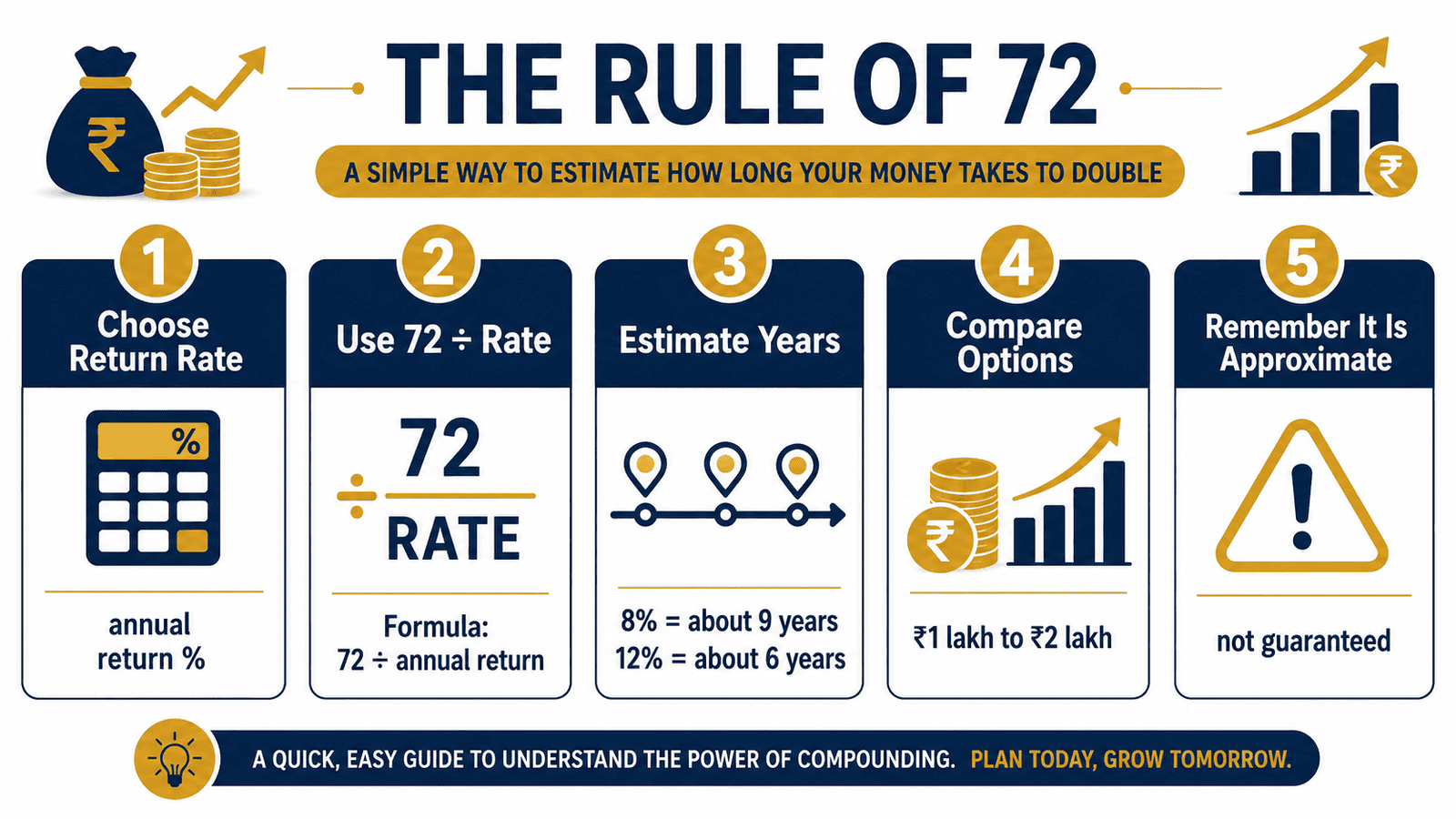
Rule of 72 is a quick way to estimate when money may double under compounding. Divide 72 by the assumed annual return rate. For example, at 8% annual return, ₹1 lakh may become about ₹2 lakh in around 9 years, before taxes, inflation, fees, and market risk.
Key Takeaways
- The Rule of 72 formula is simple: divide 72 by your assumed annual return rate to get the approximate number of years for money to double under compounding.
- At an assumed 8% return, ₹1 lakh may take around 9 years to become ₹2 lakh — before taxes, fees, and inflation are accounted for.
- At an assumed 12% return, the same ₹1 lakh may double in about 6 years — but higher assumed returns typically involve higher risk or greater uncertainty.
- The rule also works in reverse: at 6% inflation, the purchasing power of ₹1 lakh may halve in about 12 years.
- The Rule of 72 assumes a steady, fixed annual return — which does not reflect how most real investments, including equity mutual funds and stocks, actually behave.
- Taxes, exit loads, fund expenses, and irregular contributions are not captured by this formula — always use a proper calculator for goal-based planning.
- Use this rule for quick mental comparisons and financial awareness, not as a basis for choosing a specific product or committing money.
Key Facts at a Glance
| Parameter | Detail | Note |
|---|---|---|
| Formula | 72 ÷ assumed annual return % = approximate doubling years | Works under compound interest only |
| Example (assumed 8%) | 72 ÷ 8 = approximately 9 years | Return assumed, not guaranteed |
| Example (assumed 12%) | 72 ÷ 12 = approximately 6 years | Higher return = higher risk assumption |
| Best use | Quick mental comparison and financial awareness | Not for detailed planning or product selection |
| Inflation version | 72 ÷ inflation rate = years for purchasing power to halve | Shows how inflation silently erodes wealth |
| Not suitable for | Guaranteed projections, volatile returns, SIPs with irregular amounts | Use a proper calculator instead |
How the Rule of 72 Works
Money grows differently depending on whether it earns simple interest or compound interest. With simple interest, you earn the same fixed amount on your original principal every year. With compounding, you also earn interest on the interest already accumulated — which means growth accelerates over time. That acceleration is why the Rule of 72 exists, and why it is so powerful as a mental tool.
Read more about why this distinction matters in our guide on the power of compounding.
Why Doubling Time Depends on Your Return Rate
Under compounding, a higher annual return rate means your money grows faster each year — because a larger base earns return in the following year. A lower rate means slower acceleration. The Rule of 72 captures this relationship in one simple division: divide 72 by the assumed annual return percentage, and the result is roughly how many years it will take for your money to double.
This is very different from simple interest, where doubling time is always exactly 100 ÷ rate — no compounding benefit included. If you deposit ₹1 lakh at 8% simple interest, you earn ₹8,000 per year, and it takes exactly 12.5 years to reach ₹2 lakh. Under compounding at the same rate, the Rule of 72 estimates the doubling happens in around 9 years — because each year’s return is added to the growing base. For a deeper comparison, see our article on simple interest vs compound interest.
The Formula in Plain Terms
The rule of 72 formula is:
Years to double ≈ 72 ÷ annual return rate (%)
This gives you an approximation. It is most accurate in the 6%–12% return range. At very low rates (below 4%) or very high rates (above 15%), the approximation becomes less reliable — the actual doubling time will differ more noticeably from the formula’s output.
The Critical Assumption Behind the Formula
The Rule of 72 assumes a steady, fixed annual return every single year. In reality, very few investments deliver this. Fixed deposits at a bank or PPF contributions earn a defined rate for a fixed period — and the Rule of 72 is reasonably applicable to these. But equity mutual funds, stocks, and even debt funds with changing interest rate environments deliver returns that vary year on year. Applying the Rule of 72 to variable-return products gives you a rough directional sense — not a reliable projection.
Nominal Return vs Real Return
The return rate you use in the formula matters enormously. If you assume 8% annual return but inflation is running at 6%, your real return — the actual increase in purchasing power — is only about 2%. At that real rate, the Rule of 72 gives 72 ÷ 2 = 36 years for your purchasing power to double. That is very different from the 9 years suggested by the nominal 8% figure. Always be clear about whether you are working with nominal return or real return when applying the formula.
Real Example: Rohan’s ₹1 Lakh and Two Scenarios
Rohan, 29, is a software engineer in Pune earning ₹85,000 per month. He has just started reading about SIPs and FDs and wants to understand how long it might take for ₹1 lakh of savings to become ₹2 lakh.
Scenario A — Assumed 8% annual return: Rohan applies the formula: 72 ÷ 8 = 9. At an assumed steady 8% return per year, his ₹1 lakh may become approximately ₹2 lakh in around 9 years — before taxes, fund expenses, and any impact of inflation on purchasing power.
Scenario B — Assumed 12% annual return: If Rohan assumes 12% annual return (as some equity mutual funds have delivered over certain past periods, though past performance does not guarantee future results), the formula gives 72 ÷ 12 = 6. His ₹1 lakh may potentially double in about 6 years — but this higher assumed return typically means higher market risk and greater volatility along the way.
Rohan notes, correctly, that neither scenario is a guarantee. According to SEBI’s investor education resources at sebi.gov.in, returns on market-linked investments are not fixed and depend on market performance. The Rule of 72 gives him a mental benchmark — not a contract.
How to Calculate Your Doubling Time
Doubling Time (years) ≈ 72 ÷ Assumed Annual Return (%)
Step 1: Choose your assumed annual return rate — be honest about whether this is a fixed rate (like an FD rate) or an assumed rate for a variable product.
Step 2: Divide 72 by that rate. This gives you the approximate number of years for your money to double under compounding.
Step 3: Interpret the result as an approximation, not a prediction. The formula is most reliable between 6% and 12%.
Step 4: Adjust your expectations. Taxes on returns (such as long-term capital gains tax or interest income tax), fund management expenses, exit loads, and the effect of inflation will all reduce your effective outcome.
Step 5: Use a dedicated calculator for any real financial goal. The Rule of 72 is for quick thinking — not detailed planning.
| Assumed Annual Rate | Formula Output | Approximate Doubling Time |
|---|---|---|
| 6% (illustrative) | 72 ÷ 6 | ~12 years |
| 8% (illustrative) | 72 ÷ 8 | ~9 years |
| 10% (illustrative) | 72 ÷ 10 | ~7.2 years |
| 12% (illustrative) | 72 ÷ 12 | ~6 years |
Comparison: Doubling Time at Different Assumed Rates and Inflation Scenarios
| Assumed Annual Rate / Inflation | Approximate Doubling / Halving Time | What It Means in Practice |
|---|---|---|
| 4% assumed return (illustrative) | ~18 years | Very conservative assumption; typically low-risk instruments. Low Risk |
| 6% assumed return (illustrative) | ~12 years | Moderate conservative assumption; some fixed income products. Low-Moderate |
| 8% assumed return (illustrative) | ~9 years | Mid-range assumption; often used as a planning benchmark. Moderate |
| 10% assumed return (illustrative) | ~7.2 years | Higher assumption; usually involves market-linked products with volatility. Moderate-High |
| 12% assumed return (illustrative) | ~6 years | Aggressive assumption; equity exposure; past performance not indicative of future. Higher Risk |
| 4% inflation scenario | ~18 years to halve purchasing power | Lower inflation: wealth erosion is slower but still present over time. |
| 6% inflation scenario | ~12 years to halve purchasing power | At 6% inflation, ₹1 lakh today may have the purchasing power of ₹50,000 in about 12 years. |
These figures are illustrative assumptions only. They do not represent current FD rates, PPF rates, mutual fund returns, or stock market performance. For context on how inflation affects your money’s real value, see our detailed guide on inflation and purchasing power. According to RBI data available at rbi.org.in, inflation trends in India are published regularly — always check current figures before making planning assumptions.
How to Decide What’s Right for You
you want a quick mental estimate of how long a fixed-rate product might take to double your money — THEN the Rule of 72 is perfectly appropriate; divide 72 by the rate and use it as a rough benchmark.
you are planning a goal like building a retirement corpus or buying a house — THEN move beyond the Rule of 72 and use a proper calculator; a SIP calculator handles variable contributions, step-ups, and realistic timelines far better than this shortcut.
you are comparing two investment options at very different assumed return rates — THEN also compare the risk level; a higher doubling-time advantage disappears if the product is far more volatile or uncertain.
you want to understand how inflation is affecting your savings — THEN apply the rule to the inflation rate instead: 72 ÷ inflation rate gives you the years before your purchasing power approximately halves.
you are a beginner learning about compounding and want a simple number to anchor your understanding of long-term investing — THEN the Rule of 72 is an excellent starting point for building financial intuition.
you understand that the assumed return rate in any Rule of 72 calculation is just that — an assumption — you should not use this formula to compare products, make investment decisions, or set expectations for what any specific scheme will deliver.
Common Mistakes to Avoid
Treating Assumed Returns as Guaranteed Returns
The Rule of 72 requires you to input an annual return rate — but for most real investments, that rate is an assumption, not a commitment.
Assuming a mutual fund will deliver 12% every year because it did so over some past period is dangerous. Markets do not deliver smooth, fixed returns. Applying the formula with unrealistic return assumptions gives you a misleading doubling time — and can lead to serious underestimation of how long it actually takes to build wealth.
Always label any return rate you use as an assumption and stress-test your plan at lower rates, such as 6% or 7%.
Ignoring Tax on Returns
The formula gives you a gross doubling time — before any tax is applied to your returns.
Interest income from FDs is added to your taxable income and taxed at your slab rate. Long-term capital gains on equity funds above ₹1.25 lakh per year are taxed at 12.5%. These taxes reduce your effective annual return, which means your actual doubling time is longer than the formula suggests. A salaried employee in the 30% bracket earning 8% FD interest is effectively earning closer to 5.6% after tax — giving a doubling time nearer 13 years, not 9.
Always apply the Rule of 72 to your after-tax return for a realistic estimate.
Forgetting Fund Expenses and Exit Loads
Mutual funds deduct an expense ratio each year — typically ranging from around 0.1% for direct index funds to over 1.5% for some actively managed funds.
On an assumed 10% return, a 1.5% expense ratio brings your net return to about 8.5% — adding more than half a year to your doubling time. Exit loads further reduce actual proceeds if you redeem early. These are real costs that the Rule of 72 does not capture unless you subtract them from your assumed return before applying the formula.
Use the net return after expenses when applying the formula to fund investments.
Applying the Rule to Highly Volatile Assets
The formula assumes a steady annual return. Equity markets, cryptocurrency, and some sectoral funds can swing by 30%–40% in a single year in either direction.
Applying the Rule of 72 to these assets produces a number that may bear no relationship to actual outcomes. In a year where the market falls 25%, you are not on track for a smooth doubling — you are significantly behind. The formula does not account for sequence of returns, which matters enormously for volatile assets.
Reserve the Rule of 72 for relatively stable, predictable return assumptions.
Ignoring Inflation
A common error is celebrating that ₹1 lakh will become ₹2 lakh in 9 years — without accounting for what ₹2 lakh will actually buy in 9 years.
At 6% inflation, purchasing power halves in about 12 years. If your money doubles in 9 years at 8% nominal return but inflation runs at 6%, your real wealth has grown — but far less than the nominal doubling suggests. Real return ≈ nominal return minus inflation rate, which at these figures is about 2% — giving a real doubling time of around 36 years.
Always calculate your real return alongside nominal return.
Using it for SIPs or Irregular Investments
The Rule of 72 applies to a lump-sum investment where the full amount compounds from day one. SIPs invest a fixed amount every month — each instalment has a different time in the market and a different compounding period.
Applying the Rule of 72 to a SIP return assumption will give you a meaningless output. Use a SIP calculator instead, which correctly accounts for the timing of each contribution.
Comparing Products at Different Risk Levels Using Only Doubling Time
A scheme claiming 18% assumed return doubles money in only 4 years by the formula — but at that assumed return level, risk is almost certainly very high, the scheme may not be regulated, or the projection may simply be unrealistic.
Doubling time alone is not a comparison metric. Risk, regulatory status, liquidity, and track record must all be considered alongside it. A shorter doubling estimate is not better if it comes with dramatically higher risk of losing the principal.
When This May Not Be the Right Choice
The Rule of 72 is a useful shortcut, but it breaks down in several specific situations. If you are investing through a SIP with step-up contributions, making partial withdrawals, or using a product with variable interest rates, the formula cannot account for those moving parts — actual outcomes will differ significantly from its output.
If you are evaluating highly volatile assets like direct equities or small-cap funds, the assumption of a steady annual return embedded in the formula is not realistic. Applying a long-run average return to these products can create false confidence.
If you are in a higher tax bracket and your returns are taxed as income (as FD interest is), the post-tax doubling time will be meaningfully longer than the formula suggests — and the gap widens as your income and tax rate increase.
Finally, if you are doing serious financial planning — for retirement, children’s education, or a large purchase — the Rule of 72 is too rough to base decisions on. Exact calculators, cash flow modelling, and ideally professional guidance are more appropriate at that stage. According to SEBI’s investor education guidelines at sebi.gov.in, investors are encouraged to use detailed planning tools and seek registered investment advisers for personal financial goals.
If any of these apply to your situation, it may be worth exploring alternatives before committing.
Official Rules and Where to Verify
The Rule of 72 is a mathematical concept and does not have a governing regulatory authority. However, the investments and products you apply it to are regulated in India. Always verify current rates, rules, and product terms from official sources before making any financial decision.
- SEBI (Securities and Exchange Board of India) — sebi.gov.in: For information on mutual funds, investor education, registered investment advisers, and market-linked investment regulations.
- RBI (Reserve Bank of India) — rbi.org.in: For banking regulations, FD-related guidelines, inflation data, and monetary policy context.
- Product providers — individual AMC websites, bank portals, and scheme information documents: For actual fund expense ratios, exit loads, current FD rates, and PPF interest rate notifications.
Rules, limits, and rates on this topic can change with each Budget or regulatory update. Always verify current figures directly from the official source before making any financial decision.
Expert Tips
- Use it as a first filter, not a final answer. When you hear a new investment product or scheme, apply the Rule of 72 immediately to sense-check the claimed return. If someone says your money will double in 3 years, that implies an assumed annual return of 24% — which should prompt serious scrutiny about the risk and reliability of that claim.
- Always calculate real return alongside nominal return. Subtract the prevailing inflation rate from your assumed return before applying the formula. If you assume 9% return and inflation is 5%, your real return is approximately 4% — giving a real doubling time of 18 years, not 8.
- Use conservative assumptions when planning. For retirement and long-term goal planning, consider running the formula at a return rate 2%–3% below your optimistic estimate. This builds in a buffer for bad years, higher inflation, or regulatory changes that affect product rates.
- Combine the rule with a proper calculator for any real goal. For retirement corpus estimation, a SIP with step-up contributions, or education planning, use a dedicated calculator — not the Rule of 72 alone. Read our guide on retirement corpus planning to understand what realistic numbers look like for Indian salaried employees.
- Recheck your return assumptions annually. Interest rates on FDs and PPF change. Mutual fund expense ratios can be revised. The return assumption you used two years ago may no longer be valid — revisit your doubling-time estimates periodically and adjust your planning accordingly.
- Apply the inflation version proactively. Every year you delay investing, inflation is running the reverse Rule of 72 on your cash savings. At 6% inflation, idle cash roughly halves in purchasing power in about 12 years — a concrete, sobering reminder of why time matters in personal finance.
- Never use doubling time as a sales pitch validator. Advertisements, scheme promoters, and social media posts frequently use doubling-time language to create excitement. The Rule of 72 is a tool for your analysis — not a reason to trust someone else’s projection.
Frequently Asked Questions
What is the Rule of 72?
The Rule of 72 is a simple mental shortcut to estimate how many years it may take for a sum of money to double under compound interest. You divide 72 by the assumed annual return rate to get the approximate doubling time. It is an approximation, not a guaranteed outcome, and works best for return rates in the 6%–12% range.
What is the Rule of 72 formula?
The formula is: Years to double ≈ 72 ÷ Annual Return Rate (%). For example, at an assumed 9% annual return, 72 ÷ 9 = 8 years. The result is approximate — the actual outcome depends on whether the return is truly fixed and compounding annually, and whether taxes and expenses have been factored in.
Is the Rule of 72 accurate?
It is reasonably accurate for steady annual return rates between about 6% and 12%. Outside that range, the approximation becomes less reliable. It also becomes inaccurate when applied to variable-return products, tax-affected returns, or investments with irregular contributions. Use it as a rough guide, not a precise calculation.
Can the Rule of 72 be used for SIPs?
No — not meaningfully. A SIP invests a fixed amount each month, and each instalment compounds for a different period. The Rule of 72 applies to a single lump sum invested at a fixed rate. Applying it to an assumed SIP return gives a misleading result. Use a dedicated SIP calculator for accurate SIP projections.
Does the Rule of 72 work for inflation?
Yes. You can reverse the application: divide 72 by the prevailing inflation rate to estimate how many years it may take for the purchasing power of money to halve. At an assumed 6% inflation, 72 ÷ 6 = approximately 12 years before ₹1 lakh today has the purchasing power of roughly ₹50,000.
How long will money take to double at an assumed 8% return?
Using the Rule of 72: 72 ÷ 8 = 9 years. This is before taxes, fund expenses, and inflation. After applying a 30% income tax on interest (for a higher-bracket salaried employee), the effective return drops to about 5.6%, and the doubling time extends to approximately 13 years. The rule gives the gross estimate — taxes and costs can significantly extend the real timeline.
Is doubling money guaranteed using the Rule of 72?
No. The Rule of 72 is an estimation tool that assumes a fixed, steady annual return. No market-linked investment guarantees a fixed annual return. Even fixed-rate products like FDs and PPF are subject to rate changes at different points. The rule gives you a useful ballpark — it is not a guarantee of any outcome.
What is the Rule of 72 for compound interest specifically?
The Rule of 72 is designed for compound interest — it does not work for simple interest. With simple interest, doubling time is 100 ÷ rate, and there is no compounding benefit. The Rule of 72 accounts for the accelerating growth effect of compounding, where each year’s return is added to the growing principal before the next year’s return is calculated.
Can I use the Rule of 72 for inflation and real return together?
Yes, and it is highly recommended. First apply it to your nominal return to estimate how long before your money doubles in nominal terms. Then apply it to the inflation rate to see how long before purchasing power halves. The gap between those two timelines tells you how much real wealth you are actually building. A nominal doubling in 9 years alongside a purchasing power halving in 12 years means your real wealth is growing — but more slowly than the headline number suggests.
What are the limitations of the Rule of 72?
The main limitations are: it assumes a fixed annual return; it ignores taxes, fees, and inflation unless you adjust the input rate; it does not apply to SIPs or irregular cash flows; it becomes less accurate at very low or very high return rates; and it gives no information about risk. It is a tool for financial intuition — not a substitute for detailed financial planning.
Final Verdict
The rule of 72 is one of the most practical tools in personal finance — not because it is precise, but because it builds intuition quickly. It helps beginners in India understand why an extra 2% annual return matters enormously over time, why inflation is a silent threat to idle savings, and why starting early is not just good advice but a mathematical advantage. Use it to develop your financial thinking, compare options at a high level, and appreciate the power of compounding over long time horizons.
It is not a promise. It is not a substitute for a proper calculator or a qualified financial adviser. The assumed return you input is exactly that — an assumption. Real investments involve taxes, fees, market risk, and changing regulations. If you are planning a significant goal, always verify current product rates and rules, use dedicated planning tools, and consider professional guidance.
Always verify the latest rules from official sources or consult a qualified professional before making any financial decision.
This article is for educational purposes only and should not be treated as personalised financial, tax, investment, insurance, or legal advice. Tax rules, interest rates, regulatory limits, and product features can change with each Budget or policy update. Please verify current rules from official government sources or consult a qualified and registered professional before making any financial decision.

Sanya Malhotra writes about everyday personal finance for Indian individuals and families. Her content focuses on budgeting, saving, emergency funds, debt control, net worth tracking, family money decisions, and practical habits that help readers manage money with more confidence.
She covers topics such as monthly budgeting, expense planning, saving habits, emergency fund behaviour, debt repayment, household financial planning, family discussions about money, financial mistakes, net worth tracking, short-term vs long-term goals, and beginner personal finance concepts.
Sanya’s writing style is warm, simple, and realistic. She avoids making personal finance feel intimidating and instead explains money decisions through relatable Indian examples, ₹ budgets, checklists, and step-by-step frameworks. Her articles are useful for students, freshers, couples, parents, and families who want to improve daily money habits. Her content is educational and does not provide personalised financial advice. Readers should adapt examples to their own income, family responsibilities, city, debt level, risk comfort, and financial goals.