

You open two FD brochures. Both say 8% interest. Both have a ₹1,00,000 minimum. Three years later, one pays ₹1,24,000 and the other pays ₹1,25,971. Same principal. Same rate. Same tenure. Different maturity amount. The reason is simple interest vs compound interest — two formulas that look similar on paper but produce different results in your bank account.
This difference matters whenever you park money in an FD, open an RD, take a personal loan, or invest in a debt fund. Most beginners skip past it or assume the stated interest rate is the only thing that matters. It is not. How interest is calculated — and how often it is added back — determines what you actually receive.
This article explains both formulas, shows the exact ₹ difference using a consistent example, compares how each type applies to Indian savings and loan products, and gives you a practical framework to evaluate your own options.
Quick Answer: Simple Interest vs Compound Interest
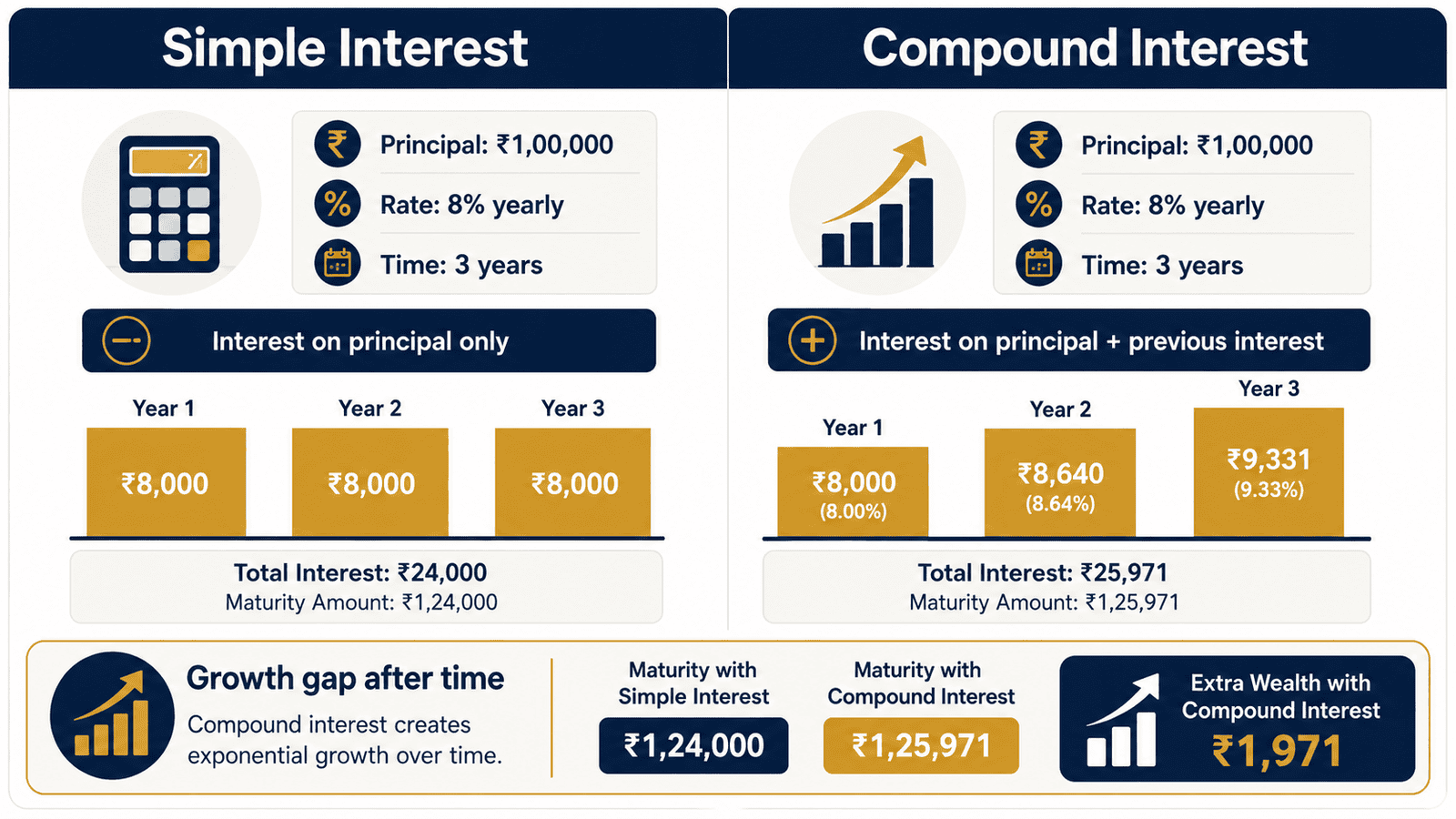
Simple interest vs compound interest compares two ways of calculating interest. In simple interest, ₹1,00,000 at 8% for 3 years earns ₹24,000 because interest applies only to principal. In compound interest, interest is added back, so annual compounding grows the amount to about ₹1,25,971, creating higher interest over time.
Key Takeaways
- Simple interest is calculated only on the original principal — ₹1,00,000 at 8% for 3 years always earns exactly ₹24,000, no matter the tenure.
- Compound interest is calculated on the principal plus all accumulated interest — the same ₹1,00,000 at 8% for 3 years (annual compounding) earns ₹25,971, about ₹1,971 more.
- The gap between simple and compound interest widens sharply with longer tenure: over 10 years at 8%, compounding annually produces roughly ₹1,15,892 in interest versus ₹80,000 in simple interest.
- Compounding frequency matters: quarterly compounding on ₹1,00,000 at 8% for 3 years gives a higher maturity amount than annual compounding on the same deposit.
- For savings products, more frequent compounding generally works in your favour; for loans, compounding can increase your total interest outgo significantly.
- Many Indian FDs compound interest quarterly but pay it at maturity — check the interest crediting frequency, not just the annual rate, before booking.
- Always compare actual maturity amounts, not headline rates — two products at the same stated rate can produce different payouts depending on their compounding structure.
Comparison: Simple Interest vs Compound Interest
| Parameter | Simple Interest | Compound Interest |
|---|---|---|
| Interest calculated on | Original principal only | Principal + accumulated interest |
| Growth pattern | Linear — grows by the same amount each period | Exponential — grows faster as tenure increases |
| Formula | SI = P × R × T / 100 | A = P × (1 + r/n)^(nt) |
| ₹1,00,000 at 8% for 3 years (illustration) | Maturity: ₹1,24,000 | Maturity: ₹1,25,971 (annual compounding) |
| Effect of longer tenure | Gap between principal and maturity stays proportional | Gap widens significantly with each passing year |
| Common Indian use cases (saver) | Some government schemes, short-term loans | Most bank FDs, RDs, savings accounts, debt mutual funds |
| Common Indian use cases (borrower) | Some flat-rate personal loans | Home loans, credit card outstanding, most EMI products |
| Easier to calculate mentally? | Yes | No — use a calculator |
Key Facts at a Glance
| Fact | Simple Interest | Compound Interest |
|---|---|---|
| Meaning | Interest earned only on the original amount deposited or borrowed | Interest earned on the principal plus all previously earned interest |
| Formula | SI = P × R × T / 100 | A = P × (1 + r/n)^(nt) |
| ₹ Example (₹1L, 8%, 3 yr) | Interest = ₹24,000; Maturity = ₹1,24,000 | Interest ≈ ₹25,971; Maturity ≈ ₹1,25,971 |
| Appears in | Some flat-rate loans, select government deposits | Bank FDs, RDs, savings accounts, mutual funds, most loans |
| Compounding frequency | Not applicable | Annual, half-yearly, quarterly, monthly |
Understanding Simple Interest and Compound Interest
Before you compare maturity amounts, it helps to understand what each formula is actually doing to your money. The difference comes down to one question: does the interest you earn in year one sit idle, or does it start earning interest of its own?
What Is Principal, Rate, and Tenure?
Every interest calculation starts with three inputs. Principal is the original amount you deposit or borrow. Rate is the annual interest percentage offered. Tenure is how long the money stays deposited or the loan remains outstanding. The maturity amount is what you receive at the end: principal plus interest.
Simple Interest: Linear Growth
In simple interest, the interest earned each year is always calculated on the same original principal. If you deposit ₹1,00,000 at 8% per annum, you earn ₹8,000 in year one, ₹8,000 in year two, and ₹8,000 in year three. The interest does not build on itself. The growth is perfectly linear — a straight line on a graph.
This predictability is useful. For short tenures, simple interest is easy to verify with mental arithmetic. Many flat-rate personal loans in India use a version of simple interest, where the EMI is calculated on the full principal for the full tenure, then divided into equal monthly payments. Understanding how FDs work clarifies why most deposit products move beyond this basic formula.
Compound Interest: Interest on Interest
Compound interest does something different. At the end of each compounding period, the interest earned is added to the principal. In the next period, interest is calculated on this larger amount. Your ₹1,00,000 becomes ₹1,08,000 after year one at 8%. Year two’s interest is not ₹8,000 — it is 8% of ₹1,08,000, which is ₹8,640. Year three’s interest is calculated on ₹1,16,640, giving ₹9,331.
The total interest earned: ₹8,000 + ₹8,640 + ₹9,331 = ₹25,971. Compare that to ₹24,000 under simple interest. The difference is ₹1,971 over just three years — and this gap accelerates the longer money stays invested.
Why Longer Tenure Amplifies the Gap
In year one, the difference between simple and compound interest on ₹1,00,000 at 8% is zero — both earn ₹8,000. By year five, compound interest has earned roughly ₹46,933 versus ₹40,000 under simple interest — a gap of ₹6,933. By year ten, compound interest has produced approximately ₹1,15,892 in total interest versus ₹80,000 under simple interest — a difference of ₹35,892. The gap is not constant; it compounds too.
Why Compounding Frequency Matters
Even within compound interest, the frequency of compounding changes the outcome. Most bank FDs in India compound interest quarterly. If ₹1,00,000 is invested at 8% per annum for 3 years with quarterly compounding, the maturity amount is approximately ₹1,26,824 — higher than the ₹1,25,971 produced by annual compounding on the same deposit. The more frequently interest is compounded within a year, the higher the effective return.
This is why comparing two FDs by their stated annual rate alone can mislead you. An FD offering 7.5% with quarterly compounding may produce a higher maturity amount than one offering 7.6% with annual compounding, depending on tenure. Always compare the actual maturity amount or the effective annual rate (EAR).
Real Example: Neha’s ₹1,00,000 Savings Decision
Neha, 31, a marketing manager from Pune, receives a ₹1,00,000 bonus. She is evaluating two savings options, both offering 8% per annum for a 3-year tenure. One product calculates interest on the original principal only. The other compounds interest annually. The rate and tenure are identical — only the interest method differs.
Option A — Simple Interest: Interest = ₹1,00,000 × 8 × 3 / 100 = ₹24,000. Maturity amount = ₹1,24,000. Each year, Neha earns exactly ₹8,000 in interest regardless of what was earned before.
Option B — Compound Interest (annual compounding): Year 1: ₹1,00,000 × 8% = ₹8,000 → balance becomes ₹1,08,000. Year 2: ₹1,08,000 × 8% = ₹8,640 → balance becomes ₹1,16,640. Year 3: ₹1,16,640 × 8% = ₹9,331 → maturity amount becomes ₹1,25,971. Total interest earned: ₹25,971.
The difference: ₹1,971 in Neha’s favour if she chooses the compounding product. That is a 8.2% higher return on interest alone, simply from choosing a product that compounds. Note that 8% is used as an illustration only — actual FD rates vary by bank, tenure, and depositor category, and should be verified before booking.
How to Calculate Simple Interest and Compound Interest
Simple Interest Formula: SI = P × R × T / 100
Where: P = Principal | R = Annual Interest Rate (%) | T = Tenure in years
Example calculation — Simple Interest:
P = ₹1,00,000 | R = 8% | T = 3 years
SI = ₹1,00,000 × 8 × 3 / 100 = ₹24,000
Maturity Amount = ₹1,00,000 + ₹24,000 = ₹1,24,000
Compound Interest Formula: A = P × (1 + r/n)^(n×t)
Where: A = Maturity Amount | P = Principal | r = Annual Rate (decimal) | n = Compounding frequency per year | t = Tenure in years
Example calculation — Compound Interest (annual compounding):
P = ₹1,00,000 | r = 0.08 | n = 1 | t = 3
A = ₹1,00,000 × (1 + 0.08/1)^(1×3) = ₹1,00,000 × (1.08)^3 = ₹1,00,000 × 1.259712 ≈ ₹1,25,971
Compound Interest = ₹1,25,971 − ₹1,00,000 = ₹25,971
Quarterly compounding example (same principal, rate, tenure):
n = 4 | A = ₹1,00,000 × (1 + 0.08/4)^(4×3) = ₹1,00,000 × (1.02)^12 ≈ ₹1,26,824
For longer tenures or non-standard compounding frequencies, use an online tool like the FD maturity calculator to get exact figures without manual computation.
| Scenario | Key Inputs | Maturity Amount (Illustrative) |
|---|---|---|
| Simple Interest | ₹1,00,000 | 8% | 3 yr | ₹1,24,000 |
| Compound Interest — Annual | ₹1,00,000 | 8% | 3 yr | n=1 | ₹1,25,971 |
| Compound Interest — Quarterly | ₹1,00,000 | 8% | 3 yr | n=4 | ₹1,26,824 |
How to Decide What’s Right for You
You are parking money for less than 1 year and want predictable returns — THEN simple interest products are easy to evaluate and verify mentally; short tenure minimises the compounding advantage anyway.
You are investing for 3 years or more and want higher maturity value — THEN prioritise products that compound quarterly or more frequently, as the compounding advantage grows meaningfully over longer horizons.
You are comparing two FDs or RDs with similar rates — THEN calculate or compare the actual maturity amount rather than just the headline rate; compounding frequency will determine the real difference. See the FD and RD comparison for a practical guide.
You are taking a personal loan described as a “flat rate” — THEN understand that flat-rate loans often use a form of simple interest on the full principal, which can mean a higher effective cost than a reducing-balance loan at a similar stated rate.
You need the money within 12 months for an emergency or planned expense — THEN liquidity and penalty-free access may matter more than maximising compounding returns.
You should not make a deposit or borrowing decision based on the interest formula alone — if credit risk, issuer safety, liquidity, tax impact, or premature withdrawal penalties are relevant to your situation, factor those in before the formula comparison.
Common Mistakes to Avoid
Comparing Only the Stated Rate, Not the Maturity Amount
Two products with identical annual rates can produce different payouts if their compounding frequencies differ.
A 7.5% FD compounded quarterly can outperform a 7.6% FD compounded annually for tenures beyond 2 years — the stated rate alone does not reveal this.
Always request or calculate the actual maturity amount before comparing products.
Assuming All FDs Compound the Same Way
Banks in India are not required to use a single compounding standard across all products or tenures.
Some FDs compound quarterly, some half-yearly. Some post-office deposits use simple interest for certain schemes. Assuming uniformity without reading the product document can produce incorrect return expectations.
Check the product’s Key Information Document or the bank’s official FD page before booking.
Ignoring Tax on Interest Income
FD interest is taxable as income at your applicable slab rate. A product that appears to offer a higher pre-tax return may deliver a lower post-tax return than an alternative.
For example, ₹25,971 in FD interest for a person in the 30% tax bracket means approximately ₹7,791 payable as tax — reducing the net return to around ₹18,180.
Always evaluate net-of-tax returns when comparing products, especially for amounts above ₹40,000 in interest per year where TDS applies.
Confusing Simple Interest With Flat-Rate Loan Interest
Many borrowers assume a “flat rate” personal loan works like a simple-interest savings product and directly compare it with a home loan rate. They are not comparable.
A flat rate of 10% on a ₹5,00,000 loan for 3 years can have an effective interest rate exceeding 18% on reducing balance terms, because you pay interest on the full principal even as you repay EMIs. The total interest outgo is significantly higher than the stated rate implies.
Always ask for the reducing balance equivalent or the total cost of credit before signing a loan agreement.
Ignoring Premature Withdrawal Penalties
A compound interest FD that offers a higher maturity amount may impose a penalty of 0.5%–1.0% on premature withdrawal, or disallow withdrawal entirely for a lock-in period.
If you break the FD early, the effective return can fall below the simple interest alternative — sometimes below the savings account rate.
Check premature withdrawal conditions before committing to any deposit product, especially for amounts you may need access to.
Applying School-Level Simple Interest Logic to Real Products
The standard school formula assumes annual compounding or simple interest. Real bank products may compound quarterly and calculate interest on a 365-day actual/actual basis.
Using SI = P × R × T / 100 to estimate an FD return when the bank compounds quarterly will give a figure that is slightly lower than actual — not harmful, but inaccurate enough to mislead comparisons.
Use an actual maturity calculator for any comparison involving more than two products or tenures longer than one year.
Treating Compound Interest as a Guaranteed Wealth Creator
Compound interest on deposits is subject to the product’s terms, the issuer’s financial stability, applicable tax, and regulatory changes.
The power of compounding is real but not automatic — it requires uninterrupted tenure, reinvestment of returns, and a product that actually compounds. Withdrawing interest annually from a cumulative FD and treating it as compound interest defeats the compounding effect entirely.
Keep the deposit intact for the full tenure to benefit from compounding as intended.
When This May Not Be the Right Choice
Focusing primarily on simple vs compound interest as a decision framework may not be sufficient in these situations:
When you may need the money before maturity: If there is any chance you will need to access the funds within the deposit tenure, a locked-in compound interest FD can result in penalties that reduce or eliminate the compounding advantage. Liquidity should take precedence over formula optimisation in this case.
When issuer safety is uncertain: A higher-yield product from an NBFC or small finance bank may compound more aggressively but carries different credit risk than a scheduled commercial bank deposit. Deposit Insurance and Credit Guarantee Corporation (DICGC) covers deposits up to ₹5,00,000 per depositor per bank — but not beyond. The interest formula matters less if the issuer risk is high.
When tax impact dominates the return: For investors in the 30% tax bracket, high-interest compounding products can produce a pre-tax figure that looks attractive but a post-tax yield that is less competitive than tax-efficient alternatives. Comparing gross maturity amounts across tax treatments can lead to poor decisions.
When comparing loans rather than deposits: On the borrowing side, compounding increases your cost. Evaluating whether to prepay a loan or invest the surplus requires a net-of-tax, net-of-penalty comparison — not simply a formula preference.
If any of these apply to your situation, it may be worth exploring alternatives before committing.
Official Rules and Where to Verify
Interest calculation methods, compounding frequencies, and FD/RD terms are set by individual banks and financial institutions — not by a single uniform national standard for all products. Before booking any deposit or signing any loan agreement, verify the following directly from official sources:
- RBI (rbi.org.in): Banking regulations, customer awareness resources, and guidelines for deposit-taking institutions. Check the RBI’s consumer education section for general banking norms.
- Your bank or NBFC’s official website: Product-specific FD/RD interest rates, compounding frequency, maturity calculation method, and premature withdrawal terms. This is the only reliable source for current rates.
- Your bank’s Key Information Document (KID) or schedule of charges: Details the exact terms of the specific product you are considering, including any penalty clauses.
For savings account interest crediting, see how savings account interest is calculated and credited by Indian banks — the methodology differs from FD compounding.
Rules, limits, and rates on this topic can change with each Budget or regulatory update. Always verify current figures directly from the official source before making any financial decision.
Expert Tips
- Compare the maturity amount, not the headline rate — ask the bank for the maturity figure on your exact deposit amount and tenure, or use a reliable FD calculator to cross-check before booking.
- Ask specifically how often interest is compounded: annually, half-yearly, or quarterly. On a ₹5,00,000 deposit at 7.5% for 5 years, the difference between annual and quarterly compounding can exceed ₹4,000.
- If you are investing for 5 years or more, even a 0.25% improvement in effective compounding can produce a meaningful difference in maturity value — small rates become significant at long tenures and large principals.
- For emergency funds, prioritise instant or penalty-free access over the highest compounding frequency. A liquid fund or savings account may serve your emergency corpus better than a locked-in FD, even if the FD compounds more. Explore the power of compounding explained for beginners to understand how to use this principle patiently.
- Reinvest maturity proceeds promptly if you want compounding to continue working — leaving the maturity amount idle in a savings account breaks the compounding chain.
- For loan repayment decisions, a flat-rate loan should always be converted to its reducing-balance equivalent before you compare it to a home loan or other EMI product.
- Use the Rule of 72 as a mental shortcut: divide 72 by the annual rate to estimate how many years it takes to double your money under compound interest. At 8%, the estimate is 72 ÷ 8 = 9 years.
Frequently Asked Questions
Which is better: simple interest or compound interest?
For savings and investments, compound interest generally produces a higher maturity amount over time because interest is reinvested and earns further returns. For borrowers, compound interest increases the total cost of the loan. The “better” option depends entirely on which side of the transaction you are on and over what time horizon.
Is FD interest simple or compound interest?
Most bank FDs in India use compound interest, with quarterly compounding being the most common standard for cumulative FDs. However, some post-office deposit schemes and certain short-tenure products may calculate interest differently. Always check the specific product’s terms on the bank’s official website before assuming a compounding structure.
What is the formula for simple interest?
Simple Interest (SI) = P × R × T / 100, where P is the principal amount, R is the annual rate of interest in percentage, and T is the tenure in years. For example, ₹1,00,000 at 8% for 3 years gives SI = ₹1,00,000 × 8 × 3 / 100 = ₹24,000.
What is the formula for compound interest?
Maturity Amount (A) = P × (1 + r/n)^(n×t), where P is the principal, r is the annual rate in decimal form, n is the number of compounding periods per year, and t is the tenure in years. Compound Interest earned = A − P. For ₹1,00,000 at 8% annually for 3 years: A = ₹1,00,000 × (1.08)^3 ≈ ₹1,25,971.
Why does compound interest give more return than simple interest?
Because in compound interest, the interest earned in each period is added back to the principal before the next period’s interest is calculated. This means you earn interest on your interest — a process that accelerates returns as tenure increases. In simple interest, the base remains the original principal throughout, so there is no reinvestment effect.
Does compound interest also increase the cost of a loan?
Yes. On the borrower side, compound interest means that unpaid interest is added to the outstanding principal and itself attracts interest in the next period. This is particularly relevant for credit card outstanding balances, where monthly compounding on unpaid dues can rapidly escalate the total amount owed. For most home and personal loans, EMI schedules use a reducing-balance method, which is different from flat-rate or simple interest, and compound interest principles still apply to the outstanding principal.
What is the Rule of 72 and how does it apply here?
The Rule of 72 is a mental shortcut: divide 72 by the annual compound interest rate to estimate the number of years it takes to double your money. At 8% compound interest, 72 ÷ 8 = 9 years to approximately double ₹1,00,000 to ₹2,00,000. The Rule of 72 does not apply to simple interest in the same way, because simple interest growth is linear and the doubling point depends directly on the rate and tenure without the acceleration effect.
Can I use the simple interest formula to estimate FD returns?
You can use it as a rough lower-bound estimate, but it will understate the actual maturity amount for most bank FDs, which compound quarterly. For any amount above ₹50,000 or tenure beyond one year, use an actual FD maturity calculator to get the correct figure rather than relying on the SI formula.
What is the difference in maturity between quarterly and annual compounding at the same rate?
On ₹1,00,000 at 8% for 3 years: annual compounding gives approximately ₹1,25,971; quarterly compounding gives approximately ₹1,26,824 — a difference of about ₹853. Over longer tenures and larger principals, this gap becomes more significant. At 10 years and ₹5,00,000, the difference between annual and quarterly compounding at 8% can exceed ₹15,000.
Does saving account interest use simple or compound interest?
Savings account interest in India is typically calculated daily on the end-of-day balance and credited monthly or quarterly depending on the bank. This is closer to compound interest in effect, though the frequency and calculation basis differ from a standard FD. For a detailed explanation, see how savings account interest works in India.
Final Verdict
Simple interest is predictable, easy to calculate, and works well for short-tenure, straightforward comparisons. Compound interest can create a higher maturity value over time — the longer the tenure and the more frequent the compounding, the wider the advantage becomes.
For most Indian savers evaluating FDs, RDs, or savings accounts, the products you are comparing already use compound interest. The real decisions are: how often does interest compound, what is the actual maturity amount at your tenure, what are the tax implications, and can you access the money if needed? Comparing only the stated annual rate without checking compounding frequency and maturity figures is the single most common mistake in deposit comparisons.
Whether you are parking a bonus, building a safety net, or evaluating a long-term savings goal, always compare actual maturity amounts, verify terms from official bank sources, and factor in tax and liquidity before choosing a product. Always verify the latest rules from official sources or consult a qualified professional before making any financial decision.
This article is for educational purposes only and should not be treated as personalised financial, tax, investment, insurance, or legal advice. Tax rules, interest rates, regulatory limits, and product features can change with each Budget or policy update. Please verify current rules from official government sources or consult a qualified and registered professional before making any financial decision.

Meera Iyer writes about banking, fixed deposits, recurring deposits, savings accounts, emergency funds, senior citizen deposits, and safe cash management for Indian readers. Her work is especially useful for families, retirees, conservative savers, and beginners who want to understand where to keep short-term or low-risk money.
She covers topics such as FD meaning, FD calculator, RD calculator, FD vs RD, simple interest vs compound interest, savings account interest, sweep-in FD, premature FD withdrawal, senior citizen FD rules, TDS on FD interest, Form 15G, Form 15H, joint account rules, zero balance accounts, minimum balance charges, small finance bank FDs, post office FD vs bank FD, and emergency fund planning.
Meera’s content focuses on safety, liquidity, taxation, and practical decision-making. She avoids hype and explains both benefits and limitations of banking products. Since deposit interest rates, TDS rules, penalty charges, DICGC coverage, and bank policies can change, readers should always confirm the latest details from their bank, RBI, DICGC, India Post, or relevant official sources before making decisions.