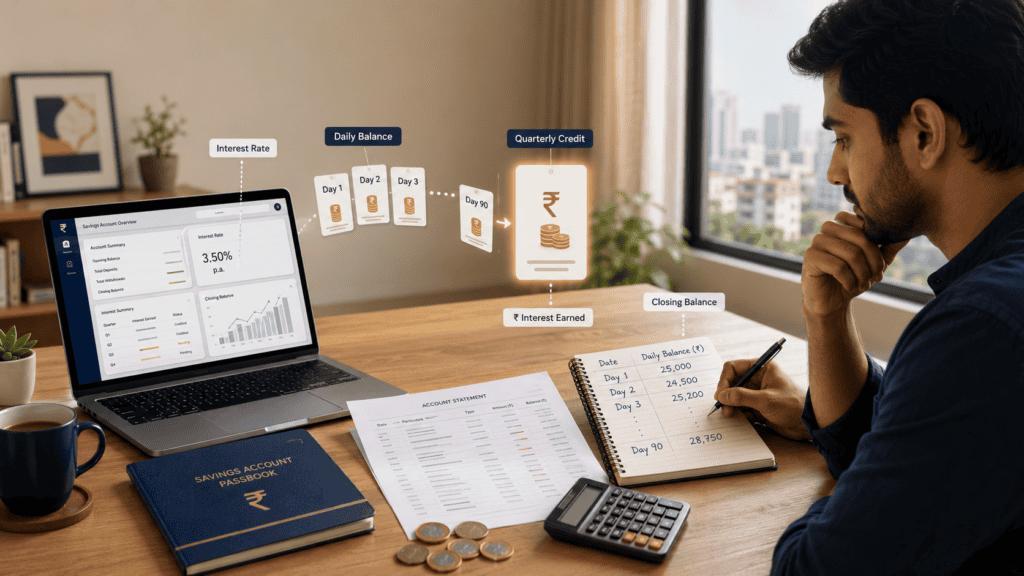

You get your salary credit on the 1st. Ten thousand rupees go to savings, as planned. But where exactly should they go — into an RD that drips in monthly, or should you wait until you have a lump sum and open an FD? This is one of the most common money questions salaried employees in India ask, and the answer is not as obvious as most banking websites make it sound.
FD vs RD is not just a rates comparison. It depends on whether you already have money sitting idle or whether you are building savings from scratch — month by month from salary. Get this wrong and you either lose interest by keeping cash in a savings account, or you lock in a product that does not suit how you actually save. This article breaks it all down: interest, maturity, tax, liquidity, and the practical decision framework for salaried readers.
Quick Answer: FD vs RD
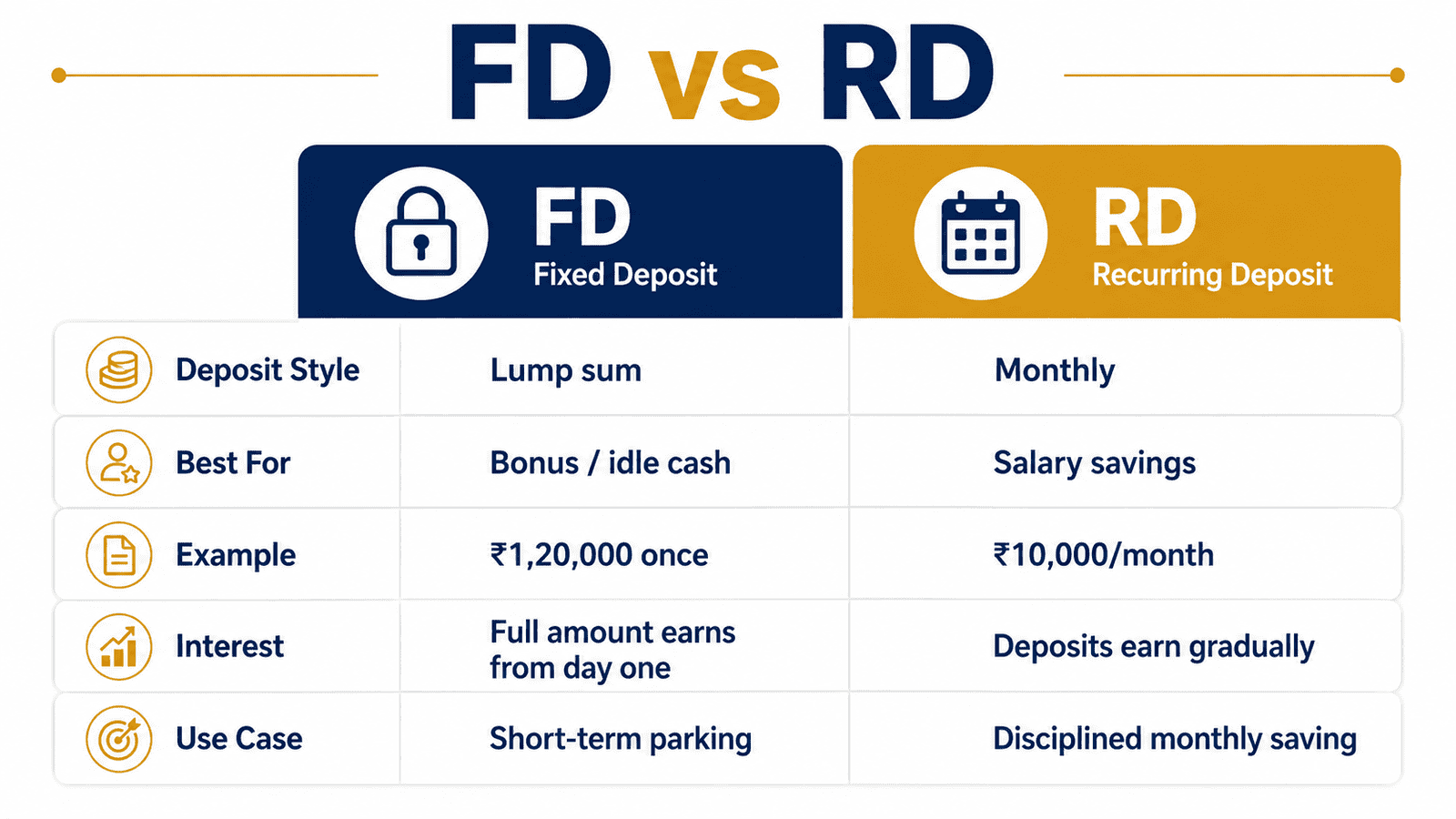
FD vs RD depends on how you save. Choose FD if you already have a lump sum like ₹1,20,000 because the full amount earns interest from day one. Choose RD if you can save monthly, such as ₹10,000 from salary, and want disciplined bank-based savings with fixed maturity.
Key Takeaways
- FD earns interest on the full amount from day one — ₹1,20,000 in a 12-month FD at 7% generates roughly ₹8,400 in interest. An RD with ₹10,000/month at the same rate earns approximately ₹4,550 over the same period because early instalments earn full-year interest but later ones earn very little.
- RD interest is lower in absolute terms than FD interest for the same total deposit — that is not a flaw, it reflects the fact that your money arrives gradually, not all at once.
- TDS is deducted on FD interest above ₹40,000 per year (₹50,000 for senior citizens) as per Income Tax rules — RD interest is also taxable but TDS rules differ by bank; verify with your bank before assuming no TDS on RD.
- Premature withdrawal is available on both FD and RD, but usually attracts a penalty of 0.5%–1% on the applicable interest rate — this reduces your actual return.
- DICGC deposit insurance covers both FD and RD deposits up to ₹5 lakh per depositor per bank — this applies to bank deposits, not NBFC FDs.
- If you are building an emergency fund or have irregular income, locking money in either FD or RD may not be wise — keep at least three months of expenses liquid before choosing either product.
- Senior citizens typically get 0.25%–0.75% higher interest on FD and RD compared to general customers — check the specific rate at your bank, as it varies.
FD vs RD: Full Comparison
| Parameter | Fixed Deposit (FD) | Recurring Deposit (RD) |
|---|---|---|
| How you deposit | One lump sum at opening | Fixed amount every month |
| Who it suits | Someone with an existing lump sum | Salaried earner saving monthly |
| Interest earned (same rate, same total) | Higher — full principal earns from day 1 | Lower — later instalments earn less time |
| Interest rate (as of recent data) | 5%–8%+ varies by bank and tenure | Generally same as FD for equivalent tenure |
| Compounding | Quarterly (most banks) | Quarterly (most banks) |
| Minimum deposit | ₹1,000–₹5,000 (varies by bank) | ₹100–₹500/month (varies by bank) |
| Premature withdrawal | Allowed with penalty | Allowed with penalty |
| TDS applicability | Above ₹40,000/year interest (₹50,000 for seniors) | Varies — confirm with your bank |
| Loan against deposit | Available at most banks | Available at most banks |
| DICGC insurance | Up to ₹5 lakh per bank | Up to ₹5 lakh per bank |
| Auto-renewal | Available at most banks | Not typically available — closes at maturity |
| Nomination facility | Yes | Yes |
Key Facts at a Glance
| Fact | Detail |
|---|---|
| FD minimum tenure | 7 days (varies by bank) |
| RD minimum tenure | 6 months (varies by bank) |
| TDS threshold on FD interest | ₹40,000/year (₹50,000 for senior citizens) — verify at incometax.gov.in |
| DICGC insurance limit | ₹5 lakh per depositor per bank (FD + RD + savings combined) |
| Premature penalty range | Typically 0.5%–1% reduction on applicable interest rate |
| Compounding frequency | Quarterly at most banks; cumulative FDs reinvest interest |
| Income tax on interest | Added to total income, taxed at your slab rate |
| Governing regulation | RBI guidelines — rbi.org.in |
Understanding FD and RD: What They Are and How They Work
A Fixed Deposit is a one-time deposit made to a bank or NBFC for a fixed tenure at a fixed interest rate. The moment you deposit the money, the entire principal starts earning interest — whether it is ₹50,000 or ₹5 lakh. For a deeper understanding of how FDs are structured, read our guide on bank deposit basics.
A Recurring Deposit works differently. You commit to depositing a fixed amount — say ₹5,000 or ₹10,000 — every month for a chosen tenure. The bank applies the interest rate to each instalment separately, based on how many months that instalment has left to earn. Your first instalment earns interest for the full tenure. Your last instalment earns interest for just one month. This is the single most important structural difference between the two products.
Why FD Interest Is Higher for the Same Total Amount
Assume you deposit ₹1,20,000 total — either as a lump sum FD or as ₹10,000/month in an RD over 12 months. The bank rate is 7% per annum for both. Your FD earns interest on ₹1,20,000 for all 12 months. Your RD’s first instalment earns interest for 12 months, but the second earns for 11 months, the third for 10 months, and so on. The last instalment earns interest for just one month.
This is not a penalty. It reflects the reality that in an RD, you are still building the corpus — the money arrives gradually. So if you already have ₹1,20,000 in a savings account earning 3%–3.5%, moving it to an FD makes far more sense than trickling it into an RD month by month. Understanding how compounding affects deposits helps explain why deposit timing changes your maturity amount.
When RD Makes More Sense
RD is designed for people who do not have a lump sum. Most salaried employees in India receive ₹50,000–₹80,000 per month. After rent, EMIs, and daily expenses, saving ₹8,000–₹12,000 per month is realistic — but accumulating ₹1 lakh before opening an FD takes 10–12 months of waiting. During that waiting period, the money sits in a savings account at 3%–3.5%. An RD starts earning a higher fixed rate from the first instalment, even if the absolute interest amount is lower than an FD.
RD also builds financial discipline. The standing instruction auto-deducts from your account each month — you cannot spend what is not there. For first-time savers or anyone who struggles to keep savings untouched, this structure is genuinely useful.
Interest Rates: Are They the Same?
At most banks, the interest rate on an RD is equal to the FD rate for the same tenure and depositor category. However, some banks offer slightly different rates — always check your specific bank’s rate card before opening either product. Rates can change without notice, and comparing banks before deciding is worth the 10 minutes it takes. As of recent data, major bank FD rates for 1-year tenures have ranged from approximately 6.5% to 7.5% for general customers, with small finance banks offering higher rates — but small finance bank FDs carry a different risk profile that deserves separate evaluation.
Tax on FD and RD Interest
Interest earned on both FD and RD is added to your total income and taxed at your applicable slab rate — there is no special concessional rate. If you are in the 30% tax bracket and earn ₹8,000 in FD interest, your tax outgo on that interest is ₹2,400. For FDs, TDS is deducted by the bank if your total interest from that bank in a financial year exceeds ₹40,000 (₹50,000 for senior citizens) — verify the current threshold at incometax.gov.in before assuming. For RDs, TDS rules vary by bank and depositor category — check with your bank directly. If your total income is below the taxable limit, you can submit Form 15G (or Form 15H for senior citizens) to prevent TDS deduction.
Real Example: Rohit in Pune Chooses Between FD and RD
Rohit is 29 years old, a software support analyst in Pune earning ₹65,000 per month. He has been saving ₹10,000 per month for four months — he now has ₹40,000 sitting in his savings account at 3.5% interest. He wants to grow this money and start saving more purposefully.
He has two realistic options. Option A: Open an RD at ₹10,000 per month for 12 months at 7% per annum. Option B: Move the ₹40,000 lump sum into a 12-month FD at 7%, and separately open an RD for future monthly savings of ₹10,000.
If Rohit parks ₹40,000 in a 12-month FD at 7%, it earns approximately ₹2,800 in interest at maturity. If he had left it in the savings account for the same 12 months at 3.5%, he would earn only about ₹1,400. The FD doubles his interest on the lump sum — just by moving it to the right product. Meanwhile, his RD of ₹10,000/month for 12 months at 7% generates around ₹4,550 additional interest. So by separating lump sum into FD and monthly savings into RD, Rohit earns roughly ₹7,350 total in interest versus ₹4,550 if he had only used the RD from scratch. The key insight: do not let an idle lump sum wait in a savings account when an FD can put it to work immediately.
How to Calculate FD and RD Maturity
FD Maturity = P × (1 + r/n)^(n×t)
P = Principal, r = Annual rate (decimal), n = Compounding frequency per year, t = Time in years
For Rohit’s ₹40,000 FD at 7% compounded quarterly for 1 year:
₹40,000 × (1 + 0.07/4)^(4×1) = ₹40,000 × (1.0175)^4 ≈ ₹40,000 × 1.0719 = approximately ₹42,876
Interest earned: approximately ₹2,876
RD Maturity = M × [(1 + r/n)^(n×t) − 1] / (1 − (1 + r/n)^(−1/3))
M = Monthly instalment, r = Annual rate (decimal), n = 4 (quarterly compounding)
For Rohit’s ₹10,000/month RD at 7% for 12 months, the approximate maturity amount is ₹1,24,550, meaning interest earned is approximately ₹4,550. Use our maturity amount calculator to work out your FD figure instantly, and our recurring deposit calculator to estimate your RD maturity with your exact instalment and tenure.
| Scenario | Key Inputs | Approx. Interest Earned |
|---|---|---|
| FD — lump sum | ₹1,20,000 at 7% for 12 months | ~₹8,400 |
| RD — monthly saving | ₹10,000/month at 7% for 12 months | ~₹4,550 |
| FD + RD combined (Rohit’s approach) | ₹40,000 FD + ₹10,000/month RD at 7% | ~₹7,350 combined |
| FD — senior citizen | ₹1,20,000 at 7.5% for 12 months | ~₹9,000 |
How to Decide What’s Right for You
You have a lump sum sitting in a savings account earning 3%–3.5% — THEN open an FD immediately. Every month it sits in savings instead of an FD costs you the difference in interest.
You are salaried and can consistently set aside ₹5,000–₹15,000 from each month’s salary — THEN an RD is built exactly for you. It automates discipline and earns a fixed rate on every instalment.
You have both a lump sum and monthly savings capacity — THEN use both: FD for the existing corpus, RD for ongoing monthly surplus. This is Rohit’s approach and it maximises interest on both pools.
You are saving for a specific goal 12–24 months away, such as a wedding, car down payment, or home renovation — THEN match your FD or RD tenure to the goal date so you do not need to break it early.
You are in the 30% income tax bracket and your FD interest in a year will exceed ₹40,000 at one bank — THEN split your FD across two banks to potentially stay below the TDS threshold at each, but note that the interest is still taxable regardless.
You are a senior citizen — THEN check your bank’s senior citizen rate separately, as the additional 0.25%–0.75% over the general rate can add meaningfully to your maturity amount at higher principal levels.
You do not yet have a three- to six-month emergency fund — THEN do not lock money in FD or RD yet. Breaking an FD or RD early costs you penalty interest. Build your liquid emergency buffer first.
Common Mistakes to Avoid
Opening an RD when you already have a lump sum
Many salaried employees open an RD with their accumulated savings rather than an FD, assuming it is the safer or simpler choice.
If you have ₹1,20,000 in a savings account and open an ₹10,000/month RD instead of a 12-month FD, you earn roughly ₹3,850 less in interest over the year — purely because the lump sum was not deployed upfront.
Move existing lump sums into an FD first. Start an RD only for ongoing monthly savings.
Breaking the deposit early without checking the penalty
Both FD and RD can be withdrawn prematurely, but banks reduce the applicable interest rate by 0.5%–1% as a penalty.
If you opened an FD at 7% and withdraw at 6 months, you may receive only 5.5%–6% on the completed period. On ₹1,20,000 that is a difference of ₹300–₹600 in interest lost — and the real damage is the planning failure that forced the early withdrawal in the first place. Review the early withdrawal rules before locking in any deposit.
Ensure your tenure matches when you actually need the money.
Ignoring TDS on FD interest
Many depositors assume TDS does not apply to them, especially when interest seems small.
If you hold multiple FDs across different bank branches under the same bank PAN, the bank aggregates interest across all branches. If your total FD interest at that bank exceeds ₹40,000 in a financial year, TDS applies. Not filing Form 15G when eligible means excess TDS is deducted and you then need to claim a refund — a time-consuming process.
Check your projected annual interest before the financial year starts, and submit Form 15G or 15H proactively if eligible.
Choosing tenure without a goal in mind
Opening a 3-year FD because it pays the highest rate — without a plan to use that money — is a common mistake.
If you need the money in 18 months, a 3-year FD forces an early withdrawal with penalty. You actually earn less than if you had chosen an 18-month FD at a slightly lower rate.
Match your tenure to your actual goal. Rate is secondary to liquidity alignment.
Not submitting a nominee for the deposit
Both FD and RD allow nomination, but many depositors skip this step at opening, especially when opening online.
Without a nominee, the deposit becomes part of the deceased’s estate and requires legal documentation to release — delaying access for the family by weeks or months.
Add a nominee when opening any deposit. It takes under two minutes.
Parking emergency funds in an FD or RD
An FD or RD is not an emergency fund — it is a goal-based savings product. If an emergency strikes and you break the deposit, you lose penalty interest and potentially disrupt a savings goal.
Keep your emergency fund in a liquid instrument — a high-interest savings account or a liquid mutual fund — and use FD and RD only for money you will not need before maturity. Use our emergency fund amount guide to figure out how much to keep liquid before locking anything away.
Assuming RD interest is not taxable
A surprisingly common misconception is that RD interest is tax-free or that TDS never applies to RD accounts.
RD interest is fully taxable as income, just like FD interest. Some banks may not deduct TDS on RD accounts or may handle it differently — but the tax liability exists regardless. Not declaring RD interest in your ITR can result in a tax notice.
Always include all FD and RD interest in your annual income while filing your return.
When This May Not Be the Right Choice
FD and RD are low-risk, fixed-return products — but that also means they may not be the right fit in every situation.
If you are in the 30% tax bracket, your post-tax return on a 7% FD is approximately 4.9%. Inflation in India has regularly run at 5%–6% — meaning your real return may be negligible or negative on a tax-adjusted basis. For long-term wealth building, equity mutual funds or PPF may serve you better.
If you are still building your emergency fund, locking money in an FD or RD before that fund is in place is premature. Breaking deposits under financial pressure costs more than the interest earned. Before committing any amount to a fixed tenure, understand your liquidity needs — our guide on how much emergency fund to keep can help.
If your savings goal is more than five years away — retirement, child education, or a long-term property goal — FD and RD rates may not beat inflation over that horizon. Consider whether tax-saving instruments like EPF, PPF, or equity-linked products might be more appropriate for that portion of your money.
If any of these apply to your situation, it may be worth exploring alternatives before committing.
Official Rules and Where to Verify
FD and RD products are governed by RBI guidelines. Interest rates, TDS thresholds, premature withdrawal terms, and deposit insurance limits can change with regulatory updates or bank policy revisions. Always verify current figures directly from the official source before making any financial decision.
- Reserve Bank of India — rbi.org.in (deposit regulations, NBFC deposit rules)
- Income Tax Department — incometax.gov.in (TDS thresholds, Form 15G and 15H rules, interest income declaration)
- Deposit Insurance and Credit Guarantee Corporation — dicgc.org.in (₹5 lakh insurance coverage details)
- Your bank’s official website — for current FD and RD rates, minimum deposit requirements, and premature withdrawal penalty terms
Rules, limits, and rates on this topic can change with each Budget or regulatory update. Always verify current figures directly from the official source before making any financial decision.
Expert Tips
- Ladder your FDs instead of putting everything in one tenure. Split your lump sum into three FDs — 6 months, 12 months, and 18 months. As each matures, you can reinvest at prevailing rates or use the funds if needed. This avoids a full premature withdrawal and gives you periodic liquidity.
- Set your RD standing instruction to trigger one day after salary credit. If your salary arrives on the 1st, set the RD debit for the 2nd. This removes the temptation to spend before saving — and ensures the instalment never bounces due to salary delays of a day or two.
- Check the senior citizen rate specifically if you are opening an FD for a parent. The difference between the general rate and senior citizen rate at many banks can be 0.5% — on ₹5 lakh over two years, that is approximately ₹5,000 in additional interest. Open it in the senior family member’s name where applicable.
- Use cumulative FDs for goal-based savings, non-cumulative for supplemental income. Cumulative FDs reinvest interest quarterly — your maturity amount includes compounded growth. Non-cumulative FDs pay interest monthly or quarterly — useful for retirees or those who want periodic cash flow from a lump sum.
- Submit Form 15G before April 30 each financial year if your total income is below the basic exemption limit. Waiting until TDS is already deducted means filing for a refund — which takes time. Proactive submission prevents the deduction entirely. Verify current eligibility conditions at incometax.gov.in.
- Before opening an RD, confirm the exact penalty terms for missed instalments. Some banks allow a short grace period; others charge a fee immediately. If your salary is irregular or you expect a month with tight cash flow, check your bank’s policy before committing to an RD instalment amount you may not always be able to maintain.
- Do not chase the highest rate at an unknown NBFC without checking their credit rating. NBFC FDs are not covered by DICGC deposit insurance. If the NBFC defaults, your deposit is at risk. Stick to bank FDs for safety, or check SEBI-registered credit ratings if you do consider an NBFC FD at a higher rate.
Frequently Asked Questions
Is FD better than RD for monthly savings?
It depends on whether you have a lump sum or are saving from monthly income. FD is better when you already have money accumulated — the full amount earns interest from day one. RD is better when you are saving ₹5,000–₹15,000 per month from salary and want a structured, automatic savings habit. The two products serve different cash flow situations — neither is universally better.
What is the interest rate difference between FD and RD?
At most banks, FD and RD rates for the same tenure and depositor category are identical. The difference in actual interest earned comes from timing — an FD earns on the full principal from day one, while an RD’s later instalments earn interest for fewer months. As of recent data, rates vary by bank and tenure — always check the current rate card at your specific bank before opening either account.
Can I open both FD and RD at the same time?
Yes. There is no restriction on holding both simultaneously. Many salaried savers open an FD for existing savings and an RD for monthly contributions — this is a practical strategy that maximises interest on both pools. Your DICGC insurance covers both deposits together, up to ₹5 lakh per bank.
What happens if I miss an RD instalment?
Banks typically charge a penalty for missed RD instalments — the amount varies by bank. Some banks allow a short grace period. If instalments remain unpaid for an extended period, the RD may be converted to a savings account or closed prematurely. Confirm your bank’s exact policy before opening an RD, especially if your monthly cash flow has any variability.
Is RD interest taxable in India?
Yes. RD interest is fully taxable under the head “Income from Other Sources” and is added to your total income for the year, taxed at your applicable slab rate. Whether TDS is deducted on your RD depends on your bank’s policy and the interest amount — confirm with your bank. Regardless of TDS, you must declare all RD interest in your income tax return.
What is the minimum amount to start an RD?
Most banks allow you to start an RD with as little as ₹100–₹500 per month, though this varies. Post Office Recurring Deposits start at ₹100 per month. Private sector banks typically require ₹500–₹1,000 as a minimum monthly instalment. Check your specific bank’s terms before opening the account.
Can I withdraw my RD before maturity?
Yes, premature withdrawal of an RD is generally permitted, but it attracts a penalty. The bank typically reduces the applicable interest rate by 0.5%–1%. You receive the principal plus interest at the reduced rate for the period the deposit was held. If you anticipate needing the money before the RD matures, this is an important cost to factor into your decision.
Is FD safe? What if the bank fails?
Bank FDs are covered by DICGC (Deposit Insurance and Credit Guarantee Corporation) up to ₹5 lakh per depositor per bank — this includes the combined principal and interest across all deposits at that bank. NBFC FDs are not covered by DICGC. For amounts above ₹5 lakh, consider spreading across multiple banks. Verify current DICGC coverage terms at dicgc.org.in.
Should I choose cumulative or non-cumulative FD?
Choose cumulative if you are saving for a future goal and do not need periodic income — interest compounds quarterly and is paid at maturity, giving you a larger final amount. Choose non-cumulative if you want regular income from your deposit, such as monthly or quarterly interest payouts — this is commonly used by retirees who want steady cash flow from their savings.
What is the difference between FD and RD in terms of tax saving?
Regular bank FDs and RDs do not provide any tax deduction. However, a Tax Saving FD with a 5-year lock-in qualifies for a deduction under Section 80C of the Income Tax Act, up to ₹1.5 lakh per year — but only under the old tax regime. There is no equivalent tax-saving RD product. The interest earned on tax-saving FDs is still taxable at your slab rate.
Final Verdict
The FD vs RD decision comes down to one question: do you already have money, or are you still building it? If you have a lump sum sitting in a savings account, an FD will always put it to work more efficiently — the full principal earns from day one. If you are a salaried earner saving monthly, an RD is the right tool — it is structured for exactly that cash flow pattern and automates the habit of saving.
For most salaried readers like Rohit, the most practical approach is to use both: an FD for any existing accumulated savings, and an RD for ongoing monthly contributions. This is not complicated — it is just matching the right product to the right pool of money.
Before you open either product, make sure your emergency fund amount is in place — liquid and accessible. Do not lock money you may need in an emergency. And always compare current rates at your bank, as FD and RD interest rates change and what applies today may differ next quarter.
Always verify the latest rules from official sources or consult a qualified professional before making any financial decision.
This article is for educational purposes only and should not be treated as personalised financial, tax, investment, insurance, or legal advice. Tax rules, interest rates, regulatory limits, and product features can change with each Budget or policy update. Please verify current rules from official government sources or consult a qualified and registered professional before making any financial decision.

Meera Iyer writes about banking, fixed deposits, recurring deposits, savings accounts, emergency funds, senior citizen deposits, and safe cash management for Indian readers. Her work is especially useful for families, retirees, conservative savers, and beginners who want to understand where to keep short-term or low-risk money.
She covers topics such as FD meaning, FD calculator, RD calculator, FD vs RD, simple interest vs compound interest, savings account interest, sweep-in FD, premature FD withdrawal, senior citizen FD rules, TDS on FD interest, Form 15G, Form 15H, joint account rules, zero balance accounts, minimum balance charges, small finance bank FDs, post office FD vs bank FD, and emergency fund planning.
Meera’s content focuses on safety, liquidity, taxation, and practical decision-making. She avoids hype and explains both benefits and limitations of banking products. Since deposit interest rates, TDS rules, penalty charges, DICGC coverage, and bank policies can change, readers should always confirm the latest details from their bank, RBI, DICGC, India Post, or relevant official sources before making decisions.