
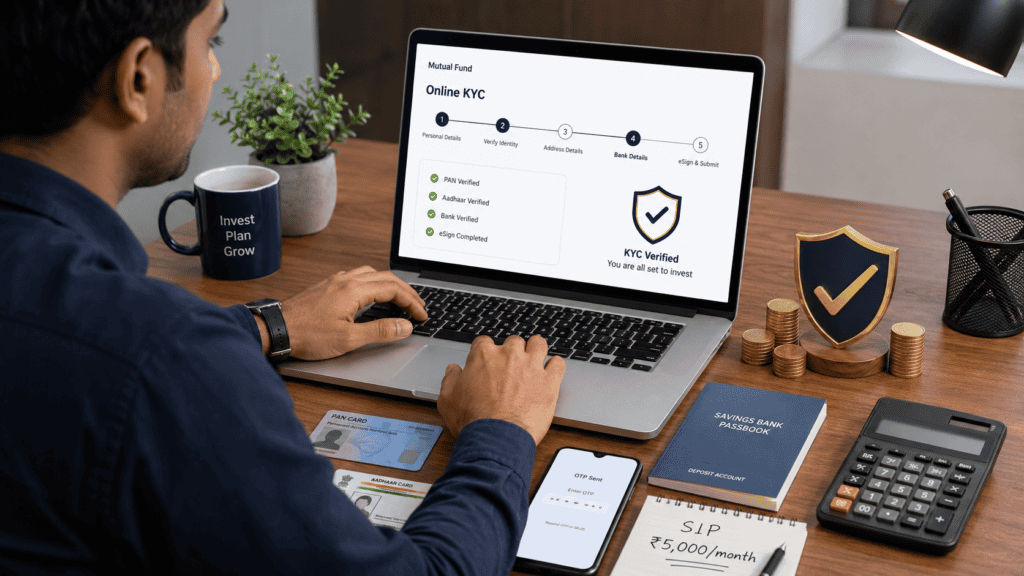
You open a mutual fund app, enter your PAN, and pick a fund. Then a prompt appears: Complete KYC to start investing. Most beginners get stuck here. They are not sure whether Aadhaar OTP is enough, why PAN matters separately, or what “KYC registered” even means versus “KYC validated.” Meanwhile, the ₹5,000 SIP they planned stays unstarted. If you want to start your first SIP, KYC is the mandatory first step — and this guide walks you through the entire process in plain language. No jargon. No fund recommendations. Just the steps you actually need.
Quick Answer: Mutual Fund KYC
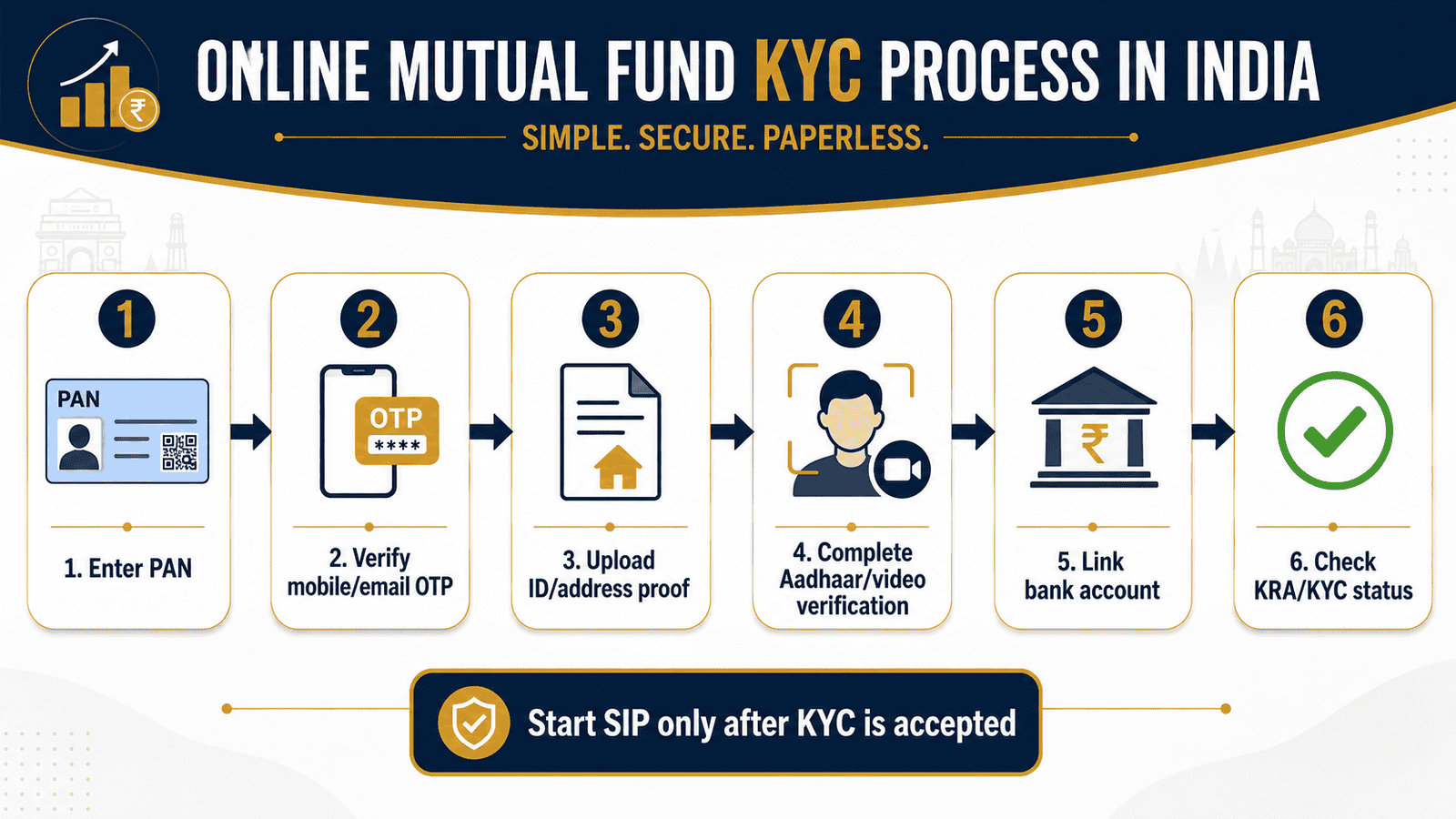
Mutual fund KYC is the identity and address verification needed before you invest in mutual funds in India. You can usually complete it online using PAN, Aadhaar-based verification, mobile/email OTP, bank details, and document upload, then check your KRA status before starting a SIP or lumpsum investment.
Key Takeaways
- KYC is mandatory for all mutual fund investors in India — you cannot place a SIP or lumpsum without it.
- PAN is the primary identifier for mutual fund investing; it links your investments to your tax records and tracks 80C claims, capital gains, and dividends.
- Online KYC typically involves PAN entry, Aadhaar-based OTP or video verification, document upload, and bank account validation — the exact flow varies by platform and KRA.
- Completing KYC on one AMC or platform does not automatically mean every platform recognises it — always check your KRA status before investing through a new app or fund house.
- “KYC registered” and “KYC validated” are different statuses — some transaction types may require validated status; check with your platform or AMC before assuming all investments are open.
- A name, date-of-birth, or PAN mismatch with Aadhaar or bank records is the most common reason KYC goes “on hold” — fix this before submitting documents.
Key Facts at a Glance
| Parameter | Detail |
|---|---|
| What it means | Know Your Client — identity and address verification required by SEBI before mutual fund investing |
| Who must complete it | Every individual investor, first-time or existing, before placing a new folio or SIP mandate |
| Core documents usually required | PAN card, Aadhaar (for OTP/verification), address proof, recent photograph, bank account details |
| Where to complete it | AMC website or app, RTA (CAMS/KFintech), investment platform, or KRA-supported onboarding flow |
| Where to check status | KRA portals (e.g. CVL KRA, Karvy KRA), AMC websites, or CAMS/KFintech RTA portals — verify current routes with your platform |
| Common KYC statuses | KYC Validated, KYC Registered, KYC On Hold, KYC Rejected / Not Available — meaning and next action vary; confirm with platform or KRA |
| Regulator | SEBI (sebi.gov.in) — KYC rules for the securities market |
| PAN–Aadhaar linkage | PAN must be linked to Aadhaar for the PAN to remain active for financial transactions — verify at incometax.gov.in |
What Is Mutual Fund KYC and Why Does It Exist?
KYC stands for Know Your Client. It is an identity and address verification process mandated by SEBI for all investors in the Indian securities market — including mutual funds. Before you can open a folio, place a SIP mandate, or invest a single rupee, a registered fund house or platform must confirm that you are who you say you are. According to SEBI guidelines, KYC compliance is a prerequisite for mutual fund transactions.
This is not the same as signing up for an app, opening a bank savings account, or creating a demat account — each of those has its own verification layer. Mutual fund KYC is specifically for your investor identity in the securities ecosystem.
Why PAN Is Central to the Whole Process
Your Permanent Account Number (PAN) is the single most important identifier in the mutual fund KYC process. It is how the income tax department tracks capital gains from fund redemptions, dividends received, and 80C deductions claimed on ELSS investments. Every mutual fund folio, every SIP mandate, and every redemption is linked to your PAN. If your PAN is not active or not linked to Aadhaar, your KYC submission may be flagged or rejected. Verify your PAN–Aadhaar link status at incometax.gov.in before starting the KYC process.
To understand mutual funds properly, it helps to know that the entire system — from AMC to RTA to KRA — is designed around PAN as the universal investor identifier.
What Is a KRA and How Is It Different from an AMC?
A KRA is a KYC Registration Agency — a SEBI-registered entity that stores and validates your KYC data centrally. Once you complete KYC through any SEBI-registered intermediary (AMC, broker, or platform), your details are uploaded to a KRA. Other intermediaries can then verify your status through the KRA without you having to redo the full process.
An AMC (Asset Management Company) is the fund house — HDFC Mutual Fund, Nippon India, Mirae Asset, and so on. An RTA (Registrar and Transfer Agent) — primarily CAMS and KFintech — processes transactions and maintains folio records on behalf of multiple AMCs. Both AMCs and RTAs interact with KRAs for KYC status verification.
Where Does CKYC Fit In?
CKYC (Central KYC) is a centralised KYC repository managed by CERSAI (Central Registry of Securitisation Asset Reconstruction and Security Interest of India) under the finance ministry. A CKYC number is assigned once your KYC is registered in the central system. Some platforms and AMCs use CKYC as part of their onboarding flow. Whether your existing KYC translates directly into a valid CKYC number for mutual fund transactions depends on the platform and current regulatory process — verify with your AMC or platform rather than assuming portability.
Aadhaar in the KYC Process
Aadhaar-based verification — where your 12-digit Aadhaar number is used to fetch basic identity details via an OTP sent to your Aadhaar-registered mobile — is one route that some platforms and AMCs offer for digital onboarding. Not all platforms support Aadhaar OTP as the sole verification method. Some may require a video KYC call, document upload, or in-person verification (IPV) depending on their current process and SEBI guidance. Verify what your specific platform accepts before beginning. Check your Aadhaar mobile linkage at uidai.gov.in if your OTP is not arriving.
Real Example: Rohan Starts His First SIP
Rohan Sharma, 28, is a software engineer in Bengaluru earning ₹85,000 per month. He decides to invest ₹5,000 per month in a mutual fund through a direct-plan investment app. During sign-up, he enters his PAN and sees: “Complete your KYC to start investing.”
Here is what Rohan’s process looks like on a typical online platform:
Step 1 — PAN entry and verification: Rohan enters his PAN. The platform fetches his name and date of birth from the income tax database. He confirms the details match his documents exactly.
Step 2 — Identity and address documents: He uploads a clear scan of his PAN card and a recent Aadhaar copy as address proof. The name on both matches his bank account — no mismatch.
Step 3 — Aadhaar/OTP or video verification: The platform asks him to either complete an Aadhaar OTP step (if supported) or join a short video KYC call. Rohan completes the video verification in under five minutes.
Step 4 — Bank account validation: He links his savings account. A ₹1 penny-drop or bank statement upload confirms the account belongs to him.
Step 5 — KRA status check: Two to three days later, Rohan checks his KYC status on his platform. Status shows “KYC Validated.” He is now cleared to place his ₹5,000 SIP. He uses the SIP calculator to estimate monthly SIP growth before choosing his fund category.
If Rohan’s status had shown “On Hold,” his platform would flag a specific reason — typically a document mismatch or missing information — and he would need to resubmit before investing.
Comparison: Online KYC vs Offline KYC and Key Status Differences
| Parameter | Online KYC | Offline / In-Person KYC |
|---|---|---|
| Process | Document upload, Aadhaar OTP or video KYC via platform/AMC app | Physical form submission at AMC branch, RTA centre, or KRA office with original documents |
| Convenience | Higher — done from home | Moderate — requires in-person visit |
| Suitable for | Investors with Aadhaar-linked mobile, clear scans, stable internet | NRIs, investors with OTP issues, complex cases, or those uncomfortable with digital upload |
| Common limitation | Aadhaar OTP fails if mobile not linked; video KYC requires good camera and lighting | Branch availability; slower processing time |
| KYC status after completion | Usually “KYC Registered” or “KYC Validated” — confirm with platform | Usually “KYC Validated” after verification — confirm with KRA |
| KYC Status | What It Likely Means | Likely Next Action |
|---|---|---|
| KYC Validated | Identity and address verified and accepted by KRA | You can typically invest — confirm with platform for any transaction-specific requirement |
| KYC Registered | KYC submitted and registered but may need additional validation for certain transaction types | Check with your AMC or platform whether your intended transaction is permitted |
| KYC On Hold | Submission received but flagged — usually a document mismatch, name discrepancy, or missing detail | Contact platform or AMC to identify and correct the flagged item; resubmit |
| KYC Rejected / Not Available | No valid KYC on record or submission was rejected | Complete fresh KYC through an AMC, RTA, or KRA-supported platform |
How to Decide What’s Right for You
You have never completed mutual fund KYC — complete fresh KYC through your chosen AMC’s website/app, an RTA (CAMS or KFintech), or a SEBI-registered investment platform before placing any investment.
Your KRA status shows “KYC Registered” but not “KYC Validated” — contact your AMC or platform to check whether your intended transaction (new SIP, new folio) is permitted under registered status, or whether validation is required first.
Your KRA status shows “KYC On Hold” — do not attempt a new investment until you have resolved the flagged issue; contact your platform or AMC, identify the mismatch, and resubmit corrected documents.
You have changed your mobile number, email address, or residential address since your last KYC — update your details through your AMC, RTA, or platform before starting a new folio or SIP mandate, to avoid OTP and communication failures.
You plan to invest through a direct plan on an AMC website or through a distributor-linked regular plan — you will still need the same KYC, but the platform or advisor route affects cost and support; choose direct or regular based on your preference for self-service versus guidance.
Your Aadhaar OTP is consistently not arriving — verify that your current mobile number is linked to your Aadhaar at uidai.gov.in before retrying; do not share your Aadhaar details with third-party agents offering to “fix” the issue.
You are an NRI, a minor investor, an HUF, or a non-individual entity — the standard online individual KYC process may not apply; contact your AMC or an SEBI-registered intermediary for the correct documentation and process before proceeding.
Common Mistakes to Avoid
PAN Name Mismatch with Aadhaar or Bank Records
Your PAN-registered name and your Aadhaar name must match closely for digital verification to succeed.
Even a small difference — an initial versus full first name, or a missing middle name — can trigger “KYC On Hold” status. This delays your SIP start by days or weeks while you resolve the discrepancy through the income tax portal or UIDAI.
Before submitting, check that the name on your PAN card, Aadhaar, and bank account are consistent.
Using an Aadhaar with an Unlinked or Outdated Mobile Number
Aadhaar OTP is sent only to the mobile number registered with UIDAI — not your current number.
If you changed your SIM card or number after Aadhaar enrollment and never updated UIDAI, the OTP will not reach you. You will be stuck mid-process with no way to complete digital verification online.
Update your Aadhaar-linked mobile at uidai.gov.in or through an Aadhaar enrolment centre before attempting Aadhaar OTP-based KYC.
Assuming App Signup Equals KYC Completion
Creating an account on a mutual fund app is not the same as completing KYC.
Many apps allow you to register, browse funds, and even set up a SIP draft without KYC being complete. The transaction will fail — or sit unprocessed — until KYC is accepted. You may not receive a clear notification.
Always check your KRA status explicitly after completing the in-app KYC steps, rather than assuming the process is done.
Not Saving Acknowledgement or Reference Details
After submitting KYC documents, most platforms generate a reference number or acknowledgement.
Not saving this means you have no proof of submission if the status is delayed or flagged. A missing reference number makes follow-up with AMC, RTA, or KRA support very slow.
Screenshot or note down every acknowledgement number immediately after submission.
Ignoring “KYC On Hold” or “KYC Registered” Status
Some investors see a non-rejected status and assume they can invest freely.
A “KYC Registered” or “KYC On Hold” status may block certain transaction types. Starting a SIP on a platform that shows these statuses can lead to failed mandates or rejected folios — costing you time and delaying your investment plan.
Contact your AMC or platform to confirm which transaction types are permitted under your current status before investing.
Uploading Blurry or Partially Cut-Off Document Scans
Document quality is a frequent reason for KYC rejection.
If your PAN scan is too dark, if the Aadhaar corners are cut off, or if your selfie is blurry, the verification system or human reviewer will flag the submission. This adds two to five working days to your timeline.
Upload only clear, well-lit, full-document scans. Test the image on your own screen before submitting.
Sharing OTP or Documents with Unofficial Agents
Fraudsters often offer to “complete KYC for you” by asking for your Aadhaar OTP, PAN scan, or bank login over phone or WhatsApp.
No genuine AMC, KRA, or platform requires you to share an OTP with a third party. Sharing your Aadhaar OTP gives an external party access to your Aadhaar-linked identity and can enable identity fraud or unauthorised financial transactions.
Complete KYC only through the official AMC website, CAMS/KFintech portal, or the platform’s verified app — never through a link sent by an unsolicited caller or message.
When This May Not Be the Right Choice
Online individual KYC has clear limits. If your Aadhaar OTP is consistently failing despite a linked mobile number, or if your video KYC connection is repeatedly dropping, the online route may not work for you — an in-person visit to an AMC branch or RTA centre is more reliable in these cases.
If there is a PAN-Aadhaar name or date-of-birth mismatch, you must resolve the underlying discrepancy at the income tax portal or UIDAI before attempting KYC again — the platform cannot override a system-level mismatch.
For NRIs, minors, HUFs, and non-individual investors such as companies or trusts, the standard online individual KYC process does not apply. These categories require specific documentation and typically need offline or assisted onboarding through an AMC or SEBI-registered intermediary.
If you are not comfortable uploading Aadhaar details and document scans to a private investment platform, the offline route through an AMC branch or recognised RTA centre is a legitimate alternative.
If any of these apply to your situation, it may be worth exploring alternatives before committing.
Official Rules and Where to Verify
Mutual fund KYC rules, accepted document types, Aadhaar verification guidelines, KYC status labels, and online process flows can change based on SEBI circulars and KRA process updates. Always verify the current process from the following official sources before acting:
- SEBI (sebi.gov.in) — the market regulator that sets KYC requirements for all securities market participants including mutual fund investors
- AMFI (amfiindia.com) — the Association of Mutual Funds in India; offers KYC status check information and investor guidance
- CAMS (camsonline.com) and KFintech (kfintech.com) — RTAs for most AMCs; provide KYC status check and update services for investors
- UIDAI (uidai.gov.in) — for Aadhaar-linked mobile number verification and Aadhaar-related update context
- Income Tax Department (incometax.gov.in) — to verify PAN status and PAN–Aadhaar link status
Rules, limits, and rates on this topic can change with each Budget or regulatory update. Always verify current figures directly from the official source before making any financial decision.
Expert Tips
- Check KRA status on every new platform: Even if your KYC was completed years ago, some platforms run their own verification layer. Checking your status at CAMS, KFintech, or the platform’s KYC check tool before placing your first transaction saves a failed-payment surprise.
- Keep all four identifiers consistent: Your name, date of birth, PAN, and Aadhaar details must match each other and your bank account records. A mismatch between any two of these is the most common cause of KYC delay — fix it at the source (income tax portal or UIDAI) rather than trying to work around it in the platform.
- Save every acknowledgement: After submitting KYC documents, save the reference or acknowledgement number. This is your only proof of submission if the status does not update within the expected window, and it speeds up AMC/RTA support queries significantly.
- Use official channels only: Complete and update KYC only through the official AMC website, CAMS/KFintech portal, or the platform’s verified app. Never click on links sent via SMS, WhatsApp, or unsolicited email claiming to offer “quick KYC.”
- After KYC, evaluate funds properly: Once your status is validated, resist the temptation to pick the fund with the highest one-year return. Instead, compare fund returns using CAGR, XIRR, and rolling returns to understand true performance — not just the last twelve months. Mutual fund investments are subject to market risks. Past performance does not guarantee future returns.
- Update details proactively: If you change your mobile number, email address, or home address, update these through your AMC or RTA immediately — not only when you next need to invest. An outdated mobile means missed OTPs on future transactions, SIP mandates, and redemptions.
- KYC is not an investment decision: Completing KYC clears a regulatory requirement. It does not mean any specific fund or asset class is right for you. Always assess suitability, risk level, investment horizon, and expense ratio before committing your money. Reference SEBI’s investor education resources at sebi.gov.in for unbiased guidance.
Frequently Asked Questions
Is mutual fund KYC mandatory in India?
Yes. SEBI requires all investors to complete KYC before investing in mutual funds. This applies to every individual investor, whether you are starting a ₹500 SIP or making a lumpsum investment of any size. No fund house or platform can process your investment without a valid KYC on record.
Can I start a SIP without completing KYC?
No. Your SIP mandate will not be processed — or will fail after the first debit attempt — if your KYC is incomplete, on hold, or rejected. Always confirm that your KRA status shows “KYC Validated” or the equivalent accepted status on your platform before activating a SIP.
How do I check my mutual fund KYC status?
You can check KYC status through your AMC’s website or app, through CAMS (camsonline.com), KFintech (kfintech.com), or through SEBI-registered KRA portals. Enter your PAN to retrieve the current status. The exact route and available status labels may vary — verify with your platform or AMC for the current process.
What is KRA KYC status?
KRA stands for KYC Registration Agency — a SEBI-registered entity that stores and validates investor KYC data centrally. Your KRA status reflects whether your identity and address details have been verified and accepted in the central KYC system. When you invest through a new AMC or platform, they check your KRA status rather than requiring you to redo the entire process from scratch.
What is the difference between KYC registered and KYC validated?
“KYC Registered” typically means your KYC submission has been received and recorded in the system, but may not yet have full verification clearance for all transaction types. “KYC Validated” generally means your KYC has been fully verified and accepted. However, the exact definitions, implications for specific transaction types, and whether additional steps are needed differ by KRA and AMC — always confirm with your platform what your current status permits before investing.
Can I complete mutual fund KYC using only Aadhaar OTP?
Some platforms and AMCs support Aadhaar OTP as part of their digital KYC flow, but it is typically one step in a multi-step process — not the only step. Most platforms also require document upload, a selfie or video verification step, and bank account validation. Whether Aadhaar OTP alone is sufficient depends on the platform, AMC, and current SEBI/KRA process guidelines. Verify with your specific platform before beginning.
What documents are typically required for mutual fund KYC?
Most platforms require: a valid PAN card, Aadhaar card (for address proof and/or digital verification), a recent passport-size photograph, and bank account details (account number and IFSC). Some may also require a cancelled cheque or bank statement for bank validation. Document requirements can vary by platform and KRA. Always check the current document list on your AMC’s or platform’s official website before starting the process.
How long does online KYC take for mutual funds?
Online KYC processing time varies. Document verification and KRA status updates can take anywhere from a few hours to three to five working days depending on the platform, current processing load, and whether any document needs re-verification. Do not assume your KYC is complete the moment you click “submit.” Check your KRA status explicitly before placing your first investment. Avoid platforms that guarantee “instant” KYC approval without the ability to verify the claim from official sources.
What happens if my KYC is on hold?
A “KYC On Hold” status means your submission was received but flagged — usually due to a name mismatch, unclear document scan, PAN–Aadhaar discrepancy, or missing detail. You cannot invest until the issue is resolved. Contact your AMC, RTA, or platform support with your reference number, identify the specific flag, and resubmit corrected information. Resolving a name or date-of-birth mismatch at the source (income tax portal or UIDAI) is often necessary before resubmission succeeds.
Is CKYC the same as mutual fund KYC?
CKYC (Central KYC) is a centralised repository managed under the finance ministry, and a CKYC number may be assigned when your KYC is registered in the central system. Some AMCs and platforms use CKYC records as part of their onboarding. However, whether a CKYC record is automatically recognised for all mutual fund transactions depends on the platform, AMC, and current regulatory process. Confirm with your platform whether your CKYC record is sufficient for the transaction you intend to place.
Final Verdict
Mutual fund KYC is not an investment decision — it is the regulatory clearance that lets you invest at all. Every investor, whether starting a ₹500 SIP or a ₹1 lakh lumpsum, must complete this step before the first rupee can be deployed. The process is straightforward for most salaried individuals: PAN entry, Aadhaar-based verification, document upload, and bank validation — typically completed online in under thirty minutes on most platforms. What trips people up is assuming the process is done when it is not, ignoring non-validated statuses, or having mismatched details across PAN, Aadhaar, and bank records.
Once your KRA status is confirmed as validated, the real work begins — choosing the right fund, understanding risk, evaluating cost, and sticking to a plan. To move from KYC completion to your first investment with confidence, follow the complete start investing stepwise guide next. Always verify the latest rules from official sources or consult a qualified professional before making any financial decision.
This article is for educational purposes only and should not be treated as personalised financial, tax, investment, insurance, or legal advice. Tax rules, interest rates, regulatory limits, and product features can change with each Budget or policy update. Please verify current rules from official government sources or consult a qualified and registered professional before making any financial decision.

Arjun Kapoor writes about mutual funds, SIPs, ELSS, fund categories, investment returns, and beginner investing concepts for Indian readers. His focus is on education, not product promotion or fund recommendations. He helps readers understand how mutual funds work before they start investing or comparing schemes.
He covers topics such as mutual fund meaning, SIP meaning, SIP calculator, direct mutual funds vs regular plans, NAV, ELSS tax-saving funds, CAGR, absolute returns, XIRR, expense ratio, large cap vs mid cap vs small cap funds, flexi cap funds, index funds vs active funds, liquid funds, debt mutual funds, SIP pause vs SIP stop, lumpsum vs SIP, and how to start SIP in India.
Arjun’s writing is simple, risk-aware, and long-term oriented. He avoids guaranteed-return language and explains investment concepts using examples, timelines, and comparison tables. His articles remind readers that mutual fund investments are subject to market risks, and past performance does not guarantee future returns. Readers should verify scheme details from SEBI, AMFI, fund houses, and official scheme documents.