

The moment your company calls you into a meeting you weren’t expecting — or sends that email — your salary stops, but your rent, EMI, and insurance premiums do not. Learning how to handle job loss is not just an emotional challenge: it is a timing challenge. Your first goal in the days that follow is not to invest perfectly or restructure your portfolio. It is to protect your survival runway long enough to land on your feet. This article gives Indian salaried employees a practical, calm money checklist — how to use your emergency fund, what to do with EPFO, how to handle final settlement, Form 16, TDS, and ITR in the right sequence. The guidance here is educational and does not substitute for personalised tax or financial advice.
Quick Answer: How to Handle Job Loss
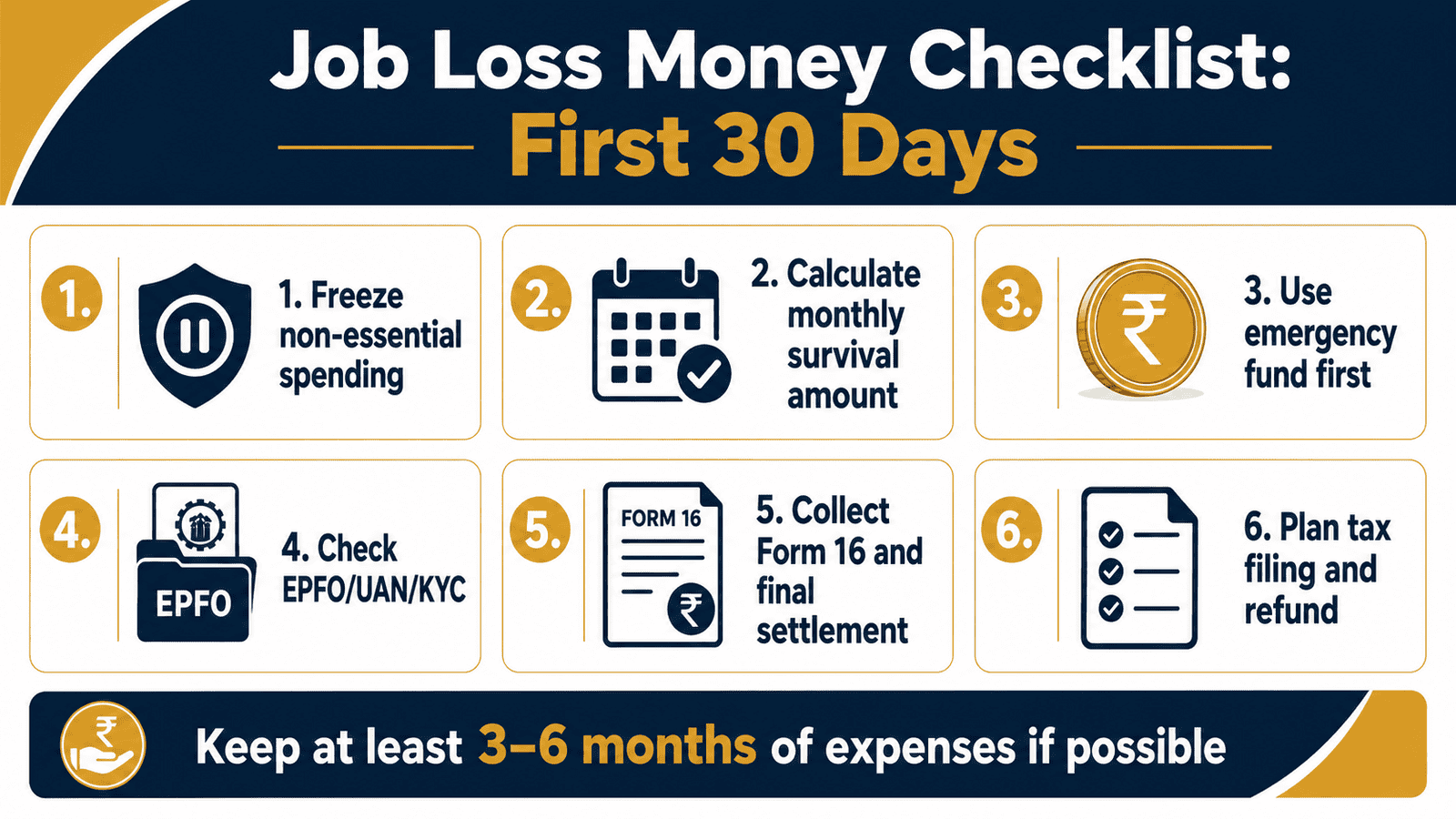
How to handle job loss starts with protecting cash flow, checking EPFO options, and collecting tax documents before making big withdrawals. Keep essential expenses covered for at least 3–6 months, review PF withdrawal tax rules, download Form 16, track TDS, and file ITR correctly even if salary stopped mid-year.
Key Takeaways
- Do not make irreversible financial decisions — PF withdrawal, cancelling insurance, or taking on new high-interest debt — in the first week after job loss. A calm, deliberate sequence beats speed every time.
- List every essential expense: rent or home loan EMI, groceries, health and term insurance premiums, utility bills, school fees, and family support. Dividing your liquid savings by this number gives you your survival runway in months.
- PF withdrawal may be available after 2 months of unemployment, but withdrawing before completing 5 years of total continuous service can trigger TDS and permanently reduce your retirement corpus.
- Final settlement, severance pay, and leave encashment may each carry different tax treatments — do not spend any of these amounts before understanding what is taxable and what may be exempt.
- Your employer must issue Form 16 for the salary period you worked, even if you resigned or were laid off mid-year. Cross-check it against Form 26AS and the Annual Information Statement on incometax.gov.in.
- If TDS was deducted at the full annual rate on your partial-year salary, you are likely entitled to a refund — but only after filing your ITR correctly and on time.
- Pausing SIPs is free, reversible, and takes under five minutes online. It is almost always better than redeeming equity investments at a market low to cover routine expenses.
Key Facts at a Glance
| Action Area | First Step | Where to Verify |
|---|---|---|
| Emergency Fund | Calculate essential monthly spend. Divide total liquid savings by that number to find your survival runway in months. | — |
| EPFO / PF | Log in to EPFO portal. Check UAN activation, KYC, service history, PF balance, and withdrawal eligibility before filing any claim. | epfindia.gov.in |
| Tax Documents | Collect Form 16 (Part A + B), full and final settlement letter, TDS certificate, Form 26AS, and AIS from the IT portal. | incometax.gov.in |
| EMI / Loans | Contact your lender before the due date. Ask about deferral or restructuring options specific to your loan type. | Bank / rbi.org.in |
| Investments | Pause SIPs if cash flow is tight. Avoid selling equity holdings unless runway is under 1 month and no other liquid option exists. | sebi.gov.in |
How to Handle Job Loss: Five Financial Stages
Most salaried employees react to job loss one of two ways: they freeze completely for weeks, or they make three large financial decisions in the first 48 hours out of panic. Both responses are expensive. The better path is a clear five-stage sequence — moving from the most urgent to the most complex.
Stage 1: Know Your Survival Runway
Your single goal in the first 72 hours is to understand exactly how long your current savings will last. Add up every rupee of liquid money accessible right now — savings account balance, sweep FDs, and liquid mutual funds. Do not include PF, PPF, insurance surrender value, or equity holdings in this first number. These require time, tax, or penalty to access.
Next, list your essential monthly expenses: rent or home loan EMI, groceries, utility bills, health and term insurance premiums, school fees, existing loan EMIs, and any regular family support. Everything else — OTT platforms, dining out, gadgets, gym memberships — is non-essential and gets paused immediately.
Divide your liquid balance by your essential monthly expense total. That result is your survival runway in months. Use our Emergency fund amount calculator to run this number before making any other financial decision.
Stage 2: Reduce Non-Essential Spending
Even with four to five months of runway, cutting non-essential expenses immediately extends your options. Cancel or pause subscriptions, defer planned major purchases, and reduce discretionary food and entertainment spending. Every ₹10,000 saved per month adds roughly 8–12 extra days of runway — and during a job search, those days matter more than they appear to.
Stage 3: Draw Down Liquid Savings in the Right Order
When you need to use savings, follow this sequence: savings account first, sweep FDs or short-term FDs second, liquid mutual funds third. Avoid breaking fixed-term FDs early unless the need is urgent — premature withdrawal may reduce the interest you have earned on that deposit. Avoid touching equity mutual funds or stocks unless every other option is exhausted; markets may be down at the exact moment you need to sell, which compounds the damage.
Stage 4: Review EPFO Options — Before Acting
According to EPFO guidelines, members can apply for a non-refundable advance after a period of unemployment, and a full settlement after a longer period. However, EPF withdrawal before completing 5 years of total continuous service has significant tax consequences — TDS is deducted at source and the withdrawn amount is treated as income for that financial year, which can push you into a higher slab at the worst possible moment.
Before filing any EPFO claim, log in to the member portal at epfindia.gov.in and verify that your UAN is active, KYC is complete, service history is accurate across all employers, and your bank account is correctly linked. Errors in any of these details delay processing or result in rejection.
Stage 5: Complete Tax and Documentation Steps
If your salary stopped in October, you are still required to file an ITR for that financial year. Your employer must issue Form 16 — both Part A (TDS deducted and deposited) and Part B (salary breakup and deductions) — covering the period you worked. Cross-check these figures against your Form 26AS and Annual Information Statement on incometax.gov.in. A TDS mismatch between Form 16 and AIS can delay a refund or trigger a tax notice.
If TDS was deducted at the projected full-year rate but your actual income for the year is lower because salary stopped mid-year, you are likely entitled to a refund. According to Income Tax Department rules, the only way to claim this refund is by filing a correct and timely ITR.
Real Example: Rahul’s First 30 Days After a Layoff
Rahul, 33, is a software engineer in Pune earning ₹1.2 lakh in-hand per month. He is laid off in October and receives two months of notice pay plus a full and final settlement. His essential monthly expenses are ₹74,000: ₹22,000 rent, ₹18,000 home loan EMI, ₹12,000 groceries and utilities, ₹8,000 insurance premiums, ₹7,000 family support, and ₹7,000 for fuel and commute.
Rahul has ₹4,80,000 in savings and sweep FDs. Survival runway: ₹4,80,000 ÷ ₹74,000 = 6.5 months — before touching PF, mutual funds, or any new debt.
His action sequence: cut ₹14,000 per month of non-essential spending immediately to extend runway further, collect Form 16 and the final settlement letter from HR before his last working day, log in to EPFO portal to verify service history and PF balance, call his home loan lender to ask about options if the search extends beyond six months, and wait for Form 26AS and AIS to be updated before filing ITR.
Rahul does not withdraw PF in month one. His runway is already healthy, and a rushed withdrawal at partial-year income could increase his tax liability and permanently shrink his retirement corpus. Knowing his runway number gave Rahul a plan instead of a panic.
How to Calculate Your Survival Runway
Survival Runway (months) = Total Liquid Emergency Money ÷ Essential Monthly Expenses
Essential monthly expenses include: rent or home loan EMI, groceries, utility bills, health and term insurance premiums, school or tuition fees, family support transfers, and minimum loan repayments. Do not include SIP contributions, investments, dining out, or entertainment — those are non-essential and can be paused.
| Scenario | Liquid Money Available | Runway at ₹74,000/month essentials |
|---|---|---|
| Savings + sweep FD (Rahul’s base case) | ₹4,80,000 | 6.5 months |
| After cutting ₹14,000/month non-essential spend | ₹4,80,000 | 8.0 months at ₹60,000 essential costs |
| No emergency savings at all | ₹0 | 0 months — PF or new debt becomes unavoidable immediately |
Run this calculation before you decide whether to withdraw PF, apply for a personal loan, or redeem mutual fund units. For a complete breakdown of what EPFO withdrawal options are available after resignation or unemployment and what conditions apply, see our guide to PF withdrawal rules.
Comparison: Money Sources After Job Loss
| Money Source | Access Speed | Key Trade-off |
|---|---|---|
| Savings account / Emergency fund | Immediate | Limited by how much is saved. No tax, no penalty. Best first option by a wide margin. |
| Sweep FD / Short-term FD | 1–3 days | Premature withdrawal may reduce interest earned. Check your bank’s specific terms before breaking. |
| EPF withdrawal | 2–4 weeks online | TDS risk if total service under 5 years. Permanently reduces retirement corpus. Verify EPFO portal details first. |
| SIP pause or MF redemption | Pause: immediate / Redemption: 2–5 days | Pausing is free and reversible. Redeeming equity at a market low creates a real and permanent wealth loss. |
| Personal loan or credit card | Fast but very costly | High interest rates create fixed repayment pressure during job search. Last resort only — after all other options are exhausted. |
How to Decide What’s Right for You
your survival runway is under 1 month — cut every non-essential expense immediately and draw on every safe liquid source (savings account, sweep FDs, liquid mutual funds) before considering any new debt.
your runway is 3–6 months — resist panic withdrawals. Use this window to job-search calmly, collect all tax documents, verify EPFO status, and plan before making any irreversible financial move.
you have active home or personal loan EMIs — contact your lender before the payment due date. Ask specifically whether a temporary deferral or restructuring option is available for your loan type. Do not go silent.
dependents rely entirely on your income — protect health and term insurance before any other financial adjustment. The cost of reinstating a lapsed policy — or facing hospitalisation without coverage — is far higher than the premium you would have saved.
your total PF service period is under 5 years — check the tax implications before withdrawing. TDS applies on EPF withdrawals above ₹50,000 when total service is under 5 years, and the amount becomes part of your taxable income for the year.
your compensation includes ESOPs, RSUs, deferred bonuses, or a large severance or VRS amount — do not treat any of it as freely disposable income before consulting a qualified tax professional. The tax timing and treatment rules for these components vary significantly.
you have any emergency savings and are already carrying credit card or personal loan debt — this checklist alone may not resolve your situation. Building a six-month safety buffer must become your highest financial priority once regular income resumes.
Common Mistakes to Avoid
Withdrawing PF Without Checking Service Period and Tax Rules
Many employees submit an EPF withdrawal claim within days of job loss — treating the PF balance as easy money to access freely.
If total continuous service is under 5 years and the withdrawal exceeds ₹50,000, TDS is deducted and the amount is added to taxable income for that year. On a ₹3 lakh PF balance at a 20% tax slab, that is ₹60,000 in additional tax — at the worst possible moment in your financial calendar.
Log in to epfindia.gov.in first, verify your service history and PF balance, and understand the full tax impact before submitting any withdrawal claim.
Not Collecting Form 16 Before Leaving the Company
Some employees move on quickly after a layoff and do not collect Form 16 from their former employer while they still have easy access to HR.
Without Form 16, reconstructing your salary, deductions, and TDS from payslips alone is time-consuming — and any mismatch against Form 26AS can delay your refund or trigger an income tax notice. Your employer is legally required to issue Form 16 for the period you worked.
Collect Form 16 (Part A and Part B), the full and final settlement letter, and all TDS certificates before or shortly after your last working day. Our guide to the Form 16 checklist explains every line item you should cross-check.
Rolling Over Credit Card Dues
Paying only the minimum amount on a credit card during unemployment feels manageable in the short run.
Credit card interest rates can be very high. On a ₹60,000 unpaid balance, interest alone can add a significant amount over 3–4 months — on top of the original principal. During a job search that stretches beyond expectations, this compounds quickly and creates a second financial problem on top of the first.
Use savings, FD proceeds, or a PF advance — in that order — before allowing credit card interest to build.
Maintaining All SIPs While Borrowing at High Interest
Continuing equity SIPs while paying double-digit interest on a personal loan or credit card creates a certain ongoing cost against an uncertain future gain.
Pausing SIPs is free, reversible, and takes minutes online. Pausing a ₹15,000 per month SIP saves ₹45,000 over three months — real runway money during a job search. Resume at the original amount, or higher, as soon as regular income restarts.
Missing EMI Without Talking to the Lender
Going silent on a bank when you cannot pay is one of the most damaging mistakes during job loss.
A missed EMI reported without prior communication typically appears as a default on your CIBIL report quickly. A damaged credit score at the time you are signing new leases, applying for roles with financial background checks, or seeking a new loan is exactly the wrong outcome.
Call or email your lender before the due date. State your situation clearly and ask what options exist for your specific loan product.
Treating Severance Pay as a Bonus
Receiving a full and final settlement cheque after job loss can feel like financial breathing room — and some employees spend part of it quickly on deferred purchases or travel.
Severance is survival money. It needs to extend your runway, cover EMIs, and fund your job search — not reward the end of employment. Treat every rupee of it as income for the next three to six months before making any discretionary spending decision.
When This May Not Be the Right Choice
This checklist is designed for most salaried employees handling a straightforward job loss. It may not fully apply if:
- You are facing an ongoing medical emergency and current health insurance coverage is insufficient — healthcare costs must take absolute priority over any savings or spending strategy described here.
- You were already carrying significant high-interest debt before the job loss — standard emergency fund logic changes substantially when existing debt is compounding faster than your savings can grow.
- You are within 3–5 years of retirement and your EPF corpus is your primary retirement asset — withdrawing from it now could have consequences that no job-search runway can compensate for later.
- Your compensation includes ESOPs, RSUs, foreign income, deferred bonuses, or a large VRS or severance payout — the tax timing and treatment rules for these components are complex and require specific professional guidance.
If any of these apply to your situation, it may be worth exploring alternatives before committing.
Official Rules and Where to Verify
EPFO rules, income tax slabs, TDS rates, and lender policies can change with each Union Budget or regulatory update. Verify current figures directly from official sources before taking any financial action.
- EPFO (epfindia.gov.in): UAN activation, KYC status, PF balance, withdrawal eligibility, claim status, and service history across all employers.
- Income Tax Department (incometax.gov.in): ITR filing, Annual Information Statement (AIS), Form 26AS, TDS credit verification, refund status, and any PAN-linked tax notices.
- Your Employer HR / Payroll: Full and final settlement statement, Form 16 (Part A and Part B), leave encashment amount, notice period recovery calculation, and severance structure.
- Your Bank or Lender: EMI restructuring or deferral options for your specific loan product. Get any arrangement confirmed in writing before relying on it.
Before filing any PF withdrawal, review our detailed breakdown of PF tax treatment — it explains exactly what TDS and income tax exposure applies based on your service period. When you are ready to file your return, our ITR filing checklist walks you through every document required for a partial-year salary situation.
Rules, limits, and rates on this topic can change with each Budget or regulatory update. Always verify current figures directly from the official source before making any financial decision.
Expert Tips
- Create a bare-minimum monthly budget within 24 hours. List every fixed and variable expense, mark each as essential or non-essential, and cut every non-essential item immediately. Saving ₹10,000–₹15,000 per month can meaningfully extend your runway — even a few extra weeks can change the outcome of a job search.
- Build one master spreadsheet the same day. Track your PF balance, all bank account balances, every EMI due date, insurance premium renewal dates, SIP pause status, and all incoming tax documents in one place. Scattered financial information during job loss leads to missed deadlines and costly errors.
- Do not cancel health insurance to save money. A lapsed policy may attract higher premiums, waiting periods, or exclusions on reinstatement. Pay this premium before almost any non-essential expense — a single hospitalisation without coverage costs far more than the annual premium you were trying to save.
- Save every employer document before leaving. Store resignation or termination letters, all payslips, the full and final settlement slip, any written severance communication, and relevant employer emails. These matter for ITR filing, background verification at your next company, and potential employment disputes.
- Allocate a dedicated job-search budget. Interview travel, professional attire, online certifications, and LinkedIn Premium are real costs that add up during a search. Assign a fixed monthly amount — say ₹5,000–₹8,000 — rather than letting these chip away at essential savings without tracking.
- Check AIS before filing ITR. The Annual Information Statement on incometax.gov.in reflects every income and TDS entry reported against your PAN — including salary, interest, and any PF withdrawal. Review it carefully against your Form 16 and final settlement documents before filing, to catch any mismatch before it causes a problem.
Frequently Asked Questions
Should I withdraw my PF immediately after losing my job?
Not necessarily. EPFO rules allow a non-refundable advance from your PF balance after a period of unemployment, and a full settlement after a longer waiting period. However, if your total continuous service is under 5 years, TDS applies on withdrawals above ₹50,000 and the amount is added to your taxable income for the year. If your survival runway is 3 or more months, it is usually better to verify service history, tax impact, and EPFO KYC details before filing any withdrawal claim rather than acting immediately.
Is severance pay taxable in India?
It depends on the nature of the payment. Regular severance or ex-gratia paid at termination is generally treated as taxable salary income. Payments under an approved Voluntary Retirement Scheme may have a different tax treatment. Leave encashment on resignation or layoff also carries its own tax rules. The specific conditions and limits can change with Budget updates — verify the current position on incometax.gov.in or with a qualified tax professional before spending or investing any part of your settlement.
Do I need to file ITR if my salary stopped mid-year?
Yes, if your total income for the financial year exceeds the basic exemption limit, ITR filing is mandatory — regardless of when the salary stopped. Filing is also the only way to claim a refund if excess TDS was deducted during your employment period. Even if your total income for the year falls below the taxable threshold, filing is advisable to maintain a clean income and refund record with the department.
What happens to Form 16 if I resign or get laid off?
Your employer is legally required to issue Form 16 for the period you worked during the financial year — even if that is only a few months. Part A shows TDS deducted and deposited with the government against your PAN. Part B shows your salary structure, HRA, deductions claimed, and net taxable income for that period. If your employer delays issuance, you can cross-reference TDS data from Form 26AS and AIS on incometax.gov.in while following up with HR directly.
Should I stop SIPs after job loss?
Pausing SIPs is usually far better than stopping them permanently or redeeming units at a loss. Most mutual fund platforms allow you to pause SIPs for one to three months online without any penalty. If cash flow is under genuine pressure, pause immediately. Avoid redeeming equity mutual fund units unless your survival runway is under one month and no other liquid option exists — selling at a market low locks in a permanent loss to your long-term wealth.
Should I use my emergency fund or take a personal loan?
Use your emergency fund first — it is interest-free, immediately accessible, and creates no repayment obligation during your job search. A personal loan carries interest rates of 12–24% per year at most banks and creates a fixed monthly repayment regardless of your employment status. Only consider a loan if liquid emergency savings are fully exhausted and essential expenses cannot otherwise be covered by any other source.
Can I claim a tax refund after my salary stopped mid-year?
Yes. If your employer deducted TDS based on a projected full-year salary but your actual income for the year is lower because salary stopped early, you are likely entitled to a partial refund. The refund is processed only after you file your ITR. Before filing, cross-check the TDS amount in your Form 16 against Form 26AS and AIS to ensure figures match and the refund claim is accurately reflected.
How do I check my PF balance and service history?
Log in to the EPFO member portal at epfindia.gov.in using your UAN and registered mobile number. Under the member passbook section, you can view employer-wise contributions across your full career. The service history section shows your employment period with each employer — this is essential for determining whether the 5-year service rule applies to any potential withdrawal you are considering.
Final Verdict
Knowing how to handle job loss comes down to one principle: sequence beats speed. Protect your survival runway first — calculate your essential expenses, cut non-essential spending immediately, and understand how many months your liquid savings will cover. Gather your documents second — Form 16, full and final settlement letter, Form 26AS, and AIS. Decide on PF withdrawal only after verifying your service history, KYC status, and the tax consequences of acting now versus waiting. File your ITR correctly for the partial salary year so any TDS refund you are owed actually comes back to you. Job loss is temporary — but rushed PF withdrawals, credit card rollovers, and missed tax filings can create financial damage that outlasts the job search by years. Always verify the latest rules from official sources or consult a qualified professional before making any financial decision.
This article is for educational purposes only and should not be treated as personalised financial, tax, investment, insurance, or legal advice. Tax rules, interest rates, regulatory limits, and product features can change with each Budget or policy update. Please verify current rules from official government sources or consult a qualified and registered professional before making any financial decision.

Ishita Sharma writes about goal-based financial planning for Indian families and individuals. Her content connects saving, budgeting, investing, insurance, and debt decisions to real-life goals such as child education, marriage, retirement, home buying, emergency funds, family protection, and long-term wealth building.
She covers topics such as child education planning, marriage goal planning, retirement planning, home-buying goals, inflation-based goal estimation, monthly investment planning, savings timelines, emergency buffers, asset allocation basics, family financial milestones, and goal calculators.
Ishita’s writing is structured, thoughtful, and decision-oriented. She helps readers move from vague goals like “save more” to clearer questions such as how much may be needed, by when, what assumptions matter, and what trade-offs exist. Her articles use Indian examples, timelines, ₹ amounts, and simple planning frameworks. Her content is educational and should not be treated as personalised investment, tax, loan, or insurance advice. Since future costs, inflation, returns, product rules, and tax treatment can change, readers should verify current information before acting.