

Salary gets credited. Rent goes. A few bills follow. Then UPI spends creep in — lunch here, a subscription there, a quick online order. By the 20th, you are wondering where ₹75,000 disappeared. If this sounds familiar, you are not alone. Most salaried Indians earn enough to save but never build a system to make it happen. A monthly budget for salaried Indians fixes exactly that — not by restricting everything, but by telling your salary where to go before it decides on its own. This guide uses your actual in-hand salary, covers real Indian expenses like rent, EMI, groceries, insurance, parents’ support, and school fees, and gives you a step-by-step system you can start this salary day. If you are new to managing money, read our personal finance basics guide first to understand where budgeting fits in your overall money picture.
Quick Answer: Monthly Budget for Salaried Indians
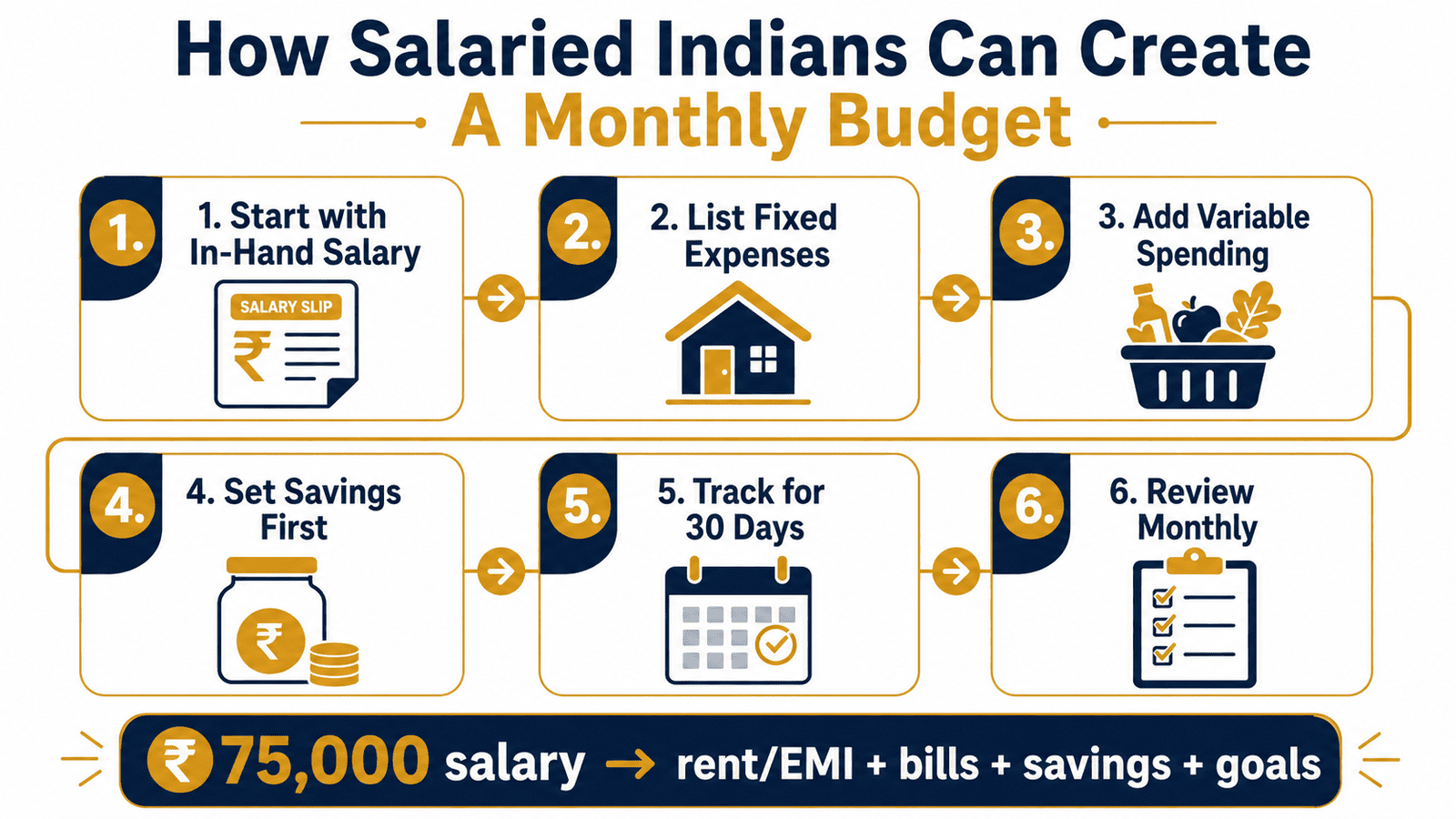
A monthly budget for salaried Indians is a simple plan that divides in-hand salary into fixed expenses, variable spending, savings, EMIs and future goals. Start with your actual take-home pay, list unavoidable bills, set aside at least one savings amount, track spending for 30 days, then adjust categories monthly.
Key Takeaways
- Always budget from in-hand salary, not CTC — your actual take-home can be ₹10,000–₹20,000 lower than your CTC after PF, tax, and deductions.
- Separate expenses into fixed (rent, EMI, insurance), variable (groceries, transport), irregular (annual fees, festivals), and goal-based (emergency fund, SIP) — each needs its own budget line.
- Save first, not last: decide your savings amount on salary day before any spending begins, then spend from what remains.
- UPI and credit card leakage are the single biggest reason Indian household budgets fail — a ₹200 daily UPI leak adds up to ₹6,000 a month.
- Annual expenses like insurance premiums, school fees, and festival spending should be converted into monthly reserve amounts — divide the annual total by 12 and set it aside each month.
- The first monthly budget will not balance perfectly — expect to adjust categories for two or three months before finding a system that fits your household.
- No single rule like 50/30/20 works for everyone: high-rent cities, EMI-heavy households, and families with dependents often need a customised split.
Key Facts at a Glance
| Parameter | Detail |
|---|---|
| Best suited for | Salaried employees, new earners, couples, and families |
| Starting input | In-hand (take-home) salary after all deductions |
| Expense categories needed | Rent/EMI, groceries, utilities, transport, insurance, savings, goals, irregular reserves, family support |
| Popular methods | 50/30/20, 60/20/20 (high-EMI), zero-based budgeting, envelope/jar method |
| Review frequency | Monthly |
| Tools needed | Notebook or spreadsheet, banking app statement, UPI app export, or expense tracker app |
| Time to set up first budget | 30–60 minutes on salary day |
What Is a Monthly Budget and Why Salaried Indians Need a Personalised One
A monthly budget is a salary allocation plan — a written decision about where each rupee of your in-hand pay will go before the month begins. The core advantage of a salaried income is predictability: you know roughly how much will arrive and on which date. That predictability is your biggest budgeting tool, and most people never use it deliberately.
The first principle is to work from in-hand salary only. Your CTC (Cost to Company) includes employer PF contributions, gratuity provisions, and sometimes variable pay — none of which reach your bank account monthly. If your CTC is ₹12 lakh per year, your in-hand might be anywhere from ₹72,000 to ₹85,000 per month depending on your tax slab, PF deduction, and professional tax. Budgeting from CTC sets you up to overspend from day one.
The Five Expense Categories Every Salaried Budget Needs
Fixed expenses are the same amount every month: rent, home loan EMI, car EMI, insurance premium (monthly mode), and fixed SIPs. These are non-negotiable and should be listed and totalled before anything else.
Variable expenses change monthly but are still unavoidable: groceries, electricity, cooking gas, internet, fuel, and medicines. These need a realistic ceiling, not a fantasy number.
Discretionary spending is the flexible category: dining out, movies, online shopping, travel, subscriptions like OTT platforms, and personal care. This is where most budgets either succeed or leak.
Irregular expenses happen a few times a year: car servicing, annual insurance premiums paid lump sum, school fees, festivals, weddings, and home repairs. These are the most commonly forgotten category — and the most likely to break a budget when they arrive unexpectedly.
Goal-based savings include emergency fund contributions, equity SIPs, PPF deposits, and short-term goals like a holiday or home down payment. These should be treated like a fixed expense — transferred out on salary day before any other spending.
50/30/20 as a Starting Point, Not a Rule
The 50/30/20 rule suggests allocating 50% of income to needs, 30% to wants, and 20% to savings. It is a useful first framework, but Indian households often find it difficult to follow precisely. In cities like Mumbai, Bengaluru, or Pune, rent alone can consume 30–40% of take-home salary. Add an EMI, and the “needs” bucket crosses 60% before groceries are counted.
A more practical approach for Indian households is to calculate your unavoidable fixed and variable costs first, then decide what a realistic savings amount is, and treat the rest as flexible spending. The family budget rule guide covers better alternatives for Indian rent, EMI, and dependent situations in detail.
According to RBI data on household financial behaviour, Indian households with a written or tracked budget are more likely to maintain consistent savings compared to those who rely on residual saving (saving only what is left at month-end). The direction is clear: plan first, spend from what remains.
Real Example: Rohit’s ₹75,000 Monthly Budget in Pune
Rohit, 29, works as a software engineer in Pune and takes home ₹75,000 per month. He shares a 2BHK flat with a flatmate, pays one personal loan EMI, and sends ₹5,000 to his parents every month. Here is how his budget breaks down:
| Category | Monthly Amount (₹) |
|---|---|
| Rent (his share of 2BHK) | 15,000 |
| Groceries and household | 6,000 |
| Utilities (electricity, gas, internet) | 2,500 |
| Transport (fuel + Ola/Uber) | 3,000 |
| Personal loan EMI | 7,500 |
| Health insurance premium (monthly) | 1,200 |
| Term insurance premium (monthly) | 800 |
| Emergency fund SIP (until 6× monthly expenses) | 5,000 |
| Equity SIP (long-term goal) | 6,000 |
| Family support (parents) | 5,000 |
| Irregular expense reserve (annual costs ÷ 12) | 3,000 |
| Discretionary / wants | 20,000 |
| Total | 75,000 |
Rohit’s split is roughly 65% needs, 15% savings/investments, and 27% discretionary — not a textbook 50/30/20, but it balances on his actual income and city. The ₹3,000 irregular reserve covers his annual car servicing (₹8,000), one festival trip (₹12,000), and phone insurance (₹16,000 spread across 12 months). Before building this budget, Rohit was not estimating for these at all — they used to clean out his savings account in October and December every year. To figure out how much emergency fund he needs before investing aggressively, he used the emergency fund amount calculator.
How to Calculate Your Monthly Budget
Budget Formula = In-hand salary − Fixed expenses − EMIs − Minimum savings − Irregular expense reserve = Flexible spending limit
Step 1 — Start with in-hand salary: ₹75,000
Step 2 — Subtract fixed, non-negotiable expenses: Rent ₹15,000 + EMI ₹7,500 + Insurance ₹2,000 + Family support ₹5,000 = ₹29,500
Step 3 — Subtract minimum savings: Emergency fund SIP ₹5,000 + Equity SIP ₹6,000 = ₹11,000
Step 4 — Subtract variable necessities: Groceries ₹6,000 + Utilities ₹2,500 + Transport ₹3,000 = ₹11,500
Step 5 — Subtract irregular reserve: ₹3,000
Flexible spending limit = ₹75,000 − ₹29,500 − ₹11,000 − ₹11,500 − ₹3,000 = ₹20,000
Rohit’s daily flexible spending ceiling: ₹20,000 ÷ 30 = approximately ₹667 per day for dining, entertainment, shopping, and personal expenses. If his expenses exceed salary in month one, the fix is usually to trim discretionary first — not to cut savings.
| Scenario | Key Change | Flexible Spending Left |
|---|---|---|
| Rohit adds ₹5,000 EMI for a new bike | EMI rises to ₹12,500 | ₹15,000 |
| Rohit’s rent rises to ₹18,000 | Rent increases by ₹3,000 | ₹17,000 |
| Rohit clears personal loan (no EMI) | EMI drops to ₹0 | ₹27,500 |
Comparison: Which Budgeting Method Suits You?
| Method | Best For | Works When |
|---|---|---|
| 50/30/20 Rule | Mid-income earners with moderate rent and no heavy EMI | Rent + EMI < 40% of salary |
| 60/20/20 Rule | High-rent cities, families with dependents, or heavy EMI | Rent + EMI 40–55% of salary |
| Zero-Based Budgeting | Disciplined savers who want full control; those paying down debt fast | Consistent income; patient with tracking |
| Envelope / Jar Method | People who overspend on specific categories like food or shopping | Cash users or those who set UPI limits |
| Tracker-First Method | Absolute beginners who have no idea where money currently goes | First 1–2 months only; upgrade after baseline is known |
How to Decide What’s Right for You
Your income is ₹30,000–₹40,000 per month and you are just starting out — THEN begin with tracking only for 30 days, then build a simple three-bucket budget: essentials, savings (even ₹1,000), and spending.
Your rent and EMIs together exceed 50% of your in-hand salary — THEN use a 60/20/20 framework and prioritise building at least a ₹50,000 emergency buffer before increasing SIPs.
You have dependents including children, elderly parents, or a non-earning spouse — THEN add insurance, school fees, and medical buffer as fixed line items before calculating discretionary spending.
You are carrying expensive personal loan or credit card debt — THEN direct at least 20% of salary to debt repayment and pause any new lifestyle spending until the high-interest debt is cleared. Build your six-month safety fund after debt is under control.
Your salary has recently increased — THEN increase savings and SIPs before upgrading lifestyle. A ₹10,000 raise invested from day one compounding over 10 years is worth significantly more than a slight apartment or phone upgrade.
You earn a predictable salary with low EMI and no dependents — THEN zero-based budgeting is highly effective: assign every rupee a purpose and end the month at exactly ₹0 unallocated.
If you have never tracked spending for even one month, do not start with a rigid zero-based or 50/30/20 budget — you will underestimate too many categories and abandon the system. Track first, budget second.
Common Mistakes to Avoid
Budgeting from CTC Instead of In-Hand Salary
Many salaried employees use their CTC figure to estimate monthly finances, not realising their actual take-home is 15–25% lower after PF, tax, and deductions.
If your CTC is ₹10 lakh per year, your monthly take-home could be ₹68,000–₹72,000, not ₹83,333. Building a budget on the higher number means you routinely overspend by ₹10,000–₹15,000 per month.
Always start with the amount actually credited to your bank account on salary day.
Ignoring Annual Expenses Until They Arrive
Insurance renewals, school fees, Diwali shopping, a family trip, car servicing, and home repairs do not happen every month — but they cost real money when they do.
A ₹24,000 annual insurance premium arriving in October will destroy a budget that was never prepared for it. It either forces credit card use or raids the emergency fund.
List your annual expenses, total them, divide by 12, and park that amount in a separate account each month. Even ₹2,000–₹3,000 monthly removes most surprise shocks.
Treating the Credit Card Limit as Spare Income
A ₹1 lakh credit card limit is not ₹1 lakh of additional money. It is a short-term loan that charges 36–42% annual interest if you revolve the balance.
Using the card beyond what you can pay in full each month means next month’s budget already starts at a deficit. Many Indian salaried employees cycle credit card debt for months without realising the interest cost is eating their savings.
Use the credit card for convenience and rewards only — never as a bridge for overspending.
Not Tracking UPI and Small Daily Spends
A ₹150 chai-and-snacks UPI payment, a ₹299 streaming add-on, a ₹450 impulse grocery order — these feel invisible but compound into ₹5,000–₹8,000 of unaccounted monthly spending for most salaried professionals.
Export your UPI app or bank statement once a month and categorise every payment. Most people are genuinely surprised by what they find the first time they do this.
You do not need to stop spending — you need to see the total and decide consciously.
Saving Only What Is Left at Month-End
Residual saving — saving what is left after spending — almost always results in saving nothing or very little. Spending expands to fill available money.
Pay yourself first: transfer your savings target on salary day before any discretionary spending starts. Even ₹3,000 saved consistently every month builds ₹36,000 a year before any returns.
Increasing Lifestyle Immediately After Every Salary Hike
Getting a ₹10,000 increment and immediately upgrading the apartment, phone, or daily dining budget is a classic lifestyle inflation trap. The new salary feels normal within a month, and savings never improve despite income rising every year.
A practical rule: direct at least 50% of any salary increase into savings or SIPs before making any lifestyle upgrade. See our guide on controlling lifestyle inflation for a deeper look at this pattern.
Expecting the First Budget to Be Perfect
Beginners often set unrealistically low variable expense figures in the first month and then abandon the whole system when they overspend in a category.
The first month is data collection. The second month is adjustment. The third month is where a realistic, working budget usually emerges. Expect and accept this curve instead of treating imperfection as failure.
When This May Not Be the Right Choice
Variable income households — freelancers, consultants, or gig workers earning through a salaried account — cannot rely on a fixed monthly budget. They need a minimum-survival budget based on their lowest expected month, plus a separate strategy for months when income is higher.
Severe debt situations — if more than 50% of your income is going to EMI and debt repayments, a standard budget may not help without first restructuring the debt. A qualified financial counsellor or debt management professional may need to be consulted before building a normal budget.
Medical or family emergencies — if a household member is dealing with a serious medical condition or unexpected crisis, regular budget categories will not hold. A temporary triage budget prioritising critical expenses, one savings line, and all discretionary eliminated is more realistic until stability returns.
Job transitions — the first one to three months of a new job often bring irregular salary credit dates, changed PF deductions, variable arrears, and uncertain CTC components. Build a provisional budget and revise it only after two or three stable salary credits land.
If any of these apply to your situation, it may be worth exploring alternatives before committing.
Official Rules and Where to Verify
Budgeting frameworks like 50/30/20 or zero-based budgeting are personal finance methods — not government-mandated rules. You are free to adapt or ignore them entirely based on your household’s needs.
However, several inputs that feed into your budget are governed by official rules you should verify directly:
- Income Tax Department (incometax.gov.in) — TDS on salary, tax slabs, Section 80C and 80D deduction limits, and changes introduced in each Union Budget that affect your in-hand pay.
- RBI (rbi.org.in) — Bank account charges, savings account interest rates, EMI regulations, credit card minimum payment rules, and guidelines on financial products.
- SEBI (sebi.gov.in) — Mutual fund regulations, SIP rules, and investor education resources for goal-based investments that form part of your budget.
Rules, limits, and rates on this topic can change with each Budget or regulatory update. Always verify current figures directly from the official source before making any financial decision.
Expert Tips
- Set up your budget on salary day, not at month-end. The first 24 hours after salary is credited are when most impulse spending begins. Block off 30 minutes on salary day to allocate all categories before touching discretionary money.
- Automate savings and recurring bills first. Set up standing instructions or auto-debit for SIPs, recurring deposits, and major bill payments on the day after salary day. What gets automated gets done; what relies on willpower often does not.
- Keep one dedicated account or sub-wallet for annual expenses. Move your ₹2,000–₹3,000 monthly irregular reserve into a separate savings account or liquid fund. Do not mix it with daily spending. When the car service or insurance renewal arrives, the money is already there.
- Review the budget monthly but focus only on major leaks first. In month one, do not try to fix every overspent category. Fix the one or two biggest leaks — usually food delivery, online shopping, or fuel — and leave the rest for month two. Small consistent fixes compound over time.
- Track net worth every quarter to see whether your budget is working. A budget controls cash flow; net worth tells you whether total wealth is actually growing. If monthly budgets are balanced but net worth is flat, look for hidden wealth destroyers like revolving credit card debt or low-return savings. Use our guide to calculating real wealth to get started.
- Build a buffer of ₹5,000–₹10,000 in your current account. Keeping only the exact budgeted amount means one unexpected expense — a medical bill, an urgent repair — immediately breaks the month. A small buffer absorbs shocks without touching the emergency fund.
Frequently Asked Questions
How much of my salary should I save every month?
There is no single correct percentage. A common starting target is 20% of in-hand salary, but this depends on income, city, debt, and dependents. If you have active EMIs and high rent, even 10% saved consistently is better than zero. Increase the savings rate as debts are cleared or income rises. The goal is consistency, not a specific percentage from day one.
Is the 50/30/20 rule practical for salaried Indians?
It works well for moderate earners in tier-2 cities with low to moderate EMI. In metros where rent is ₹20,000–₹35,000 and EMIs add another ₹10,000–₹20,000, the needs category alone exceeds 50%. The 60/20/20 framework or a fully customised split is more realistic for most Indian urban households.
Should I pay my EMI first or transfer savings first on salary day?
EMIs auto-debit on a fixed date regardless — they will be paid whether you plan for them or not. Savings, however, will only happen if you transfer them deliberately. The practical answer: set up EMI auto-debit and savings auto-transfer both to trigger within 1–2 days of salary credit. Do not rely on manual transfers for savings.
What is the easiest way to track monthly expenses in India?
Export your bank account statement and your UPI app transaction history (PhonePe, Google Pay, and Paytm all offer monthly summaries) at month-end. Categorise each payment manually for the first two or three months. After that, you will know your natural spending patterns and can set realistic category limits without tracking every transaction forever.
How do I budget if my rent is very high relative to my salary?
If rent exceeds 35–40% of your in-hand salary, start by maximising the remaining fixed categories and set a minimum savings amount — even ₹2,000 per month. Then work on reducing the rent burden over 6–12 months: consider a flatmate, moving slightly farther from the office, or negotiating a longer lease for lower rent. Do not skip savings entirely because rent is high — it becomes a permanent habit.
Can I use a credit card while on a monthly budget?
Yes, with one condition: pay the full outstanding balance every month, without exception. Credit cards used within budget for rewards and convenience are a net positive. Credit cards used as a bridge for overspending — and revolved with minimum payments — add 36–42% annual interest to every rupee you spent beyond budget. Budget the card’s spend as real money, not as future money.
What should I do if my budget does not balance in the first month?
Do not abandon the budget — adjust one or two categories. Most first-month imbalances happen because variable expenses like groceries, fuel, or dining were underestimated. Increase those estimates using actual data, reduce discretionary by the same amount, and rerun the budget for month two. It typically takes two to three months to get realistic figures.
Should I include my spouse’s or partner’s income in the household budget?
Yes, a household budget works best when it covers all income and all expenses under one plan. List both incomes, divide expenses based on what is agreed (equal split, proportional split, or category-based division), and treat savings as a shared household goal. Running two separate budgets in one household often creates gaps and duplicate spending.
How do I budget for irregular annual expenses like festivals and family events?
List all annual irregular expenses at the start of the year — Diwali, travel, annual insurance, birthdays, school admissions. Total the expected cost and divide by 12. Transfer that monthly amount into a separate account labelled “sinking fund” or “annual reserves.” When the expense arrives, the money is already there. Avoid treating these as surprises — they happen every year.
Is it worth using a budgeting app instead of a spreadsheet?
Both work. A spreadsheet gives full control and is free. Apps like Walnut, Money Manager, or bank-native expense trackers are faster for daily logging. The best tool is the one you will actually use every month. If app notifications remind you to log spending, use an app. If you prefer reviewing everything at month-end in one sitting, a spreadsheet is fine.
Final Verdict
A monthly budget for salaried Indians is not about cutting everything down to the bone — it is about giving every rupee of your in-hand salary a deliberate purpose before the month begins. The first goal is control, not perfection. The second goal is consistency: save something every month, track where the leaks are, and run a short review at month-end. A budget that a household can actually follow month after month — even an imperfect one — is worth far more than a theoretically perfect system that gets abandoned by day 10. Start with your actual take-home salary this month, list what must go out, set aside savings first, and treat the rest as your spending limit. Adjust next month based on what you learned. That is the whole system. Always verify the latest rules from official sources or consult a qualified professional before making any financial decision.
This article is for educational purposes only and should not be treated as personalised financial, tax, investment, insurance, or legal advice. Tax rules, interest rates, regulatory limits, and product features can change with each Budget or policy update. Please verify current rules from official government sources or consult a qualified and registered professional before making any financial decision.

Sanya Malhotra writes about everyday personal finance for Indian individuals and families. Her content focuses on budgeting, saving, emergency funds, debt control, net worth tracking, family money decisions, and practical habits that help readers manage money with more confidence.
She covers topics such as monthly budgeting, expense planning, saving habits, emergency fund behaviour, debt repayment, household financial planning, family discussions about money, financial mistakes, net worth tracking, short-term vs long-term goals, and beginner personal finance concepts.
Sanya’s writing style is warm, simple, and realistic. She avoids making personal finance feel intimidating and instead explains money decisions through relatable Indian examples, ₹ budgets, checklists, and step-by-step frameworks. Her articles are useful for students, freshers, couples, parents, and families who want to improve daily money habits. Her content is educational and does not provide personalised financial advice. Readers should adapt examples to their own income, family responsibilities, city, debt level, risk comfort, and financial goals.