
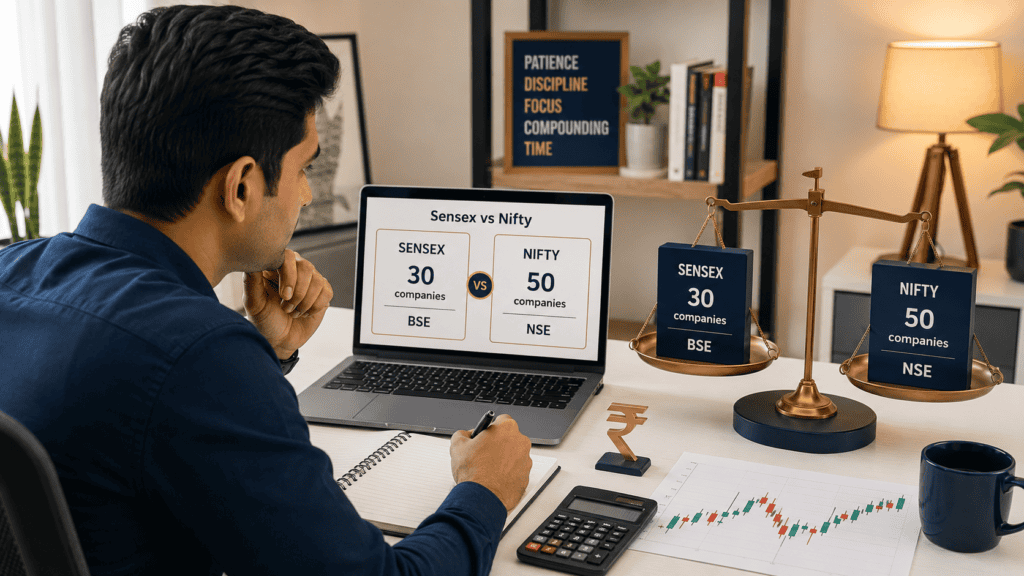
Every morning, headlines declare “Sensex rallies 500 points” or “Nifty hits a new high” — and most beginners have no idea what to do with that information. Should you buy? Should you sell? Is your portfolio safe? If you have just started investing in India through a demat account or a mutual fund SIP, understanding stock market basics is the first step — and that means knowing what Sensex and Nifty actually are before reacting to every news headline. These are not individual stocks. They are not economic guarantees. They are scorecards — and once you understand how they are built, you will stop letting daily index moves control your investing decisions.
Quick Answer: Sensex vs Nifty
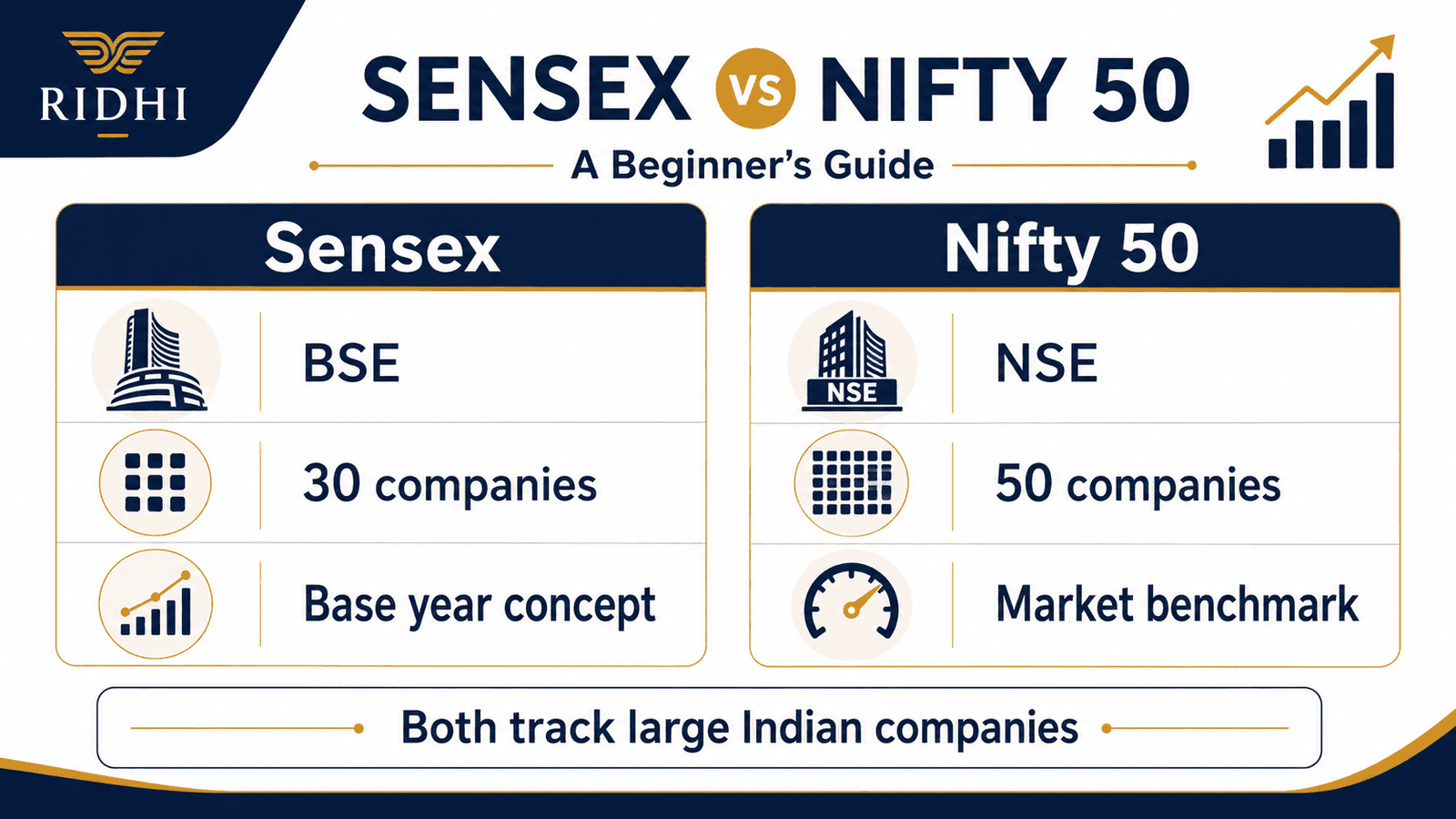
Sensex vs Nifty compares India’s two main stock market benchmarks: Sensex tracks 30 large BSE-listed companies, while Nifty 50 tracks 50 large NSE-listed companies. Both show broad market direction, but they are not the whole market, not guaranteed return indicators, and not direct advice to buy or sell stocks.
Key Takeaways
- Sensex is the benchmark index of the BSE (Bombay Stock Exchange) and tracks 30 of India’s largest and most liquid companies.
- Nifty 50 is the benchmark index of the NSE (National Stock Exchange) and tracks 50 large-cap companies across 13 sectors.
- Both indices use free-float market capitalisation weighting — meaning larger companies move the index more than smaller ones.
- A rising Sensex or Nifty does not mean every stock or mutual fund is rising: mid-cap, small-cap, or sector funds often move independently.
- Neither index represents all listed Indian companies — BSE has over 5,000 listed companies; Sensex tracks just 30 of them.
- Beginners should use these indices as broad market direction signals, not as buy or sell instructions.
- Mutual fund investments are subject to market risks. Past performance does not guarantee future returns.
Sensex vs Nifty: Key Comparison
| Parameter | Sensex | Nifty 50 |
|---|---|---|
| Full name | S&P BSE Sensex | NSE Nifty 50 |
| Exchange | BSE (Bombay Stock Exchange) | NSE (National Stock Exchange) |
| Number of companies | 30 | 50 |
| Calculation method | Free-float market capitalisation weighted | Free-float market capitalisation weighted |
| Breadth | More concentrated — 30 stocks | Broader — 50 stocks across 13 sectors |
| Base year / value | 1978–79 / 100 | November 1995 / 1,000 |
| Typical use by beginners | Checking broad market sentiment in news | Benchmarking large-cap mutual funds and ETFs |
| What it cannot tell you | Direction of mid-cap, small-cap, or your individual portfolio | Direction of mid-cap, small-cap, or your individual portfolio |
Key Facts at a Glance
| Fact | Sensex | Nifty 50 |
|---|---|---|
| Launched by | BSE — bseindia.com | NSE — nseindia.com |
| Companies tracked | 30 large-cap, liquid BSE stocks | 50 large-cap stocks across 13 sectors |
| Index type | Market capitalisation weighted benchmark | Market capitalisation weighted benchmark |
| Primary regulator | SEBI — sebi.gov.in | SEBI — sebi.gov.in |
| Review frequency | Reviewed periodically by BSE index committee | Reviewed semi-annually by NSE index committee |
What Is a Stock Market Index?
Think of a stock market index as a scoreboard for a cricket tournament — instead of tracking every ball played in every match across India, it picks a representative group of top matches and gives you an overall score. That is what Sensex and Nifty do: they track a selected group of large companies and calculate a single number that tells you how those companies performed as a group on any given day.
According to SEBI’s investor education framework, an index is used as a benchmark to measure the performance of a broad segment of the market. Neither Sensex nor Nifty captures the entire Indian stock market — they capture a slice of the largest and most liquid companies.
What Is Sensex?
Sensex — short for Sensitive Index — is the benchmark index of the BSE (Bombay Stock Exchange). It was created in 1986 and tracks 30 large, financially sound, and frequently traded companies listed on the BSE. The full official name is S&P BSE Sensex. These 30 companies span sectors like banking, information technology, oil and gas, FMCG, and automobiles. Because only 30 companies are included, Sensex is more concentrated — a single large bank or IT company can move the entire index by a meaningful amount on a single day.
Understanding the difference between NSE and BSE difference helps clarify why Sensex and Nifty exist as separate indices — they belong to competing exchanges with their own listing rules and index methodologies.
What Is Nifty 50?
Nifty 50 is the benchmark index of the NSE (National Stock Exchange). It was created in 1996 and tracks 50 large companies listed on the NSE across 13 sectors. The full name is NSE Nifty 50. Because it holds 50 stocks instead of 30, Nifty offers slightly broader representation — including more companies from healthcare, consumer goods, and metals alongside the dominant banking and IT sectors.
Both indices include companies that represent what a share means at scale — each company’s influence on the index is proportional to its freely tradable market value, not just its stock price.
Why Index Movement Is Not the Whole Economy
A common beginner mistake is treating a Sensex or Nifty move as a report card for the Indian economy. It is not. India has over 5,000 listed companies on the BSE alone. Sensex tracks 30 of them. When IT and banking stocks — which carry high weight in both indices — rise on a good earnings day, the index can show a sharp gain even if hundreds of mid-cap and small-cap companies fell the same day. The index reflects large-cap sentiment, not the full market breadth.
Real Example: Aarav’s Monday Morning Confusion
Aarav, 27, a software engineer in Pune earning ₹85,000 per month, started a ₹10,000 monthly SIP in a flexi-cap mutual fund six months ago. On a Monday morning, he opens his news app and sees: “Nifty 50 up 1.2% — market surges on banking rally.” He immediately checks his fund app — and his portfolio is up just 0.1%.
He is confused. If the market is up 1.2%, why is his fund barely moving?
The answer: his flexi-cap fund holds a mix of large-cap, mid-cap, and small-cap stocks. On that particular Monday, banking stocks — which carry heavy weight in Nifty 50 — drove the index up. But mid-cap and small-cap stocks in his fund’s portfolio were flat or slightly down. His fund uses a different benchmark — not Nifty 50 but a flexi-cap category benchmark that blends exposure across market caps.
This is a normal outcome, not a problem. Aarav’s ₹10,000 SIP is not broken. He is simply comparing his portfolio to the wrong yardstick. The lesson: always match your investment to its correct benchmark before drawing conclusions.
How Index Calculation Works
You do not need to calculate an index yourself — but understanding the basic idea prevents confusion about why large companies dominate index movement.
Market Capitalisation = Share Price × Total Number of Shares Issued
Free-Float Market Capitalisation = Share Price × Shares Available for Public Trading
Free-float excludes shares held by promoters, government bodies, or other locked-in holders — because those shares are not freely tradable. According to NSE methodology, the Nifty 50 uses free-float market capitalisation weighting, which means a company’s influence on the index equals its freely tradable market value as a proportion of the total freely tradable value of all 50 companies combined.
In practical terms: if a large private bank has a free-float market cap of ₹8 lakh crore and a smaller auto company has ₹50,000 crore, the bank moves the index 16 times more than the auto company on any given day.
Understanding market cap explained in detail helps you see why Sensex and Nifty are not equally distributed across 30 or 50 stocks — the top 5–8 companies often account for a disproportionate share of the index weight.
| Scenario | What Happens in the Index | What May Happen in Your Portfolio |
|---|---|---|
| Large bank stock rises 3% | Nifty may rise 0.5–1% even if other stocks are flat | Small-cap or sector fund may show no movement |
| IT sector falls on weak guidance | Both Sensex and Nifty fall noticeably | Pharma or FMCG-heavy fund may hold steady |
| Mid-cap stocks rally 2% | Nifty 50 barely moves (mid-caps not included) | Mid-cap fund rises significantly |
How to Decide What’s Right for You
you want a quick read on broad large-cap market sentiment — THEN check either Sensex or Nifty. Both tell you the same directional story for large-cap India.
you are benchmarking a large-cap mutual fund or Nifty 50 index fund — THEN compare your fund’s returns against Nifty 50 or Sensex, as most fund factsheets use one of these as the benchmark.
your fund invests in mid-cap or small-cap companies — THEN do not compare it against Nifty 50 or Sensex. Use the fund’s stated benchmark from its factsheet instead.
you are deciding between a passive index fund and an actively managed fund — THEN understanding Nifty 50 as a benchmark is essential. Read more on index funds comparison before choosing.
you are a complete beginner who has not yet opened a demat account — THEN focus on understanding indices before investing, and when you are ready, learn how to open a demat account step by step.
you should not use Sensex or Nifty as a benchmark if you invest in sector-specific funds, international funds, or debt funds — these have entirely different risk profiles and benchmarks that have nothing to do with large-cap Indian equities.
Common Mistakes to Avoid
Treating Sensex or Nifty as “the whole market”
Sensex tracks 30 companies. Nifty 50 tracks 50. BSE alone lists over 5,000 companies.
Thousands of listed companies — including most mid-cap and small-cap stocks — are completely absent from these indices. A flat or rising index does not mean all companies are doing well. Investors who rely only on Sensex/Nifty headlines often miss large corrections happening in the broader market at the same time.
Check broader indices like Nifty Midcap 150 or BSE 500 for a wider market view.
Buying stocks because the index is rising
A rising Nifty 50 means the 50 companies in that basket did well on average — not that every stock is worth buying.
Individual stocks within the index can still fall even on days when the overall index rises. Buying any stock purely because the index is green is not a strategy — it is a reaction. According to SEBI’s investor awareness guidelines, investment decisions should be based on research and suitability, not index direction alone.
Evaluate stocks on fundamentals, not on whether today’s headline index number is green.
Assuming a rising index means your mutual fund will also rise
Your mutual fund’s performance depends on what it holds — not on what Sensex or Nifty holds.
A small-cap fund, a pharma sector fund, or an international fund can fall sharply on a day when Nifty rises 1%. Each fund has its own benchmark. Comparing a mid-cap fund with Nifty 50 is like comparing a test cricketer’s run rate with a T20 match average — the format is different.
Always check your fund’s official benchmark on its factsheet to compare accurately.
Treating index levels as price targets or future predictions
When someone says “Sensex will reach 1,00,000,” that is speculation, not a rule.
Index levels reflect past and current market prices — they do not predict future levels. Investors who make large investment or withdrawal decisions based on index level predictions frequently time the market incorrectly and lock in avoidable losses.
Make investment decisions based on your goal timeline and risk tolerance — not on index level forecasts.
Using Sensex or Nifty to evaluate debt fund performance
Debt mutual funds invest in bonds, treasury bills, and fixed-income instruments — not equities.
Comparing a debt fund’s 7% annual return with a Nifty that returned 12% in the same period is not a fair or useful comparison. Debt funds carry lower risk and lower expected returns by design. They have their own benchmarks like CRISIL indices.
Match your fund category to its relevant category benchmark before judging underperformance.
Ignoring sector weights when reading index moves
Banking and financial services typically carry heavy weight in both Sensex and Nifty 50.
On days when banking stocks move sharply — due to RBI policy decisions, earnings, or regulatory news — the entire index can swing significantly even if every other sector was flat. A beginner who does not know this may believe the broad market moved, when in fact only one sector did.
When reading index news, check which sector drove the move before drawing any conclusion.
When This May Not Be the Right Choice
Sensex and Nifty are the wrong benchmarks for several common investor situations. If you invest in a sector-specific fund — such as pharma, technology, or infrastructure — that fund will be benchmarked against its own sector index, not Nifty 50 or Sensex. Comparing it with a broad index will give you a misleading picture of performance.
If your mutual fund holds mid-cap or small-cap companies, its returns will often diverge sharply from large-cap indices — sometimes outperforming by a wide margin, sometimes underperforming. The Nifty Midcap 150 or Nifty Smallcap 250 are more appropriate reference points. Similarly, international funds, global ETFs, and fund-of-funds need global benchmarks like the S&P 500 or MSCI World — Sensex is irrelevant to their performance.
Debt mutual funds, fixed deposits, and hybrid funds should never be compared against equity indices. Their risk profile and return expectations are fundamentally different. If any of these apply to your situation, it may be worth exploring alternatives before committing.
Official Rules and Where to Verify
Index methodology, sector weights, and constituent companies are reviewed periodically and can change. Before making any investment decision based on index composition or weights, verify current information directly from the official sources:
- NSE (National Stock Exchange) — nseindia.com — official Nifty 50 methodology, constituent list, and index factsheets.
- BSE (Bombay Stock Exchange) — bseindia.com — official Sensex methodology, constituent list, and index data.
- SEBI (Securities and Exchange Board of India) — sebi.gov.in — investor education resources, market regulation guidelines, and advisory context for retail investors.
Rules, limits, and rates on this topic can change with each Budget or regulatory update. Always verify current figures directly from the official source before making any financial decision.
Expert Tips
- Focus on percentage change, not index points. A 500-point Sensex fall sounds alarming — but if Sensex is at 75,000, that is less than 0.7%. Points are misleading without context; percentage moves give you the real picture.
- Check your fund’s stated benchmark before comparing returns. Open your fund factsheet on the AMC website. The benchmark will be clearly listed — it may be Nifty 50, Nifty 500, Nifty Midcap 150, or something else entirely. Compare only against that number.
- Watch which sector is driving the index move. When Nifty rises 1% in a session, check the sector breakdown. If banking alone is up 3% and everything else is flat, the move tells you something specific about financial stocks — not about the broad economy.
- Use indices to build market intuition before putting money at risk. Spend a few weeks watching how Sensex and Nifty react to RBI policy announcements, quarterly earnings results, and global market moves. This pattern recognition is free — and it builds the instinct that most beginners skip.
- Do not invest in index funds purely because the index hit a record high. A new high means prices are elevated relative to history — not that they will keep rising. Systematic investing through SIPs is a more consistent approach than timing entry based on index levels. According to SEBI, retail investors are encouraged to invest regularly and not react to short-term market movements.
- Rebalancing happens inside the index — your fund benefits automatically. Both Nifty 50 and Sensex undergo periodic index rebalancing — removing underperforming or delisted companies and replacing them with stronger ones. If you hold an index fund tracking either benchmark, your fund manager does this automatically at no decision cost to you.
Frequently Asked Questions
Is Nifty 50 better than Sensex for beginners?
Neither is “better” — they serve the same purpose of showing large-cap market direction. Nifty 50 is slightly broader with 50 companies across 13 sectors, which many beginners find more representative. For benchmarking large-cap mutual funds, Nifty 50 is more commonly used in fund factsheets. For checking market sentiment in news headlines, either works equally well.
Why is the Sensex value much higher than Nifty?
Because they started from different base values. Sensex started at a base of 100 in 1978–79, while Nifty 50 started at 1,000 in November 1995. The two numbers are not comparable in absolute terms — they are calculated on different scales from different base years. What matters is the percentage change over any period, not the absolute level.
Can I invest directly in Sensex or Nifty?
Not directly. Sensex and Nifty are indices — mathematical calculations, not tradable products. However, you can invest in Nifty 50 index funds or Nifty 50 ETFs that replicate the index. Similarly, BSE Sensex index funds exist. These products mirror the index composition so your returns closely match the index performance, minus a small expense ratio.
Why does my mutual fund not move the same way as Nifty 50?
Because your fund may hold different companies, in different proportions, than Nifty 50. A flexi-cap fund, a mid-cap fund, or a sector fund will all behave differently from a large-cap index. Even large-cap funds that claim Nifty 50 as their benchmark can deviate due to the fund manager’s stock selection. Check your fund’s portfolio holdings on the AMC’s website monthly to understand what it actually owns.
Are Sensex and Nifty safe indicators to follow?
They are useful indicators for large-cap market direction — but they are not predictive tools and they do not reflect your personal portfolio. Both can be influenced heavily by a handful of large companies or sectors. Relying on them as “safe” signals for investment timing would be a mistake. Use them as context — not as instructions.
Which index should beginners track first?
Start with Nifty 50. It has broader coverage across 13 sectors, is used as the benchmark by most large-cap and flexi-cap mutual funds, and is widely referenced in market analysis. Once you are comfortable reading Nifty 50, add Sensex for a second data point. Over time, also follow Nifty Midcap 150 if your portfolio includes mid-cap exposure.
What happens if a company is removed from Nifty 50 or Sensex?
Both indices undergo periodic rebalancing. When a company no longer meets the eligibility criteria — based on market cap, liquidity, or listing requirements — it is replaced by a qualifying company. If you hold an index fund, the fund manager automatically adjusts the portfolio to mirror the updated index. No action is needed on your part. The constituent list is published on nseindia.com and bseindia.com after every review.
Can Sensex and Nifty fall to zero?
Theoretically, no — because the indices would need every constituent company to go to zero simultaneously, which has never happened in any major economy. In practice, both indices have fallen sharply during crises — Sensex fell roughly 38% during the 2008 global financial crisis and over 35% during the March 2020 COVID crash — but recovered over time. Past recoveries do not guarantee future recoveries, but diversified large-cap exposure has historically been resilient over long periods.
Is a rising Sensex good news for everyone in India?
Not necessarily. A rising Sensex reflects higher prices for the 30 companies it tracks — mostly large corporations. It does not directly indicate improvements in employment, inflation, or the financial health of the broader population. Many Indians who do not invest in equities are not affected by Sensex movements in their daily financial life. The index measures financial market sentiment, not broader economic wellbeing.
Final Verdict
Sensex and Nifty 50 are both essential benchmarks for understanding the direction of India’s large-cap equity market. Sensex is more concentrated — 30 companies, BSE-listed — while Nifty 50 is slightly broader — 50 companies, NSE-listed, across 13 sectors. For most beginners, Nifty 50 is the more practical starting point because it is referenced more widely in mutual fund factsheets and market analysis. But for understanding the sensex vs nifty difference at its core, both indices are telling you roughly the same story — just from slightly different vantage points.
Neither index replaces the need for proper asset allocation, goal-based investing, or understanding what you personally own. Use them as a compass for large-cap market direction. Do not use them as a buy signal, a sell signal, or a report card for your own portfolio. Always verify the latest rules from official sources or consult a qualified professional before making any financial decision.
This article is for educational purposes only and should not be treated as personalised financial, tax, investment, insurance, or legal advice. Tax rules, interest rates, regulatory limits, and product features can change with each Budget or policy update. Please verify current rules from official government sources or consult a qualified and registered professional before making any financial decision.

Devika Shah writes about stock market basics for Indian beginners who want to understand equity investing before taking financial risk. Her content is educational and does not provide stock tips, trading calls, price predictions, or personalised investment advice.
She covers topics such as demat account meaning, trading account basics, IPOs, dividends, brokerage charges, delivery vs intraday trading, market orders, limit orders, stock indices, blue-chip stocks, capital gains tax, stock market terminology, risk management, and the difference between long-term investing and short-term speculation.
Devika’s writing is clear, balanced, and risk-conscious. She helps readers understand how the stock market works, what accounts and documents are needed, what charges may apply, and what mistakes beginners should avoid. Her articles are suitable for students, salaried employees, and first-time investors who want a foundation before investing. Since market rules, tax treatment, brokerage fees, IPO processes, and regulatory requirements can change, readers should verify current information from SEBI, exchanges, brokers, and official tax sources.