

You check your demat account one morning and your share quantity has doubled overnight. No new purchase. No money transferred. The share price has also halved. Your first reaction: did I just get free money — or did the company do something strange?
This happens with two common corporate actions in the Indian stock market basics: a bonus share issue and a stock split. They look almost identical on your portfolio screen. But the mechanism, the accounting treatment, and the tax tracking are meaningfully different — and confusing them leads to bad decisions around buying, selling, and record-keeping.
This article explains bonus share vs stock split with a plain before/after comparison, Indian examples, and a clear guide on what you actually need to do when your company announces either one.
Quick Answer: Bonus Share vs Stock Split
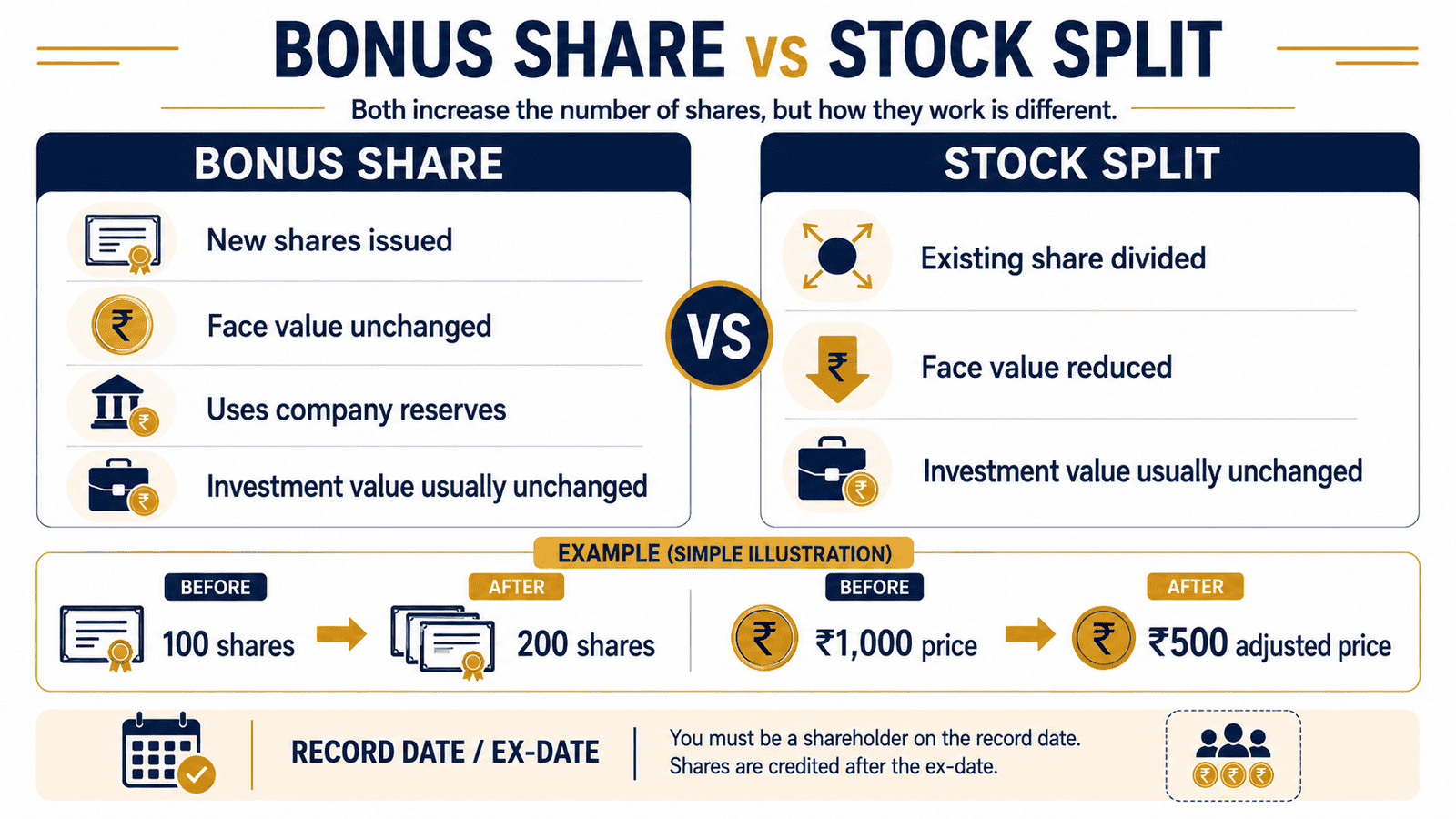
Bonus share vs stock split compares two corporate actions that increase your share count but usually do not change your total investment value immediately. In a 1:1 bonus, 100 shares become 200; in a 1:2 split, one share becomes two and face value reduces proportionately.
Key Takeaways
- Bonus shares are issued from a company’s free reserves — you receive additional shares at no cost, but your total portfolio value does not automatically rise on the ex-date.
- A stock split divides each existing share into smaller units and reduces the face value proportionately — a 1:2 split on a ₹10 face-value share produces a ₹5 face-value share.
- In both cases, the exchange adjusts the share price on ex-date so your pre-event portfolio value stays broadly the same: 100 shares at ₹200 become 200 shares at roughly ₹100.
- Neither action increases the company’s market capitalisation on its own — if the fundamentals do not improve, neither does your real wealth.
- For tax purposes, bonus shares have a ₹0 cost of acquisition; you must track the record date carefully when calculating capital gains on future sales.
- Confirm the record date and ex-date from official exchange disclosures — not social media — before making any buy or sell decision.
| Parameter | Bonus Share | Stock Split |
|---|---|---|
| Meaning | Additional shares issued free from company reserves | Each existing share divided into smaller units |
| Source / mechanism | Free reserves and surplus converted to paid-up share capital | Existing share capital restructured; total capital unchanged |
| Face value impact | No change | Reduces proportionately |
| Share count | Increases per bonus ratio (e.g. 1:1 doubles count) | Increases per split ratio (e.g. 1:2 doubles count) |
| Adjusted market price | Falls proportionately on ex-date | Falls proportionately on ex-date |
| Paid-up share capital | Increases | No change |
| Cost of acquisition (tax) | ₹0 for bonus shares; original cost retained for original shares | Original cost spread across new share count |
| Investor action required | None — shares credited to demat automatically | None — shares credited to demat automatically |
Key Facts at a Glance
| Fact | Bonus Share | Stock Split |
|---|---|---|
| What it is | Free additional shares from reserves | Division of each existing share |
| Face value after action | Unchanged (e.g. still ₹10) | Reduced (e.g. ₹10 → ₹5 in a 1:2 split) |
| Typical ratios | 1:1, 1:2, 2:1, 3:1 | 1:2, 1:5, 1:10 |
| Portfolio value change on ex-date | Broadly unchanged | Broadly unchanged |
| Investor action needed | None; verify demat credit | None; verify demat credit |
How Bonus Shares and Stock Splits Actually Work
When a company earns profit over several years, it can choose to pay dividends, reinvest in the business, or retain the surplus in its reserves. A bonus issue is one way a company deploys those reserves — it converts a portion of its free reserves into paid-up share capital and distributes additional shares to existing shareholders. You receive these shares in proportion to how many you already hold. A 1:1 bonus means one extra share for every share you own. A 2:1 bonus means two extra shares for every one you hold.
The key accounting point: the company’s total net worth does not change. Reserves reduce and paid-up capital increases by the same amount. The economic pie stays the same size. It just gets sliced differently.
Why Companies Issue Bonus Shares
Companies issue bonus shares for a few practical reasons. A high share price can reduce trading liquidity — fewer retail investors can afford to buy even one share. A bonus issue brings the price down to a more accessible level without the company spending cash. It also signals management’s confidence: you only convert reserves to capital if you believe the business can sustain growth without that cushion. According to SEBI guidelines, companies must follow SEBI’s ICDR regulations and exchange disclosure frameworks when announcing a bonus issue.
What a Stock Split Actually Does
A stock split divides each existing share into a smaller denomination. In a 1:2 split, one ₹10 face-value share becomes two ₹5 face-value shares. No new shares are created from reserves. The paid-up share capital in rupees stays exactly the same — only the face value and share count change. A 1:5 split turns 100 shares at ₹10 face value into 500 shares at ₹2 face value, with identical total paid-up capital.
Companies split shares primarily to improve affordability and liquidity. A stock trading at ₹4,000 per share can feel out of reach for small investors. A 1:4 split brings it to ₹1,000, widening the potential buyer pool. This is the same logic as a bonus issue — the method differs, but the affordability goal is similar.
The Role of Record Date and Ex-Date
Both corporate actions use two key dates. The record date is the date on which the company checks its register to determine which shareholders are eligible for the bonus or split. If you hold shares in your demat account on the record date, you qualify. The ex-date is typically one trading day before the record date (due to T+1 settlement in India). If you buy on or after the ex-date, you will not receive the benefit. The exchange adjusts the share price downward on the ex-date to reflect the higher share count.
Understanding owning a share and how demat settlement works is essential to understanding why the ex-date matters — your shares must settle in your account before the record date.
Adjusted Price Is Not a Crash
One of the most common beginner panics: seeing the share price drop 50% on ex-date and assuming something went wrong. It did not. The exchange adjusts the price mechanically to reflect the increased share count. If you had 100 shares at ₹400, worth ₹40,000, and after a 1:1 bonus the price adjusts to ₹200, your 200 shares are still worth ₹40,000. Wealth unchanged. Price adjusted. This is different from a genuine fall caused by poor earnings or market sentiment. Bonus shares and splits are different from company dividends explained — dividends pay cash out of the company to shareholders, while bonus issues retain value inside the company but redistribute share units.
Real Example: Rohan’s Portfolio Before and After
Rohan, 31, Pune, works as a software engineer earning ₹1.2 lakh per month. He holds shares in two companies — one announces a 1:1 bonus and the other announces a 1:2 stock split.
Scenario A — Bonus Issue: Rohan holds 100 shares of Company X at ₹200 per share. Total portfolio value: ₹20,000. Company X announces a 1:1 bonus. After the record date, Rohan’s demat account shows 200 shares. The exchange-adjusted price on ex-date is approximately ₹100. Total portfolio value: 200 × ₹100 = ₹20,000. Face value of Company X shares: still ₹10.
Scenario B — Stock Split: Rohan holds 100 shares of Company Y at ₹200 per share. Total portfolio value: ₹20,000. Company Y announces a 1:2 stock split. After the record date, Rohan’s demat account shows 200 shares. The exchange-adjusted price is approximately ₹100. Total portfolio value: 200 × ₹100 = ₹20,000. Face value of Company Y shares: reduced from ₹10 to ₹5.
The portfolio outcome looks identical on screen. The difference is under the hood: the source of new shares (reserves vs. share restructure) and the face value. As the market cap meaning article explains, market capitalisation is shares outstanding × market price — and since both change proportionately, market cap does not automatically rise from a bonus or split alone.
How to Calculate the Impact
Bonus Issue — New Share Count = Old Shares × (1 + Bonus Ratio)
Approximate Adjusted Price = Old Market Price ÷ (1 + Bonus Ratio)
For a 1:1 bonus on 100 shares at ₹200: New shares = 100 × (1 + 1) = 200. Adjusted price = ₹200 ÷ 2 = ₹100. Total value = 200 × ₹100 = ₹20,000.
Stock Split — New Share Count = Old Shares × Split Factor
Approximate Adjusted Price = Old Market Price ÷ Split Factor
For a 1:2 split on 100 shares at ₹200: New shares = 100 × 2 = 200. Adjusted price = ₹200 ÷ 2 = ₹100. Total value = 200 × ₹100 = ₹20,000.
| Scenario | Key Inputs | Result |
|---|---|---|
| 1:1 Bonus (100 shares at ₹200) | New count = 200; adjusted price ≈ ₹100 | Portfolio value ≈ ₹20,000 |
| 1:2 Split (100 shares at ₹200) | New count = 200; adjusted price ≈ ₹100 | Portfolio value ≈ ₹20,000 |
| 2:1 Bonus (100 shares at ₹300) | New count = 300; adjusted price ≈ ₹100 | Portfolio value ≈ ₹30,000 |
These are illustrative figures only. Actual market prices after ex-date move with supply, demand, and sentiment — they do not mechanically stay at the adjusted price. For tax treatment when you sell these shares, refer to current guidance from the Income Tax Department at incometax.gov.in before filing.
How to Decide What’s Right for You
You already hold shares in a company announcing a bonus or split — THEN simply wait for the demat credit; no action is required from you.
You are considering buying a stock only because it announced a bonus or split — THEN first check the company’s fundamentals: revenue growth, profit trend, debt levels, and valuation. The corporate action alone does not improve business quality.
You want to be eligible for a bonus or split — THEN confirm the record date from the official NSE or BSE exchange disclosure and ensure your purchase settles before the ex-date; buying on or after ex-date makes you ineligible.
You are comparing a bonus-issuing company vs a dividend-paying company for long-term holding — THEN read about company dividends explained because dividends deliver cash today while bonus shares increase future capital gains potential without immediate cash income.
You need to calculate capital gains after selling bonus shares — THEN note that the cost of acquisition for bonus shares is ₹0 (as per current tax treatment); consult incometax.gov.in or a tax professional for the latest rules before filing.
If the company’s earnings, cash flows, or debt situation are deteriorating — a bonus or split announcement should NOT be treated as a reason to accumulate more shares; corporate actions do not reverse weak fundamentals.
Common Mistakes to Avoid
Treating Bonus Shares as Free Profit
Bonus shares increase your share count but adjust the price proportionately. Your total investment value does not increase on the day of the corporate action.
Many beginners see double shares in their demat account and assume they made a profit. If you bought 100 shares at ₹500 (total ₹50,000) and receive a 1:1 bonus, your 200 shares will trade at roughly ₹250 — still ₹50,000. Celebrating prematurely can lead to selling at a price you consider “high” but is actually just the adjusted market value.
Track total portfolio value, not just share count, to assess performance accurately.
Assuming a Stock Split Means the Share Is Now Cheap
A lower share price after a split does not mean the company’s valuation has become more attractive.
Valuation is measured by price-to-earnings ratio, price-to-book, earnings growth — not face value or absolute share price. A ₹100 share after a 1:5 split can still be more expensive in valuation terms than a ₹5,000 share in a different company. Confusing price with value is one of the most costly beginner errors in stock investing.
Always analyse the P/E ratio and fundamentals, not just the per-share price.
Panicking When the Price Drops on Ex-Date
On ex-date, the exchange adjusts the share price downward to reflect the increased share count.
This is a mechanical adjustment, not a sign the company is in trouble or the market is selling off. Selling in panic on ex-date locks in no gain — and you would already have missed the bonus credit. Wait for your demat statement to confirm the new share count before acting.
Buying After the Ex-Date Expecting the Benefit
If you purchase shares on or after the ex-date, you will not receive the bonus shares or the split credit.
This is a frequent mistake among investors chasing an announcement. You pay the pre-adjustment price but receive shares without the benefit. The settlement cycle means you must buy at least one trading day before ex-date for your shares to settle before the record date.
Check the official exchange circular for exact dates before placing any order.
Ignoring Tax Records After a Bonus Issue
Bonus shares have a ₹0 cost of acquisition for capital gains purposes (under current Indian tax law).
When you sell bonus shares later, your entire sale consideration may be treated as capital gains, potentially creating a significant tax liability you did not anticipate. Similarly, the holding period for bonus shares starts from the date of allotment — not the date you purchased the original shares. Poor record-keeping here can lead to errors in ITR filing.
Note the allotment date for all bonus shares in your portfolio tracker immediately after credit.
Confusing Bonus Ratio Notation
A 1:2 bonus means one additional share for every two held. A 2:1 bonus means two additional shares for every one held.
The notation can confuse beginners, especially when different news sources write it differently. Verify the exact ratio from the company’s official exchange filing — not headlines. A misread ratio can produce wrong calculations for your expected credit quantity.
When This May Not Be the Right Choice
A bonus issue or stock split announcement is not a signal to increase your position in a company. If any of the following apply, the corporate action offers limited benefit to you as an investor:
Weak or declining fundamentals: If the company’s revenue is falling, debt is rising, or profits are shrinking, a bonus issue changes nothing about the business quality. More shares in a deteriorating company do not improve your position.
Already overvalued on fundamentals: A lower share price after a split does not make a fundamentally overvalued stock a bargain. Valuation ratios like P/E and P/B remain unchanged by the split itself.
Short-term hype-driven buying: Bonus and split announcements sometimes trigger temporary price spikes driven by retail excitement. Buying into that spike often means paying more than the stock is worth — and the subsequent price adjustment can look like a loss.
Unclear record date or settlement risk: If you are unsure whether your purchase will settle before the record date, the risk of buying without receiving the benefit is real. Buying last-minute without confirming settlement dates is speculative, not strategic.
If any of these apply to your situation, it may be worth exploring alternatives before committing.
Official Rules and Where to Verify
Corporate actions like bonus issues and stock splits are governed by SEBI’s regulations, including the ICDR Regulations and Listing Obligations and Disclosure Requirements (LODR). Companies are required to disclose all material corporate actions to the stock exchanges before they take effect.
For stock tax basics related to capital gains on bonus shares and split shares, refer to the Income Tax Department’s guidance before selling or filing your returns.
- SEBI — sebi.gov.in (corporate action regulations, LODR disclosures, investor grievance)
- Income Tax Department — incometax.gov.in (capital gains treatment, cost of acquisition for bonus shares, holding period rules)
- NSE and BSE exchange circulars — nseindia.com and bseindia.com (official ex-date, record date, and corporate action notifications)
- Your broker/demat statement — confirms the actual credit of shares post-record date and the adjusted cost basis in some platforms
Rules, limits, and rates on this topic can change with each Budget or regulatory update. Always verify current figures directly from the official source before making any financial decision.
Expert Tips
- After a bonus or split, compare your total portfolio value — not just the share count — against your original investment to measure real performance. Share quantity doubling while price halves is not wealth creation.
- Log the record date for every corporate action in a separate tracker. When you sell bonus shares months or years later, the acquisition date (allotment date) and ₹0 cost basis are critical inputs for capital gains calculation.
- Read the official exchange circular, not just the news headline. The exact bonus ratio notation (1:1 vs 1:2) and record date are confirmed only in the NSE/BSE circular — these govern your actual entitlement.
- Watch for liquidity improvement after a split, but do not confuse it with valuation improvement. More liquid shares trade more easily, but liquidity alone does not justify a higher P/E multiple.
- If a company has issued bonus shares multiple times over the years, your effective cost of acquisition per share is very low — creating potentially large taxable capital gains when you sell. Plan your exit with this in mind rather than being surprised at tax filing time.
- Compare bonus shares with a rights issue meaning before assuming all corporate actions are equivalent — rights issues require you to pay for additional shares, while bonus issues are genuinely free of cost but funded from the company’s own reserves.
Frequently Asked Questions
Is a bonus share better than a stock split?
Neither is inherently better for the investor in terms of immediate wealth impact. Both increase share count and adjust the price proportionately. The key difference is accounting: a bonus uses company reserves and increases paid-up capital; a split restructures existing shares and reduces face value. For tax purposes, the treatment differs — verify current rules at incometax.gov.in before selling either type of shares.
Does a bonus share issue increase my wealth?
Not automatically. On the ex-date, the exchange adjusts the share price downward in proportion to the bonus ratio, so your total portfolio value remains broadly unchanged immediately. Your wealth grows only if the company’s earnings and business performance improve over time, which causes the market price to rise after the corporate action.
Does a stock split reduce my investment value?
No. A stock split does not reduce your investment value. Your total holding — number of shares multiplied by adjusted price — remains the same as before the split. The split only changes the denomination: instead of one ₹10 face-value share at ₹400, you hold two ₹5 face-value shares at ₹200 each. The total is still ₹400.
What happens to the face value of shares after a stock split?
Face value reduces proportionately. In a 1:2 split, a ₹10 face-value share becomes two ₹5 face-value shares. In a 1:5 split, it becomes five ₹2 face-value shares. This is the most visible accounting difference between a bonus issue (face value unchanged) and a stock split (face value reduced).
Are bonus shares taxable in India?
Yes, when you sell bonus shares, the capital gains are taxable. Under current tax treatment, the cost of acquisition for bonus shares is ₹0, which means your entire sale consideration for those shares may be treated as capital gains. The holding period for short-term vs long-term classification starts from the date of allotment of the bonus shares, not your original purchase date. Tax rules can change — verify current rates and holding period definitions at incometax.gov.in or consult a tax professional before selling or filing.
What is record date and ex-date, and how are they different?
The record date is the date the company checks its share register to identify eligible shareholders. The ex-date is typically one trading day before the record date (under T+1 settlement). If you buy shares on or after the ex-date, your purchase settles after the record date and you do not qualify for the bonus or split. The exchange adjusts the share price on the ex-date morning to reflect the corporate action.
Should I buy shares before a bonus issue or stock split to benefit?
You need to hold shares before the ex-date to be eligible. However, this does not mean the corporate action itself makes it a good time to buy. Share prices often rise in anticipation of an announcement and may not increase further after the event. Buying purely to capture a bonus or split is a speculative strategy, not a fundamental investment rationale. Evaluate the company’s earnings, valuation, and long-term business quality first.
Can I sell my shares before the bonus shares are credited and still receive the bonus?
If you sell your shares before the record date, you will not receive the bonus shares. Eligibility is based on holding shares in your demat account on the record date. Selling after the ex-date but before the record date is a grey area depending on settlement — confirm the exact position with your broker and refer to the exchange circular for your specific corporate action.
What is the difference between a bonus issue and a rights issue?
A bonus issue gives you free additional shares funded from the company’s reserves — no payment required. A rights issue gives you the right to buy additional shares at a specified price, usually below the market price, but you must pay for them. Rights issues can dilute non-participating shareholders; bonus issues do not require any payment from shareholders. Both are corporate actions that affect your share count and portfolio structure differently.
Does a bonus share or split affect the company’s market capitalisation?
Not directly. Market capitalisation equals share price multiplied by total shares outstanding. When both the price and share count change proportionately, the market cap remains the same. The market cap can only increase if investors re-price the company higher after the event — which depends on fundamentals and sentiment, not the corporate action itself.
Final Verdict
Bonus share vs stock split are both corporate actions that increase the number of shares you hold, adjust the share price proportionately, and broadly leave your immediate portfolio value unchanged. The difference lies in the mechanism: a bonus issue converts company reserves into additional paid-up share capital, while a stock split divides existing shares and reduces face value without touching reserves. For most investors, the practical impact on ex-date is similar — more shares at a lower price.
Where the two diverge is in accounting, face value, and tax record-keeping. Bonus shares carry a ₹0 cost of acquisition, which creates a capital gains liability entirely on the sale proceeds when you eventually exit. Track your allotment dates and retain your demat statements. Focus on the company’s fundamentals and long-term earnings power, not the share count optics. Mutual fund investments are subject to market risks. Past performance does not guarantee future returns. Reference SEBI at sebi.gov.in for regulatory context on corporate actions and investor disclosures.
Always verify the latest rules from official sources or consult a qualified professional before making any financial decision.
This article is for educational purposes only and should not be treated as personalised financial, tax, investment, insurance, or legal advice. Tax rules, interest rates, regulatory limits, and product features can change with each Budget or policy update. Please verify current rules from official government sources or consult a qualified and registered professional before making any financial decision.

Devika Shah writes about stock market basics for Indian beginners who want to understand equity investing before taking financial risk. Her content is educational and does not provide stock tips, trading calls, price predictions, or personalised investment advice.
She covers topics such as demat account meaning, trading account basics, IPOs, dividends, brokerage charges, delivery vs intraday trading, market orders, limit orders, stock indices, blue-chip stocks, capital gains tax, stock market terminology, risk management, and the difference between long-term investing and short-term speculation.
Devika’s writing is clear, balanced, and risk-conscious. She helps readers understand how the stock market works, what accounts and documents are needed, what charges may apply, and what mistakes beginners should avoid. Her articles are suitable for students, salaried employees, and first-time investors who want a foundation before investing. Since market rules, tax treatment, brokerage fees, IPO processes, and regulatory requirements can change, readers should verify current information from SEBI, exchanges, brokers, and official tax sources.