You booked a hotel in Singapore, paid with your Indian credit card, and the exchange rate looked fair. Then your statement arrived — and the amount was noticeably higher than you expected. You are not imagining things. Foreign transaction fee on credit cards is the reason. It is a separate charge on top of the currency conversion, and most cardholders only discover it after they return home. Before your next international trip, subscription payment to a US streaming service, or overseas education fee, it helps to know exactly what you are paying — and why.
This article breaks down every layer of the cost: forex markup, GST on the fee, dynamic currency conversion, overseas ATM charges, and how rewards may or may not offset what you spend. The goal is not to tell you which card to use — it is to make sure the bill does not surprise you again.
Quick Answer: Foreign Transaction Fee on Credit Cards
Foreign transaction fee on credit cards is the extra cost you pay when an Indian credit card is used abroad or on foreign-currency websites. The final bill can include currency conversion, forex markup of 0%–3.5% (verify current rate before publishing), GST on the fee (verify current rate before publishing), and sometimes dynamic currency conversion.

Key Takeaways
- Foreign transaction fee is charged on top of currency conversion — a ₹1,00,000 equivalent overseas spend can cost ₹3,500–₹4,500 more in markup and taxes alone, depending on your card’s rate.
- Forex markup is typically between 0% and 3.5% of the converted ₹ amount — but the exact rate for your card is in the MITC, not on the marketing page.
- GST may apply on the forex markup fee — verify the current applicable rate from your card’s tariff sheet or issuer website before travel.
- Choosing to pay in Indian rupees at a foreign POS through Dynamic Currency Conversion (DCC) often costs more than paying in local currency — decline the INR option unless you have confirmed the DCC rate is competitive.
- A zero forex markup card does not automatically mean zero extra cost — check for annual fee, reward rate, and overseas ATM cash advance charges separately.
- Rewards may offset some of the markup cost, but only if the reward value exceeds the total fee — calculate this before concluding a card is “free” for international use.
- Your credit card must have international transactions enabled before you travel — enable it and set a sensible limit in your banking app or by calling your issuer.
Key Facts at a Glance
| Parameter | Detail | Where to Verify |
|---|---|---|
| What it is | Extra fee on foreign-currency or overseas transactions beyond the base exchange rate | Card MITC / tariff sheet |
| Where it applies | Foreign travel, international websites, overseas subscriptions, overseas ATM withdrawals | Card MITC |
| Typical forex markup range | 0% to 3.5% of converted ₹ amount — verify current rate | Issuer’s schedule of charges |
| GST on fee | May apply on the markup/fee component — verify current rate and treatment | Card statement, issuer website |
| Dynamic Currency Conversion | Merchant’s INR rate — often less favourable than card network rate | Decline at POS; check issuer FAQ |
| Overseas ATM charge | Cash advance fee applies in addition to forex markup — verify current amount | Card tariff sheet |
| Best place to verify all charges | Card MITC, issuer tariff sheet, RBI consumer portal, monthly statement | rbi.org.in / issuer website |
How Foreign Transaction Fee on Credit Cards Actually Works
When you swipe your Indian credit card at a shop in Singapore or pay for a Netflix US subscription, your bank does two things. First, it converts the foreign-currency amount into Indian rupees. Second, it adds a foreign transaction fee — commonly called a forex markup fee — on top of that converted amount.
These are two separate steps, and that separation is where most cardholders get confused.
Currency Conversion vs Forex Markup
Currency conversion is handled by the card network — Visa, Mastercard, or RuPay. The network uses its own reference rate, which is close to the interbank rate but not identical to the rate you see on Google. This conversion rate changes daily and is applied at the time the transaction settles, which may be a day or two after you actually pay.
Forex markup is what your card issuer charges separately. It is expressed as a percentage of the converted ₹ amount. According to the fee schedules published by Indian card issuers, this markup typically ranges from 0% on select premium and travel cards to 3.5% on standard cards — but these rates are set by each issuer and can be revised. Always verify the current rate in your card’s Most Important Terms and Conditions (MITC) document before travelling.
GST on the Forex Markup Fee
GST may be charged on the forex markup fee itself, not on the full converted amount. This means the tax applies to the fee, making the effective additional cost slightly higher than the headline markup percentage. The exact GST treatment and applicable rate should be verified from your card’s current tariff sheet or issuer website — these can change with regulatory updates.
Where the Fee Triggers
The foreign transaction fee is not limited to physical travel. It also applies when you pay in a foreign currency online — for example, a US dollar-denominated software subscription, a hotel booking on an international site that bills in euros, or a university fee payment to a foreign institution. If your card is billed in any currency other than INR, the forex markup applies.
If you are still choosing your first card and considering whether a particular card suits international use, reading a first card choice guide can help you understand which features matter before you commit to a card for overseas spending.
International Usage Limit and Enabling the Feature
RBI guidelines require card issuers to allow cardholders to enable or disable international transactions on their card. Many cards issued in India are set to block international use by default. Before any overseas travel or foreign-currency purchase, log in to your banking app, enable international usage, and set a daily or trip-level transaction limit. According to RBI’s consumer guidelines at rbi.org.in, this control is a cardholder right — use it to protect yourself against unauthorised charges.
The Card Network Exchange Rate
Neither Visa nor Mastercard charges an additional fee directly to cardholders — the rate they use for conversion is their daily reference rate, and the markup is applied by the issuing bank on top of it. The statement conversion rate you see for a transaction will reflect the network’s rate at the time of settlement, which is why the exact ₹ amount on your statement may differ slightly from what a currency calculator showed when you paid.
Real Example: Rohit’s Singapore Vacation Bill
Rohit, 32, is a product manager from Bengaluru earning ₹22 lakh per year. He travels to Singapore with his family and spends the equivalent of ₹1,00,000 across hotel stays, dining, and shopping. He uses his standard Indian credit card, which has a forex markup of 3.5% (illustrative — verify your card’s current rate).
Here is how the ₹1,00,000 equivalent spend actually lands on his statement:
- Base converted amount: ₹1,00,000
- Forex markup at 3.5%: ₹3,500
- GST on forex markup (illustrative — verify current rate): approximately ₹630 at 18%
- Total approximate bill: ₹1,04,130
Rohit earns reward points worth roughly ₹600 on the same spend. After netting rewards, the effective extra cost above the base exchange-rate amount is approximately ₹3,530. His mental estimate before travel assumed the bill would be very close to ₹1,00,000. The gap surprises him when the statement arrives.
The statement post-date also shifts the timing of his bill. Understanding your billing cycle basics helps you anticipate when the overseas charges will appear and when they must be paid, so you avoid late fees or finance charges on top of the forex markup.
Important: All figures above are illustrative only. Exchange rate, forex markup percentage, GST rate, and reward value must be verified from your card’s current MITC and issuer website before travel.
How to Calculate Your Real Overseas Spend Cost
Final Cost ≈ Converted ₹ Amount + Forex Markup + GST on Markup − Usable Reward Value
Apply this formula step by step using Rohit’s ₹1,00,000 spend as a worked example:
- Step 1 — Convert: Foreign amount is converted to ₹ using the card network’s settlement rate. Assume ₹1,00,000 in this example.
- Step 2 — Forex markup: Multiply converted amount by the forex markup rate. At 3.5% (illustrative): ₹1,00,000 × 3.5% = ₹3,500.
- Step 3 — GST on markup: Multiply the markup fee by the applicable GST rate. At 18% (illustrative — verify current rate): ₹3,500 × 18% = ₹630.
- Step 4 — Subtract rewards: If reward points convert to ₹600 of usable value: ₹3,500 + ₹630 − ₹600 = ₹3,530 net extra cost.
- Step 5 — Compare alternatives: A zero forex markup card would save the ₹3,500 markup on the same spend — but only if the card’s annual fee, reward dilution, and overseas ATM charges do not exceed this saving.
| Scenario | Markup Rate (Illustrative) | Approx. Extra Cost on ₹1L |
|---|---|---|
| Standard card with 3.5% markup | 3.5% + GST on fee | ~₹4,130 (before reward offset) |
| Mid-tier card with 2% markup | 2% + GST on fee | ~₹2,360 (before reward offset) |
| Zero forex markup card | 0% markup | ~₹0 markup (check annual fee) |
All percentage figures are illustrative. Verify your card’s current markup rate, GST applicability, and reward earning rate before relying on these calculations.
Comparison: Credit Card vs Other Overseas Payment Options
| Payment Option | Possible Fees / Charges | Best Suited For |
|---|---|---|
| Credit card — standard forex markup | Forex markup (up to 3.5%), GST on fee, possible overseas ATM cash advance fee — Verify rate | Frequent card users who pay bill in full and offset fees with rewards |
| Credit card — zero/low forex markup | Low or nil markup; check annual fee and reward earning rate — Lower fee | Regular international spenders; frequent travellers |
| Forex card (prepaid travel card) | Loading fee, conversion fee at load time, ATM fee — Locked rate | Travellers who want rate certainty; students abroad |
| Debit card | Forex markup, overseas ATM fee, potential cross-currency charge — Check limits | Short trips with low spend; backup payment |
| Cash exchange | Currency exchange margin, possible commission — Convenient locally | Small daily expenses; markets with low card acceptance |
No single option is universally best. The right choice depends on your travel frequency, spend amount, repayment discipline, and whether a low-markup card’s annual fee is justified by your overseas spending volume. Verify all current charges from official issuer sources before travel.
How to Decide What’s Right for You
You travel internationally once a year or less and your current card has a 3.5% markup — THEN check whether your reward earning rate genuinely offsets the total fee before assuming your existing card is adequate for travel.
You travel internationally three or more times a year or spend more than ₹3 lakh equivalent per trip — THEN a dedicated low or zero forex markup card may save a meaningful amount annually, especially if the annual fee is waived on a spend milestone.
Your primary goal is earning reward points or cashback on overseas spend — THEN compare the net reward value (after redeeming against actual options) against the full markup plus GST cost before deciding the card is efficient for international use. Reward or cashback cards differ significantly in how points can be redeemed for travel value.
You are travelling as a family with combined spends above ₹2 lakh — THEN carry at least two payment methods, enable international transactions on both, and set per-card limits so a single compromised card does not block your entire travel budget.
You are a student or on a long-stay assignment abroad — THEN compare a forex card or a dedicated international debit/savings account against a credit card, since the cost dynamics change significantly over weeks or months rather than a holiday trip.
You are confident you will pay your full credit card bill by the due date after returning — do NOT use a credit card as your primary overseas payment tool, because finance charges on unpaid balances will far exceed any forex markup saving you may have sought.
Common Mistakes to Avoid
Choosing INR at a Foreign POS Without Knowing the DCC Rate
When you pay abroad, the merchant’s payment terminal may ask whether you want to pay in INR or local currency. This is Dynamic Currency Conversion (DCC) — the merchant’s bank sets the rate, not your card network.
DCC conversion rates are frequently less favourable than your card network’s rate, sometimes by 2%–6% (illustrative — actual margin varies by merchant and terminal). Choosing INR looks convenient because you can see the exact ₹ amount, but you may be paying a hidden premium for that transparency.
Always pay in the local currency at foreign POS terminals unless you have explicitly confirmed the DCC rate is competitive. If the terminal switches to INR automatically, ask the cashier to re-run in local currency. Read your statement after travel to check whether DCC was applied to any transaction without your clear consent.
Assuming a Zero Annual Fee Card Means Low Forex Charges
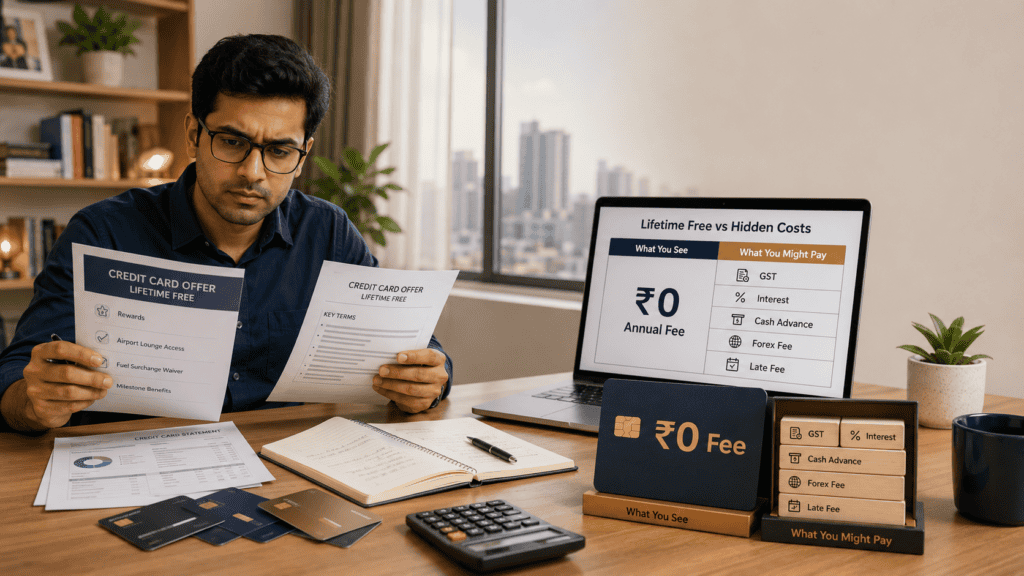
Annual fee and forex markup are completely separate charges. A lifetime-free card can still carry a 3.5% forex markup, while a card with a ₹5,000 annual fee may offer zero markup.
On ₹3 lakh of annual overseas spend, a 3.5% markup costs approximately ₹10,500 per year in markup alone — more than the annual fee on several premium travel cards.
Check the forex markup in the MITC, not the marketing headline.
Not Enabling International Transactions Before Travel
Indian cards issued with international use blocked by default will be declined abroad. Cardholders who discover this at a foreign counter face both the embarrassment of a declined card and the risk of carrying more cash than is safe.
Enable international transactions and set a sensible daily limit at least three to five days before departure, in case the change requires processing time.
Ignoring Overseas ATM Cash Advance Charges
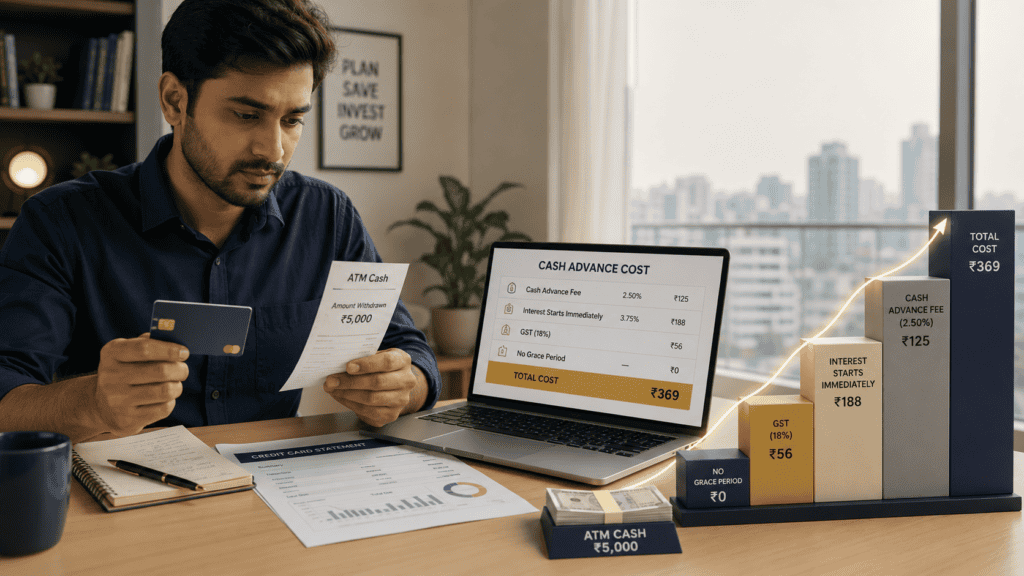
Withdrawing cash from an overseas ATM using a credit card triggers both the cash advance fee and immediate interest — there is no interest-free period on cash advances.
On top of that, the overseas ATM may apply its own transaction fee. The total cost of ₹10,000 cash withdrawn at a foreign ATM can exceed ₹11,500 once all charges and immediate interest are included.
Avoid overseas ATM withdrawals with a credit card unless absolutely unavoidable.
Not Checking the Statement After Travel
Most card statements list the foreign-currency amount, the converted ₹ amount, and the forex fee as separate line items — but only if you look. Many cardholders see only the total due and never verify whether DCC was applied incorrectly or whether the markup was charged at the correct rate.
Check each overseas transaction line in your statement within seven days of returning.
Treating Reward Points as a Full Offset for Forex Costs
Reward points earned on overseas transactions are subject to earning caps, expiry, and redemption value. A card that earns 5x points on international spend may appear to offset the markup — but if the redemption value is 25 paise per point, the actual cash-equivalent return is lower than it looks on paper.
Calculate the full monetary value of rewards you can realistically redeem, then compare that against the total forex fee.
When This May Not Be the Right Choice
Using your standard credit card for overseas spending may not be cost-effective in these situations:
High markup, weak rewards: If your card charges 3.5% forex markup and the reward earning rate does not come close to offsetting it, the card is adding cost without return on every international transaction. A forex card or a dedicated travel card may be more efficient.
Overseas ATM withdrawals: If your travel plan involves frequent cash withdrawals from foreign ATMs, a credit card is particularly expensive — cash advance fees and immediate interest apply from withdrawal date. Explore debit cards or forex cards for cash access. Learn more about cash advance charges before making this decision abroad.
Risk of unpaid balance: If there is any chance you will not pay the full bill by the due date after your trip, the finance charges on the unpaid overseas balance will dwarf the original forex markup. A credit card is only a low-cost international payment tool when the bill is paid in full every cycle.
Limited merchant acceptance: In some countries and smaller towns, Visa or Mastercard acceptance is not universal. Carrying only a credit card without a backup can leave you without a payment option in genuine emergencies.
If any of these apply to your situation, it may be worth exploring alternatives before committing.
Official Rules and Where to Verify
Foreign transaction charges on Indian credit cards are governed by each issuer’s individual tariff schedule and the RBI’s regulatory framework for credit card operations. Rules, limits, and rates on this topic can change with each Budget or regulatory update. Always verify current figures directly from the official source before making any financial decision.
- Reserve Bank of India — rbi.org.in: Consumer protection guidelines, credit card regulations, and customer rights regarding charges and dispute resolution.
- Card issuer’s MITC — available on your issuer’s official website or on request: The definitive source for your card’s forex markup rate, overseas ATM fee, cash advance charge, and GST treatment.
- Issuer’s schedule of charges / tariff sheet — updated periodically on the issuer’s website: Check under “fees and charges” or “credit card tariff” for the most current forex-related fees.
- Your monthly credit card statement — available in the issuer app or net banking: Verify every overseas transaction for correct markup application and DCC status after travel.
Expert Tips
- Always pay in local currency at foreign POS terminals. Decline the DCC option unless you have confirmed the offered INR rate is competitive with your card network’s rate. The default answer at any foreign payment terminal should be “local currency.”
- Enable international transactions and set a trip-level limit before you leave India. Log in to your issuer’s app at least three days before departure, activate international usage, and set a limit that covers your planned spend plus 20% buffer. This protects you from card-not-present fraud and from the card being blocked abroad for appearing unusual.
- Carry at least two payment methods on any international trip. One credit card and one backup — whether a debit card, forex card, or a small amount of cash — ensures that a card block, network downtime, or merchant-acceptance issue does not strand you.
- Set transaction SMS and email alerts before travel. Real-time notifications on every overseas transaction let you spot an incorrect DCC conversion or an unauthorised charge while you are still in the country to dispute it easily.
- Pay your full credit card bill within the due date after returning. Finance charges on unpaid international balances can run significantly higher than the forex markup you tried to minimise. If you carry forward even a portion of the overseas spend, the interest cost erases any card-benefit value. Read more about card interest costs to understand how the billing cycle affects the total amount you owe.
- Check your statement within a week of returning. Compare each overseas transaction line against your receipts. Verify that DCC was not applied to any transaction without your consent, and that the forex markup percentage matches your MITC.
- If you travel internationally more than twice a year, calculate your annual forex cost. Multiply your estimated annual overseas spend by your card’s markup rate and add GST on fee. If the total exceeds the annual fee of a dedicated travel card, the switch may be financially justified — but always verify the full fee schedule of the new card before applying.
Frequently Asked Questions
What is foreign transaction fee on credit cards?
It is the extra charge your card issuer applies when you use your Indian credit card for a transaction in a foreign currency — whether at a merchant abroad, at an overseas ATM, or on a foreign-currency website. It is separate from the base currency conversion done by the card network and is expressed as a percentage of the converted ₹ amount. The exact rate varies by card and issuer and is stated in the card’s MITC.
Is forex markup the same as currency conversion?
No. Currency conversion is the process of translating a foreign-currency amount into Indian rupees, typically done by the card network (Visa or Mastercard) at their reference rate. Forex markup is a separate fee charged by your card issuer on top of the converted ₹ amount. You are billed for both, but they are different items from different entities.
Does GST apply on the forex markup fee?
GST may apply on the forex markup fee charged by the issuer. The GST is calculated on the fee amount, not on the full converted ₹ transaction. The applicable rate and treatment should be verified from your card’s current tariff sheet or issuer website, as this is subject to change with regulatory updates.
Should I pay in INR or local currency at a foreign POS?
Pay in local currency. When a foreign terminal offers you the option to pay in INR — called Dynamic Currency Conversion — the conversion rate is set by the merchant’s bank, not by your card network. This rate is frequently less favourable. Paying in local currency lets your own card network do the conversion, which is generally the better outcome.
Do international websites trigger foreign transaction fees?
Yes. Any transaction billed in a currency other than Indian rupees can trigger the forex markup, regardless of whether you are physically abroad. This includes US dollar subscriptions, euro hotel bookings, and foreign university fee payments made from India. Check whether the website charges in INR or a foreign currency before assuming no fee applies.
Are zero forex markup cards always the better choice?
Not automatically. A zero markup card eliminates the conversion fee, but you must also check the annual fee (and whether it is waived), the reward earning rate on international transactions, overseas ATM charges, and the card’s acceptance network. A card that saves ₹3,500 in markup but costs ₹5,000 more in annual fee with weaker rewards is not necessarily a net gain for moderate international spenders.
How do I check the forex markup charge on my credit card statement?
Your monthly statement should show each overseas transaction with the original foreign-currency amount, the converted ₹ amount, and the forex fee as separate line items. Look for a line labelled “forex markup,” “cross-currency markup,” or “foreign transaction fee.” If you see only the total and cannot find the breakdown, contact your issuer and request the transaction detail or check the issuer’s app for itemised charges.
What happens if I do not pay my credit card bill in full after an overseas trip?
Finance charges begin accruing on the unpaid amount from the payment due date at your card’s applicable interest rate — typically expressed as a monthly rate. On a large overseas spend, the interest cost can exceed the original forex markup within one or two billing cycles. Always aim to pay the full outstanding amount by the due date. If you are unsure how billing cycles affect your international spend, review the basics before travel.
Can I dispute a DCC charge if it was applied without my consent?
Yes. If you did not explicitly choose to pay in INR and DCC was applied anyway, you can raise a transaction dispute with your card issuer. Keep your receipts, which should show the currency in which you agreed to pay. Contact your issuer’s customer service within the dispute window specified in your card’s terms, and provide the receipt as evidence.
Is there a limit on how much I can spend internationally on my credit card?
Yes. Your card’s international usage limit may be set by the issuer or by you through your banking app. RBI guidelines require issuers to provide controls to cardholders. Before travel, verify your current international transaction limit and increase it if your planned spend exceeds it — but set a reasonable cap to limit exposure in case the card is compromised.
Final Verdict
A credit card can be one of the most convenient and safest ways to pay abroad — provided you understand the full cost before you travel. Foreign transaction fee on credit cards is not a single charge; it is a stack of currency conversion, forex markup, possible GST on the fee, and the ever-present risk of DCC at foreign payment terminals. On ₹1,00,000 of overseas spend, the difference between a standard-markup card and a zero-markup card can easily exceed ₹4,000 per trip.
That does not automatically make every travel card worth having. The right card for your usage is the one where the annual fee, reward value, and markup rate add up to the lowest net cost given your actual travel frequency and spend pattern. Before your next international trip or large foreign-currency payment, read your card’s MITC, check the forex markup and overseas ATM fee, and enable international transactions with a sensible limit.
Always verify the latest rules from official sources or consult a qualified professional before making any financial decision.
This article is for educational purposes only and should not be treated as personalised financial, tax, investment, insurance, or legal advice. Tax rules, interest rates, regulatory limits, and product features can change with each Budget or policy update. Please verify current rules from official government sources or consult a qualified and registered professional before making any financial decision.

Nikhil Bansal writes about credit cards, billing cycles, card charges, rewards, cashback, credit utilisation, card EMI, BNPL, and responsible credit usage in India. His content is designed for readers who want to use credit cards wisely without falling into expensive repayment mistakes.
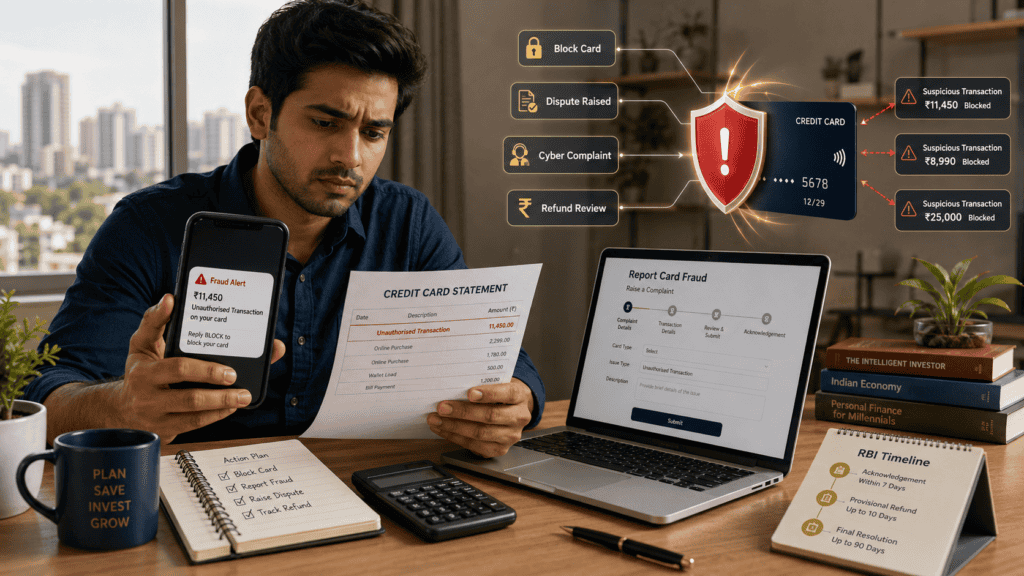
He covers topics such as how to choose a first credit card, credit card billing cycle, due date, grace period, minimum amount due, credit utilisation ratio, reward points vs cashback, lifetime free credit cards, annual fee waivers, credit card statement reading, add-on cards, cash advance charges, EMI on credit cards, credit card fraud reporting, BNPL vs credit card, and foreign transaction fees.
Nikhil’s writing is beginner-friendly, direct, and risk-aware. He explains how small mistakes such as paying only the minimum due, withdrawing cash from a credit card, missing due dates, or overusing credit limits can become costly. Since card fees, interest rates, reward rules, waiver conditions, and bank offers change often, readers should verify the latest Most Important Terms and Conditions from the card issuer.