

You have ₹5 lakh sitting in your savings account for the next 6–12 months. Leaving it there earns 3–3.5% — taxed as regular income. A fixed deposit gives you 7%, but that interest is also fully taxable at your slab rate. Then someone mentions arbitrage funds and their equity-like taxation. But is the arbitrage funds tax advantage real, or just a marketing angle? The answer depends on how long you park money, what tax slab you are in, and whether you understand what “equity-like taxation” actually means for a fund that barely takes equity risk. This article breaks it down with a real example, a three-way comparison, and a clear answer on when the tax advantage matters — and when it simply does not.
Quick Answer: Arbitrage Funds Tax Advantage for Short-Term Parking
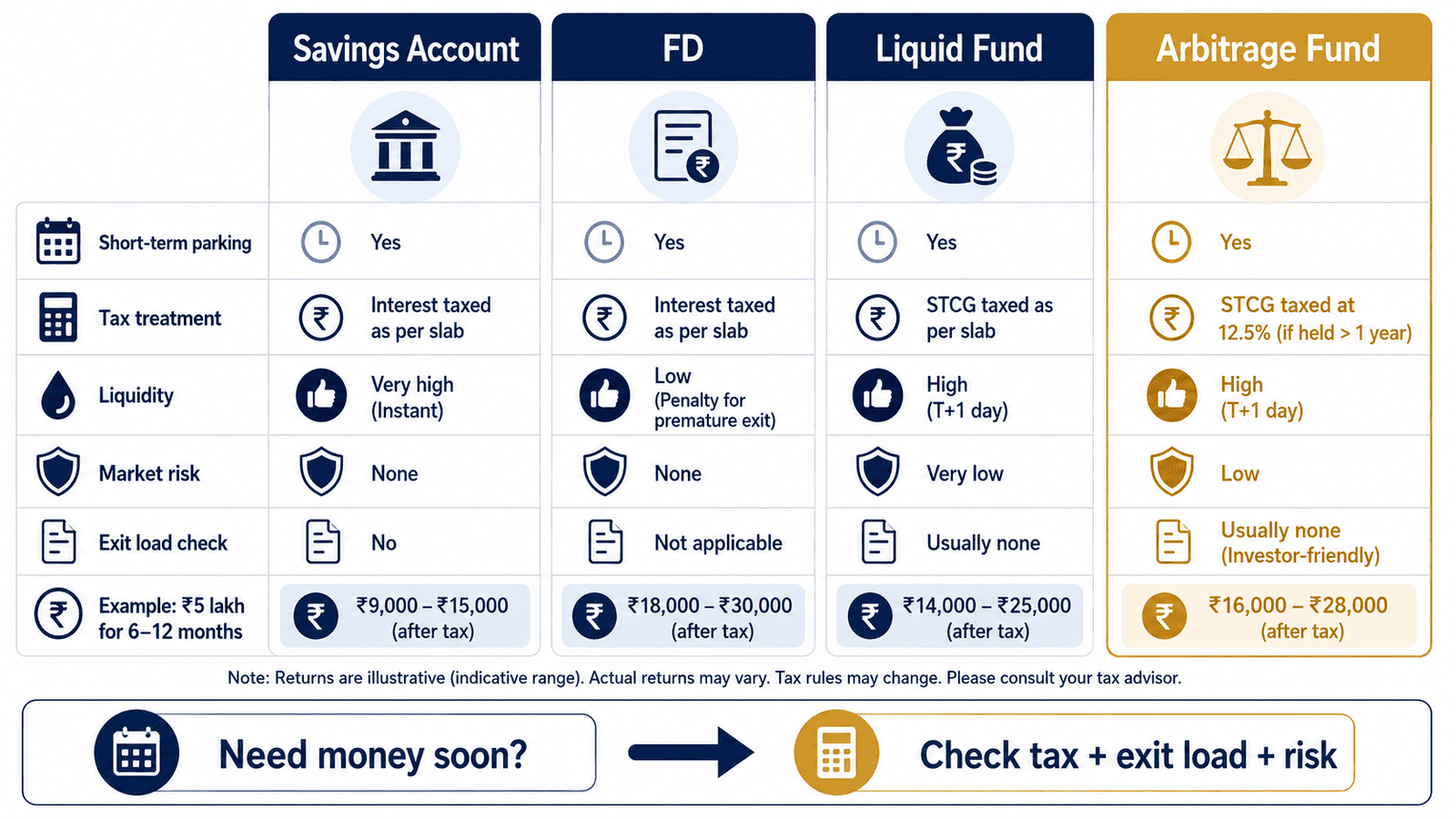
Arbitrage funds tax advantage comes from equity-oriented mutual fund taxation, which can be useful for short-term parking if you can accept low market-linked risk. For example, ₹5 lakh parked for 6–12 months may be compared with FD and liquid fund post-tax returns, after checking STCG, LTCG, exit load and current tax rules. Verify current STCG and LTCG rates from incometax.gov.in before making any decision.
Key Takeaways
- Arbitrage funds are classified as equity-oriented mutual funds by SEBI, which means gains are taxed under Section 111A (STCG) and Section 112A (LTCG) — not as debt or income.
- If you hold for under 12 months, STCG applies at a flat rate — regardless of your income tax slab. For someone in the 30% slab, this is a meaningful difference versus FD interest taxed at 30%.
- Holding for 12 months or more triggers LTCG treatment — with gains above a specified threshold taxed at a lower rate than debt or FD returns.
- Exit loads typically apply for redemptions within 15–30 days of investment — arbitrage funds are generally designed for parking beyond that window.
- Arbitrage funds are not risk-free. Returns are market-linked and can vary — they are not a substitute for FDs when capital protection is the only priority.
- In the 30% tax slab, arbitrage funds parked for 12+ months can generate meaningfully higher post-tax returns than FDs earning equivalent pre-tax yields — but the pre-tax yield gap matters too.
- Liquid fund taxation changed in 2023 — gains are now taxed at your income slab rate. This makes the comparison with arbitrage funds more relevant than before.
Comparison: Arbitrage Funds vs Liquid Funds vs Fixed Deposits
| Parameter | Arbitrage Fund | Liquid Fund | Fixed Deposit |
|---|---|---|---|
| Tax classification | Equity-oriented (Section 111A / 112A) | Debt-oriented — slab rate | Interest income — slab rate |
| STCG (under 12 months) | Flat rate — verify current rate at incometax.gov.in | Taxed at your slab rate | Taxed at your slab rate |
| LTCG (12 months+) | Gains above threshold taxed at LTCG rate — verify at incometax.gov.in | Taxed at your slab rate | Taxed at your slab rate |
| Tax advantage for 30% slab investor | High | None | None |
| Tax advantage for 5% / nil slab investor | Low | Low | Low |
| Typical pre-tax return range (indicative) | 5.5–7% annualised (market-linked) | 6.5–7.5% annualised | 6.5–7.5% (varies by bank, tenure) |
| Capital protection | Not guaranteed | Not guaranteed | Yes (up to ₹5L DICGC) |
| Exit load | Typically 0.25% within 15–30 days | Nil or graded (7 days) | Premature penalty applies |
| Redemption T+ | T+2 business days | Same-day / T+1 | Instant (digital break) |
| TDS applicability | No TDS on mutual fund gains (resident Indians) | No TDS on mutual fund gains (resident Indians) | TDS above ₹40,000/year — learn about FD TDS rules |
All return figures above are illustrative. Verify current tax rates at incometax.gov.in and current fund returns at amfiindia.com before making any decision.
Key Facts at a Glance
| Fact | Detail |
|---|---|
| SEBI classification | Equity-oriented hybrid fund (maintains ≥65% in equity and equity-related instruments) |
| How returns are generated | Cash-futures arbitrage — buying in cash market, selling simultaneously in futures market, locking a spread |
| Holding period for LTCG | 12 months (verify at incometax.gov.in) |
| STT applicability | Securities Transaction Tax applies on equity trades — already priced into fund returns |
| AMFI-tracked category | Arbitrage Fund under Hybrid Funds |
| Typical expense ratio range | 0.3–0.8% (direct plans) — affects net yield meaningfully in this low-return category |
| Minimum investment | ₹500–₹1,000 (varies by fund house) |
| DICGC protection | Not applicable — mutual funds are not bank deposits |
Understanding the Arbitrage Funds Tax Advantage in Plain English
If you are a salaried professional in the 30% tax bracket and you park money in a fixed deposit earning 7%, your post-tax return is approximately 4.9%. The entire interest is treated as income and added to your salary. There is no way around it. To understand mutual fund basics first helps here — funds have a distinct tax structure that does not follow bank deposit rules.
Why arbitrage funds get equity taxation
SEBI mandates that arbitrage funds maintain at least 65% of their assets in equity and equity-related instruments at all times. Even though the actual risk exposure is hedged — the fund simultaneously holds a stock in the cash market and a short futures position — the regulatory structure qualifies it as equity-oriented. This single classification is the foundation of the entire tax advantage.
Under Indian income tax rules, equity-oriented mutual funds attract capital gains tax — not income tax on interest. This matters because the rate and the treatment are different from bank FDs or debt mutual funds.
Short-term capital gains (STCG) under Section 111A
If you redeem your arbitrage fund units within 12 months, the gain is classified as short-term capital gain under Section 111A of the Income Tax Act. This is taxed at a flat rate — verify the current rate at incometax.gov.in. The critical point: this rate is applied regardless of your income tax slab. A 30% bracket investor and a 20% bracket investor pay the same flat STCG rate on these gains.
Compare this with FD interest: a 30% bracket investor pays 30% on every rupee of FD interest, plus applicable surcharge and cess. The STCG rate on equity funds is lower than 30% — which is the source of the tax advantage for higher-bracket investors.
Long-term capital gains (LTCG) under Section 112A
Hold your arbitrage fund for 12 months or more and the gains become long-term capital gains under Section 112A. Gains up to the specified exemption threshold in a financial year are exempt. Beyond that, the LTCG rate applies — which is lower than the STCG rate and significantly lower than the 30% slab rate. Verify the current LTCG rate and exemption threshold at incometax.gov.in before planning your withdrawal.
Securities Transaction Tax — already absorbed
Arbitrage funds do pay Securities Transaction Tax on their equity trades. However, this cost is already priced into the fund’s NAV and reflected in the returns you see. You do not pay STT separately on top of the reported return. For a deeper look at how STT and capital gains work together across equity products, see the stock market tax guide.
How is this different from debt or liquid funds today?
After the Finance Act 2023, debt mutual funds — including liquid funds — lost their indexation benefit and are now taxed at your income slab rate, regardless of holding period. This fundamentally changed the comparison. Earlier, debt funds held for three years enjoyed indexed LTCG treatment. Today, a liquid fund and an FD are taxed broadly the same way: at your slab rate. Arbitrage funds still retain equity classification and the associated lower-rate capital gains tax.
For a detailed look at how liquid funds compare to savings accounts, that article explains the product mechanics. Here, the key point is tax treatment — and that treatment now makes arbitrage funds more competitive for investors in higher slabs who can hold for at least a month beyond the exit load window.
The expense ratio factor — often underestimated
Arbitrage funds generate low pre-tax spreads because cash-futures arbitrage opportunities are thin and contested by institutional players. A typical arbitrage fund may generate 6–7% annualised in normal market conditions — but a regular plan with an expense ratio of 0.8–1% eats meaningfully into that return. For a product where the entire value proposition is a small tax saving, cost matters enormously. Always use direct plans for arbitrage funds and check the expense ratio impact before choosing a specific scheme.
Real Example: Rohan’s ₹5 Lakh Home Down Payment Fund
Rohan, 34, is a product manager in Bengaluru earning ₹28 lakh per year — placing him firmly in the 30% income tax bracket. He needs to park ₹5 lakh for 12 months before his home loan down payment. He is comparing three options: a bank FD at 7%, a liquid fund at 7%, and an arbitrage fund targeting 6.5%.
FD after 12 months: ₹5 lakh × 7% = ₹35,000 gross interest. At 30% slab rate + 4% cess, he pays approximately ₹10,920 in tax. Net gain: ₹24,080. Post-tax return: approximately 4.82%.
Liquid fund after 12 months: ₹35,000 gain taxed at slab rate — same as FD. Effective post-tax return is broadly similar to FD for someone in the 30% bracket.
Arbitrage fund after 12 months: ₹5 lakh × 6.5% = ₹32,500 gain. At the applicable LTCG rate (verify current rate at incometax.gov.in) with the current LTCG exemption threshold applicable, the tax outflow may be significantly lower than ₹10,920 — improving the post-tax yield despite the lower pre-tax return.
The exact outcome depends on current LTCG rates and the annual exemption limit — Rohan should verify these at incometax.gov.in. For understanding how to read annualised returns on a 12-month investment, see CAGR vs absolute vs XIRR explained.
The key insight: the 30% bracket investor’s tax saving can overcome a 0.5% pre-tax yield gap between FD and arbitrage fund — but only if the holding period clears the 12-month LTCG threshold.
How to Calculate Post-Tax Return on an Arbitrage Fund
Post-Tax Return = Pre-Tax Gain × (1 − Applicable Tax Rate) ÷ Investment Amount × 100
Using Rohan’s numbers for the arbitrage fund (12-month hold, LTCG applies):
- Investment: ₹5,00,000
- Pre-tax gain at 6.5% annualised: ₹32,500
- Applicable tax rate: LTCG rate on gains above the exemption threshold — verify current figures at incometax.gov.in
- Net gain (illustrative, assuming a meaningful exemption threshold covers part of the gain): potentially ₹28,000–₹32,500 depending on current rules
- Post-tax return: approximately 5.6–6.5% depending on current LTCG rate and threshold
| Scenario | Investment + Holding Period | Approximate Post-Tax Return (30% bracket) |
|---|---|---|
| FD at 7%, 12 months | ₹5L, 12 months | ~4.8–4.9% (slab rate applies) |
| Liquid fund at 7%, 12 months | ₹5L, 12 months | ~4.8–4.9% (slab rate applies) |
| Arbitrage fund at 6.5%, 12 months (LTCG) | ₹5L, 12 months | ~5.5–6.5% (LTCG rate applies — verify) |
| Arbitrage fund at 6.5%, 6 months (STCG) | ₹5L, 6 months | ~4.5–5.0% (STCG flat rate applies — verify) |
All figures above are illustrative. Current STCG and LTCG rates and the LTCG exemption threshold must be verified at incometax.gov.in before use.
How to Decide What’s Right for You
You are in the 30% income tax bracket and can hold for 12 months or more — THEN an arbitrage fund’s LTCG treatment may deliver meaningfully higher post-tax returns than an FD or liquid fund at comparable pre-tax yields.
You need the money within 6 months — THEN STCG applies and the tax advantage narrows. Run the actual post-tax numbers using your slab rate versus the STCG flat rate before deciding.
You are in the 5% or 10% income tax bracket — THEN the tax advantage of arbitrage funds is minimal. An FD or liquid fund at a higher pre-tax yield may leave you with more money after tax.
Your investment horizon is under 30 days — THEN exit load applies. Most arbitrage funds levy 0.25% on early redemptions, which can eliminate the tax saving entirely on a small gain.
Capital protection is non-negotiable — for example, a home down payment you cannot afford to reduce by even ₹5,000 — THEN an FD with DICGC cover up to ₹5 lakh is structurally safer despite the lower post-tax return.
You need same-day or next-day liquidity — THEN arbitrage funds settle on T+2, which may not work for emergency access. Liquid funds are faster.
You should not choose arbitrage funds if your primary goal is capital safety above everything else, your tax bracket is below 20%, or your holding period is under 30 days — the tax advantage will not compensate for the added complexity and exit load friction.
Common Mistakes to Avoid
Assuming the tax advantage always beats FD
The tax advantage depends on your slab rate, the current STCG/LTCG rates, and how long you hold.
A 5% bracket investor comparing an arbitrage fund at 6.5% with an FD at 7.2% will likely end up with more from the FD — because the slab rate is nearly the same as the STCG rate, and the pre-tax yield gap works against the arbitrage fund.
Always compute the post-tax figure for your specific slab before deciding.
Ignoring exit load on short holds
Most arbitrage funds charge a 0.25% exit load if you redeem within 15–30 days.
On a ₹5 lakh investment, that is ₹1,250 gone immediately. For a hold of under two months, this can eliminate the entire tax benefit and leave you worse off than a liquid fund with no exit load.
Check the specific scheme’s SID (Scheme Information Document) for its exit load policy before investing.
Counting the LTCG exemption without checking the current threshold
LTCG on equity funds above a specified annual threshold is exempt from tax. But this threshold is set by the government and can change with each Budget.
Some investors assume the full gain is tax-free when it may not be — depending on the current rule and their total equity gains that financial year across all instruments.
Verify the current exemption limit at incometax.gov.in each financial year.
Using the regular plan instead of direct
Arbitrage funds generate thin pre-tax spreads. A regular plan may carry an expense ratio 0.4–0.6% higher than a direct plan.
On a 6.5% gross yield, that is a 6–9% drag on returns before tax. For a product where the entire edge is a modest post-tax improvement, this matters. See how expense ratios affect returns before choosing a plan.
Treating arbitrage funds as risk-free savings
Because returns are generated through hedged positions, arbitrage fund NAVs are generally stable. But they are not guaranteed.
In extreme market conditions — circuit breakers, exchange halts, settlement failures — the hedge can temporarily break down, causing NAV volatility. This is uncommon but real. Arbitrage funds are not bank deposits.
If your goal demands zero NAV risk, an FD is the more appropriate tool.
Comparing gross returns without adjusting for holding period
An arbitrage fund quoting 6.5% annualised and an FD paying 7% for 12 months look close. But the FD’s 7% is fixed and certain; the arbitrage fund’s 6.5% is a trailing or indicative average — actual returns over your 6–12 month window may differ.
Always look at recent rolling 6-month and 12-month category returns from AMFI data, not just the headline figure on a fund house website.
Forgetting that Budget changes can alter the tax equation mid-year
India’s Union Budget can and does change STCG rates, LTCG rates, exemption thresholds, and fund category tax treatment. The 2023 Budget removed the indexation advantage on debt funds. Future Budgets could alter equity fund taxation too.
If you invest in January expecting a July redemption under current LTCG rules, those rules could change. Always verify rates at incometax.gov.in before and at the time of redemption.
Overlooking the T+2 settlement when timing matters
Arbitrage fund redemptions settle in T+2 business days. If you are redeeming to fund a home down payment or a property booking deadline, a last-minute redemption can miss the date.
Plan your exit at least a week before the actual payment date.
When This May Not Be the Right Choice
Arbitrage funds make less sense if your income tax slab is 5% or nil — the STCG and LTCG rates may be equal to or higher than your slab rate, eliminating any tax benefit while accepting mutual fund risk instead of guaranteed FD returns.
They are also a poor fit if your holding period is under one month. Exit loads apply, arbitrage spreads in that window are thin, and the post-tax return advantage will not compensate for the complexity and cost. Consider a liquid fund for very short-term parking instead.
If the money is earmarked for a payment you cannot risk losing even ₹1,000 on — a property token, a school admission fee, an overseas transfer — the non-guaranteed NAV of a mutual fund is a structural mismatch. Fixed deposits carry DICGC deposit insurance up to ₹5 lakh and are the appropriate vehicle. To understand why low-risk mutual funds are still not risk-free, read about debt mutual fund safety — the same principle applies here.
Finally, if tax rules change before you redeem — particularly if the Union Budget revises equity fund STCG or LTCG rates — the advantage you planned for may no longer exist. Mutual fund investments are subject to market risks. Past performance does not guarantee future returns. Reference SEBI’s guidelines at sebi.gov.in for advisory context on mutual fund investments.
If any of these apply to your situation, it may be worth exploring alternatives before committing.
Official Rules and Where to Verify
Arbitrage fund taxation sits at the intersection of SEBI fund classification rules and Income Tax Department capital gains provisions. Both can change with regulatory updates or the Union Budget. The sources below are the only authoritative references — do not rely on fund house marketing material or aggregator sites for tax rates.
- Income Tax Department — incometax.gov.in — for current STCG rate (Section 111A), LTCG rate (Section 112A), LTCG exemption threshold, and cess/surcharge rates
- SEBI — sebi.gov.in — for fund classification rules, equity-oriented fund definition, and regulatory circulars on hybrid fund categories
- AMFI — amfiindia.com — for fund category definitions, recent NAV data, and rolling return data for arbitrage funds as a category
Rules, limits, and rates on this topic can change with each Budget or regulatory update. Always verify current figures directly from the official source before making any financial decision.
Expert Tips
- If you are in the 30% bracket and your horizon is exactly 12 months, set a calendar reminder 2–3 days before the 12-month mark to ensure you redeem after LTCG kicks in — not one day before, which would trigger STCG instead. The difference on ₹5 lakh can be ₹3,000–₹6,000 depending on current rates.
- Always invest via direct plans. On a 6.5% gross yield with a 0.5% lower expense ratio in the direct plan, you reclaim roughly ₹2,500 per year on a ₹5 lakh investment — a meaningful share of the total post-tax edge.
- Check the current rolling 6-month and 12-month returns for the arbitrage fund category on amfiindia.com before investing. If arbitrage spreads have compressed and the category average has dropped below 5.5% annualised, the post-tax advantage over a bank FD narrows considerably.
- Do not invest money you may need in under 30 days. The exit load at 0.25% on ₹5 lakh is ₹1,250 — more than a day’s worth of gross return on this product.
- If you are investing for tax planning near March 31, be aware that redemption in early April means the gain falls in the new financial year — useful if you want to preserve the LTCG annual exemption for that year instead of using it up in March.
- Run a simple three-column spreadsheet: pre-tax return, tax at applicable rate, post-tax return — for FD, liquid fund, and arbitrage fund — using current numbers from incometax.gov.in and amfiindia.com. Decisions based on live numbers beat rule-of-thumb advice every time.
- If you have multiple goals — some in 6 months, some in 18 months — consider splitting: liquid fund for the 6-month tranche (no exit load, instant liquidity), arbitrage fund for the 18-month tranche (LTCG benefit fully captured).
Frequently Asked Questions
What is the arbitrage funds tax advantage in simple terms?
Arbitrage funds are classified as equity-oriented by SEBI, so gains are taxed under capital gains rules — not as regular income. For investors in the 20% or 30% income tax bracket, the applicable STCG or LTCG rate on these gains is lower than their income slab rate, which is what creates the tax advantage over FDs and liquid funds (both taxed at slab rate after the 2023 Budget changes).
What happens if I redeem my arbitrage fund before 12 months?
Gains are classified as short-term capital gains under Section 111A and taxed at a flat STCG rate — verify the current rate at incometax.gov.in. This rate is lower than 30% for high-bracket investors, but narrower than the LTCG advantage. Additionally, if you redeem within the exit load window (typically 15–30 days), you also pay an exit load of around 0.25%.
Is there any LTCG exemption on arbitrage fund gains?
Yes — LTCG on equity-oriented funds up to a specified annual threshold is currently exempt. Gains above that threshold are taxed at the LTCG rate. The threshold and rate are set by the government and can change with each Budget — verify the current figures at incometax.gov.in before planning your redemption.
Can I use arbitrage funds as an emergency fund?
Not ideally. Arbitrage funds take T+2 business days to settle on redemption, have an exit load for early withdrawals, and carry non-guaranteed NAVs. An emergency fund needs same-day or next-day access with zero risk of NAV loss. A savings account or overnight/liquid fund is more appropriate for emergency money.
Are arbitrage funds safe for short-term money in India?
They are low-risk, not no-risk. Returns come from cash-futures arbitrage spreads, which are generally stable. But in extraordinary market events — exchange circuit breakers, settlement disruptions — the hedge can temporarily break down. NAVs are not guaranteed. Mutual fund investments are subject to market risks. For absolute capital safety, a bank FD with DICGC cover up to ₹5 lakh is structurally safer.
How are arbitrage funds different from liquid funds now?
After the Finance Act 2023, liquid funds lost their favourable debt taxation. Gains are now taxed at your income slab rate regardless of holding period — the same as FD interest. Arbitrage funds still retain equity classification and STCG/LTCG treatment, which makes them meaningfully more tax-efficient than liquid funds for investors in the 20–30% brackets, particularly for holds of 12 months or more.
What is the exit load on arbitrage funds?
Most arbitrage funds levy a 0.25% exit load for redemptions within 15–30 days of investment. Beyond that window, there is typically no exit load. Always check the specific scheme’s Scheme Information Document (SID) on the AMC’s website or amfiindia.com before investing, as this can vary by fund house.
Is the LTCG exemption limit per fund or per investor per year?
It is per investor per financial year — across all equity and equity-oriented fund redemptions combined. If you have gains from stocks, equity mutual funds, and arbitrage funds in the same year, they are all aggregated to determine how much of the LTCG exemption you have used. This is an important planning consideration if you redeem multiple equity products in one financial year.
What is the holding period for arbitrage funds to qualify for LTCG?
12 months, as they are equity-oriented. This is different from debt funds, which previously had a 3-year holding period for LTCG (now abolished). Holding your arbitrage fund for one day beyond the 12-month mark shifts the entire gain from STCG to LTCG treatment — a meaningful difference in tax outflow for higher-bracket investors.
Should I choose a direct plan or regular plan for an arbitrage fund?
Always direct, especially for arbitrage funds. Because gross yields in this category are low (typically 6–7% in normal conditions), even a 0.5% difference in expense ratio between regular and direct plans is a significant drag on returns. On ₹5 lakh, that is ₹2,500 per year — a large proportion of the total post-tax edge you are trying to capture. You can invest in direct plans through the AMC’s own website or through a direct mutual fund platform.
Final Verdict
The arbitrage funds tax advantage is real — but conditional. For a salaried investor in the 20–30% income tax bracket who can park money for 12 months or more, arbitrage funds can deliver a materially higher post-tax return than FDs or liquid funds at similar pre-tax yields. The LTCG treatment under Section 112A, with its lower rate and annual exemption, is the mechanism — and it is most powerful precisely when your income slab rate is highest. For shorter holds of 6–12 months, the STCG flat rate still offers a modest advantage over slab-rate taxation, but you need to verify the current rates to confirm the spread is worth the added complexity. For investors in lower slabs — 5% or nil — or for money that needs to be accessed within 30 days, FDs and liquid funds are simpler and often better net. To see how tax rules interact with returns on other short-term options, start with the income tax calculator for FY 2025-26 to model your slab and then run the post-tax comparison yourself. Always verify the latest rules from official sources or consult a qualified professional before making any financial decision.
This article is for educational purposes only and should not be treated as personalised financial, tax, investment, insurance, or legal advice. Tax rules, interest rates, regulatory limits, and product features can change with each Budget or policy update. Please verify current rules from official government sources or consult a qualified and registered professional before making any financial decision.

Arjun Kapoor writes about mutual funds, SIPs, ELSS, fund categories, investment returns, and beginner investing concepts for Indian readers. His focus is on education, not product promotion or fund recommendations. He helps readers understand how mutual funds work before they start investing or comparing schemes.
He covers topics such as mutual fund meaning, SIP meaning, SIP calculator, direct mutual funds vs regular plans, NAV, ELSS tax-saving funds, CAGR, absolute returns, XIRR, expense ratio, large cap vs mid cap vs small cap funds, flexi cap funds, index funds vs active funds, liquid funds, debt mutual funds, SIP pause vs SIP stop, lumpsum vs SIP, and how to start SIP in India.
Arjun’s writing is simple, risk-aware, and long-term oriented. He avoids guaranteed-return language and explains investment concepts using examples, timelines, and comparison tables. His articles remind readers that mutual fund investments are subject to market risks, and past performance does not guarantee future returns. Readers should verify scheme details from SEBI, AMFI, fund houses, and official scheme documents.