

You have built a mutual fund corpus over the years. Now the question is practical: how much can you actually withdraw every month without the money running out too early? That is exactly what an SWP — Systematic Withdrawal Plan — is designed to address. And an SWP calculator India tool helps you model different scenarios before you commit to any withdrawal amount.
SWP is not a pension. It is not FD interest. Every withdrawal redeems mutual fund units at the current NAV, which means the outcome depends on market performance, your withdrawal rate, tax, exit load, and timing. Understanding these variables before setting up SWP is the difference between a sustainable income plan and a corpus that runs out faster than expected.
Quick Answer: SWP Calculator India
SWP calculator India helps you estimate how much you can withdraw monthly from a mutual fund corpus and how long the balance may last. For example, a ₹50 lakh corpus with ₹25,000 monthly SWP depends on assumed returns, NAV movement, tax, exit load, and market risk.
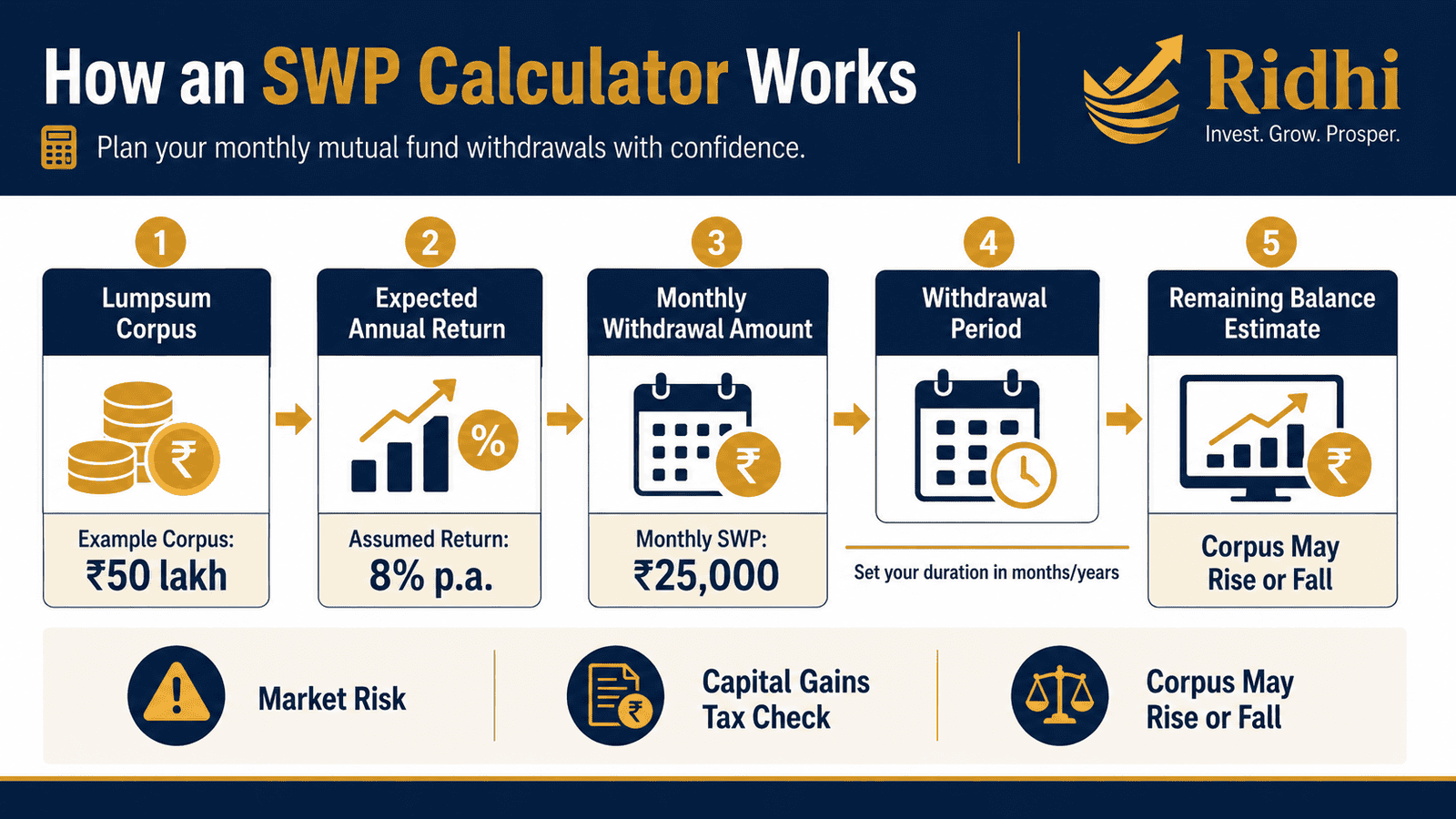
How to Calculate Your Monthly SWP Withdrawal
An SWP calculator works by simulating periodic unit redemptions from your corpus based on the inputs you enter. Here is what each input means and how to use it:
Input 1 — Initial Corpus: The current market value of your mutual fund investment. This is your starting point. Enter the actual current value, not the amount you originally invested.
Input 2 — Monthly Withdrawal Amount: The fixed rupee amount you want redeemed every month. The fund house redeems however many units are needed to pay you this amount at the prevailing NAV. If NAV is high, fewer units are sold. If NAV is low, more units are sold.
Input 3 — Expected Annual Return: A hypothetical assumption about how your remaining corpus will grow. This is not a guaranteed number. For illustration, a balanced or hybrid fund might be modelled at 8–10% p.a., while a debt fund might use 6–7% p.a. The actual return could be higher or lower. See fund returns explained to understand how return assumptions are calculated.
Input 4 — Withdrawal Period: How many years or months you plan to make withdrawals. A 20-year retirement horizon gives very different results from a 5-year plan.
Output — Remaining Balance: The estimated corpus value after the withdrawal period. A positive remaining balance means the corpus survived. A zero or negative balance means it was depleted.
Estimated Remaining Corpus = (Starting Corpus × Growth Factor) − (Monthly Withdrawal × Number of Months)
In practice, calculators adjust this month by month because the corpus grows at the return rate while units are redeemed each month.
| Scenario | Key Assumptions | Estimated Result (₹50L corpus, ₹25,000/month) |
|---|---|---|
| Conservative | 6% p.a. return, 20 years | Corpus likely depleted around year 16–17 |
| Moderate | 9% p.a. return, 20 years | Corpus may survive with balance remaining |
| Optimistic | 12% p.a. return, 20 years | Corpus grows even while withdrawing |
These are illustrative scenarios only. Actual outcomes will differ based on fund performance, sequence of returns risk, and withdrawal timing. Tax and exit load will reduce your net receipts further.
Key Takeaways
- SWP redeems mutual fund units periodically — you receive cash, but your unit count reduces every month.
- A ₹50 lakh corpus withdrawing ₹25,000 per month at 9% p.a. assumed return may last 20+ years; the same corpus at 6% p.a. may be depleted in under 17 years.
- If your monthly withdrawal rate exceeds your fund’s actual monthly return, your corpus shrinks with every redemption.
- Capital gains tax applies to each SWP redemption — equity and debt funds are taxed differently; verify the current applicable rates before setting up SWP.
- Exit load, if applicable in the first 1–3 years, can reduce your net withdrawal amount — check the scheme’s SID before activating SWP.
- SWP is most suitable after corpus accumulation is largely complete — not while you are still in the primary investment phase.
Key Facts at a Glance
| Parameter | Detail |
|---|---|
| Full Form | Systematic Withdrawal Plan |
| Used For | Periodic redemption of mutual fund units to generate cash flow |
| Common Withdrawal Frequency | Monthly, quarterly, half-yearly, or yearly depending on fund and platform |
| How Redemption Works | Units redeemed at applicable NAV on the selected date |
| Tax Treatment | Treated as mutual fund unit redemption; capital gains tax applicable — rates depend on fund type and holding period (verify current rates) |
| Exit Load | Applicable if SWP is initiated within the exit load period specified in the Scheme Information Document |
| Key Risk | Corpus can deplete if withdrawals consistently exceed fund growth |
| Regulator | SEBI — sebi.gov.in |
What Is SWP in Mutual Funds and How Does It Work
A Systematic Withdrawal Plan is a facility offered by mutual fund AMCs and investment platforms that allows you to redeem a fixed rupee amount from your existing mutual fund investment at regular intervals. According to SEBI guidelines, mutual fund schemes must clearly disclose all features including SWP facility, frequency options, and applicable exit loads in their Scheme Information Documents.
Here is the key mechanic that confuses most investors: SWP does not pay you from a separate “income pool.” The AMC calculates how many units to sell on each SWP date based on the NAV that day. If you have instructed ₹25,000 per month and the NAV on the redemption date is ₹50, the fund redeems exactly 500 units. If next month NAV has dropped to ₹45, the fund redeems 555 units to pay you the same ₹25,000.
This is the fundamental difference between SWP and FD interest. FD interest comes from the bank without touching your principal (until maturity). SWP always reduces your unit balance — by fewer units when markets are high, by more units when markets are low.
The remaining corpus — the units not yet redeemed — stays invested in the same mutual fund scheme. It continues to earn returns (or fall in value) based on market performance. This is why the assumed return rate in your SWP calculator is critical. If the actual fund return is lower than your assumed rate, the real corpus will deplete faster than the calculator estimated. For readers new to the product, understanding mutual fund basics first will make the SWP mechanics significantly easier to grasp.
SWP frequency can typically be set to monthly, quarterly, half-yearly, or yearly depending on the fund house and platform. Most retirees use monthly SWP to match regular household expenses.
Sequence of returns risk is a concept specific to withdrawal plans. If markets fall sharply in the first two or three years of your SWP — when your corpus is still large — you redeem many more units at low NAVs. Even if markets recover later, the lost units do not come back. This is why the same average return can produce very different final outcomes depending on whether good years or bad years happen first.
Real Example: Rajesh’s Monthly Withdrawal Plan
Rajesh, 49, is a senior manager in Pune earning ₹28 lakh per year. He has built a ₹50 lakh mutual fund corpus over 12 years and is considering semi-retirement in the next two years. He wants to know if ₹25,000 per month from SWP is sustainable.
Rajesh uses an SWP calculator with a ₹50 lakh starting corpus, ₹25,000 monthly withdrawal, and 9% assumed annual return. The calculator projects his corpus lasts well beyond 20 years with a significant balance remaining.
However, Rajesh’s financial advisor runs a second scenario: 6% return for the first five years (a slow-growth period) followed by 10% thereafter. The outcome changes noticeably — the corpus survives but with a smaller remaining balance, because those early low-return years forced higher unit redemptions while the corpus was at its peak.
A third scenario models ₹40,000 per month. At 9% return, the corpus lasts roughly 17–18 years before depletion. At 6% in early years, depletion happens faster.
Rajesh’s key insight: ₹25,000 per month looks sustainable at his corpus size with moderate return assumptions. ₹40,000 is riskier and requires either a larger corpus or a higher-return fund — which carries more volatility. Tax on each redemption and any applicable exit load will also reduce the actual amount he receives each month.
Comparison: SWP vs SIP vs Dividend Plan vs FD Income
| Option | How It Works | Key Trade-off |
|---|---|---|
| SWP (Systematic Withdrawal Plan) | Redeems fixed rupee amount from existing corpus at each interval; units reduce | Flexible but corpus depletes if withdrawal exceeds growth |
| SIP investment calculator — SIP mode | Invests fixed amount periodically to build corpus; opposite of SWP | Builds wealth but not suited for withdrawal phase |
| Lump Sum Redemption | Withdraws all or large amount in one go | Tax concentrated in one year; no ongoing income |
| Dividend / IDCW Plan | Scheme distributes income when declared; not guaranteed or regular | Not assured — amount and frequency depend on scheme decision |
| FD Interest Income | Bank pays interest at agreed rate; principal returned at maturity | Predictable but taxed as income; lower post-tax return in higher brackets |
According to SEBI investor education guidelines, IDCW (Income Distribution cum Capital Withdrawal) plans — formerly called dividend plans — do not guarantee regular payouts. The scheme distributes from realised gains and can reduce or stop payouts entirely. SWP gives you more control over the amount and timing, but the corpus risk stays with you.
How to Decide What’s Right for You
You have a corpus of ₹30 lakh or more and need ₹15,000–₹25,000 per month — your annual withdrawal rate is likely below 10% of corpus, which is generally more sustainable with moderate return assumptions.
Your required monthly amount is more than 1% of your total corpus — run a conservative scenario (6% p.a.) in the SWP calculator before committing; corpus depletion is a real risk.
You need funds within the next 6–12 months — consider keeping that portion in a lower-volatility instrument. For planned, stable withdrawals, explore debt fund basics before placing an equity SWP.
You are in the 30% income tax bracket — the tax on each SWP redemption can materially reduce net receipts; verify current applicable capital gains tax rates before setting up SWP.
You have no emergency fund outside your mutual fund corpus — do not set up SWP until you have 6–12 months of expenses in a liquid instrument; an unexpected expense will force unplanned redemptions on top of SWP.
You are still in the accumulation phase and relying on monthly SWP to supplement income while also investing — SIP accumulation and SWP withdrawal at the same time from the same fund often neutralise each other. Build the corpus first.
Common Mistakes to Avoid
Treating SWP as Guaranteed Monthly Income
SWP redeems units at market NAV — it is not a fixed income product.
If NAV falls sharply, more units are redeemed to pay the same amount. Over time, a sustained downturn can deplete the corpus significantly faster than the calculator estimated, because unit loss during bad markets is permanent even when markets recover.
Model SWP as a variable income plan, not as a pension substitute.
Setting Too High a Withdrawal Amount
Withdrawing more than your corpus earns in returns means net unit depletion every month.
A ₹50 lakh corpus at 8% p.a. earns roughly ₹3.3 lakh per year — about ₹27,500 per month before tax. Withdrawing ₹40,000 per month means you are consistently drawing down principal, not just returns. The corpus will not last 20 years at that rate.
Use the SWP calculator to find the sustainable withdrawal amount, not just the amount you wish for.
Ignoring Sequence of Returns Risk
Two portfolios with the same average return over 20 years can have very different SWP outcomes depending on the order of good and bad years.
A sharp market fall in years 1–3 of SWP forces large unit redemptions when the corpus is at its peak size. Those units are gone permanently. Later recoveries help what remains, but cannot restore lost units.
Always stress-test your SWP against a scenario where returns are poor in the first five years.
Forgetting Exit Load
Many equity mutual funds charge an exit load of 1% if redeemed within one year of each investment. SWP activates redemptions continuously, so units purchased recently may still carry exit load.
Check the expense ratio impact and exit load details in your scheme’s SID before setting up SWP, especially if your investment is recent. Exit load goes back to the fund, not to you.
Not Accounting for Tax on Each Redemption
Every SWP redemption is a mutual fund redemption and triggers capital gains tax. Equity and debt fund taxation rules differ, and holding period matters.
According to the Income Tax Department at incometax.gov.in, capital gains on mutual fund redemptions are taxable in the year of redemption. Verify current applicable rates before setting up SWP, since tax rules have changed in recent Budgets.
Budget your net withdrawal after tax — do not assume the full ₹25,000 withdrawn means ₹25,000 in hand.
Using Only Equity Funds for Near-Term Monthly Expenses
Equity mutual fund NAVs can fall 20–40% in a market correction. If all your SWP corpus is in equity funds and markets fall sharply, you face a double problem: lower NAV and higher unit redemption per month.
Consider maintaining near-term SWP needs in a lower-volatility fund category and only keeping long-horizon money in equity.
When This May Not Be the Right Choice
SWP may not suit your situation if your corpus is below ₹15–20 lakh and your required monthly withdrawal is ₹15,000 or more — at that withdrawal rate, your corpus will likely be depleted within 7–10 years even with moderate returns.
If you need the money within the next 6–12 months, SWP from a volatile equity fund introduces timing risk. A short-term cash need is better served by a liquid or short-duration debt instrument. For context on how your long-term retirement corpus connects to this decision, read retirement corpus planning.
If you cannot tolerate seeing your mutual fund balance reduce month by month — especially during market corrections — the psychological pressure of watching unit depletion can lead to poor decisions like stopping SWP at exactly the wrong time.
Finally, if you have not yet assessed your tax situation and all your investments are in equity funds purchased recently, the combined impact of exit load and capital gains tax can meaningfully reduce what you actually receive each month.
If any of these apply to your situation, it may be worth exploring alternatives before committing.
Official Rules and Where to Verify
Mutual fund rules, capital gains tax rates, exit load structures, and IDCW policies can change with each Budget or regulatory update. Do not rely on any calculator output — including this article — as the final word on rates or rules.
- SEBI — sebi.gov.in: For mutual fund regulations, SWP disclosure norms, and investor protection guidelines.
- Income Tax Department — incometax.gov.in: For current capital gains tax rates on equity and debt mutual fund redemptions, and for understanding how holding period affects tax treatment.
Rules, limits, and rates on this topic can change with each Budget or regulatory update. Always verify current figures directly from the official source before making any financial decision.
For fund-specific exit load, SWP minimum amounts, and frequency options, check the Scheme Information Document (SID) of the specific fund, available on the AMC’s website.
Expert Tips
- Run at least three scenarios in the SWP calculator — conservative (6% p.a.), moderate (9% p.a.), and optimistic (12% p.a.) — and base your withdrawal decision on what the conservative scenario shows, not the optimistic one.
- If you are starting SWP during or just after a market peak, reduce your initial withdrawal amount by 10–15% for the first year and review once market conditions stabilise. A lower start protects more units at a vulnerable time.
- Keep 6–12 months of planned SWP withdrawals in a liquid fund or short-duration debt fund outside your SWP corpus. This buffer means you do not need to redeem equity units at low NAVs during short-term market falls.
- Review your SWP annually — check the actual remaining corpus versus what the calculator estimated at the same point. If the corpus is running ahead of schedule, your plan is working. If it is significantly below estimate, reduce the withdrawal amount before the gap widens.
- Avoid increasing your monthly SWP amount just because markets have done well for 1–2 years. Sequence of returns risk means the next few years could underperform, and a higher withdrawal rate locks in more unit depletion at any NAV level.
- If you are in the 30% tax bracket, consult a tax professional to understand whether structuring withdrawals across two financial years reduces your aggregate capital gains liability. This is a planning question, not a loophole.
- Check exit load dates fund by fund. If you have made SIP investments in the last 12 months, those units may still carry exit load. Some platforms allow you to set SWP to redeem older units first — verify this setting before activating.
Frequently Asked Questions
Is SWP monthly income guaranteed?
No. SWP redeems mutual fund units at the prevailing NAV to pay you a fixed amount. The cash amount is fixed by your instruction, but the number of units redeemed varies with NAV. If your corpus is depleted, SWP stops. There is no income guarantee — mutual fund investments are subject to market risks.
How much SWP can I withdraw monthly from a ₹50 lakh corpus?
A commonly referenced guideline is keeping annual withdrawals at 4–5% of corpus. For ₹50 lakh, that works out to ₹16,700–₹20,800 per month. ₹25,000 per month (6% annually) may also be sustainable at higher return assumptions, but you should model it in an SWP calculator with conservative return scenarios to verify. Your actual sustainable amount depends on fund returns, tax, and withdrawal period.
Is SWP taxable in India?
Yes. Each SWP redemption is treated as a mutual fund unit redemption and is subject to capital gains tax. The applicable tax rate depends on the type of fund (equity or debt) and the holding period of the units being redeemed. Tax rules for mutual fund redemptions have been revised in recent Budgets — verify current applicable rates at incometax.gov.in before setting up SWP.
Is SWP better than SIP?
SWP and SIP serve opposite purposes. SIP invests money regularly to build a corpus over time. SWP withdraws from an existing corpus to generate cash flow. They are not alternatives — they are different phases of a mutual fund investment journey. Many investors use SIP during their earning years and SWP after building sufficient corpus.
Can SWP be used for retirement income?
Yes, SWP is commonly used for retirement cash flow. However, it requires a sufficiently large corpus, realistic return assumptions, a tax plan, and an emergency buffer outside the SWP fund. It works best when the withdrawal rate is sustainable relative to expected returns. SWP is not a pension — if markets underperform, the corpus depletes faster than planned.
Does SWP reduce my mutual fund units?
Yes, every SWP redemption reduces your unit balance. The reduction is smaller when NAV is high (fewer units needed to pay the fixed amount) and larger when NAV is low. Over time, if your withdrawal amount exceeds the fund’s growth, the total unit count will decline steadily, eventually reaching zero.
What is the difference between SWP and dividend plan in mutual funds?
SWP gives you control — you set the amount and frequency, and units are redeemed to pay you. Dividend or IDCW (Income Distribution cum Capital Withdrawal) plans pay out when the scheme decides to distribute, and the amount is not fixed or guaranteed. As per SEBI guidelines, IDCW plans must disclose that distributions come from the scheme’s NAV and are not assured.
Can I change or stop my SWP after starting?
Yes, in most cases SWP can be modified or cancelled by submitting a request to the fund house or platform. However, check whether units recently redeemed under SWP attracted exit load, and whether there are minimum notice period requirements under your scheme’s terms.
What happens to SWP during a market crash?
During a market crash, NAV falls. To pay you the same fixed monthly amount, the fund redeems more units at the lower NAV. Those extra units are permanently gone from your account. Even after markets recover, you only earn returns on the reduced unit balance. This is sequence of returns risk — and it is the main reason why large early-year falls are particularly damaging for SWP investors.
Is SWP suitable for someone who is not yet retired?
SWP can be used at any age to generate periodic cash flow from an existing corpus — for example, to fund a child’s education fees or supplement income. However, it makes most sense after your corpus is largely built, because withdrawing while still needing to accumulate can undermine long-term growth. If you are still in the accumulation phase, prioritise completing your corpus target first.
Final Verdict
An SWP calculator India tool is a planning instrument, not a prediction engine. It helps you test whether your corpus, withdrawal amount, and return assumption are aligned — before you commit to a monthly redemption. Used correctly, SWP can convert a mutual fund corpus into a structured cash flow for retirement, semi-retirement, or planned expenses.
The discipline is in the assumptions. Use conservative return scenarios. Account for tax on each redemption. Keep an emergency buffer outside the SWP fund. Review your actual remaining corpus every year and adjust withdrawals if the numbers are diverging from plan. SWP is most powerful when your withdrawal rate is modest relative to your corpus size.
If you are still building your retirement corpus, read retirement corpus planning before deciding how much corpus you need before SWP makes sense for your situation. Always verify the latest rules from official sources or consult a qualified professional before making any financial decision.
This article is for educational purposes only and should not be treated as personalised financial, tax, investment, insurance, or legal advice. Tax rules, interest rates, regulatory limits, and product features can change with each Budget or policy update. Please verify current rules from official government sources or consult a qualified and registered professional before making any financial decision.

Arjun Kapoor writes about mutual funds, SIPs, ELSS, fund categories, investment returns, and beginner investing concepts for Indian readers. His focus is on education, not product promotion or fund recommendations. He helps readers understand how mutual funds work before they start investing or comparing schemes.
He covers topics such as mutual fund meaning, SIP meaning, SIP calculator, direct mutual funds vs regular plans, NAV, ELSS tax-saving funds, CAGR, absolute returns, XIRR, expense ratio, large cap vs mid cap vs small cap funds, flexi cap funds, index funds vs active funds, liquid funds, debt mutual funds, SIP pause vs SIP stop, lumpsum vs SIP, and how to start SIP in India.
Arjun’s writing is simple, risk-aware, and long-term oriented. He avoids guaranteed-return language and explains investment concepts using examples, timelines, and comparison tables. His articles remind readers that mutual fund investments are subject to market risks, and past performance does not guarantee future returns. Readers should verify scheme details from SEBI, AMFI, fund houses, and official scheme documents.