

You just changed jobs. Your old PF balance is sitting in an account you may not have logged into in months — and now you face two choices: transfer it to your new employer’s account or withdraw it and move on. Most people pick withdrawal because it feels like easy money. That decision can quietly cost them lakhs at retirement.
This guide breaks down PF balance transfer vs withdrawal across five dimensions that actually matter: EPFO rules, tax impact, service continuity, retirement corpus, and ease of process. By the end, you will have a clear answer for your specific situation — not a vague “it depends.”
Quick Answer: PF Balance Transfer vs Withdrawal
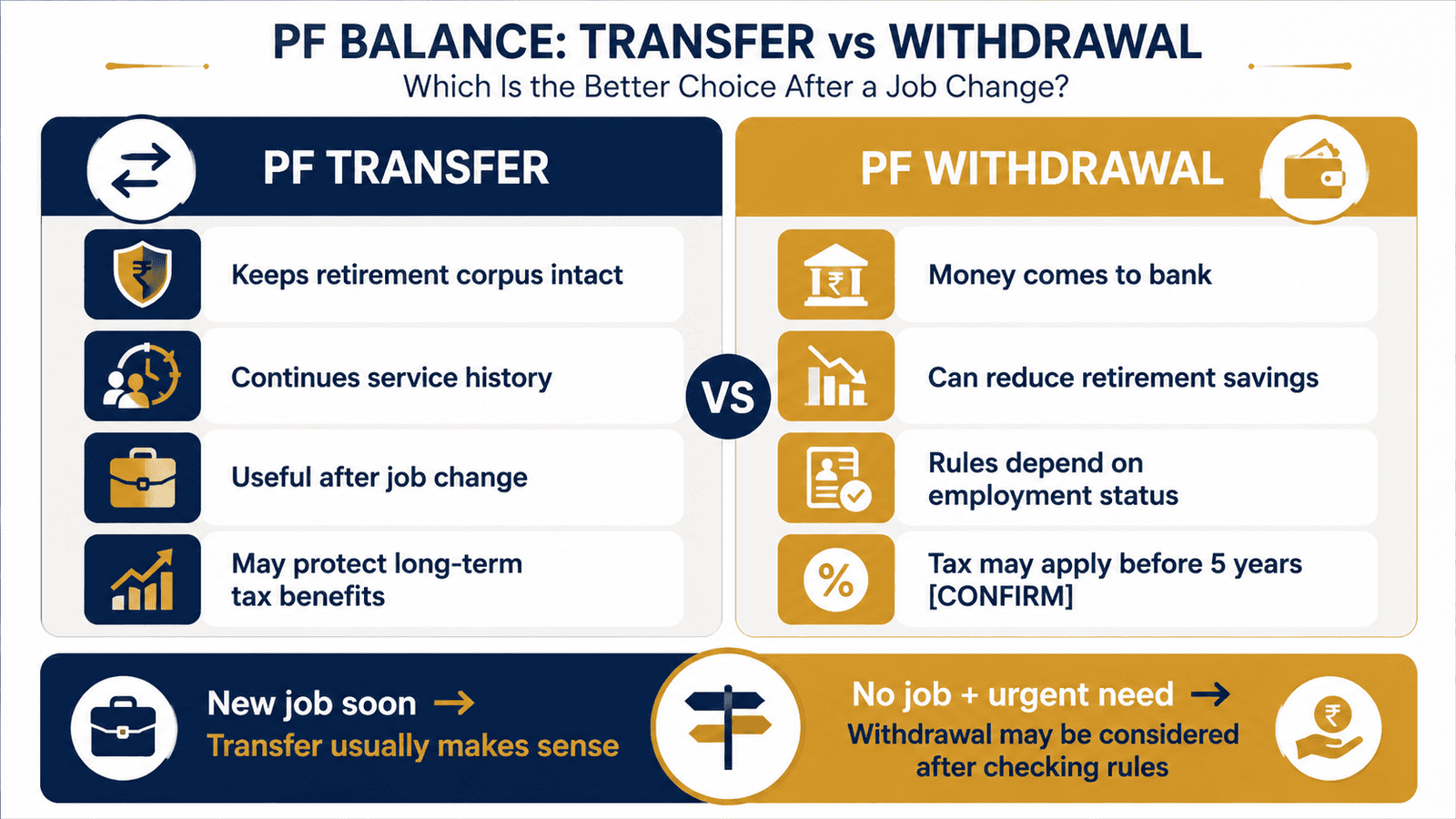
PF balance transfer vs withdrawal is usually a choice between preserving long-term EPF retirement savings and taking money out for immediate needs. If you join another job, transferring keeps service history and compounding intact. Withdrawal may suit genuine unemployment or emergency needs, but tax can apply before 5 years of continuous service.
Key Takeaways
- Transferring your PF keeps your service history continuous — which matters directly for EPS pension eligibility and gratuity calculations with future employers.
- If you withdraw before completing 5 years of continuous service, TDS applies: 10% with PAN, 30% without PAN — and the full amount is added to your taxable income for the year.
- ₹1,00,000 left to compound in EPF at 8.25% per annum for 25 years grows to approximately ₹7,40,000. Withdrawing early means losing that compounding benefit entirely.
- If your total EPF withdrawal amount is below ₹50,000, TDS is not deducted — but the amount is still taxable income in your hands if your service period is under 5 years.
- Transfer is processed entirely online through the EPFO member portal using your UAN — no physical form or employer signature needed in most cases if KYC is complete.
- Employees who withdraw EPF also lose the EPS (Employee Pension Scheme) corpus linked to the same account — this is a separate component from your EPF balance and requires its own decision.
- For most salaried employees moving between jobs, transfer is the better long-term choice. Withdrawal is rarely the right call unless there is no new job on the horizon.
Comparison: PF Transfer vs PF Withdrawal
| Parameter | PF Transfer | PF Withdrawal |
|---|---|---|
| Best suited for | Joining a new employer | Unemployed / genuine emergency |
| Service continuity | Preserved across all employers | Broken — resets to zero |
| Tax on the amount | Zero tax on transfer | Taxable if service under 5 years; TDS applies |
| Long-term retirement corpus | Compounds until retirement at EPF interest rate | Lost permanently from corpus |
| EPS pension component | Transferred or scheme certificate issued | Withdrawable or forfeited depending on service length |
| Process channel | Online via EPFO member portal (Form 13) | Online via composite claim form (Aadhaar-based) |
| Waiting period after resignation | Can apply immediately after joining new employer | 2 months of unemployment required for full withdrawal |
| KYC requirement | UAN active with Aadhaar seeded and KYC verified | UAN active with Aadhaar seeded and KYC verified |
Key Facts at a Glance
| Parameter | Rule / Figure |
|---|---|
| Employee PF contribution rate | 12% of basic salary + DA |
| Employer contribution split | 3.67% to EPF; 8.33% to EPS |
| Current EPF interest rate | 8.25% p.a. (FY 2023–24) |
| TDS on withdrawal before 5 years (with PAN) | 10% |
| TDS on withdrawal before 5 years (without PAN) | 30% |
| TDS-exempt withdrawal threshold | Below ₹50,000 — no TDS deducted |
| Waiting period for full withdrawal after resignation | 2 months of unemployment |
| Form for EPF transfer | Form 13 (online via EPFO member portal) |
| Form for EPF withdrawal | Composite Claim Form (Aadhaar-based) |
| Governing authority | EPFO — epfindia.gov.in |
PF Balance Transfer vs Withdrawal: What Each Option Actually Means
How EPF Transfer Works
When you change jobs, your EPF account from the old employer does not automatically move to the new one. You need to raise a transfer claim using Form 13 through the EPFO unified member portal. Because your Universal Account Number (UAN) stays the same across all employers, the transfer simply moves the balance from your old PF account to the new one — under the same UAN. No new account is created. Your service history, which EPFO tracks for pension eligibility under EPS, remains unbroken.
According to EPF rules explained, an EPF account consists of two components: the main EPF corpus (to which both employee and employer contribute) and the EPS (Employee Pension Scheme), funded by 8.33% of the employer’s share of basic salary. When you transfer, both components are handled — the EPF balance moves directly, and the EPS balance either transfers or a scheme certificate is issued if the new employer is not covered under EPS.
What Service Continuity Means — And Why It Matters
EPFO tracks total service across employers when calculating pension eligibility under EPS. You need a minimum of 10 years of continuous service to become eligible for a monthly pension from EPFO at age 58. If you withdraw between jobs, that service clock resets. A 31-year-old employee who withdraws and re-joins will restart the 10-year count from scratch — potentially losing the EPS pension entirely.
Service continuity also affects how EPFO treats your EPF balance from a tax perspective. Withdrawals within 5 years of continuous service are treated as taxable income in the year of withdrawal — and TDS is deducted at source. Transfer is completely tax-free, regardless of how long you have been contributing. This asymmetry is one of the strongest arguments for always choosing transfer when a new job is on the table.
How EPF Withdrawal Works
EPF withdrawal after resignation requires you to have been unemployed for at least 2 months before raising a full withdrawal claim. You can make a partial withdrawal after 1 month for the employee’s share only — but the employer’s share and the EPS balance require the full 2-month waiting period to be complete.
The claim is filed online through the EPFO unified member portal using the composite claim form (Aadhaar-based). Your UAN must be KYC-verified — linked to Aadhaar, PAN, and your bank account — before the claim will be processed. EPFO typically settles claims within 5–10 working days once the application is accepted.
The Tax Impact: Where Withdrawal Hurts Most
Tax treatment is one of the most consequential factors in the PF balance transfer vs withdrawal decision. If your total period of continuous EPF membership across all employers is less than 5 years, any withdrawal is taxed as income in the year of receipt. EPFO deducts TDS at 10% if you have provided your PAN; the rate rises to 30% if PAN is not linked. If the withdrawal amount is below ₹50,000, TDS is not deducted — but the amount is still reportable as income in your ITR and taxed at your applicable slab rate.
Transfer, by contrast, attracts zero tax. The amount moves between accounts within the EPFO system. Interest continues to accrue and is only taxed at the time of final withdrawal at retirement — by which point many taxpayers are in lower slabs or qualify for the full tax exemption after 5 years of continuous service.
The Online Process: Transfer Is Simpler Than It Used to Be
A common reason employees choose withdrawal over transfer is a belief that transfer is complicated or requires employer involvement. This was largely true before 2016, when physical forms required employer attestation. Today, if your UAN is Aadhaar-seeded and KYC-verified, you can raise a Form 13 transfer claim entirely online in about 10 minutes — no employer signature needed in most cases. The EPFO member portal tracks claim status in real time.
Both transfer and withdrawal require the same KYC prerequisites. The key practical difference: transfer can be initiated immediately after joining a new employer, while full withdrawal requires the 2-month wait. Employees often withdraw the first month’s share out of impatience, without realising they are triggering a taxable event for a relatively small amount.
The One Member One EPF Account Initiative
EPFO’s One Member One EPF Account initiative is designed to consolidate fragmented PF accounts under a single UAN. If you have old PF accounts from employers you worked at years ago, they can all be merged into your current active account through the EPFO portal. This consolidation preserves total service history and ensures no balance goes dormant or unclaimed. If your Aadhaar-seeded UAN has accumulated multiple member IDs, address this before your next transfer or withdrawal claim — it simplifies the process significantly.
Real Example: Rohit’s PF Decision After Changing Jobs
Rohit is 31 years old, a software engineer in Pune earning ₹14 lakh per year. He recently moved from a mid-size IT company, where he worked for 3 years, to a product-led startup. His old PF account holds ₹1,20,000 — accumulated over his first three years of employment. He is deciding whether to transfer or withdraw.
If Rohit withdraws: his service period is 3 years, which is under 5 years. EPFO deducts TDS at 10% — ₹12,000 on ₹1,20,000. Rohit receives ₹1,08,000 in hand. He must also report the full ₹1,20,000 as income in his ITR. Added to his ₹14 lakh salary, this pushes that portion into the 30% tax bracket — creating an additional tax liability well above the ₹12,000 already deducted. His effective tax cost on the withdrawal could reach ₹30,000–₹36,000.
If Rohit transfers: ₹1,20,000 moves seamlessly to his new PF account. His 3-year service count carries forward unbroken. At 8.25% per annum, that ₹1,20,000 compounds for 27 years until he turns 58 — growing to approximately ₹8,88,000. He pays zero tax on the transfer and his retirement corpus gets a meaningful head start from day one at the new job.
The key insight: withdrawing ₹1,20,000 today costs Rohit roughly ₹7.5–₹8 lakh at retirement — plus a tax bill this financial year.
How to Calculate the Real Cost of Withdrawing Your PF
Future Value = Principal × (1 + r)^n
Where r = annual EPF interest rate and n = number of years remaining to retirement
Using ₹1,00,000 as the base and an EPF interest rate of 8.25% per annum (verify current rate before publishing):
| Scenario | Key Inputs | Result |
|---|---|---|
| Transfer and hold until retirement (age 58, 25 years away) | ₹1,00,000 at 8.25% for 25 years | ≈ ₹7,40,000 |
| Withdraw today with PAN (before 5 years) | ₹1,00,000 minus 10% TDS | ₹90,000 in hand — plus taxable income added to ITR |
| Withdraw today without PAN (before 5 years) | ₹1,00,000 minus 30% TDS | ₹70,000 in hand — plus taxable income added to ITR |
The opportunity cost of withdrawing ₹1,00,000 today — instead of transferring — is approximately ₹6.4–₹6.7 lakh in retirement corpus, before accounting for the income tax bill added to your ITR. Use the EPF calculator India to model the full impact on your own retirement corpus using your actual salary and contribution history.
How to Decide What’s Right for You
You have already joined a new employer or have an offer in hand — THEN transfer your PF balance. There is no financial benefit to withdrawing when employment continues, and the long-term cost is significant.
You are genuinely unemployed for more than 2 months with no offer in sight and have an urgent financial need — THEN partial or full withdrawal may be justified, but exhaust other options such as a personal loan or liquid fund redemption first.
Your EPF service is under 5 years and you are considering withdrawal — THEN calculate both TDS and income tax before deciding. The real effective cost often reaches 25–32% of the withdrawn amount, not just the 10% TDS rate.
Your old PF balance has been sitting idle in a previous employer’s account for more than 2–3 years — THEN transfer it immediately. Inactive accounts can stop earning interest under EPFO’s inoperative account rules after a period of inactivity.
You are 45 or older with 15+ years of EPF contributions — THEN withdrawal before retirement age could permanently forfeit EPS pension eligibility if you are close to the 10-year threshold. Transfer is strongly preferred.
You have completed 5 years of continuous service and are taking a planned career break — THEN you can withdraw tax-free, but the long-term corpus loss still applies. Consider leaving the balance invested if you plan to return to employment.
You have a documented financial emergency that cannot be addressed by any other means — do NOT withdraw PF simply because it is accessible. The long-term retirement cost outweighs short-term convenience in almost every case.
For a complete walkthrough of how to actually execute the transfer, see the PF transfer process guide with step-by-step EPFO portal instructions.
Common Mistakes to Avoid
Withdrawing PF Every Time You Change Jobs
Some employees treat EPF as a liquid savings account — withdrawing the balance whenever they switch companies.
Each withdrawal breaks your service history, resets EPS pension eligibility, and triggers a tax event if service is under 5 years. An employee who changes jobs three times by age 35 and withdraws each time could forfeit over ₹20–₹25 lakh in retirement corpus by age 58, depending on their salary trajectory.
Always transfer unless there is a genuine and documented financial reason not to.
Assuming the Transfer Happens Automatically
Many employees believe their new employer or EPFO handles the PF transfer without any action needed. It does not happen automatically.
Old PF balances sit idle in the previous account unless you raise a Form 13 transfer claim on the EPFO member portal. Idle accounts may stop earning interest after EPFO classifies them as inoperative. Your money is not lost — but it is not growing either.
Log into the EPFO member portal and raise the transfer claim within 30 days of joining your new employer, while your previous employer’s HR is still accessible if needed.
Withdrawing Without Accounting for the Full Tax Cost
Employees often see TDS of 10% deducted and assume that is their total tax liability on the withdrawal.
If your total income places you in the 30% tax bracket, a ₹1,00,000 PF withdrawal adds ₹1,00,000 to your taxable income — creating a year-end tax liability of ₹30,000, against which only ₹10,000 TDS was deducted. You owe the difference when you file your ITR.
Before withdrawing, model the income tax impact for the full financial year. See PF withdrawal rules for a full breakdown of eligibility and tax calculation scenarios.
Filing for Withdrawal Before the 2-Month Wait Is Complete
Some employees apply for full withdrawal immediately after resignation, not realising the employer’s share requires a 2-month unemployment waiting period.
EPFO will reject the claim if filed early — and you will need to refile from scratch, adding weeks to the process. A rejected claim also means the balance sits without a pending claim, which can cause confusion if you file again quickly.
Either wait the full 2 months for a complete claim, or file a partial claim (employee share only) in the first month if cash is needed urgently.
Ignoring the EPS Component
EPF and EPS are two separate components of your PF account — many employees focus only on the EPF balance and overlook the EPS corpus entirely.
If your service is between 6 months and 10 years, you are eligible for an EPS withdrawal or scheme certificate. If it is under 6 months, the EPS amount is generally forfeited. This is a separate decision from your EPF withdrawal and carries its own rules and forms.
Always check your EPS balance in the EPFO passbook before deciding on withdrawal or transfer — the two components require independent consideration.
Not Verifying KYC Status Before Filing Any Claim
Both transfer and withdrawal claims require your UAN to be Aadhaar-seeded and KYC-verified before filing. Attempting to file without active KYC leads to rejection.
Fixing KYC after a failed claim requires re-filing from scratch, adding 2–3 weeks to the timeline. This is especially frustrating if you are waiting on funds or trying to consolidate accounts before starting a new job.
Log into the EPFO member portal and verify your KYC status before initiating any claim. Fix any mismatch at the source first.
Treating EPF as an Emergency Fund for Non-Emergencies
EPF is a retirement corpus, not a liquid reserve. Withdrawing for vacations, gadgets, or home renovations is a decision that compounds against you over decades.
₹50,000 withdrawn at age 30 represents approximately ₹3.7 lakh missing from your corpus at 58 — at 8.25% compounding. That ₹50,000 in hand today costs ₹3.7 lakh at retirement.
Build a separate emergency fund of 3–6 months of expenses in a liquid mutual fund or savings account. Reserve EPF withdrawal strictly for situations where no other option exists.
When This May Not Be the Right Choice
Transferring PF is not always possible. If your new employer is not EPF-registered — typically organisations with fewer than 20 employees — you cannot transfer to a new active account. In this case, keep the old account open and earning interest rather than withdrawing prematurely. You can transfer when you next join an EPF-registered employer.
If you are moving into self-employment, freelancing, or starting a business with no salary income, a transfer has no destination account. The sensible approach is to leave the balance invested in EPFO until a future employment situation arises, or to withdraw after 5 years of cumulative service for a tax-free exit.
If you are approaching retirement age (58+), initiating a transfer to a new employer account adds unnecessary steps. A direct withdrawal claim or a pension application through EPFO is simpler and more appropriate at that stage.
If you have a genuine documented financial emergency — no income, no savings, and no access to any credit — withdrawal may be the only viable option. Always exhaust alternatives first. If any of these apply to your situation, it may be worth exploring alternatives before committing.
Official Rules and Where to Verify
EPF rules, interest rates, contribution limits, TDS rates, and online claim procedures are governed by EPFO and the Income Tax Department, and are subject to change with policy updates and Union Budget announcements. Use the UAN activation guide if you need help accessing the EPFO member portal before initiating any claim.
- EPFO — epfindia.gov.in: EPF contribution rates, transfer eligibility, withdrawal rules, Form 13, composite claim forms, inoperative account rules, and member portal access.
- Income Tax Department — incometax.gov.in: TDS rates on EPF withdrawals, taxability of EPF receipts before and after 5 years, and applicable income tax slab rules. See also PF withdrawal tax rules for a full breakdown of the pre- and post-5-year tax treatment.
Rules, limits, and rates on this topic can change with each Budget or regulatory update. Always verify current figures directly from the official source before making any financial decision.
Expert Tips
- Raise your PF transfer claim within 30 days of joining your new company — your previous employer’s HR team is still reachable and can assist with any approval required, which speeds up processing significantly.
- Before filing any claim, open your EPFO passbook and confirm the exact EPF and EPS balances. The EPS figure is frequently overlooked; it forms a separate component of your total claim with its own withdrawal rules.
- If you have multiple old PF accounts from previous employers, merge them all into your current active account via the EPFO portal. Fragmented accounts are harder to track, and some may quietly go inoperative — stopping interest accrual — without your knowledge.
- Never file a transfer and a withdrawal claim for the same PF account simultaneously. EPFO will reject both claims. Decide on one route, file it cleanly, and wait for confirmation before taking any further action.
- If your Aadhaar name and PAN name do not match exactly — even a middle name or spelling variation — fix this at source before filing any claim. Name mismatches are among the most common reasons EPFO rejects claims, adding weeks to the process.
- If you are in the 30% tax bracket and considering withdrawal before 5 years, write out the full tax calculation — TDS plus income tax slab liability — before proceeding. Many employees are surprised to find the actual cost is 30–35% of the withdrawn amount once all components are counted.
- After a transfer, check your EPFO passbook 10–15 working days later to confirm the balance appears in your new account. If it does not show up, raise a grievance through the EPFO portal immediately — do not wait or assume processing is ongoing.
Frequently Asked Questions
Can I transfer PF from one company to another without employer approval?
Yes, in most cases. If your UAN is Aadhaar-seeded and KYC-verified, you can raise a Form 13 transfer claim online without requiring digital approval from your previous employer. If your KYC is incomplete or there are mismatches in your records, the system may still route the claim through employer approval. Completing KYC before filing avoids this.
What happens to my PF if I withdraw before completing 5 years of service?
The full withdrawal amount is added to your taxable income in the year of receipt. EPFO deducts TDS at 10% if your PAN is linked and at 30% if it is not. The TDS deducted is an advance tax credit — you can claim it in your ITR — but the income addition itself cannot be avoided if your total continuous service is under 5 years.
Is PF withdrawal completely tax-free after 5 years?
Yes. If your total continuous EPF service — counted cumulatively across all employers where you transferred rather than withdrew — is 5 years or more, the EPF withdrawal is fully exempt from income tax. No TDS is deducted by EPFO and the amount does not need to be reported as taxable income. This is one of the strongest financial reasons to always transfer between jobs instead of withdrawing.
How long does a PF transfer typically take after I raise the claim?
EPFO generally processes online transfer claims within 5–20 working days. Actual time depends on whether employer digital approval is required, the status of your KYC, and EPFO’s current processing volumes. You can track your claim status in real time on the EPFO member portal under Track Claim Status.
Can I withdraw only a part of my PF balance instead of the full amount?
Yes. EPFO allows partial withdrawals for specific purposes — including medical emergencies, home purchase or construction, higher education, and marriage — even before resignation. These are governed by separate rules with minimum service and contribution requirements. A full withdrawal of the entire balance is only permitted after resignation, retirement, or on reaching a specific age under EPFO rules.
What is the difference between EPF and EPS when deciding between transfer and withdrawal?
EPF (Employee Provident Fund) is your main retirement savings account — both you and your employer contribute to it and you receive the full corpus on withdrawal. EPS (Employee Pension Scheme) is funded solely by 8.33% of the employer’s contribution and is designed to provide a monthly pension at retirement. When you transfer, both components move together. When you withdraw, your EPF balance is paid out, but EPS withdrawal involves a separate process and is only available under specific service-length conditions.
What happens if I do not transfer or withdraw my old PF account after leaving a job?
The balance remains within EPFO’s system. EPF interest continues to accrue for a period after your last contribution; after EPFO classifies the account as inoperative, interest accrual may stop. The balance is never lost — you can claim it at any time — but inoperative accounts should be addressed promptly. Log into the EPFO member portal to check the status of any old accounts and initiate a transfer or withdrawal as appropriate.
Is there any formal penalty for withdrawing PF before 5 years of service?
There is no formal EPFO penalty charge. However, TDS deduction and income tax at your applicable slab rate function as a significant financial consequence. For a salaried employee in the 30% bracket withdrawing ₹1 lakh before 5 years, the effective tax impact — TDS plus year-end income tax — can be ₹28,000–₹35,000. On top of that, the retirement corpus loss from forgoing compounding is a permanent cost that far exceeds any short-term benefit.
Can I transfer my EPF balance to a PPF account?
No. EPF and PPF (Public Provident Fund) are entirely separate schemes managed by different government bodies. EPF is administered by EPFO; PPF is managed through banks and post offices under the Ministry of Finance. You cannot transfer EPF funds into a PPF account. EPF must remain within the EPFO system until you meet the conditions for a legitimate partial or full withdrawal.
What should I do if my previous employer’s EPFO establishment is no longer active or the company has shut down?
In this case, the standard online transfer route may not work. You can approach your nearest EPFO regional office directly with supporting documents — appointment letter, payslips, UAN details, and bank account information. EPFO has a grievance mechanism and regional offices specifically equipped to handle claims from defunct establishments. Your balance is not lost; EPFO holds it until legally claimed regardless of the employer’s status.
Final Verdict
For most salaried employees in India, the PF balance transfer vs withdrawal decision has a clear answer: transfer. If you have joined or are about to join a new employer, there is almost no financial scenario where withdrawing makes more sense. The tax cost, the loss of service continuity, and the compounding benefit permanently surrendered make withdrawal an expensive short-term convenience that most people regret later.
Withdrawal makes sense only in genuine unemployment with no income, no savings buffer, and no other financial options available — and only after the required 2-month waiting period. Even then, weigh the long-term corpus impact before filing.
For the full framework on how EPF works, contribution rules, and employer obligations, the EPF, PF and gratuity guide covers every layer in detail. Always verify the latest rules from official sources or consult a qualified professional before making any financial decision.
This article is for educational purposes only and should not be treated as personalised financial, tax, investment, insurance, or legal advice. Tax rules, interest rates, regulatory limits, and product features can change with each Budget or policy update. Please verify current rules from official government sources or consult a qualified and registered professional before making any financial decision.

Raghav Menon writes about employment-linked retirement benefits in India, including EPF, PF, UAN, gratuity, EPS pension, EDLI, VPF, superannuation, and NPS-related salary benefits. His content is designed for employees who see deductions and benefit components in their salary structure but do not fully understand how those amounts work over time.
He covers practical topics such as EPF contribution, employer PF, employee PF, PF withdrawal rules, PF transfer after job change, UAN activation, PF balance checks, EPFO claim status, multiple PF account merging, EPF nomination, gratuity calculation, EPS pension eligibility, EDLI benefits, and tax treatment of PF withdrawals. His articles are useful for freshers, job switchers, employees planning resignation, and families thinking about retirement-linked savings.
Raghav’s writing is rule-focused, patient, and structured around common employee doubts. He aims to simplify official processes without overpromising outcomes. Since EPFO procedures, interest rates, withdrawal rules, contribution limits, and tax treatment may change, readers should verify current rules from EPFO, Income Tax Department, and relevant official sources.