
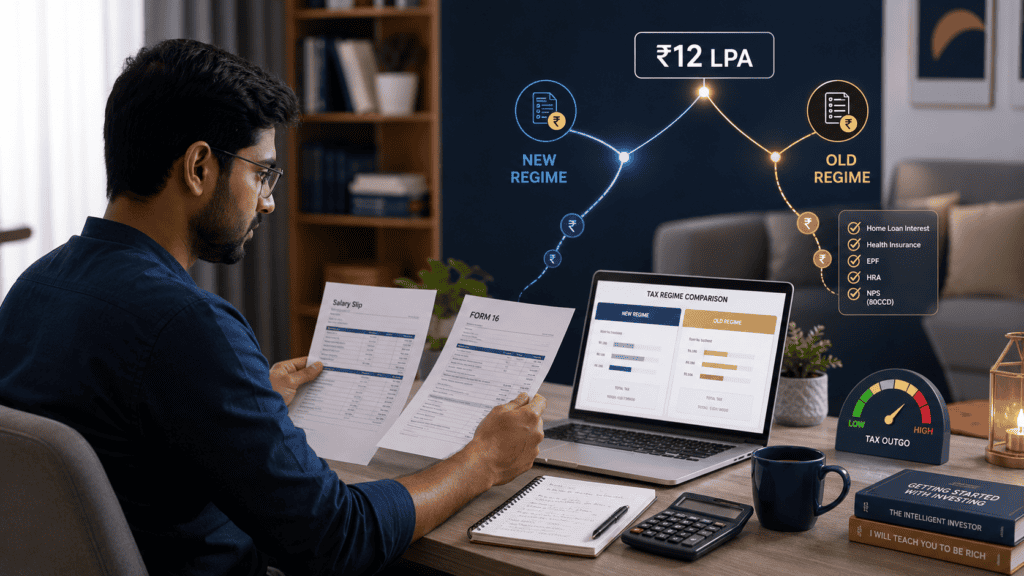
You just saw ₹12 LPA on your offer letter or payslip — and the first thing you want to know is how much of it actually reaches your bank account after tax. The answer is not as simple as applying a 30% slab on ₹12 lakh. Your taxable income is almost always lower than your CTC, and the tax on 12 LPA salary depends entirely on which regime you choose, which deductions you claim, and whether you even pay any tax at all.
This article walks you through the exact calculation under both the old and new tax regimes, explains how TDS works month by month, and helps you decide which option leaves more money with you — before you file your ITR or submit Form 12BB.
Quick Answer: Tax on 12 LPA Salary
Tax on 12 LPA salary can be zero under the new tax regime if taxable income after standard deduction stays within the Section 87A rebate limit [CONFIRM — verify current rate before publishing]. Under the old regime, tax depends on deductions such as 80C, HRA, NPS, health insurance, and professional tax [CONFIRM — verify current rate before publishing].
How to Calculate Tax on 12 LPA Salary
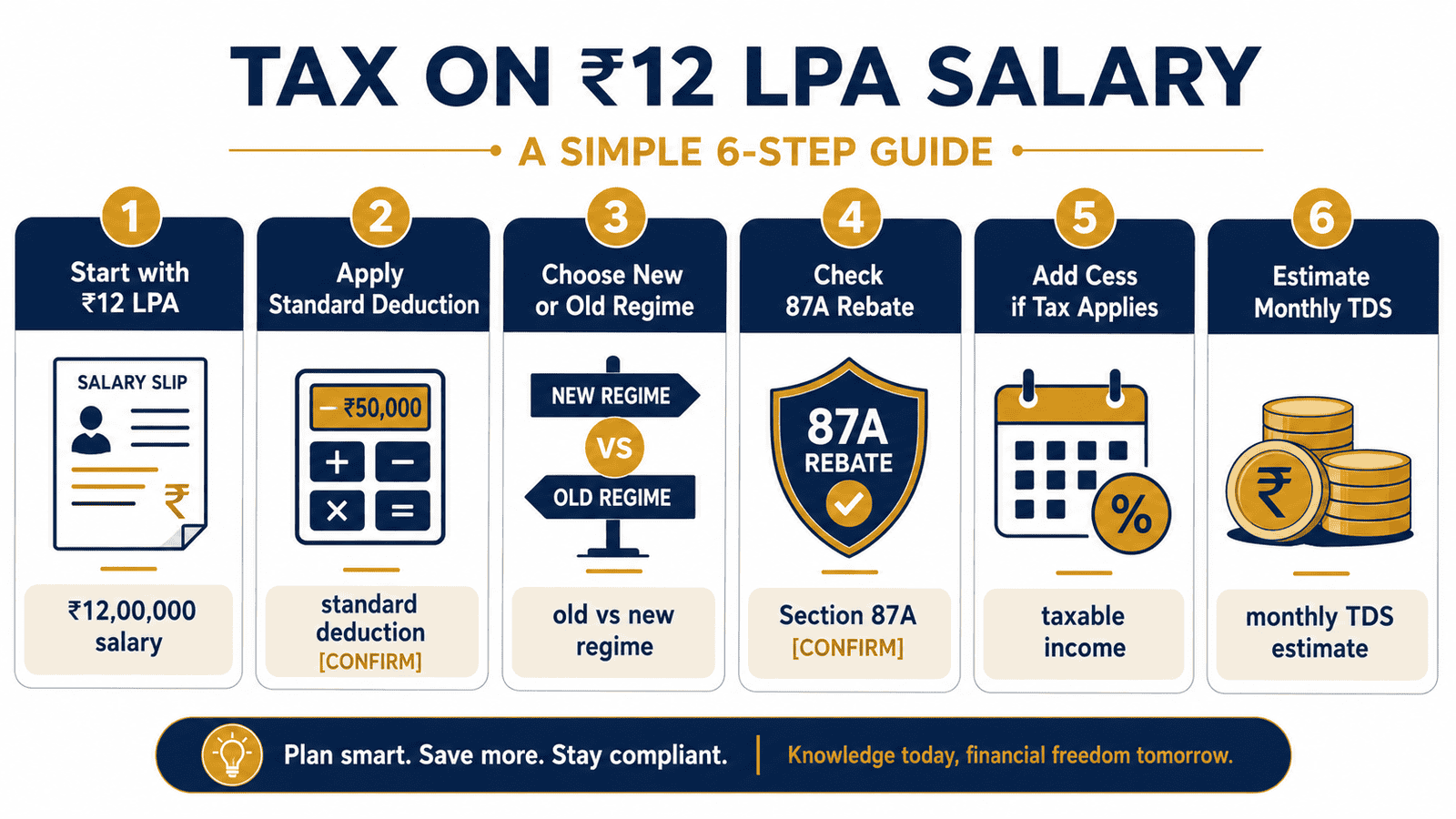
The calculation has four steps: start with gross salary, subtract exemptions and deductions to arrive at taxable income, apply the correct slab rates, then subtract the Section 87A rebate if applicable and add Health and Education Cess at 4%.
Taxable Income = Gross Salary − Standard Deduction u/s 16(ia) − HRA Exemption (old regime only) − Chapter VI-A Deductions (old regime only)
Step 1 — Gross Salary from CTC
Your CTC of ₹12 lakh is not your taxable salary. Employer PF contributions, gratuity provisions, and insurance premiums paid by your company are excluded. A typical ₹12 LPA CTC often yields a gross taxable salary of ₹11–11.5 lakh depending on your salary structure. For this calculation, assume gross taxable salary = ₹12,00,000 (worst case, fully salary — no special components).
Step 2 — Standard Deduction
Every salaried employee gets a flat standard deduction under Section 16(ia), available under both the old and new regimes. This reduces your gross salary before applying slabs. Learn more about how this works in our guide on standard deduction meaning.
Step 3 — Apply Regime Slabs
Under the new tax regime (Section 115BAC), slabs are lower but deductions (except standard deduction) are not allowed. Under the old tax regime, you keep HRA exemption, 80C up to ₹1.5 lakh, NPS under 80CCD(1B), health insurance under 80D, and professional tax — each of which shrinks taxable income further.
Step 4 — Rebate and Cess
If your net taxable income (after all deductions) is within the Section 87A rebate threshold, your tax liability becomes nil. If it exceeds that threshold, Health and Education Cess at 4% is added on top of the computed tax.
New Regime — ₹12 LPA Sample Calculation (FY 2025-26)
| Step | Amount | Note |
|---|---|---|
| Gross taxable salary | ₹12,00,000 | Assumed fully salary |
| Less: Standard deduction u/s 16(ia) | ₹75,000 | Flat deduction — verify current limit |
| Net taxable income | ₹11,25,000 | Exceeds 87A threshold |
| Tax under new regime slabs | ₹1,04,000 (approx) | Verify slabs before filing |
| Add: Health and Education Cess @ 4% | ₹4,160 | |
| Total tax payable | ₹1,08,160 | ~₹9,013/month TDS |
Old Regime — ₹12 LPA with Standard Deductions
| Step | Conservative (few deductions) | Optimised (max deductions) |
|---|---|---|
| Gross taxable salary | ₹12,00,000 | ₹12,00,000 |
| Less: Standard deduction u/s 16(ia) | ₹75,000 | ₹75,000 |
| Less: HRA exemption | Nil (own accommodation) | ₹1,20,000 (assumed) |
| Less: 80C investments | ₹50,000 | ₹1,50,000 |
| Less: 80D health insurance premium | Nil | ₹25,000 |
| Less: Professional tax | ₹2,400 | ₹2,400 |
| Taxable income | ₹10,72,600 | ₹8,27,600 |
| Approx. tax + cess | ₹1,37,000+ (verify) | ₹70,000–75,000 (verify) |
At ₹12 LPA, the new regime is typically better unless your combined deductions under the old regime exceed roughly ₹3.5–4 lakh. Use our income tax calculator to compute your exact outcome based on your actual deductions.
Key Takeaways
- Under the new tax regime, a ₹12 LPA salary yields a taxable income of approximately ₹11.25 lakh after the ₹75,000 standard deduction — above the Section 87A rebate threshold, so tax is payable.
- Tax under the new regime on ₹12 LPA is approximately ₹1,08,160 (including 4% cess), or roughly ₹9,013 per month in TDS — verify slab rates before filing.
- Under the old regime, if you fully utilise 80C (₹1.5 lakh), HRA (₹1.2 lakh), 80D (₹25,000), standard deduction, and professional tax, taxable income can fall to around ₹8.28 lakh — saving over ₹35,000 compared to the new regime.
- Your CTC is not your taxable salary — employer PF, gratuity, and group insurance components reduce your actual gross taxable income below ₹12 lakh in most structured pay packages.
- The Section 87A rebate is not available at ₹12 LPA under either regime — your taxable income exceeds the applicable threshold under both.
- If your total old-regime deductions are below ₹3.5 lakh, the new regime is likely cheaper; above ₹4 lakh in deductions, run the comparison on a calculator before deciding.
- Employers deduct TDS monthly based on the regime you declare via Form 12BB at the start of the financial year — incorrect declaration leads to either excess TDS or a tax demand at filing.
Key Facts at a Glance
| Parameter | New Regime | Old Regime |
|---|---|---|
| Gross taxable salary (assumed) | ₹12,00,000 | ₹12,00,000 |
| Standard deduction u/s 16(ia) | ₹75,000 | ₹75,000 |
| Additional deductions allowed | Not allowed | 80C, HRA, 80D, NPS etc. |
| Approx. taxable income | ₹11,25,000 | ₹8.27L–₹10.73L (varies) |
| Section 87A rebate applicable? | No | No (at this income) |
| Approx. annual tax + cess | ~₹1,08,160 | ~₹70,000–₹1,37,000 |
| Approx. monthly TDS | ~₹9,013 | ~₹5,833–₹11,416 |
| Default regime (if no declaration) | New regime | Must opt in explicitly |
| Assessment Year | AY 2026-27 | AY 2026-27 |
Understanding Tax on 12 LPA Salary: What Actually Gets Taxed
The single biggest misconception salaried employees have about tax on 12 LPA salary is treating CTC and taxable salary as the same number. They are not. Your CTC includes employer contributions to PF (12% of basic), gratuity provisions, group health insurance, and sometimes meal vouchers or other non-cash benefits — none of which are added to your taxable income.
What Is Taxable and What Is Not
Your gross taxable salary typically includes: basic salary, dearness allowance, special allowance, and performance bonus. It excludes: employer PF contribution, gratuity (up to statutory limits), reimbursements received against actual bills, and Leave Travel Allowance (LTA) if properly supported by travel proof.
HRA is a partial exclusion — the exempt portion depends on actual rent paid, basic salary, and your city. In the old regime, this exemption can be significant. In the new regime, HRA exemption is not available at all.
Standard Deduction Under Section 16(ia)
Every salaried person gets a flat deduction from gross salary before applying slabs. This deduction is available under both regimes and requires no proof or documentation. For FY 2025-26, the standard deduction is ₹75,000 — confirm this at incometax.gov.in before filing, as it is subject to Budget changes. For a ₹12 LPA employee, this alone brings gross taxable salary down to ₹11.25 lakh under the new regime.
New Tax Regime Slabs Under Section 115BAC
The new regime has been the default for salaried employees who do not submit a choice. Under Section 115BAC, tax is computed on slabs starting from nil on income up to ₹3 lakh, stepping up progressively. The regime has been revised in recent Budgets — always verify the current slab structure on incometax.gov.in before filing or advising your employer.
Health and Education Cess
After computing income tax on your taxable salary, Health and Education Cess at 4% is added on the computed tax amount. At ₹12 LPA under the new regime, this adds approximately ₹4,160 to your tax bill, taking the total from roughly ₹1,04,000 to ₹1,08,160.
TDS — What Your Employer Deducts Every Month
Your employer estimates annual tax liability at the start of the financial year (or when you join), divides it by 12, and deducts that amount monthly as Tax Deducted at Source. This TDS appears in your payslip and Form 16. If you declared the old regime and claimed deductions, your TDS will be lower. If you declared no preference, your employer defaults to the new regime. Understanding how TDS works is crucial — see our guide on TDS on salary if you want to check whether you are having excess or shortfall deductions.
Assessment Year vs Financial Year
Tax on income earned in FY 2025-26 (April 2025 to March 2026) is filed in AY 2026-27. When you search for slab rates, always confirm you are reading the correct financial year — a common mistake is applying the prior year’s rules.
Real Example: Rohan in Pune
Rohan, 29, is a software engineer working at a mid-size IT firm in Pune. His CTC is ₹12 LPA, structured as: basic ₹5.4 lakh, HRA ₹2.16 lakh, special allowance ₹3.24 lakh, employer PF contribution ₹64,800, and gratuity provision ₹26,000. His gross taxable salary — excluding employer PF and gratuity — is ₹10,80,000.
Under the new regime: Gross taxable salary ₹10,80,000 minus standard deduction ₹75,000 = taxable income ₹10,05,000. This is above the Section 87A threshold. Approximate tax plus 4% cess = ₹78,000 (verify exact figure on the calculator).
Under the old regime: Rohan pays rent of ₹12,000/month in Pune. HRA exempt = lowest of (₹2.16L, 50% of basic = ₹2.7L, rent paid minus 10% basic = ₹1.44L − ₹54,000 = ₹90,000) → ₹90,000 exempt. He contributes ₹1.5 lakh to ELSS (80C), and pays ₹12,000 annually for a health insurance policy (80D). Taxable income = ₹10,80,000 − ₹75,000 (std deduction) − ₹90,000 (HRA) − ₹1,50,000 (80C) − ₹12,000 (80D) − ₹2,400 (professional tax) = ₹7,50,600. Tax on ₹7,50,600 under old slabs + 4% cess ≈ ₹53,000–₹58,000 (verify). The old regime saves Rohan roughly ₹20,000–₹25,000 in this scenario — because his deductions exceed ₹3.5 lakh.
Key insight: For Rohan, the old regime wins because his actual CTC structure meant taxable salary was ₹10.8 lakh — not ₹12 lakh — and his deductions were substantial. Always model your actual salary structure, not your CTC headline number.
Comparison: New Tax Regime vs Old Tax Regime at ₹12 LPA
| Parameter | New Regime | Old Regime |
|---|---|---|
| Standard deduction | Yes — ₹75,000 | Yes — ₹75,000 |
| HRA exemption | Not available | Available |
| 80C deduction (up to ₹1.5 lakh) | Not available | Available |
| 80D health insurance | Not available | Available |
| NPS deduction u/s 80CCD(1B) | Not available | Up to ₹50,000 |
| Slab rates | Lower slabs | Higher slabs |
| Tax if deductions under ₹3.5 lakh | New regime cheaper | Old regime costlier |
| Tax if deductions above ₹4 lakh | New regime costlier | Old regime cheaper |
| Default regime (no declaration) | Yes — auto-applied | Must opt in explicitly |
| Best for | Fewer investments, renters in non-metro | High-deduction taxpayers, metro renters |
For a detailed breakdown, read our guide on old vs new tax regime for salaried employees.
How to Decide What’s Right for You
your total claimable deductions under the old regime (HRA + 80C + 80D + NPS + professional tax) are below ₹3.5 lakh — THEN the new tax regime will almost certainly result in lower tax at ₹12 LPA.
you pay rent in a metro city (Mumbai, Delhi, Kolkata, Chennai), fully utilise 80C (₹1.5 lakh), and have health insurance — THEN run the old regime numbers; your deductions may cross the crossover point and save ₹20,000–₹35,000.
you have not yet submitted Form 12BB or a regime declaration to your employer this financial year — THEN your employer is deducting TDS under the new regime by default; you can still change the regime when filing your ITR.
you have a home loan with both principal (80C) and interest (Section 24b) deductions active — THEN the old regime is likely better at ₹12 LPA; interest deduction under Section 24b alone can be ₹2 lakh per year for self-occupied property.
you are a new employee who just started the FY mid-year and have not invested in 80C yet — THEN default to new regime for this year and plan deductions from April next year before switching.
you have significant Chapter VI-A deductions to claim and your employer has already been deducting TDS on new regime — do not assume your excess TDS will auto-refund without filing your ITR; you must file to claim the refund. See our guide on old tax regime deductions to plan correctly.
Common Mistakes to Avoid
Treating CTC as Taxable Salary
Your ₹12 LPA CTC includes employer PF, gratuity, and other components that are not taxable in your hands.
This mistake leads to overestimating your tax liability — sometimes by ₹15,000–₹20,000 annually — and under-declaring your actual in-hand salary to lenders or for budgeting.
Identify your gross taxable salary from your payslip or Form 16 Part A before computing any tax.
Missing the Regime Declaration Deadline
If you do not inform your employer of your regime choice at the start of the year, TDS will be deducted under the new regime by default.
Mid-year switches to the old regime require re-submission of Form 12BB and may cause a bunched deduction in later months if under-deducted earlier. The employer is not obligated to accommodate late declarations in all cases.
Submit your regime choice — and investment proofs if old regime — at your HR portal in April, not February.
Skipping Section 87A Rebate Awareness
Section 87A provides a rebate that makes tax liability nil if taxable income is within a specified threshold.
At ₹12 LPA, after standard deduction, most employees will be above this threshold — but employees with structured CTC (employer PF, HRA, etc.) may find actual taxable income lower and worth verifying. Missing this check means paying avoidable tax. Learn who qualifies in our guide on TDS on salary.
Always compute your final taxable income before assuming the rebate does not apply.
Confusing 80C Limit with Total Investment
The Section 80C deduction is capped at ₹1.5 lakh annually — not per instrument.
Employees who pay PF (employee contribution), premium on life insurance, and also invest in ELSS often unknowingly exceed ₹1.5 lakh in total 80C-eligible spending. The excess earns no deduction and only reduces liquidity. At a 30% slab, this does not cost extra tax — but it wastes investment capacity that could go into NPS or 80D.
Map all 80C-eligible outflows before making new investments.
Ignoring Professional Tax in the Calculation
Professional tax — typically ₹200/month = ₹2,400/year — is deductible from gross salary under Section 16(iii) in the old regime.
It is small, but forgetting it consistently means slightly overpaying taxable income. Every ₹2,400 in missed deductions at the 20% slab costs ₹480 in extra tax.
Check your payslip for the “professional tax” line and include it in your old-regime working.
Filing ITR Under Wrong Regime
The regime you declare to your employer for TDS and the regime you file under for ITR can differ.
Many employees assume the regime on their Form 16 is final. It is not — you can choose your regime at ITR filing time (with some restrictions for those with business income). Missing this flexibility means some employees overpay by ₹20,000–₹35,000 and never claim the refund.
Always recompute tax under both regimes before filing your ITR.
When This May Not Be the Right Choice
The new tax regime is not automatically the right answer at ₹12 LPA, even though it is the default. If you have an active home loan with significant interest outgo, the Section 24b deduction of up to ₹2 lakh on interest (available only in the old regime) combined with 80C principal repayment can easily swing the calculation in the old regime’s favour by ₹30,000 or more.
If you are a government employee with high HRA or working in Mumbai or Delhi with rent payments above ₹15,000/month, the HRA exemption alone — which disappears in the new regime — may make the old regime materially cheaper.
If you have dependents requiring health coverage, the 80D deduction for parents’ health insurance (up to ₹50,000 for senior citizen parents) plus your own policy (up to ₹25,000) adds up to ₹75,000 in deductions — available only under the old regime.
If you are close to retirement and maximising NPS contributions under 80CCD(1B) for an additional ₹50,000 deduction, the old regime continues to offer meaningful tax reduction that the new regime cannot match.
If any of these apply to your situation, it may be worth exploring alternatives before committing.
Official Rules and Where to Verify
Tax slabs, standard deduction amounts, Section 87A rebate limits, and cess rates are subject to revision with each Union Budget and CBDT notification. The figures used in this article are based on available information for FY 2025-26 but must be verified before filing.
Always verify current slab rates, rebate limits, and deduction ceilings from the following official sources:
- Income Tax Department — incometax.gov.in (ITR forms, slab updates, e-filing portal)
- CBDT / Income Tax e-Filing Project — incometax.gov.in (circulars, notifications, regime guidance)
Rules, limits, and rates on this topic can change with each Budget or regulatory update. Always verify current figures directly from the official source before making any financial decision.
For step-by-step verification of current new regime slabs, see our article on new tax regime slabs FY 2025-26.
Expert Tips
- Model both regimes in April, not March: The best time to run your old vs new tax comparison is the first week of the new financial year — before TDS begins accumulating on the wrong regime. Use our income tax calculator with your actual payslip numbers, not CTC.
- Collect investment proofs before the employer deadline: If you choose the old regime, submit Form 12BB with actual proof (ELSS purchase statement, rent receipts, insurance premium receipt) by your employer’s internal deadline — usually January or February. Unproofed claims are rejected and TDS spikes in March.
- Check if your employer PF reduces taxable salary: Employee PF contribution goes to 80C — if your annual employee PF (12% of basic) is already ₹64,800 or more, you have less room for ELSS or LIC before hitting the ₹1.5 lakh 80C ceiling. Do this maths before buying an ELSS in March.
- Use the NPS corporate contribution benefit even in the new regime: Employer NPS contributions under Section 80CCD(2) are deductible even under the new regime — up to 10% of basic and DA. If your company offers this, it reduces your taxable income without requiring any personal investment.
- Cross-check Form 16 Part B before filing ITR: Form 16 Part B shows the deductions your employer considered. If you forgot to submit proofs mid-year, deductions may be understated. You can still claim them correctly while filing your ITR — resulting in a refund of excess TDS.
- Do not over-invest in insurance to save 80D: Some employees buy term plans or health policies purely to save tax under 80D. The policy must have genuine coverage value — a ₹12,000 annual health premium that gives you ₹5 lakh cover is sensible; buying a policy just for ₹2,496 in tax saving at the 20% slab rarely makes financial sense.
Frequently Asked Questions
Will I pay zero tax on a ₹12 LPA salary?
Not automatically. Under the new regime, a gross taxable salary of ₹12 lakh minus the ₹75,000 standard deduction leaves taxable income of ₹11.25 lakh — above the Section 87A rebate threshold. If your actual gross taxable salary from CTC is lower (due to employer PF, HRA structure, etc.), verify your exact position. Tax is payable for most employees at this income level.
What is the Section 87A rebate and does it apply at ₹12 LPA?
Section 87A provides a rebate that reduces tax liability to nil if net taxable income is within a specified limit. At ₹12 LPA gross salary and after standard deduction, most employees will exceed this limit under both regimes and will not qualify for the full rebate. Verify the current threshold at incometax.gov.in before filing.
Is the new regime always better at ₹12 LPA?
No. If your deductions under the old regime — HRA, 80C, 80D, NPS, home loan interest — add up to more than approximately ₹3.5–4 lakh, the old regime may result in lower tax. The crossover point depends on your actual salary structure and deductions. Always calculate both before deciding.
What is taxable income and how is it different from CTC?
Taxable income is the amount on which tax is computed — it is significantly lower than CTC. Employer PF, gratuity, and certain allowances are excluded. Then standard deduction and, in the old regime, Chapter VI-A deductions further reduce it. A ₹12 LPA CTC often results in a taxable income of ₹8–11 lakh depending on structure and deductions.
Can I change my tax regime after the financial year?
Yes — for salaried employees without business income, the regime can be changed at the time of ITR filing. Your employer may have deducted TDS under one regime, but you file under a different one and claim a refund or pay the difference. This flexibility ends if you have business or professional income, in which case switching back from the new regime has restrictions.
How does my employer calculate monthly TDS?
Your employer projects your annual tax liability at the start of the year based on your salary and the regime you declared via Form 12BB. This projected tax is divided by 12 and deducted monthly. If you add investment proofs mid-year, the employer recalculates and adjusts the balance across remaining months. Shortfalls or excess are corrected in the final months of the FY.
What happens if I submit wrong investment proofs for old regime claims?
Submitting false proofs is a serious offence under the Income Tax Act. If the actual investment is not made, the deduction is invalid, tax liability rises, and penalties under Section 271(1)(c) for concealment can apply. Always ensure actual investments are made before claiming deductions.
Is standard deduction available under both regimes at ₹12 LPA?
Yes. Standard deduction under Section 16(ia) is available to all salaried employees regardless of which regime they choose. It requires no proof or documentation. The current amount is ₹75,000 — verify at incometax.gov.in as it is subject to Budget changes each year.
What is Form 12BB and when do I need to submit it?
Form 12BB is the statement you submit to your employer declaring your estimated deductions and regime choice for TDS computation. It covers HRA, home loan interest, 80C investments, 80D premiums, and other deductions. Submit it at the start of every financial year (April) and update it when major investments change. Late submission causes TDS adjustments bunched in the final months.
What is the difference between financial year and assessment year for this tax?
The financial year (FY) is the year you earn income — FY 2025-26 is April 2025 to March 2026. The assessment year (AY) is the year in which you file the ITR for that income — AY 2026-27 for FY 2025-26 income. Always check which year a slab table or Budget notification refers to before using it.
Final Verdict
At ₹12 LPA, the tax on 12 LPA salary is not a fixed number — it ranges from approximately ₹53,000 to over ₹1,08,000 depending on your regime, deductions, and actual taxable salary from CTC. The new regime is simpler and often cheaper if your deductions are below ₹3.5 lakh. The old regime wins if you have a home loan, pay significant metropolitan rent, or maximise 80C, 80D, and NPS together. The single most important step is running both calculations with your actual payslip numbers — not your CTC headline. Use our income tax calculator to do exactly that. Always verify the latest rules from official sources or consult a qualified professional before making any financial decision.
This article is for educational purposes only and should not be treated as personalised financial, tax, investment, insurance, or legal advice. Tax rules, interest rates, regulatory limits, and product features can change with each Budget or policy update. Please verify current rules from official government sources or consult a qualified and registered professional before making any financial decision.

Kavita Mehra writes and edits Ridhi.com’s income tax content for Indian taxpayers, with a special focus on salaried employees and beginners who find tax rules confusing. Her work explains complex tax topics in simple language, helping readers understand how income, deductions, exemptions, rebates, TDS, Form 16, ITR filing, and refunds connect in real life.
She covers topics such as old vs new tax regime, income tax slabs, standard deduction, Section 87A rebate, HRA exemption, 80C, 80D, 80E, 80G, TDS on salary, taxable income, Form 16, AIS, Form 26AS, advance tax, and ITR filing checklists. Her content aims to help readers become more informed before filing returns or discussing tax matters with a professional.
Kavita’s approach is careful, compliance-focused, and official-source oriented. Because Indian tax rules can change after Budgets, circulars, and policy updates, her articles encourage readers to verify current figures, filing deadlines, and rules from the Income Tax Department or a qualified tax professional before acting.