You just received a ₹15 LPA offer letter — and now you want to know how much of that actually reaches your bank account. The number on the offer letter is not your take-home salary. Tax alone can take anywhere from ₹78,000 to over ₹1.5 lakh a year, depending on which regime you choose and which deductions you claim. Before you accept, negotiate, or start filing your ITR, you need a clear calculation — not a vague estimate.
This article walks through the exact income tax on a ₹15 lakh annual salary for FY 2025–26 under both the old and new tax regimes, with a worked example, a side-by-side comparison, and a clear answer on which regime saves you more money.
Quick Answer: Tax on 15 LPA Salary
Tax on 15 LPA salary depends on the tax regime, standard deduction, eligible deductions and employer salary structure. For a ₹15 lakh annual salary, compare new regime tax after standard deduction with old regime tax after 80C, 80D, HRA and other deductions. Under the new regime with ₹75,000 standard deduction, taxable income is ₹14,25,000 and tax (before cess) is approximately ₹1,57,500. Under the old regime with ₹1.5L in 80C, ₹25,000 in 80D, ₹1.5L HRA and ₹50,000 standard deduction, taxable income can fall to around ₹10,25,000 and tax to approximately ₹1,27,500 before cess. Verify current slabs, standard deduction amount, and surcharge from incometax.gov.in before filing.
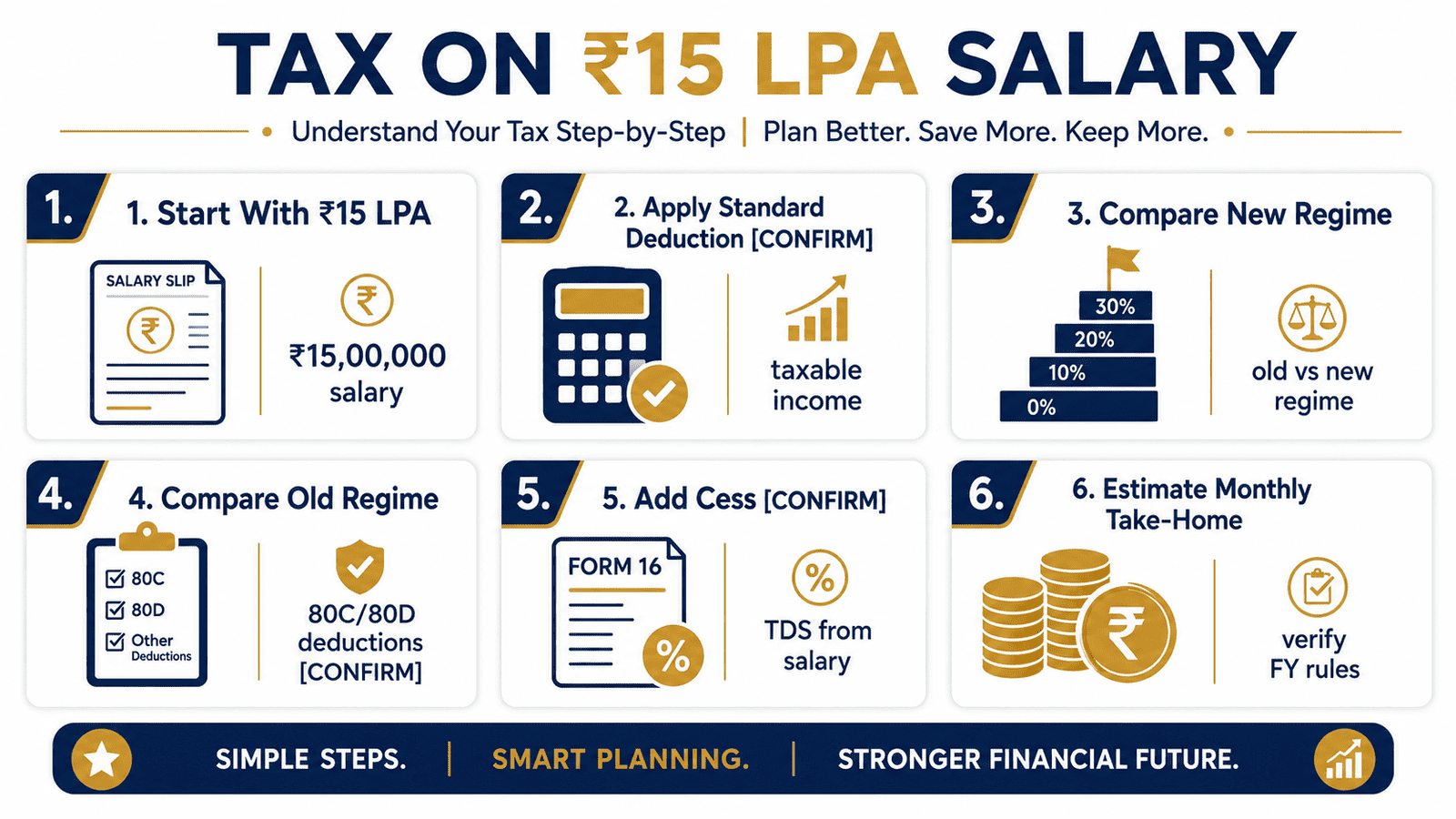
How to Calculate Tax on ₹15 LPA Salary
Tax Payable = (Taxable Income × Applicable Slab Rates) + 4% Health & Education Cess
Taxable income is not your CTC. You start with gross salary and subtract standard deduction and any eligible exemptions or deductions. Here is the step-by-step working for both regimes using a ₹15 lakh gross salary.
New Tax Regime Calculation (FY 2025–26)
| Step | Amount (₹) |
|---|---|
| Gross Salary | 15,00,000 |
| Less: Standard Deduction | −75,000 |
| Taxable Income | 14,25,000 |
New regime slab rates for FY 2025–26 (Assessment Year 2026–27):
| Income Slab (₹) | Rate | Tax on This Slab (₹) |
|---|---|---|
| 0 – 4,00,000 | 0% | 0 |
| 4,00,001 – 8,00,000 | 5% | 20,000 |
| 8,00,001 – 12,00,000 | 10% | 40,000 |
| 12,00,001 – 16,00,000 | 15% | 33,750 |
| Total Tax Before Cess | 93,750 | |
| Add: 4% Health & Education Cess | 4% | 3,750 |
| Total Tax Payable | 97,500 |
Monthly TDS under new regime: approximately ₹8,125
Old Tax Regime Calculation (FY 2025–26)
Under the old regime, you can claim HRA, 80C, 80D, standard deduction, and other exemptions to lower your taxable income significantly.
| Step | Amount (₹) |
|---|---|
| Gross Salary | 15,00,000 |
| Less: Standard Deduction | −50,000 |
| Less: HRA Exemption (assumed) | −1,50,000 |
| Less: Section 80C Deductions | −1,50,000 |
| Less: Section 80D (health insurance) | −25,000 |
| Taxable Income | 10,25,000 |
Old regime slab rates for FY 2025–26:
| Income Slab (₹) | Rate | Tax on This Slab (₹) |
|---|---|---|
| 0 – 2,50,000 | 0% | 0 |
| 2,50,001 – 5,00,000 | 5% | 12,500 |
| 5,00,001 – 10,00,000 | 20% | 1,00,000 |
| 10,00,001 – 10,25,000 | 30% | 7,500 |
| Total Tax Before Cess | 1,20,000 | |
| Add: 4% Health & Education Cess | 4% | 4,800 |
| Total Tax Payable | 1,24,800 |
Monthly TDS under old regime (with these deductions declared): approximately ₹10,400
Use our salary tax calculator to run your own numbers with your actual salary structure and deductions.
Key Takeaways
- Under the new regime with ₹75,000 standard deduction, tax on ₹15 LPA comes to approximately ₹97,500 (including 4% cess) for FY 2025–26.
- Under the old regime with full 80C (₹1.5L), 80D (₹25,000), and HRA (₹1.5L), tax falls to approximately ₹1,24,800 — but only if you actually make those investments and claim HRA.
- The new regime is simpler and often better if your total deductions under the old regime are below approximately ₹3.75 lakh.
- Section 87A rebate applies only up to ₹7 lakh taxable income in the new regime and ₹5 lakh in the old regime — neither applies at ₹15 LPA.
- Your monthly TDS is set by your employer based on regime declaration in April. If you under-declare deductions, TDS will be higher but you get a refund after filing ITR.
- CTC of ₹15 lakh is not your take-home. After PF (both sides), professional tax, and income tax, in-hand salary is typically ₹95,000–₹1,05,000/month depending on structure.
- Always verify current slab rates, standard deduction amount, and cess from incometax.gov.in before filing — these change with the Union Budget.
Key Facts at a Glance
| Parameter | New Regime | Old Regime |
|---|---|---|
| Gross Salary | ₹15,00,000 | ₹15,00,000 |
| Standard Deduction | ₹75,000 | ₹50,000 |
| Taxable Income (assumed) | ₹14,25,000 | ₹10,25,000 |
| Tax Before Cess | ₹93,750 | ₹1,20,000 |
| Total Tax (with 4% cess) | ₹97,500 | ₹1,24,800 |
| Monthly TDS (approx.) | ₹8,125 | ₹10,400 |
| Section 87A Rebate | Not applicable | Not applicable |
| Assessment Year | AY 2026–27 | AY 2026–27 |
Understanding Tax on ₹15 LPA Salary
The biggest source of confusion for salaried employees at ₹15 LPA is the gap between CTC and taxable income. CTC includes employer PF contribution, gratuity provision, and sometimes allowances that reduce your taxable salary. Your Form 16 Part B — not your offer letter — shows your actual taxable gross.
What Counts as Taxable Income at ₹15 LPA?
Your ₹15 lakh CTC typically breaks down into basic salary, HRA, special allowance, LTA, employer PF, and sometimes a variable component. Of these, only employer PF (up to ₹7,500/month) and HRA (subject to conditions) reduce taxable income. Everything else is taxable unless specifically exempt.
For most IT-sector employees in metro cities, a ₹15 LPA structure might look like: basic ₹6L, HRA ₹3L, special allowance ₹3.6L, employer PF ₹72,000, gratuity provision ₹28,846. Gross taxable salary before deductions is typically ₹13.5L–₹14.5L depending on structure.
Standard Deduction for Salaried Employees
Both regimes allow a flat standard deduction — no proof required, no investment needed. In the new regime, the standard deduction for salaried employees is ₹75,000 for FY 2025–26. In the old regime, it is ₹50,000. This is one reason the new regime’s headline taxable income is lower than many people expect. Read more about standard deduction explained and how it reduces taxable salary.
Section 87A Rebate Does Not Apply at ₹15 LPA
Section 87A gives a full tax rebate to taxpayers with taxable income up to ₹7 lakh (new regime) or ₹5 lakh (old regime). At ₹15 LPA, taxable income after standard deduction is well above both thresholds. Section 87A does not apply here — you will pay tax regardless of regime.
Surcharge at ₹15 LPA
Surcharge applies only when total income exceeds ₹50 lakh. At ₹15 LPA, there is no surcharge — only the 4% Health and Education Cess applies on top of your base tax.
How Your Employer Calculates Monthly TDS
Your employer deducts TDS from salary every month based on projected annual tax. In April, you submit a regime declaration and investment declarations (if old regime). If you declare 80C and 80D investments early in the year, TDS is lower every month. If you forget to declare or declare late, TDS is higher and you claim the refund after filing ITR. Understanding salary TDS calculation helps you avoid excess deductions and unnecessary cash flow pressure through the year.
Real Example: Rohan, Software Engineer, Bengaluru
Rohan, 29, is a software engineer at a mid-size tech company in Bengaluru with a CTC of ₹15 lakh. His salary slip shows: basic ₹6,00,000, HRA ₹3,00,000, special allowance ₹3,90,000, employer PF ₹72,000, gratuity ₹28,800, and variable pay (annual) ₹1,08,000. His actual taxable gross after employer PF exclusion is approximately ₹14,00,000.
Rohan pays rent of ₹18,000/month in Bengaluru — his HRA exemption works out to roughly ₹1,20,000. He has invested ₹1,50,000 in PPF and ELSS combined, and pays ₹15,000 annually for a health insurance policy. He also has an employee PF contribution of ₹72,000 qualifying under 80C (already within the ₹1.5L cap).
Old regime taxable income: ₹14,00,000 − ₹50,000 (std deduction) − ₹1,20,000 (HRA) − ₹1,50,000 (80C) − ₹15,000 (80D) = ₹10,65,000. Estimated tax: approximately ₹1,33,500 including cess.
New regime taxable income: ₹14,00,000 − ₹75,000 (std deduction) = ₹13,25,000. Estimated tax: approximately ₹90,750 including cess.
Rohan saves approximately ₹42,750 more under the new regime — despite making PPF, ELSS, and health insurance investments. His monthly in-hand pay under the new regime is approximately ₹1,03,000 after employee PF, professional tax, and TDS.
Key insight: At ₹15 LPA, unless your total old-regime deductions exceed approximately ₹3.75 lakh, the new regime will likely result in lower tax — even if you are actively investing.
Comparison: Old Tax Regime vs New Tax Regime at ₹15 LPA
| Parameter | Old Tax Regime | New Tax Regime |
|---|---|---|
| Standard Deduction | ₹50,000 | ₹75,000 |
| Section 80C (up to ₹1.5L) | Available | Not Available |
| Section 80D (health insurance) | Available | Not Available |
| HRA Exemption | Available | Not Available |
| Tax Slab Rates | 5% / 20% / 30% | 5% / 10% / 15% / 20% |
| Tax at ₹15 LPA (typical) | ₹1,00,000–₹1,40,000 | ₹90,000–₹1,00,000 |
| Better When Deductions Are | Above ₹3.75L | Below ₹3.75L |
| Compliance Complexity | High — proof needed | Low — minimal proof |
For a deeper breakdown of which regime suits your salary and investment profile, read our guide on the old or new regime decision.
How to Decide What’s Right for You
Your total deductions under the old regime (80C + 80D + HRA + NPS + home loan interest, etc.) are below ₹3.75 lakh — THEN the new tax regime will likely result in lower tax at ₹15 LPA.
You pay high rent in a metro (HRA exemption above ₹1.5L/year), max out 80C at ₹1.5L, and also claim 80D — THEN the old regime may save you more tax, especially if combined deductions exceed ₹4 lakh.
You are early in your career and have not yet started investing in 80C instruments — THEN the new regime removes the pressure to invest just for tax saving, and you still pay lower tax at this salary level.
Your employer defaults to the new regime and you have not submitted investment declarations — THEN your TDS may be calculated under the new regime automatically; switch regimes at ITR filing if old regime saves more.
You have a home loan with significant interest deduction (Section 24b above ₹2L/year) along with full 80C and 80D — THEN run the exact numbers; the old regime may still win despite the lower standard deduction.
You are not making any tax-saving investments and do not claim HRA — THEN do not choose the old regime by default. The new regime is almost certainly better for you at ₹15 LPA.
Common Mistakes to Avoid
Assuming CTC equals taxable salary
Many employees believe their ₹15 lakh CTC is fully taxable. It is not. Employer PF contribution (up to ₹7,500/month), gratuity provisioning, and certain allowances reduce your actual taxable gross — sometimes by ₹80,000–₹1.2 lakh.
Always check your Form 16 Part B or salary slip to identify your actual taxable gross before estimating tax.
Not declaring investments to your employer in April
If you delay submitting investment proofs to your payroll or HR team, your employer deducts TDS as if you claimed no deductions — inflating monthly TDS by ₹3,000–₹6,000/month unnecessarily.
Submit regime choice and investment declarations in April itself. You get the excess back as a refund, but only months later after filing ITR. Understanding salary TDS calculation can help you plan this better.
Picking the old regime without calculating actual deductions
A common belief is that the old regime always saves tax if you “invest.” At ₹15 LPA, this is not always true. If your actual deductions total less than ₹3.75 lakh, the new regime likely saves more despite no deductions.
Run the comparison before April each year — not in March when you are scrambling for proof submissions.
Confusing Section 87A rebate with tax exemption at ₹15 LPA
Section 87A gives zero tax only up to ₹7 lakh taxable income (new regime). At ₹15 LPA, your taxable income after standard deduction is ₹13.25L–₹14.25L. You will pay tax. Do not assume zero tax based on articles written for lower salary brackets.
Claiming HRA without meeting all three conditions
HRA exemption requires you to actually pay rent, live in a rented home (not self-owned), and have HRA in your salary structure. Employers increasingly audit rent receipts above ₹1 lakh/year. Incorrect HRA claims can lead to notices and tax demand plus interest under Section 234A/B.
Claim only what is genuinely paid and supported by receipts and, above ₹1L/year, the landlord’s PAN.
Not filing ITR thinking TDS is final tax
TDS is an advance tax deducted monthly — it is not the final settlement. If you switched jobs, had freelance income, or declared investments late, your actual tax liability may differ from TDS deducted. Filing ITR (due July 31 typically) reconciles TDS and gets you any refund owed.
Always file, even if tax is fully deducted via TDS.
Forgetting professional tax and employee PF in take-home estimation
Even if your income tax is ₹97,500/year, monthly take-home at ₹15 LPA will be lower than expected because employee PF (₹6,000/month typically) and professional tax (up to ₹2,400/year in Karnataka, for example) are also deducted from gross.
Calculate take-home with all deductions — not just income tax — using a complete salary calculator.
Ignoring the annual regime switch window
Salaried employees can switch regimes once per year — at the time of filing ITR. If you chose the new regime via employer in April but realise in March that old regime saves more (perhaps due to a home loan taken mid-year), you can switch while filing your return.
Do not assume your employer’s regime choice locks you in for ITR filing.
When This May Not Be the Right Choice
The new tax regime is not always the better option at ₹15 LPA. If you have a home loan with interest above ₹2 lakh under Section 24b, combined with full 80C and 80D, the old regime may still yield lower tax. Similarly, if your employer provides an unusually high HRA component or LTA that is fully exempt, these benefits only apply under the old regime.
If you are a government employee entitled to specific perquisites or allowances not available under the new regime, switching may cost you. And if your income is variable — with a significant bonus pushing your effective annual income above ₹15 lakh — calculations should be run on total annual income, not just basic CTC.
If any of these apply to your situation, it may be worth exploring alternatives before committing.
Official Rules and Where to Verify
Tax slabs, standard deduction amounts, rebate limits, surcharge thresholds, and cess rates can change with every Union Budget. The figures used in this article reflect FY 2025–26 (Assessment Year 2026–27) as per Ridhi’s latest editorial review. Always verify current figures before filing.
- Income Tax Department — incometax.gov.in (tax slabs, ITR forms, e-filing portal)
- EPFO — epfindia.gov.in (PF contribution rates, taxability of employer PF above limits)
Rules, limits, and rates on this topic can change with each Budget or regulatory update. Always verify current figures directly from the official source before making any financial decision.
To cross-check salary, TDS deducted, and deductions claimed, read your Form 16 carefully before you file ITR. Part A shows TDS deducted by employer; Part B shows your taxable salary breakdown.
Expert Tips
- Submit your regime choice to HR in the first week of April — not in January or February. Employer TDS is recalculated in the last three months if you change your mind, causing large deductions in January–March.
- If you are on the new regime but also invest in ELSS, PPF, or pay health insurance, do not stop those investments. They build wealth independently of tax saving — the new regime just doesn’t give you a deduction for them.
- At ₹15 LPA with a home loan, always model both regimes in April using actual interest certificate estimates. A ₹40L home loan at 9% generates approximately ₹3.5L interest in year one — well above the Section 24b limit of ₹2L.
- Ask your payroll team for a provisional tax calculation sheet in April. Most corporate payroll systems generate this. Review it before confirming your regime — it takes 10 minutes and can save ₹20,000–₹40,000 in excess TDS.
- If you joined mid-year or switched employers, ensure your new employer has Form 12B showing previous employer’s salary and TDS. Failure to submit this causes under-deduction of TDS and a tax demand at filing time.
- Use Assessment Year correctly when filing: income earned in FY 2025–26 (April 2025 to March 2026) is filed in AY 2026–27. Selecting the wrong AY is one of the most common ITR errors.
- Keep rent receipts, landlord PAN details, 80D premium payment receipts, and 80C investment statements ready before March 31 — not February 28 when you are in a last-minute scramble.
Frequently Asked Questions
What is the exact income tax on a ₹15 lakh salary under the new regime?
For FY 2025–26, tax on ₹15 lakh gross salary under the new regime is approximately ₹97,500 (including 4% cess) after a ₹75,000 standard deduction, bringing taxable income to ₹14,25,000. Monthly TDS works out to approximately ₹8,125. Verify current slab rates at incometax.gov.in before filing.
Is the new regime always better for ₹15 LPA?
Not always. The new regime is better when your old-regime deductions total less than approximately ₹3.75 lakh. If you have a home loan (Section 24b), high HRA exemption, full 80C, and 80D — the old regime may save more. Run the exact comparison using your actual deduction figures every April.
Does Section 87A rebate apply to ₹15 LPA salary?
No. Section 87A gives zero tax only up to ₹7 lakh taxable income in the new regime (₹5 lakh in the old regime). At ₹15 LPA, taxable income after standard deduction is ₹13.25L–₹14.25L under the new regime — well above the rebate threshold. Tax is payable under both regimes.
What is the take-home salary on ₹15 LPA after tax?
Take-home salary at ₹15 LPA under the new regime is typically ₹1,00,000–₹1,05,000 per month after income tax TDS (≈₹8,125/month), employee PF contribution (≈₹6,000/month), and professional tax (≈₹200/month). Actual figures vary by employer structure and metro/non-metro location.
Can I switch tax regimes after my employer has set my TDS?
Yes. Salaried employees can switch regimes while filing ITR (due July 31 typically), regardless of what regime the employer used for TDS. If switching to old regime at ITR time saves more tax, you claim the excess TDS as a refund. Switching back and forth is allowed once per year.
What is the break-even deduction amount between old and new regime at ₹15 LPA?
At ₹15 LPA, the break-even point — where old and new regime give the same tax — is when total old-regime deductions (including the extra ₹25,000 from lower standard deduction vs new regime) are approximately ₹3.5–3.75 lakh. Below this, new regime is cheaper. Above this, old regime wins.
What happens if I don’t declare my investments to my employer?
If no investments are declared, your employer deducts TDS as if you claimed zero deductions under the old regime — which means much higher monthly TDS. You get the excess back as a refund after filing ITR, but only months after the financial year ends. It is better to declare upfront in April.
Is professional tax deducted in addition to income tax at ₹15 LPA?
Yes. Professional tax is a state-level deduction of up to ₹2,400 per year in most states. In Karnataka, it is ₹2,400/year for salaries above ₹25,000/month. It is deducted from your gross salary and is also allowed as a deduction under both old and new regimes, mildly reducing taxable income.
How do I read my Form 16 to verify my tax?
Form 16 Part A shows TDS actually deposited with the government by your employer. Part B shows your salary breakdown, deductions claimed, and taxable income computed. Mismatch between Part B figures and your own calculation often indicates missed deductions or wrong regime. Read your Form 16 carefully before filing ITR to catch errors.
What is the surcharge on ₹15 lakh income?
No surcharge applies at ₹15 lakh. Surcharge kicks in only when total income exceeds ₹50 lakh (at 10%) and increases at higher thresholds. At ₹15 LPA, only the flat 4% Health and Education Cess is added on top of your base income tax.
Final Verdict
For most salaried employees earning ₹15 LPA in FY 2025–26, the new tax regime is the better starting point — tax comes to approximately ₹97,500 with minimal compliance effort, compared to ₹1.24–1.40 lakh under the old regime unless deductions are substantial. The new regime wins unless your combined old-regime deductions exceed ₹3.75 lakh. Run the numbers specifically with your actual HRA, 80C, and 80D figures every April — not in March when you are under pressure. If you are early in your career, not yet making large tax-saving investments, or simply want lower monthly TDS without paperwork, new regime is the right call for tax on 15 LPA salary. Always verify the latest rules from official sources or consult a qualified professional before making any financial decision.
This article is for educational purposes only and should not be treated as personalised financial, tax, investment, insurance, or legal advice. Tax rules, interest rates, regulatory limits, and product features can change with each Budget or policy update. Please verify current rules from official government sources or consult a qualified and registered professional before making any financial decision.

Ananya Rao writes about salary structures, CTC, in-hand salary, salary slips, allowances, bonuses, deductions, and workplace-linked financial decisions for Indian salaried employees. Her work is focused on helping readers understand the difference between what an offer letter promises and what actually reaches their bank account every month.
She covers topics such as CTC vs in-hand salary, gross salary vs net salary, basic salary, HRA, PF deductions, professional tax, joining bonus, retention bonus, variable pay, notice period buyout, leave encashment, and salary increment impact. Her writing is especially useful for freshers, job switchers, mid-career professionals, and families trying to plan monthly budgets around salary income.
Ananya’s style is practical, simple, and example-driven. She uses Indian salary-slip style breakdowns, ₹ amounts, and real-world scenarios to explain salary concepts clearly. Her articles are educational and should not be treated as guaranteed salary, tax, or employment advice because salary structures vary by employer, state, policy, and individual circumstances.