A baby changes everything — including your bank account. The costs start before delivery and keep coming for the next 18 years. Delivery bills, maternity insurance waiting periods, newborn paediatric visits, diapers, childcare, and eventually school fees: financial planning for new parents in India means thinking about all of it before cash flow gets tight. This article gives you a practical, step-by-step checklist — covering delivery fund, insurance review, emergency buffer, and education savings — so you can enjoy this milestone without financial stress catching you off guard.
Quick Answer: Financial Planning for New Parents in India
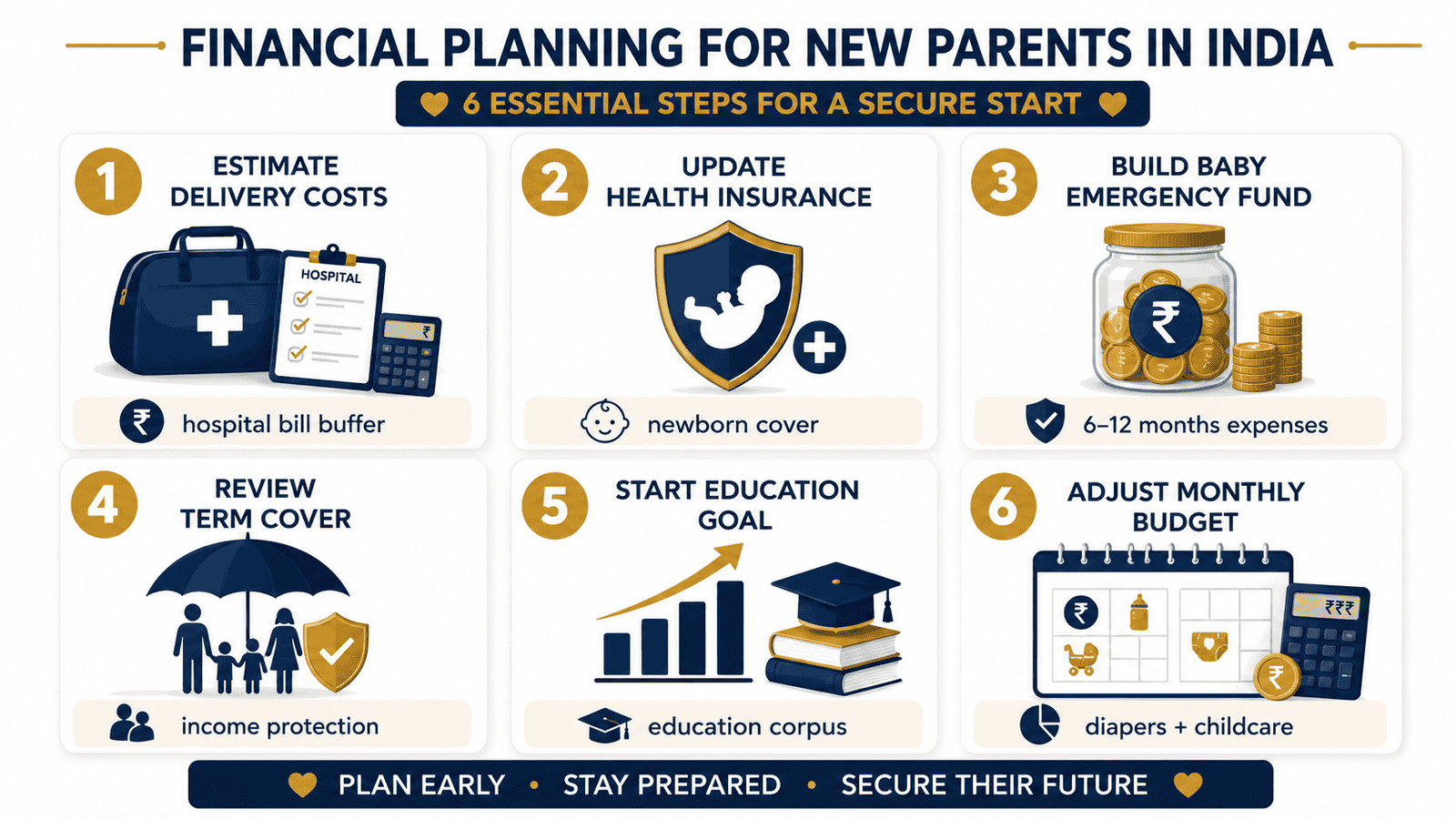
Financial planning for new parents in India means preparing for delivery costs, baby expenses, insurance, emergency fund, childcare, and long-term education goals before cash flow becomes stressful. A practical starting point is keeping 6 months of expanded family expenses, reviewing health cover, and starting a goal-based savings plan early.
Key Takeaways
- Pregnancy and delivery costs in India vary widely — a normal delivery at a private hospital can range from ₹50,000 to ₹2,00,000 or more depending on the city and facility; build a dedicated fund before the third trimester.
- Many health insurance policies have a maternity waiting period of 2–4 years — check your policy now, not when you are already pregnant.
- Your emergency fund should cover 6 months of expanded household expenses after adding baby costs; bump this to 9–12 months if one parent plans to take extended or unpaid leave.
- Term insurance needs to increase once a child becomes a dependent — a ₹1 crore cover that felt sufficient before the baby may not be adequate after.
- Child ULIP or endowment plans lock in money for decades with high charges — explore low-cost mutual fund SIPs or PPF for education goals before committing.
- Start education savings only after your protection layer (insurance) and liquidity layer (emergency fund) are in place — sequence matters.
- Sukanya Samriddhi Yojana (SSY) is a government-backed option for girl children — verify current interest rates and deposit limits at India Post or a nationalised bank.
Key Facts at a Glance
| Planning Area | What to Do | Practical Benchmark |
|---|---|---|
| Delivery Fund | Set aside dedicated savings before third trimester | ₹80,000–₹2,50,000 (illustrative; verify locally) |
| Newborn Monthly Expenses | Budget for diapers, formula, paediatric visits, baby products | ₹8,000–₹20,000/month (illustrative) |
| Health Insurance — Maternity | Check waiting period; add newborn to policy within insurer’s deadline | Waiting period: often 2–4 years; verify with IRDAI-registered insurer |
| Emergency Fund | Expand to cover 6–12 months of new family expenses | Monthly expense × 6 (or × 9–12 if income dips) |
| Term Insurance | Review cover after baby becomes a dependent | At least 10–15× annual income; recalculate post-baby |
| Education Savings | Start goal-based SIP or SSY after insurance and liquidity in place | Depends on target corpus and child’s age; start early |
What Actually Changes When a Baby Arrives
Most new parents are surprised not by one big bill, but by several medium ones arriving at once. Understanding how your cash flow shifts — and when — is the foundation of good financial planning for new parents in India.
One-Time vs Recurring Costs
Delivery, hospital stay, and immediate newborn essentials are one-time (or once-per-pregnancy) costs. After that, you move into recurring monthly expenses: diapers, formula or lactation support, paediatric consultations, vaccines not covered by government programmes, and household help. These recurring costs typically last 2–5 years at elevated levels before childcare and school fees take over.
Build your first baby budget before the third trimester — not after delivery, when the bills have already arrived. Map your current expenses, then layer on estimated baby costs line by line.
Income Changes During Maternity or Paternity Leave
Maternity Benefit Act, 1961 provides 26 weeks of paid leave for eligible employees. Paternity leave norms vary by employer. But many families — especially those where one parent is self-employed, on contract, or working at a smaller firm — face partial or unpaid leave. Even with paid leave, a spouse’s freelance income or consulting income may drop. Plan for this income gap explicitly, not optimistically.
If one parent is likely to take a career break or reduce hours after the baby, the family’s monthly income may change significantly for 6–36 months. A larger emergency buffer matters more than an aggressive investment plan during this window.
Insurance Responsibility Grows Immediately
The moment a child is born, your income becomes someone else’s lifeline. Term insurance becomes more urgent — not something to review “later.” Similarly, your health policy needs to cover a new family member. Both tasks have deadlines: insurers typically require you to add a newborn within 90 days of birth (verify with your insurer) or the child may not get coverage from day one.
Long-Term Goals Become Visible
Higher education in India is expensive and getting more so. Engineering, medicine, and professional degrees at good private institutions can cost ₹25–₹80 lakh or more by the time your child turns 18. Starting a small, consistent education savings plan early — even ₹2,000 a month — allows compounding to do significant work over 15–18 years.
Real Example: Priya and Arjun’s First-Year Baby Budget
Priya, 31, is a marketing manager in Bengaluru earning ₹95,000 per month. Her husband Arjun, 33, earns ₹60,000 per month as a software professional. Combined monthly income: ₹1,55,000. Their current monthly expenses before the baby: ₹90,000 (rent ₹28,000, groceries and utilities ₹12,000, EMIs ₹20,000, insurance premiums ₹8,000, savings and SIPs ₹22,000).
After the baby arrives, their revised monthly outgoings look like this (illustrative figures only — not averages):
- Diapers and baby consumables: ₹4,500/month
- Formula or lactation support: ₹2,500/month
- Paediatric visits and vaccines (private): ₹2,000/month average
- Additional household help: ₹8,000/month
- Baby clothing, gear, and miscellaneous: ₹3,000/month
That adds roughly ₹20,000/month to their recurring expenses. Plus a one-time delivery and hospital fund of approximately ₹1,20,000 (illustrative) set aside before the third trimester. Their revised financial priority: fund the delivery, rebuild the emergency fund to reflect the new ₹1,10,000 monthly expense baseline, then restart SIPs. Education savings start 6 months after the emergency fund is rebuilt — not before.
How to Calculate Your Expanded Emergency Fund
Expanded Emergency Fund = (Current Monthly Household Expenses + Estimated Monthly Baby Expenses) × Emergency Months
Using Priya and Arjun’s example:
- Pre-baby monthly expenses: ₹90,000
- New baby-related monthly expenses: ₹20,000
- Expanded monthly baseline: ₹1,10,000
- Target emergency fund at 6 months: ₹1,10,000 × 6 = ₹6,60,000
- If one parent may take extended leave: ₹1,10,000 × 9 = ₹9,90,000
Keep this fund in a high-interest savings account or liquid mutual fund — accessible within 24–48 hours, not locked in FDs with early withdrawal penalties. Use the baby emergency fund calculator to run this number for your own household.
| Scenario | Monthly Expense Baseline | Emergency Fund Target |
|---|---|---|
| Both parents working, stable income | ₹1,10,000 | ₹6,60,000 (6 months) |
| One parent on partial unpaid leave | ₹1,10,000 | ₹9,90,000 (9 months) |
| One parent full career break (12 months) | ₹1,10,000 | ₹13,20,000 (12 months) |
Comparison: Financial Priorities Before, During, and After Baby
| Stage | Key Financial Action | Priority |
|---|---|---|
| Before Pregnancy | Review health insurance maternity cover and waiting period; start delivery fund; check and grow emergency fund | Critical |
| During Pregnancy | Get hospital cost estimate (normal and C-section); plan leave and income gap; start baby essentials budget; update nominees | High |
| First 12 Months | Add newborn to health insurance (within insurer deadline); track paediatric and childcare costs; rebuild emergency fund | Critical |
| Long Term (1–18 Yrs) | Start education goal SIP or SSY; review term insurance cover; revisit nominees and will | Important |
How to Decide What’s Right for You
Your emergency fund covers less than 3 months of current expenses — THEN prioritise rebuilding it to 6 months before starting any new investment for the baby.
Your health insurance is only through your employer’s group policy — THEN review whether it includes maternity cover, what the sub-limit is, and whether a personal family floater policy is worth adding before pregnancy.
One parent is likely to reduce working hours or take a full career break for 6+ months — THEN set aside a six month buffer based on the single-income scenario, not the current dual-income baseline.
Your in-laws or family will support childcare at home — THEN your monthly childcare expense may be lower; redirect that savings to your emergency fund or education SIP.
You are already servicing high-interest loans (personal loan, credit card EMI) — THEN reduce those first; aggressive investing while paying 18–24% interest on debt rarely makes financial sense.
You have adequate term insurance and your family’s income is not dependent on just one earner — then the urgency around term insurance is lower; but still review cover adequacy once the child arrives.
Common Mistakes to Avoid
Buying Expensive Baby Products Before the Emergency Fund Is Ready
Premium strollers, nursing chairs, and imported baby monitors are heavily marketed to expectant parents. Many cost ₹15,000–₹60,000 individually.
Spending ₹80,000 on baby gear before building an emergency fund can leave the family financially exposed if medical expenses spike in the first month. Babies grow out of most items within 6 months anyway.
Borrow or buy second-hand for non-safety items. Spend on emergency fund first.
Assuming Maternity Expenses Are Automatically Covered
Many health insurance policies have a maternity waiting period of 2–4 years. Others cap maternity benefits at ₹30,000–₹50,000 with a sub-limit that does not reflect actual private hospital costs.
A couple who buys health insurance in month 3 of the pregnancy may receive no maternity claim at all. Pre-existing waiting periods and maternity sub-limits are set by the insurer — check them explicitly before delivery, not after.
Read your policy document and call your insurer to confirm exactly what maternity and newborn expenses your plan covers.
Depending Only on Employer Group Health Insurance
Employer group policies change every year. If you switch jobs or are laid off, coverage lapses immediately. Maternity and newborn cover may not transfer seamlessly.
A salaried employee relying entirely on employer coverage could face a ₹1–2 lakh medical bill with no fallback if they change jobs during pregnancy. Build a personal family floater policy with a waiting period that starts now, not during the pregnancy.
Use the parent term cover guide to review whether your life and health cover are adequate with a new dependent.
Buying a Child ULIP or Endowment Plan Without Comparing Costs
Child ULIPs and endowment plans are aggressively sold to new parents. They combine insurance and investment — which sounds reassuring, but usually means high charges, low flexibility, and returns that can lag inflation over 15–20 years.
A ₹5,000/month commitment to a child plan locked for 18 years may deliver significantly lower corpus than a similar amount in a low-cost equity mutual fund SIP, according to SEBI’s investor education materials on cost impact.
Compare the total charges, lock-in, and surrender terms before signing. Mutual fund SIPs with a separate term insurance policy often offer more flexibility.
Ignoring Term Insurance After Adding a Dependent
A ₹50 lakh term cover may have felt sufficient before the baby. After the child is born, the family’s financial dependence on the primary earner increases sharply — especially if one parent takes a career break.
The income replacement needed increases immediately. Term insurance premiums are lowest when bought young and healthy — delaying increases cost and may introduce health exclusions.
Recalculate cover need based on outstanding liabilities, dependent years, and income replacement. Do this within 6 months of the baby’s birth.
Skipping Nominee Updates After Birth
Many parents forget to update nominees on bank accounts, EPF, PPF, insurance policies, and mutual fund folios after having a child. In the event of an untimely death, nomination clarity avoids legal delays and family stress.
Update nominees within 3 months of birth across all financial accounts and insurance policies. This takes under an hour but often delays years.
When This May Not Be the Right Choice
Aggressive investing for child education goals — even with the best intentions — may need to wait if your financial situation is not yet stable:
- If you are carrying high-interest debt (personal loan, credit card outstanding above ₹1 lakh), service that first. Paying 18–24% interest while earning 10–12% on equity investments rarely adds up.
- If your emergency fund covers less than 3 months of expenses, a medical emergency or job loss could force you to redeem the very investments meant for your child’s education.
- If your income is seasonal, contract-based, or likely to drop in the next 12–18 months, prioritise liquidity over locking money into long-term instruments.
- If your insurance — both health and term — is inadequate, the financial protection gap is more urgent than education savings. A ₹500/month SIP does not compensate for missing ₹1 crore in life cover.
If any of these apply to your situation, it may be worth exploring alternatives before committing.
Official Rules and Where to Verify
Maternity cover terms, waiting periods, sub-limits, and newborn addition windows are set by individual insurers and regulated by IRDAI. Rules on what is covered, what requires a waiting period, and how long you have to add a newborn to a family floater policy vary — read your policy document and verify with your insurer directly. Check newborn health cover basics before assuming what your plan includes.
Rules, limits, and rates on this topic can change with each Budget or regulatory update. Always verify current figures directly from the official source before making any financial decision.
- IRDAI — irdai.gov.in — for health and life insurance consumer information, grievance redressal, and policy terms
- Income Tax Department — incometax.gov.in — for Section 80C, Section 80D, and other deductions relevant to insurance premiums and savings
- SEBI — sebi.gov.in — for mutual fund investor education, risk classification, and cost comparison tools
- RBI — rbi.org.in — for savings account interest rates, fixed deposit guidelines, and banking consumer rights
Expert Tips
- Create three separate labelled funds: one for delivery, one for emergency, one for education. Keeping them in the same account makes it tempting to borrow from the education fund for delivery costs — and vice versa.
- Check your health insurance maternity waiting period today. If it is 2 years and you are planning to have a baby within the next 3 years, your window to start that waiting period is now — not when you get pregnant.
- Keep your expanded emergency fund only in liquid instruments — a high-interest savings account or liquid/overnight mutual fund. An FD with a 1-year lock-in that charges a premature withdrawal penalty defeats the purpose of an emergency fund.
- Update nominees on all accounts within 3 months of birth: EPF, PPF, mutual fund folios, bank accounts, and insurance policies. This single admin task protects your family’s access to money in the worst circumstances.
- Start the education SIP small and increase it annually. Even ₹2,000/month started when your child is 2 years old gives you 16 years of compounding. Increase the SIP amount every year as salary increments come in — this is more effective than starting large and stopping due to cash flow pressure. For details, visit education goal corpus planning.
- Continue at least the minimum retirement contribution even during the baby years. Pausing EPF voluntary contributions or NPS entirely for 5–10 years to fund child expenses has a disproportionate long-term cost to your retirement corpus due to compounding loss.
- Mutual fund investments carry market risk. Returns are not guaranteed. For conservative parents, a combination of PPF and low-risk balanced funds may suit better than pure equity exposure for child education savings. Verify all fund-related information at sebi.gov.in.
Frequently Asked Questions
How much money should new parents save before having a baby in India?
There is no universal number, but a practical framework is: a delivery fund (₹80,000–₹2,50,000 at a private hospital, illustrative), an expanded emergency fund covering 6–12 months of post-baby expenses, and reviewed insurance cover. The exact amount depends on your city, hospital choice, income stability, and health insurance. Start building these funds at least 12–18 months before the expected delivery.
Does health insurance cover maternity expenses in India?
Many health insurance policies include maternity cover, but most have a waiting period of 2–4 years before you can make a claim. Sub-limits on maternity benefits (e.g. ₹30,000–₹50,000) may also apply and may not cover actual private hospital costs. Employer group health insurance may offer maternity cover with a shorter or no waiting period — check your policy document. Verify terms with your insurer and the IRDAI consumer portal at irdai.gov.in.
When should a newborn be added to health insurance?
Most insurers allow you to add a newborn to an existing family floater policy within 90 days of birth without a fresh waiting period. Some insurers offer day-one cover for newborns under certain plans. The exact window and conditions vary by insurer and policy — contact your insurer immediately after birth to confirm the process and deadline. Missing this window can mean the child is treated as a new member with a fresh waiting period.
Should new parents buy term insurance after having a baby?
Yes — if you do not already have adequate cover, having a child makes term insurance more urgent, not less. Your income is now someone else’s financial lifeline. A broad benchmark is 10–15 times your annual income, adjusted for outstanding liabilities and the number of dependent years. Premiums are lower when bought young. Use the parent term cover calculation guide to check your current adequacy.
Should child education savings start immediately after birth?
The sooner you start, the longer compounding works. But sequence matters: protect cash flow first (delivery fund, emergency fund), then insurance, then begin education savings. Starting a ₹2,000/month SIP 12 months after birth is better than starting a ₹5,000/month SIP that you stop after 6 months because cash flow collapses. Consistency beats size.
Is Sukanya Samriddhi Yojana (SSY) useful for a girl child?
Sukanya Samriddhi Yojana is a government-backed small savings scheme for a girl child, offering a sovereign guarantee and tax benefits under Section 80C. The account can be opened at a post office or nationalised bank. Current interest rates and deposit limits are set by the Government of India and reviewed periodically — verify current figures at India Post or your bank before opening an account. The scheme has a long lock-in with partial withdrawal allowed at age 18.
Can I claim a tax deduction for baby expenses in India?
Baby expenses in themselves (diapers, formula, paediatric visits) are not directly deductible. However, health insurance premiums for the family are deductible under Section 80D, and maternity costs covered under an insurance claim reduce out-of-pocket spending. Some tuition and education expenses may be eligible under Section 80C (tuition fee component) — verify current deduction rules at incometax.gov.in as these can change with each Budget.
What happens if I only have employer group health insurance when I have a baby?
Employer group insurance may cover maternity expenses — but if you change jobs, are laid off, or the employer switches insurer, your coverage can lapse or change terms. A personal family floater policy that you own independently provides continuity regardless of employment changes. This is especially important for couples where both parents work and one plans to change jobs near the delivery period.
Is a child ULIP a good investment for education planning?
Child ULIPs combine life insurance and investment in one product. They are often marketed as “complete” solutions, but come with premium allocation charges, fund management charges, and policy administration charges that can reduce net returns significantly over 15–18 years. Compare total costs versus a term insurance plus low-cost SIP combination before deciding. SEBI’s investor education tools at sebi.gov.in can help you understand mutual fund cost structures.
How do I plan for reduced income during maternity or paternity leave?
Estimate your actual take-home during leave period — is it full pay, partial pay, or unpaid? If partial or unpaid, calculate the monthly shortfall. Set aside that shortfall as a separate leave-gap fund before the baby arrives. For example, if your household income drops by ₹30,000/month for 4 months during leave, you need ₹1,20,000 pre-saved to maintain the same expense level without dipping into the emergency fund.
Final Verdict
Financial planning for new parents in India is best done in sequence: protect first, then plan. Start with a dedicated delivery fund and an expanded emergency buffer. Review your health insurance maternity cover before pregnancy if possible. Add the newborn to your health policy within the insurer’s deadline after birth. Revisit your term insurance cover once a dependent is added. Only after these protection and liquidity layers are in place should you move to education savings — whether through a goal-based SIP, PPF, or SSY for a girl child. Revisit the entire plan every 6–12 months as income, expenses, and family needs evolve. This plan can help reduce financial stress significantly — but it requires starting early and maintaining discipline through the expensive first years. Always verify the latest rules from official sources or consult a qualified professional before making any financial decision.
This article is for educational purposes only and should not be treated as personalised financial, tax, investment, insurance, or legal advice. Tax rules, interest rates, regulatory limits, and product features can change with each Budget or policy update. Please verify current rules from official government sources or consult a qualified and registered professional before making any financial decision.

Ishita Sharma writes about goal-based financial planning for Indian families and individuals. Her content connects saving, budgeting, investing, insurance, and debt decisions to real-life goals such as child education, marriage, retirement, home buying, emergency funds, family protection, and long-term wealth building.
She covers topics such as child education planning, marriage goal planning, retirement planning, home-buying goals, inflation-based goal estimation, monthly investment planning, savings timelines, emergency buffers, asset allocation basics, family financial milestones, and goal calculators.
Ishita’s writing is structured, thoughtful, and decision-oriented. She helps readers move from vague goals like “save more” to clearer questions such as how much may be needed, by when, what assumptions matter, and what trade-offs exist. Her articles use Indian examples, timelines, ₹ amounts, and simple planning frameworks. Her content is educational and should not be treated as personalised investment, tax, loan, or insurance advice. Since future costs, inflation, returns, product rules, and tax treatment can change, readers should verify current information before acting.